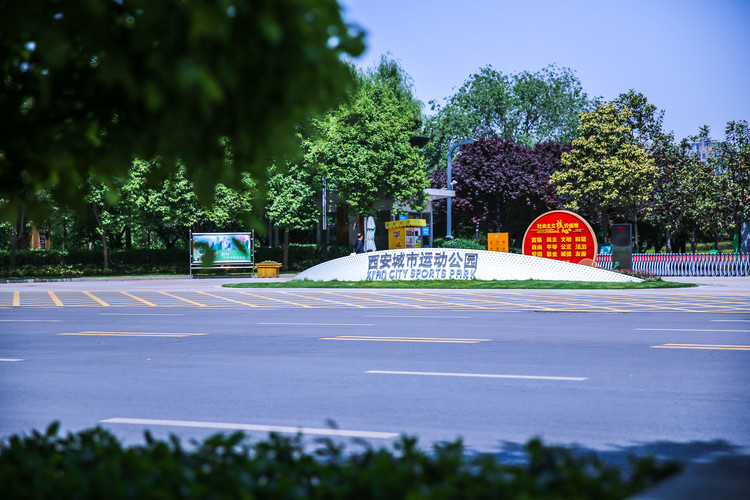
Text description provided by the architects. Xi ‘an City Sports Park, which was built in 2006, is located north of Longshou and close to xi ‘a municipal government. With the 14th National Games to be held in Xi ‘an in 2021 as an opportunity, an exploratory renovation of the Xi’an City Sports Park is underway.
Reshaping the Image (East Entrance, Osmanthus Square, South Entrance). The first step of the design is to rebuild the boundaries based on the characteristics of specific scenarios while retaining the functional space of the passage.
The east entrance faces serve as the main pedestrian entrance during the National Games, it renews the overall landscape of the sports park through the integration of water landscapes and greenery.
The Osmanthus Square serves as a traffic hub and an important visual focal point within the park. Inspired by the ticking clock, the hour pointer of the area changes with gradations of light and shade, indicating the vitality and perpetual movement of sports.
The south entrance was an abandoned water landscape, before the renovation. Through the simple form to reshaping the new appearance. The ivory translucent Logo Wall increases the vitality, publicity, and attraction of the south entrance.
Ecological Rehabilitation (Dredging, Greening). Dredging starts from three aspects: water purification, water ecological restoration, and sediment remediation. A nature-based solution is adopted to improve water flow, restore the underwater ecological base, realize the natural integration of waters and greenery so that every corner of the park will be immersed in a natural, dynamic and ecological atmosphere.
Spur Vitality (Roller Skating Rink, Jogging Path). The original facilities of the roller skating rink are old and creaked. Through spatial analysis, the project decides to update most of the infrastructure, and build a “ZHESUO Gallery” in the surroundings to provide shading to people while adding more vigor to the place. After the renovation, the roller rink has become a popular area of the park.
By analyzing the demands of people’s activities, the functions of the jogging path around the lake are rearranged. Instead of the traditional single and linear design, various functions are added in this area to reorganize the functions, enrich the colors and enhance the vitality.
Space Renovation (Basketball Court). In the basketball court area, the design takes sports demand and spurring vitality and potentials as the fundamental goal instead of following a common style. The renovated basketball court, with the colorful ground and artistic modeling of the surrounding fence, indicates the free and unconstrained temperament of sports.
Function Supplement ((Drinking Water, Marking System). Part of the original facilities in the park is old. In this renovation, the signs of the drinking water area are upgraded and added for daily use.
With China suffering from a museum growth, and cities of all dimensions making cultural venues at unprecedented velocity, there is some thing refreshingly modest about Li Hu and Huang Wenjing’s solution to architecture.
The spouse-and-wife duo, founders of Beijing-centered practice Open Architecture, are responsible for some of the final decade’s most imagined-provoking Chinese arts locations. Ideal acknowledged for transforming a series of aviation gasoline tanks into a popular riverside gallery in Shanghai, the pair’s understated theaters and efficiency areas offer a welcome dose of subtlety in a place with skylines all much too usually blighted by bold statements.
“It is about making a dialogue concerning us, as humanity, and mother nature,” Li said in a video clip job interview.
Chapel of Sound, a live performance corridor constructed in a valley northeast of Beijing. Credit rating: Courtesy Ni Nan/Open
The couple’s most up-to-date undertaking is a case in level. Nestled in a valley northeast of Beijing, a stone’s throw from the Terrific Wall, the boulder-like Chapel of Seem seems as if it had been carved from the landscape itself. The architects additional area rocks to the concrete and mimicked sedimentary layers to aid assimilate the structure with its surroundings.
While envisaged as a location for tranquil contemplation — or “a chapel without having religion,” as Li set it — the developing is primarily a live performance corridor. As a substitute of regular soundproofing, Li and Huang opted for strategically placed holes that, they declare, play the very same job as absorbent surfaces.
The openings also provide two extremely different functions: Manufacturing performs of light and shadow that vacation across the cavernous interior as the sunlight moves as a result of the sky and letting in the appears of breeze, birds and insects. Whilst this may perhaps seem counterintuitive for a peaceful live performance space, the architects have been never ever interested in generating “a excellent silence.”
A further check out of the Chapel of Seem. Credit score: Courtesy Jonathan Leijonhu/Open
“We’re really seeking to make a further link to the ancient organic history of the site,” Li said. “There’s a mysterious quality of house, and mysteriousness is a thing we’re really interested in: bringing men and women to find out a unique form of expertise.”
Far more than landmarks
Around 150 miles to Beijing’s east, in the seaside town of Qinhuangdao, an equally mysterious artwork museum features a distinct take on Open up Architecture’s manifesto pledge of “hanging a new stability in between the person-designed and nature.”
UCCA Dune, a new outpost for a person of Beijing’s most respected contemporary artwork institutions, normally takes the visual appearance of pebbles strewn throughout a sandy beach. The primordial, cave-like gallery areas are not only integrated with their environment — they are partly submerged by them.
The photogenic design and style has assisted make Qinhuangdao an unlikely place for style-lovers and working day-trippers from the Chinese funds. And while Li and Huang appear unshowy by character, they are acutely mindful of the energy of iconic architecture.
UCCA Dune, an artwork museum in the coastal town of Qinhuangdao. Credit history: Courtesy Zaiye Studio/Open
In China, it really is a energy that has been abused in new yrs — by property giants branding authentic estate developments with outlandish skyscrapers, and by area officers employing major-funds cultural properties to place their metropolitan areas on the map. But, citing Sydney Opera Home as an instance, Li thinks that effectively-made arts venues can give cities a unique identification while also contributing to their cultural cloth.
What Open up Architecture is opposed to, he said, are landmarks for landmarks’ sake. This stance can put the pair at odds with their clients, like when officers from Yantai, in Shandong province, approached them with an invitation to “produce an iconic landmark.”
“That was the only quick: ‘Make a landmark,'” Li recalled. “They came to us and reported, ‘We want some thing like the Vessel in New York’s Hudson Yards.’ And I reported that was exactly what we never want to do.”
Alternatively than going for walks absent, Li said he certain the city’s governing administration to develop a a lot more meaningful cultural application. Eventually happy that their creation would serve a goal, the architecture duo made a sundial-motivated structure — dubbed The Sunshine Tower and established for completion in 2023 — that incorporates a library, electronic museum and outdoor theater.
“I think it’s a enormous waste of sources to develop a thing devoid of being aware of what it is,” Li stated.
A electronic rendering of the Solar Tower in Yantai, Shandong province. Credit history: Courtesy Open up
The thought that architects must only generate structures that are needed looks easy ample. But it is a person usually disregarded in China. With the country’s federal government now pumping billions of dollars a calendar year into the cultural sector, supply can outstrip demand, foremost to unused vanity tasks and “ghost” museums. When it will come to tradition, the “make and they will come” product that has accommodated China’s breakneck rural-city migration, may possibly not apply, Huang explained.
“There is a big force for cultural structures,” she mentioned. “(In China, we) sense as if we have created seriously speedy, but still left ourselves powering and have to have to catch up to clearly show the earth we have lifestyle. But it is really hard to cultivate society and… considerably more rapidly to establish. So that is why you see a lot of cultural buildings pop up with no contents and no person to work them.”
These kinds of accusations could not be leveled versus Open up Architecture’s Tank Shanghai, a gallery that breathed new lifestyle into the internet site of a decommissioned airport by the Huangpu River. Constructed into 5 renovated gas tanks, the location provides not only gallery areas but also a pub, a cafe and overall performance services. Landscaped parks in the meantime dissolve the distinction concerning community and personal place, large lifestyle and recreation.
Tank Shanghai was created in a series of disused aviation gas tanks. Credit history: Courtesy Tian Fangfang/Open
Giving local community parkland was not basically a gesture to the town — it expressed the concept that artwork ought to not stand aside from everyday lifestyle.
“The reason of a cultural properties is to try and enlighten people, but today they’re starting to be a lot more and a lot more like isolated objects,” Li stated. “Art is set up (on a pedestal). We want to convey it nearer to the floor — to the folks — and blur the boundaries.”
Universal values
That homegrown designers like Li and Huang are staying entrusted with a new era of Chinese venues must occur as very little surprise. But the cultural landscape has lengthy been formed by international forces. From Zaha Hadid’s sculptural Guangzhou Opera Property to a Norman Foster’s extensive-awaited museum in considerably-flung Datong, Western names are often questioned to oversee China’s most important up to date landmarks — not only for their technical prowess and avant-garde layouts but, frequently, for the prestige.
The pattern traces back to the early 2000s and Beijing’s Nationwide Centre for the Executing Arts (NCPA), a big, shining oval identified domestically as “The Big Egg.” Just a couple blocks from the historic Forbidden Town, French architect Paul Andreu’s controversially futuristic making sparked a wave of Western-made landmarks and, in Li’s text, “started the full work out” of constructing “legendary buildings” in China.
It is also a venue that immediately shaped Open Architecture’s strategy. Going to when for a concert, Li identified himself on a extensive quest for h2o during the intermission, inevitably discovering just one particular spot “in the entire gigantic put” to get a consume. A smaller gripe, admittedly, but just one he felt spoke to a absence of consumer-centric design.
By way of comparison, Li then recounted a current stop by to Germany’s “wonderful” Berliner Philharmonie live performance corridor: “The crack was fifty percent an hour, and it was like a get together. It was a wonderful social function. That is the legitimate objective of a cultural creating: bringing people today alongside one another, not just listening to audio though you won’t be able to even get a h2o.”
This is not to propose that Open’s founders are somehow opposed to Western structure in China. Following all, Li built his identify under Steven Holl, one particular of the most prolific international architects operating in the country, when Huang after labored for the late I.M. Pei in New York. And even though the pair welcome a leveling participating in area for neighborhood corporations, they see their styles as neither Chinese nor Western, but an expression of a thing common.
A person of the cave-like gallery areas at UCCA Dune. Credit history: Courtesy Wu Qingshan/Open
“Undeniably, getting Chinese, we have our means of on the lookout at our romance with — and our existence in relation to — mother nature and the cosmos,” Huang explained. “But intuitively we are exploring for a thing a lot more timeless.”
“We usually get this question from clients and students who say, ‘Your setting up would not glimpse really Chinese, the place are the connections?'” Li added. “Which is since we believe in a great deal deeper which means, and a further connection to culture.
“There are two traits of architecture that are profoundly essential,” he summarized. “Just one is remaining radical. We want anything that radically improvements our way of residing, and this is more urgent than at any time.
“The other detail is poetry. The poetic top quality of architecture is so critical. It is a little something that you should encounter in particular person by strolling all over the space, touching the surfaces and feeling the textures.”
As part of an ongoing effort to make content more accessible, LAM will be making select stories available to readers in Spanish.
The state of Virginia has regulated landscape architecture as a profession since 1980, certifying practitioners through its professional occupational agency. In 2010, landscape architecture became a licensed profession in the state.
A few bills attempted to deregulate or lower the level of regulation back to certification, but none of them made it out of legislative committee. Around 2011, Republican then-Governor Robert McDonnell set up a commission to eliminate regulations in general, including of professions such as landscape architecture and interior design. Members of the Virginia chapter of ASLA persuaded the governor to remove landscape architects from the list.
Robert McGinnis, FASLA, an associate principal at Kennon Williams Landscape Studio and a member of the Virginia ASLA chapter’s government affairs committee, says that interior designers and landscape architects get targeted because people don’t know what they do. “They see the word landscape and think we put trees in the ground.”
“Once we show them what we do, they usually back off,” McGinnis says. “We believe that our defense of our licensure in Virginia is important not just to our licensure but to the entire licensure status of all landscape architects, because once you pull that one licensure out, it will be identified by another state—particularly nearby abutting states—as an example.”
McGinnis has been active in the profession for 35 years and engaged in advocacy for licensure for more than 20 of them. “It is exhausting,” he says. “I never wanted to do it. I wanted to just practice. But once your license or regulatory status is threatened, somebody has got to do something.”
Led by right-of-center advocacy organizations and often funded by private interests, state legislatures have increasingly been writing bills to restrict licensing requirements for professions and occupations. With legislative titles such as the “Right to Earn a Living Act” and “Consumer Choice Act,” the laws are put forward under the premise that professional licensing imposes an unfair barrier to entry into certain types of work, infringes on individual freedom, and increases the costs of services to the consumer.
Lawmakers have included landscape architecture in “right-to-work” bills reflexively, without clearly understanding the nature of the practice or its difference from other kinds of landscape work. Conservative and libertarian lobbying groups such as the Institute for Justice,the Goldwater Institute, and Americans for Prosperity—the latter funded by the libertarian Koch brothers, heirs to the commodities-production-and-trading conglomerate Koch Industries—began pushing these laws around 2016; by now, nearly every state has voted on some version of a law rolling back or limiting licensing requirements.
Licensing laws now guard entry into hundreds of occupations, including jobs that offer upward mobility to those of modest means, such as cosmetologist, auctioneer, athletic trainer, and landscape contractor. Yet research provides scant evidence that licensing does what it is supposed to do—raise the quality of services and protect consumers. Instead, licensing laws often protect those who already have licenses from competition, keeping newcomers out and prices high.
ASLA, other professional design associations, and licensing boards argue, on the other hand—with decades of jurisprudence as evidence—that the rationale for licensing professional practices and occupations derives from the idea that their work can have significant impact on public health, safety, and welfare. The public has an interest in ensuring that someone calling themselves a doctor, engineer, or an architect—or, for that matter, a beautician using chemical agents on clients’ bodies—has adequate education, knowledge, and experience to perform their job without causing injury or harm.
One of the first direct assaults on landscape architecture licensure was in Arizona in 2016. Licensure came up for sunset review, a routine process in which programs, regulations, or agencies are reviewed for relevance. The Arizona ASLA chapter hired a lobbyist, went to legislative committee meetings, and then the licensing board, which makes decisions about licensure applications, passed the renewal through the legislative committee in a unanimous vote. (To get passed into law, a bill has to be approved by the relevant legislative committee, then put on the floor for a vote of all members of the legislature.) In February, a bill came up, introduced by Representative Warren Petersen, a surrogate of Republican Governor Doug Ducey, that included landscape architects with occupations such as geologists, citrus packers, and athletic instructors as licensed work that should be deregulated. The chapter had to scramble to figure out how to respond, with help from ASLA national.
Because the bill was being sponsored by the Republican governor, it was going to be difficult for Republican-majority legislators to vote against it. The chapter’s lobbyist advised a strategy of simply getting landscape architects removed from the bill. Then they notified their membership, called on state universities with landscape architecture programs, and engaged ASLA national and chapters in adjoining states. Students showed up en masse to speak and explained to the governor’s aides that, if the bill passed, they’d have to leave the state to practice after investing in a four-year degree. Within 24 hours, landscape architects were removed from the bill.
Galen Drake, ASLA, a senior landscape architect at J2 Engineering and Environmental Design, was president of the Arizona chapter of ASLA. “After this experience it became clear, especially in 2016, talking to legislators, that they had no clue—no clue—what landscape architects did,” says Drake. “At one point they said, ‘Why do we need registration? Why can’t we just go on Yelp and see who’s good?’ So, our focus became education: Let’s educate them as to what we do.”
Elizabeth Hebron is the director of state government affairs at ASLA, and she has led the fight to protect licensure as attempts to deregulate landscape architecture have proliferated in statehouses over the past five years. Hebron oversees the tracking of licensure bills and coordinating the response to educate lawmakers and the public on the importance of clear, responsible licensing standards for landscape architecture—a highly skilled, technical profession with a direct public impact.
ASLA and the state licensing boards operate independently of each other, but ASLA has been engaging them in recent years through quarterly joint webinars with CLARB, sharing information about what’s happening with legislation, organizing in-person summits, and encouraging closer communication between the state chapters of ASLA and licensing boards.
Hebron gives as examples a boy who nearly punctured his heart because of a spear-like thorny bush on the edge of a playground, and larger-scale flood mitigation failures in Louisiana. In presentations she gives to various groups about the importance of licensure, she offers images of unnavigable driveways laid abnormally steep at nearly 45-degree angles and playground slides that literally run into tombstones.
Anti-licensing advocates invert the logic of harm prevention: Occupations and professions should have to prove a continuing need for regulations. In some cases, they argue for mandating a periodic review or automatic sunsetting of licensing requirements. In the most extreme cases, they claim the free market will weed out the incompetent players and that wrongs can be pursued through the justice system.
In Wisconsin, the battle against deregulation started with a November 2016 report by the libertarian think tank Wisconsin Institute for Law and Liberty,Fencing Out Opportunity, which argued that occupational licensing creates barriers to employment and identified landscape architecture among the target professions. Republican legislators moved to study an approach to professional licensure involving “self-certification.” Instead of licenses, a Yelp-like review platform would allow consumers to choose self-identified professionals based on evaluation by past clients.
Jonathan Bronk, ASLA, a landscape architect in the campus planning department at the University of Wisconsin–Madison, was the president of the Wisconsin ASLA chapter at the time. He spoke at the hearing, gathered others to speak, and coordinated with lobbyists to fight the bill. Among the occupations listed for the study, landscape architects turned out in the largest numbers to defend licensure, and the profession was removed from the list for the study. In the end, the bill passed committee but never made it to the floor for a vote; it was not prioritized by legislative leadership.
Recently, ASLA has joined a coalition to defend professional licensure alongside architects, engineers, civil engineers, accountants, and surveyors. Founded in 2019, the Alliance for Responsible Professional Licensing (ARPL) has an office at and receives most of its support from the American Institute of Certified Public Accountants (AICPA). The other members of the coalition along with ASLA are the American Society of Civil Engineers, CLARB, the National Association of State Boards of Accountancy, the National Council of Architectural Registration Boards, the National Council of Examiners for Engineering and Surveying, and the National Society of Professional Engineers.
To support its defense of licensing, ARPL commissioned a study, published in January, to examine the value of the licensure process and its outcomes from Oxford Economics, a business consulting and forecasting firm. The report found that, as of 2019, nearly a quarter of workers in the United States held a certificate or license, according to the Bureau of Labor Statistics. The report cites a public opinion survey finding that 75 percent of the public recognizes the importance of the distinction between trades and “highly technical professions that have a direct impact on public health and safety.”
Oxford also surveyed studies of the impact of licensure on salaries, which indicate that, on average, unlicensed workers earn wages that are 10 to 15 percent lower than those of licensed workers with similar education, training, and experience. Although this figure suggests an increased cost to the consumer, the report cited studies to show that two-thirds of the increase is because a license signals higher productivity on the part of workers. A plumber or an electrician earns more not only because the consumer is captive to licensed workers but because the requirement to have a license—and the specialized nature of the knowledge necessary to perform the job—ensures the consumer a higher value of work. The report also noted that for women and people of color, licensure led to significantly higher wages and earnings, even narrowing the wage gap between them and white men in professions, especially among highly trained professionals. One study found that college-educated women with licenses earned 20 percent more than their non-licensed counterparts, whereas college-educated men earned only 8 percent more than their non-licensed counterparts.
Marta Zaniewski, the executive director of the Alliance for Responsible Professional Licensing and vice president of state regulatory and legislative affairs at AICPA, notes that it isn’t just libertarians and industrial lobbyists who push for limiting licensing. “What we saw that began with the Obama administration and carried on with the Trump administration was suggesting legislation that would take a broad brush to everyone from your manicurist to your engineer, looking at deregulating these professions,” she says. “There was just too much risk [to the public] to say that everyone should reform regulation across the board, and they were fixing something that didn’t need to be fixed.”
Hebron says that ASLA doesn’t necessarily oppose all of the features of the bills when legislated in a careful, responsible way that does not have the potential to affect public health, safety, and welfare. Some of the bills mandate reciprocity of licensing among states, also known as universal licensure, which allows professionals to move and work fluidly across state borders without additional testing, certification, and fees. Some state boards restrict licenses for people who have defaulted on their student loans, a practice that 13 bills have sought to limit. Many boards prohibit licenses for people with criminal records, which could be regarded as further punishing and ostracizing formerly incarcerated persons who have already paid their debt to society. Legislation known as Second Chance Acts limits the use of criminal histories in hiring and eligibility for a license: Sixty-three bills have attempted to limit use of criminal histories in hiring, with 15 of them so far passing and 23 others yet to be voted on.
For some landscape architects, there is also a concern with the barriers licensing creates to the profession, particularly as they impede those who are historically shut out of design fields. The licensing process became particularly arbitrary and onerous in the case of Sara Zewde, the founding principal of Studio Zewde and assistant professor of practice at the Harvard University Graduate School of Design.
By the time she began her licensing exams in 2016, Zewde had already become fairly recognized in the field. She had topflight credentials, having studied sociology and statistics at Boston University and earning master’s degrees in landscape architecture from the Harvard GSD and city planning from MIT. Zewde started her exams in the state of Washington, where she lived at the time. After she moved to the East Coast in 2018, even though all states use the same exam—the Landscape Architect Registration Examination, developed and administered by CLARB—she had to fly back to Washington at significant expense to finish the examinations where she had originally begun them. By 2019, her exams complete, she then submitted her paperwork for licensure in Pennsylvania, where she had most of her ongoing work. Then came the multiple reference letters and the requirement to undergo a criminal background check in every state where she had lived in the previous five years, involving hundreds of dollars in additional fees. A gap in her timeline in which she was traveling for research raised additional questions with the licensing board, leading them to ask her for additional background checks in those states or an FBI check, which she followed through on.
By this time, it was 2020 in the early months of the pandemic. Zewde’s work had already been published in this magazine, Harvard Design Magazine, and Topos, among other places, and she had been working and teaching in the field for more than five years. Yet the state board rejected her license, saying she should have asked for permission from Pennsylvania to apply for licensure there before she began taking the tests five years earlier—before she knew where she would be working, and something that she says was stated nowhere in any available public information.
During the appeals process, Zewde, who is Black, says she had to submit samples of work to demonstrate her proficiency and was told to prepare for questions from the all-white board in Harrisburg, Pennsylvania, to prove her credentials, though she had already passed all of the exams. Finally, in the spring of 2021 she received the approval.
“I feel like I stand in a position of privilege, knowing that I am a professor and show some level of competence there,” she says. “Being put in that situation to be voted on by this board is a harrowing experience that I don’t wish on anyone, but I especially don’t wish it on young Black people or young people of color, or young people at all. Knowing that there are [so few] Black women licensed in landscape architecture in the country, it seems like something is wrong with this process. I never even questioned the idea of licensure, but in the form that it exists right now, I cannot defend it.” (In response, the Pennsylvania State Board of Landscape Architects cited the relevant regulatory statutes mandating its requirements.)
CLARB represents the state licensing boards that set policy and developed the universal examination that is used in every U.S. jurisdiction. Veronica Meadows, CLARB’s chief strategy officer, agrees that some reforms in the process could be helpful but defends the public interest in licensing.
“We know that landscape architecture does have a profound impact on people [and] the environment, and so we do push to defend the integrity of licensure in the public’s interest,” Meadows says. “We have obviously seen in the last six years much more significant movement for licensure reform.” She allows that reforms are needed but cautions, “Reducing barriers to entry of a licensed profession that doesn’t have a direct public safety outcome is a good thing. Smart, targeted licensing improvements are important, but those have been hijacked and taken to extreme.”
CLARB joined ARPL as a founding member, and ASLA joined soon thereafter. ARPL provides support to local chapters and boards when proposed legislation would undermine the board’s authority to protect the public interest and works with ASLA and other member organizations to track, monitor, and respond to the legislation. As of today, no landscape architecture licensing restriction has passed in any state, but several sunset regulations, reviews, and studies of the issue have been approved. ASLA and its local chapters remain vigilant, engaging in outreach, activating advocacy networks, and educating legislators about the profession and what landscape architects actually do.
In a sense, professional licensure belongs to a legacy of good multinational and transregional governance and oversight that suffers from being misunderstood and underappreciated, quietly preventing harm without fanfare.
“I have not ever seen what I have seen in the last 10 years,” Robert McGinnis says. “It’s scary to see how this may play out in the future. We don’t know how long we’re going to have to deal with wrong-minded, uninformed individuals who hate government and just simply want to destroy it.”
Stephen Zacks is an advocacy journalist, architecture critic, urbanist, and organizer based in New York City.
KINGSTON, R.I. – Sept. 23, 2021 – The University of Rhode Island’s 29th yearly Landscape Architecture Lecture Series opens Thursday, Sept. 23, with a presentation by Patricia O’Donnell, a preservation landscape architect and urban planner whose organization has worked on such legendary projects as the Nationwide Mall and the Woodstock Festival Web-site as properly as advancing the valued landscape heritage of various cultures.
The slide lectures will discover the indicating of history and lifestyle in the operates of experienced landscape architects, claimed William Inexperienced, professor of landscape architecture and collection organizer. The sequence returns to an in-individual structure this semester with lectures Thursdays at 7 p.m. in the Ernest Mario Auditorium (space 170) in Avedesian Corridor, 7 Greenhouse Road, on the Kingston Campus. The lectures are cost-free and open up to the public. All attendees will have to put on a face masking.
O’Donnell, founder of Heritage Landscapes LLC in Charlotte, Vermont, will talk about “Cultural Landscapes for Planetary Justice – How Does Heritage Contribute” in her virtual communicate, which will be broadcast in the Earnest Mario Auditorium, followed by a issue-and-solution session. (Speakers for the remainder of the tumble plan are anticipated to be in individual.)
Because its start off in 1987, Heritage Landscapes has completed far more than 500 commissions that foster preservation and market financial, environmental and societal sustainability for valued public spaces. The corporation was honored with the American Modern society of Landscape Architects’ prestigious Firm Award in 2019 for 32 decades of preservation operate.
Emily Humphrey ’15
On Oct. 7, alumni Emily Humphrey ’15 and Ramón Ibarlucea ’14 will be the showcased speakers. Humphrey, an affiliate of Michael Van Valkenburgh Associates in Cambridge, Massachusetts, will talk on “Uncovering the Multifaceted Record of the Toronto Port Lands.” Ibarlucea, an affiliate in the business Stimson Associates, also of Cambridge, will talk about “Historical Fiction: Collecting Inspiration from Context and Website Background.”
Humphrey’s layout perform was influenced by the simple and tactile characteristics of the land as a high-quality gardener and farmhand whilst at URI, as nicely as a a few-month highway vacation all-around the U.S. to pay a visit to countrywide parks. At URI, she also assisted in study on sea level rise and its impression on coastal communities, and took aspect in a permaculture structure internship in Hawaii.
Ramón Ibarlucea ’14
At URI, Ibarlucea was intrigued in studio and investigate assignments that centered on mitigating the impact of local weather modify and sea degree rise on coastal communities. With Stimson, he has labored on these kinds of initiatives as developing outside the house spaces for learners at Babson College, and building landscape interventions and acquiring the landscape for a new doing arts center, both of those at Brown University.
On Oct. 28, Thaïsa Way, software director of yard and landscape experiments at Dumbarton Oaks Analysis Library and Collection in Washington, D.C., will emphasis on “Race and Gender in the Emergence of Landscape Architecture.”
Thaïsa Way
Way, who holds a Ph.D. in architecture and landscape background from Cornell College and a master’s degree in architectural historical past from the College of Virginia, is a fellow of the American Academy in Rome and a member of the American Culture of Landscape Architects, as very well as an urban landscape historian teaching and looking into heritage, principle, and layout in the Section of Landscape Architecture at the Higher education of Constructed Environments at the University of Washington.
On Nov. 18, Danielle Desilets ’99, a senior affiliate at Kyle Zick Landscape Architecture (KZLA) in Boston, will talk about “Shifting Perspectives: Correcting the National Report.”
Danielle Desilets ’99
In her 20 a long time as a landscape architect, Desilets has focused on historic and cultural landscape preservation, along with serving as a job supervisor on initiatives together with park learn preparing and recreation style, path technique organizing and design and style, campus planning, and layout for accessibility and sustainability. At KZLA, Desilets has labored with the U.S. Section of Condition, the Nationwide Park Service, the Massachusetts Division of Conservation and Recreation, and municipalities throughout New England and New York State. She has documented and prepared historically considerable landscapes for jobs these kinds of as the U.S. Chancery & Chief of Mission Home in New Delhi, India, and the U.S. Embassy Compound in Rome.
Closing out the fall semester are Eric Kramer and Beka Sturges, companions at Reed Hilderbrand Landscape Architects in Cambridge, Massachusetts. On Dec. 2, they will converse on “Designing Histories – Voices, Claims, and Reconciliation.”
Eric Kramer
By way of works that contain Boston’s Central Wharf Plaza and the Alamo Plaza Interpretive Master Prepare in San Antonio, Kramer has designed various landscapes involved with the renewal and enrichment of campuses, towns and establishments. Kramer attained his master’s diploma in landscape architecture at Harvard Graduate College, in which he been given the Charles Eliot Fellowship.
As head of Hilderbrand’s New Haven place of work, Sturges’ new assignments consist of Yale University, Storm King Artwork Centre, and phase a single of the Mill River Path, a 4-acre linear park jogging by the center of New Haven. Her perform is recognized for its highly effective spatial demonstration of the cultural and environmental worth of landscapes. Sturges also teaches at Yale College of Architecture and Connecticut Higher education.
Beka Sturges
For far more data, email William Inexperienced at wagre@uri.edu or contact (401) 874-2983. All presentations will also be accessible around Zoom by emailing Environmentally friendly for a hyperlink to the lecture.
The collection is sponsored by the Rhode Island Chapter of the American Modern society of Landscape Architects, URI School of the Setting and Lifetime Sciences, College Libraries, the departments of Landscape Architecture and Art and Artwork History, and the Gaetano and Pasqualina Faella Endowment.
Planner 5D, a electronic design tool, has developed a free instructional variation to assist faculties train architecture and design. The tool, which makes it possible for users to produce 3D house designs, is giving its no cost academic licenses to “encourage pupils to foster their creative imagination in a digital realm whilst learning style principles.” The device accessible to teachers worldwide, who can obtain up to 100 cost-free academic licenses for use by learners.
The initiative has been launched to aid the instructing of STEM subjects to faculty little ones, which includes focuses on art, architecture, engineering, and inside structure. The application is centered on “problem based mostly learning”, which invites learners to establish computational expertise by studying and resolving property style and design challenges employing a library of 6000 objects.
“With this no cost academic model for universities, we not only present students throughout the world with accessibility to the platform but also help lecturers to persuade them to foster their creative imagination even though studying standard design rules required to make their desires arrive genuine,” said Alexey Sheremetyev, the company’s founder.
The instructional edition makes use of the exact app-centered infrastructure of Planner 5D’s standard 2D/3D home design tool, which has been employed by in excess of 70 million novice designers. In addition to the new instructional initiative, the app has also not long ago unveiled a “Style and design Battle” element, which difficulties contestants to accomplish design and style-similar tasks working with unique predefined aspects.
Related on Archinect: Leading countrywide architectural corporations collaborate to provide guides to assistance students and teachers discover professions in architecture. Picture credit score: Washington College in St. Louis’ Alberti Software
Planner 5D’s initiative joins other means lately unveiled to encourage professions in STEM topics. Before this thirty day period, we carried the story of workwear brand Carhartt teaming up with major metallic band Metallica’s nonprofit All In just My Palms Foundation in an effort and hard work to bring in a new generation of workers in the experienced trades. 1 thirty day period earlier, the Norman Foster Basis unveiled a new series of 14 masterclasses checking out fundamental areas of developing libraries and archives, which adopted a earlier unveiling of 20 videos on the issue of city setting up.
Before this 12 months, in the meantime, a group of foremost architectural organizations collaborated on a set of guides serving to students and lecturers discover professions in architecture. Though the “Your Guideline to a Occupation in Architecture” is created for high school and K-12 pupils fascinated in becoming a member of the architectural local community, the “Your Tutorial to Encouraging Learners Think about a Vocation in Architecture” is supposed for faculty counselors and educators to advise pupils by the method.


Similar content articles on Archinect that may perhaps desire you…
The 11th version of the Global Biennial of Landscape Architecture of Barcelona
From 27 September to 2 October 2021, the 11th edition of the Global Biennial of Landscape Architecture of Barcelona will just take put. The Biennial will host the symposium “Climate modify, all over again: Town and Nature“, to mirror on the importance of landscape layout in reducing the implications of local weather improve, as effectively as the Rosa Barba Global Landscape Award, and the Worldwide Landscape Educational facilities Award – Banco Sabadell Basis. The 2021 version – which due to the pandemicwill be held on-line – will deliver together professionals and gurus in landscaping and architecture in a congress that has grow to be a reference on an international scale. The symposium will count on 8 renowned company who will reveal tools to confront the climate unexpected emergency, the authors of the 11 finalist landscape tasks of the prestigious Rosa Barba Intercontinental Landscape Award, and reps of the 8 finalist colleges of the Award Landscape Educational facilities International.
address image: Gustafson Porter + Bowman, Central Park, Valencia, Spain.
The 8 invited experts of the Symposium are:
Martha Schwartz Landscape architect, urban planner, climate activist, and professor at Harvard University Graduate College of Structure. Colleen Mercer Clarke. Landscape architect and coastal ecologist. Karin Helms. Landscaper, biologist, and professor at the Oslo Faculty of Architecture and Structure. She incorporates participation to carry out in wonderful cultural landscapes. President of IFLA Europe. Maguelonne Déjeant-Pons. Govt Secretary of the European Landscape Convention of the Council of Europe. Li Xiong. Professor and VicePresident of Beijing Forestry University and member of the China Qualified Committee on Landscape Architecture. Gilles Clément. Horticultural engineer, landscape architect, writer, gardener, and professor at the Countrywide Outstanding School of the Country of Versailles. Xavier Matilla. Main Architect of the Barcelona Town Council. RamonTorra. Architect and manager of the Metropolitan Space of Barcelona.
11th Worldwide Landscape Biennial of Barcelona 27 September – 2 Oct 2021 Put: On line Registration of symposium by 20th of September | Web site: https://landscape.coac.web/en
Michael Van Valkenburgh Associates Inc.- Landscape Architects, Brooklyn Bridge Park, Brooklyn, NYC, United states of america
Landprocess, Chulalongkorn University Centenary Park, Bangkok, Thailand
The Influence of alpine Ski Tourism on the Austrian Alps Landschaftsarchitektur und Entwerfen – Emerging subject areas in Landscape Architecture Leibniz University, Hannover., Germany
You can come across all the 11 finalist landscape assignments of the Rosa Barba Worldwide Landscape Award, and the 8 finalist faculties of the Award Landscape Schools Global on the web-site https://landscape.coac.net/en




 + 36
+ 36