Water-efficient gardens, such as the one at Dunne Park, are encouraged during drought.
This article was written by BenitoLink intern Juliana Luna
Shawn Novack, Director of the Water Resources Association of San Benito County, says “60{6d6906d986cb38e604952ede6d65f3d49470e23f1a526661621333fa74363c48} of water usage goes into home landscapes,” and that “we need to start thinking of saving water.”
As an incentive for residents to conserve water, the Water Resources Association is offering three free water-wise landscape plans created by landscape designer Rosemary Bridwell. The designs consist of different themes—a meadow, dry creek and strolling garden (See PDFs below). Each plan has a $500 value.
Water-wise landscaping is a term for gardening practices that use water efficiently.
Since 2007, Dunne Park has been an example of the water-wise approach. Leo Vasquez, a member of Water Resources, has been taking care of the garden, which is located at the corner of Powell and Sixth streets.
Vasquez said Dunne Park’s garden is watered twice a week, whereas normal gardens need to be watered three times a week. He noted that a rose garden takes up to two gallons a day and needs to be watered three times a week as well.
Dunne Park’s garden design includes a walkway of pavers, which allows water to run through them and into the ground.
When choosing plants, Novack said native plants should be kept in mind because they help support local biodiversity.
Gov. Gavin Newsom this year put all of California under a drought emergency. Novack said that in May, runoff water from Sierra Cascade snowpack was drained dry by warm temperatures and parched soil. This caused significant reductions in the amount of water flowing to reservoirs.
He added that San Benito County is following Stage 1 water conservation measures, as follows.
Outdoor water restriction
Landscape watering is limited and restricted to no more than three days per week with a duration of 15 minutes of watering.
No washing down sidewalks, driveways, or other hardscape surfaces.
No washing cars without the use of a quick-acting, positive shutoff nozzle.
No watering landscapes that cause runoff to adjacent, private, and public walkways.
General
Leaks, breaks and malfunctions of irrigation systems and plumbing equipment causing waste of water shall be repaired.
Prohibitions affecting commercial businesses
Water is to be served only when requested in restaurants and other food service establishments.
Operators of hotels and motels must provide guests with the option of choosing not to have towels and linens laundered daily and prominently display notice of this option.
The BenitoLink Internship Program is a paid, skill-building program that prepares local youth for a professional career. This program is supported by Monterey Peninsula Foundation AT&T Golf Tour, United Way, Taylor Farms and the Emma Bowen Foundation.
Help us bring on more interns! As a local nonprofit news organization, BenitoLink needs community support to continue developing important local programs like our youth and Latinx intern training program. You can keep it going strong by going to our BenitoLink donation page.
SALT LAKE CITY — For decades, the U.S. Forest Service’s practice of putting out wildfires was a huge success. But the policy backfired, setting the stage for the massive destructive wildfires that have flared with increasing regularity across the West.
While putting out fires remains a priority, deliberately setting them is becoming more common, especially in Utah, as a more cost-effective and ecologically sound strategy for fixing forest health, the Salt Lake Tribune reported.
The pitfalls of fire suppression are evident across Monroe Mountain in central Utah. The plateau’s historically abundant aspen stands are disappearing under thickets of fir and other conifers that have long impeded fresh aspen growth that should be succeeding the aging trees, but aren’t.
In the hopes of restoring the historic role of fire, at least three Utah national forests plan to sharply expand the use of “prescribed fire” to nurse sickly forests back to health.
Like much of the West’s wooded terrain, large parts of the Fishlake National Forest are ecologically wired to burn from time to time. To thrive, aspen groves need to get wiped out from time to time, according to Richfield District Ranger Jason Kling of the Fishlake National Forest.
“That keeps the fuels in check, not allowing the overgrowth to occur, keeping the landscape open, allowing sunlight to reach the forest floor,” Kling says while touring places on the mountain treated with prescribed fire in the last few years. ”There’s a lot of benefits.”
A backroad crossing the mountainside overlooking the town of Koosharem borders a burn area that is now recovering. A few years ago, crews used the road as a firebreak when they torched the forest on one side. On the untreated uphill side, the forest is choked with small-diameter fir and aging aspen that are probably on their last legs.
On the downhill side, by contrast, there are no living mature trees, but it buzzes with life. The plants are mostly shrubs and young aspen, some about 8 feet high, tall enough to avoid being grazed to stubs by the cows and big game that love aspen leaves. Tens of thousands of aspen shoots per acre have “suckered” up from an ancient root system that connects all the aspen here. These genetically identical trees are essentially all one organism.
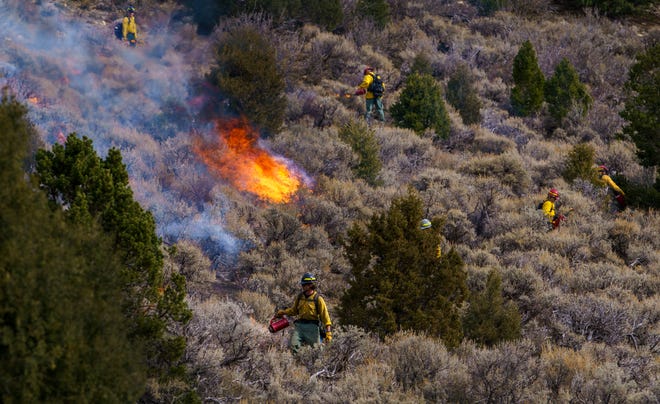
Since 2016, the Fishlake has been setting fire to patches of Monroe Mountain, sometimes dropping fuel-filled “polymer spherical devices,” or PSDs, from helicopters to ignite broad areas.
“We’re trying to insert the fire back at the right scale and right time,” says Forest Supervisor Mike Elson. These treatments are carefully managed and timed to minimize the chances controlled burn turns into a wildfire or fills communities with smoke. The wind and temperatures have to be just right.
Three of Utah’s five national forests are now developing plans for conducting controlled burns on all their land where prescribed fire would be appropriate. Fishlake, Dixie and other national forests in south-central Utah span a total of 5 million acres, mostly on high-elevation plateaus and mountains jutting above irrigated valleys and desert.
Fires reduce fuel loads and prevent bigger fires. Forest Service officials already deploy prescribed fire, whether naturally ignited or deliberately set, in the West’s national forests. But this piecemeal approach has not kept pace with the need. In short, far more fuels are added to the West’s overgrown forests each year than are being cleared out through unplanned fires and mechanical treatments, known as “thinning.”
On tap is a more comprehensive approach toward prescribed fire. In the meantime, however, the Forest Service and its state partners are struggling with massive wildfires propelled by climate change and extreme weather events, laying waste to both forests and communities.
This high-risk situation is a consequence in part of excluding fire for decades, leading to what the Forest Service calls “uncharacteristic” wildfire, or what others prefer to call “catastrophic.” Many rural communities would like to see a return to commercial timber harvests that were common before the 1990s. While logging might generate some timber jobs, it won’t solve the forests’ ecological problems, experts say.
“Fire, in general, has been on this landscape for millennia and it’ll continue to be on the landscape. Because of fire suppression, we’ve altered what that looks like,” said Ben Newburn, a fire management officer with the Forest Service’s Intermountain Region office in Ogden. ”Through prescribed fire, we can try to get back to fire regimes in the landscape, in a more historically representative way. And it is one of the more cost-effective methods of treating fuels. We can treat much broader landscapes and we can do it in a way that mimics the natural process.”
Of the three Utah forests developing forest-wide burn plans, the Fishlake was the first to complete its environmental assessment, posted on Oct. 20. Elson’s hope is to cut through the bureaucracy by getting the analysis done all at once, so specific projects are ready to roll when the weather conditions are right and the resources are available.
“Rather than doing the same thing over and over again at a really small scale,” Elson asks, “why don’t we do it at a scale that then allows us to actually focus on getting the work done on the ground as opposed to just focusing on doing paperwork and meetings?”
The Fishlake plans to burn up to 40,000 acres a year for 25 years, treating 1 million of that forest’s 1.5 million acres with prescribed fire and mechanical work. That would represent a 10-fold increase in the Fishlake’s current pace of deliberate burning. The public is invited to submit comments through Nov. 19, either by mail or online.
Other Utah forests’ targets are even more ambitious. The Manti-La Sal National Forest plans to treat up to 48,000 acres a year across 1.2 million acres. This 1.4-million-acre forest covers the Wasatch Plateau east of Ephraim and the Abajo and La Sal ranges near Moab. That proposal does not consider using prescribed fire on certain sensitive lands, including Bears Ears National Monument, designated wilderness, alpine areas and sage grouse habitat.
In southern Utah, the Dixie National Forest aims to treat up to 52,000 acres a year across 1.8 million of its 2 million acres. The public is invited to comment on Dixie’s scoping notice through Nov. 17.
“What we don’t want is all 1 million acres to burn one hot summer. We want to burn it in manageable chunks that don’t devastate whole watersheds so that you have gulleys washing out and cities losing their water supply,” Elson says. “So it’s really a balance that we’re trying to find in terms of how big and when and under what conditions.”
Acreage targets are not arbitrary but are based on historic burn intervals recorded in the growth ring of old trees.
“In some areas, it might be every 10 years, some areas might be every 100 years,” Elson says. “You add all that up and you do the math, we need to be treating between 40,000 and 120,00 acres every year to mimic that natural level of disturbance.”
To illustrate the point, Kling points to data extracted from a ponderosa pine that started growing in 1583. Its rings reveal charring, evidence of wildfire, in eight instances through 1788. On average, about 24 years passed between burns over the tree’s first 200 years of life, but then the rings showed no evidence of fire for the next 233 years, a period coinciding with the arrival of explorers and settlers in the West.
“Fire was much more frequent on the landscape, pre-European settlement versus post-European settlement,” says Kling.
A warming and drying climate has further primed Western forests for megafires that are driven by extreme weather events, putting communities at risk and leaving landscapes charred beyond recognition. Meanwhile, beetle infestations, abetted by warm winters, have killed large swaths of forests across Utah, notably in the western Uinta Mountains and the Wasatch and Markagunt plateaus.
Many academic and agency ecologists see the deliberate reintroduction of fire as a viable pathway out of this mess.
“It creates great habitat, keeps the carbon in the forest,” said ecologist Chad Hanson of the John Muir Project. While he endorses prescribed fire, he prefers to see the Forest Service harness naturally ignited fires, as opposed to setting them off artificially, especially outside the normal fire season.
“You really don’t get the natural ecological mix of conditions and natural heterogeneity with a human-set prescribe power as you do with a prescribed natural fire,” says Hanson, co-author of a book titled “Nature’s Phoenix: The ecological importance of mixed severity fires.” “And so it doesn’t really mimic the same thing. That doesn’t mean there’s not a time and place for human-set prescribed fire.”
Prescribed fire has plenty of detractors who see it as a risky endeavor that can waste timber resources, further harm landscapes and habitat, and result in serious property damage.
“The Forest Service has thousands of examples of the complete elimination of major habitat types through site conversion due to high intensity/high severity wildfires and escaped prescribed fires creating moonscapes where biodiversity once obtained,” wrote wildfire and forestry consultant Frank Carroll in an email commenting on the Fishlake burn plan. “Fire is an equal opportunity tool, often leaving smoke and ruin where life flourished before.”
He dismissed Fishlake’s environmental assessment as “hubris and fantasy” and “insulting” for failing to fully analyze impacts of fire, particularly in areas recommended for wilderness designation.
“The Forest Service has wantonly destroyed thousands of very old trees and otherwise changed or damaged wilderness and wild areas in ways we are just beginning to understand,” Carroll wrote. “What are the values we are trying to protect in wilderness? Solitude? Beauty? Views?”
Carroll spent 31 years with the Forest Service, but his thinking has diverged sharply from the pro-burn philosophy taking shape under the agency’s leadership. Forest Service Chief Randy Moore has publicly declared a goal of quadrupling the amount of land treated by prescribed fire.
Many fire ecologists agree prescribed fire, both human-set and naturally occurring, should be deployed if the West’s dense forests are to ever regain their health. Mechanical thinning is not only cost-prohibitive, but it won’t get the job done, according to Matthew Hurteau, an ecology professor at the University of New Mexico. Mechanical treatments can cost at least $1,000 an acre versus less than $100 for prescribed fire.
“Prescribed burning is a way to manage, what in fire ecology we call the surface fuels. It’s a really important tool,” Hurteau says. “You can reduce tree density by thinning the forest, but if you don’t deal with the buildup of dead plant material on the forest floor through prescribed burning or some other means, you still have quite a bit of fire hazard associated with that patch of forest.”
He and others want to see the Forest Service go even further, and “manage” naturally ignited fires in ways that improve forest health, a position Carroll thoroughly rejects. Hanson and Hurteau both argue natural fire can do a lot of good, as long as it doesn’t put homes and infrastructure at risk.
But such initiatives have courted controversy. In 2018, for example, Utah’s Uinta-Wasatch-Cache National Forest chose such a response to two lightning-caused fires; the result ignited a political firestorm of sorts. Under the watch of forest officials, the Pole Creek and Bald Mountain fires had burned harmlessly on Mount Nebo for several days before a wind event whipped them into a major fire that scorched about 120,000 acres and nearly burned into hillside subdivisions. No homes were lost, but millions were spent fighting the fire and the burn scar unleashed severe mudflows.
Carroll blamed that outcome on the Forest Service and he is now acting as a consultant for several property owners seeking compensation for alleged losses stemming from the Pole Creek Fire, which he pegs at $200 million. Utah political leaders, including Gov. Spencer Cox, also blasted the agency for not putting out those two fires when they were small.
The political fallout was not lost on the Forest Service. In the face of last summer’s devastating West Coast fires, Moore imposed a moratorium on managing natural fires in favor of immediate suppression.
That move disappointed Hurteau and 40 other ecologists who signed a letter to Moore, asking him to reconsider.
“Restoring fire to our forests through prescribed and managed wildfires can lead to long-term reductions in suppression costs and the societal and environmental impacts of severe wildfire seasons,” the Aug. 10 letter states. “We have far too much fuel buildup stored in most of our forested landscapes, and when combined with extreme fire weather, continued fire exclusion puts firefighters, communities, and historical ecosystems at risk.”
Still prescribed fire remains in play, and Forest Service crews were back in the Fishlake last week with drip torches and incendiary PSDs. Those operations charred 250 acres at Manning Reservoir and Moroni Peak.
Taos Ski Valley held a digital open household Saturday (Oct. 2) to examine the new Kachina Space Master Plan. Presenters Peter Talty, Vice President of Belvedere House Administration at TSV, and Jessica Garrow and Leah Stoltz – with the Design Workshop Crew – reviewed means in which the Kachina Basin space can be enhanced to assist far more practical use with less density.
Following the presentation, a group survey was despatched out to the community. “It can be critical that the community have an chance to weigh in,” explained Garrow, a previous land use planner and communities development director for the town of Aspen, Colorado.
In accordance to Garrow, in the spring of 2020 private home house owners in the Kachina Basin place higher than the Village of Taos Ski Valley arrived jointly to handle the pending development planned by the new homeowners, Shopoff Realty Investments.
The organization at first proposed to create two inns, just about every with 96 rooms and 70 villas, on an upper portion of the Kachina base space, but this would have essential a zoning modify for the surrounding home and cooperation with the Village of Taos Ski Valley. Total, Shopoff’s system would have included heavy website traffic on narrow dust roadways at superior altitude.
Following Shopoff sold 74 acres to Taos Land and Cattle Enterprise, LLC (owned by Robert Corroon Jr.), personal house entrepreneurs came together to determine their personal aims for the Kachina area, Garrow claimed. Approximately a yr of discussion and assessment led to a mutual settlement on a eyesight – a person that would outcome in fewer development, a little something tiny and relaxed that would defend their environmental means.
Huge buffers of undeveloped land are planned to shield water resources these as the Phoenix Spring, which contains a chlorination plant. H2o for the Village of Taos Ski Valley arrives from the Phoenix Spring complex, and sewage is piped to the sewage remedy plant. The Village consumes about 181,000 to 207,000 gallons per working day, and retailers about 750,000 gallons in a few distinct h2o tanks, Garrow stated.
Land investigation and evaluation identified a quantity of constraints that would impression improvement, which include steep slopes, wetlands, avalanche paths, elevation, transportation and parking, as well as infrastructure like water and normal gasoline. Zoning and subdivision specifications ought to allow a good deal of potential advancement on about 57 acres of land in the Kachina spot, Garrow mentioned.
The intention, on the other hand, is not to build as substantially as attainable, but somewhat to build sustainably and thoughtfully. The initial Shopoff approach included an expansion of 100,000 square ft of industrial space and the addition of up to 1,485 opportunity household and lodging models, 56 solitary-relatives homes, 1,225 lodge models and 204 condominium models, but the core team of stakeholders determined people additions were not ideal for the spot.
In its place, the plan is to lower Shopoff’s possible commercial sq. toes from 100,000 to 24,000 and lodging lodging from 1,485 to 100 – a 76 percent lessen in the business area and a 92 percent lower in lodging units. This is an unparalleled lower in the amount of money of development, explained Garrow.
The land proprietors agreed that they desired people to have a pure mountain working experience, rugged and remote, and cohesive stewardship for the land. Their Vision Statement is for the Kachina Basin to serve as an ancillary foundation camp in the substantial alpine landscape. “Kachina will stay a skier portal, not a 2nd base that’s in levels of competition,” explained Garrow. The target is to spotlight character-based mostly recreation, alpine beauty and a preserved and restored purely natural landscape, and make the location a exclusive spot with minimal density structures on a modest scale.
Component of the expansion features a earlier submitted approach for a bottom-to-frontside gondola that will help minimize congestion from the foundation area and unfold skiers and riders throughout the mountain. Further advancements highlighted in the open up home consist of added parking areas for these driving up to the backside, the realignment of Lift 4, the addition of a Nordic path program, a spa facility, and staff housing.
The deadline for public remarks on the Kachina Space Foundation Enhancement Strategy is Saturday, Oct. 9. The general public is inspired to take part in the Grasp Approach survey at: little bit.ly/3oDw8fH.