
Here’s how ‘xeriscaping’ your yard can help save water and money

So far, Northern California’s drinking water calendar year is off to a promising start out. Previously this 7 days, sections of the Sierra picked up 12″ to 18″ of snow although Valley rain served to dampen the ground.Much more rain and snow are in the forecast above the up coming 7 days, but on the heels of a few straight yrs of drought, it truly is going to just take additional than a few of storms to set the state’s water offer in excellent standing. That signifies water conservation will carry on to be best of mind for weather experts, drinking water supervisors and point out leaders. Sacramento County h2o administrators say that residential shoppers use most of their drinking water on out of doors watering. That landscaping alternatives a person area in which a large amount of h2o can be saved. Dr. Haven Kiers is a landscape architecture professional with UC Davis. Kiers states that switching a yard’s landscaping to “xeriscaping” can make a large big difference in the long time period.”Xeriscaping is just a extravagant term for a really simple principle which is prioritizing small-water plants above vegetation that need to have extra h2o,” Kiers claimed.Usually common sod, grass and decorative plants involve a good deal of h2o to manage and many of those people thirsty plant species are not indigenous to Northern California. Kiers claims that switching even some of those people crops to something more drought-tolerant can make a big difference in quite a few means.”It truly is gonna lower your h2o bill. And then also you’re bringing in a ton of California indigenous vegetation, you can carry in a lot more biodiversity,” Kiers reported.Drought-tolerant crops also require a ton fewer labor and eliminate the require for mowing. Though the added benefits of switching to a xeriscape can be many, it arrives with a price. Based on yard sizing, ripping out grass and introducing in gravel can charge thousands of pounds. In that case, Kiers encourages persons to commence compact.”The attractiveness with landscaping is that it usually takes years to create, it is likely to be there for several years,” Kiers claimed. “You will not have to go out and promptly rip out your full lawn and swap it with these great drought-tolerant plants.”And Kiers says that even although trees have substantial water requires, it really is significant to continue to keep them in put.”If you have a tree that is founded and is executing perfectly then you want to keep watering it. Preserving your trees alive is just one of the most vital factors that you can do,” Kiers mentioned.Due to the fact trees support manage soils, mitigate flooding and supply shade which can make a large variance on a hot day.A lot of regional drinking water businesses give courses that can aid offset the expenses of h2o-saving investments. Sacramento County Water Company is now offering up to $2,500 in its “Money for Grass” method.”This method gets extremely well known for the duration of situations like this when we are in the middle of a drought mainly because people today want to try to locate means to help save funds,” stated Matt Robinson, spokesperson for Sacramento County. Robinson states that 1,200 people have benefitted from this system since 2015. He also notes that this only applies to SCWA’s customers. There are additional than 20 h2o suppliers in Sacramento County alone. Robinson endorses residents get in touch with their provider straight to check with about approaches to save cash on their drinking water bill.

So far, Northern California’s drinking water 12 months is off to a promising start. Previously this week, elements of the Sierra picked up 12″ to 18″ of snow even though Valley rain served to dampen the floor.

Extra rain and snow are in the forecast in excess of the future 7 days, but on the heels of three straight yrs of drought, it is really going to acquire much more than a couple of storms to put the state’s h2o offer in great standing. That signifies water conservation will continue to be best of brain for climate authorities, water managers and condition leaders.

Sacramento County drinking water administrators say that residential buyers use most of their drinking water on out of doors watering. That landscaping selections just one area where by a lot of water can be saved.

Dr. Haven Kiers is a landscape architecture pro with UC Davis. Kiers says that switching a yard’s landscaping to “xeriscaping” can make a huge change in the long phrase.

“Xeriscaping is just a extravagant phrase for a seriously simple idea which is prioritizing very low-water plants more than vegetation that need far more h2o,” Kiers claimed.

Usually common sod, grass and ornamental plants require a whole lot of water to retain and a lot of of those thirsty plant species are not native to Northern California. Kiers says that switching even some of those people crops to something extra drought-tolerant can make a distinction in numerous ways.

“It’s gonna lessen your h2o invoice. And then also you’re bringing in a whole lot of California indigenous vegetation, you can bring in a lot more biodiversity,” Kiers stated.

Drought-tolerant vegetation also require a great deal a lot less labor and eradicate the need to have for mowing.

When the rewards of switching to a xeriscape can be lots of, it comes with a expense. Based on property measurement, ripping out grass and introducing in gravel can value countless numbers of dollars. In that scenario, Kiers encourages folks to start off compact.

“The attractiveness with landscaping is that it will take many years to build, it can be likely to be there for yrs,” Kiers explained. “You really don’t have to go out and right away rip out your complete garden and substitute it with these perfect drought-tolerant plants.”

And Kiers suggests that even although trees have significant water requires, it is critical to maintain them in spot.

“If you have a tree that is set up and is carrying out properly then you want to hold watering it. Preserving your trees alive is 1 of the most significant points that you can do,” Kiers mentioned.

Since trees support maintain soils, mitigate flooding and supply shade which can make a major change on a incredibly hot day.

A lot of neighborhood water companies give courses that can assist offset the charges of h2o-preserving investments. Sacramento County Water Agency is now giving up to $2,500 in its “Hard cash for Grass” system.

“This program gets quite well known throughout periods like this when we’re in the middle of a drought because people today want to attempt to locate ways to save revenue,” reported Matt Robinson, spokesperson for Sacramento County.

Robinson suggests that 1,200 citizens have benefitted from this method considering that 2015. He also notes that this only applies to SCWA’s customers. There are additional than 20 drinking water suppliers in Sacramento County on your own. Robinson recommends residents get in contact with their supplier immediately to check with about ways to preserve dollars on their water invoice.

Drought-Tolerant Landscaping Saves Money and Water

Alameda is getting an eco-friendly makeover one drought-tolerant yard at a time

Take a walk around your neighborhood and see how many front lawns are now dry and patchy, turned into yellow straw or dirt. This is no accident, nor are residents too lazy to take care of their yards. Most of them are conserving water. Living in extreme drought has prompted many Alamedans to make major changes in water usage, including converting lawns to drought-tolerant gardens and using drip irrigation systems. Lawns simply have to go in order to plant new landscaping. The initial transition may not always be lovely to look at, but the result can be lush and beautiful—and highly successful at conserving water.

Alameda Post - A Traditional Lawn Alameda Post - Lawn after conversion to draught-tolerant landscaping

Lawn before and after drought-tolerant landscaping. Photos courtesy EBMUD.

Here in the Bay Area, we have reduced our water consumption far more than the average Californian, according to state leaders and Bay Area water agencies gathered this week at the Quarry Lakes Demonstration Garden in Fremont. During the first six months of 2022, we reduced water use to an average of 60 gallons per person per day compared to the state average of 82 gallons, according to East Bay Municipal Utility District (EBMUD). Multiply that by EBMUD’s 1.4 million users and you get a picture of how much we saved by changing our water habits and habitats—at least 72 million gallons a day. “EBMUD customers are phenomenal at conserving water,” EBMUD general manager Clifford Chan said.

Get up to $2000 for making the switch

Transitioning from lawns to drought-tolerant landscaping not only saves water, it also saves money. Less water usage means lower water bills each month. And on top of that, EBMUD issues rebates for lawn conversions of up to $2.50 per square foot, with a maximum of $2,000 for single-family and small multi-family homes, or $15,000 for commercial, municipal, and large multi-family properties. There also are rebates for switching to efficient irrigation systems, using flow meters, and using gray water from indoor sources for outdoor landscaping. Visit the EBMUD website for information about the rebate program and instructions on how to apply.

A lot of Alamedans have already received those rebates. During the past eight years, EBMUD has processed more than 250 lawn conversion rebates, representing more than 380,000 square feet of conversions from lawn to drought-tolerant landscaping within the City of Alameda, according to Nelsy Rodriguez, the water agency’s public information representative. “We’ve also processed approximately 180 rebates for conversion from spray to drip irrigation,” she noted.

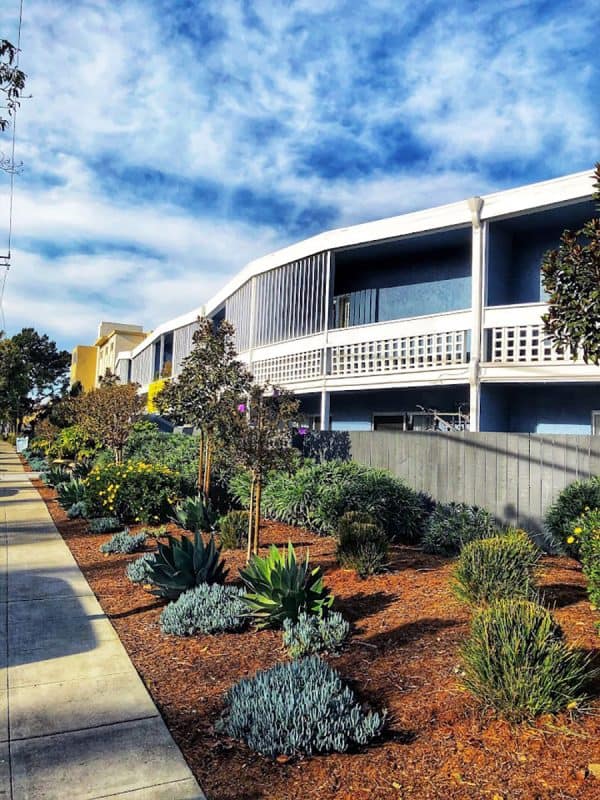
Alameda Post - A Lush Drought-tolerant Landscape at Otis Terrace
Otis Terrace Apartments transformed their sidewalk median into a lush drought-tolerant garden. Photo Google image capture.

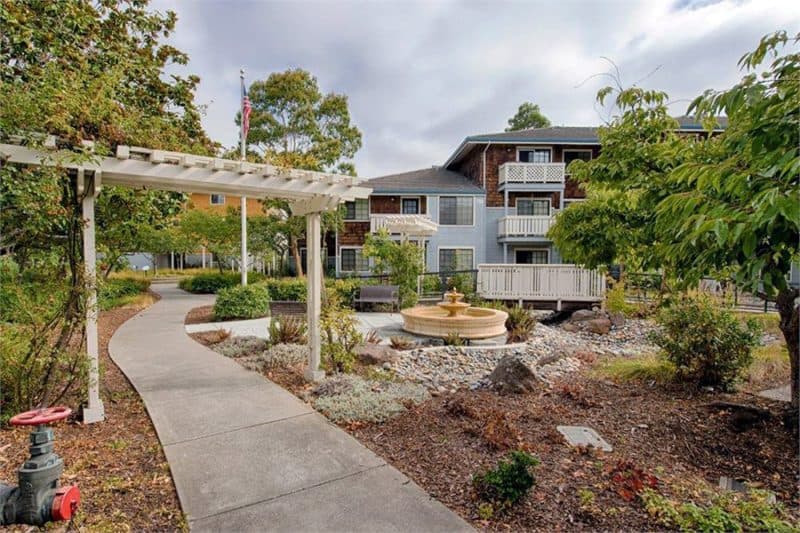
It’s not just individual homeowners or renters who are making the switch. Many apartment complexes around town already have converted their lawns to beautiful drought-tolerant gardens. Most of the apartments that line Otis Drive across from the South Shore Center now have drought-tolerant landscaping on their medians between the sidewalk and the street. And the City of Alameda is conserving water as well, not just with City Hall’s new lawn conversion but also with city-owned properties such as Independence Plaza, an apartment complex for people aged 62 and older, which has drought-tolerant, bay-friendly habitat throughout the grounds.

Alameda Post - A Garden with a fountain, rocks, and plants
Independence Plaza’s senior apartment complex features drought-tolerant landscaping. Photo Alameda Housing Authority.

Getting started with a drought-tolerant garden is fairly simple

Ready to convert your yard to a drought-tolerant garden? The first step is to get rid of your lawn in the area you want to re-landscape. The easiest and cheapest way to get started is sheet mulching (see video below).

Start by gathering cardboard boxes, often available from your neighborhood grocery store. Open the boxes out flat, cover your entire lawn with the cardboard, and then cover that with wood chip mulch, or bark. Many tree service companies will deliver free wood chips, and EBMUD will give you coupons for free mulch and compost at nearby nurseries.

Then just wait three to six months to let the cardboard and mulch break down into the soil. The best time to do this is summer or fall, but you can start whenever it is most convenient for you. The key ingredient is patience.

Check out free garden plans

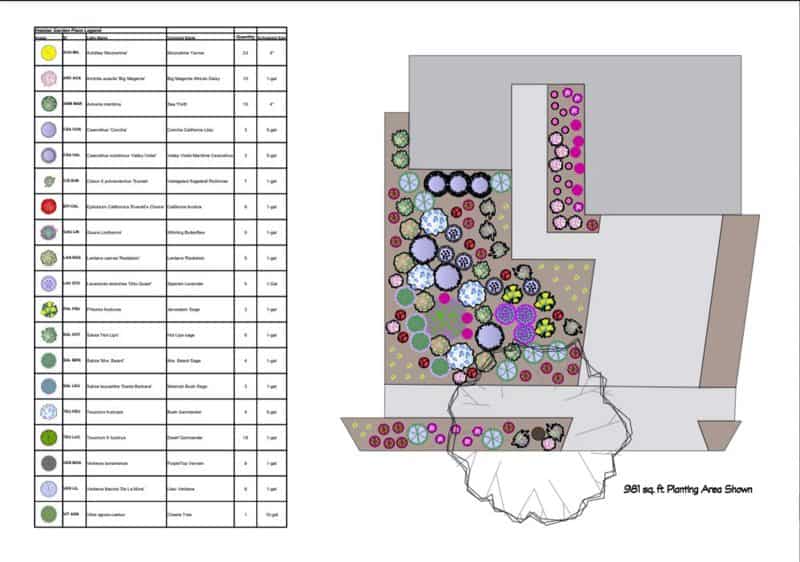
For those of us who aren’t gardening experts, there’s a wealth of information online. The Harbor Bay Isle Homeowners Association (Bay Farm Island) offers free downloadable drought-tolerant landscape plans and lawn conversion guidelines with detailed plans for a variety of different gardens. Take a look at the fully customizable California Native Plant Society garden planner to see plants that are native to Alameda and suit your goals as well as your preferred garden aesthetic.

Alameda Post - A birds-eye view of a plan for converting a lawn to a drought-tolerant landscape. The plan includes a map of where all the plants will be placed.
Harbor Bay Isle provides free lawn conversion plans online. Photo HarborBay.org.
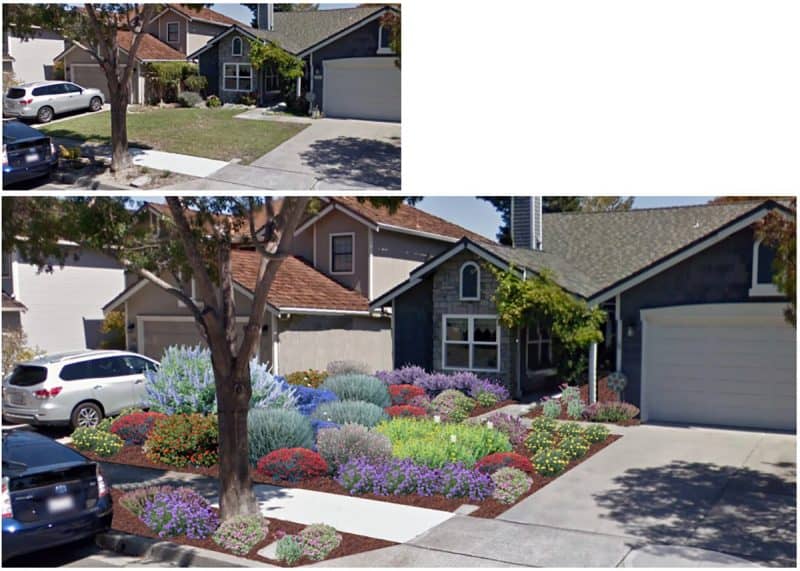
Alameda Post - A rendered photo of what a lawn could look like before and after replacing the lawn with a drought-resistant landscape
A rendering of a the lawn transformation using the above plans. Photo HarborBay.org.

Garden Center resources for drought-tolerant plants

And by all means, visit our local nurseries and ask questions. Encinal Nursery (2057 Encinal Ave., open seven days a week) is family-owned and operated and has been here in Alameda since 1946. Their huge variety of beautiful plants is second to none here on the island, and the staff is very helpful. Their greenhouse is filled with cacti and succulents.

Alameda Post - A wall of different plants available for sale
Encinal Nursery has a wide selection of cacti and succulents. Photo @encinalnursery.

Ploughshares Nursery (2107 Main St., open Wednesday through Sunday), specializes in California native, drought-tolerant, and edible plants. Part of Alameda Point Collaborative (APC), the full-scale nursery has its own demonstration garden and offers hands-on workshops on sustainable landscaping and garden design. Sales from the nursery generate revenue for APC’s supportive housing for the formerly homeless, and the business provides job training to APC residents as well.

Alameda Post -Ploughshares manager Jordan Taylor smiling and holding a plant
Ploughshares manager Jordan Taylor is happy to help Alamedans with drought-tolerant garden planning. Photo Liz Barrett.

“Many people who come here are looking for heat-lovers and native plants that eventually will take care of themselves as far as water-wise gardening,” said Ploughshares manager Jordan Taylor. “Also, a lot of native plants have natural defenses against pests, so you can avoid using pesticides.”  Walking through the nursery, she noted that although succulents and cacti are beautiful and very popular in drought-tolerant gardens, they’re certainly not the only options. “Native milkweed is amazing,” Jordan said. “Monarch butterflies love milkweed. Echinacea is very popular. And people love passionflower vines. They’re not necessarily native, but they are once established, they are definitely drought-tolerant and very much love the heat. Salvia and most lavender also will be great for your drought-tolerant garden.”  Taylor and her staff are available during business hours and are happy to share advice on garden planning.

Liz Barrett is the Copy Editor of the Alameda Post and writes about the community. Contact her via [email protected]. Her writing is collected at AlamedaPost.com/Liz-Barrett.

Salt Lake City’s landscaping rules could soon allow more water conservation

Stan Holmes was trying to enable preserve the world when he swapped the thirsty grass in his compact park strip for compacted gravel.

Soon after all, his Capitol Hill home is in the desert.

“(We) slice our water usage drastically,” he stated. “I experience like we’re variety of undertaking our little bit to try out to conserve h2o in what, the 2nd driest state in the U.S.?”

For yrs, the alter drew no notice. But past fall, right after Holmes joined a social media discussion about Salt Lake City’s enforcement of landscaping benchmarks, the very first violation notice strike.

Failure to comply with a regulation that necessitates 33{6d6906d986cb38e604952ede6d65f3d49470e23f1a526661621333fa74363c48} of a park strip to be covered by vegetation could end result in lawful motion, a compliance officer wrote.

Due to the fact getting the very first detect in Oct, Holmes has been a vocal critic of the city’s landscaping regulations and has called on officers to make variations.

“We’re striving,” he said. “Folks are striving to help you save (drinking water). They should not be penalized for that.”

Holmes might get his wish.

In a report sent to the City Council this month, officers made the case for revising the landscaping regulations, acknowledging the existing benchmarks operate counter to h2o conservation endeavours as the local climate dries and the population mushrooms.

Town code involves park strips, entrance yards and road-dealing with side yards on corner a lot to have a third of the place coated by vegetation. The metropolis paused enforcement in Might when it reviewed the ordinance.

Between Jan. 1, 2021, and July 21 of this year, the metropolis recorded 136 violations of park strip landscaping rules. These kinds of violations could include things like not possessing enough vegetation, obtaining also numerous weeds or leaving trash in the park strip.

A critique of metropolis data showed dozens of homes ran afoul of the vegetation least.

“Property proprietors are not normally informed that these policies exist,” the report mentioned, “resulting in irritation when they are hoping to preserve h2o, an endeavor that is supported by most.”

What could improve in SLC’s landscape ordinance?

(Leah Hogsten | The Salt Lake Tribune) Salt Lake Metropolis resident Stan Holmes’ parking strip, crammed with gravel, is noncompliant with Salt Lake City code, Aug. 25, 2022. He produced the alter to save h2o.

Metropolis officers gave council customers a number of selections to consider for modifying the rules, together with a transform in the way vegetation coverage is calculated.

Below present code, monitoring vegetation other than sod is difficult since it involves measuring the spread of individual crops. A new code could incorporate a distinct metric, like demanding a selected variety of vegetation for each sq. foot.

Council associates also could depend shade from trees, most likely eradicating the need for vegetation on the ground.

Or, according to the report, the town could fall the vegetation coverage regulations solely, a transfer that officers warn would likely guide to a hotter natural environment and greater storm runoff.

Zach Frankel, government director of the Utah Rivers Council, bristles at the assertion that landscaping in park strips does a great deal to interesting urban temperatures. He explained the metropolis has presented no details in the report to back again its claim.

“That desires to appear out,” Frankel stated, “and not be used to stop the modification of Salt Lake City’s byzantine landscaping ordinances.”

If people want to get rid of the vegetation in their park strips and yards, he explained, they need to be allowed to do so. And if the metropolis is worried about capturing floor h2o runoff, it must set extra concentration on receiving rain barrels to people to acquire water all through storms.

Synthetic turf in SLC?

The purpose of the critique, Mayor Erin Mendenhall stated, is to look “even further at how we can not just inspire but insist on specific thresholds of conservation,” although nonetheless making it possible for lush landscapes.

Though the up coming methods are for members of the Metropolis Council to choose (they’ll want to carve out time at a upcoming meeting to discuss a new ordinance), the mayor has an strategy of what ought to be prioritized.

She wishes to expand the city’s urban forest due to the fact trees carry a bevy of advantages, like cooling the natural environment. She also hopes to steer present neighborhoods and new developments absent from grass. She even supports an option that existing policies forbid: phony grass.

“The city need to be allowing synthetic turf use to an suitable extent that nevertheless maintains our tree canopy and doesn’t leave us significant and dry on our urban forest,” she mentioned. But “Kentucky bluegrass simply cannot be the foreseeable future of all landscapes in Salt Lake Metropolis.”

Most vegetation planted in the city’s produced parts is made up of nonnative species that demand excess drinking water to keep alive throughout sizzling, dry summers. This style of landscaping, the metropolis said, is the main contributor to high h2o demand in summer time months that pressure the capital’s supplies.

Long term laws, the administration argues, need to be modified with an emphasis on weather-appropriate vegetation.

Kyle Roerink, govt director of the Great Basin H2o Network, agrees. And transitioning away from drinking water-guzzling landscapes, he stated, doesn’t necessarily mean settling for barren wastelands.

“Kentucky bluegrass is not indigenous to the Wasatch Entrance,” he claimed. “So let us determine out what is, and let us determine out how we can start off residing in harmony with what was in the Excellent Salt Lake’s greater ecosystem before people arrived.”

Editor’s note • This tale is out there to Salt Lake Tribune subscribers only. Thank you for supporting nearby journalism.

Xeriscaping: The growing landscaping trend that saves water, helps pollinators

ST. PAUL, Minn. — As drought ailments worsen in the West, and carry on to effects elements of Minnesota, a growing development is aimed at saving drinking water and supporting pollinators.

Xeriscaping is the procedure of getting rid of grass lawns and planting indigenous, much more drought-resistant vegetation instead. Elisa Bernick has been xeriscaping for several years at her St. Paul house and now has a flourishing back garden with a lot of diverse species.

“I imagine numerous of us are coming to phrases of the truth we do not want to use extra sources than important. Fertilizer, water, this intense kind of gardening that we grew up with, but now we have an understanding of it is not appropriate for the planet, the way we are moving ahead,” Bernick reported.

She made the decision to start out xeriscaping right after design still left her soil unfertile in her backyard.

“I essentially just put sand and some dirt on major of all that particles and thoroughly chose my vegetation,” she said.

The location of where she chose to plant is just as important at the type of plant by itself. She said it took a ton of research, endurance and demo and mistake ahead of her backyard commenced to prosper.

“General, my water use has gone down, my plants are flourishing,” she stated.

Her neighbor is also hopping on the development.

“We are gonna in with each other on some gardening, so which is fascinating,” she reported.

Julie Weisenhorn, a horticulture educator at the College of Minnesota Extension, states though Minnesota’s climate is severe, it is really nevertheless possible to make a xeriscape.

“Native vegetation appear to thoughts correct absent for the reason that they have advanced, and they evolve actually well with different varieties of climate and distinctive forms of weather conditions circumstances,” Weisenhorn mentioned.

The exercise can also be advantageous for pollinators and need less upkeep from owners.

Knowing the landscape and drainage techniques is a great initially step for all those intrigued in transforming a lawn.

The University of Minnesota, among other places, offers soil testing for a smaller charge. The university offered other guidelines to conserve drinking water. 

How to Use the Latest Landscape Irrigation Techniques to Save Water

Drip irrigation
Drip irrigation. Courtesy San Diego County H2o Authority

Tenth in a sequence republished with permission from the San Diego County H2o Authority‘s website.

Irrigation is an crucial element of any excellent landscape style and design. It makes certain crops and trees get the drinking water they have to have to thrive with out squandering a drop. At the time you know how substantially h2o your landscape vegetation need, it’s time to acquire a closer appear at your irrigation process.

Whether you are performing with a professional designer or are carrying out the venture yourself, the next checklist will enable you maintain monitor of the most important selections associated in irrigation design and style.

The 4 Types of Irrigation

High-performance irrigation is the most economical process to provide drinking water to vegetation is small-stream irrigation. It delivers h2o from the valve by means of a filter and then by way of a community of lateral pipes and sometimes adaptable tubing, to the unique emission units this sort of as drip emitters, in-line drip emitters, or bubblers. Strain compensating units are generally the most economical solution.

Minimal flow irrigation is a good preference for trees and shrub places and must be utilized in any landscaped parts upcoming to hardscape and in areas much less than eight toes large to protect against runoff from overspray. When employing drip emitters, cut down routine maintenance and ensure very long-phrase longevity by picking out fantastic high-quality tubing and developing for at the very least two emitters for each shrub.

Average effectiveness irrigation is the following most efficient kinds of irrigation include things like rotating or minimal precipitation (usually for areas eight to 30 toes in measurement). These nozzles are a far better preference than traditional spray heads for watering turf mainly because they have a reduced software price — they drinking water bit by bit. Your watering periods will increase, but these sprinklers do not develop mist, and they utilize h2o at a level turf can absorb it, lowering runoff.

Lower-performance irrigation. The least successful styles of automated irrigation include things like traditional spray irrigation and impact rotors. These sorts of high precipitation irrigation distribution units typically apply water a lot quicker than the soil can take up. Putting in a new system with very low-effectiveness irrigation is not advisable. If you have an existing common spray process, you can simply retrofit it with new low precipitation nozzles.

Use a Good Controller to Help you save Water

Enhance to a sensible controller, an automated controller (also termed a timer or clock) is both weather conditions-based mostly or has historic climate knowledge involved as a reference. Some methods allow for adding a weather conditions sensor or moisture detection system that mechanically adjusts your watering plan in reaction to current weather or soil humidity level.

Clever controllers can switch off your sprinklers when it rains and enhance the frequency and/or period of watering in hotter temperature. Find the controller in a location that is straightforward for you to accessibility, these kinds of as the garage.

Verify Your Water Use

Drinking water-conserving landscape irrigation aims to implement drinking water as proficiently as feasible. This suggests applying reduced stream drip or bubblers each time feasible and in locations with overhead sprays, delivering the suitable stress and products structure to guarantee even protection to improve performance.

When you have decided what type of irrigation you would like to use, divide your garden into zones and take note what type of irrigation you plan to use in just about every zone. Get hold of some of the major irrigation companies to obtain an irrigation design information to enable you with the details of your irrigation format. Some irrigation brands even offer free irrigation design solutions.

It is essential to double-check to make sure your structure meets the goal landscape drinking water use soon after set up. You may perhaps will need to alter the design to meet up with your concentrate on to increase h2o discounts.

The San Diego County H2o Authority offers systems, methods, and incentives to make improvements to water-use performance for residential, professional, and agricultural people. For far more drinking water-use efficiency assets, go to WaterSmart.SD.org.

Water levels driving Utahns to water-wise landscaping | News, Sports, Jobs

&#13
&#13
&#13
&#13
&#13

Deborah Wilber, Common-Examiner

Drip tape is demonstrated in Carie Frantz’s xeriscaped lawn on Monday, June 6, 2022.

OGDEN — Actions taken by drinking water end users within just the Weber Basin H2o Conservancy District, alongside with modern temperature, has benefited drinking water source all over the location. With reservoirs at 55{6d6906d986cb38e604952ede6d65f3d49470e23f1a526661621333fa74363c48} capability, up from 35{6d6906d986cb38e604952ede6d65f3d49470e23f1a526661621333fa74363c48} in March, the district plans to shift from their latest response — level 5-serious — to a level 4-extreme, in accordance with their Drought Contingency Approach.

Scott Paxman, the district normal manager and CEO, mentioned they are grateful for people who responded to drought messaging and mitigation endeavours by participating in conservation courses and landscape modifications.

According to Paxman, adopting sustainable h2o behaviors now will assist get ready men and women for moments of drought.

“Our communities will have significant impacts on all sides of our lives, now and well into the upcoming,” he mentioned.

Over 700,000 citizens inside of Davis, Weber, Morgan, Summit and Box Elder counties receive h2o from district sources.

Deborah Wilber, Typical-Examiner

Carie Frantz’s xeriscaped lawn is pictured Monday, June 6, 2022.

In accordance to Paxman, late fall and early winter storms appreciably impacted soil dampness throughout the watershed. Having said that, mitigation actions are ongoing, which includes an early termination of irrigation process deliveries for wholesale and retail contracts in mid-September.

The district is encouraging the community to choose gain of its conservation packages, which includes instructional courses, rebate systems and the “Learning Backyard garden.”

To day, approximately 850 purposes have been been given by the district for their “Flip-Your-Strip” incentive software recognized very last summer time. Parking strips, the narrow strip of land among sidewalks and the highway, are reportedly inefficiently irrigated and challenging to retain.

With a substantial total of the drinking water intended for parking strips ending up on sidewalks and roadways, the district initiated the application to get the general public to switch to drinking water-clever landscaping.

Although some inhabitants have debated whether or not or not they would switch the landscaping, Carie Frantz, an Environmental Scientist and Professor of Earth and Environmental Sciences at Weber State University, realized zero-scaping was one thing she was likely to do.

Deborah Wilber, Conventional-Examiner

Carie Frantz’s xeriscaped garden is pictured Monday, June 6, 2022.

Frantz commenced operating on her drinking water-clever landscape final 12 months. She now has a web page on the matter, outlining the method for people who may well want to make the transform, but really do not know how to do it. Far more info can be discovered at websites.google.com/check out/cariescaping.

Paxman reported towns and the public have been really receptive to the incentive. “Interest in the program has been exploding these days,” he claimed.

&#13 &#13
&#13
&#13

Newsletter

&#13

&#13

Be a part of 1000’s presently getting our every day newsletter.

&#13