Where to buy the best affordable art and design prints online

Yes, you could buy a mass-produced print from a high street shop. But that’s not exactly great for the soul. Instead, certain online stores enable you to find much more unique, quirky and interesting art prints for your home. That way, you’ll be directly supporting contemporary artists, and you’re far more likely to find work that will truly wow you day after day.

For this article, we’ve gathered together the best place to buy affordable art and design prints today. As you’d expect, we’ll begin with our own online store, which we’ve recently launched to support the independent artist community.

But we’ll also list some other great online stores, which we have no involvement with, nor are we taking affiliate income from the links. We just think that the more stores are supporting artists, the better, and we want to give readers as much choice as possible!

Following our own Creative Boom Shop launch earlier this month, we’re now collaborating with exciting artists and designers to sell their work online. And we’ve taken a unique approach to how we do so.

We’re collaborating with top artists, who’ve all created one-of-a-kind A3 prints that will be available for seven days only. You won’t find these anywhere else on the planet, and once the seven-day sales period is over, they’re gone forever. That means you’ll only get one chance to get your hands on one of our curated pieces.

To kick things off, we’ve collaborated with top illustrators Luis Mendo, Haley Tippmann (now available), and Murugiah, who’ve all created one-of-a-kind prints that will available for seven days only. In future, we’ll be selling exclusive works by huge names like Rob Lowe aka Supermundane, illustrator Danielle Rhoda and graphic artist Sarah Boris.

These pieces are printed on the finest art paper, with 100 per cent carbon neutral printing and delivery to anywhere in the world – tracked and insured. We’re supporting artists by sharing 50 per cent of all profits with those we collaborate with, and 10 per cent of our own portion is being donated to Create, the UK’s leading charity empowering lives through the creative arts.
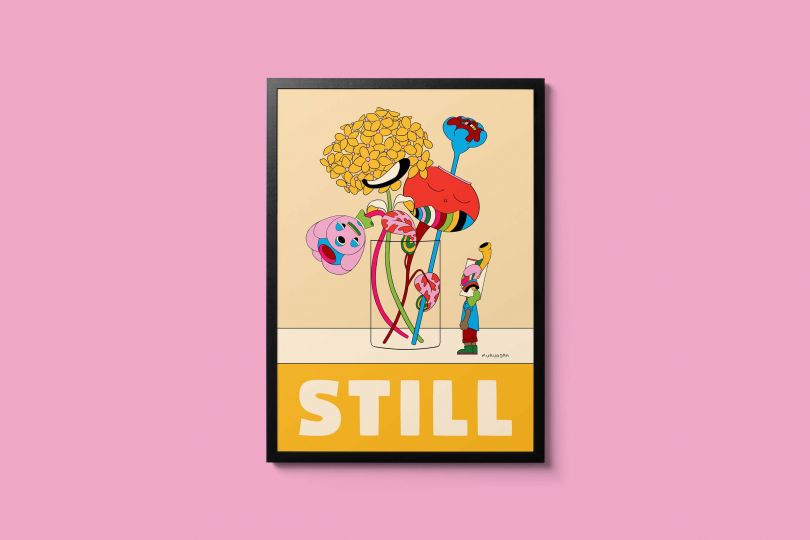
Still by Murugiah, available soon from Creative Boom's new shop


Still by Murugiah, available soon from Creative Boom’s new shop

The Tate is a network of four art galleries in London, Liverpool and Cornwall housing the national collection of British art and a variety of international modern and contemporary art. In their online shop, you’ll find an astonishing breadth and depth of work by some of the world’s most celebrated artists, new and old. And although few of us will ever be able to afford one of the original paintings, the Tate’s expertly produced prints remain nicely affordable.

“Making walls into galleries since 2010″…. the tagline of East End Prints says it all. Based in London, the organisation houses a carefully curated collection of graphic art. They have one physical shop and an archive of more than 4,000 art prints to buy online, divided into theme categories such as abstract, music, sport and figurative. With artists including Fiona Watson, Lizzie Prestt and husband and wife team Studio Cockatoo, a portion of the profits go to Cool Earth, a charity working to fight deforestation in the Amazon rainforest.

Barbican Conservatory via [East End Prints](https://www.eastendprints.co.uk/products/barbican-conservatory.html)


Barbican Conservatory via East End Prints

Another business based in East London, Wrap, started life in 2010 as a magazine and now includes a stationery and product range, online shop, and editorial content in print and digital. They collaborate with illustrators and designers from around the world on prints for people’s homes and stationery products such as greetings cards, wrapping paper, notebooks, trays and scented candles. The store is currently selling a range of beautiful prints by artists Laurie Maun and Alexandria Coe.

Describing itself as ‘The Home of Original Cycling Art’, The Handmade Cyclist occupies quite a fascinating niche in the world of commercial art. Inspired by a deep and lifelong love of the sport, they offer a unique and alluring selection of prints bringing a variety of well-known cyclists, quotes and races to life. Influenced by art deco and characterised by rich, vivid colours, all designs are created in-house and shipped worldwide from the UK. Normally limited to a run of 50, these works are custom printed in the studio on premium-quality paper stock, using archival inks.

While Others Sleep by [The Handmade Cyclist](https://thehandmadecyclist.com/collections/original-cycling-prints/products/while-others-sleep)


While Others Sleep by The Handmade Cyclist

RoomFifty was launched in 2017 by professional illustrators and art directors to make the best contemporary art accessible to everyone. They sell limited, museum-standard prints, starting at just £30, by a curated roster of illustrators and designers worldwide. All prints are produced using Enhanced Matte Art (EMA) substrate – a 200gsm museum-quality paper with a gently textured surface – and come with a 100+ year colour guarantee. Artists on their roster include Belle Mellor, Peter Greenwood and Simone Massoni.

Blood Moon by Nicole Rifkin via RoomFifty


Blood Moon by Nicole Rifkin via RoomFifty

In 2014, London was named the most visited city on the planet. The people behind We Built this City wanted to raise the quality of souvenirs for visitors. And their solution was to bring together products curated from over 650 renowned and upcoming London-based artists and makers, including a fabulous range of art prints. Contributing artists include Kristjana S Williams, Supermundane and David Sparshott.

Rise Art is an online marketplace for hundreds of emerging and established contemporary artists, giving them a way to reach collectors and first-time art buyers alike. Its online shop showcases limited edition prints from some of the most exciting creators active today. The extensive collection includes woodcut prints, linocut prints, screenprints, and monoprints by artists including Alexandar Khabbazi, Chowwai Cheung and Daniel Nagy.
Time to turn off irrigation controllers

California has welcomed recent rain showers with open arms and we will continue to hope for a wet season throughout the winter. While we celebrate the much needed precipitation, it’s also the time to be consciously conserving, Home Decor Ideas.

Water management is a phrase you will hear a lot as we collect our efforts as a community into every pipeline of saving water. One of the easiest ways you can do this is by adjusting and/or turning off your irrigation controllers this time of year.

A controller is the device, or electronical “clock” that operates an irrigation system with intended frequency, duration and start times. It plugs into a 120 volt outlet on the outside of your home or in your garage.

Most systems typically have 12-14-gauge wires that run from the controller to each one of the valves. It sends a low amount of voltage, (between 12-14 volts), to operate a solenoid which then actuates and opens the electric valve.

Water pressure is built up in the valve at all times, so once that signal is received, the solenoid opens and pressurizes the sprinkler or drip system. Once the electronic current stops, the solenoid closes, which in turn closes your irrigation valve and stops the flow. This device is the key to saving water. If the controller is turned off, your irrigation system will not run; if the clock is on, the irrigation will run based on the pre-programmed run times and frequency.

It can be tricky during this time of the year when we have a big early rain and then the weather begins to warm back up; you may not be sure what to do with the programming of your controller.

There are some great components available that will help you with this process and one is a rain sensor. This unit will interrupt the scheduled program if it senses rain or moisture. It can help avoid the sprinklers coming on during or right after a rain. They are less than $100 in most cases and I recommend every landscape have one.

Many people ask me, “When is it time to completely turn my controller off for the season?” The simple answer is after the first rain hits, its generally safe to turn your controller off for the winter.

For Thanksgiving, check out new Native art in Seattle

Movies and virtual events 

Due to experience gained by all those pandemic pivots, virtual art events abound this year, which means you can enjoy including Native films, visual art shows and readings from your couch.

>> Washington state’s poet laureate, Bellingham-based poet Rena Priest (a member of the Lhaq’temish/Lummi Nation), will join two other Indigenous poets, New Zealand-based Iona Winter (Waitaha/Kāti Māmoe/Kāi Tahu/Pākehā) and Tacoma-based Sasha LaPointe, a Coast Salish author from the Nooksack and Upper Skagit Indian tribes for a reading co-hosted by Seattle City of Literature and Dunedin (NZ) City of Literature. The writers will discuss their work and shared resonances in a prerecorded virtual talk (Dec. 1, 6-7 p.m. Free). 

>> “Three years, two months and nine days,” says Ken Workman, the great-great-great-great-grandson of Chief Seattle, “from the time that the Denny Party landed at Alki Point on November 13, 1851, to the signing of the Point Elliott treaty in 1855.” This astonishingly brief time span becomes an incantation in Three Years, a new short (streaming free, online) by Seattle filmmaker B.J. Bullert. In simple scenes shot on a windy day at Alki Beach, Workman repeats the timeline, and explains in Lushootseed how Chief Seattle initially welcomed the new arrivals: “Come ashore my friends, come ashore onto this ancient land of the Duwamish.” When the wind kicks up, Workman’s words seem to push the waves backward, as if to reverse time. “The Duwamish remain,” he says. “We are fixed to the land. We are still here.”

>> The multidisciplinary arts group yəhaw̓ Indigenous Creatives Collective recently premiered two online visual art exhibits. Telling Our Own Stories: Afro-Indigenous Creatives, curated by local artist Brit Reed, includes short films, multimedia collages, beadwork, music, quilts and digital artwork by artists from across the Western Hemisphere. A second virtual, multimedia art show featuring intriguing artworks (also curated by Reed) chronicles Indigenous responses to COVID-19 under the banner of Being A Good Ancestor. As Reed writes, these are the questions posed to artists: “How are you being a good ancestor as we go through this era of COVID-19, a continuing Civil Rights Movement, and political strife? What stories from the past, from the ancestors, are inspiring your actions today?” 

>> Three Dollar Bill Cinema is streaming a virtual Indigenous showcase consisting of two feature-length and two short films (Nov. 19-29). Being Thunder follows a two-spirit gender-queer teenager from the Narragansett tribe in Rhode Island, and in Fire Song, a gay Anishinaabe teenager grapples with a life-changing event. Also in the lineup is the short Drive to Top Surgery, by local Emmy-award-winning creator and director Raven Two Feathers, who will moderate a panel of Indigenous filmmakers on Nov. 21 at 1 p.m. on Three Dollar Bill’s Facebook and YouTube pages.

Van Gogh exhibit at the Columbus Museum a must-see experience

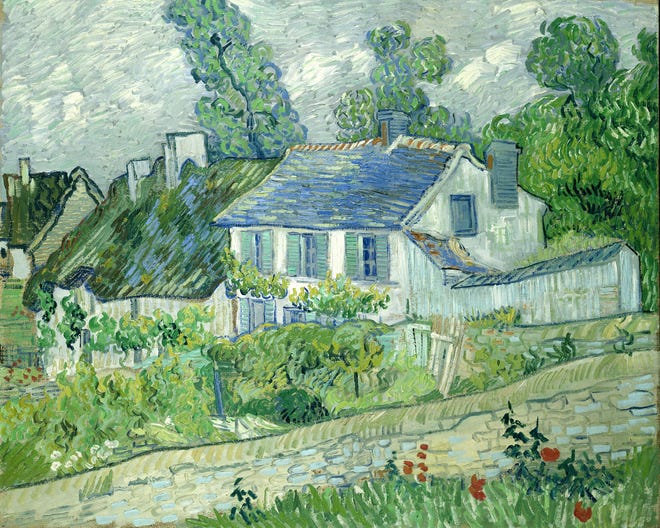
"Houses at Auvers" by Vincent van Gogh

The Columbus Museum of Art is paying homage to Vincent Van Gogh and his contemporaries in a spectacular, thoughtful and must-see exhibit.

“Through Vincent’s Eyes: Van Gogh and His Sources” celebrates the tortured Post-Impressionist with 17 of his signature works, interspersed with more than 100 paintings, prints and sculptures by artists who influenced and were admired by van Gogh. 

The beautifully installed exhibit places van Gogh works on a deep-blue background, surrounded on white walls by meaningful works created by Van Gogh’s contemporaries.

So, it is possible to do a 15-minute “Louvre” walk-through to find and inspect just the Van Gogh works. But viewers would be doing themselves a huge disservice to go this route; throughout the exhibit there are artistic gems by the likes of Edgar Degas, Paul Gauguin, Edouard Manet, Claude Monet, Camille Pissarro and Henri de Toulouse-Lautrec, to name a few.

How the World’s Foremost Maze-Maker Leads People Astray

Elsewhere in the maze, there were long stretches without any junctions. Oskar van Deventer, a Dutch telecom engineer and a renowned designer of mechanical puzzles, told me, “This is something you will recognize in all Adrian Fisher mazes: that it has some long corridors with no decision to be made.” This provides the choice-fatigued aspirant with a brief, blissful break, but, of course, as I discovered when I hit one and thought I must finally be on the right track, it also serves Fisher’s wily purposes. “A long journey with no choices reinforces the feeling that either you’re going to solve it—or you’re getting very lost,” Fisher explained.

Escot’s bridges are similarly misleading: I approached my first with a sense of relief, only to discover that they offer just enough vertical perspective to make you think you can plan your route but too little to actually figure out the whole maze. “It’s sort of, like, Let me give you a hint that’s not as much of a hint as you think it is,” Rothstein said. “It tantalizes.”

Fisher had even employed the classic Runcie trick: a turn toward the periphery in order to reach the center. Hugo Spiers, a cognitive neuroscientist at University College London, told me he has found that humans are seemingly helpless to resist the magnetic attraction of a goal. “They kind of hedge-scan when they know they’re near the goal,” he said. “They look over to it, like they’re longing to get to it.” That single-minded focus makes it all too easy to discount paths that lead backward, away from the goal. At Escot, the bridges, as well as several paths that run immediately around the edge of the goal without providing access to it, offer tempting views of the maze’s central tower, while the path to reach the center requires aspirants to maintain their distance, travelling under rather than over the bridges.

At Escot, a series of gates allows groundskeepers direct access to the maze’s interior.

Van Deventer, who lives near another Fisher hedge maze, Europe’s largest, built at the point where the Netherlands, Belgium, and Germany meet, attempted to make me feel better about my miserable maze-solving skills. “In that maze, the final path to the exit is going outwards, so you have to walk away from your goal,” he said. “And, for the first and the second time there, I missed that one path, so Adrian’s trickery works on me, even though I may be prepared for it.”

Fisher frequently likens his role as a maze designer to that of a chess player faced with unusual constraints. “I have to play all my moves in advance, and I have to let you win, and I have to let you win just before you’ve had enough,” he said. “I’m here to entertain.” Part of a maze’s amusement value lies in presenting a decent yet surmountable challenge; the other part involves engineering the conditions for a fun family day out. After all, chess is, like most puzzles, a fairly solitary activity. Mazes, on the other hand, tend to be social spaces, and Fisher’s designs are especially, and intentionally, so.

“I’m not bragging,” van Deventer told me, “but I believe that by walking through a maze I’m able to recognize whether it is an Adrian Fisher.” One of the clues, he said, is long loops that repeatedly throw people back together. “We’ve seen you before,” a young woman at Escot said as we passed each other going in opposite directions. Two little girls huddled under one of the pergolas, developing a leaf-based divination system; when we came across them again, at the center, they explained that the leaves had failed to provide the solution, but that they’d found a spot where a very small person could squeeze through the hedge instead. Running into the same people while failing at the same puzzle fosters a curious camaraderie; even when we were visually alone, we could hear the comforting sounds of our comrades-in-confusion through the hedge walls.

“I think he is the world’s best maze psychologist,” van Deventer said. “He has a mental model of what people would be doing, and he is using that against the unsuspecting solver and even against the suspecting solver.”

One day in 1898, Edmund Sanford, a leading professor of psychology at Clark University, was discussing the extraordinary navigational skills of rats with two graduate students, Linus Kline and Willard Small. Kline later recalled that Sanford, having just returned from a trip to London, “at once suggested the possibility of using the pattern of the Hampton Court maze for purposes of constructing a ‘home-finding’ apparatus.” Kline, who had never heard of a maze, looked up the design of Hampton Court’s horticultural puzzle in the Encyclopædia Britannica, warped it to fit into a square box, scaled it down to rodent height, and replaced the hedges with gnaw-resistant mesh. A few years later, Small published the first research on the intelligence of white rats, as evidenced by their maze-solving ability. Together, as the historian of psychology C. James Goodwin has written, “they launched a rats-in-mazes tradition that continues to this day.”

For decades, the behavior of albino rats in mazes—and, by extension, that of the humans who studied them—was turned into a science: something that could be explained and, ultimately, engineered. As a challenge, the maze translated well across species, unlike tests involving, say, symbols or color; as a model, the maze was “the most general, the most representative, and the most perfect” simulation of the larger, choice-filled problem of life itself, as Rebecca Lemov writes in “World as Laboratory,” a history of behavioral research. For a new generation of researchers, mazes became “a shorthand way of asking, ‘Why does the self behave as it does?’ ”

Over time, the Hampton Court design has been superseded: today’s cognitive-enhancement-drug trials are typically carried out in something called the Morris water maze, in which swimming rats must respond to various spatial cues to reach a platform. Still, the importance of mazes in research persists, as does the sense that mazes reveal something about our minds. The great Italian Renaissance mathematician Luca Pacioli, who laid the foundations of modern accounting by inventing double-entry bookkeeping, suggested that mazelike puzzles might be a useful tool to “sharpen the ingenuity of youths,” in much the same way that sudoku is now recommended for seniors.

Speculation about the point of a maze leads, inevitably, to the question of why one would choose to get lost in the first place. The psychologist Kenneth Hill, an emeritus professor at Saint Mary’s University in Halifax, Nova Scotia, who spent his career doing seminal work studying how lost people behave, told me that he found it hard to see the attraction of a maze. “When I talk to people who’ve been lost, they say it’s the scariest, most frightening thing they’ve ever experienced,” he said. “That’s not something I want to pay to do.”

On the other hand, with rare exceptions, no one dies in a maze: like a roller coaster, it’s a safe way to experience danger. And, assuming you reach the goal and then make it out, you will come away with a sense of triumph—a tamer version of the heroic narrative that Hill has found is common among people who have been truly lost. “If you talk to them right away, they can’t say much—they’re still in shock,” he said. “If you wait a couple of days, what you get is this saga about conquering their emotions and their fears and how they pushed through.”

Some scientists hope that understanding the ways in which humans get lost in mazes will offer useful insights into how to design the built environment, as well as techniques we can use to train ourselves to pay better attention to our surroundings. As Spiers told me, “A major part of being human and living life is adapting to change, remembering what you can do, exploiting shortcuts to get to your goal—the kind of flexibility of thinking you need to navigate a maze.” My repeated returns to the mouth of the Escot maze illustrated the point: the puzzle would not change, which meant that my approach had to.

“Well, that was up to the usual high standard,” Fisher said as we exited the Escot maze. While I said hello to Escot’s newly rescued orphan bear cubs, housed in a temporary enclosure just behind the maze, Fisher returned to the parking lot to fetch a drone that he would use to shoot aerial footage of the maze, in order that I might describe his masterpiece as it looked from above. Within his mazes, Fisher is used to pulling the strings to manipulate a captive audience, and it frequently seemed as though he had trouble switching off his inner puppet master in his dealings with the rest of the world.

As I watched tiny humans filmed by the drone make exactly the same mistakes that I had, I recalled that a German word for maze, der Irrgarten, translates as “error garden,” and that, during the first golden age of hedge mazes, they were often positioned beneath terraces or high windows, so that spectators could savor the confusion of others. Meanwhile, Fisher, who favors a Socratic style of conversation, directed my attention to a series of locked gates near the entrance. “What might they be for, I wonder?” he said. When I declined to guess, he provided the answer: “They’re for the groundskeepers, so they can get the clippings out without walking for miles.” With similar pride, he pointed out the roof over the maze’s central tower. At half the size of the square platform it covered, it left four triangular corners exposed to the elements—and used fifty per cent less lumber. “This is one of my hallmarks,” he said, perhaps even more delighted by the maze’s practical and cost-saving measures than by its ingeniously disorienting layout.

Fisher is in many respects interested in his projects only while they are still unrealized designs—Escot’s owners were left to plant all its beech trees. Nonetheless, solving the challenges faced by maze managers, like hedge maintenance, customer throughput, and budget balancing, is at least as fascinating to Fisher as creating puzzles for public enjoyment. Not that he gets it right every time. As he gleefully ignored his G.P.S. on the way home, squeezing into the inside lane to sail past traffic, he told me that his most recent maze, in Ningbo, despite being the world’s largest, was not tough enough. “I was frightened that it was too big,” he said. “But the Chinese are utterly driven.”

Hedge mazes rely on turns and high hedges to disrupt the kind of landmark-based navigation on which humans rely.

He pulled out a worn road atlas and balanced it on the steering wheel, tracing our new route before pointing out that the crucial element of all networks is the node, not the channel. “There’s no point making planes fly faster and burn up more fuel,” he said, while attempting to overtake a tractor on a single-lane road going uphill. “The crucial thing is, can you shave twenty-eight minutes off from the moment of touchdown to the moment of picking up your car?”

Automotive Natural Gas Market 2021 SWOT Analysis, Competitive Landscape and Significant Growth

Reports Globe has released a new research study on the Global Automotive Natural Gas Market 2021 by manufacturer, region, type and application, planned for 2026, which promises a comprehensive review of the market, clarifying past experiences and trends. Based on these past experiences, it offers prediction of the future by taking into account other factors that affect the growth rate. The report covers the crucial parts of the global Automotive Natural Gas market and such factors as driving forces, current trends, monitoring scenario and technological growth. The research document presents an in-depth assessment of the market. It shows detailed observation of various aspects, including growth rate, technological progress and various strategies implemented by major players in the current market.

It also focuses more on current statistics on the global Automotive Natural Gas market. In addition, this research report presents a history of the global market along with future forecasts. A team of experts focuses on examining Automotive Natural Gas industry conditions, supply and demand analysis, and the productivity of leading companies. Different analysis methods have been used to study data from various reliable sources such as websites, media publications, press releases, etc.

Get FREE Sample copy of this Report with Graphs and Charts at: https://reportsglobe.com/download-sample/?rid=85574

Automotive Natural Gas Market Segmentation:

Automotive Natural Gas Market, By Fuel Type (2016-2017)

Automotive Natural Gas Market, By Vehicle Type (2016-2027)

  • Passenger Vehicles
  • Light-duty & Heavy-duty Buses and Trucks
  • Three-wheelers

Automotive Natural Gas Market, By Region (2016-2027)

  • North America
  • Europe
  • Asia Pacific
    • China
    • India
    • Japan
    • South Korea
  • Latin America
  • Middle East & Africa

Major Players Operating in the Automotive Natural Gas Market:

  • Agility Fuel Solutions
  • AB Volvo
  • Beiqi Foton Motor Co., Ltd.
  • CNH Industrial N.V.
  • Clean Energy Fuels
  • Cummins, Inc.
  • PACCAR, Inc.
  • Navistar, Inc.
  • Quantum Fuel Systems LLC
  • Westport Fuel Systems Inc.
  • Siemens PLM Software, Inc.
  • SolidWorks Corporation
  • ZWCAD Software Co., Ltd.

This report includes the estimation of market size for value (million USD) and volume (K Units). Both top-down and bottom-up approaches have been used to estimate and validate the market size of Automotive Natural Gas market, to estimate the size of various other dependent submarkets in the overall market. Key players in the market have been identified through secondary research, and their market shares have been determined through primary and secondary research. All percentage shares, splits, and breakdowns have been determined using secondary sources and verified primary sources.

Get up to 50{6d6906d986cb38e604952ede6d65f3d49470e23f1a526661621333fa74363c48} discount on this report at: https://reportsglobe.com/ask-for-discount/?rid=85574

What to expect from the report?

  1. Automotive Natural Gas Total Available Market (TAM) Size
  2. Automotive Natural Gas Serviceable Available Market (SAM) Size
  3. Business Implications of COVID-19 on the Overall Market
  4. Market Share/ Revenue Share ({6d6906d986cb38e604952ede6d65f3d49470e23f1a526661621333fa74363c48}) of Top Market Players in Total Market Size (2019)
  5. Market Size & Forecast (2016-2027) At Country & Regional Level, By Segments
  6. Overview & Analysis of Key Players Operating in the Market

The Automotive Natural Gas Industry focuses on major leading industry players providing information such as company profiles, product picture and specification, capacity, production, price, cost, revenue and contact information. Upstream raw materials and equipment and downstream demand analysis is also carried out. The Automotive Natural Gas industry development trends and marketing channels are analyzed. Finally the feasibility of new investment projects are assessed and overall research conclusions offered. With the tables and figures the report provides key statistics on the state of the industry and is a valuable source of guidance and direction for companies and individuals interested in the market.

The Study Objectives are:

  1. To analyze and research the global Automotive Natural Gas status and future forecast involving production, revenue, consumption, historical data and forecast.
  2. To present the key Automotive Natural Gas manufacturers, production, revenue, market share, and recent development.
  3. To split the breakdown data by regions, type, manufacturers and applications.
  4. To analyze the global and key regions market potential and advantage, opportunity and challenge, restraints and risks.
  5. To identify significant trends, drivers, influence factors in global and regions.
  6. To analyze competitive developments such as expansions, agreements, new product launches, and acquisitions in the market.

Ask your queries regarding customization at:  https://reportsglobe.com/need-customization/?rid=85574

How Reports Globe is different than other Market Research Providers:

The inception of Reports Globe has been backed by providing clients with a holistic view of market conditions and future possibilities/opportunities to reap maximum profits out of their businesses and assist in decision making. Our team of in-house analysts and consultants works tirelessly to understand your needs and suggest the best possible solutions to fulfill your research requirements.

Our team at Reports Globe follows a rigorous process of data validation, which allows us to publish reports from publishers with minimum or no deviations. Reports Globe collects, segregates, and publishes more than 500 reports annually that cater to products and services across numerous domains.

Contact us:

Mr. Mark Willams

Account Manager

US: +1-970-672-0390

Email: [email protected]

Website: Reportsglobe.com