But DaCosta Ahern died on April 19 last year, before the gallery was able to pay the studio a visit.
“She was just this quiet, but vivacious personality,” said Folsom.
“Even though she was quiet, she would always challenge you,” added Flythe, “challenge your beliefs and challenge the way you thought about things.”
Elizabeth DaCosta Ahern’s “O Mar Salgado” Handout/Courtesy Galerie d’Orsay
On Saturday’s showing of DaCosta Ahern’s work, Galerie d’Orsay presented a thread from mentor to mentee. “Jump In! Celebrating the thread between student + mentor” features a few of Frankenthaler’s works such as “Causeway” and “Aerie,” around 30 of DaCosta Ahern’s paintings, and then carries through to some of her students’ art. The works will be on view until the end of the year.
Severalspeakers remembered DaCosta Ahern’s influence. DaCosta Ahern’s husband, Thomas J. Ahern Jr., read aloud condolences sent to him by some of DaCosta Ahern’s students throughout the years. “I can tell you that she will be missed terribly … I will hear [her] in my head whenever I am painting, so I will still have her in my life,” one note read.
Originally from Providence, DaCosta Ahern taught at the deCordova Sculpture Park and Museum, Lesley University, and Worcester Art Museum. A graduate student at the School of the Museum of Fine Arts in the 1970s, she later made it her mission to mentor students.
In a phone interview, her husband recalled a recent visit he madeto the Concord Center for Visual Arts. Coincidentally, three of the faculty artists presenting work were formerstudents of DaCosta Ahern.
“She had an imprint on many working artists and very successful artists,” Ahern Jr. said.
Along with some of her students,DaCosta Ahern was a participant in the Art in Embassies program, exploring and presenting her work in Portugal and Angola. Frankenthaler encouraged her to partake in her workshops, resulting in six trips to Sante Fe,according to Ahern Jr.
“Every trip produced something,” he said. “She was a beautiful person who made beautiful paintings.”
Elizabeth DaCosta Ahern’s “Luanda Sunset”Handout/Courtesy Galerie d’Orsay
Many of DaCosta Ahern’s friends and students were in attendance at the exhibit. Laura Lester said she felt both honored and grateful to be able to share her artwith her mentor.
“[Elizabeth] would stand back with you and look at your work and not talk until she was ready to say something that was meaningful,” Lester said in an interview. “I will always miss her, and when I paint, I talk to her, and I hope she’s talking to me.”
After59 years of marriage,“I feel enhanced,” Ahern Jr. said, noting that he couldn’thelp but feel her presence at the gallery. “I feel grateful, except for the quantum of sadness and so forth, and the unavoidable remembrances looking at all her work.”
According to those who knew her, DaCosta Ahern always knew when her paintings were finished.
“I think it was innate in her,” Folsom said. “I wouldn’t say that about everyone.”
“Jump In! Celebrating the thread between student + mentor” is an ongoing exhibit until the end of the year at the Galerie d’Orsay on 33 Newbury St.
Ramsey Khalifeh can be reached at ramsey.khalifeh@globe.com.
WHEN THE SWISS textile designer and artist Christoph Hefti worked for the Belgian fashion designer Dries Van Noten in Antwerp from the late 1990s to 2010, he was involved in many parts of the process, from fabric design to budgets to collaborating with Italian printmakers. “It was rewarding,” says Hefti. “As part of the team, we built a vision with a great deal of concentration and mutual understanding.” When Hefti left the company to freelance, he eventually became frustrated — he found himself missing Van Noten’s holistic approach: “I design the fabric but someone else develops it into the final product, and I began to realize that wasn’t enough. I wanted to make something that was completely mine.”
In an attempt to recharge, he embarked in 2011 upon a five-week trip to Latin America, from Argentina up through Mexico; everywhere he traveled, he found himself noticing carpets, which were ubiquitous and had been mostly created for tourism purposes. “All of them were sized to fit a suitcase,” he says, “and in the tourist markets, they all looked more or less the same.” But one day in La Paz, Bolivia, he spotted an unusual, unexpectedly abstract rug, which appeared as if it had been pleated into a pattern of Art Deco-inflected waves. When he asked about it, the boutique’s salesperson told him that it was woven by “a crazy lady in the mountains who never follows the rules,” he recalls. “She said that she had only purchased the carpet because she felt sorry for her. I immediately bought it, and that was the moment I knew I wanted to make carpets.”
Hefti, 54, shares this story from the dining room table of his 750-square-foot apartment in Brussels’s Saint-Gilles neighborhood. Despite the flat’s size, each small, square room — a bedroom, a kitchen and a living/dining room — resembles an immersive theater set, filled with the designer’s vibrant custom textiles, from the curtains hanging in several windows that line the front of the Beaux-Arts five-story building to the carpets, which cover nearly every inch of the wooden floors. In the living room, which is dominated by a wildly overgrown dragon tree and a Monstera deliciosa plant, a large, rectangular carpet depicts six huge blue hands throwing and catching lemons. “For some time, I kept drawing landscapes [that were] indirectly inspired by all the magical realism I was reading while traveling through Latin America,” Hefti says. Along with the carpets, the shelves and mantels are lined with ceramic objects, including 1970s-era French tea sets and thickly glazed ceramic sculptures made by his friend the Belgian ceramist Gregory Georgescu.
ALTHOUGH IT WAS South America that inspired his now eight-year-old carpet enterprise, Hefti produces his pieces in Nepal, with two artisanal firms run by descendants of Tibetan exiles who live in Kathmandu. “There is always an exchange,” he says of his manufacturers. “I propose a design, and we discuss the technical possibilities from there.” The pieces are sold in the Brussels design gallery Maniera, which is co-owned by two of Hefti’s friends, Amaryllis Jacobs and Kwinten Lavigne. “The rugs are an explosion of color and texture, but they’re not just about beauty. There is always something disturbing about them,” says Jacobs, referencing their uncannily lifelike motifs, among them human faces and wild animals.
Most of Hefti’s creative work is done at his studio in a converted industrial warehouse on the Brussels Canal, but he spends his downtime between his apartment and a place he keeps in Zurich. The designer regularly commutes between the two cities by train, stopping over in Paris to create textiles for fashion houses like Mugler. Switzerland is where he takes care of himself, swimming in Lake Zurich, while Brussels is “the interesting, messy place that inspires my work. I meet creative people, have unexpected encounters, work until 11 p.m. and eat French fries for dinner.” The city’s avant-garde theater and dance scene regularly influences his work, in particular shows by the contemporary dance troupe Ultima Vez and the performance artists Diederik Peeters and Miet Warlop, both of whom fuse elements of horror and absurdism in their practices.
Late last year, Hefti held his own show at Dries Van Noten’s gallery, Little House, adjacent to the brand’s new Los Angeles boutique. In addition to his rugs, Hefti created a surrealistic curtain with facial parts floating in woodlands and poufs upholstered with fabrics pulsating with psychedelic colors, all of which are now installed in his living room. The exhibit allowed Hefti to completely manifest his vision, and was made all the sweeter by the fact that it was facilitated by his mentor. “I look around now and see that I have built a space of objects that’s entirely of my own making,” he says, adding that, despite his recent success, he still thinks of his rugs as “monsters on the floor with whom you become friends. They are often the strangest element in an apartment — but I have found that the carpets make friends with the rest of the room very quickly.”
Easements are a right to enter and use land that may transfer with the ownership of the land. Easement issues usually arise when one property owner makes improvements on his or her property without first surveying the property to identify the boundary lines of the property. If the improvement goes over the property line into a neighbor’s property, then the neighbor may seek legal action to remove the improvement or force an easement.
An easement allows a party to use land that belongs to someone else for a specific purpose, such as:
The right to walk through someone’s land to access your property;
The right to maintain a rockery, fence, or other landscaping features between your property and a neighbor’s; or
The right to use and access sidewalks, stairs, and other aspects of a communal living space between townhome or condo units or between properties.
The purpose of an easement it to allow the owner of the land to retain full legal title to the property but allow another party access to the land.
For example:
You live in a community with specific landscaping guidelines and pockets of community space or shared pathways between homes. The Homeowners’ Association also has limitations on the type of fencing and landscaping permitted.
During COVID your neighbor has become an avid gardener and has made improvements to their landscaping and added features that run along the edge of your property line. In an effort to maintain your own yard, you decide to conduct a survey and do landscaping work on your property. The survey reveals that a portion of the area your neighbor has been landscaping is actually a portion of your property. What can you do?
Your neighbor unknowingly has been landscaping a portion of your property which has resulted in them placing a rockery landscaping feature worth thousands of dollars. You want to maintain a good relationship with your neighbor but you are concerned that if they sell the property a new neighbor will expand the landscaping or otherwise stop maintaining the landscaping feature that now crosses onto your property.
How can you navigate this to ensure that they remain financially responsible for maintaining their encroaching landscaping and, if they ever remove it, do not replace it with a new feature?
In such a situation, an express easement can be drafted to provide specific terms regarding the maintenance of the landscaping feature. An express easement can be used to convey easement rights for the benefit of a specific neighbor that cannot be sold, assigned, or inherited. An express easement can also be used to delegate financial responsibility for ongoing maintenance of the landscaping feature to limit your financial liability if your neighbor fails to maintain the landscaping feature they build onto your property. Further, an express easement can be drafted to address what happens to the landscaping feature if it is removed or otherwise deteriorates to such a degree that it causes waste to your property. This allows you as the property owner to negotiate with your neighbor to limit any access they have to your property to solely maintaining the feature so long as it is feasible or until it is otherwise removed and prevents them from further expanding their landscaping onto your property.
The New Art Dealers Alliance (NADA), the definitive non-profit arts organization dedicated to the cultivation, support, and advancement of new voices in contemporary art, is partnering with MobileCoin for the inaugural MobileCoin Art Prize, an award that highlights, celebrates, and supports artwork addressing the critical topic of privacy at NADA Miami 2021. Juried by writer and curator Andrew Beradini and contemporary artist and MobileCoin Art Director Inga Bard, the prize is the first of its kind within the cryptocurrency sector, establishing MobileCoin as an industry pioneer thoughtfully navigating the intersection between art and cryptocurrency. It will be awarded to one of the 170 plus exhibitors at NADA Miami 2021 in the form of $7,500 equivalent to MOB.
“We’re thrilled to partner with MobileCoin to introduce a new initiative that shines a light on privacy issues in the digital art space. As we see the art world expand into the digital sphere, we share in MobileCoin’s commitment to give artists at all stages of their careers the space, time, and platform that remains essential to artistic freedom.”
said NADA Executive Director Heather Hubbs.
MobileCoin is a cryptocurrency designed to be used as digital cash on your phone. With nearly instantaneous transactions and a strong commitment to supporting the arts, MobileCoin is the first carbon-negative cryptocurrency.
“We believe that privacy is fundamental to art. The right to privacy is the right to solace, to reflection, to expression; it is the right to association and movement without intrusion or intimidation. Privacy is essential to the autonomy and dignity required to make art and participate in the cultural life of a free society,”
said Joshua Goldbard, Founder of MobileCoin.
NADA Miami will feature over 170 exhibitors across three sections: Galleries; NADA Projects, an open, exhibition-like presentation of new art from emerging voices; and the latest addition, Artists’ Book Publishers, a co-presentation of artist book publishers with Printed Matter and EXILE Books. This year also introduces Curated Spotlight, an inaugural special section at NADA Miami 2021 curated by Ebony L. Haynes. The section will feature eight solo presentations by exhibiting galleries.
NADA MIAMI 2021VIP Opening Previews (by Invitation): Wednesday, December 1, 10am–2pm Open to the Public: Wednesday, December 1, 2–8pm, Thursday, December 2, 11am–7pm Friday, December 3, 11am–7pm Saturday, December 4, 11am–7pm newartdealers.org/nada-miami-2021
About MobileCoin MobileCoin is a cryptocurrency designed to be used as digital cash on your phone. MobileCoin’s payment system is easy to use with near-instantaneous transactions. With a strong commitment to supporting the arts, MobileCoin is the first carbon-negative cryptocurrency. @mobilecoin.art
Categories
Tags
Author
Mark Westall
Mark Westall is the Founder and Editor of FAD magazine Founder and co-publisher of Art of Conversation and founder of the platform @worldoffad
The Ingram Collection today announced the finalists for Ingram Prize 2021, the leading annual prize for contemporary artists in the UK. The […]
The covid-19 pandemic revealed to many people just how important travelling is. The lockdown has been eased in many countries; […]
Jacob Love wins the Concord Art Prize with his three-channel audio-visual installation, created in response to Rodgers & Hammerstein’s My […]
CasinoUSA.com has recently announced a plan to acquire a total of 50 BTC. The popular online gambling platform has been […]
Osher Lifelong Learning Institute at Ringling College presents “Celebrating Florida’s Wild Wonders,” a one-day event inspired by the book, The Wilder Heart of Florida, and featuring eight celebrated writers, poets, educators, environmentalists, architects, and artists.
The event is Friday, March 11, 2022, 9 a.m.-5 p.m. at the Ringling College Museum Campus, 1000 S. Tamiami Trail, Sarasota. General admission is $125; registration opens on December 7. The registration fee includes lunch and a complimentary reception. For more information and to register, call 941-309-5111, or visit www.OLLIatRinglingCollege.org.
Julie Cotton, a member of OLLI’s Advisory Council’s Strategic Program Committee, is the creative spark for “Celebrating Florida’s Natural Wonders.” She says that participants will “expand their emotional connection to Florida’s natural treasures and learn about places they never knew existed.” Cotton adds that audience members will have the opportunity to offer their own perspectives and interact with the guest speaker. The day will also include book signings and interactions with local environmental and art groups at display tables. Cotton encourages audience members to prepare for the event by reading The Wilder Heart of Florida, edited by Jack E. Davis and Leslie K. Poole, and The Palmetto Book by Jono Miller.
“This event was inspired by The Wilder Heart of Florida,” says Cotton. “Using the arts as our vantage point via evocative prose, poetry, painting, photography, architecture, and film, we aim to engage hearts and minds in celebrating and safeguarding our precious wild wonders.”
Panelists include: Leslie K. Poole, co-editor of The Wilder Heart of Florida and assistant professor of environmental studies at Rollins College; Gianna Russo, assistant professor of English and creative writing at Saint Leo University, author of several poetry collections, and winner of a Florida Book Award; and Bruce Stephenson, professor of environmental studies at Rollins College and author of John Nolen: Landscape Architect and City Planner.
Other presenters include notable environmental writers, artists, and educators, including: Jean Blackburn, contemporary artist, photographer, and naturalist who celebrates nature and the joy it can bring to human life; Susan Cerulean, multiple award-winning writer, naturalist, earth advocate, and author of three books, including the newly published I Have been Assigned the Single Bird, A Daughter’s Memoir; Pamela Callender, adjunct professor of eco-art history at Eckerd College, who has created a unique landscape design project called “Lifelines, Connecting Nature’s Habitat”; Joe King, the architect/developer who designed River Forest, the unique 26-home neighborhood on the Braden River, set among a lush native plants landscape; and Jono Miller, educator, activist, and natural historian who works to understand and protect wild places in Southwest Florida.
SALT LAKE CITY — For decades, the U.S. Forest Service’s practice of putting out wildfires was a huge success. But the policy backfired, setting the stage for the massive destructive wildfires that have flared with increasing regularity across the West.
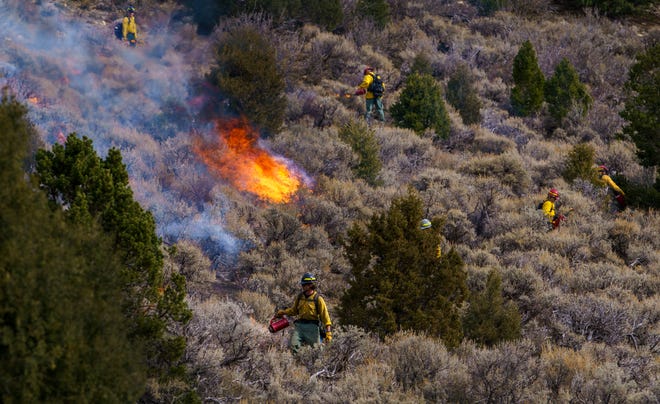
While putting out fires remains a priority, deliberately setting them is becoming more common, especially in Utah, as a more cost-effective and ecologically sound strategy for fixing forest health, the Salt Lake Tribune reported.
The pitfalls of fire suppression are evident across Monroe Mountain in central Utah. The plateau’s historically abundant aspen stands are disappearing under thickets of fir and other conifers that have long impeded fresh aspen growth that should be succeeding the aging trees, but aren’t.
In the hopes of restoring the historic role of fire, at least three Utah national forests plan to sharply expand the use of “prescribed fire” to nurse sickly forests back to health.
Like much of the West’s wooded terrain, large parts of the Fishlake National Forest are ecologically wired to burn from time to time. To thrive, aspen groves need to get wiped out from time to time, according to Richfield District Ranger Jason Kling of the Fishlake National Forest.
“That keeps the fuels in check, not allowing the overgrowth to occur, keeping the landscape open, allowing sunlight to reach the forest floor,” Kling says while touring places on the mountain treated with prescribed fire in the last few years. ”There’s a lot of benefits.”
A backroad crossing the mountainside overlooking the town of Koosharem borders a burn area that is now recovering. A few years ago, crews used the road as a firebreak when they torched the forest on one side. On the untreated uphill side, the forest is choked with small-diameter fir and aging aspen that are probably on their last legs.
On the downhill side, by contrast, there are no living mature trees, but it buzzes with life. The plants are mostly shrubs and young aspen, some about 8 feet high, tall enough to avoid being grazed to stubs by the cows and big game that love aspen leaves. Tens of thousands of aspen shoots per acre have “suckered” up from an ancient root system that connects all the aspen here. These genetically identical trees are essentially all one organism.
Since 2016, the Fishlake has been setting fire to patches of Monroe Mountain, sometimes dropping fuel-filled “polymer spherical devices,” or PSDs, from helicopters to ignite broad areas.
“We’re trying to insert the fire back at the right scale and right time,” says Forest Supervisor Mike Elson. These treatments are carefully managed and timed to minimize the chances controlled burn turns into a wildfire or fills communities with smoke. The wind and temperatures have to be just right.
Three of Utah’s five national forests are now developing plans for conducting controlled burns on all their land where prescribed fire would be appropriate. Fishlake, Dixie and other national forests in south-central Utah span a total of 5 million acres, mostly on high-elevation plateaus and mountains jutting above irrigated valleys and desert.
Fires reduce fuel loads and prevent bigger fires. Forest Service officials already deploy prescribed fire, whether naturally ignited or deliberately set, in the West’s national forests. But this piecemeal approach has not kept pace with the need. In short, far more fuels are added to the West’s overgrown forests each year than are being cleared out through unplanned fires and mechanical treatments, known as “thinning.”
On tap is a more comprehensive approach toward prescribed fire. In the meantime, however, the Forest Service and its state partners are struggling with massive wildfires propelled by climate change and extreme weather events, laying waste to both forests and communities.
This high-risk situation is a consequence in part of excluding fire for decades, leading to what the Forest Service calls “uncharacteristic” wildfire, or what others prefer to call “catastrophic.” Many rural communities would like to see a return to commercial timber harvests that were common before the 1990s. While logging might generate some timber jobs, it won’t solve the forests’ ecological problems, experts say.
“Fire, in general, has been on this landscape for millennia and it’ll continue to be on the landscape. Because of fire suppression, we’ve altered what that looks like,” said Ben Newburn, a fire management officer with the Forest Service’s Intermountain Region office in Ogden. ”Through prescribed fire, we can try to get back to fire regimes in the landscape, in a more historically representative way. And it is one of the more cost-effective methods of treating fuels. We can treat much broader landscapes and we can do it in a way that mimics the natural process.”
Of the three Utah forests developing forest-wide burn plans, the Fishlake was the first to complete its environmental assessment, posted on Oct. 20. Elson’s hope is to cut through the bureaucracy by getting the analysis done all at once, so specific projects are ready to roll when the weather conditions are right and the resources are available.
“Rather than doing the same thing over and over again at a really small scale,” Elson asks, “why don’t we do it at a scale that then allows us to actually focus on getting the work done on the ground as opposed to just focusing on doing paperwork and meetings?”
The Fishlake plans to burn up to 40,000 acres a year for 25 years, treating 1 million of that forest’s 1.5 million acres with prescribed fire and mechanical work. That would represent a 10-fold increase in the Fishlake’s current pace of deliberate burning. The public is invited to submit comments through Nov. 19, either by mail or online.
Other Utah forests’ targets are even more ambitious. The Manti-La Sal National Forest plans to treat up to 48,000 acres a year across 1.2 million acres. This 1.4-million-acre forest covers the Wasatch Plateau east of Ephraim and the Abajo and La Sal ranges near Moab. That proposal does not consider using prescribed fire on certain sensitive lands, including Bears Ears National Monument, designated wilderness, alpine areas and sage grouse habitat.
In southern Utah, the Dixie National Forest aims to treat up to 52,000 acres a year across 1.8 million of its 2 million acres. The public is invited to comment on Dixie’s scoping notice through Nov. 17.
“What we don’t want is all 1 million acres to burn one hot summer. We want to burn it in manageable chunks that don’t devastate whole watersheds so that you have gulleys washing out and cities losing their water supply,” Elson says. “So it’s really a balance that we’re trying to find in terms of how big and when and under what conditions.”
Acreage targets are not arbitrary but are based on historic burn intervals recorded in the growth ring of old trees.
“In some areas, it might be every 10 years, some areas might be every 100 years,” Elson says. “You add all that up and you do the math, we need to be treating between 40,000 and 120,00 acres every year to mimic that natural level of disturbance.”
To illustrate the point, Kling points to data extracted from a ponderosa pine that started growing in 1583. Its rings reveal charring, evidence of wildfire, in eight instances through 1788. On average, about 24 years passed between burns over the tree’s first 200 years of life, but then the rings showed no evidence of fire for the next 233 years, a period coinciding with the arrival of explorers and settlers in the West.
“Fire was much more frequent on the landscape, pre-European settlement versus post-European settlement,” says Kling.
A warming and drying climate has further primed Western forests for megafires that are driven by extreme weather events, putting communities at risk and leaving landscapes charred beyond recognition. Meanwhile, beetle infestations, abetted by warm winters, have killed large swaths of forests across Utah, notably in the western Uinta Mountains and the Wasatch and Markagunt plateaus.
Many academic and agency ecologists see the deliberate reintroduction of fire as a viable pathway out of this mess.
“It creates great habitat, keeps the carbon in the forest,” said ecologist Chad Hanson of the John Muir Project. While he endorses prescribed fire, he prefers to see the Forest Service harness naturally ignited fires, as opposed to setting them off artificially, especially outside the normal fire season.
“You really don’t get the natural ecological mix of conditions and natural heterogeneity with a human-set prescribe power as you do with a prescribed natural fire,” says Hanson, co-author of a book titled “Nature’s Phoenix: The ecological importance of mixed severity fires.” “And so it doesn’t really mimic the same thing. That doesn’t mean there’s not a time and place for human-set prescribed fire.”
Prescribed fire has plenty of detractors who see it as a risky endeavor that can waste timber resources, further harm landscapes and habitat, and result in serious property damage.
“The Forest Service has thousands of examples of the complete elimination of major habitat types through site conversion due to high intensity/high severity wildfires and escaped prescribed fires creating moonscapes where biodiversity once obtained,” wrote wildfire and forestry consultant Frank Carroll in an email commenting on the Fishlake burn plan. “Fire is an equal opportunity tool, often leaving smoke and ruin where life flourished before.”
He dismissed Fishlake’s environmental assessment as “hubris and fantasy” and “insulting” for failing to fully analyze impacts of fire, particularly in areas recommended for wilderness designation.
“The Forest Service has wantonly destroyed thousands of very old trees and otherwise changed or damaged wilderness and wild areas in ways we are just beginning to understand,” Carroll wrote. “What are the values we are trying to protect in wilderness? Solitude? Beauty? Views?”
Carroll spent 31 years with the Forest Service, but his thinking has diverged sharply from the pro-burn philosophy taking shape under the agency’s leadership. Forest Service Chief Randy Moore has publicly declared a goal of quadrupling the amount of land treated by prescribed fire.
Many fire ecologists agree prescribed fire, both human-set and naturally occurring, should be deployed if the West’s dense forests are to ever regain their health. Mechanical thinning is not only cost-prohibitive, but it won’t get the job done, according to Matthew Hurteau, an ecology professor at the University of New Mexico. Mechanical treatments can cost at least $1,000 an acre versus less than $100 for prescribed fire.
“Prescribed burning is a way to manage, what in fire ecology we call the surface fuels. It’s a really important tool,” Hurteau says. “You can reduce tree density by thinning the forest, but if you don’t deal with the buildup of dead plant material on the forest floor through prescribed burning or some other means, you still have quite a bit of fire hazard associated with that patch of forest.”
He and others want to see the Forest Service go even further, and “manage” naturally ignited fires in ways that improve forest health, a position Carroll thoroughly rejects. Hanson and Hurteau both argue natural fire can do a lot of good, as long as it doesn’t put homes and infrastructure at risk.
But such initiatives have courted controversy. In 2018, for example, Utah’s Uinta-Wasatch-Cache National Forest chose such a response to two lightning-caused fires; the result ignited a political firestorm of sorts. Under the watch of forest officials, the Pole Creek and Bald Mountain fires had burned harmlessly on Mount Nebo for several days before a wind event whipped them into a major fire that scorched about 120,000 acres and nearly burned into hillside subdivisions. No homes were lost, but millions were spent fighting the fire and the burn scar unleashed severe mudflows.
Carroll blamed that outcome on the Forest Service and he is now acting as a consultant for several property owners seeking compensation for alleged losses stemming from the Pole Creek Fire, which he pegs at $200 million. Utah political leaders, including Gov. Spencer Cox, also blasted the agency for not putting out those two fires when they were small.
The political fallout was not lost on the Forest Service. In the face of last summer’s devastating West Coast fires, Moore imposed a moratorium on managing natural fires in favor of immediate suppression.
That move disappointed Hurteau and 40 other ecologists who signed a letter to Moore, asking him to reconsider.
“Restoring fire to our forests through prescribed and managed wildfires can lead to long-term reductions in suppression costs and the societal and environmental impacts of severe wildfire seasons,” the Aug. 10 letter states. “We have far too much fuel buildup stored in most of our forested landscapes, and when combined with extreme fire weather, continued fire exclusion puts firefighters, communities, and historical ecosystems at risk.”
Still prescribed fire remains in play, and Forest Service crews were back in the Fishlake last week with drip torches and incendiary PSDs. Those operations charred 250 acres at Manning Reservoir and Moroni Peak.