Evergreen College Longhouse exhibit celebrates Native art

Glass-blown vases, detailed canvases and intricate cedar hats and masks line the white walls of the Evergreen Gallery at Evergreen State College in Olympia.

Artists from around the Pacific Rim are represented in “The Longhouse at 25: Across the Waters,” an exhibition celebrating the 25th anniversary of the Longhouse Education and Cultural Center that was postponed due to the COVID pandemic.

Known as an international hub for Indigenous arts, culture and education since 1995, the longhouse – named s’gʷi gʷi ʔ altxʷ or “House of Welcome” in the Lushootseed language – is the first Tribally-directed Native arts center on a college campus in the U.S.

Curated by the Seneca artist Linley Logan, the gallery has collected pieces since putting a call out for artists in January. New artists, students and those within the longhouse’s circle have spent months creating art and working to submit it.

Due to the pandemic, some post offices around the world were unable to ship items to the longhouse. Artists, like some of the Māori artists in New Zealand, had to find other ways to display their work by sending photographs or digital files for display.

“It’s been really tough. The usual venues, galleries and income for artists have been affected tremendously by the pandemic. So we’re very grateful to those who sent in the work and made the gallery a success” said Longhouse Director Laura VerMeulen, who is Tlingit and Haida.

Comanche artist Cynthia Masterson’s piece “Recipe for a Quarantine” features a whisk with a beautiful design created in glass beads on the handle. The beaded whisk stands inside a glass measuring cup filled with white beads, like flour being measured for a cake.

Evergreen-5.jpg
Indigenous artists from the Pacific Rim and beyond are represented in “The Longhouse at 25: Across the Waters” exhibit celebrating the 25th anniversary of the Longhouse Education and Cultural Center. The exhibit is on display until Jan. 29 at the Evergreen Gallery at Evergreen State College in Olympia. Natasha Brennan McClatchy

“Cultural Burdens III” by Northern Arapahoe and Seminole artist Carol Emarthle Douglas depicts a series of women – each carrying a miniature woven basket or a small cradleboard with a baby on their back. The design can be seen from the inside and outside of the basket, intricately woven with waxed linen, red and yellow cedar bark.

The two pieces, both created within the last year, reflect the solemn but resilient spirit of many artists during the pandemic.

“It’s been such a difficult time, but so much beautiful art has come out of it,” said Evergreen’s Vice President for Tribal Relations, Arts and Culture Kara Briggs – a Sauk-Suiattle Tribal member.

Makah artist T. McCarty, a sophomore studying metalsmithing, submitted her 2017 glass piece “Orca” in the show.

Evergreen-4.jpg
“Cultural Burdens III” by Northern Arapahoe and Seminole artist Carol Emarthle Douglas depicts a series of women – each carrying a miniature woven basket or a small cradle board with a baby on their back – on display at “The Longhouse at 25: Across the Waters’’ exhibit celebrating the 25th anniversary of the Longhouse Education and Cultural Center. The exhibit is on display until Jan. 29 at the Evergreen Gallery at Evergreen State College in Olympia. The design can be seen from the inside and outside of the basket, intricately woven with waxed linen, red and yellow cedar bark. Natasha Brennan McClatchy

While attending an artist-in-residency workshop at the college, students like McCarty were invited to bring designs for a glass-working session. She brought the design for “Orca” and made her first glass piece.

“I had this concept in mind about a whale that was in the ocean, and it had this level of comfort and kept coming back and spouting,” she said.

The dark blue glass reflects the shine of the overhead gallery lights onto the white pillar below, revealing the orca among the ocean waves in the piece.

With hand-dyed wool, the fully-twined button blanket – named “Fish Net Blanket” – was created by Squaxin Island artist Andrea Wilbur-Sigo for her son’s high school graduation ceremony.

Evergreen-3.jpg
“Mr. and Mrs. Grouse” by Skokomish artist Peter Peterson Sr., left, and “Inigun Rock Formation Patterned by Action of Water on the Shore” by Yup’ik artist Jennifer Angaiak Wood hang from the walls of “The Longhouse at 25: Across the Waters” exhibit. Celebrating the 25th anniversary of the Longhouse Education and Cultural Center, the exhibit is on display until Jan. 29 at the Evergreen Gallery at Evergreen State College in Olympia. Natasha Brennan McClatchy

The blanket, and two others, hang off the shoulders of three mannequins in the center of the gallery. Each decorated with woven shirts, beaded medallions or a woven cedar hat, Wilbur-Sigo’s piece and the work of six other artists come together to create a trio of Native fashion.

BEHIND OUR REPORTING

Please help support this reporting

Natasha Brennan covers Washington state tribes’ impact on our local communities, environment and politics, as well as traditions, culture and equity issues, for McClatchy media companies in Bellingham, Olympia, Tacoma and Tri-Cities.

She joins us in partnership with Report for America, which pays a portion of reporters’ salaries. You can help support this reporting at bellinghamherald.com/donate. Donations are tax-deductible through Journalism Funding Partners.

You can sign up for her weekly newsletter here.

“It’s always such an honor to participate in exhibits for the longhouse,” Wilbur-Sigo said. “I love to see how the work of artists with different skills and expertise come together to make a beautiful gallery.”

“The Longhouse at 25: Across the Waters” runs through Jan. 29 and is located on the second floor of Evans Hall (Library building) in the Evergreen Gallery. For up-to-date information on hours of operation, visit evergreen.edu/longhouse/markets-and-exhibits.

This story was originally published December 23, 2021 5:00 AM.

Related stories from Tacoma News Tribune

Profile Image of Natasha Brennan

Natasha Brennan covers Indigenous Affairs for Northwest McClatchy Newspapers. She’s a member of the Report for America corps. She has worked as a producer for PBS Native Report and correspondent for Indian Country Today. She graduated with a master of science in journalism in 2020 from the University of Southern California, Annenberg School for Communication and Journalism, and a bachelor of arts in journalism from University of La Verne.

Artists who use insects in art

Through history and across cultures, insects have inspired artists and challenged viewers to shift their perspective

One day when Barrett Klein was a young boy, he found a dead butterfly in the driveway of his family’s house and marveled at its beauty. It was a transformative moment. “At age five I had a nebulous epiphany in which I knew that insects would be the core of my existence,” says Klein, who is now an entomologist at the University of Wisconsin-La Crosse. He’s also an artist, and insects feature prominently in his art.

Throughout history and across many cultures, insects have inspired artists and artisans. Moth larvae, bees and beetles have provided silk, wax, dyes and other art media. Some insects leave traces on their environment that artists capture, while others in effect become collaborators as their natural behaviors are incorporated into art. “With all of their myriad forms, you’ve got exquisite behaviors as well as colors and shapes to choose from, or be mesmerized by,” says Klein, who recently reviewed the role of insects in art in the Annual Review of Entomology.

Much of this work plays on the conflicting feelings we humans tend to have toward insects — we’re simultaneously fascinated by their strange biology and unfamiliar lifestyles and repulsed or frightened by their stingers, toxins and the diseases they may (or may not) carry. Not to mention their sheer scuttling, swarming numbers.

“They don’t live like us. They don’t look like us. They do the things that we do in such bizarre and wild ways that it’s just endlessly intriguing,” says artist Catherine Chalmers. “They offer a very, very different perspective on life on Earth.”

From ancient cricket etchings to beetle shawls

One of the oldest known examples of insect art is an engraving of a cricket carved into a fragment of bison bone found in a cave in southern France and thought to be about 14,000 years old. Ancient people were great observers of the natural world, says Diane Ullman, an entomologist and cofounder of the Art/Science Fusion Program at the University of California, Davis. Insects are found everywhere humans live (they’re scarce near the poles of the Earth and absent only in the ocean’s depths), and they show up in artifacts from Mesoamerica to Mesopotamia. “Insects became part of the cultural and spiritual stories of people all over the world,” Ullman says.

Images of scarab beetles, for example, are common in the religious art of ancient Egypt, where their habit of rolling balls of dung across the ground (to provide food and shelter for their brood) symbolized the god Khepri rolling the sun across the sky each day. In the Navajo creation myth, Ullman says, cicadas lead people to emerge into the world, mirroring their own life cycle of periodic emergence from underground.

Insects have long provided artists with material for their work. Shellac, derived from the resinous secretions of the female lac bug, has been used for more than 3,000 years. It helps give the sheen to ornate Tibetan armor, among many other examples. Carmine, a brilliant crimson dye derived by crushing up cactus-sucking cochineal bugs and used by the Aztecs and Mayas, commanded exorbitant prices in 16 thcentury Europe, where it was coveted by artists and textile makers. It made reds pop for Rembrandt and other Dutch master painters.

Some cultures use insects themselves, or at least parts of them. The Zulu people of southern Africa string the tiny bodies of immature scale bugs into elaborate necklaces (the insects coat themselves in protective wax that makes them look a little like pearls). Fireflies add “living jewels” to clothing in India, Sri Lanka and Mexico.

Another striking example is the singing shawls made by the Karen people of Myanmar and northern Thailand, says Jennifer Angus, who teaches textile design at the University of Wisconsin–Madison. These woven garments, so named because they’re worn at funeral ceremonies where mourners sing around the clock for several days, sometimes have a fringe made from the shiny, iridescent elytra, or hard outer wings, of jewel beetles. Angus, who grew up in Canada, had never seen anything like it. “I really had trouble believing that it was real,” she says.

The discovery inspired Angus to start incorporating insects into her own work. Her first installation was at a storefront gallery in Toronto, where she arranged hundreds of weevils into a wallpaper-like pattern on the walls. When people walked up to take a closer look, Angus says, “literally, I saw them take a step back as they realized the wallpaper was composed of insects.” The piece created tension, she says, between what people expect when they see a pattern they associate with domestic spaces and the realization that the pattern is composed of bugs, which most people don’t like to find in their homes.

Angus continues to exploit that tension in her work. “A lot of people don’t like insects, but they’re OK with them when they’re put in patterns, because a pattern is ordering and it’s asserting a kind of control,” she says. “When I put them into something that’s sort of like a swarm, people find that very disturbing because that’s mimicking what they actually do in the wild.”

Making art from insect creations

Experimental designer Marlène Huissoud says she’s had a similar reaction to some of the objects she creates from products made by bees and other insects. “A lot of people, when they see the pieces, they say they are very attractive … but at the same time there’s something a bit scary to them,” she says.

Huissoud grew up around bees — her father was a beekeeper in the French Alps — and her work applies methods that are commonly used with industrial materials to products made by insects. In some projects, for example, she’s used glassblowing methods to work with bee propolis, a resinous substance that bees use to build and repair their hives. (To make it, bees gather plant resin from leaf buds and bark and process it with saliva and secretions from their wax glands). Huissoud says she can harvest 50 kilograms of propolis a year from her father’s 700 hives — a small haul compared to the roughly 20,000 kilograms of honey they extract.

Huissoud devised a low-temperature kiln to work with propolis, which melts at around 100° Celsius (212° Fahrenheit), compared with 1200°C or so (about 2200°F) for glass. But from there the process is similar: building up layers of melted resin on a rotating rod and allowing it to cool slightly before blowing it. In her Of Insects and Men series, she used both bee propolis and actual glass to “disturb the eye of the audience” and challenge notions about what’s a natural material and what’s an industrial material. The bee propolis binds the shards of black glass together. “It’s only when you see them in real [life] that you actually realize it’s pure resin because it’s really smelling like in the beehive.”

Other artists work with the traces that insects leave behind. Seattle-based artist Suze Woolf first noticed evidence of bark beetles while hiking in the forests of the Cascade mountains near her home. Bark beetles are small insects that lay their eggs under the bark of trees. In the process, they excavate tiny tracks through the phloem, the vessel-laden tissue that distributes sugar and nutrients made by the leaves to other parts of a tree. These squiggles caught Woolf’s eye when she saw them on bits of bark that had fallen to the ground. “They look very much like a strange script that we just can’t read,” she says.

The resemblance to written language inspired Woolf to create a series of 36 (and counting) unconventional books that incorporate bark beetle tracks in different ways. One, called Survivorship, was inspired by the chemical warfare that takes place between mountain pine beetles and the trees they choose as hosts. The trees release aromatic compounds called terpenes to deter the beetles, but the beetles are able to convert some terpenes into a pheromone that attracts more beetles and can initiate a mass attack. The cover of Survivorship is an actual slice of log engraved with mountain pine beetle tracks; the pages contain ink reproductions of beetle tracks overlaid on the genetic code for monoterpene synthase, one of the enzymes that trees use to generate defensive chemicals.

Woolf says Survivorship was inspired in part by research by University of Montana entomologist and ecologist Diana Six, who has been searching for genetic variations and differences in trees’ chemical defenses that might explain why some trees survive beetle outbreaks and others don’t. Other books in Woolf’s series incorporate other bits of scientific data — graphs showing the spread of bark beetles through forests in British Columbia and Alberta, for example, or satellite images that show the resulting damage to trees — gleaned from conversations with scientists and from reading their research. “They teach me things I didn’t know,” Woolf says of her scientific collaborators. “I get ideas I wouldn’t otherwise get.”

Science, not art, was what initially motivated Walter Tschinkel to make casts of underground ant nests, something he’s been doing for decades. “I thought I knew what they looked like underground just from having dug them up,” says Tschinkel, a myrmecologist (an entomologist specializing in ants) and emeritus professor at Florida State University. “It turned out I hadn’t really imagined it correctly.”

As he recounts in his 2021 book, Ant Architecture: The Wonder, Beauty, and Science of Underground Nests , Tschinkel tried several materials, including latex and dental plaster, before finally settling on molten aluminum. The tricky part, naturally, is heating aluminum beyond its 660°C (1220°F) melting point in the field and pouring it into an ant nest without hurting yourself. To do this, Tschinkel developed a portable kiln fired by charcoal. He used the bottom half of a steel scuba tank as a crucible. Sometimes he uses zinc, which has a lower melting point than aluminum and stays liquid longer, penetrating further into finely structured nests. Once the metal cools, it can take hours to dig out the cast of a large nest and clean it up. (A video of Tschinkel’s process has been viewed more than 370,000 times on YouTube.)

The molten metal captures the intricate chambers and passages of the nest, which turn out to be a lot less random and more organized than Tschinkel had realized. Tschinkel describes it as a “shish kebab” structure, with many horizontal chambers connected by long vertical tunnels. “Practically all nests have that basic structure, which tells me that the ancestral ant a hundred million years ago probably dug a simple nest … and from that basis all other nests have evolved.”

Harvester ant colonies can live for 30 or 40 years and, when possible, Tschinkel waits for a colony to move to a new nest before making a cast, to avoid killing the inhabitants. “I’m very fond of them,” he says. He estimates he’s made several hundred casts over the years, including the nests of about 40 species, most of them native to Florida. “I think they’re beautiful objects,” he says. “That’s part of the joy of doing this kind of work.”

Artist-insect collaborations

Insects may be unwitting collaborators in the work of Woolf and Tschinkel, but some artists see them as collaborators in a more literal sense. One colorful illustration of this is the French artist Hubert Duprat’s work with caddisflies, a group of insects related to butterflies and moths. Caddisfly larvae feed on decaying leaves and other detritus in rivers and streams. They encase themselves in a protective layer of silk, which they adorn and reinforce with grains of sand, pieces of twigs and other materials in their environment.

Duprat wondered what the larvae could do with more glamorous materials. So he raised some in an aquarium, giving them access only to flecks of gold, tiny pearls and bits of precious stones. The insects fashioned new, blinged-out cases for themselves. “The work is a collaborative effort between me and the caddis larvae,” Duprat says in a video segment on the project. “I create the conditions necessary for the caddis to display their talents.” Last year, Duprat published a book on his caddisfly collaboration, The Caddisfly’s Mirror.

Insect behavior itself becomes the art in the work of Catherine Chalmers. In one long-running project, she photographed and filmed leafcutter ants in Costa Rica. These ants cut bits of leaves from high in the forest canopy and carry them back to their underground nests to provide a substrate for the fungi they cultivate as food. They use airborne chemical signals and vibrations to coordinate their activities, and their colonies can sustain millions of individuals. The eminent biologist E.O. Wilson called leafcutters “the most complex social creatures other than humans.”

In a series of works Chalmers describes on her website as intended to “blur the boundaries between culture and nature,” she carted 300 pounds of camera gear to Costa Rica each winter to create works based on the ants’ natural behavior in ways that draw parallels to our own. In one series, called War, she captured gruesome scenes from a three-week battle between two colonies in which many ants were dismembered and killed. Chalmers placed white plastic sheets around the area where the ants were fighting before filming them (the ants quickly habituated to the sheets and resumed their nightly battle). A video from the series looks like it was staged and filmed in a studio, even though Chalmers filmed it in the field. This somehow makes it more disturbing to watch than if it looked more like a nature documentary.

Chalmers doesn’t kill the insects in her work, although sometimes that’s how it looks. In a series called Executions, she placed cockroaches purchased from a biological supply company and kept in her New York City apartment in scenes of a hanging, an electrocution, a gas chamber and so on. In one, she filmed a live cockroach tied to a stake (she blew on it to make it move), then swapped in a cockroach that had died of natural causes before setting the stake on fire. The series elicited varied reactions, Chalmers says, from someone in San Francisco who ran out of the theater, to a man at her show in Boise urging her to kill as many cockroaches as possible.

“In her executions series, she really stirred emotions — you could argue in surprising ways — from people who might not think twice about spewing pesticide or squashing cockroaches,” says Klein. The series raises an interesting question, he says: Does seeing a cockroach play the part of a human condemned to die change how you feel about the cockroach? “Do you extend your circle of empathy … to a hexapod?”

Other artists have gone further, implanting computer chips in living insects or staging live fights, as in Chinese artist Huang Yong Ping’s controversial work   Theater of the World. For Klein, the latter, at least, is a step too far. “I think that’s a gratuitous display of gladiator-style entertainment,” he says. “You’re purposely throwing organisms together to cause harm to each other, and I don’t see much value in that, but others might and others have. I think all of us draw our own lines.”

Many artists hope their work with insects will raise awareness of the important roles the creatures play in the environment and provide a lens through which to reexamine our own influences on the natural world.

“The longer I’ve worked with insects, the more I’ve learned about them,” says Angus. “I’ve come to an understanding of just how important insects are to, frankly, our wellbeing on this planet.” Insects pollinate plants, including many food crops, and they play integral roles in diverse ecosystems as decomposers of waste and as parts of the food chain. Some of them may be sentinel species for the impacts of climate change — the mountain pine beetles Woolf has worked with, for example, are expanding their range northward and taking a bigger toll on trees made more susceptible to attack by the stress of longer, hotter springs, summers and falls.

There is still tremendous untapped potential for artists interested in working with insects, says Klein. He examined 164 works of insect art for his recent review article and found that the majority involved just two orders of insects, Hymenoptera (which includes bees) and Lepidoptera (butterflies and moths). Even within those two orders, the two species with the most extensive history of human exploitation — honeybees and silkworms — were heavily overrepresented. “What about the other 183,000 described species of Lepidoptera?” Klein asks. In addition to new silks and dyes, there may be other materials artists could use — like chitin, the tough, lightweight material that forms much of the exoskeleton of insects. Engineers have considered chitin for building structures on Mars, he says, but the artistic possibilities have scarcely been explored.

With many millions of insect species (only about a million of which have been named) and 10 quintillion individuals, the world is literally crawling and buzzing with possibilities.

Editor ’ s note: This article was edited December 22, 2021, to clarify that caddisflies do not begin their lives as larvae but as eggs and that scale bugs feed on the liquid cactus phloem, not the cactus flesh itself.


This article originally appeared in
Knowable Magazine, an independent journalistic endeavor from Annual Reviews. Sign up for the
newsletter.

First Islamic NFT Charity Art Gallery Opens December 26 in Chicago

Artists Ruby Jaffrey, Shayma Al-Shiri, Qasim Arif and Mustafa Horton each contributed a few unique artworks ranging in style from Arabic calligraphy, calligraphy-themed art, summary realism and summary artwork. Each and every artist minted non-fungible tokens for their artwork on the preferred NFT marketplace OpenSea and are donating all royalties to Baitulmaal, the charity behind the artwork project. 

Readers to the art gallery can bid on prints of the electronic artwork and a part of the proceeds from the auctions will also be donated to Baitulmaal. 

“We’ve been wanting to start a task that supports the creative group while also benefiting folks in will need all around the globe,” said John Janney, Baitulmaal communications director and chief curator for the Providing is Attractive initiative. “With art as the motor vehicle, donors can delight in the splendor of their contributions on their walls, in their digital collections and in their hearts.” 

Two other pieces will be demonstrated during the conference. 1 is an immersive online video art set up by videographer Possibility Issa that attributes footage from humanitarian support deliveries funded by Baitulmaal donors as well as clips of popular social influencers like Khaled Beydoun and Linda Sarsour speaking about how they have interaction with magnificence in the planet and how they foster interior magnificence via supplying and other charitable acts. 

The other artwork piece is an interactive artwork installation featuring a personalized-created vending device that delivers charity options rather of treats and sodas. Readers can decide on from 30 various giving solutions, this sort of as supporting winter season reduction, h2o accessibility, orphan guidance or education and learning. Artist and Baitulmaal graphic designer Mustafa Horton made the colourful mosaic-themed art that addresses the inside of and outside of the vending machine. 

Artwork enthusiasts outside the house of Chicago seeking to see or acquire picks can stop by givingisbeautiful.org. The web site also features an application for artists fascinated in signing up for the assortment. 

Baitulmaal is an worldwide humanitarian support organization that delivers lifetime-preserving, everyday living-sustaining and lifestyle-enriching aid to persons in need to have around the earth. With headquarters in Texas, the charity has domestic offices in California, Florida, Illinois, Michigan and New Jersey as effectively as intercontinental places of work in Africa, South Asia and the Middle East.

Media Get hold of: John M. Janney, APR
[email protected] or (469) 619-7273

Source Baitulmaal, Inc.

Four Arts exhibit in Palm Beach celebrates fiber arts

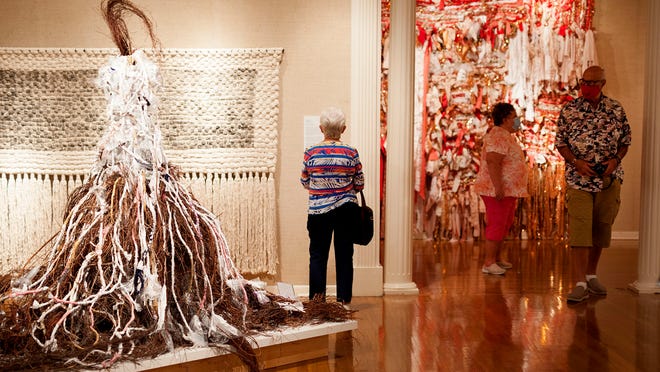
"Millefleur" by artist Kirsten Hassenfeld is included in the exhibit "A Beautiful Mess: Weavers and Knotters of the Vanguard."

It is a single of the oldest forms of artistic creativity in the world, dating back to the Neolithic period, but a modern interpretation of weaving and textile art is on show now at The Culture of the 4 Arts.

“A Lovely Mess: Weavers and Knotters of the Vanguard” is a modern day textile exhibition structured by the Bedford Gallery at the Lesher Center for the Arts in Walnut Creek, Calif.

The 4 Arts is hosting the show’s debut as a traveling exhibition and an accompanying show, ”Speaking Threads: Dialogues with Weavers and Knotters,” featuring artists from the Fiber Artists-Miami Association. The displays run via Jan. 30. 

“A Wonderful Mess” features 19 is effective, including wall-hangings, gallery installations and monumental pieces from an all-female roster of conceptual artists that use twisted, tied and braided will work manufactured from tactile and utilitarian materials such as rope, yarn, clay and wire. 

Vibrant Paintings Merge Beautiful Blooms With Female Figures

Flower Portrait Painting by Jessica Watts

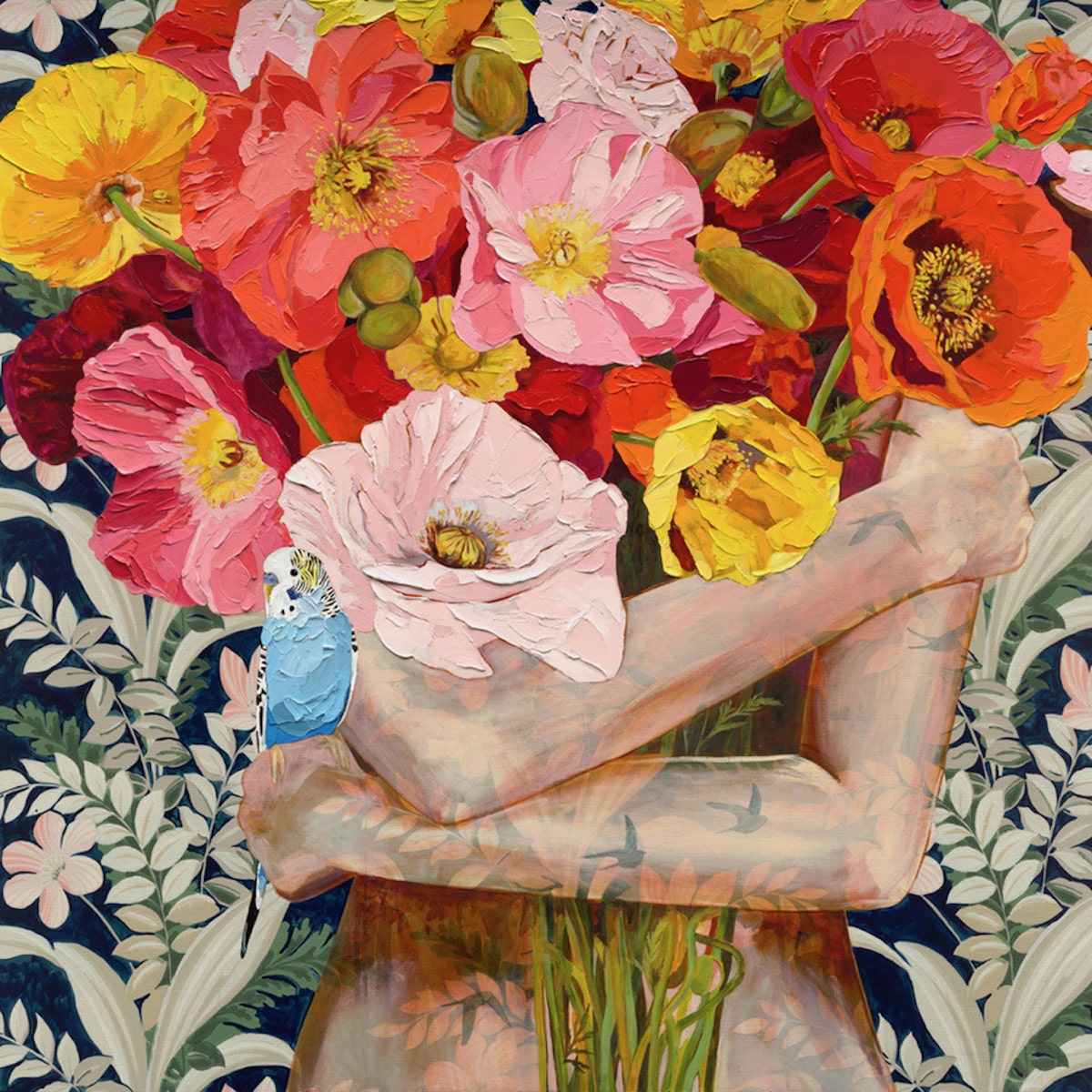
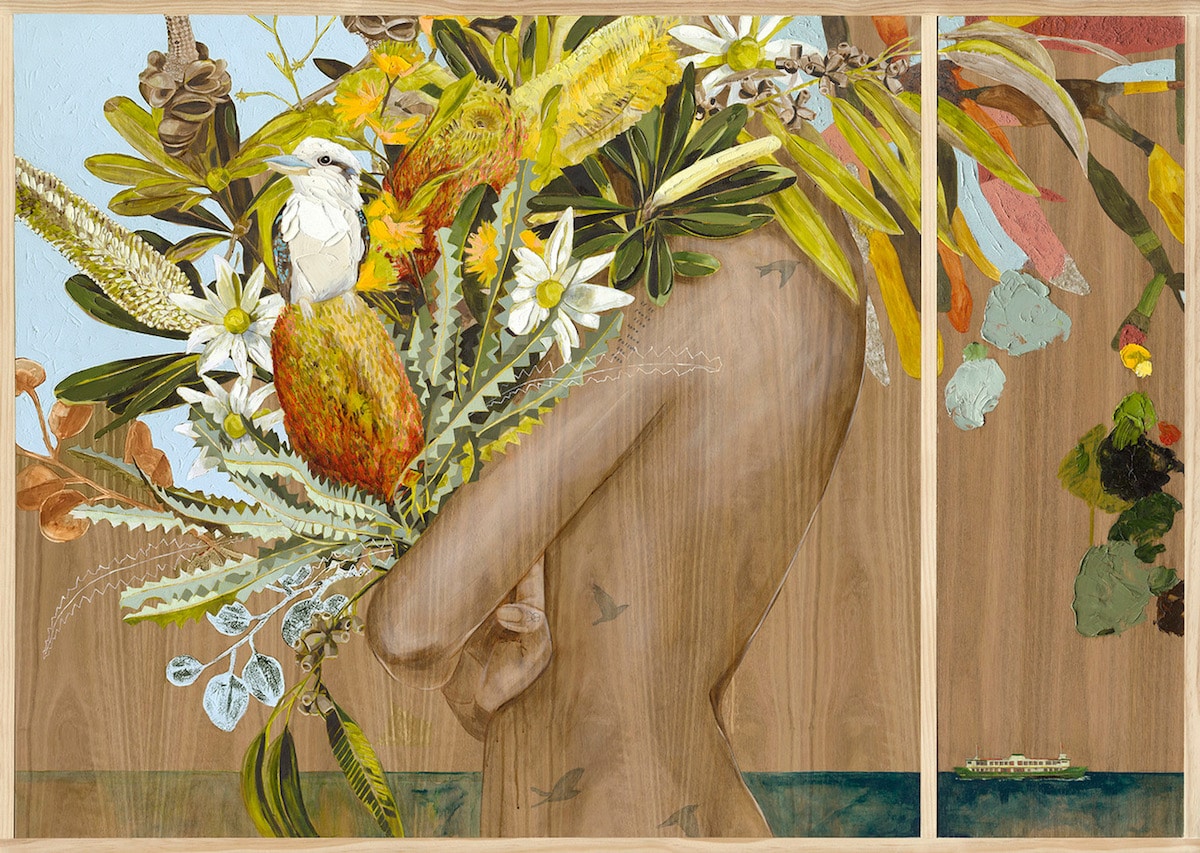
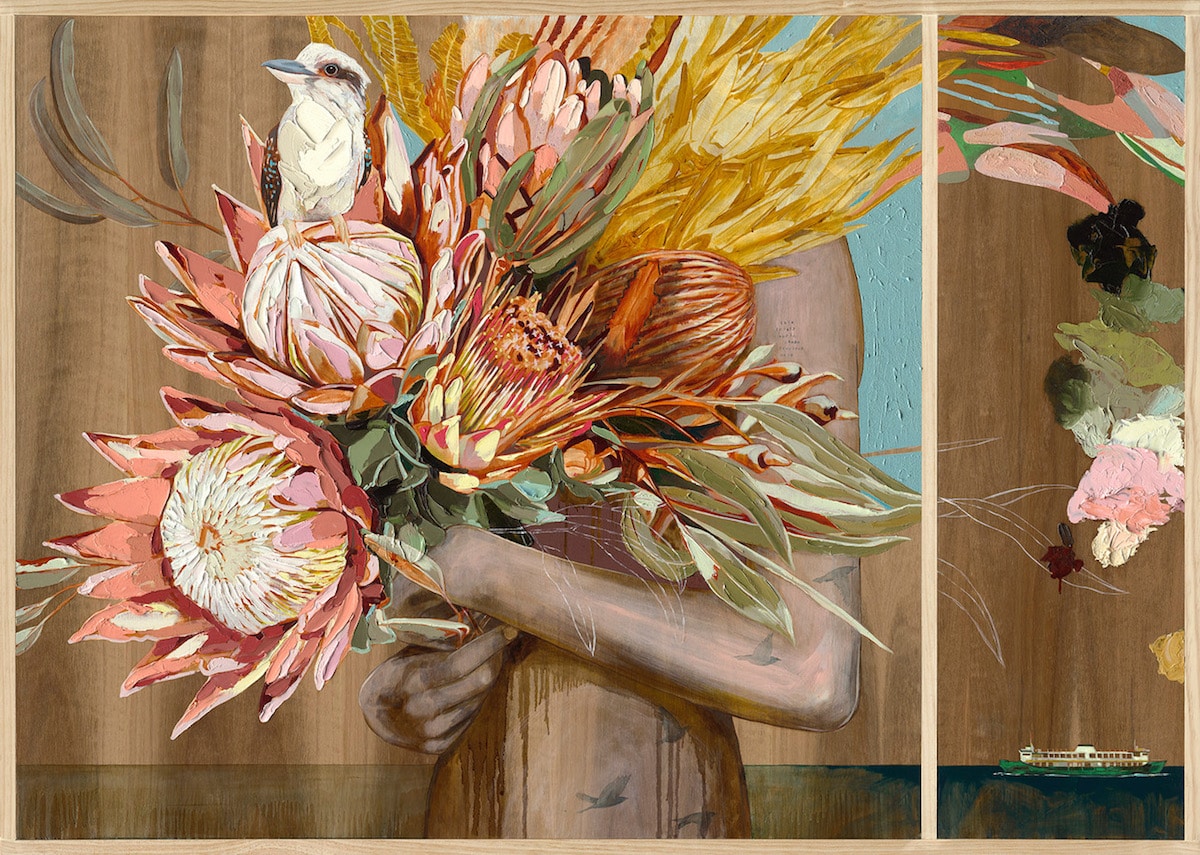
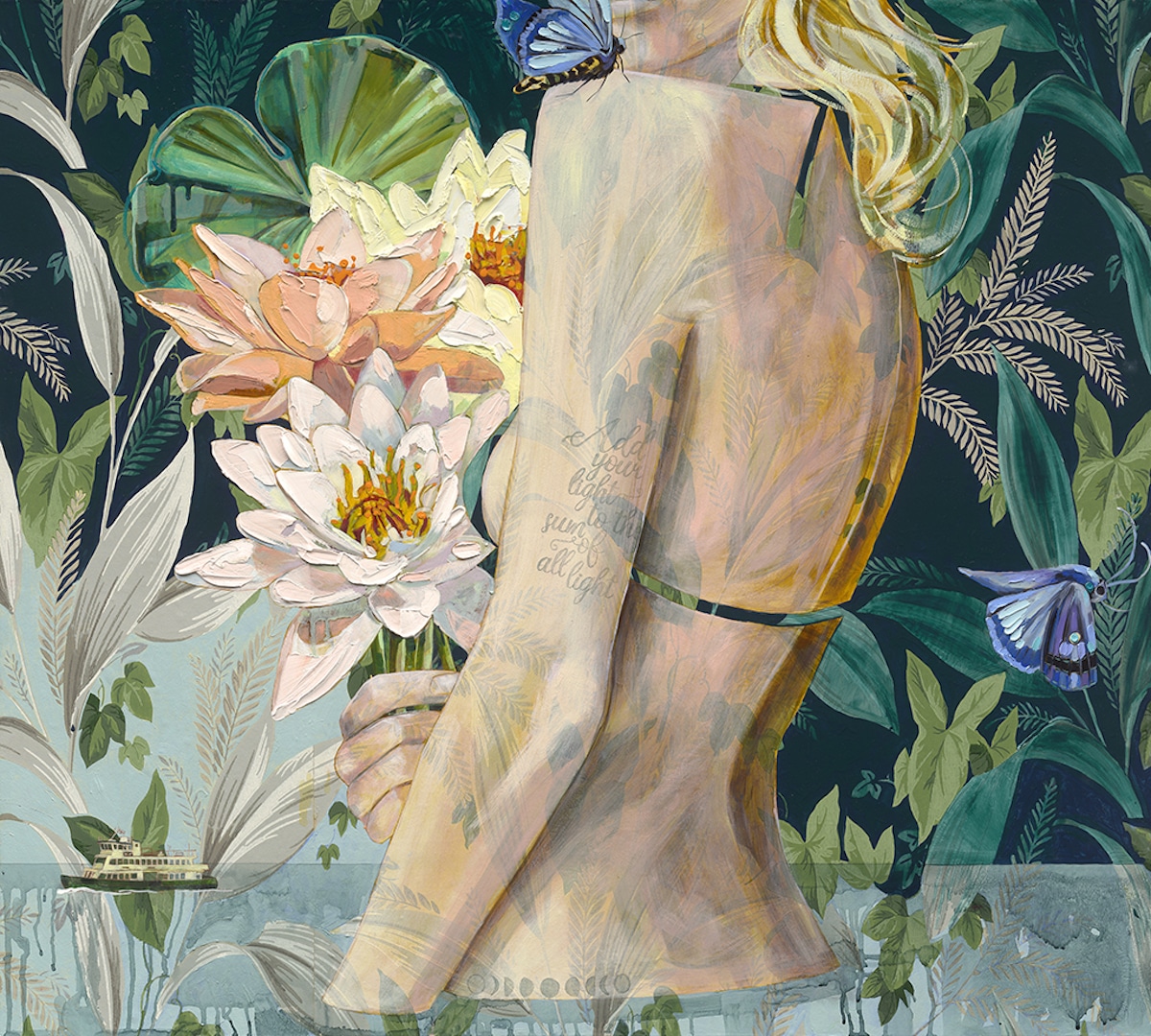
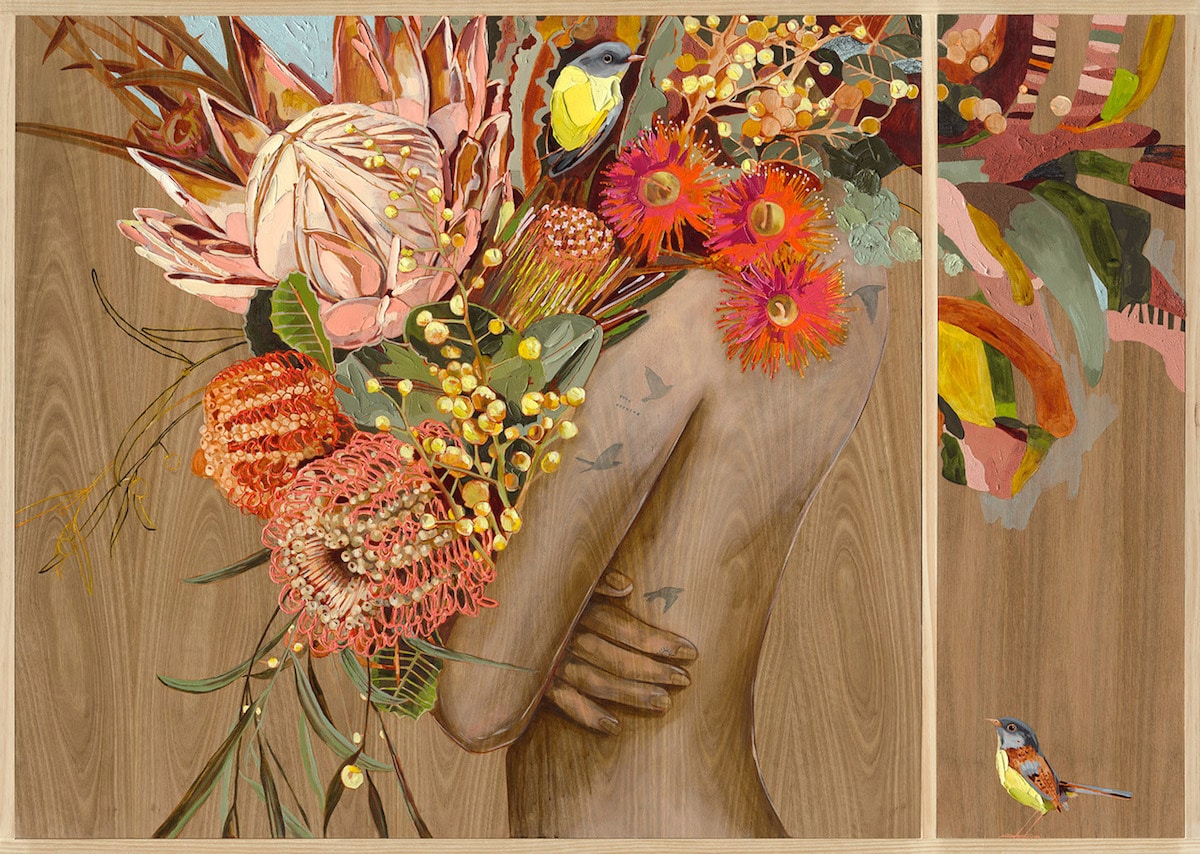
Australian artist Jessica Watts celebrates all items female in her series of colourful paintings. She works by using a unique collage type to fuse depictions of the female figure with vibrant blooms, botanical wallpaper styles, and scenes from nature.

In advance of she turned a painter, Watts worked as an promotion art director in Sydney and New York for nearly 20 several years. In the course of this time, she collected an array of paraphernalia with beautiful design and style, like classic rubber stamps, wallpaper, and typography manuals. Afterwards, when Watts made a decision to make portray her full-time profession, she used her memorabilia as the inspiration for her initially creative collection.

“My paintings look into gender clichés and focus on the positive and the stunning,” Watts tells My Modern-day Met. “My assortment of 1940s wallpaper was the inspiration for my series, Wallflower, a big group of operates that depict the female entire body immersed in both mother nature and a popular domestic decoration—wallpaper,” she proceeds. “Both of these themes discuss to the female, in a gorgeous and strong way.” Her other sequence, In the Raw, functions the similar flower-female-portrait mash-ups painted in oil and acrylic on hand-designed Australian hardwood timber with custom frames.

Not only does Watts celebrate female expression in her operate, but she also gives it a electricity that it does not ordinarily have. “Whereas the common strategy of a wallflower is a shy female waiting around to be decided on, these gals are heart stage they are self-possessed, confident, and solid,” she points out. “I perform with sample and brightly coloured blooms and birds to accentuate the relationship with mother nature. Similarly, by cloaking the figures in flowers, I strive to seize them in a way that reveals that elegance is a lot more about the hidden than the revealed.”

You can get authentic art and prints by using Watts’ on the web retailer, and hold up to day with her most current tasks by following the artist on Instagram.

Australian artist Jessica Watts results in exquisite paintings that merge bouquets with the female determine.

Flower Portrait Painting by Jessica WattsFlower Portrait Painting by Jessica WattsFlower Portrait Painting by Jessica WattsFlower Portrait Painting by Jessica WattsJessica Watts: Web page | Fb | Instagram

My Modern day Met granted permission to element shots by Jessica Watts.

Similar Content:

Vibrants Paintings Search Like Kaleidoscopic Flowers Pressed on Canvases

Idyllic Pastel Drawing of Two Sleeping Females Appears Like a Victorian-Period Painting

Beautiful Oil Paintings Immortalize the Neglected Moments of Day to day Daily life

A room full of beautiful art

A Home with All Our Issues, an ongoing joint exhibition featuring five future male and woman artists offers aesthetics and crucial engagement to art enthusiasts.

WE’ll retain seeking for younger and forthcoming artists, the ones that have their heads on their shoulders. The kinds that know what they are accomplishing and all they demand is a system to be uncovered. We’ll do our finest in controlling them,” the artwork supervisor and director of The Artwork Pantheon Gallery, Nana Sonoiki had promised in an interview in early November.

A thirty day period immediately after, she’s fulfilling her assure with ‘A Space With All Our Things’, a group exhibition of performs by approaching and vibrant artists which include Toju Clarke, Abisola Gbadamosi, Tolulope Daramola, Paul Ayihawu and Samuel Vittu.

The demonstrate, which opened on December 12 and finishes on Boxing Day, is Artwork Pantheon’s very last for 2021 and showcases an fascinating combine of paintings, which affirms Sonoiki’s observation in her curatorial take note that it “makes evident what a shared place of mutual recognition and consolation can be, probing into the choices these kinds of a house can unlock.”

Their thrilling voices, she notes further, “are distinctive, their types exceptional, but in A Place with All Our Items, these five artists have fashioned a typical place for us all, a room of their factors, and ours.”

It’s without a doubt a space for every person with the artists reflecting on distinctive socio-cultural, political and spiritual difficulties with the showcased works.

Ayihawu, who visited ‘Escapism’, Artwork Pantheon’s final joint show in November obtained on the ongoing exhibition serendipitously. He achieved out to Sonoiki on Instagram and confident by the high quality of his works, she invited him to be element. His four paintings, ‘Tulips & Roses’, ‘Day Dreaming’, ‘Eyin Ju’ and ‘Borno’s Bloom’ glance at the effects of colonialism on African cultures and values. He expresses this with flipped portraits of black men and women dressed in a hybrid of western and African attire.

‘Tulips & Roses’, for instance, reveals two females sitting down on a bench and keeping roses but the two their eyes are included by purple head ties (gele). In addition to, a single of them is holding a mirror she seems to be on the lookout into. Why would somebody whose sight is hindered by a gele however be wanting into a mirror? The artist explained that the gele on the western gown was intentionally incongruous. “The cap and the gele are vernacular to the gown, they are not meant to go with each other and I’m making use of that to talk about modern issues like loneliness, companionship and self-analysis.”

Purple is present in all of Ayihawu’s operates and conveying his choice for the color, he said, “I feel purple stands for royalty. It stands for purity as well so I want that touch in my get the job done.”

Making use of sgraffito (a scratching technique), Clark’s performs depict the attitudes and condition of head of his topics. Making use of muted tones of brown, gold and lack, he highlights the thoughts of his topics in will work which includes ‘The Lacking Piece’, ‘Watchers’, ‘Bipolar’, ‘Perspective I’ and ‘Perspective II’. In ‘The Missing Piece’, the YABATECH graduate performs on unique views on his female subject’s deal with. But his ‘Bipolar’ is placing, affirming his curiosity in mental well being advocacy. “A great deal of men and women never choose their mental wellbeing significantly and bipolar is one of those people health problems Nigerians never imagine they have until they are diagnosed. This is to attract consideration to the issue”.

Vittu, favouring anthropomorphism for all his operates, ‘This Aspect of Heaven’, ‘A Gentleman’s Rose’, ‘The Hurt of Pain’ and ‘Not Holier Thou’, explores earthly and celestial themes. His choice for anthropomorphism, he explained is since “animals have the similar traits as human beings and, in most cases, when you appear at it diligently, animals are extra structured than people. It’s a trait that you get to admire from a distance so I determined to discover their approaches of lifetime.”

He included that the inclusion of roses in all the will work is simply because “most animals, especially domestic kinds crave like from us human beings and the indication of really like is a flower. You get to specific oneself to the types you adore by often obtaining bouquets, so it’s a deliberate exertion to infuse appreciate into my message.”

‘Not Holier Than Thou’, exhibiting a monkey-confronted priest in a cassock with cherubs gripping the edges of his garment, preaches spirituality over faith, with spirituality cleverly inscribed on it in Arabic and Hebrew. “The strategy is for us to dwell in like over faith, and then have a personalized partnership with God instead than likely as a result of intermediaries.”

Daramola’s reasonable portraits employ dim-toned colors to evoke the moodier sides of the human psyche. The subjects of his paintings are typically sombre, contemplative. Their eyes, pores and skin tones, and factors evince an air of melancholy. We see all these in ‘Family Tree’, ‘In Her Individual Crown’, and ‘Gentle Reminder’.

Narrative expressionist and mother nature lover, Gbadamosi shows gorgeous watercolours that contains bits of herself mainly because the will work ended up excerpted from her journal. These contain ‘Aurora’, ‘Who are you when no one’s seeing, ‘We are One’, ‘True Colours’ and ‘Can You Hear Me.’ Gbadamosi’s journey into visible art begun with henna making and it’s not a surprise that quite a few of her watercolours in the present are warm and luscious. ‘Aurora’, which the artist who initial confirmed at the Brick Lane Gallery, London in 2016, is an example.

Obtaining hosted a few reveals before in the year, Sonoiki’s Artwork Pantheon could not have picked a far better way to near the year. ‘A Place with All Our Things’ has anything for every person.