Dave Hickey, a prominent American art critic whose essays covered topics ranging from Siegfried & Roy to Norman Rockwell, has died.
His books, including “The Invisible Dragon: Essays on Beauty” (1993) and “Air Guitar: Essays on Art & Democracy” (1997), won him legions of fans beyond the art world experts.
His stylish prose, brash criticism of taste-making institutions like museums and universities and equal embrace of works considered both high- and low-brow left a lasting influence on a generation of artists and critics.
“There is no one like him. He belongs in the canon of American nonfiction prose,” his biographer Daniel Oppenheimer wrote in “Far From Respectable: Dave Hickey and His Art,” published last June.
He died Nov. 12 at home in Santa Fe, New Mexico, after years of heart disease, said Libby Lumpkin, an art historian who was married to him. He was 82.
David Hickey was born in 1938 in Fort Worth, Texas, and grew up moving around Texas, Oklahoma, Louisiana and California. After hopscotching through graduate school programs, he dropped out and opened a contemporary art gallery in Austin, Texas. He moved to New York in 1971, where he ran more galleries, edited the publication Art in America and wrote for the Village Voice and Rolling Stone magazine. His work and interests immersed him in an artistic community that included Andy Warhol, Dennis Hopper and David Bowie.
Art critic Dave Hickey often defended the gambling culture and lifestyle of Las Vegas.John Sciulli/Getty Images for Art Los Angeles Contemporary
Hickey later moved to Las Vegas to teach at the University of Las Vegas, Nevada. In the essays published in “Air Guitar” about how art should fit into broader culture, he championed Las Vegas as the most American of American cities for its detachment from traditional social hierarchies.
America “is a very poor lens through which to view Las Vegas, while Las Vegas is a wonderful lens through which to view America. What is hidden elsewhere exists here in quotidian visibility,” he wrote.
Hickey challenged the idea that the Strip’s neon lights were somehow inauthentic, pushed back against notions that Las Vegas entertainment was culturally irrelevant and “especially enjoyed a good smoke and gambling spree at Eureka Casino on East Sahara Avenue, where he was often spotted with a cigarette while jabbing at slot machine buttons,” according to a Las Vegas Review-Journal obituary.
Dave Hickey (left) with fellow art critic Peter Schjeldahl in May 2008.Libby Lumpkin via AP
In “The Invisible Dragon” and later works, Hickey’s endorsement of “beauty” as the ultimate arbiter of artistic value ignited a clash with his contemporaries focused on 20th century conceptual art’s theory and meaning, who preferred to deconstruct the reasons why people find things to be beautiful.
“He chooses to overlook the view that beauty may be merely what the ruling economic and social elites say it is. In the process, his adversaries argue, he substitutes his own bad-boy outsider judgments for those of narrow-minded art professionals,” The New York Times wrote in a 1999 profile of Hickey.
Lumpkin said her husband never intended to champion traditionalism as his critics claimed.
“A lot of Dave’s work was misinterpreted. The assumption was made that the beauty he was talking about was something very old fashioned, but he was a supporter of very conceptual artists from the beginning,” she said.
Dave Hickey (right) spent his remaining years being a professor at the University of New Mexico in Albuquerque.Denise Truscello/WireImage
His tastes were indeed eclectic. He sang the praises of artists and figures in popular culture ranging from Norman Rockwell to Robert Mapplethorpe to Ellsworth Kelly. His essays covered basketball player Julius Erving, reruns of the television series “Perry Mason,” and outlaw country music.
In 2001, the MacArthur Foundation awarded him a “genius” grant for his body of work. He was inducted into the Nevada Writers Hall of Fame in 2003 and won a Peabody Award for a 2006 documentary about Andy Warhol.
Hickey and Lumpkin decamped to Santa Fe in 2010 and accepted positions at the University of New Mexico in Albuquerque. Lumpkin said Hickey considered teaching among his most important work and legacy.
“He was a real intellectual without being a snob and he trusted his students to be able to think theoretically. When you put your trust in students like that, they get it and they make good art,” Lumpkin said.
Rebekah Headen fell in love with Tony Hernandez years before she actually met him. Not only that, it was love at first sight.
“Where did you get that beautiful painting?” Ms. Headen, 57, who is known as Becky, recalled asking a neighbor who had moved from Atlanta to Charlotte, N.C., where she lives, in 2001.
“It’s a Tony Hernandez,” the neighbor said of the painting of a WWI airplane with a fish hook hanging out of one of the wings. “He’s an extremely talented artist who lives in Atlanta.”
Ms. Headen’s interest in Mr. Hernandez, 56, as an artist increased significantly when he enjoyed a brush with fame following the release of “Drops of Jupiter,” the second album produced by the rock band Train, which featured his artwork.
“That was huge for him,” said Ms. Headen, who received a bachelor’s degree in studio art from the University of North Carolina, Chapel Hill, and works as a talent strategy manager for the Hendrick Automotive Group in Charlotte.
“I fell in love with his style,” added Ms. Headen, who at the time was married and raising two young boys. “I was like OK, I’m going to get one of those paintings one day.”
In 2002, she did just that, commissioning a painting by Mr. Hernandez through Hidell Brooks, an art gallery in Charlotte, as a Father’s Day gift for her then husband. (Titled “Inhook,” it was completed in 2003.)
Ms. Headen followed her order with her very first call to Mr. Hernandez, with whom she confirmed shipping details before learning that he is a history buff who has drawn inspiration from the lives of children who grew up during the Holocaust, as well as those who struggled through the Great Depression, especially in the ghettos of the Bronx where his grandparents lived.
An Atlanta native, Mr. Hernandez attended Georgia Tech before leaving college to pursue a career in painting. His works, mostly of children during the Holocaust and Great Depression, are currently on display at numerous art galleries, including the Fine Arts Museums of San Francisco and the Bronx Museum of the Arts.
The two connected again in 2004, this time in person, at a gallery opening in Charlotte.
“He was such a nice guy,” Ms. Headen said, “though he did seem to mumble a lot.”
After that, they would not see each other until 2013.
Early that year, Ms. Headen, who by then was divorced, went to Chicago with several friends, one of whom mentioned that she had a friend who was single and talented and that his name was Tony Hernandez.
“I thought to myself, ‘This could be very interesting,’” Ms. Headen said.
Mr. Hernandez, also divorced, reached out to Ms. Headen at the suggestion of their mutual friend in June 2013. They eventually began a conversation that led to a first date to watch the Sept. 1 episode of Breaking Bad, their favorite television show.
Mr. Hernandez rode his Harley motorcycle in the rain from Atlanta to Charlotte to meet Ms. Headen for the date.
“I had no negative thoughts as to why I shouldn’t go, which is rare for me,” Mr. Hernandez said. “So I thought maybe it was meant to be.”
In February 2018, after years of dating long-distance, Mr. Hernandez moved to Charlotte to live with Ms. Headen. (Her two sons were living on their own by then.) The pair became engaged roughly three years later, on Feb. 14, 2021.
“I found Becky to be the sum of so many beautiful things,” Mr. Hernandez said. “She was beautiful, smart and understanding, especially about the fact that I spend more time with my painting than I do with her.”
The couple was married Oct. 29 at the home of their friends Kim and Ed Seeger on Little Stono Island, in Charleston, S.C. Lauren Stines, a Unitarian Universalist minister, officiated before 10 fully vaccinated guests, who included Ms. Headen’s sons Franklin, 27, and James, 24.
“We connect on so many different levels,” the groom said of the bride a week after their wedding. “She fell in love with my art long before she fell in love with me, and I don’t think we could have happened any other way.”
But DaCosta Ahern died on April 19 last year, before the gallery was able to pay the studio a visit.
“She was just this quiet, but vivacious personality,” said Folsom.
“Even though she was quiet, she would always challenge you,” added Flythe, “challenge your beliefs and challenge the way you thought about things.”
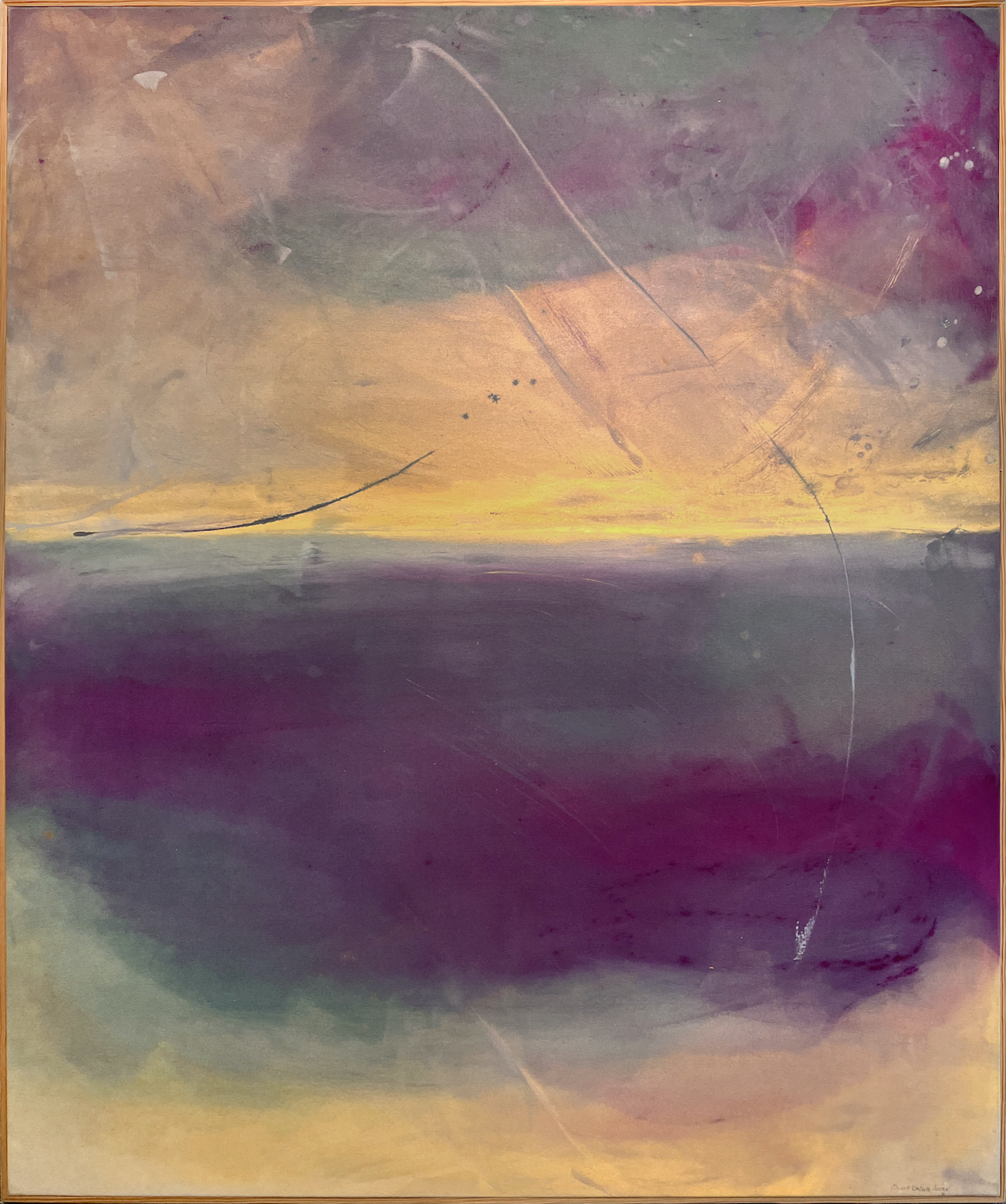
Elizabeth DaCosta Ahern’s “O Mar Salgado” Handout/Courtesy Galerie d’Orsay
On Saturday’s showing of DaCosta Ahern’s work, Galerie d’Orsay presented a thread from mentor to mentee. “Jump In! Celebrating the thread between student + mentor” features a few of Frankenthaler’s works such as “Causeway” and “Aerie,” around 30 of DaCosta Ahern’s paintings, and then carries through to some of her students’ art. The works will be on view until the end of the year.
Severalspeakers remembered DaCosta Ahern’s influence. DaCosta Ahern’s husband, Thomas J. Ahern Jr., read aloud condolences sent to him by some of DaCosta Ahern’s students throughout the years. “I can tell you that she will be missed terribly … I will hear [her] in my head whenever I am painting, so I will still have her in my life,” one note read.
Originally from Providence, DaCosta Ahern taught at the deCordova Sculpture Park and Museum, Lesley University, and Worcester Art Museum. A graduate student at the School of the Museum of Fine Arts in the 1970s, she later made it her mission to mentor students.
In a phone interview, her husband recalled a recent visit he madeto the Concord Center for Visual Arts. Coincidentally, three of the faculty artists presenting work were formerstudents of DaCosta Ahern.
“She had an imprint on many working artists and very successful artists,” Ahern Jr. said.
Along with some of her students,DaCosta Ahern was a participant in the Art in Embassies program, exploring and presenting her work in Portugal and Angola. Frankenthaler encouraged her to partake in her workshops, resulting in six trips to Sante Fe,according to Ahern Jr.
“Every trip produced something,” he said. “She was a beautiful person who made beautiful paintings.”
Elizabeth DaCosta Ahern’s “Luanda Sunset”Handout/Courtesy Galerie d’Orsay
Many of DaCosta Ahern’s friends and students were in attendance at the exhibit. Laura Lester said she felt both honored and grateful to be able to share her artwith her mentor.
“[Elizabeth] would stand back with you and look at your work and not talk until she was ready to say something that was meaningful,” Lester said in an interview. “I will always miss her, and when I paint, I talk to her, and I hope she’s talking to me.”
After59 years of marriage,“I feel enhanced,” Ahern Jr. said, noting that he couldn’thelp but feel her presence at the gallery. “I feel grateful, except for the quantum of sadness and so forth, and the unavoidable remembrances looking at all her work.”
According to those who knew her, DaCosta Ahern always knew when her paintings were finished.
“I think it was innate in her,” Folsom said. “I wouldn’t say that about everyone.”
“Jump In! Celebrating the thread between student + mentor” is an ongoing exhibit until the end of the year at the Galerie d’Orsay on 33 Newbury St.
Ramsey Khalifeh can be reached at ramsey.khalifeh@globe.com.
(Yadkinville, NC) –Beautiful Star, a down-home celebration and joyous musical revue, is back for an encore stage run this season from December 9-12, 2021. Beginning with the story of Adam and Eve, leading up to the birth of Jesus, this dramatized retelling will have you tapping your toes and singing its praises. Catchy Appalachian tunes and that peculiar mountain sense of humor make this a holiday favorite of families everywhere. This show also features backtrack recordings by local Bluegrass Americana band, None of the Above.
Beautiful Star: An Appalachian Nativity
Book by Preston Lane, Music and lyrics by Laurelyn Dossett
Show Directed by Jessie Grant & Presented by Willingham Performing Arts Academy
Tickets & Additional Information
What & When:”Beautiful Star” – December 9-11 at 7:30-pm; December 12 at 3pm.
Tickets: $22. Tickets for these shows can be purchased at www.yadkinarts.org or at the Box Office from 10am-4pm, Monday-Friday.
Where: Willingham Theater, 226 E. Main St., Yadkinville
About the Yadkin Arts Council
Transforming lives in our community through the arts by offering opportunities to encounter, create, and participate is the Yadkin Arts Council’s mission. We believe art is transformational. Arts open minds, frees imagination, and helps people see the world from different perspectives.
The Yadkin Arts Council is a nonprofit 501(c)3 organization dedicated to enriching the lives of Yadkin County citizens through the arts. In September, 2010, the council opened the new Yadkin Cultural Center, providing a home for the arts in Yadkin County. It encompasses the Welborn Gallery, the Willingham Theater, the Center Bistro, classrooms and meeting rooms, staff offices and working artist studios.
About the Willingham Performing Arts Academy
The Willingham Performing Arts Academy is located across the street from the Yadkin Cultural Arts Center and is operated by the Yadkin Arts Council. WPAA is a creative team, an educational studio, with a mission to enrich, educate, create, entertain, and collaborate with our community through professional quality productions and training.
About the Willingham Theater
The Willingham Theater hosted its first performance in December 2012, just two short years after the Yadkin Cultural Arts Center opened its doors to the citizens of Yadkin County. While many might dismiss the power of a small city theater, we like to prove that we can indeed bring the big city excitement and experience to our small town. Our state-of-the-art theater seats 193 patrons and showcases a variety of engaging performances ranging from music, dance, drama, comedy, and even film. In addition to ample seating, the Willingham Theater has remarkable state-of-the-art-technology. The Willingham Theater is owned and operated by the Yadkin Arts Council.
The Columbus Museum of Art is paying homage to Vincent Van Gogh and his contemporaries in a spectacular, thoughtful and must-see exhibit.
“Through Vincent’s Eyes: Van Gogh and His Sources” celebrates the tortured Post-Impressionist with 17 of his signature works, interspersed with more than 100 paintings, prints and sculptures by artists who influenced and were admired by van Gogh.
The beautifully installed exhibit places van Gogh works on a deep-blue background, surrounded on white walls by meaningful works created by Van Gogh’s contemporaries.
So, it is possible to do a 15-minute “Louvre” walk-through to find and inspect just the Van Gogh works. But viewers would be doing themselves a huge disservice to go this route; throughout the exhibit there are artistic gems by the likes of Edgar Degas, Paul Gauguin, Edouard Manet, Claude Monet, Camille Pissarro and Henri de Toulouse-Lautrec, to name a few.
In addition, the panels accompanying all the works give relevant and entertaining information.
There are numerous quotes from van Gogh himself, taken largely from his correspondence with his brother and supporter, Theo, that tell what the artist thought of his fellow painters and how they impacted his work.
For instance, as you enter the exhibit, one of the first paintings to strike your eye is van Gogh’s “Roses (1890), a beautiful oil owned by Washington D.C.’s National Gallery of Art. Originally painted pink, the roses faded so that in today’s painting, they’re white. Hung on one side of “Roses” is Henri Fantin-Latour’s “Chrysanthemums of Summer” (1887) and on the other, Manet’s “Peonies” (1864-65). The panel includes the following quote from van Gogh:
“Do you remember that one day at the Hotel Drouot we saw a quite extraordinary Manet, some large pink peonies and their green leaves on a light background? As much in harmony and as much a flower as anything you like, and yet painted in solid, thick impasto …. That’s what I’d call simplicity of technique.”
This kind of placement of works and information makes for a fine viewer experience — enjoying the artistry of van Gogh and his peers in a context-rich presentation.
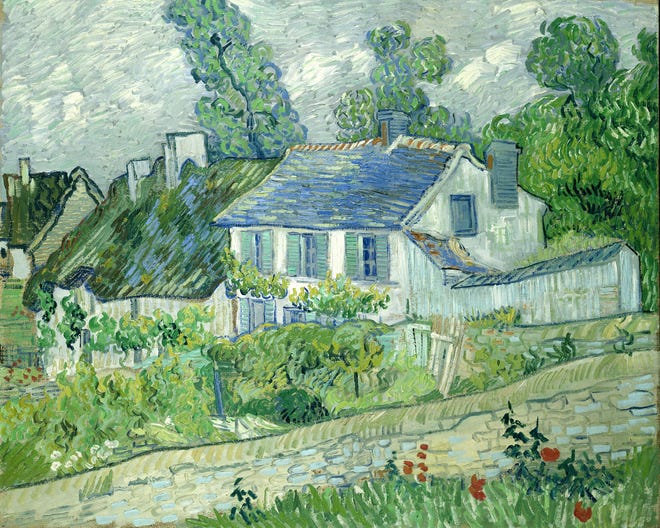
Of course, there are standout Van Gogh works — not the iconic “Sunflowers” or “Starry Night;” these are not part of this exhibition — but wonderful still lifes, landscapes and portraits, including “Houses at Auvers” and “Les Vessenots in Auvers” (both 1890), “Tarascon Stagecoach” (1888), “Undergrowth with Two Figures” (1890), lithograph “Potato Eaters” (1885) and “Portrait of Dr. Gachet” (1890), van Gogh’s only etching that captures the doctor who attended to him in the final years of his life.
Van Gogh’s love and appreciation for Japanese art — he collected woodblock prints — is reflected with the inclusion of lovely works by Ando Hiroshige (“Sudden
Evening Shower at Ohashi Bridge” from 1857) and Katsushika Hokusai (“Great Wave off Kanagwa” from between 1823-31).
The exhibit is organized in categories such as the “Life in Paris,” “Portraits,”
“Impressionism and After,” “Rustic Life and the Working Class,” “Landscapes” and “Religion.”
Occupying the first floor of the museum’s Walter Wing, the exhibit can be traversed however one likes, but exhibit co-curator David Stark suggests veering off to your left as you enter and first discovering some of van Gogh’s earliest works.
In the more southern portion of the wing, the museum has placed early editions of books van Gogh read (in their original languages because he was multilingual), including Harriet Beecher Stowe’s “Uncle Tom’s Cabin,” Edgar Allan Poe’s “The Raven and Other Poems” and a variety of Charles Dickens’ novels including “Oliver Twist” and “A Tale of Two Cities.” A great admirer of Dickens, van Gogh wrote: “I want to paint what Dickens has done with words.”
That the exhibit has obtained loans from prominent museums throughout the United States and the world is reflected in the van Gogh works and the numerous gems by his contemporaries. Not to be missed are Jean-Francois Millet’s “The Sower” (after 1852), Gauguin’s “Christmas Night” (1902-03) and Jean-Francois Raffaelli’s “The Absinthe Drinkers” (1881).
Along with Stark, co-curator for the exhibit was Columbus native Steven Naifeh, author of the new “Van Gogh and the Artists he Loved” and co-author with his late husband Greg White Smith of the biography “Van Gogh: The Life.” The exhibit was organized by the museum along with the Santa Barbara Museum of Art, where it will travel after closing in Columbus.
“Through Vincent’s Eyes” captures the remarkable output of van Gogh during his very short 10 years producing art, and has placed his work in context with that of his peers and the times. Viewers are the beneficiaries of this abundant, intelligently presented collection of art.
negilson@gmail.com
At a glance
“Through Vincent’s Eyes: Van Gogh and His Sources” continues through Feb. 6, at the Columbus Museum of Art, 480 E. Broad St. Hours: 10 a.m. to 5 p.m. Tuesdays through Sundays, until 9 p.m. Thursdays. Timed tickets cost $10 plus the regular admission of $18, or $9 for senior citizens, students and ages 4 to 17; free for members and children age 3 and younger. Masks required. Discounted admissions are available Thursday evenings and Sundays. Parking costs $5. Go to www.columbusmuseum.org.
Kehinde Wiley has a love-hate relationship with western art history. “There’s something glorious about the portraits that you see of aristocrats and royal families. Something beautiful in those expansive imperialist landscapes.” But there’s a dead end. Such paintings, from the baroque, rococo, renaissance and Dutch golden age eras, are ultimately displays of European power, wealth, and beauty. “What I wanted to do was to take the good parts, the parts that I love, and fertilise them with things that I know to be beautiful – people who happen to look like me.”
Wiley, 44, beloved by hip-hop superstars, signed to a Hollywood talent agency, and the first Black, gay artist to paint a US president’s official portrait, rose to art world fame in the 2000s for reimagining such classic European paintings with Black protagonists. His brightly coloured work is easy to identify: glowing brown skin, statuesque poses, richly patterned, often floral, backgrounds and a roster of unfamiliar but photogenic faces. His subversion of the conventions of the medium often involved creating pastiches that foreground Black youth and hip-hop culture and fashion; his works include remakes of Napoleon Crossing the Alps, by Jacques-Louis David, Jacob de Graeff by Gerard ter Borch andThe Dead Christ in the Tomb by Hans Holbein the Younger. While he is famed for painting celebrities and cultural figures, from Spike Lee to LL Cool J, Questlove to Ice-T (his best known work is his 2018 portrait of Barack Obama, sitting relaxed on a wooden chair and surrounded by an abundance of leafy flowers), his work is just as likely to feature ordinary Black people he has found by scouring the local neighbourhoods.
In a similar way to other African American artists such as Kerry James Marshall, Amy Sherald and Jordan Casteel, Wiley’s work inserts Black faces into historical white spaces and thus also into the canon of painting. “It’s an opportunity for people who traditionally have had very little relationship to museums and to what’s on their walls, to feel themselves included,” he says.
Speaking over Zoom from New York, Wiley appears in a good mood. He’s at the SoHo Grand Hotel and has just finished his Observer photoshoot. There’s a sense of urgency in the air as he’s conducting several interviews back to back. “[I’m] busy but good,” he says, sounding exhausted but smiling widely.
We are on the call to talk about Wiley’s move into landscape painting for his latest show, The Prelude, which opens at the National Gallery next month. Inspired by Romantic landscapes and seascapes in the gallery’s collection by painters including Claude Lorrain, Caspar David Friedrich, JMW Turner, and Claude-Joseph Vernet, six new works (five paintings and one film) will still feature the emblematic Black figures, but the style will mark a dramatic departure from his kaleidoscopic portraits, with their lively brocade backdrops and vibrant pigments. Set in the fjords of Norway, these new paintings are muted in tone and hue. Sombre, but still arrestingly grand.
Christine Riding, head of the National Gallery’s curatorial department, believes the institution is the perfect forum for Wiley’s work. “I so admire how he draws out complex historical and contemporary issues – race, gender, identity, climate – with such power and poignancy,” she says, “while giving us the opportunity to look afresh at the gallery’s celebrated paintings.” Riding first encountered Wiley’s “exhilarating” work at the Brooklyn Museum in 2015. Determined to work with him, she led the acquisition of his Ship of Fools (2017) for the Royal Museums Greenwich, the first work by the painter to enter a UK public collection.
Wiley’s interest in remaking historical European paintings has everything to do with searching for a sense of belonging in places that feel alien. “We know that museums and institutions, like art, have to respond to the world that they’re in, in order to stay current, in order to survive, in order to correspond to the society that surrounds them,” he says. “It’s an exciting opportunity to take a stodgy old language and breathe into it the vibrant now.”
The models for the new paintings were cast on London streets. This way of working began when Wiley moved from Los Angeles to New Yorkafter finishing his studies in 2000, and began to approach strangers he met on the streets of Harlem, bringing them back into his studio and making preparatory images of them in poses they chose from an art history book. “Los Angeles is so mitigated by car culture,” he says. “In New York, everyone was in the streets. You can see how everyone is dressing and the peacocking that goes on every Saturday afternoon in Harlem. That was something I wanted to capture. It was magical to live in that new type of Black community. I thought it was really cool and translated really well to painting and portraiture specifically.”
Kehinde Wiley’s Portrait of Melissa Thompson, 2020. Photograph: Mark Blower/Courtesy Kehinde Wiley/ Stephen Friedman Gallery
There’s much to admire in Wiley’s flâneur tendencies – they have led him to pick up many people in places not normally classed as hotspots for model-scouting, such as Ridley Road market in Dalston, where he spotted Melissa Thompson in 2019. He painted her sitting on a Regency-style chair against a backdrop of William Morris wallpaper in a work that has now been acquired by the V&A. For the new show, he did an open call and street casting in south London. This time, instead of taking preparatory photographs of the models in his studio, he flew them to Norway and shot them in the fjords against snow-covered mountain backdrops.
Why Norway? I ask. “Mountains have always been figured and imagined as being closer to God,” he says. There are also political currents running through these images, including climate change as well as colonialism. “When we look at landscapes, we’re also thinking about domination and annexation. In my opinion, while the work is critiquing that it’s also imagining a new way of looking at the landscape in the 21st century. We have to reconsider some of the questions surrounding sustainability. Do we want to hold nature at arm’s length? We have to perhaps think about it as something a lot more fragile, a lot more vulnerable.”
Wiley was born in South Central Los Angeles in 1977. He is one of six siblings, a twin, and was raised by an African American mother, Freddie Mae Wiley, who encouraged his artistic talent. He beams at the mention of his mother. “She was a constant inspiration for me from day one, principally by leading by example,” he explains. “Her interest in languages, in linguistics, allowed me to understand both language and art as a series of systems that can be understood and dismantled.”
What seems certain is that without her sensing his talent early on, Wiley would not have had a career as an artist. “Essentially, I didn’t have a choice, I was sort of trapped into this,” he says laughing. His mother put him into Los Angeles County High School for the Arts, a public, tuition-free school, when he was 11. “I think so many kids just want to be able to be good at something, to be recognised and to be singled out as special. I was considered special for my drawings and I have held on to them, all these years later. My way of looking at the world, my way of painting was informed by the things that surrounded me.”
Photograph: Ali Smith/The Observer
Some of the things surrounding him were the objects in his mother’s thrift shop, known locally as Freddie’s Store. It sold secondhand art books, picture frames, figurines and knick-knacks and these offered Wiley his earliest encounter with creativity. “The decorative filigree on so many of the tchotchkes [trinkets] that my mom was selling when we were kids, that is a way of looking at the world that comes from someone who was part of a marginalised community,’’ he says. “The work that I ultimately made was informed by a type of empathy that comes from an outsider’s sensibility.”
At the age of 12, Wiley was sent to Russia on a free art programme for 50 American schoolchildren in a forest outside St Petersburg. The experience was transformative. “It opened my eyes to a community of artists and young people outside of what I knew in South Central. It represented a break from seeing what was immediately around me, and made me see that there were so many different ways to live. So many traditions to see. And so, as someone who was interested in art, I started digging directly into other histories, and seeing the histories of others as being perhaps something that belongs to me as well. So it almost created a kind of global citizen out of me.” It also made him fervently aware of his good fortune in receiving a creative education. He saw that the arts could give young people, especially those from under-served communities, “not only a creative outlet, but also a sense of mastery in the world … a confidence and grace that come from being able to fast-form your ideas into objects, into words, statements, images. That shouldn’t be for the privileged, that should be for the people.”
As a youngster, Wiley would visit the Huntington Library and Botanical Gardens collection in San Marino, California (the museum recently commissioned him to reimagine a 1770 painting by Gainsborough in their collection, Blue Boy). He recalls they had a great repository of British portraiture, but it was Kerry James Marshall’s De Style(1993), which depicts a scene at a barber shop, that really took hold of his imagination. “There was something absolutely heroic and fascinating about being able to feel a certain relationship to the institution,” he has said. “The fact that these people happen to look like me on some level.”
Winter Landscape, 1811, by Caspar David Friedrich, one of the Romantic landscapes in the National Gallery’s collection that have inspired Wiley’s new work. Photograph: Publicity image
Museums, says Wiley, need to appeal to all of society. “Their number one goal is to look at culture and society, and to say: this is our best. This is what we stand for. This is what we as a civilisation choose to put out there for eternity. And what happens when that responsibility is expanded to include people who come from different walks of life? It enriches us all.” For a brief moment, his pride jumps out. “So far I’ve been blessed because for every one of my shows, the number of people who attend that museum skyrockets.”
Wiley oscillates between institutional and commercial exhibitions. His first solo show was in Chicago in 2002, and since then, he’s had more than 20 shows across the US from New York to Seattle. His paintings have made a lot of money – in 2020, his Portrait of Mickalene Thomas (The Coyote), 2017, broke his previous auction record, selling for $378,000 – and he has had mainstream success through several high-profile commissions (including one from Michael Jackson, who is depicted in 2010’s Equestrian Portrait of King Philip II, which Wiley started just months before the singer died). Such is the demand for his art that he has a group of assistants in a Beijing studio to help with the creation of new works. When New York magazine asked him about having a team based in China, his answer was somewhat prickly: “I don’t want you to know every aspect of where my hand starts and ends, or how many layers go underneath the skin, or how I got that glow to happen.”
It’s understandable that Wiley might prefer not to reveal the mechanics of what is essentially a profitable business. Though he isn’t the first artist to use assistants (he follows Michelangelo and Damien Hirst, to name just two), few artists want to be viewed as sales tycoons. As Anish Kapoor said: “If everything’s for sale, how is it possible to find anything that’s radical?” I ask Wiley how much an awareness of collectors and buyers seeps into his art-making. “The commercial success of the work allows the work to get that much larger and that much more exciting,” he says. “It allows me to have a bigger reach and an ability to say more complicated things in more complicated structural ways.” However, thinking too much about a work’s place in the world has its limits. “I think it’s important to strike a balance and to understand oftentimes it’s not necessary to use brute force in order to create an image that appeals.”
Wiley seems committed to giving back financially and supporting other artists. In 2019, he founded Black Rock, a residency programme based in Dakar, Senegal. Inspired by his own early experience of an international programme, it aims to give others “the ability to go outside of your own country and personal experience, allowing you to grow as a thinker, as a creator”. Some of the artists who have visited include Amsterdam-based Nigerian artist Tyna Adebowale, who portrays queer bodies, and film producer Abbesi Akhamie, whose work focuses on African and diasporan cultures and experiences.
“For many people, living and working in Africa is a complete mystery,” he explains. “To be able to work side by side with other creative people in an international context allows everyone to grow, not only African artists, but artists from all over the world”
Why does he think there’s been such a surge in interest in art and culture from Africa? “Africa is hot right now,” he says. “But Africa has been hot for hundreds of years, because of our labour pool, our mineral resources and our habitable climate, and now we’re slowly starting to realise that there are people there. People with histories, and ways of looking at themselves and traditions of beauty. Unlike a fad or something that is simply a temporary shift, this is a thing that represents a whole new way of looking, not just at Africa but at the west.”
President Barack Obama shakes hands with Kehinde Wiley at the unveiling of his portrait in Washington DC, February 2018. Photograph: Saul Loeb/AFP/Getty Images
Wiley was at Black Rock last year when the Black Lives Matters protests spread across America after the murder of George Floyd. The distance from the US gave him a new perspective on Black America’s impact. “I saw that what smoulders in the United States catches fire in the rest of the world as well,” he says. “You start to see the advent of social movements – End SARS [a protest against police brutality] in Nigeria, young South Indians deciding to talk about colour issues and class issues… It’s a sort of global reckoning with power imbalances, and specifically with racial imbalances.”
Wiley tells me he’s working on sculpture next, for a major show in Italy. He’s made bronze busts in the past, but it’s thrilling to imagine someone with such an established “brand” and identity exploring a new medium. His debut film work, Narrenschiff (2017), reveals Wiley’s ability to tell stories as extravagant as his paintings. A three-channel digital film, it features a group of young Black men at sea struggling to reach land. It is a metaphor for migration and social dislocation and was inspired by the idea of the “ship of fools” –an allegory for the problems that arise when political governance is not supported by expert knowledge that was very popular in European culture from the late 15th century. The new National Gallery show builds upon these themes. “A show that opens in a British museum needs to be aware of the history of empire,” says Wiley.
The models in the new landscapes are connected by African ancestry. “It was interesting to create a global narrative in this new work,” Wiley says, “so that it becomes [about] more than the motif of western European painting, but a question of what it feels like to be young and Black and alive in the 21st century.”
Though race, Blackness, and identity are clear themes in Wiley’s works, his paintings aren’t overtly political. In the past, he’s even described them as “atheists”: the last thing he wants to do is preach, he wants to give us something to celebrate. His portraits feel something like posters for Black excellence, his subjects in positions of power, idealised and commanding respect. There’s another side to the coin, though. The attempt to challenge stereotypes through fantastical aspirational imagery can sometimes feel hollow. Must Black people assimilate into white-constructed displays of regalness, wealth, authority and class in order to be seen as valuable? Can’t we be ordinary, exist in ordinary conditions, and still matter? That’s not a question Wiley is trying to answer. “I hope my work doesn’t do harm,” he once said, “but I don’t necessarily design it to do good.”
That the work has a social impact is “a good thing”, Wiley says. “But sometimes to do that so consciously doesn’t make the best work. To make the best work you have to make it intensely personal. You have to have faith in the fact that everything that you do as an artist can be seen through a political rubric.”
In the past, Wiley himself has made some not-so-subtle works that have caused controversy, most notably Judith Beheading Holofernes, a 2012 painting which depicts a tall Black woman in a long blue dress. In one hand, she holds a knife. In the other, she swings the severed head (which was the head of one of Wiley’s assistants) of a white woman. Conservative media outlets, not knowing it was a play on Caravaggio’s painting of the same name, based on the Bible story, blasted it as racist.
So what advice does he have for young Black artists, who might feel a pressure to make “timely” work that fits a cultural landscape which has a fetish for a singular (often traumatic) Black narrative? “The best way to do it is to get really small and look at the details of your life, and to zoom in and find the beauty in the mundane,” says Wiley. “The beauty in that person who was just walking by you, who the world is ignoring. That is ultimately the most personal thing you can do and one of the most political things you can do.”