DEMING – Keep Luna County Beautiful and the Deming Art Council have grown in marriage with two goals in mind.
1. Bring art and culture to the communities of Deming, Columbus and Luna County.
2. Organize and execute beautification projects in Luna County in conjunction with the state-wide “Toss No Mas” campaign.
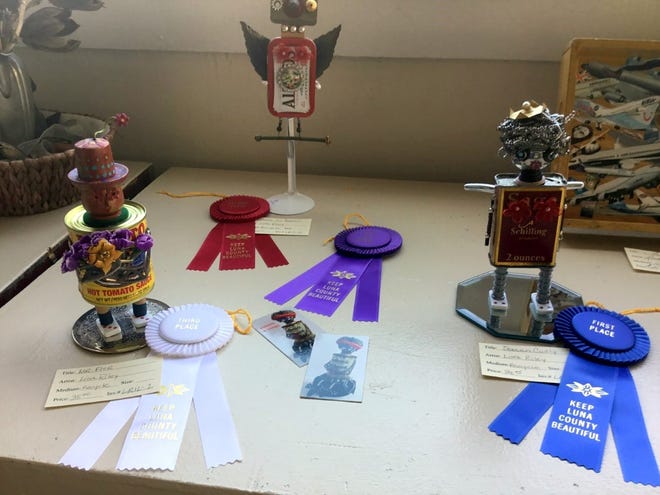
The Deming Art Council has provided a vehicle over the years for the KLCB program to showcase art work created by using recycled materials. In November, the DAC presents the KLCB Recycled Art Show at the Deming Art Center located at 100 S. Gold Street.
The center exhibits the art entries throughout the month of November and each artist must use 90 percent of recycled materials when creating each piece. Each artist can enter as many as three pieces of artwork and the show is judged by a panel of KLCB members.
Prizes are awarded by KLCB and the winners for the 2021 exhibit have been announced.
Artist Lisa Riley was a big winner by sweeping her age division’s top three place and capturing the Best of Show Award.
Riley’s pieces, “Stella Parrot” and “Queen Curly,” each finished with the top number of votes in the Best of Show.
In the 13-and-under division, Haley Lanning was first with “Bird Watching.” Nadia Griffin placed second with “Nadia Griffin Robot.” Landon Lanning came in third place with “Can’t Loupe.”
In the 18 to 55 division, Riley made a clean sweep of the awards. Riley’s “Queen Curly” was first, “Stella Parrot” was second and “Mr. Flor” took third-place honors.
In the Senior Division (55 and over), Michael Colson was first with “Methuselah.” Barbara Besser placed second with “Cosmic Star.” Marci Colson finished third with “The Key to Happiness.”
There were no entries in the 13-to-18 age division this year.
The Recycled Show is among our more popular and creative shows of the year,” said Marilyn Goble of the DAC. “We manage to get entries from our mainstream artists, but the show also caters to the occasional artists in Luna County. It is interesting to see the different pieces each year and a big thank you to the Keep Luna County Beautiful people.”
KLCB saw the potential for promoting its agenda through the collaboration with the DAC. KLCB is Luna County government’s department for beautification and trash pick-up within the county lines.
KLCB also sponsors major clean-up events like the Great American Clean-up, Community Yard Sale and the Paint the Town trash barrel painting contest.
Bill Armendariz can be reached at 575-546-2611 (leave a message) or biarmendariz@demingheadlight.com.
There is a long tradition among scientists of comparing scientific models, images, theories and experiments to works of art. We are told that Albert Einstein’s theory of relativity, the double helix structure of DNA molecules, and images of colliding particles are beautiful, and that, just like works of art, they evoke in us aesthetic responses. Scientists themselves, like artists, are praised for their creativity, originality and aesthetic sensibility. Einstein, for one, regarded the American physicist Albert Michelson, who with Edward Morley co-designed the experiment to measure the velocity of Earth relative to the ether, as ‘the Artist in Science’, claiming that not only did Michelson care for devising a good experiment, he wanted his creations to be beautiful too.
So what does it mean for an experiment to be beautiful? Let us start with the example of Foucault’s pendulum, which allows us to illustrate three important ways in which an experiment can be beautiful. In 1851, the French physicist Léon Foucault devised a way of demonstrating that Earth rotates on its axis. He hung a heavy metal weight from a long cable fixed to the inside of the dome of the Panthéon in Paris. When he set this pendulum in motion, it slowly swung back and forth, tracing lines in sand placed beneath it. After some time, it became clear that the traces were not all in one line because of Earth’s rotation beneath the pendulum.
This pendulum was beautiful in an obvious visual sense – as a kind of kinetic sculpture with an almost mesmeric, slow, back-and-forth movement. Scientific equipment can indeed be beautiful, and often is. Take, for instance, chemical retorts, prisms, microscopes and complicated structures built in laboratories. Museums house beautifully crafted scientific instruments and equipment from the past because we can appreciate their aesthetic features. The phenomena we study in the experimental setup – such as copper sulphate crystals, rainbows produced by prisms, and the microscopic structure of cells – can be beautiful too. But what made Foucault’s pendulum a beautiful experiment is more than its visual beauty. Far more importantly, it showed the effects of Earth’s rotation, something important that hadn’t been demonstrated before, and it did this in a clever, imaginative and elegant way. The pendulum itself was beautiful, but the ultimate beauty of the experiment is a combination of its significance and its design.
It’s hard to identify the most beautiful experiment in science, but one of the most beautiful in biology was designed by the American geneticists Matthew Meselson and Franklin Stahl to discover how DNA replicates. What is it about this experiment that makes it beautiful? To understand this, first let us reflect on what the experiment set out to do. It was performed only a few years after one of the most exciting scientific breakthroughs of the 20th century: the discovery in 1953 of the double helix structure of DNA. With the structure of DNA established, the next question the scientific community needed to address was how DNA replicated. There were already three different hypotheses proposed: 1) conservative replication, according to which each of the two strands of the parent DNA molecule are replicated in the new one; 2) semi-conservative replication, according to which one strand of the parent DNA is conserved in the daughter DNA; and 3) dispersive replication, according to which the parent DNA chains break at intervals, with the parental segments combining with new segments to form the daughter DNA. Meselson and Stahl set out to give an answer to the question of how DNA replicates by designing an experiment that would decisively discriminate between the three proposed hypotheses.
In 1958, the two scientists published the results of that experiment. What they had done to determine the correct hypothesis on DNA replication was to feed bacteria nutrients containing a heavy nitrogen isotope that gets incorporated into the bacterial molecules through metabolising. They studied the genetic material through the next generations, knowing the rates at which bacteria multiply. Instead of using radioactive labelling of the DNA strands, which was common at the time, they decided to use density, and separated the heavy DNA from the light using density-gradient centrifugation. By studying the ratios of light, heavy and hybrid DNA that they obtained, Meselson and Stahl were able to eliminate the conservative and dispersive replication hypotheses, confirming that DNA in fact replicates semi-conservatively.
A further aspect of its aesthetic value is not only what this research taught us but also how it did so
One of the reasons why this experiment is celebrated in science is because it is an example of an experimentum crucis, or a ‘crucial experiment’. Such experiments are important; they deliver a decisive answer to a question. Usually, an experiment is considered crucial when it confirms a hypothesis among alternative competitors, and thus settles a dispute. It is from this ability to deliver a decisive answer to the question of how DNA replicates that the Meselson-Stahl experiment can be considered to derive its beauty. The results are taken to have been clear and straightforward, to have decisively spoken in favour of one of the contender hypotheses, and to have dismissed the alternatives. In his book Beauty and the Beast (1999), the German historian of science Ernst Peter Fischer argues that ‘the Meselson-Stahl experiments speak … for themselves and made all further commentary superfluous’. In his historyMeselson, Stahl, and the Replication of DNA (2001), Frederic Lawrence Holmes further argues that the simplicity and clarity of the result makes this experiment easily presentable even to students, serving as an exemplar experiment for science education.
The above considerations focus on what the Meselson-Stahl experiment did, the significance of its results, but a further aspect of its aesthetic value is not only what this research taught us but also how it did so, and this later consideration concerns its design. The Meselson-Stahl experiment is regarded as having an elegant and apt design that is optimally suited for the purpose it set out to achieve. Following the reasoning behind their experimental setup reveals the ingenious beauty of the design that the scientists created. By making the genetic material initially heavy and then light, Meselson and Stahl could extract and measure its weight through the next generations. It is this idea that makes their design original and elegant, and they used the optimal materials and techniques for the job. As such, their simple experiment integrates innovative and creative thinking, and shows aptness by delivering on what the elegant experiment was designed to do, by conclusively deciding which hypothesis was correct.
Having established that the beauty of experiments lies in the elegance and simplicity of their design, the significance of their results and the creative thinking of their designers, I now want to consider whether these aesthetic ideals have carried over to contemporary experiments in science.
There is a clear asymmetry between experiments of a century ago and experiments today. Past experiments, such as the Meselson-Stahl experiment, often involved a few scientists in a room, relatively cheap equipment, and generally the results could be perceived or established without lengthy interpretative work. Experiments today look rather different. Take, for instance, CERN’s experiments at the Large Hadron Collider (LHC) near Geneva, which not too long ago made one of the most significant discoveries in the history of particle physics: the detection of the Higgs boson that was predicted by the Standard Model. This experiment involves highly complex machinery (which has its own kind of beauty) and data analysis; it is the result of collaborative work between thousands of scientists; and the very boundary of the experiment transcends the borders of countries. Given their complexity and size, do large-scale experiments fit with previous aesthetic ideals? Have they become aesthetically disvalued, or can they still be praised for their aesthetic features?
It is undeniable that such contemporary experiments are highly complex: from the machinery they use to the data they produce, they can overwhelm with their size and setup. However, perhaps there is still scope to assign a similar aesthetic value to them as to experiments from a century ago. It seems to me that, despite the complexity behind large-scale experiments, design and aptness continue to be the subject of aesthetic appreciation, and so is the creativity and originality exhibited in the experiment’s design. This is despite the fact that the creativity exhibited in the experimental design is now better ascribed to the collective thinking of the community, rather than necessarily to a specific individual, and the optimality and aptness of the design is concealed beneath the complexity of the experimental setup and the machinery involved.
The appreciation of beauty in science, and in art, is not necessarily immediate to us
Even if we could make the argument that similar aesthetic features get praised during different experimental traditions, there is a further difference between experiments from a century ago and those of today that perhaps should force us to reconsider the claim of similarity. The difference concerns the way in which we arrive at experimental results. As mentioned earlier, one of the aspects we can appreciate in the experiments on DNA replication is their immediacy: we can observe the results in a ‘singular historical event’, as Holmes noted. Such immediacy was characteristic of many, although certainly not all, early experiments. Let’s go back to the experiments that natural philosophers performed with the air pump, which allowed them to study many phenomena with a newly invented instrument that could extract air from a cylinder.
As the painting An Experiment on a Bird in the Air Pump (1768) by Joseph Wright of Derby depicts, one could immediately perceive the effect on the living creature when the air from the cylinder was extracted using the air pump, which in turn generated a variety of responses in the audience, from fascination and awe to terror. Similarly, we can see the rainbow through Isaac Newton’s prisms, and we can see the bands of light-, heavy- and intermediate-density genetic material in the Meselson-Stahl experiments.
An Experiment on a Bird in the Air Pump (1768), by Joseph Wright of Derby. Courtesy the National Gallery, London
But is there anything immediate when it comes to detecting particles and forces in a huge particle accelerator such as those detected by the LHC? Is there any sense in which the experimenter perceives the result in a ‘singular historical event’? Large-scale experiments often involve lengthy statistical data analysis before the experimental scientists can agree whether the data collection indicates an ‘event’ and whether the event constitutes a discovery. But this asymmetry between experiments with immediately perceivable results and those whose results involve time-consuming analysis, while noteworthy, is not surprising. It simply shows us that the appreciation of beauty in science, and in art, does not always involve perceptual features, and the aesthetic response is not necessarily immediate to us. After all, while many paintings and sculptures might evoke in us an immediate aesthetic response, this is certainly not necessary, and is certainly not the case when we consider artworks such as novels and concertos. We need some time and work to get through an entire novel or a concerto before we can fully appreciate its beauty and aesthetic significance more generally. Similarly with the results of many, especially very complex, experiments, it is ultimately the appreciation of the interplay between design and the significance of the result that provokes the aesthetic response.
So far, we have seen that design is an integral part of our aesthetic appreciation of experiments, but we also seem to value those experiments that did something important: whose results helped to confirm a theory or to make a discovery. A final point I want to explore is how we can understand the significance of experiments that produce null results – can such experiments be beautiful too? Both the abovementioned experiments – the Meselson-Stahl and the Michelson-Morley – were highly original and elegant in their design. But while the former helped confirm the nature of DNA replication, the latter did not deliver on what it was designed to do: the interferometer never detected ether drift, despite continued attempts. Is the Michelson-Morley experiment then disqualified from being beautiful, because of the null results?
I have argued that our understanding of what qualifies as a successful experiment needs to be much broader than simply its confirmation of a hypothesis or its discovery of a predicted particle. For example, the existence of the ether was once an undisputed assumption, until Michelson and Morley set up their incredibly careful experiment, which showed creativity and imagination in its elegant design. Even though it turned out that there is no such thing as an ether, their null results challenged accepted beliefs at the time and prompted the exploration of a new paradigm. So the Michelson-Morley experiment is beautiful because it offered the most elegant way to achieve its goal: the two scientists exhibited original and creative thinking, inventing one of the period’s most precise measurement devices, and delivering an experiment of insurmountable scientific import.
Contrary to Meselson and Stahl, who did deliver an answer aligning with scientific expectation, the results of the Michelson-Morley experiments were disruptive. But it is this disruptive nature of their results that prompted the identification of the limitations of our knowledge and opened the door to revisit and reformulate our physics, leading to the acceptance of Einstein’s special theory of relativity and the abandonment of the Newtonian framework. The design was beautiful, the setup careful and original, and the results were disruptive, surprising and awe-provoking. Just like many artworks that challenge our fundamental assumptions about ourselves and our place in the world, beautiful experiments can deliver results that prompt us to reconsider our working assumptions. Their aesthetic significance is intricately related to our state of understanding, and illustrates the diverse nature of the aesthetic experiences that scientific products and artworks can elicit.
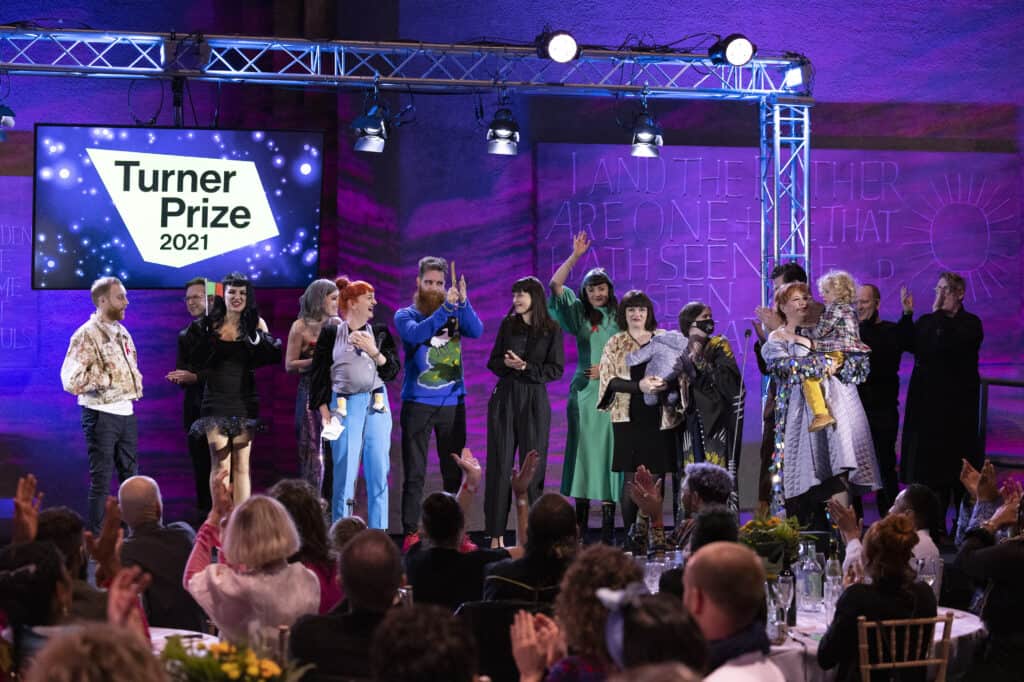
Array Collective are announced as the winner of Turner Prize 2021, the leading international award for contemporary art, at Coventry Cathedral. Picture date: Wednesday December 1, 2021. The Turner Prize exhibition at the Herbert Art Gallery & Museum is a highlight of the city’s year-long tenure as UK City of Culture. Photo credit should read: Matt Alexander/PA Wire
The Turner Prize 2021 has been awarded to Array Collective. The £25,000 prize was presented by Pauline Black, the lead singer of 2 Tone pioneers, The Selecter, during a live broadcast on the BBC. A further £10,000 was awarded to each of the other nominees. This year the Turner Prize exhibition is being held at the Herbert Art Gallery & Museum in Coventry as a highlight of its City of Culture year.
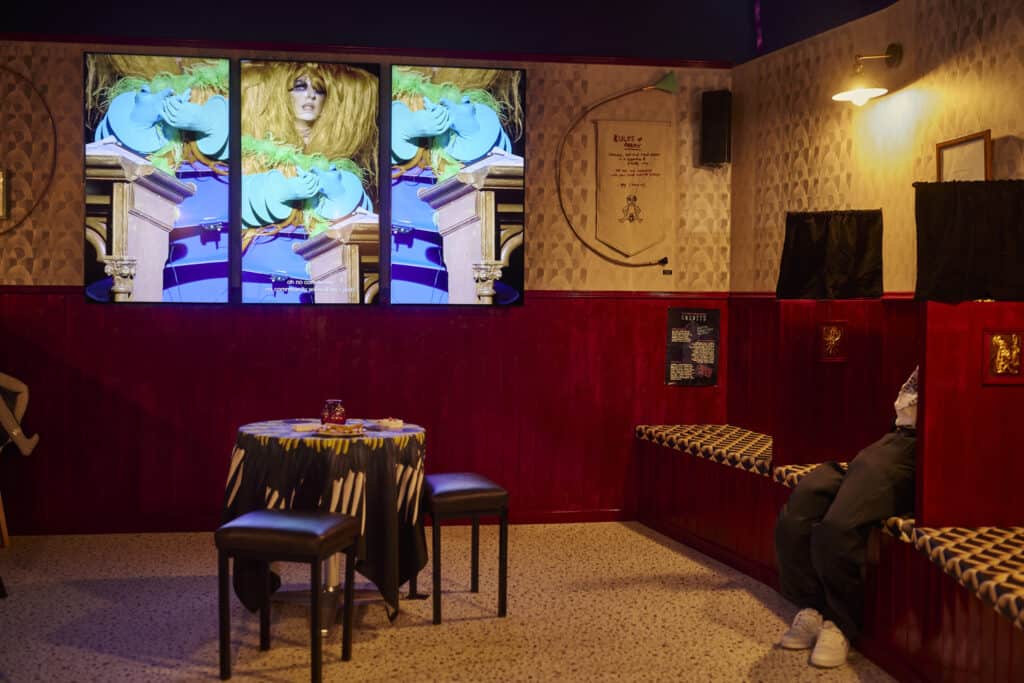
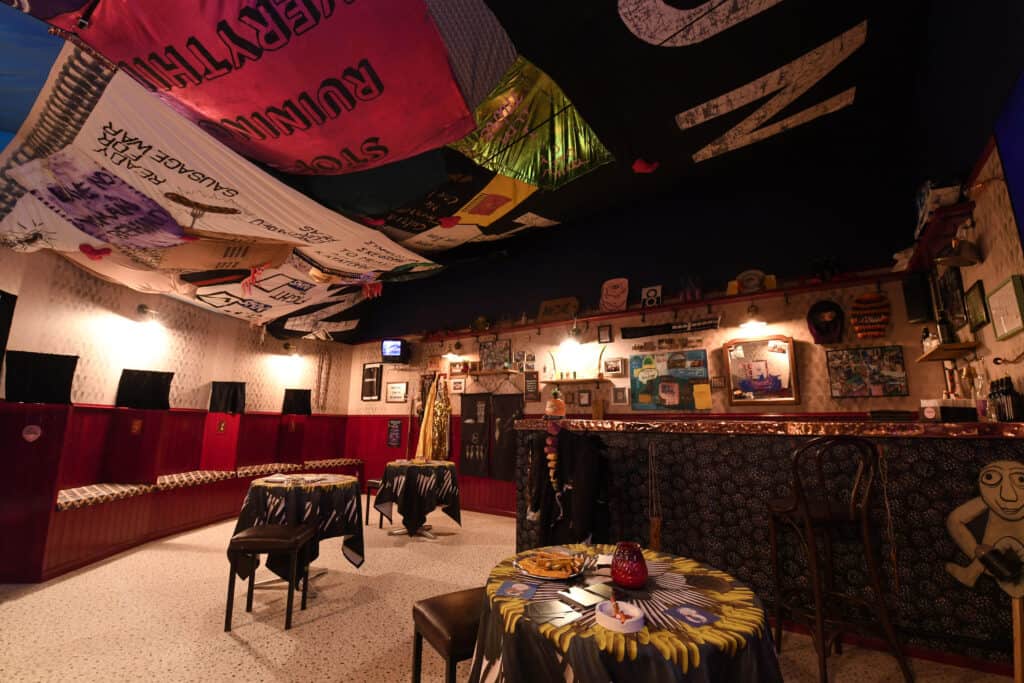
The jury awarded the prize to Array Collective for their hopeful and dynamic artwork which addresses urgent social and political issues affecting Northern Ireland with humour, seriousness and beauty. The jury were impressed with how Belfast-based Array Collective were able to translate their activism and values into the gallery environment, creating a welcoming, immersive and surprising exhibition. The jury commended all five nominees for their socially engaged artworks, and how they work closely and creatively with communities across the breadth of the UK. The collaborative practices highlighted in this year’s shortlist also reflect the solidarity and generosity demonstrated in response to our divided times.
Details and installation shots of The Druithaib’s Ball, by Array Collective. The Turner Prize 2021 Exhibition. The Herbert Art Gallery and Museum. Coventry. Photograph by David Levene 24/9/21.
One of the world’s best-known prizes for the visual arts, the Turner Prize aims to promote public debate around new developments in contemporary British art. For the first time, this year’s Turner Prize jury selected a shortlist consisting entirely of artist collectives and artist-run projects: Array Collective, Black Obsidian Sound System, Cooking Sections, Gentle/Radical and Project Art Works.
General views at The Herbert Art Gallery and Museum in Coventry as the Turner Prize Shortlist is announced. Picture date: Friday September 24, 2021. Photo credit: Doug Peters/ PA Wire
The members of the Turner Prize 2021 jury are Aaron Cezar, Director, Delfina Foundation; Kim McAleese, Programme Director, Grand Union; Russell Tovey, Actor; and Zoé Whitley, Director, Chisenhale Gallery. The jury is chaired by Alex Farquharson, Director, Tate Britain.
The exhibition is a highlight of Coventry’s UK City of Culture 2021 celebrations. Herbert Art Gallery and Museum champions Coventry’s culture, city and arts and is one of the UK’s leading regional museums. As part of its preparations for City of Culture 2021, the museum underwent a major redevelopment of its gallery spaces in anticipation of the Turner Prize exhibition. In parallel to the Turner Prize exhibition, Coventry also hosts ‘Coventry Biennial 2021: Hyper-Possible’ across Coventry and Warwickshire.
Turner Prize 2021 12th January 2022 Admission free Herbert Art Gallery & Museum, Jordan Well, Coventry CV1 5QP
About the artist
Array Collective is a group of 11 artists who create collaborative actions in response to socio-political issues affecting Northern Ireland. The collective has been working together more actively since 2016, motivated by the growing anger around human rights issues happening at the time. Their intention is to reclaim and review the dominant ideas about religio-ethnic identity in Northern Ireland. Working as constituents or allies of the communities they protest with and make art about, Array Collective aims to create a new mythology for the growing number of people who do not prescribe to embedded sectarian dichotomies.
Recent initiatives and works include: JerwoodCollaborate!, Jerwood Arts, London (2019), a-n Artists Council’s Artists Make Change (2020), as well as organising projects in response to issues such as queer liberation, abortion rights, mental health, gentrification, eco-politics, social welfare and Northern Ireland’s fractured past.
Array Collective playfully use performance, protest, photography, print, installation and video. They work with a range of other creative people and organisations to create a combination of artistic expression, direct action and public interventions in the city and online. Their recent project As Others See Us (2019), for example, centred on three fictional characters drawn from the pre-Christian myths and folklore of ancient Ireland: ‘Ban Bidh: The Sacred Cow’, ‘An Scáth Fada: The Long Shadow’ and ‘An Mór Ríoghain: The Morrigan’. These characters have since shape-shifted through crowds at Belfast Pride and up the banks of the River Thames in a series of interventions and performance protests.
Array Collective was nominated for their use of DIY sensibility to tackle issues facing Northern Ireland. The jury commended recent projects, including public artworks in support of the decriminalisation of abortion, challenging legislative discrimination of the queer community in Northern Ireland, and participation in the group exhibition Jerwood Collaborate! in London in late 2019.
Array Collective comprises: Sighle Bhreathnach-Cashell, Sinéad Bhreathnach-Cashell, Jane Butler, Alessia Cargnelli, Emma Campbell, Mitch Conlon, Clodagh Lavelle, Grace McMurray, Stephen Millar, Laura O’Connor and Thomas Wells. The collective is based and predominantly works in Belfast. arraystudiosbelfast.com
.
Categories
Tags
Author
Mark Westall
Mark Westall is the Founder and Editor of FAD magazine Founder and co-publisher of Art of Conversation and founder of the platform @worldoffad
When it comes to outsized projects with geopolitical undertones, Walter Smerling has form. Between 2015 and 2017, the chairman of the Stiftung für Kunst und Kultur (Foundation for Art and Culture) in Bonn and a German art-world statesman of sorts organised the largest ever exhibitions of Chinese art in Germany and German art in China. And when tensions between western Europe and Russia started rising around the same time, he envisaged a continent-spanning exhibition: “A dialogue,” as he puts it, “about what unites people in Europe. About democracy, about solidarity, about personal and political freedom.”
The result is Diversity United, a traveling group exhibition comprising over 150 artworks by around 100 living artists, from 34 countries, chosen by 10 curators. It is not, mercifully, about Brexit, but it does aim to highlight “the importance of a united Europe during times of political uncertainty”. Smerling says he is on a mission to promote basic liberal values. “How do we work together?” he wanted the show to ask. “What do respect, dignity and freedom mean?”
In 2018, he convened curators from museums and galleries across the continent and together they whittled down a longlist of 300-plus living artists to about 90. And for something funded almost entirely by the private sector, it is an impressive muster. All the textbook Europe-related names feature: from octogenarian luminaries Georg Baselitz, Paula Rego and Sheila Hicks to Sonia Boyce (who will represent Britain at the Venice Biennale in 2022), and Yan Pei-Ming (one of the few contemporary artists whose work sits in the Louvre, following his own Venice appearance in the early 2000s). Moscow-based painter Ekaterina Muromtseva is the youngest, born in 1990.
All-out … Winter Journey (Winterreise), an installation by Anselm Kiefer. Photograph: Julia Zaharova/Tretyakov gallery
Gerhard Richter, who at this point in his career really could get away with always saying no, called Smerling up and instantly agreed to take part. He proposed his European Landscapes, a set of 60 uncharacteristically small, gem-like overpainted photographs, that few will know. Anselm Kieffer too went all out, with a piece that no one had seen yet: a full-scale mise-en-scène of 19th-century Romantics (from Madame de Staël to Lord Byron), inscribed, in that immediately recognisable cursive of his, into a painterly, wintery forest.
And Christian Boltanski, who sadly passed away between the printing of the catalogue and the show being installed in Berlin in May, made a new video work entitled Etre à nouveau (“To be again”) Diversity United. Formatted like one of those children’s books where you can mix and match the heads, bodies and tails of creatures, this piece features monochrome headshots of unnamed children from Russia, Germany and France, their foreheads, eyes and mouths constantly shuffling into new facial configurations.
The curatorial team spent hours transcribing telephone conversations with the artists about their work and their relationships to Europe as a place and an idea. Nothing about that is straightforward though, not least what is meant by “Europe”.
The term refers neither to the EU, nor to the Council of Europe. The map in the catalogue excludes Turkey (which has been on said council since 1950, 46 years before Russia was granted membership) yet Turkish-born, Amsterdam-based conceptual artist Ahmet Ögüt makes his mark with an arresting installation composed of protective police shields.
Several of the curators point out that most of the artists here have lived in at least two countries, many in several more, and several weren’t born where they now call home. As Paris-based British curator Simon Baker says of Yan Pei-Ming: “One of China’s greatest artists has been based in Dijon for the last 38 years and has made these incredible paintings about Napoleon. To me, that’s contemporary Europe.”
I saw the first instalment in West Berlin, entering through a discombobulating portal of yellow light courtesy of Icelandic – Danish artist Olafur Eliasson (the second instalment is now open in Moscow). The show is divided into 10 chapters. In the opener – titled Dreams and Democracy – at Lucy and Jorge Orta’s Antarctica World Passport Office, you can acquire citizenship and papers for a fictional community dedicated to combatting climate change and global inequality. My passport is numbered 2188. You can get a mini man too – one of the thousands of plastic models Fernando Sanchez Castillo has made of the one resistant who refused to give the Nazi salute in a crowd of Hitler supporters in 1936. And you can sit with Moldovian film-maker Pavel Brăila’s magnificent Shoes for Europe, from 2002: a documentary about how former USSR trains have to make a stop en route to western Europe because their carriages are fitted for a wider gauge of railroad track. They have to change their shoes.
Yan’s depiction of Napoleon crowning himself (in masterful, monochrome crimson) anchors the third and most powerful of the chapters. Entitled Memory and Conflict, this grouping includes a Tarkovskyesque video meditation on fear – an endless shot of what looks like an asteroid that ceaselessly flames but never crashes, by Moscow collective Bluesoup. Polish sculptor Alicja Kwade’s rocks on slender structures is a mesmerising moment of heft and disquiet both. And Latvian artist Kristaps Epners offers up a deeply evocative diptych featuring, on the one hand, a silent film about an old man in a leather jacket traversing a cold lake and, on the other, a patchwork travelogue about two young men on a journey into Siberia.
You come out of that (I was moved to tears) only to be greeted by Estonian sculptor Kris Lemsalu’s altogether more rambunctious poetry: a wall-based pincushion of freewheeling, lifesized limbs cast in clay and glazed like a Jackson Pollock, ensconced in this tufted pink eiderdown with a boombox and multicoloured climbing wall grips scattered all about in every which way. It is a dance you can’t hear but you can definitely feel: satisfyingly and gleefully tactile.
The project, like any textbook, is as deeply flawed as the territory it seeks to showcase. For something that literally has “diversity” in the title, the cast is almost all white. Certainly all the curators are. But there is, undeniably, beautiful art everywhere, from some of Europe’s most spellbinding artists. And in that sense this is a show that cannot fail.
Many of the city’s skyscrapers, I learned, were seen as contributions to the postmodern architecture movement. “PoMo,” in the shorthand favored in the architecture world, began to emerge in the 1960s as a reaction to the white-walled minimalism of modernist architecture, epitomized by Mies van der Rohe’s oft-quoted dictum “Less is more.” Early PoMo architects like Charles Moore and Robert Venturi rejected this formula — “Less is a bore,” Venturi famously quipped — and sought to inject color, iconography and kitschy nods to historical ornamentation into their designs. In the Southwest, this tendency bloomed in the 1980s during the savings-and-loan boom.
Unlike modernists, PoMo architects conceived their buildings as dynamic components of urban life, not as exalted geometric abstractions. They wanted to create theatrical set pieces that visitors could navigate experientially, almost like at an amusement park. Moore argued cheekily that the most authentic urban experience available in the American West, where so many cities emerged after the invention of the automobile, was Disneyland, whose eclectic historical references and architectural playfulness encouraged a participatory experience of public space. Were some of the resulting buildings provocative? Certainly. Gaudy? No doubt. When the real estate bubble burst at the end of the 1980s, PoMo buildings were roundly dismissed as tacky and targeted for demolition. Now a new generation of architects is arguing that PoMo spaces are architectural landmarks that deserve re-evaluation.
On my first trip home after joining the magazine, I decided to explore some PoMo sites for myself. I discovered a trove of delightfully eccentric urban environments I had never encountered growing up, a secret map of magnificent lobbies and semipublic piazzas hidden behind the city’s corporate facades. I was thrilled by the battlement-shaped Cityplace Tower that looms beside Central Expressway like a colossal sentinel, its grounds containing a Grecian amphitheater and the city’s only underground subway station. My favorite find was the Plaza of the Americas, a complex known for its 13-story indoor atrium, which was immortalized in the 1987 film “RoboCop.” With capsule elevators zooming up and down, inward-facing concrete balconies from the adjoining hotel, gargantuan glass skylights and access to the “Dallas Pedestrian Network” — a warren of tunnels and sky bridges connecting many of downtown Dallas’s buildings — it makes for a grandiose and strange urban experience, part Galleria Vittorio Emanuele II in Milan, part abandoned shopping mall.
It was during a recent canal-side stroll in Las Colinas, an extravagant experiment to create an “alternative downtown” on Dallas’s outskirts, that I realized I had come to see my hometown in a new light. Walking beside a defunct monorail from the 1980s, while a collection of skyscrapers towered overhead and a stripes-clad gondolier punted by, I found a spatial identity as evocative of its era as anything from the Art Deco or neoclassical days. I’d developed a rueful affection for PoMo’s theatrical vision of urban life, scattered in far-flung semipublic environments or among glass corporate facades — a vision I hadn’t experienced as a child. Dallas’s postmodern cityscapes offer a conception — though largely unrealized — of how car-centric cities can carve out communal urban spaces tailored to their logic.
When I moved to Berlin, I fell for the drama of its rich architectural past, the feeling that the closer you inspected, the more there was to discover. I had thought this was an experience unavailable to a city like Dallas, but it turned out I just hadn’t known where to look.
Bhubaneswar: On the closing ceremony of the METIS Initiative on Plastics and Indo-Pacific Ocean 2021 at Utsha Foundation here this evening, the grant-winning artist Manveer Singh shared his experience at the month-long residency and also displayed a short film on his journey in Odisha in transforming his ideas to create beautiful art from plastics and also generating awareness among people and especially among the youth and students.
Today’s installation by Manveer at Utsha created a wall of Olive Ridley turtles hanged from net and the artist has the concept to tell to the visitors, how human activities like fishing are killing the turtles. The tiny ones consuming plastics are also facing life threat near the coastline and especially adjacent locations near the mass nesting grounds. The work today at Utsha, thus explained all the challenges behind the lifecycle of the Olive Ridley turtles, which are in love with the Odishan coast.
The wonderful event on art and sustainability was attended by Consulate General of France Kolkata Mr. Talpain, Regional Director South Asia AgenceFrançaise de Développement (AFD) or French Development Agency Mr. Jacky Amprou, Director AFD India Mr. Bruno Bosle and Sector Portfolio Manager AFD Mrs. Fanny Ragot and Founder of Utsha Foundation and eminent artistJagannath Panda, among others.
Congratulating Manveer, the Consulate General of France Mr. Talpain said ‘’this artistic food for thought is the reminder that art and artists have the power to influence the way we think about the environment. I strongly believe that artists have the power not just to raise awareness about critical issues, but their work is also the key to creating real world impact.’’
Delhi-based artist Manveer Singh’s concept “From Plastic to Art” was selected from 26 applicants. During his stay for the Utsha Residency in association with AFD, Manveer visited various institutions and offices and distributed 40 habit changer boxes to collect the layered plastics to make the tiny turtles for his art work. He also organized a workshop with 28 Peer Leaders (PragatiSathis) of the Bhubaneswar Smart City so that the concept of “From Plastic to Art” is translated to action by others in the society. Peer Leaders are youth and student leaders of Bhubaneswar Smart City to create public awareness among the 100 slums across the Temple City. The workshop was organized at BDA City Centre (NICCO Park) where the Quick Win project under City Investments to Innovate, Integrate and Sustain (CITIIS) is under implementation in Bhubaneswar.
Manveer also conducted a workshop for students at Unit VI Girls High School in which 50 students participated. He also interacted with more than 15 families residing in Government quarters near Utsha Foundation. His installation on Puri sea beach also attracted more than 5,000 visitors on November 24.
The artist, popularly known as “Plastic Wallah’’ in Delhi, has dedicated his works in creating awareness on the menace of plastics in and around the human habitations. However, as the marine ecology is going to be severely affected by plastics by 2050, the artist feels, the awareness level should also get more attention so that the oceans and their ecosystems would be less affected by the plastics and their derivatives.
The METIS initiative is part ofAFD celebrating its 80th Anniversary on December 2, this year and for this the agency has planned events across the Indo-Pacific Region including India, Mauritius and Indonesia. AFD has decided to launch a global initiative METIS, to create a global public opinion on marine debris and pollution.
While this has encouraged participation of artists in India to express their ideas relating to plastic waste production, management and its ill effects on the fragile coastal ecosystem, in Mauritius and Indonesia music and comics respectively were used to create the public awareness.
Currently, AFD is also funding the CITIIS Programme in Bhubaneswar and 11 other cities of India through the Smart City Mission. AFD is funding CITIIS Programme here, supported by Ministry of Housing and Urban Affairs, European Union and National Institute of Urban Affairs, New Delhi and the Government of Odisha.