Plantations threaten Indonesia’s orangutans, but they’re not oil palm

  • A significant portion of orangutan habitat in Indonesia lies within corporate concessions, but industrial tree companies, like pulp and paper, don’t have strong enough safeguards and commitment to protect the critically endangered apes, a new report says.
  • According to the report by Aidenvironment, there are 6.22 million hectares (15.37 million acres) of orangutan habitat within corporate oil palm, logging, and industrial tree concessions.
  • Of the three types of concessions, industrial tree companies are the “key stakeholder” as they operate with much less transparency and scrutiny than the palm oil sector, Aidenvironment says.

JAKARTA — The vast majority of orangutan habitat in Indonesia is located outside of protected areas. That can be bad news for orangutans living in corporate concessions, where a new report finds many companies lack safeguards and commitments to protect these critically endangered apes.

The report, by Amsterdam-based sustainability consultancy Aidenvironment, found that Indonesia has 14.1 million hectares (34.8 million acres) of forested habitat suitable for orangutans. Only a quarter of that, or 3.46 million hectares (8.55 million acres), falls within the boundaries of protected areas such as national parks, nature reserves, game reserves and protected forests.

Meanwhile, almost double this amount, 6.22 million hectares (15.37 million acres), lies within corporate oil palm, logging, and industrial tree concessions, according to the analysis. This finding comes from overlaying Aidenvironment’s concession data with data on orangutan habitats derived from the orangutan population and habitat viability assessment (PHVA) carried out by the Indonesian government.

Aidenvironment pointed out that just because there’s orangutan habitat in a corporate concession, it doesn’t necessarily mean there are orangutans still living in the concession.

However, based on observations, orangutans are often found within areas with human activities, instead of in primary natural forests with no disturbance, according to Belinda Arunarwati Margono, the Indonesian environment ministry’s director of forest resource monitoring.

“What’s interesting is that they don’t only live in [undisturbed forests]. They live everywhere,” she said at an online press conference. “So orangutans like to be close to us, their distant relatives. They like to be in disturbed areas.”

Aidenvironment noted that if there are orangutans in a concession, it doesn’t necessarily mean they’re at risk of being captured and killed.

“However, in general, the ever-decreasing forest patches they are being confined to as a result of corporate concessions means it is harder for orangutans to survive in these landscapes,” Aidenvironment said.

A male orangutan in Indonesian Borneo. Image by Rhett A. Butler/Mongabay.

Industrial tree plantations the ‘key stakeholder’

The study’s findings are in line with a 2021 analysis by the U.S.-based Environmental Investigation Agency (EIA), which also showed that orangutan habitat in Sumatra and Kalimantan (the Indonesian portion of the island of Borneo) covers millions of hectares of oil palm, pulpwood and logging plots.

Orangutan habitat occurs in 898,652 hectares (2.22 million acres) of industrial tree plantations, according to Aidenvironment, while 4.76 million hectares (11.76 million acres) overlap with selective logging concessions.  Oil palm concessions host 563,282 hectares (1.39 million acres).

Industrial tree companies operate with much less transparency and scrutiny than the palm oil sector. And while they cover a smaller area of habitat than selective logging concessions, industrial tree plantations — by the very nature of their operations, which involve clearing vast swaths of forest — are what Aidenviroment calls “the key stakeholder.” It says this means more focus needs to be put into conserving orangutan habitat in industrial tree concessions, where trees are grown and cut to produce paper and textile fibers, as well as for timber and wood chips.

Of the 21 largest oil palm growers in Indonesia, 16 have adopted the so-called NDPE policy, which commits them to zero deforestation, no peatland development, and no exploitation of communities and workers. At the same time, the study found that only three of Indonesia’s 21 largest industrial tree growers have sustainability commitments that are close to palm oil NDPE policies: Sinar Mas, Royal Golden Eagle (RGE) and Marubeni.

Even then, the sustainability commitments of companies like Sinar Mas and RGE still allow the planting of industrial trees, like acacia, on peatlands, albeit non-forested ones, Aidenvironment said.

By contrast, palm oil NDPE policies forbid any development of peat areas, whether still forested or not.

Aidenvironment also pointed out that industrial tree concessions can also be cleared of native vegetation, unlike logging concessions.

Nevertheless, the adoption of sustainability policies among pulpwood producers has contributed to a decline in deforestation within industrial tree concessions.

Deforestation fell by 85{6d6906d986cb38e604952ede6d65f3d49470e23f1a526661621333fa74363c48} in the 2015-2019 period compared to 2010-2012 inside the 91 concessions supplying wood fiber to Indonesian pulp mills belonging to Sinar Mas, RGE, and Marubeni — all which have made public commitments to end deforestation in their supply chains. That’s according to a 2021 study by Trase, a transparency initiative that maps deforestation in commodities supply chains.

While there’s been some progress on curbing deforestation, clearing still continues in the industrial tree sector. Aidenvironment identified five industrial tree companies that were responsible for 13,000 hectares (32,100 acres) of deforestation in Indonesia in 2020, and four in 2021 that cleared 11,000 hectares (27,181 acres) of forest, peat forest and peat.
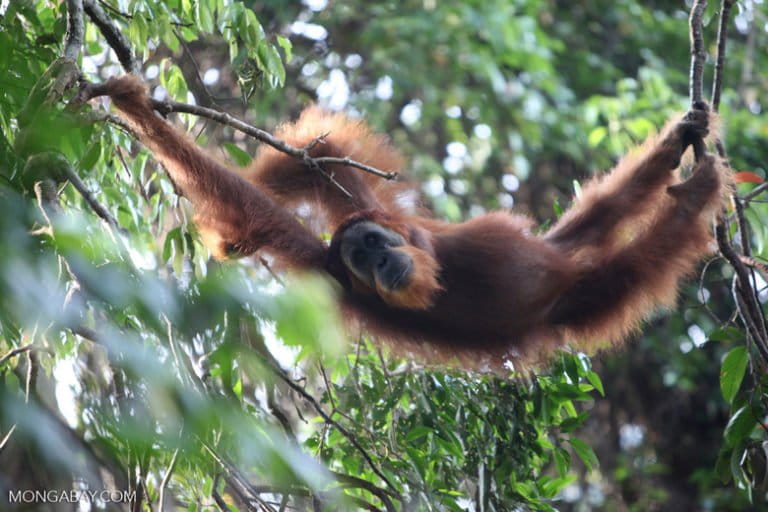
An orangutan hanging in a tree in Sumatra, Indonesia. Image by Rhett A. Butler/ Mongabay.

Top three concession holders — and deforesters

Aidenvironment highlighted three industrial key concessions with the largest areas of orangutan habitat. They are PT Mayawana Persada in the Mendawak habitat unit of the Kubu Raya landscape in West Kalimantan province; PT Industrial Forest Plantation in the Sungai Murui Hulu habitat unit of the Kahayan-Kapuas landscape in Central Kalimantan; and PT Taiyoung Engreen in the Rungan Timur habitat unit of the Rungan River landscape in Central Kalimantan.

All three concession holders are also among the largest deforesters in the industrial tree sector.

Of the three landscapes, the Rungan River has the best additional data and evidence of a viable orangutan population, with between 2,220 and 3,275 orangutans identified in the area.

The large number of individuals in the landscape means the Rungan River is home to one of the biggest unprotected populations of orangutans in the world.

Of the 147,357 hectares (364,127 acres) of forested orangutan habitat in the Rungan River, 41,609 hectares (102,818 acres), or 28{6d6906d986cb38e604952ede6d65f3d49470e23f1a526661621333fa74363c48}, are in the industrial tree concession of PT Taiyoung Engreen. The company is a joint venture between South Korea’s Taiyoung Global Co. Ltd. (which holds a 40{6d6906d986cb38e604952ede6d65f3d49470e23f1a526661621333fa74363c48} stake) and the Indonesian company Jhonlin (30{6d6906d986cb38e604952ede6d65f3d49470e23f1a526661621333fa74363c48}).

According to Aidenvironment’s analysis, deforestation has been ongoing in Taiyoung’s concession for years, with 3,510 hectares (8,673 acres) of deforestation detected since 2018, a quarter of it in 2021 alone.

Aidenvironment said the deforestation is almost entirely inside orangutan habitat.

More areas of orangutan habitat are likely to be cleared in the same concession, Aidenvironment said.

This is because neither Jhonlin nor Taiyoung have strong sustainability policies. Jhonlin recently moved into Indonesia’s domestic biofuel sector, which has weaker sustainability standards than the NDPE market.

Aidenvironment also noted that Jhonlin has a track record of clearing rainforests and peatlands as well as being embroiled in numerous disputes with local communities over land, labor, and human rights violations.
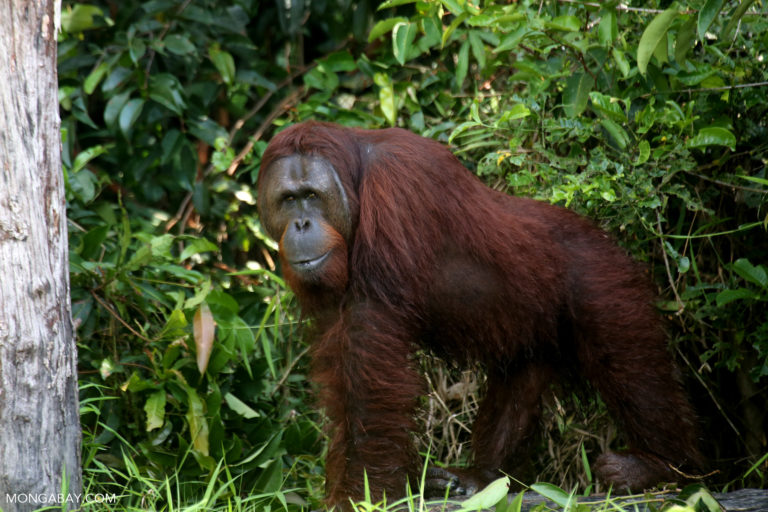
A Bornean Orangutan in Central Kalimantan province, Indonesia. Image by Rhett A. Butler/Mongabay.

Kahayan

The Kahayan-Kapuas landscape, also in Central Kalimantan, has a larger orangutan habitat than the Rungan River, spanning almost 400,000 hectares (988,400 acres), but likely has fewer orangutans, with a population estimated at  between 1,065 and 2,300 individuals. Most of the forests in the landscape are peat swamp.

PT Industrial Forest Plantation is the key concession holder in the landscape.

Some 52,125 hectares (128,803 acres), or more than half of its concession, is forested orangutan habitat. The concession is also the scene of ongoing deforestation, with 9,673 hectares (23,902 acres) of forests having been cleared since 2018, largely in a strip running through the center of the concession.

It’s not known how many orangutans live in IFP’s concession, but a 2014 assessment identified the existence of orangutans and other protected flora and fauna inside the concession boundaries.

The Aidenvironment report also identified other industrial tree concessions operating inside the orangutan habitat in the Kahayan-Kapuas landscape, including PT Nusantara Fiber, PT Kalteng Green Resources, PT Bumi Hijau Prima, PT Bumi Agro Prima, PT Ramang Agro Lestari, and PT Hutan Produksi Lestari.

Despite the landscape having a significant orangutan habitat with many industrial tree concessions operating within it, there are no known conservation organizations working in the landscape. Surveys are badly needed in the landscape to develop relevant conservation interventions, according to Aidenvironment, which identified two areas in the landscape suitable for conservation.

The first one is a tract of forest that overlaps with the concessions held by Kalteng Green Resources and Industrial Forest Plantation, both of which contain most of the remaining forest within the landscape. Aidenvironment said the 23,000 hectares (56,800 acres) in these concessions, adjacent to each other, could be used to create a central undisturbed block for orangutan conservation.

“The central block of forest is still in good condition and is not intersected by roads or rivers, allowing unfettered movement for orangutans,” Aidenvironment said in the report.

The second proposed area is around 7,500 hectares (18,500 acres) of forested orangutan habitat that’s surrounded by two roads, a river to the north, and large amounts of cleared land within Industrial Forest Plantation’s concession to the southeast.

Large male orangutan in Sumatra, by Rhett A. Butler for Mongabay

Kubu Raya

The third landscape highlighted in the report is the Kubu Raya landscape in West Kalimantan province, which covers an area of 284,481 hectares (702,968 acres), where at least 1,348 orangutans live.

Most of the landscape here is forested orangutan habitat, estimated by Aidenvironment to be at 223,014 hectares (551,080 acres). This is more than double the amount of forested habitat in Gunung Palung National Park, located just south of the Kubu Raya landscape.

While civil society organizations have made high-profile efforts to conserve orangutan habitat within the park itself, the Kubu Raya landscape has received little attention, with just one conservation area, the 20,000-hectare (49,400-acre) Mendawak Protected Forest, lying within it.

But Mendawak has been heavily impacted by illegal logging, and there’s also conflicting information about whether the area is home to any orangutans.

According to Aidenvironment, field surveys conducted by WWF Indonesia in 2020 found indications that orangutans live in the area. “[However] from Aidenvironment’s own engagement in the area, we believe that there are no orangutans within the Mendawak Protected Forest,” Aidenvironment said.

The rest of the landscape is covered almost entirely by eight corporate concessions.

The one with the most remaining forested orangutan habitat is the 137,000-hectare (338,500-acre) concession held by PT Mayawana Persada, which contains 68,776 hectares (169,949 acres) of forested orangutan habitat.

According to Aidenvironment’s analysis, the orangutan habitat inside Mayawana Persada’s concession is under threat as there’s little to no information regarding conservation activity by the company.

“Specifically, it is unclear how many orangutans are present within PT Mayawana Persada, how much forest is designated for clearing and for protection, or whether the company has policies in place to protect orangutans,” Aidenvironment said.

The latest Indonesian government-instigated audit of the company in 2021, for instance, makes no mention of orangutans or company policies pertaining to orangutans.

Mayawana Persada is actively clearing forests to make way for industrial plantations, with 8,852 hectares (21,873 acres) of forest cleared between 2018 and 2021, Aidenvironment said. A small part of this was caused by third-party bauxite mining.

Most of the deforestation occurred last year, with 5,250 hectares (13,000 acres) of forest loss, indicating an increase in activity, Aidenvironment said.

“This demonstrates how under threat orangutans are in this area, and why PT Mayawana Persada should stop clearing immediately and conduct orangutan surveys of their concession,” Aidenvironment said. “Based on current available evidence the orangutan habitat, and orangutans it may contain, within this concession appear to be under significant threat.”

Mayawana Persada has previously denied the allegation that it has been clearing orangutan habitat within its concession.

“There’s no deforestation activity in orangutan’s habitat by PT Mayawana Persada,” the company told Mongabay in an email dated May 2021. “This can be seen from the company’s working map and the company’s activities on the ground, which have taken into account the results of studies on orangutan and high conservation values areas.”

Mayawana Persada said the studies were done by a consultancy called Ecology and Conservation Center for Tropical Studies (Ecositrop).

“The studies were to minimize the impact of the industrial forest plantation on the orangutan population in PT Mayawana Persada’s concession,” the company said.

However, satellite and drone analysis by Aidenvironment shows high conservation value (HCV) areas have been cleared.

To preserve the remaining orangutan habitat within the Mendawak Protected Forest, Aidenvironment said there are two areas where conservation should be prioritized. The first one is a continuous stretch of forest between the concession of PT Daya Tani Kalbar and the protected forest that passes through three other concessions, held by Sumitomo Forestry. This area covers approximately 36,000 hectares (89,000 acres).

The second one is a 38,000-hectare (93,900-acre) forest that stretches from the coastal areas on the outskirts of Mayawana Persada until the thin strip of forest that lies between Mayawana Persada’s and Daya Tani Kalbar’s concessions.
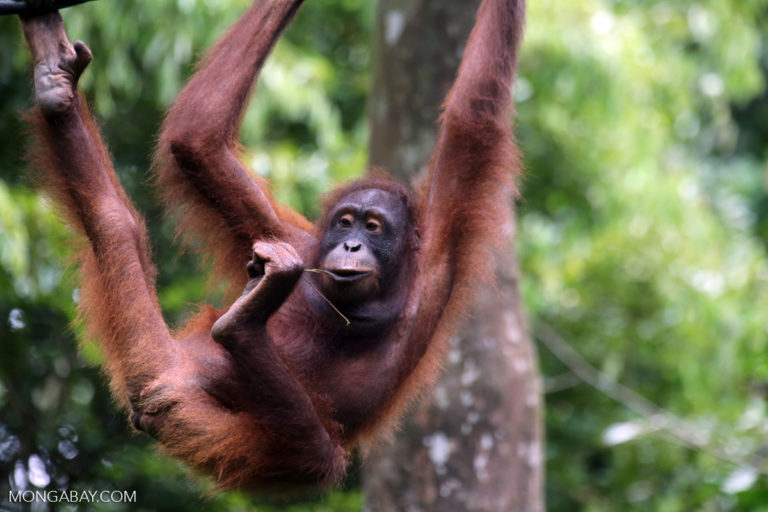
Borneo orangutan at Sepilok Rehabilitation Center in Sabah, Borneo. Image by Rhett A. Butler.

Connecting fragmented habitats

When asked whether the government’s forest protection policies, particularly a permanent moratorium on the clearance of primary forests and peatlands, could protect orangutan habitat as well, the environment ministry’s Belinda said the moratorium wasn’t specifically designed to conserve orangutan habitat.

However, if a forest area has protected status or is zoned for conservation, it is automatically protected under the moratorium policy, even though the area might no longer be forested, she added.

“So we design so that at least primary forests and peatlands are protected, while the function of conservation and protection is maintained [through the moratorium policy],” Belinda said.

There are other policies that could protect forests and subsequently orangutan habitat as well, such as the social forestry program, she added. This program aims to reallocate state forest to local communities and give them the legal standing to manage the forests.

Some of the community titles under the social forestry programs are designed with forest conservation in mind, based on the idea that forests that are managed by communities will be better protected and more sustainably managed.

“So what’s important is to connect the network [of orangutan habitat] and to minimize fragmented forest, but not directly through the forest moratorium policy itself,” Belinda said.

The EIA said it’s not enough for the moratorium policy to only protect primary forests and peatlands as orangutans also live in secondary forests and forest fragments. A 2021 study, drawing on several decades of ground and aerial surveys in Borneo, found that some orangutans are adapting to the presence of oil palm plantations.

But this doesn’t mean that orangutans can cope well with massive alterations to their habitat and don’t need forest to survive, the researchers of the study said. They found that orangutans are able to survive in and among plantations only when they have access to small fragments of standing forest nearby.

Conservation groups like the EIA have called on the Indonesian government to place orangutan habitat, no matter where they are, under formal protection by including them within the permanent forest moratorium area.

The need for a more robust strategy in protecting orangutan habitat has grown even more urgent now as recent developments in Indonesian policies — such as the recent expiration of a moratorium on new oil palm concessions and the deregulation of environmental protections ushered in by controversial legislation passed in 2020 — put orangutan habitat at greater risks, according to the EIA.

“The confluence of threats facing orangutans is nothing short of a crisis,” Taylor Tench, EIA policy analyst, said in a press release.

Citations:

Wiggs, C., & Cunningham, J. (2022). Orangutan landscapes at risk: The role of industrial tree concessions in protecting key forest habitat. Aidenvironment, Amsterdam. Retrieved from https://aidenvironment.org/publications/orangutan-habitat-forest/

Environmental Investigation Agency. (2021). Orangutans in crisis. Washington, D.C./London. Retrieved from https://us.eia.org/report/20211029-orangutans-in-crisis-report

Ancrenaz, M., Oram, F., Nardiyono, N., Silmi, M., Jopony, M., Voigt, M., … Meijaard, E. (2021). Importance of small forest fragments in agricultural landscapes for maintaining orangutan metapopulations. Frontiers in Forests and Global Change. doi:10.3389/ffgc.2021.560944


FEEDBACK: Use this form to send a message to the author of this post. If you want to post a public comment, you can do that at the bottom of the page.


Banner image: A young orangutan in Indonesian Borneo’s Tanjung Puting National Park. Image by Rhett A. Butler/Mongabay.


Article published by Hayat

agribusiness, Animals, Apes, Borneo Orangutan, Conservation, Corporate Environmental Transgessors, Corporate Environmental Transgressors, Corporations, Deforestation, Endangered Species, Environment, Forestry, Forests, Great Apes, Logging, Orangutans, Palm Oil, Plantations, Protected Areas, Pulp And Paper, Rainforest Deforestation, Rainforest Destruction, Rainforests, Threats To Rainforests, Tropical Forests, Wildlife, Wildlife Conservation

Print

UN: Short-Term Economic Gains Harming Well-Being and Integrity of Nature

(Further than Pesticides, July 15, 2022) Nature is far too typically sacrificed to a world and outsized focus on shorter-phrase revenue and economic development, according to a new report by the United Nations Intergovernmental Science-Coverage System on Biodiversity and Ecosystem Services (IPBES). The report warns that plan generating, broadly, does not reflect the worth of Nature’s roles in supporting human lifestyle and exercise, by no means head all the peripheral added benefits (aesthetic, psychological, religious) people derive from the pure globe. The report calls on leaders in all sectors to combine the contributions of Nature in progress and deployment of coverage in a much more-extensive way — as Le Monde writes, “beyond staying ‘a huge factory.’” Further than Pesticides provides a seminal reminder from Fred Kirschenmann, PhD: the prevailing philosophy of optimum efficient generation for small-expression economic return at the expense of Character causes havoc in the earth and will not operate in the long run as an alternative, we must establish a broad ecological conscience that guides all that we do.

The report’s Summary for Policymakers was permitted on July 11 by reps from 139 Member States the report by itself is the end result of four decades of hard work by 82 collaborating researchers and specialists from several disciplines. The exact member consultant authorised an extra IPBES report that urges the member governments to sustainably regulate the wild plant and animal species on which the world’s populations rely for their survival.

IPBES co-chairs Patricia Balvanera, Brigitte Baptiste, Mike Christie, and Unai Pascual observed, according to the UN’s push release, that examples of “embedd[ing] [N]ature into policymaking are ‘in brief provide.’” The push release asserts that, despite the fact that “economic and political choices have predominantly prioritized marketplace-primarily based values of character . . . they do not adequately mirror how modifications in the pure globe have an effect on people’s high-quality of existence.”

As Le Monde experiences, for example, re: the biodiversity disaster: “According to IPBES, the worth that is predominantly attributed to biodiversity, its current market benefit, does not mirror the benefit of its contribution to humanity. And also, undertaking so does not make it possible for us to confront the enormous challenge of the reduction of biodiversity. With their minimal vision of what mother nature presents us, the political and financial decisions becoming built right now are, on the contrary, ‘a vital factor’ in the origin of the disaster.” An IPBES webpage sales opportunities with this headline about the values assessment: “Decisions Based on Narrow Established of Market place Values of Mother nature Underpin the World Biodiversity Crisis.”

On the lookout to background to describe some of this condition, we obtain that a blend of components is most likely at get the job done, not least of which is the Industrial Revolution and its large impacts — produced feasible by the extraction and burning of (finite) fossil fuels. Reaching farther back in time, we recall the Enlightenment (and biblical) notions that individuals are by some means individual from, and destined to dominate and subdue, Nature. Dr. Kirschenmann argues that these led to folks concentrating dominantly on individuals and their enterprises, and — detrimentally — less and fewer through the previous fifty percent millennium on the natural globe and its welfare.

From that paradigm — and fertilized by low-cost power, the growing electricity of organizations during the earlier 100 years, and their affect on govt — have flowed particular methods to human action, which includes specialization, a focus on productivity, and the neurochemical and financial “feel-goods” of brief-expression income. Those approaches are effortlessly acknowledged in what they have wrought — most of the woes and crises of modernity, which include:

    &#13

  • galloping local weather change
  • &#13

  • chemical saturation of human beings, other organisms, and the organic entire world
  • &#13

  • depleted sources (which were being generally finite, but which human hubris has generally picked out to overlook)
  • &#13

  • substantial financial inequality
  • &#13

  • growing “brittleness” in systems’ potential to be resilient to a range of assaults
  • &#13

  • emerging civil and economic tensions and crises (historically followed by civil unrest)
  • &#13

  • the increase of oligarchic and authoritarian figures in the political landscape
  • &#13

The UN IPBES report is an attempt to connect with humanity’s, and pointedly, world-wide leaders’, awareness to these issues, and to advocate for the integration of valuations of Mother nature into final decision generating. The authors commenced with a deep dive on valuations of Character. The Summary for Policymakers identifies four “values-primarily based leverage points” — endeavor valuation, embedding values in choice building, coverage reform, and shifting societal plans — that co-authors say may catalyze a transformation to a sustainable and just potential.

The a lot more-educational function on the valuations of mother nature that educated the IPBES report (obtainable in the “Contrasting Ways to Values and Valuation” document) asserts that the existing discursive paradigm tends to emphasize the break up among anthropocentric (instrumental) and non-anthropocentric (intrinsic) elements of Mother nature. Mostly, persons cleave to one or the other of individuals frameworks in their wondering. The authors create, “[M]uch of the policy discourse on the need for valuation of nature’s contributions to people intensely depends on both a a person-dimensional value lens (worth-monism) that derives from a utilitarian financial perspective or on an environmental ethics stance of nature-human associations, furthering the instrumental vs. intrinsic dichotomy.”

As a substitute, they argue, what’s wanted in human contemplating, and in policymaking, is “value pluralism” — a extra dynamic and relational comprehending of Nature’s values, i.e., a person that emphasizes the value of the interactions between people and nature, and all those between individuals in society. IPBES co-chair Mike Christie clarifies the concentrate on values evaluation by stating that “‘valuation is an explicit and intentional process” that hinges on “how, why and by whom” the valuation is “designed and used.’” Co-chair Brigitte Baptiste included that “recognizing and respecting the worldviews, values, and classic understanding of indigenous peoples and nearby communities makes it possible for guidelines to be extra inclusive, which also translates into superior results for people today and character.”

The push launch proffers that “‘Living from, with, in, and as nature’ suggests providing methods that sustain people’s livelihoods, requirements and wishes, such as foods and materials items. . . . It also focuses on non-human everyday living, these as the intrinsic legal rights of fish in a river to ‘thrive independently of human wants,’ and sees the purely natural globe as a ‘physical, mental and religious component of oneself.’”

Beyond Pesticides has created about the worth of Nature’s ecosystem services and threats to them, such as the fragility of ecosystems to chemical assaults. We have protected the biodiversity and local climate crises, and the outsize corporate and industry influence on policy at EPA and other federal organizations. We have published about a precautionary tactic that would go significantly in addressing the environmental crises that very seriously threaten not only human well being, but all everyday living on Earth. And we have researched, created about, and advocated endlessly for the big job that the transition to natural and organic regenerative agriculture would engage in in resolution of numerous of the threats humanity faces.

What every 1 of all those arenas has in widespread is what this IPBES report identifies: governmental, company, and institutional prioritizing of limited-expression economic gains about the nicely-staying and integrity of Character and its elegant, advanced, and lifestyle-sustaining units. Drawing again from the short article by Dr. Kirschenmann in his 2015 post in Pesticides and You, we offer you other ideas of his.

“This is what we have to do now. It is not enough any extended for us simply to treatment about our fellow individuals. We have to treatment for all of the lifetime in the biotic community of which, as Aldo Leopold stated, we are simply plain members and citizens. [Beyond Pesticides adds that this means all of Nature, including non-biotic elements.) We are not the dominators. We are not the culture. We are not the conquerors. . . . So, we have to find our place in [Nature], for the reason that if it is not all nutritious and if it does not all have the capability for self-renewal, then none of it will contain us.

“This is the new consciousness that we have to develop. Leopold recognized . . . . that was a big obstacle. . . . He understood there wasn’t substantially that he could do as an particular person to make this transpire. He last but not least concluded that this experienced to turn out to be part of a social evolution.”

This UN report is testament to the require for, and a connect with to enact, these evolution with all pace. Still, this is a big elevate, and Beyond Pesticides is but one particular actor in a substantial landscape of individuals and organizations clamoring for adjustments in “business as regular,” which are at the root of our several crises. Be sure to — you should — turn into engaged with Outside of Pesticides or with any other environmental, wellbeing, civic, and/or justice business that recognizes the perilous follies of our current ways to plan creating. Bringing to coverage an ethic of “value pluralism” that integrates the relevance of Mother nature and its integrity is not only essential, but also, a person path ahead to a purposeful, equitable, livable upcoming.

Supply: https://news.un.org/en/tale/2022/07/1122322


All unattributed positions and views in this piece are individuals of Outside of Pesticides.


A Photographer Follows Paul Revere Williams Into the West

Paul Revere Williams arrived by his nickname “architect to the stars” over a profession that observed his patterns dot the wealthiest enclaves of Southern California, leaving a silver-screen-dimension impression for the duration of the a long time coinciding with Hollywood’s golden period. He developed houses for Frank Sinatra and Lucille Ball, between other folks, and aided erect classy municipal, federal and business developments as considerably afield as Washington, D.C. In two ideal-promoting books, he championed reasonably priced housing for a new technology of homeowners.

But in those identical decades racial discrimination and prejudice ended up nonetheless so unrelenting that lots of enamored of Williams’s achievements had been unaware that he was Black, and his life and legacy, consigned to segregated qualified and social worlds, were lengthy obscured. That is no for a longer time the situation, as Hollywood’s elite from Hancock Park to Beverly Hills scramble for documented mansions in the array of revival models he utilized. Architectural historians are increasing on the investigate and crafting by Karen E. Hudson, his granddaughter and archivist, that initial spurred his rediscovery in the early 1990s. And devotees of his signature design vocabulary are enhancing their coffee tables with “Regarding Paul R. Williams: A Photographer’s See,” a collection of exclusive black-and-white images by the Los Angeles photographer Janna Eire, released in 2020.

Even during his lifetime, nevertheless, a substantial, multilayered system of Williams’s work mainly slipped through the cracks of movie star true-estate and development protection. (Williams died in 1980.) It kinds a gap in the recognition that is at last currently being afforded his prolific vocation. Now, in a new collection of photos, Ireland has re-engaged with Williams to support chronicle how, from the early 1930s by means of the 1960s, the urbane, matinee-idol-handsome architect from Los Angeles created his mark on the promptly reworking western landscape of Nevada and the resort, gambling and vacationer industries having root there. Ireland’s photos, commissioned by the Nevada Museum of Artwork in Reno, are on perspective there by means of Dec. 2 in the exhibition “Janna Ireland on the Architectural Legacy of Paul Revere Williams in Nevada,” which then travels to the Nevada State Museum in Las Vegas.

“Seeing Williams working in Nevada in new strategies was such a revelation,” Eire explained, “but also, as clients from Los Angeles bought property there, to see the connections in his architecture in between Southern California and Nevada. I hope this conjures up people today to preserve additional of his get the job done.” She spoke in a Zoom interview from her studio in the back garden of the 1913 California Craftsman dwelling exactly where she life with her spouse and two sons.

Daonne Huff, director of community courses and local community engagement at the Studio Museum in Harlem, and a participant in a symposium at the Reno museum, mentioned the exhibition has authorized Eire, 37, to create on her bond with an architect from yet another era and his work. “For both, it’s about constructions as portraits,” claimed Huff, “about the layers of life lived there.”

To solidify that affinity, Ireland stated, she has adhered to black-and-white photography and purely natural light, “so all those people extra specifics of colors and materials, wallpaper, inside furnishings and numerous mild resources get taken out for a concentrate on the specifics of the architecture.”

But her feeling of relationship operates further. Williams, born in 1894 in Los Angeles and orphaned at 4, observed in church friends of his dad and mom a foster family that nurtured his push and self-self confidence to withstand the racism all over him, and supported his ambition to turn into an architect. The large university instructor he confided his aspirations to did not. “‘Who at any time read of a Negro turning into an architect,’ he reported,” Williams explained to Ebony magazine in a 1947 profile.

Eire had a very similar working experience as a Black substantial faculty university student in Philadelphia when she reported she wanted to examine images at New York University. “They informed me N.Y.U. really wasn’t for someone from my track record,” Eire claimed. In 2007 she graduated with a B.A. in pictures from N.Y.U.’s Tisch School of the Arts, and in 2013 gained her M.F.A. from the office of artwork at the College of California, Los Angeles.

Eire realized of Williams when she was approached in 2016 by Barbara Bestor, govt director of the Julius Shulman Institute in Los Angeles, who was setting up a exhibit on Williams. “I required to start out a discourse all-around Williams’s function that wasn’t based mostly on styles and blueprints but in pictures,” Bestor said. The artist James Welling, a trainer of Ireland’s at U.C.L.A, described her interest in dwelling portraiture. Curated by Bestor, “There is Only A person Paul R. Williams: A Portrait by Janna Ireland” opened on Dec. 9, 2017, at the Woodbury College Hollywood gallery.

Williams, who drove a streamlined Wire motor car or truck produced by the automobile enterprise started by Errett Lobban (“E.L.”) Cord, a key residential shopper in Beverly Hills, was summoned to Nevada in 1934 by Luella Garvey, a wealthy Pasadena doyenne drawn, like several, to the state as a tax haven, and to Reno for a quickie divorce from a second partner. To announce her prominence in an exceptional new community, Williams developed a genteel mansion in a westernized Colonial Revival model. Even with the restraint, Ireland’s pictures clearly show such hallmark Williams thrives as the swirl of a grand entrance staircase or imposing mullioned windows within, and outside, the New Orleans-fashion ironwork he favored as reflecting his racial heritage.

In 1938, Williams bested intense opposition to style and design Reno’s First Church of Christ, Scientist. Unsuccessfully repurposed as a theater in 1998, it sits vacant while the Metropolis of Reno decides its fate. In her starkly tender pictures Eire transforms Williams’s stalwart pews into stand-ins for long-departed parishioners although the peeling facade’s sunburst window observes the ignominies of time.

Before Earth War II drafted Williams as an architect for the Navy, it deposited him about 15 miles outside the house the Las Vegas town limitations in which Basic Magnesium Inc. was creating metal utilised in airplanes, bullets and bombs. Williams was tasked with coming up with Carver Park, segregated housing for BMI’s 3,000 Black staff. “They have been mostly recruited from Arkansas and Louisiana,” stated Carmen Beals, the show’s curator, and they uncovered they experienced not left the attitudes of Jim Crow guiding.

The wall textual content for the exhibition’s entrance arrives from an posting Williams wrote for American Magazine in 1937. “Today I sketched the preliminary designs for a huge region house which will be erected in one of the most lovely residential districts in the planet,” it reads in aspect. “Sometimes I have dreamed of dwelling there. I could afford these a household.” But by paragraph’s end, Williams has dismissed the chance, “because … I am a Negro.”

He had now taught himself to draw and write upside down so white shoppers would not stress about the tall, impeccably dressed Williams sitting down subsequent to them, and to stand or wander with his arms clasped nonchalantly powering his back so they could avoid a handshake.

Prevented as a Black architect for white clientele from establishing an particular person design and style, Williams ongoing to hone a variety, and in 1941 he shipped to E.L. Twine a cowboy-state estate in Nevada’s remote Fish Lake Valley. Twine, claimed David Walker, government director of the Nevada Museum of Art, “was certain that the Japanese ended up heading to just take out Southern California,” and Williams’s ranch distribute — like the ubiquitous Circle L brand name he made — was fortified to wait around out the war. Touring there, Ireland photographed enfiladed rooms in knotty pine, and glass-entrance designed-ins deserted to a lone rifle and scant rows of guides.

Practically as isolated was the Lovelock Inn, a motel Wire commissioned in 1949 for his brother-in-legislation, a tarnished Louisiana politician. The distressing incongruity wasn’t dropped on Ireland when she highway-tripped to the distant location on US 40. Ireland highlighted the motel’s twin-bedded geometries and flat veranda stretching to an arid vanishing place.

In which, then, did Williams keep as he traveled in between states, or required to sit down to a meal, when frequently each and every institution except those people shown in “The Negro Motorist Green Book” was off-boundaries? “That is the greatest thriller of all,” mentioned Claytee White, director of the Oral Record Investigation Centre for the College of Nevada, Las Vegas Libraries. “The most significant matter is how he dealt with racism in his era.”

As Karen Hudson wrote in an email, “he hardly ever stayed for any duration of time in cities where he was not welcome to stay …. In other towns, normally the client located him housing in the residences of their pals or relatives.” A further Black visitor, the Harlem Renaissance author Langston Hughes, in 1935 explained Reno as “a pretty prejudiced city with no community spots the place Negroes could take in … no Negro part as such” preserve “a scrubby tiny area across the railroad tracks exactly where the Coloured Club for gambling was located.”

As Ireland’s pictures expose, Williams’s last Reno challenge, the El Reno Apartments of 1937, ended up in actuality two-bed room properties prefabricated from steel. An inveterately savvy businessman, Williams served as corporation marketing consultant, his title highlighted prominently in its advertisements. The steel was manufactured to appear like painted wood, with jaunty bay windows and miniaturized variations of vintage Williams ironwork on the outside the house, and space-preserving ingenuities indoors.

The continuing circulation of Blacks to Las Vegas just after the war also generated Nevada’s to start with center-course housing enhancement for African Individuals, Williams’s Berkley Square of 1954.

Bearing out Williams’s credo of cost-effective housing for even the most modest youthful families, the exteriors have insistent remnants of Williams’s architectural input.

The Las Vegas Williams would have seasoned in the 1960s was a distinct proposition, a glamorous spot where by white movie stars rubbed elbows with white mobsters while Black performers in the Strip’s accommodations and casinos weren’t permitted to dress there or swim in the swimming pools.

Williams responded with an inventive tactic to Googie architecture, the La Concha Motel of 1961, a style so ebullient that its previous foyer now extends a winged welcome to the well-liked Neon Museum. But Eire said her most loved Williams composition in Nevada is the Guardian Angel Shrine (1964), designed for Morris “Moe” Dalitz, a Jewish casino operator and Bugsy Siegel affiliate who needed a church for his Catholic staff. It was rechristened the Guardian Angel Cathedral in 1977, with a particular clearly show-organization flair. In Ireland’s photos, each individual depth appears to be to stage skyward in a gesture of promise, optimism or hope.

“I preferred to celebrate Williams’s unique architecture in Nevada,” Eire stated, “so that an individual would see one particular of these buildings and say, ‘I want one of those people.’”

Hawaii Volcanoes National Park given Big Island’s historic Pohue Bay

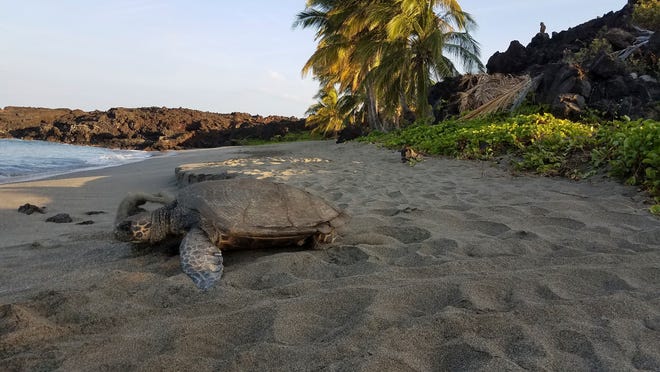
An endangered Hawaiian hawksbill sea turtle rests on the beach of Pohue Bay on Hawaii's Big Island in this undated National Park Service photo.

HONOLULU — Hawaii Volcanoes Countrywide Park on the Huge Island was supplied new land on Tuesday in a deal that will safeguard and manage a pristine white sand beach and ocean bay spot that is property to endangered and endemic species and to unusual, culturally major Indigenous Hawaiian artifacts.

Have faith in for General public Land, a countrywide nonprofit land preservation group, transferred its ownership of Pohue Bay and surrounding land to the Nationwide Park Provider.

Hawaii Volcanoes National Park has the world’s major and most lively volcanoes, Mauna Loa and Kilauea. Most of the shoreline in which the bay is located is made of ancient lava flows, black rock and sea cliffs that dart out into the ocean.

A LOCAL’S Guideline TO HAWAII:Black sand or crystal obvious waters, listed here are the shorelines you want to take a look at

Over and above THE Seaside:Discovering Hawaiian heritage at Haleakalā National Park

Pohue Bay, a unusual and idyllic oasis in an if not rugged landscape, is residence to endangered hawksbill sea turtles, inexperienced sea turtles, endangered Hawaiian monk seals and other species uncovered only in Hawaii. The region properties anchialine ponds — landlocked pools with a blend of new and salt drinking water — exactly where scarce Hawaiian crimson shrimp named ʻōpaeʻula live.

The region is also culturally substantial mainly because it has remains of historic Hawaiian villages, petroglyphs, burial web-sites and the largest known abrader instrument quarry in the state, in accordance to the Have faith in for Community Lands. Abraders are ancient equipment utilized for sanding, smoothing and grinding.

Park officials hope to finally open the region up to the general public, but the 26 sq. miles of land will continue to be shut to people as countrywide park staff members check with with regional industry experts and people to improved have an understanding of the various cultural web pages.

Indigenous The usa:How to see The us by means of Indigenous journey

Hawaii Volcanoes National Park officials hope to eventually open Pohue Bay up to the public, after consulting with locals and experts about preserving its history and protecting species unique to the area.

The addition provides the full park dimensions to 554 sq. miles, just about as massive as the full island of Oahu.

While the park has not too long ago obtained a couple of smaller parcels of land in the identical spot, the donation is the park’s most significant addition since 2003, when about 156 square miles of land was integrated.

Hawaii Volcanoes National Park Superintendent Rhonda Loh in a assertion referred to as the Pohue Bay place “an exceptionally cherished and culturally significant landscape that requirements to be guarded.”

Phoenix, Mesa and Chandler offer desert landscape programs

In Phoenix, the city’s next City Heat Leadership Academy is seeking for people today to sign up to support neat the neighborhood.

PHOENIX — It appears as well excellent to be accurate, but there are courses in place to help you help you save income, though also encouraging the setting. 

On best of that, you will get paid to participate.

Multiple cities all over the valley offer you payouts, engaging neighbors to trade their h2o-thirsty yards for anything a lot far more drought acutely aware.

Here’s a list of metropolitan areas with the programs:

&#13

Mesa

The City of Mesa’s xeriscape method has been all around because 2007. Mesa is now incorporating trees into the deal, as component of its “trees are cool” incentive.

The xeriscape software applies to solitary-loved ones home owners in Mesa who want to get rid of at minimum 500 sq. ft of living grass and change it with xeriscape. Xeriscape is low-water-use landscape plants like eucalyptus, bottlebrush, orchid trees and much more.

Homeowners who participate in the system can get up to $575 dollars back again if the vegetation are on Arizona’s very low drinking water use plant list. In addition to xeriscape, neighbors who consist of trees are eligible for an added $50 bucks for the first tree and $75 for two.

Mesa’s conservation coordinator, Becky Zusy, mentioned the lower-h2o-use trees are an added bonus for our desert landscape.

“Plants supply all types of added benefits which includes heat mitigation, shade and power personal savings  and they assistance retain drinking water on a property,” Zusy claimed. “Yes, they use water, if you select extra indigenous vegetation. Some can live off rainfall. All lower h2o-use trees use much less h2o than grass.”

Connected: Indeed, switching from grass to desert landscapes can save heaps of drinking water

&#13

Chandler

The Metropolis of Chandler provides identical programs encouraging owners to enable make a dent in the drought. Just one is for new residences that are not landscaped nonetheless.

If people put in minimal-h2o-use plants, they’re qualified for a $200 rebate.

Some of the stipulations consist of no black plastic below the granite and there wants to be 50 {6d6906d986cb38e604952ede6d65f3d49470e23f1a526661621333fa74363c48} coverage with low-h2o-use plants.

The next program is for turf conversion or grass removal. Owners who eliminate at minimum 1,000 square ft of grass or a lot more get $200 for every 1,000 sq. ft eradicated. The same rules as over use to contribute to preserving h2o in the Valley, explained Deina Burns, Water Conservation Coordinator.

“Grass takes advantage of a good deal of water, so with turf conversion, which we do have some quantities on, all those save about 75,000 gallons on normal for our residential consumers,” Burns stated. “That’s a ton of h2o in a year. We all know factors are drying up and it is obtaining hotter. We just want to be wise with our water use extended expression.”

&#13

Phoenix

In Phoenix, for the next yr in a row, an environmental nonprofit is taking action to great Valley communities to make lifetime a little much more tolerable for neighbors in the course of the summer time months.

The Urban Heat Leadership Academy is on the lookout for people today to be part of them on the request, next a good deal of achievements from very last year’s plan. Tuesday in the previous day Phoenix residents can indicator up for the virtual academy. It allows men and women who are living in the city find strategies to make their communities cooler, greener and much healthier, Anna Bettis, with The Mother nature Conservancy, said.

“We’ll be inviting them to meet our prior cohort, and volunteer to put into practice their initiatives,” Bettis mentioned. “Our hope is to build this group of practice and persons who have these relationships with each individual other and can assist just about every other as they keep on to try out to do the job for transform in their neighborhoods.”

The Urban Heat Academy comes right after results present communities like Edison Eastlake in Phoenix can be as a lot as 13 per cent hotter compared to a community just two miles away. Public overall health knowledge also reveals there have been a history-large quantity of heat-relevant deaths in Maricopa County and Phoenix accounted for a lot of of people deaths way too. Much more than 330 persons died since of the heat, in accordance to the county health department.

Cooling towns has an financial effect much too. The Character Conservancy estimates Metro Phoenix will eliminate $2.5 billion per 12 months by 2050 in economic output without the need of having action to neat Phoenix and mitigate impacts of climate modify.

The academy is absolutely free and is made available in each English and Spanish. The classes are reside beginning in the center of June and functioning through October.

Related: Blocking Arizona wildfires: Non-revenue gets rid of invasive crops from desert landscape

&#13

Scorched Earth

Capture up on the newest news and stories on our 12 News YouTube playlist in this article.

https://www.youtube.com/enjoy?v=videoseries

How to create, plant a natural landscape in North Texas

The Sperry backyard landscape has a natural look.

The Sperry yard landscape has a organic look.

Specific to the Star-Telegram

When I sit down to compose my column for the Fort Really worth Star Telegram, I believe initially of the good persons of the lovely metropolis of Fort Really worth and all of its suburbs. That is, immediately after all, the core support region of this historic newspaper.

And then I realize that the paper’s protection place extends scores of miles past to all the establishing counties and metropolitan areas all over. So, I think about these locations and people as nicely.

Finally, I know that there are subscribers hundreds of miles absent in considerably diverse configurations that also get the Star Telegram. I consider about you, as well, but for needs of this story, I’m fine-tuning my imagining to North Central Texas.

With that rather rambling preamble, my subject for right now is “creating a organic landscape.” I hear that motivation several times a week. Folks explain to me that is their target, but when they clearly show me images of what they’d like to accomplish, I’m wanting at points that undoubtedly never search like Fort Worth, its suburbs or the encompassing counties. They really don’t appear natural to our location. They search much more like rocky outcroppings from the mountains of far southwest Texas.

We live in what was the Grand Prairie of Texas. It was large grasslands, a few of which even now exist. They prolonged from the Midwest down into Central Texas quite a great deal along what would turn out to be the I-35 corridor. There were being rolling hillsides interrupted by occasional forests. Rocky outcroppings have been reserved for eroding streambeds where hurrying runoff reduce by means of the black clay to expose levels of limestone.

In essential terms, it was a uncomplicated “natural landscape” that awaited the initially human beings 1,000 years in the past. When I consider to build a “natural landscape” all-around my dwelling, that’s what I’m keeping in brain.

Some points to think about …

My spouse and I have lived on 11 rural acres listed here in the Metroplex for the past 45 many years. These are some of the strategies that I’ve acquired to retain my landscape on the lookout as purely natural as probable.

▪ When planting new shade trees I pick out styles that are indigenous to my place. I want my house to seem like it and the landscape all grew up with each other. The quickest way I can make a landscape appear like it was just introduced in from afar would be to plant matters that do not appear proper for the location. I use stay oaks, Shumard red oaks, Chinquapin oaks and bur oaks, cedar elms, pecans, redbuds, Mexican plums and japanese redcedars.

▪ If I require a privateness screen, I plant jap redcedars, native to our location, on 18- to 20-foot facilities in a zigzag sample so they glimpse like they just happened the natural way. I commence with knee-large seedlings that I transplant in mid-winter season when they are dormant. Nellie R. Stevens hollies can also perform properly, but all over again, on irregular spacings.

▪ I try out not to plant something in straight rows. Character doesn’t do that (other than for hackberry trees planted together a fence row by birds).

▪ Official shearing doesn’t seem natural. I pick plants that increase to the peak and width that I want and then keep there with only occasional trimming to correct erratic advancement. Higher than all, I stay away from remarkably sculpted and “poodled” vegetation.

▪ When setting up berms for privacy, seem deadening or to immediate movement of h2o or wind, I do so with mild swoops of soil. Other than fireplace ant mounds, character doesn’t leave us with globs of soil climbing abruptly out of the earth. The mounds will need to be low and they should taper gently into the surface.

And, when you get all set to landscape your berm, keep that simple, too. Really do not plant tall shrubs or trees down the top rated spines of the berms like you are going to see some people today doing. For a person issue that can make it hard to drinking water the vegetation. All the irrigation operates off.

Second, strictly from the element of seeking your landscape to seem all-natural, you will rarely see large crops increasing atop hills in character. They’re normally down the slopes a bit, exactly where the seeds have washed and gotten caught in a tiny draw. Drinking water was extra considerable there, so the seed sprouted and the plant thrived.

▪ When I’m constructing retaining partitions or bringing in boulders or river rock, I try out to match what exists in my area. I’m in an region exactly where limestone is predominant, so I’m not as fascinated in purchasing orange/purple stone that will be prominently noticeable in my backyard structure. It just would not search like it belonged there.

▪ My wife and I dwell in a pecan/purple oak forest. It was that way when we acquired our home in 1971, and the trees have just gotten bigger in the 50 many years since. Having said that, I’ve also learned an vital lesson during that time. Some of the old trees have died or turn into weakened. We have had to choose all those trees out. If I (or my ancestors) were being to continue on on this existing pattern for a further 50 several years, our home would be headed back again towards becoming a grassland. You have to have some young trees coming along in the forest. When you have a landscape, too often you’re fast paced thinking about pulling all the weeds, tree seedlings bundled. So, that all-natural appear also incorporates reforestation.

You can listen to Neil Sperry on KLIF 570AM on Saturday afternoons 1-3 p.m. and on WBAP 820AM Sunday mornings 8-10 a.m. Be a part of him at www.neilsperry.com and abide by him on Facebook.

Related stories from Fort Really worth Star-Telegram