The Creepy, Crawling History of Insect Art | Arts & Culture

One day when Barrett Klein was a young boy, he found a dead butterfly in the driveway of his family’s house and marveled at its beauty. It was a transformative moment. “At age five I had a nebulous epiphany in which I knew that insects would be the core of my existence,” says Klein, who is now an entomologist at the University of Wisconsin-La Crosse. He’s also an artist, and insects feature prominently in his art.

Throughout history and across many cultures, insects have inspired artists and artisans. Moth larvae, bees and beetles have provided silk, wax, dyes and other art media. Some insects leave traces on their environment that artists capture, while others in effect become collaborators as their natural behaviors are incorporated into art. “With all of their myriad forms, you’ve got exquisite behaviors as well as colors and shapes to choose from, or be mesmerized by,” says Klein, who recently reviewed the role of insects in art in the Annual Review of Entomology.

Much of this work plays on the conflicting feelings we humans tend to have toward insects — we’re simultaneously fascinated by their strange biology and unfamiliar lifestyles and repulsed or frightened by their stingers, toxins and the diseases they may (or may not) carry. Not to mention their sheer scuttling, swarming numbers.

“They don’t live like us. They don’t look like us. They do the things that we do in such bizarre and wild ways that it’s just endlessly intriguing,” says artist Catherine Chalmers. “They offer a very, very different perspective on life on Earth.”

From ancient cricket etchings to beetle shawls

One of the oldest known examples of insect art is an engraving of a cricket carved into a fragment of bison bone found in a cave in southern France and thought to be about 14,000 years old. Ancient people were great observers of the natural world, says Diane Ullman, an entomologist and cofounder of the Art/Science Fusion Program at the University of California, Davis. Insects are found everywhere humans live (they’re scarce near the poles of the Earth and absent only in the ocean’s depths), and they show up in artifacts from Mesoamerica to Mesopotamia. “Insects became part of the cultural and spiritual stories of people all over the world,” Ullman says.

Images of scarab beetles, for example, are common in the religious art of ancient Egypt, where their habit of rolling balls of dung across the ground (to provide food and shelter for their brood) symbolized the god Khepri rolling the sun across the sky each day. In the Navajo creation myth, Ullman says, cicadas lead people to emerge into the world, mirroring their own life cycle of periodic emergence from underground.

The Creepy, Crawling History of Insect Art

The varied use of insect parts and products in art includes (from left to right), lac bug–derived shellac decorating a piece of Tibetan horse armor, iridescent beetle elytra incorporated in an ear ornament made by the Awajún people of South America, and red pigment derived from cochineal insects in a painting by the Flemish artist Anthony van Dyck.

Metmuseum.org/Public Domain; B.A. Klein, taken with permission in the collections of the Field Museum of Natural History; A. Van Dyck/Public Domain

Insects have long provided artists with material for their work. Shellac, derived from the resinous secretions of the female lac bug, has been used for more than 3,000 years. It helps give the sheen to ornate Tibetan armor, among many other examples. Carmine, a brilliant crimson dye derived by crushing up cactus-sucking cochineal bugs and used by the Aztecs and Mayas, commanded exorbitant prices in 16th century Europe, where it was coveted by artists and textile makers. It made reds pop for Rembrandt and other Dutch master painters.

Some cultures use insects themselves, or at least parts of them. The Zulu people of southern Africa string the tiny bodies of immature scale bugs into elaborate necklaces (the insects coat themselves in protective wax that makes them look a little like pearls). Fireflies add “living jewels” to clothing in India, Sri Lanka and Mexico.

Another striking example is the singing shawls made by the Karen people of Myanmar and northern Thailand, says Jennifer Angus, who teaches textile design at the University of Wisconsin–Madison. These woven garments, so named because they’re worn at funeral ceremonies where mourners sing around the clock for several days, sometimes have a fringe made from the shiny, iridescent elytra, or hard outer wings, of jewel beetles. Angus, who grew up in Canada, had never seen anything like it. “I really had trouble believing that it was real,” she says.

The discovery inspired Angus to start incorporating insects into her own work. Her first installation was at a storefront gallery in Toronto, where she arranged hundreds of weevils into a wallpaper-like pattern on the walls. When people walked up to take a closer look, Angus says, “literally, I saw them take a step back as they realized the wallpaper was composed of insects.” The piece created tension, she says, between what people expect when they see a pattern they associate with domestic spaces and the realization that the pattern is composed of bugs, which most people don’t like to find in their homes.

This time-lapse video shows how artist Jennifer Angus transformed an entire room of the Renwick Gallery at the Smithsonian American Art Museum with patterns of carefully arranged insects and a pink wash made from the cochineal insects used in carmine dye. (Credit: Smithsonian American Art Museum)

Angus continues to exploit that tension in her work. “A lot of people don’t like insects, but they’re OK with them when they’re put in patterns, because a pattern is ordering and it’s asserting a kind of control,” she says. “When I put them into something that’s sort of like a swarm, people find that very disturbing because that’s mimicking what they actually do in the wild.”

Making art from insect creations

Experimental designer Marlène Huissoud says she’s had a similar reaction to some of the objects she creates from products made by bees and other insects. “A lot of people, when they see the pieces, they say they are very attractive … but at the same time there’s something a bit scary to them,” she says.

Huissoud grew up around bees — her father was a beekeeper in the French Alps — and her work applies methods that are commonly used with industrial materials to products made by insects. In some projects, for example, she’s used glassblowing methods to work with bee propolis, a resinous substance that bees use to build and repair their hives. (To make it, bees gather plant resin from leaf buds and bark and process it with saliva and secretions from their wax glands). Huissoud says she can harvest 50 kilograms of propolis a year from her father’s 700 hives — a small haul compared to the roughly 20,000 kilograms of honey they extract.

Huissoud devised a low-temperature kiln to work with propolis, which melts at around 100° Celsius (212° Fahrenheit), compared with 1200°C or so (about 2200°F) for glass. But from there the process is similar: building up layers of melted resin on a rotating rod and allowing it to cool slightly before blowing it. In her Of Insects and Men series, she used both bee propolis and actual glass to “disturb the eye of the audience” and challenge notions about what’s a natural material and what’s an industrial material. The bee propolis binds the shards of black glass together. “It’s only when you see them in real [life] that you actually realize it’s pure resin because it’s really smelling like in the beehive.”

Other artists work with the traces that insects leave behind. Seattle-based artist Suze Woolf first noticed evidence of bark beetles while hiking in the forests of the Cascade mountains near her home. Bark beetles are small insects that lay their eggs under the bark of trees. In the process, they excavate tiny tracks through the phloem, the vessel-laden tissue that distributes sugar and nutrients made by the leaves to other parts of a tree. These squiggles caught Woolf’s eye when she saw them on bits of bark that had fallen to the ground. “They look very much like a strange script that we just can’t read,” she says.

The resemblance to written language inspired Woolf to create a series of 36 (and counting) unconventional books that incorporate bark beetle tracks in different ways. One, called Survivorship, was inspired by the chemical warfare that takes place between mountain pine beetles and the trees they choose as hosts. The trees release aromatic compounds called terpenes to deter the beetles, but the beetles are able to convert some terpenes into a pheromone that attracts more beetles and can initiate a mass attack. The cover of Survivorship is an actual slice of log engraved with mountain pine beetle tracks; the pages contain ink reproductions of beetle tracks overlaid on the genetic code for monoterpene synthase, one of the enzymes that trees use to generate defensive chemicals.

The Creepy, Crawling History of Insect Art

On the pages of her work Survivorship, one in a series of bark beetle books, artist Suze Woolf printed the genetic sequence for one of the defensive chemicals used by trees to fend off bark beetle attacks, overlaid with the pattern made by the insect. The cover is made from a log engraved by mountain pine beetles.

Photo courtesy of Suze Woolf

Woolf says Survivorship was inspired in part by research by University of Montana entomologist and ecologist Diana Six, who has been searching for genetic variations and differences in trees’ chemical defenses that might explain why some trees survive beetle outbreaks and others don’t. Other books in Woolf’s series incorporate other bits of scientific data — graphs showing the spread of bark beetles through forests in British Columbia and Alberta, for example, or satellite images that show the resulting damage to trees — gleaned from conversations with scientists and from reading their research. “They teach me things I didn’t know,” Woolf says of her scientific collaborators. “I get ideas I wouldn’t otherwise get.”

Science, not art, was what initially motivated Walter Tschinkel to make casts of underground ant nests, something he’s been doing for decades. “I thought I knew what they looked like underground just from having dug them up,” says Tschinkel, a myrmecologist (an entomologist specializing in ants) and emeritus professor at Florida State University. “It turned out I hadn’t really imagined it correctly.”

As he recounts in his 2021 book, Ant Architecture: The Wonder, Beauty, and Science of Underground Nests, Tschinkel tried several materials, including latex and dental plaster, before finally settling on molten aluminum. The tricky part, naturally, is heating aluminum beyond its 660°C (1220°F) melting point in the field and pouring it into an ant nest without hurting yourself. To do this, Tschinkel developed a portable kiln fired by charcoal. He used the bottom half of a steel scuba tank as a crucible. Sometimes he uses zinc, which has a lower melting point than aluminum and stays liquid longer, penetrating further into finely structured nests. Once the metal cools, it can take hours to dig out the cast of a large nest and clean it up. (A video of Tschinkel’s process has been viewed more than 370,000 times on YouTube.)

The Creepy, Crawling History of Insect Art

Myrmecologist Walter Tschinkel stands next to a plaster cast he made of a Florida harvester ant nest. The 8.5-foot-long sculpture captures the intricate structure and depth of the underground nest.

Photo by Charles F. Badland/Wikimedia Commons

The molten metal captures the intricate chambers and passages of the nest, which turn out to be a lot less random and more organized than Tschinkel had realized. Tschinkel describes it as a “shish kebab” structure, with many horizontal chambers connected by long vertical tunnels. “Practically all nests have that basic structure, which tells me that the ancestral ant a hundred million years ago probably dug a simple nest … and from that basis all other nests have evolved.”

Harvester ant colonies can live for 30 or 40 years and, when possible, Tschinkel waits for a colony to move to a new nest before making a cast, to avoid killing the inhabitants. “I’m very fond of them,” he says. He estimates he’s made several hundred casts over the years, including the nests of about 40 species, most of them native to Florida. “I think they’re beautiful objects,” he says. “That’s part of the joy of doing this kind of work.”

Artist-insect collaborations

Insects may be unwitting collaborators in the work of Woolf and Tschinkel, but some artists see them as collaborators in a more literal sense. One colorful illustration of this is the French artist Hubert Duprat’s work with caddisflies, a group of insects related to butterflies and moths. Caddisfly larvae feed on decaying leaves and other detritus in rivers and streams. They encase themselves in a protective layer of silk, which they adorn and reinforce with grains of sand, pieces of twigs and other materials in their environment.

Duprat wondered what the larvae could do with more glamorous materials. So he raised some in an aquarium, giving them access only to flecks of gold, tiny pearls and bits of precious stones. The insects fashioned new, blinged-out cases for themselves. “The work is a collaborative effort between me and the caddis larvae,” Duprat says in a video segment on the project. “I create the conditions necessary for the caddis to display their talents.” Last year, Duprat published a book on his caddisfly collaboration, The Caddisfly’s Mirror.

The Creepy, Crawling History of Insect Art

A caddisfly larva has constructed a bejeweled case for itself, using materials supplied by artist Hubert Duprat.

Photo H. Del Olmo/Courtesy Gallery Art Concept, Paris

Insect behavior itself becomes the art in the work of Catherine Chalmers. In one long-running project, she photographed and filmed leafcutter ants in Costa Rica. These ants cut bits of leaves from high in the forest canopy and carry them back to their underground nests to provide a substrate for the fungi they cultivate as food. They use airborne chemical signals and vibrations to coordinate their activities, and their colonies can sustain millions of individuals. The eminent biologist E.O. Wilson called leafcutters “the most complex social creatures other than humans.”

In a series of works Chalmers describes on her website as intended to “blur the boundaries between culture and nature,” she carted 300 pounds of camera gear to Costa Rica each winter to create works based on the ants’ natural behavior in ways that draw parallels to our own. In one series, called War, she captured gruesome scenes from a three-week battle between two colonies in which many ants were dismembered and killed. Chalmers placed white plastic sheets around the area where the ants were fighting before filming them (the ants quickly habituated to the sheets and resumed their nightly battle). A video from the series looks like it was staged and filmed in a studio, even though Chalmers filmed it in the field. This somehow makes it more disturbing to watch than if it looked more like a nature documentary.

The Creepy, Crawling History of Insect Art

A cockroach in an electric chair is part of Catherine Chalmers’s Executions series, which challenges viewers to reexamine their attitudes toward these widely despised insects.

Catherine Chalmers

Chalmers doesn’t kill the insects in her work, although sometimes that’s how it looks. In a series called Executions, she placed cockroaches purchased from a biological supply company and kept in her New York City apartment in scenes of a hanging, an electrocution, a gas chamber and so on. In one, she filmed a live cockroach tied to a stake (she blew on it to make it move), then swapped in a cockroach that had died of natural causes before setting the stake on fire. The series elicited varied reactions, Chalmers says, from someone in San Francisco who ran out of the theater, to a man at her show in Boise urging her to kill as many cockroaches as possible.

“In her executions series, she really stirred emotions — you could argue in surprising ways — from people who might not think twice about spewing pesticide or squashing cockroaches,” says Klein. The series raises an interesting question, he says: Does seeing a cockroach play the part of a human condemned to die change how you feel about the cockroach? “Do you extend your circle of empathy … to a hexapod?”

Other artists have gone further, implanting computer chips in living insects or staging live fights, as in Chinese artist Huang Yong Ping’s controversial work Theater of the World. For Klein, the latter, at least, is a step too far. “I think that’s a gratuitous display of gladiator-style entertainment,” he says. “You’re purposely throwing organisms together to cause harm to each other, and I don’t see much value in that, but others might and others have. I think all of us draw our own lines.”

The Creepy, Crawling History of Insect Art

In his antiwar piece captioned “Withus Oragainstus,” the UK-based street artist Banksy militarized a Harlequin beetle with airplane wings, missiles and a satellite dish. The framed specimen was surreptitiously displayed for a short time by the artist in the insect collection at the American Museum of Natural History in New York City.

Jan Slangen/Flickr

Many artists hope their work with insects will raise awareness of the important roles the creatures play in the environment and provide a lens through which to reexamine our own influences on the natural world.

“The longer I’ve worked with insects, the more I’ve learned about them,” says Angus. “I’ve come to an understanding of just how important insects are to, frankly, our wellbeing on this planet.” Insects pollinate plants, including many food crops, and they play integral roles in diverse ecosystems as decomposers of waste and as parts of the food chain. Some of them may be sentinel species for the impacts of climate change — the mountain pine beetles Woolf has worked with, for example, are expanding their range northward and taking a bigger toll on trees made more susceptible to attack by the stress of longer, hotter springs, summers and falls.

There is still tremendous untapped potential for artists interested in working with insects, says Klein. He examined 164 works of insect art for his recent review article and found that the majority involved just two orders of insects, Hymenoptera (which includes bees) and Lepidoptera (butterflies and moths). Even within those two orders, the two species with the most extensive history of human exploitation — honeybees and silkworms — were heavily overrepresented. “What about the other 183,000 described species of Lepidoptera?” Klein asks. In addition to new silks and dyes, there may be other materials artists could use — like chitin, the tough, lightweight material that forms much of the exoskeleton of insects. Engineers have considered chitin for building structures on Mars, he says, but the artistic possibilities have scarcely been explored.

With many millions of insect species (only about a million of which have been named) and 10 quintillion individuals, the world is literally crawling and buzzing with possibilities.

Knowable


Knowable Magazine is an independent journalistic endeavor from Annual Reviews.

A tour of the public art in Minneapolis’ new Public Service Building

When Minneapolis town workers come back to do the job on January 10th — at this time the approach, at minimum in a hybrid perception, depending on the department — they’ll be in for pretty a deal with. Numerous of the 1000’s of persons who (theoretically) operate in the manufacturer new 10-tale Community Assistance Building covering everything from 311 to General public Performs to the Police, have by no means even seen their new workplaces. In place of remaining scattered all all-around office web-sites in a wide range of downtown places, they’ll all be centralized. And waiting around for them will be the biggest debut of city community artwork in Minneapolis background.

“We barely at any time do the job indoors,” admitted Mary Altman, the city’s Community Artwork Administrator, describing the city’s other public artworks. “Usually all of our artwork has to take care of freeze-thaw problems, and be prepared all-around what it would be like to be strike by a car or truck or plow or garden mower.”

That’s not the case for the $2M of artworks that are actually embedded in the new making, funded as a result of the city’s community art ordinance that dedicates 1.5{6d6906d986cb38e604952ede6d65f3d49470e23f1a526661621333fa74363c48} of capital budgets to art.

Short article carries on soon after ad

In its place, in this building they’ve been in a position to fee and put in a wide range of intricate, detailed, and car-free of charge sculptures explicitly designed to carry architecture, employee wellness and aesthetics alongside one another in the new town making.

“There are three essential types of function: artist-intended chicken safe and sound glass, murals designed on glass, and elevator foyer ceilings,” reported Altman. “It’s been genuinely great to be ready to do this. This is a at the time-in-a- life span possibility.”

Closeup with the city seal

A historic artwork varieties the eye catching centerpiece of the overall developing: the 26-foot tall foot Seal of Minneapolis, embedded in the centre of the wall welcoming people.

As far as seals go, it is one particular of the far better ones, surely excellent to the blatantly racist state seal or the epically uninteresting seal of St. Paul.  Not trying to do much too much, the brand depicting St. Anthony Falls at its industrial zenith, underneath the overdone slogan, “En Avant.” (French for “forward.”)

Visible even from throughout the street, the seal is a impressive bit of historic preservation. It was once component of the aged Minneapolis Auditorium, the substantial historic property to the Minneapolis Lakers, that lasted from 1927 to 1989. It was embedded in the wall there, 5 stories above the sidewalk, whereupon a Minneapolis town staff named Greg Goeke saved it from the rubble, and held it preserved in a farm subject for three a long time.

MinnPost photograph by Monthly bill Lindeke

Protip: from the cantilevered skyway-hooked up walkway above the primary lobby, you can get an up-near view of the seal, and lean in and almost touch the adorable puffs of coal pollution coming out of the mill smokestacks.

In accordance to Altman, lots of of the sixteen artists whose get the job done is now in the building utilised the seal as a partial inspiration for their parts. For most or all of them, the triumphalist European-American industrial vision grew to become something to respond to, a foil for a new vision of 21st century Minneapolis.

Post carries on after ad

Artistic salve for the mundane get the job done of city bureaucracy

Functioning for government has a popularity of currently being a little bit monotonous and repetitive. And If you spend sufficient time between the cubicles of municipal workplaces — as I have —  you know that the stereotype is not a entire fabrication processing property setback permits, applying municipal tax codes or signing off on bridge engineering is not exactly captivating perform.

Maybe that is why so a lot of the new art in the Community Services Setting up is dynamic: it modifications during the working day and through the year, as if it is deliberately made to alleviate tedium.

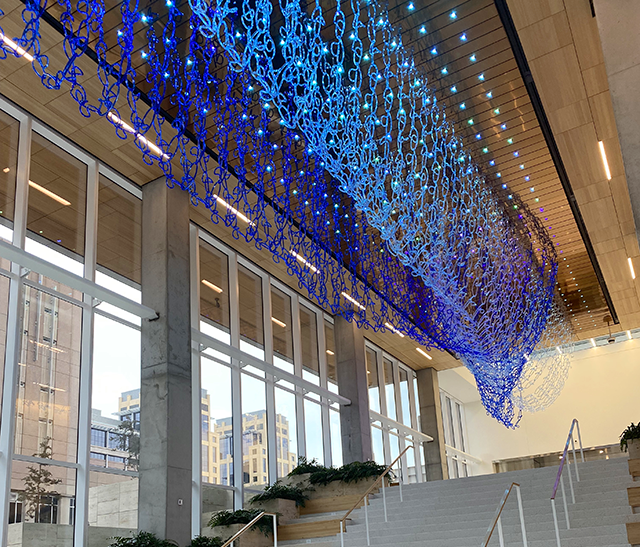
Just take for case in point, the centerpiece of the new will work, the enormous sculpture mounted above the shiny white terra-cotta floors that squeak with each and every move by means of the foyer. Named Present Ailments, Tristan Al-Haddad’s elaborate at any time-altering piece is the most high-priced piece in the setting up, and 1 of two new artworks specifically tied to are living feeds of facts. In this case, the LED lights embedded within the shifting resin depict the current temperature and humidity, organized in a time collection that visualizes the knowledge heading again six months.

Current Conditions

MinnPost photo by Bill Lindeke

As Altman describes, the piece’s complexity and mercurial nature is a element, not a bug. It is intended to continue to keep town personnel and visitors interested and engaged, give a thing various value paying interest to, day in and day out.

“There are persons in this creating that are right here every working day, for many years,” spelled out Altman, who, as a twenty-yr-veteran of metropolis govt, should really know. “They see it all the time [so] the art do the job can’t be a single ‘a-ha’ instant, it is received to be some thing exactly where the staff members keep on to see new things over time. A large amount of the artists are performing items in their works in which there’s either great attention to depth or one thing that really captivates folks for the duration of their encounter listed here.”

To that stop, Al-Haddad’s sculpture is probable never ever the same two times. It slowly reconfigures itself through the day, as very well as doing specific “programs” at sunrise and sunset. (These times, throughout the winter season solstice, it would be probable for a town employee to be about for equally of these situations.) It even delivers an artistic silver lining to those unlucky souls who have to function late.

“At night time, it plays a ‘deep indigo’ program,” described Altman. “The terrazzo just picks it up and it’s gorgeous it is really enjoyment to be listed here at evening.”

Post continues after ad

Elevator scavenger hunt

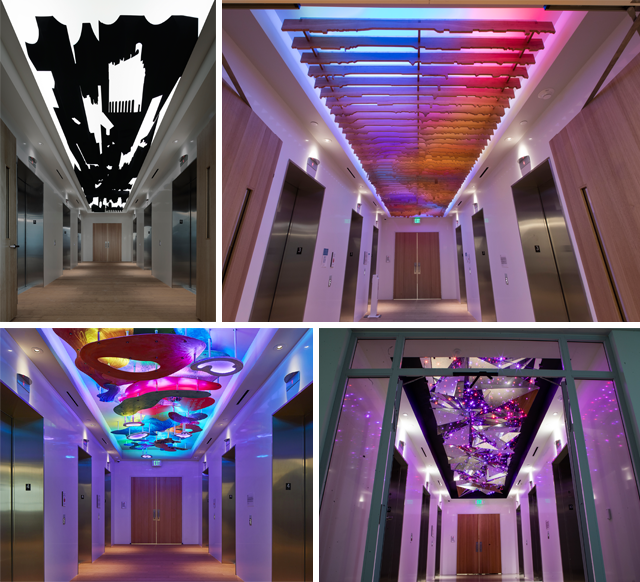
Imagine it or not, the most exciting artworks of the new creating are the ceilings of the elevator lobbies. Just about every of the seven obtainable flooring has a distinctly lit installation that, when seen in blend with the other folks, turns the constructing alone into an immersive working experience that is at least as fantastic as that cloying Van Gogh exhibit that was generating the rounds.

In other words, when you’re acquiring off the elevator on your way all around the business office, be sure to glimpse up.

“We gave the artists a foot of depth to do the job with and a requirement to use programmable LED lights,” described Altman. “They experienced to stick to building code, which was complex, but those people had been the primary parameters.”

Together the way, the artists interviewed employees in the distinctive departments to get a perception of the form of work opportunities they had, what kind of area they would respect, and a record of their fields.

The end result is 7 distinct, innovative areas that make a visit to the Public Assistance Developing a exciting journey for a visitor. In this way, it’s not unlike the lobby of the now-90-year-previous St. Paul Metropolis Corridor, where the 18 tales all have distinct kinds of wooden wall paneling.

Town of Minneapolis

From what I was able to glean from conversing with Altman, the most popular ceiling set up so far is by an artist staff known as LUCITO, named Likeness of an Allegory. Located on the 6th ground, at first look the thick black molding seems a bit harsh and grim for an workplace setting.

But the lengthier you gaze, the a lot more you get started to comprehend the cutout images are a pop-up ebook in reverse. Transferring about the flooring, and adjusting your angle, legendary Minneapolis styles expose themselves. It is a entertaining sport to wait for the elevator as the Stone Arch Bridge, Prince’s silhouette, or [gulp] the Twitter icon expose by themselves in the chaos.

Quite a few of the many others are more refined. I specially liked the 3rd flooring lobby, a perform tied to the currents and drinking water stages of the Mississippi River at St. Anthony Falls, and the 10th flooring foyer, designed by Rory Erler Wakemup, designed to mimic the night time sky. Each individual ground offers a little something various, whole of changing LED specifics value noticing.

Article proceeds after ad

“There are unique moods,” stated Altman, describing the set up by Christopher Harrison on the 4th Flooring. “Here, the artist wanted to generate a tranquil piece, simply because they are informed of the stress that employees are beneath. 311 is a notably nerve-racking occupation. You will see on the law enforcement ground on the health floor that was a aim to guidance worker wellness, and make places that are additional tranquil.”

Double-sided murals

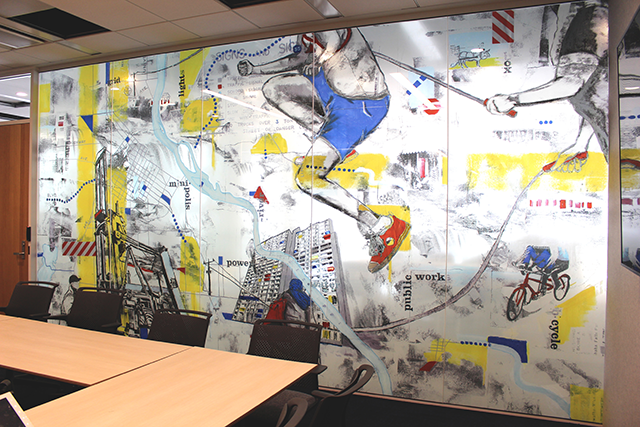
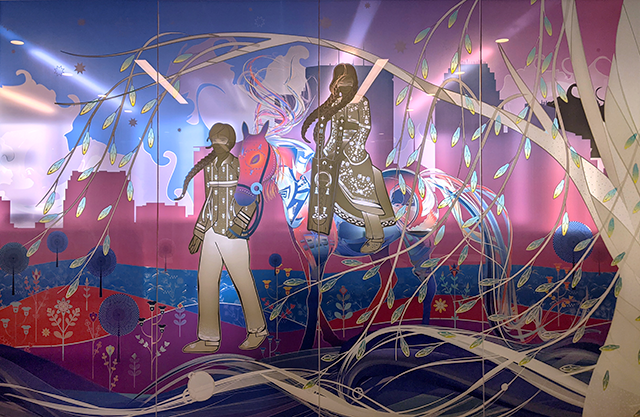
Custom made murals on substantial glass partitions in each individual floor’s meeting place are a different critical aspect of the building’s inventive setting. Created from levels of semi-opaque vinyl in diverse shades utilized to the glass partitions, they give the rooms an inside-outside the house dynamism.

The murals are all distinct and complete of fulfilling element, created far more so by their two-sided mother nature exactly where a single side of the wall bursts with color though the other retains a far more monochromatic outcome. The one that most appealed to my urbanist sensibilities was on the 4th flooring, a operate named “Power and Play” by Witt Siasoco. Drawing on the the colour palette from Ralph Rapson’s Riverside Plaza, it exhibits a palimpsest of maps, the river’s silhouette and photographs of people enjoying diverse online games.

City of Minneapolis

I also liked Dakota artist Marlena Myles’ two-part mural depicting figures about the sacred room of the falls, and Kao Lee Thao’s mural of a Hmong tale fabric artist that adorn the 6th and 5th floors, respectively. They are pretty much adequate to make you want to sit as a result of a two-hour meeting about sewer substitution scheduling.

City of Minneapolis

Acquiring the method right was a demo-and-error and, in some conditions, expected 4 prototype checks to make certain the software mirrored the artists’ vision.

Sci-fi vibes

Taken as a entire, the new making feels a little bit like a science-fiction established, just one from movies like Her or Star Trek. The new making has “smart” temperature and light-weight controls, and even the artworks hanging from the ceiling appear to be alive, shifting to reveal the humidity or the sunset or the temper of the metropolis by itself. But as COVID-risk-free tv screens wait around for users of the community, and a robotic but calming woman voice phone calls out “Now serving T-zero seven four two 7 5,” I wonder if this fiction is fully utopian.

I really do not truly desire for anyone to have to apply for a setting up renovation permit or tax evaluation variance. But if you do, I recommend savoring your time in the new Public Services Making. Changing a parking ramp, it nicely deserves its architectural and style accolades. Going for walks through the doors onto the substantial mat, embossed with san-serif City OF MINNEAPOLIS lettering, feels like eventually stepping into a improved future that we all know that metropolis governing administration can a person day grow to be.

Evergreen College Longhouse exhibit celebrates Native art

Glass-blown vases, detailed canvases and intricate cedar hats and masks line the white walls of the Evergreen Gallery at Evergreen State College in Olympia.

Artists from around the Pacific Rim are represented in “The Longhouse at 25: Across the Waters,” an exhibition celebrating the 25th anniversary of the Longhouse Education and Cultural Center that was postponed due to the COVID pandemic.

Known as an international hub for Indigenous arts, culture and education since 1995, the longhouse – named s’gʷi gʷi ʔ altxʷ or “House of Welcome” in the Lushootseed language – is the first Tribally-directed Native arts center on a college campus in the U.S.

Curated by the Seneca artist Linley Logan, the gallery has collected pieces since putting a call out for artists in January. New artists, students and those within the longhouse’s circle have spent months creating art and working to submit it.

Due to the pandemic, some post offices around the world were unable to ship items to the longhouse. Artists, like some of the Māori artists in New Zealand, had to find other ways to display their work by sending photographs or digital files for display.

“It’s been really tough. The usual venues, galleries and income for artists have been affected tremendously by the pandemic. So we’re very grateful to those who sent in the work and made the gallery a success” said Longhouse Director Laura VerMeulen, who is Tlingit and Haida.

Comanche artist Cynthia Masterson’s piece “Recipe for a Quarantine” features a whisk with a beautiful design created in glass beads on the handle. The beaded whisk stands inside a glass measuring cup filled with white beads, like flour being measured for a cake.

Evergreen-5.jpg
Indigenous artists from the Pacific Rim and beyond are represented in “The Longhouse at 25: Across the Waters” exhibit celebrating the 25th anniversary of the Longhouse Education and Cultural Center. The exhibit is on display until Jan. 29 at the Evergreen Gallery at Evergreen State College in Olympia. Natasha Brennan McClatchy

“Cultural Burdens III” by Northern Arapahoe and Seminole artist Carol Emarthle Douglas depicts a series of women – each carrying a miniature woven basket or a small cradleboard with a baby on their back. The design can be seen from the inside and outside of the basket, intricately woven with waxed linen, red and yellow cedar bark.

The two pieces, both created within the last year, reflect the solemn but resilient spirit of many artists during the pandemic.

“It’s been such a difficult time, but so much beautiful art has come out of it,” said Evergreen’s Vice President for Tribal Relations, Arts and Culture Kara Briggs – a Sauk-Suiattle Tribal member.

Makah artist T. McCarty, a sophomore studying metalsmithing, submitted her 2017 glass piece “Orca” in the show.

Evergreen-4.jpg
“Cultural Burdens III” by Northern Arapahoe and Seminole artist Carol Emarthle Douglas depicts a series of women – each carrying a miniature woven basket or a small cradle board with a baby on their back – on display at “The Longhouse at 25: Across the Waters’’ exhibit celebrating the 25th anniversary of the Longhouse Education and Cultural Center. The exhibit is on display until Jan. 29 at the Evergreen Gallery at Evergreen State College in Olympia. The design can be seen from the inside and outside of the basket, intricately woven with waxed linen, red and yellow cedar bark. Natasha Brennan McClatchy

While attending an artist-in-residency workshop at the college, students like McCarty were invited to bring designs for a glass-working session. She brought the design for “Orca” and made her first glass piece.

“I had this concept in mind about a whale that was in the ocean, and it had this level of comfort and kept coming back and spouting,” she said.

The dark blue glass reflects the shine of the overhead gallery lights onto the white pillar below, revealing the orca among the ocean waves in the piece.

With hand-dyed wool, the fully-twined button blanket – named “Fish Net Blanket” – was created by Squaxin Island artist Andrea Wilbur-Sigo for her son’s high school graduation ceremony.

Evergreen-3.jpg
“Mr. and Mrs. Grouse” by Skokomish artist Peter Peterson Sr., left, and “Inigun Rock Formation Patterned by Action of Water on the Shore” by Yup’ik artist Jennifer Angaiak Wood hang from the walls of “The Longhouse at 25: Across the Waters” exhibit. Celebrating the 25th anniversary of the Longhouse Education and Cultural Center, the exhibit is on display until Jan. 29 at the Evergreen Gallery at Evergreen State College in Olympia. Natasha Brennan McClatchy

The blanket, and two others, hang off the shoulders of three mannequins in the center of the gallery. Each decorated with woven shirts, beaded medallions or a woven cedar hat, Wilbur-Sigo’s piece and the work of six other artists come together to create a trio of Native fashion.

BEHIND OUR REPORTING

Please help support this reporting

Natasha Brennan covers Washington state tribes’ impact on our local communities, environment and politics, as well as traditions, culture and equity issues, for McClatchy media companies in Bellingham, Olympia, Tacoma and Tri-Cities.

She joins us in partnership with Report for America, which pays a portion of reporters’ salaries. You can help support this reporting at bellinghamherald.com/donate. Donations are tax-deductible through Journalism Funding Partners.

You can sign up for her weekly newsletter here.

“It’s always such an honor to participate in exhibits for the longhouse,” Wilbur-Sigo said. “I love to see how the work of artists with different skills and expertise come together to make a beautiful gallery.”

“The Longhouse at 25: Across the Waters” runs through Jan. 29 and is located on the second floor of Evans Hall (Library building) in the Evergreen Gallery. For up-to-date information on hours of operation, visit evergreen.edu/longhouse/markets-and-exhibits.

This story was originally published December 23, 2021 5:00 AM.

Related stories from Tacoma News Tribune

Profile Image of Natasha Brennan

Natasha Brennan covers Indigenous Affairs for Northwest McClatchy Newspapers. She’s a member of the Report for America corps. She has worked as a producer for PBS Native Report and correspondent for Indian Country Today. She graduated with a master of science in journalism in 2020 from the University of Southern California, Annenberg School for Communication and Journalism, and a bachelor of arts in journalism from University of La Verne.

Metropolitan Museum of Art Limits Attendance Amid Virus Surge

The Metropolitan Museum of Artwork explained Tuesday that it would restrict attendance to about 10,000 website visitors for every day because of the extremely infectious Omicron variant. Throughout a typical vacation period, the museum would be expecting just about two times as lots of people.

“The security of our team and guests remains our top rated precedence,” the Met’s chief govt, Daniel H. Weiss, mentioned in a statement. “Reduced density is a to start with move we can consider — and our dedicated employees has finished an incredible job in earning needed alterations to adapt to our public health situation even though also allowing for the museum to continue to be open up and preserve all people safe.”

The shift arrived as a different important institution, the Baltimore Museum of Artwork, stated that it was closing its galleries by means of Dec. 29 mainly because of an enhance in beneficial coronavirus assessments.

“We want a second to move back again and make certain our personnel is all set to provide museum website visitors,” the Baltimore museum mentioned in an electronic mail on Tuesday. “We assume cautiously is the very best way to move ahead.”

On Thursday, the Wintertime Clearly show (a huge art, antique and style and design good) postponed its Jan. 20 opening at the Park Avenue Armory, with strategies to announce new dates in the coming weeks. In Queens, the Noguchi Museum has closed by means of Jan. 4 because of the Omicron variant. And in New Haven, Conn., the Yale University Art Gallery and Yale Centre for British Art have equally closed by way of Jan. 2.

Kenneth Weine, the Met’s spokesman, said that reduced ability would aid limit density inside the building’s entrances. Outside the house the entrances, even though, with employees associates examining vaccination standing of people, he stated there could be for a longer period lines. The Satisfied will also conclude meals services starting on Thursday and is inquiring lots of workers to get the job done from property.

Experiences of coronavirus instances in New York State have amplified by far more than 80 {6d6906d986cb38e604952ede6d65f3d49470e23f1a526661621333fa74363c48} around two months, and federal authorities have explained the Omicron variant now accounts for almost 3-quarters of new instances.

Cultural institutions have normally relied on the holidays to support profits. This latest coronavirus surge has led to the unexpected cancellation of performances and exclusive programming close to the city. More than the weekend, almost a 3rd of all Broadway demonstrates were being canceled due to the fact of good coronavirus checks among their casts and crews, and numerous are shut down via Christmas.

“The museum subject is by now going through a gradual restoration,” said Laura Lott, president and main govt of the American Alliance of Museums.

“Another wave of minimized capacity and probable closures, without further federal aid, could show devastating,” she extra.

Museums are also applying new protection actions. Each the Nationwide Gallery of Artwork in Washington and the Brooklyn Museum, for example, have canceled several in-person excursions.

New art installation coming to El Paso’s West Side about importance of water

A new art piece will be on exhibit on El Paso’s West Aspect by the stop of January 2022.

The artwork, created by El Paso Artist Laura Turón, was inspired by the importance of water to the local community and how drinking water unites neighborhoods and associates of the group.

“I am quite energized to build this piece, and proud to be a aspect of it as a neighborhood feminine artist from El Paso,” Turón claimed. “It is great that the city gives these possibilities to regional artists to make community artwork items.”

Artwork: By means of the Looking Glass artwork gallery gives protected area for black sheep Borderland artists

A rendering of the artwork by Laura Turón that's being installed on El Paso's West Side.

A rendering of the artwork by Laura Turón that is becoming put in on El Paso’s West Aspect.

Extra: Artist Mauricio Mora finds renewed inspiration as a result of exhibit at Hal Marcus Gallery

Turón claimed the spot of the art piece is significant because of the relevance of drinking water in the location and how it connects neighborhoods and community customers,

“The Rio Grande is a lot less than a mile absent from the web page, there is a water canal that travels by way of the unique neighborhoods, and neighbors get the job done together to care for the local community irrigation process,” Turón stated. “The abstract style and design condition brings together ideas of art with science.”

Turon reported the sample is achieved making use of unique coordinates of the web-site through a spatially variant lattice algorithm designed by the EM Lab from UTEP. Turón said she frequently collaborates with them to blend principles of art with science and optical illusion styles.

“The design and style alone is an abstract illustration of h2o flowing and uniting the neighborhood,” Turón said.

Her existing neighborhood art installations represent ideas about artwork and science, ideas of repetition, deconstruction, transformation, interference and ephemeral art.

The city hosted a neighborhood assembly Sept. 3, 2020, for community enter on the artwork piece.

Additional: El Paso artist Mauricio Mora’s paintings on show at Hal Marcus Gallery starting off Dec. 9

Laura Turón's mobile art project, the Paradox Traveling Art bus, which functions as a mobile art gallery to take art to areas that have limited access to art.

Laura Turón’s cell art venture, the Paradox Touring Artwork bus, which features as a cell artwork gallery to take artwork to regions that have confined access to art.

Right until the art installation is concluded, the city of El Paso and Museum and Cultural Affairs Section (MCAD) are urging motorists using the Nation Club Highway and Memory Lane roundabout to use warning.

“Motorists can count on partial lane closures and targeted traffic delays in the course of the set up approach,” a news release from the metropolis read through.

For far more info about MCAD and the town of El Paso’s Community Artwork Software, pay a visit to www.epmcad.org.

Anthony Jackson might be reached at ADJackson@elpasotimes.com and @TonyAnjackson on Twitter.

This short article initially appeared on El Paso Periods: City of El Paso installs art piece by El Paso Artist Laura Turón

Artists who use insects in art

Through history and across cultures, insects have inspired artists and challenged viewers to shift their perspective

One day when Barrett Klein was a young boy, he found a dead butterfly in the driveway of his family’s house and marveled at its beauty. It was a transformative moment. “At age five I had a nebulous epiphany in which I knew that insects would be the core of my existence,” says Klein, who is now an entomologist at the University of Wisconsin-La Crosse. He’s also an artist, and insects feature prominently in his art.

Throughout history and across many cultures, insects have inspired artists and artisans. Moth larvae, bees and beetles have provided silk, wax, dyes and other art media. Some insects leave traces on their environment that artists capture, while others in effect become collaborators as their natural behaviors are incorporated into art. “With all of their myriad forms, you’ve got exquisite behaviors as well as colors and shapes to choose from, or be mesmerized by,” says Klein, who recently reviewed the role of insects in art in the Annual Review of Entomology.

Much of this work plays on the conflicting feelings we humans tend to have toward insects — we’re simultaneously fascinated by their strange biology and unfamiliar lifestyles and repulsed or frightened by their stingers, toxins and the diseases they may (or may not) carry. Not to mention their sheer scuttling, swarming numbers.

“They don’t live like us. They don’t look like us. They do the things that we do in such bizarre and wild ways that it’s just endlessly intriguing,” says artist Catherine Chalmers. “They offer a very, very different perspective on life on Earth.”

From ancient cricket etchings to beetle shawls

One of the oldest known examples of insect art is an engraving of a cricket carved into a fragment of bison bone found in a cave in southern France and thought to be about 14,000 years old. Ancient people were great observers of the natural world, says Diane Ullman, an entomologist and cofounder of the Art/Science Fusion Program at the University of California, Davis. Insects are found everywhere humans live (they’re scarce near the poles of the Earth and absent only in the ocean’s depths), and they show up in artifacts from Mesoamerica to Mesopotamia. “Insects became part of the cultural and spiritual stories of people all over the world,” Ullman says.

Images of scarab beetles, for example, are common in the religious art of ancient Egypt, where their habit of rolling balls of dung across the ground (to provide food and shelter for their brood) symbolized the god Khepri rolling the sun across the sky each day. In the Navajo creation myth, Ullman says, cicadas lead people to emerge into the world, mirroring their own life cycle of periodic emergence from underground.

Insects have long provided artists with material for their work. Shellac, derived from the resinous secretions of the female lac bug, has been used for more than 3,000 years. It helps give the sheen to ornate Tibetan armor, among many other examples. Carmine, a brilliant crimson dye derived by crushing up cactus-sucking cochineal bugs and used by the Aztecs and Mayas, commanded exorbitant prices in 16 thcentury Europe, where it was coveted by artists and textile makers. It made reds pop for Rembrandt and other Dutch master painters.

Some cultures use insects themselves, or at least parts of them. The Zulu people of southern Africa string the tiny bodies of immature scale bugs into elaborate necklaces (the insects coat themselves in protective wax that makes them look a little like pearls). Fireflies add “living jewels” to clothing in India, Sri Lanka and Mexico.

Another striking example is the singing shawls made by the Karen people of Myanmar and northern Thailand, says Jennifer Angus, who teaches textile design at the University of Wisconsin–Madison. These woven garments, so named because they’re worn at funeral ceremonies where mourners sing around the clock for several days, sometimes have a fringe made from the shiny, iridescent elytra, or hard outer wings, of jewel beetles. Angus, who grew up in Canada, had never seen anything like it. “I really had trouble believing that it was real,” she says.

The discovery inspired Angus to start incorporating insects into her own work. Her first installation was at a storefront gallery in Toronto, where she arranged hundreds of weevils into a wallpaper-like pattern on the walls. When people walked up to take a closer look, Angus says, “literally, I saw them take a step back as they realized the wallpaper was composed of insects.” The piece created tension, she says, between what people expect when they see a pattern they associate with domestic spaces and the realization that the pattern is composed of bugs, which most people don’t like to find in their homes.

Angus continues to exploit that tension in her work. “A lot of people don’t like insects, but they’re OK with them when they’re put in patterns, because a pattern is ordering and it’s asserting a kind of control,” she says. “When I put them into something that’s sort of like a swarm, people find that very disturbing because that’s mimicking what they actually do in the wild.”

Making art from insect creations

Experimental designer Marlène Huissoud says she’s had a similar reaction to some of the objects she creates from products made by bees and other insects. “A lot of people, when they see the pieces, they say they are very attractive … but at the same time there’s something a bit scary to them,” she says.

Huissoud grew up around bees — her father was a beekeeper in the French Alps — and her work applies methods that are commonly used with industrial materials to products made by insects. In some projects, for example, she’s used glassblowing methods to work with bee propolis, a resinous substance that bees use to build and repair their hives. (To make it, bees gather plant resin from leaf buds and bark and process it with saliva and secretions from their wax glands). Huissoud says she can harvest 50 kilograms of propolis a year from her father’s 700 hives — a small haul compared to the roughly 20,000 kilograms of honey they extract.

Huissoud devised a low-temperature kiln to work with propolis, which melts at around 100° Celsius (212° Fahrenheit), compared with 1200°C or so (about 2200°F) for glass. But from there the process is similar: building up layers of melted resin on a rotating rod and allowing it to cool slightly before blowing it. In her Of Insects and Men series, she used both bee propolis and actual glass to “disturb the eye of the audience” and challenge notions about what’s a natural material and what’s an industrial material. The bee propolis binds the shards of black glass together. “It’s only when you see them in real [life] that you actually realize it’s pure resin because it’s really smelling like in the beehive.”

Other artists work with the traces that insects leave behind. Seattle-based artist Suze Woolf first noticed evidence of bark beetles while hiking in the forests of the Cascade mountains near her home. Bark beetles are small insects that lay their eggs under the bark of trees. In the process, they excavate tiny tracks through the phloem, the vessel-laden tissue that distributes sugar and nutrients made by the leaves to other parts of a tree. These squiggles caught Woolf’s eye when she saw them on bits of bark that had fallen to the ground. “They look very much like a strange script that we just can’t read,” she says.

The resemblance to written language inspired Woolf to create a series of 36 (and counting) unconventional books that incorporate bark beetle tracks in different ways. One, called Survivorship, was inspired by the chemical warfare that takes place between mountain pine beetles and the trees they choose as hosts. The trees release aromatic compounds called terpenes to deter the beetles, but the beetles are able to convert some terpenes into a pheromone that attracts more beetles and can initiate a mass attack. The cover of Survivorship is an actual slice of log engraved with mountain pine beetle tracks; the pages contain ink reproductions of beetle tracks overlaid on the genetic code for monoterpene synthase, one of the enzymes that trees use to generate defensive chemicals.

Woolf says Survivorship was inspired in part by research by University of Montana entomologist and ecologist Diana Six, who has been searching for genetic variations and differences in trees’ chemical defenses that might explain why some trees survive beetle outbreaks and others don’t. Other books in Woolf’s series incorporate other bits of scientific data — graphs showing the spread of bark beetles through forests in British Columbia and Alberta, for example, or satellite images that show the resulting damage to trees — gleaned from conversations with scientists and from reading their research. “They teach me things I didn’t know,” Woolf says of her scientific collaborators. “I get ideas I wouldn’t otherwise get.”

Science, not art, was what initially motivated Walter Tschinkel to make casts of underground ant nests, something he’s been doing for decades. “I thought I knew what they looked like underground just from having dug them up,” says Tschinkel, a myrmecologist (an entomologist specializing in ants) and emeritus professor at Florida State University. “It turned out I hadn’t really imagined it correctly.”

As he recounts in his 2021 book, Ant Architecture: The Wonder, Beauty, and Science of Underground Nests , Tschinkel tried several materials, including latex and dental plaster, before finally settling on molten aluminum. The tricky part, naturally, is heating aluminum beyond its 660°C (1220°F) melting point in the field and pouring it into an ant nest without hurting yourself. To do this, Tschinkel developed a portable kiln fired by charcoal. He used the bottom half of a steel scuba tank as a crucible. Sometimes he uses zinc, which has a lower melting point than aluminum and stays liquid longer, penetrating further into finely structured nests. Once the metal cools, it can take hours to dig out the cast of a large nest and clean it up. (A video of Tschinkel’s process has been viewed more than 370,000 times on YouTube.)

The molten metal captures the intricate chambers and passages of the nest, which turn out to be a lot less random and more organized than Tschinkel had realized. Tschinkel describes it as a “shish kebab” structure, with many horizontal chambers connected by long vertical tunnels. “Practically all nests have that basic structure, which tells me that the ancestral ant a hundred million years ago probably dug a simple nest … and from that basis all other nests have evolved.”

Harvester ant colonies can live for 30 or 40 years and, when possible, Tschinkel waits for a colony to move to a new nest before making a cast, to avoid killing the inhabitants. “I’m very fond of them,” he says. He estimates he’s made several hundred casts over the years, including the nests of about 40 species, most of them native to Florida. “I think they’re beautiful objects,” he says. “That’s part of the joy of doing this kind of work.”

Artist-insect collaborations

Insects may be unwitting collaborators in the work of Woolf and Tschinkel, but some artists see them as collaborators in a more literal sense. One colorful illustration of this is the French artist Hubert Duprat’s work with caddisflies, a group of insects related to butterflies and moths. Caddisfly larvae feed on decaying leaves and other detritus in rivers and streams. They encase themselves in a protective layer of silk, which they adorn and reinforce with grains of sand, pieces of twigs and other materials in their environment.

Duprat wondered what the larvae could do with more glamorous materials. So he raised some in an aquarium, giving them access only to flecks of gold, tiny pearls and bits of precious stones. The insects fashioned new, blinged-out cases for themselves. “The work is a collaborative effort between me and the caddis larvae,” Duprat says in a video segment on the project. “I create the conditions necessary for the caddis to display their talents.” Last year, Duprat published a book on his caddisfly collaboration, The Caddisfly’s Mirror.

Insect behavior itself becomes the art in the work of Catherine Chalmers. In one long-running project, she photographed and filmed leafcutter ants in Costa Rica. These ants cut bits of leaves from high in the forest canopy and carry them back to their underground nests to provide a substrate for the fungi they cultivate as food. They use airborne chemical signals and vibrations to coordinate their activities, and their colonies can sustain millions of individuals. The eminent biologist E.O. Wilson called leafcutters “the most complex social creatures other than humans.”

In a series of works Chalmers describes on her website as intended to “blur the boundaries between culture and nature,” she carted 300 pounds of camera gear to Costa Rica each winter to create works based on the ants’ natural behavior in ways that draw parallels to our own. In one series, called War, she captured gruesome scenes from a three-week battle between two colonies in which many ants were dismembered and killed. Chalmers placed white plastic sheets around the area where the ants were fighting before filming them (the ants quickly habituated to the sheets and resumed their nightly battle). A video from the series looks like it was staged and filmed in a studio, even though Chalmers filmed it in the field. This somehow makes it more disturbing to watch than if it looked more like a nature documentary.

Chalmers doesn’t kill the insects in her work, although sometimes that’s how it looks. In a series called Executions, she placed cockroaches purchased from a biological supply company and kept in her New York City apartment in scenes of a hanging, an electrocution, a gas chamber and so on. In one, she filmed a live cockroach tied to a stake (she blew on it to make it move), then swapped in a cockroach that had died of natural causes before setting the stake on fire. The series elicited varied reactions, Chalmers says, from someone in San Francisco who ran out of the theater, to a man at her show in Boise urging her to kill as many cockroaches as possible.

“In her executions series, she really stirred emotions — you could argue in surprising ways — from people who might not think twice about spewing pesticide or squashing cockroaches,” says Klein. The series raises an interesting question, he says: Does seeing a cockroach play the part of a human condemned to die change how you feel about the cockroach? “Do you extend your circle of empathy … to a hexapod?”

Other artists have gone further, implanting computer chips in living insects or staging live fights, as in Chinese artist Huang Yong Ping’s controversial work   Theater of the World. For Klein, the latter, at least, is a step too far. “I think that’s a gratuitous display of gladiator-style entertainment,” he says. “You’re purposely throwing organisms together to cause harm to each other, and I don’t see much value in that, but others might and others have. I think all of us draw our own lines.”

Many artists hope their work with insects will raise awareness of the important roles the creatures play in the environment and provide a lens through which to reexamine our own influences on the natural world.

“The longer I’ve worked with insects, the more I’ve learned about them,” says Angus. “I’ve come to an understanding of just how important insects are to, frankly, our wellbeing on this planet.” Insects pollinate plants, including many food crops, and they play integral roles in diverse ecosystems as decomposers of waste and as parts of the food chain. Some of them may be sentinel species for the impacts of climate change — the mountain pine beetles Woolf has worked with, for example, are expanding their range northward and taking a bigger toll on trees made more susceptible to attack by the stress of longer, hotter springs, summers and falls.

There is still tremendous untapped potential for artists interested in working with insects, says Klein. He examined 164 works of insect art for his recent review article and found that the majority involved just two orders of insects, Hymenoptera (which includes bees) and Lepidoptera (butterflies and moths). Even within those two orders, the two species with the most extensive history of human exploitation — honeybees and silkworms — were heavily overrepresented. “What about the other 183,000 described species of Lepidoptera?” Klein asks. In addition to new silks and dyes, there may be other materials artists could use — like chitin, the tough, lightweight material that forms much of the exoskeleton of insects. Engineers have considered chitin for building structures on Mars, he says, but the artistic possibilities have scarcely been explored.

With many millions of insect species (only about a million of which have been named) and 10 quintillion individuals, the world is literally crawling and buzzing with possibilities.

Editor s note: This article was edited December 22, 2021, to clarify that caddisflies do not begin their lives as larvae but as eggs and that scale bugs feed on the liquid cactus phloem, not the cactus flesh itself.

This article originally appeared in
Knowable Magazine, an independent journalistic endeavor from Annual Reviews. Sign up for the
newsletter.