Artists who use insects in art

Through history and across cultures, insects have inspired artists and challenged viewers to shift their perspective

One day when Barrett Klein was a young boy, he found a dead butterfly in the driveway of his family’s house and marveled at its beauty. It was a transformative moment. “At age five I had a nebulous epiphany in which I knew that insects would be the core of my existence,” says Klein, who is now an entomologist at the University of Wisconsin-La Crosse. He’s also an artist, and insects feature prominently in his art.

Throughout history and across many cultures, insects have inspired artists and artisans. Moth larvae, bees and beetles have provided silk, wax, dyes and other art media. Some insects leave traces on their environment that artists capture, while others in effect become collaborators as their natural behaviors are incorporated into art. “With all of their myriad forms, you’ve got exquisite behaviors as well as colors and shapes to choose from, or be mesmerized by,” says Klein, who recently reviewed the role of insects in art in the Annual Review of Entomology.

Much of this work plays on the conflicting feelings we humans tend to have toward insects — we’re simultaneously fascinated by their strange biology and unfamiliar lifestyles and repulsed or frightened by their stingers, toxins and the diseases they may (or may not) carry. Not to mention their sheer scuttling, swarming numbers.

“They don’t live like us. They don’t look like us. They do the things that we do in such bizarre and wild ways that it’s just endlessly intriguing,” says artist Catherine Chalmers. “They offer a very, very different perspective on life on Earth.”

From ancient cricket etchings to beetle shawls

One of the oldest known examples of insect art is an engraving of a cricket carved into a fragment of bison bone found in a cave in southern France and thought to be about 14,000 years old. Ancient people were great observers of the natural world, says Diane Ullman, an entomologist and cofounder of the Art/Science Fusion Program at the University of California, Davis. Insects are found everywhere humans live (they’re scarce near the poles of the Earth and absent only in the ocean’s depths), and they show up in artifacts from Mesoamerica to Mesopotamia. “Insects became part of the cultural and spiritual stories of people all over the world,” Ullman says.

Images of scarab beetles, for example, are common in the religious art of ancient Egypt, where their habit of rolling balls of dung across the ground (to provide food and shelter for their brood) symbolized the god Khepri rolling the sun across the sky each day. In the Navajo creation myth, Ullman says, cicadas lead people to emerge into the world, mirroring their own life cycle of periodic emergence from underground.

Insects have long provided artists with material for their work. Shellac, derived from the resinous secretions of the female lac bug, has been used for more than 3,000 years. It helps give the sheen to ornate Tibetan armor, among many other examples. Carmine, a brilliant crimson dye derived by crushing up cactus-sucking cochineal bugs and used by the Aztecs and Mayas, commanded exorbitant prices in 16 thcentury Europe, where it was coveted by artists and textile makers. It made reds pop for Rembrandt and other Dutch master painters.

Some cultures use insects themselves, or at least parts of them. The Zulu people of southern Africa string the tiny bodies of immature scale bugs into elaborate necklaces (the insects coat themselves in protective wax that makes them look a little like pearls). Fireflies add “living jewels” to clothing in India, Sri Lanka and Mexico.

Another striking example is the singing shawls made by the Karen people of Myanmar and northern Thailand, says Jennifer Angus, who teaches textile design at the University of Wisconsin–Madison. These woven garments, so named because they’re worn at funeral ceremonies where mourners sing around the clock for several days, sometimes have a fringe made from the shiny, iridescent elytra, or hard outer wings, of jewel beetles. Angus, who grew up in Canada, had never seen anything like it. “I really had trouble believing that it was real,” she says.

The discovery inspired Angus to start incorporating insects into her own work. Her first installation was at a storefront gallery in Toronto, where she arranged hundreds of weevils into a wallpaper-like pattern on the walls. When people walked up to take a closer look, Angus says, “literally, I saw them take a step back as they realized the wallpaper was composed of insects.” The piece created tension, she says, between what people expect when they see a pattern they associate with domestic spaces and the realization that the pattern is composed of bugs, which most people don’t like to find in their homes.

Angus continues to exploit that tension in her work. “A lot of people don’t like insects, but they’re OK with them when they’re put in patterns, because a pattern is ordering and it’s asserting a kind of control,” she says. “When I put them into something that’s sort of like a swarm, people find that very disturbing because that’s mimicking what they actually do in the wild.”

Making art from insect creations

Experimental designer Marlène Huissoud says she’s had a similar reaction to some of the objects she creates from products made by bees and other insects. “A lot of people, when they see the pieces, they say they are very attractive … but at the same time there’s something a bit scary to them,” she says.

Huissoud grew up around bees — her father was a beekeeper in the French Alps — and her work applies methods that are commonly used with industrial materials to products made by insects. In some projects, for example, she’s used glassblowing methods to work with bee propolis, a resinous substance that bees use to build and repair their hives. (To make it, bees gather plant resin from leaf buds and bark and process it with saliva and secretions from their wax glands). Huissoud says she can harvest 50 kilograms of propolis a year from her father’s 700 hives — a small haul compared to the roughly 20,000 kilograms of honey they extract.

Huissoud devised a low-temperature kiln to work with propolis, which melts at around 100° Celsius (212° Fahrenheit), compared with 1200°C or so (about 2200°F) for glass. But from there the process is similar: building up layers of melted resin on a rotating rod and allowing it to cool slightly before blowing it. In her Of Insects and Men series, she used both bee propolis and actual glass to “disturb the eye of the audience” and challenge notions about what’s a natural material and what’s an industrial material. The bee propolis binds the shards of black glass together. “It’s only when you see them in real [life] that you actually realize it’s pure resin because it’s really smelling like in the beehive.”

Other artists work with the traces that insects leave behind. Seattle-based artist Suze Woolf first noticed evidence of bark beetles while hiking in the forests of the Cascade mountains near her home. Bark beetles are small insects that lay their eggs under the bark of trees. In the process, they excavate tiny tracks through the phloem, the vessel-laden tissue that distributes sugar and nutrients made by the leaves to other parts of a tree. These squiggles caught Woolf’s eye when she saw them on bits of bark that had fallen to the ground. “They look very much like a strange script that we just can’t read,” she says.

The resemblance to written language inspired Woolf to create a series of 36 (and counting) unconventional books that incorporate bark beetle tracks in different ways. One, called Survivorship, was inspired by the chemical warfare that takes place between mountain pine beetles and the trees they choose as hosts. The trees release aromatic compounds called terpenes to deter the beetles, but the beetles are able to convert some terpenes into a pheromone that attracts more beetles and can initiate a mass attack. The cover of Survivorship is an actual slice of log engraved with mountain pine beetle tracks; the pages contain ink reproductions of beetle tracks overlaid on the genetic code for monoterpene synthase, one of the enzymes that trees use to generate defensive chemicals.

Woolf says Survivorship was inspired in part by research by University of Montana entomologist and ecologist Diana Six, who has been searching for genetic variations and differences in trees’ chemical defenses that might explain why some trees survive beetle outbreaks and others don’t. Other books in Woolf’s series incorporate other bits of scientific data — graphs showing the spread of bark beetles through forests in British Columbia and Alberta, for example, or satellite images that show the resulting damage to trees — gleaned from conversations with scientists and from reading their research. “They teach me things I didn’t know,” Woolf says of her scientific collaborators. “I get ideas I wouldn’t otherwise get.”

Science, not art, was what initially motivated Walter Tschinkel to make casts of underground ant nests, something he’s been doing for decades. “I thought I knew what they looked like underground just from having dug them up,” says Tschinkel, a myrmecologist (an entomologist specializing in ants) and emeritus professor at Florida State University. “It turned out I hadn’t really imagined it correctly.”

As he recounts in his 2021 book, Ant Architecture: The Wonder, Beauty, and Science of Underground Nests , Tschinkel tried several materials, including latex and dental plaster, before finally settling on molten aluminum. The tricky part, naturally, is heating aluminum beyond its 660°C (1220°F) melting point in the field and pouring it into an ant nest without hurting yourself. To do this, Tschinkel developed a portable kiln fired by charcoal. He used the bottom half of a steel scuba tank as a crucible. Sometimes he uses zinc, which has a lower melting point than aluminum and stays liquid longer, penetrating further into finely structured nests. Once the metal cools, it can take hours to dig out the cast of a large nest and clean it up. (A video of Tschinkel’s process has been viewed more than 370,000 times on YouTube.)

The molten metal captures the intricate chambers and passages of the nest, which turn out to be a lot less random and more organized than Tschinkel had realized. Tschinkel describes it as a “shish kebab” structure, with many horizontal chambers connected by long vertical tunnels. “Practically all nests have that basic structure, which tells me that the ancestral ant a hundred million years ago probably dug a simple nest … and from that basis all other nests have evolved.”

Harvester ant colonies can live for 30 or 40 years and, when possible, Tschinkel waits for a colony to move to a new nest before making a cast, to avoid killing the inhabitants. “I’m very fond of them,” he says. He estimates he’s made several hundred casts over the years, including the nests of about 40 species, most of them native to Florida. “I think they’re beautiful objects,” he says. “That’s part of the joy of doing this kind of work.”

Artist-insect collaborations

Insects may be unwitting collaborators in the work of Woolf and Tschinkel, but some artists see them as collaborators in a more literal sense. One colorful illustration of this is the French artist Hubert Duprat’s work with caddisflies, a group of insects related to butterflies and moths. Caddisfly larvae feed on decaying leaves and other detritus in rivers and streams. They encase themselves in a protective layer of silk, which they adorn and reinforce with grains of sand, pieces of twigs and other materials in their environment.

Duprat wondered what the larvae could do with more glamorous materials. So he raised some in an aquarium, giving them access only to flecks of gold, tiny pearls and bits of precious stones. The insects fashioned new, blinged-out cases for themselves. “The work is a collaborative effort between me and the caddis larvae,” Duprat says in a video segment on the project. “I create the conditions necessary for the caddis to display their talents.” Last year, Duprat published a book on his caddisfly collaboration, The Caddisfly’s Mirror.

Insect behavior itself becomes the art in the work of Catherine Chalmers. In one long-running project, she photographed and filmed leafcutter ants in Costa Rica. These ants cut bits of leaves from high in the forest canopy and carry them back to their underground nests to provide a substrate for the fungi they cultivate as food. They use airborne chemical signals and vibrations to coordinate their activities, and their colonies can sustain millions of individuals. The eminent biologist E.O. Wilson called leafcutters “the most complex social creatures other than humans.”

In a series of works Chalmers describes on her website as intended to “blur the boundaries between culture and nature,” she carted 300 pounds of camera gear to Costa Rica each winter to create works based on the ants’ natural behavior in ways that draw parallels to our own. In one series, called War, she captured gruesome scenes from a three-week battle between two colonies in which many ants were dismembered and killed. Chalmers placed white plastic sheets around the area where the ants were fighting before filming them (the ants quickly habituated to the sheets and resumed their nightly battle). A video from the series looks like it was staged and filmed in a studio, even though Chalmers filmed it in the field. This somehow makes it more disturbing to watch than if it looked more like a nature documentary.

Chalmers doesn’t kill the insects in her work, although sometimes that’s how it looks. In a series called Executions, she placed cockroaches purchased from a biological supply company and kept in her New York City apartment in scenes of a hanging, an electrocution, a gas chamber and so on. In one, she filmed a live cockroach tied to a stake (she blew on it to make it move), then swapped in a cockroach that had died of natural causes before setting the stake on fire. The series elicited varied reactions, Chalmers says, from someone in San Francisco who ran out of the theater, to a man at her show in Boise urging her to kill as many cockroaches as possible.

“In her executions series, she really stirred emotions — you could argue in surprising ways — from people who might not think twice about spewing pesticide or squashing cockroaches,” says Klein. The series raises an interesting question, he says: Does seeing a cockroach play the part of a human condemned to die change how you feel about the cockroach? “Do you extend your circle of empathy … to a hexapod?”

Other artists have gone further, implanting computer chips in living insects or staging live fights, as in Chinese artist Huang Yong Ping’s controversial work   Theater of the World. For Klein, the latter, at least, is a step too far. “I think that’s a gratuitous display of gladiator-style entertainment,” he says. “You’re purposely throwing organisms together to cause harm to each other, and I don’t see much value in that, but others might and others have. I think all of us draw our own lines.”

Many artists hope their work with insects will raise awareness of the important roles the creatures play in the environment and provide a lens through which to reexamine our own influences on the natural world.

“The longer I’ve worked with insects, the more I’ve learned about them,” says Angus. “I’ve come to an understanding of just how important insects are to, frankly, our wellbeing on this planet.” Insects pollinate plants, including many food crops, and they play integral roles in diverse ecosystems as decomposers of waste and as parts of the food chain. Some of them may be sentinel species for the impacts of climate change — the mountain pine beetles Woolf has worked with, for example, are expanding their range northward and taking a bigger toll on trees made more susceptible to attack by the stress of longer, hotter springs, summers and falls.

There is still tremendous untapped potential for artists interested in working with insects, says Klein. He examined 164 works of insect art for his recent review article and found that the majority involved just two orders of insects, Hymenoptera (which includes bees) and Lepidoptera (butterflies and moths). Even within those two orders, the two species with the most extensive history of human exploitation — honeybees and silkworms — were heavily overrepresented. “What about the other 183,000 described species of Lepidoptera?” Klein asks. In addition to new silks and dyes, there may be other materials artists could use — like chitin, the tough, lightweight material that forms much of the exoskeleton of insects. Engineers have considered chitin for building structures on Mars, he says, but the artistic possibilities have scarcely been explored.

With many millions of insect species (only about a million of which have been named) and 10 quintillion individuals, the world is literally crawling and buzzing with possibilities.

Editor ’ s note: This article was edited December 22, 2021, to clarify that caddisflies do not begin their lives as larvae but as eggs and that scale bugs feed on the liquid cactus phloem, not the cactus flesh itself.

This article originally appeared in
Knowable Magazine, an independent journalistic endeavor from Annual Reviews. Sign up for the
newsletter.
Horizon, a new studio space and residency program, welcomes emerging and midcareer artists

Emerging artists, take note: There’s a bright spot peeking through the horizon for 2022.

Horizon, a new art space and residency program, will open its doors in downtown L.A. in February, the foundation announced on Friday. Former Whitney Museum of American Art curator Christopher Y. Lew will serve as chief artistic director of Horizon Art Foundation, traveling frequently to L.A. from his home in New York. L.A.-based May Xue, who previously steered Hong Kong’s K11 Art Foundation as general manager and director of education and institutional relations, is the initiative’s CEO.

The L.A.-based Chinese art patrons Jason Li and Harry Hu are the sole funders of the nonprofit.

Horizon’s mission? To provide emerging and midcareer artists from around the globe with resources to create experimental work in an environment unfettered by deadlines and the pressure to exhibit. Horizon will support one artist at a time for up to three months — four each year — and provide them with a place to live, studio space and a stipend for living expenses. The artists will retain sole ownership of work they create during the residency.

“We wanted to find a way to support artists that’s less goal-oriented, that’s much more open-ended where artists can take risks and experiment,” Lew says. Taking root in the city of Los Angeles, he adds, is key. Part of Horizon’s goal is “to help celebrate the real cultural richness of L.A.”

Horizon wouldn’t yet reveal its inaugural artists for 2022, all of whom have been chosen. The selection process included drawing up a list of about two dozen artists; four were invited to partake in the first year of the residency. There isn’t necessarily a focus on L.A. artists, but bringing artists from around the world to Los Angeles to experience the city’s charged creative communities is part of the mission. The potential applicant list was created and reviewed by Lew and a two-person advisory board comprised of Pérez Art Museum Miami’s María Elena Ortiz and the Contemporary Art Museum St. Louis’ Wassan Al-Khudhairi. The advisory board, Lew says, will change annually.

The residency is open to artists of all backgrounds, but Horizon is “giving some focus to artists of color,” Lew adds.

Creating community around artists and connecting them with patrons is key to Horizon, Xue says. As such, the space will host artist talks, open studio tours and other public programming in its 4,800-square-foot studio space in the Fashion District.

The hope is to spark an international dialogue through art to promote cultural understanding, says Xue, who ran a three-year, collaborative artist-in-residence exchange program between K11 Art Foundation and the U.K.’s Royal Academy of Arts from 2018 to 2020.

“That experience, it helped a lot of artists to discover more about the world and also themselves,” Xue says.

Drawing on Xue’s expertise in the area, Horizon plans to open an artist-in-residence exchange program in either Beijing or Shanghai, though there’s no timeline for that yet. “We’re thinking about an exchange that can happen between Los Angeles and China and Asia in general,” Lew says. “To really have artists between the two places in residence and go back and forth.”

The Horizon team is working together in other areas as well. Li is co-founder, with Xue, of the for-profit NFT editorial platform Outland, which launched earlier this month. Xue also serves as Outland’s artistic director for Asia, while Lew is chief artistic director of the company.

Lew says there is no connection between the two ventures. “They’re two distinct entities,” he notes.

Hu, who is financing Horizon along with Li, works with his family’s business, a production company in Hangzhou, China.

Horizon aims to host artists from around the world, but because of the pandemic — and uncertainty about what travel restrictions might be in place early next year — its four inaugural artists are from North America.

All of them, however, are at pivotal points in their careers.

“It was really important for us to be able to offer an opportunity to artists that would feel transformative,” Lew says. “Many artists at that early-to-midcareer point may still have day jobs or other things they depend upon to live. And here is a chance to focus on one’s art 24/7 for the length of the residency.”

Newton artists sell their wares at New Art Shop

The New Art Shop launched a three-weekend pop-up shop at the end of November selling the various wares of 45 local artists, with more than half of the artists from Newton and the rest from the Boston area. Emily O’Neil, executive director of the New Art Center, said her goal is to turn the space into a cooperative-style shop for local artists to sell their pieces while simultaneously running the shop themselves.

Currently, the artists earn a minimum of 65 percent of the profit from the sales of their work, O’Neil said, and if the shop fully becomes a co-op, the artists running the shop will also earn an hourly wage. The works sold in the shop vary from homemade candles and soaps to ceramics and wall art to books written by local authors.

“Our hope is at the culmination of our nine shopping days, we will have enough evidence to prove that there’s enough community interest to support a retail endeavor,” O’Neil said.

The New Art Center, a Newton-based nonprofit art education space, currently supports the volunteer-run shop. If the shop were to become a more permanent co-op endeavor, it would be run entirely by the artists, more independently from the Center, according to O’Neil and Kim Spencer, who founded the initiative together.

“Sales have been brisk,” Weinberg said, as 27 of her 39 pieces in the shop had already sold, and she was asked to bring in more.

Over the six days the shop has been open, sales have been “robust” and “above initial projection,” Spencer said. There have been an average of 30 transactions per day, she said, and the New Art Shop anticipates the overall gross sales for the nine sale days will be close to $20,000.

Sayaka Rawizza, a ceramic artist and instructor at the New Art Center, said the shop was “important to support the community.”

She said the shop was “an ideal style” for her this year during the pandemic, as it was less crowded and better ventilated in comparison to more traditional art fairs.

Sarah Kahn, a mixed media collage artist and New Art Center instructor, said within the first night, she received a call from the shop that she had already sold four of her pieces and they wanted her to bring in two more.

“I was so excited to think about selling myself to the community,” Kahn said.

Weinberg said it’s more important to her for people to “have my pieces in their home” than the money made from the sales.

“Having a venue for local artists to sell their work is really important to the community,” Weinberg said.

O’Neil said the New Art Shop is the only store in Newton selling work exclusively made by local artists.

“We’re hoping that people will shop locally, support local artists, support the community, and allow us to move this forward as a permanent retail venture,” O’Neil said.

The shop will be open for its last weekend of the season Friday, Dec. 10, through Sunday, Dec. 12. Hours can be found on the website.

Katherine Hapgood can be reached at newtonreport@globe.com.

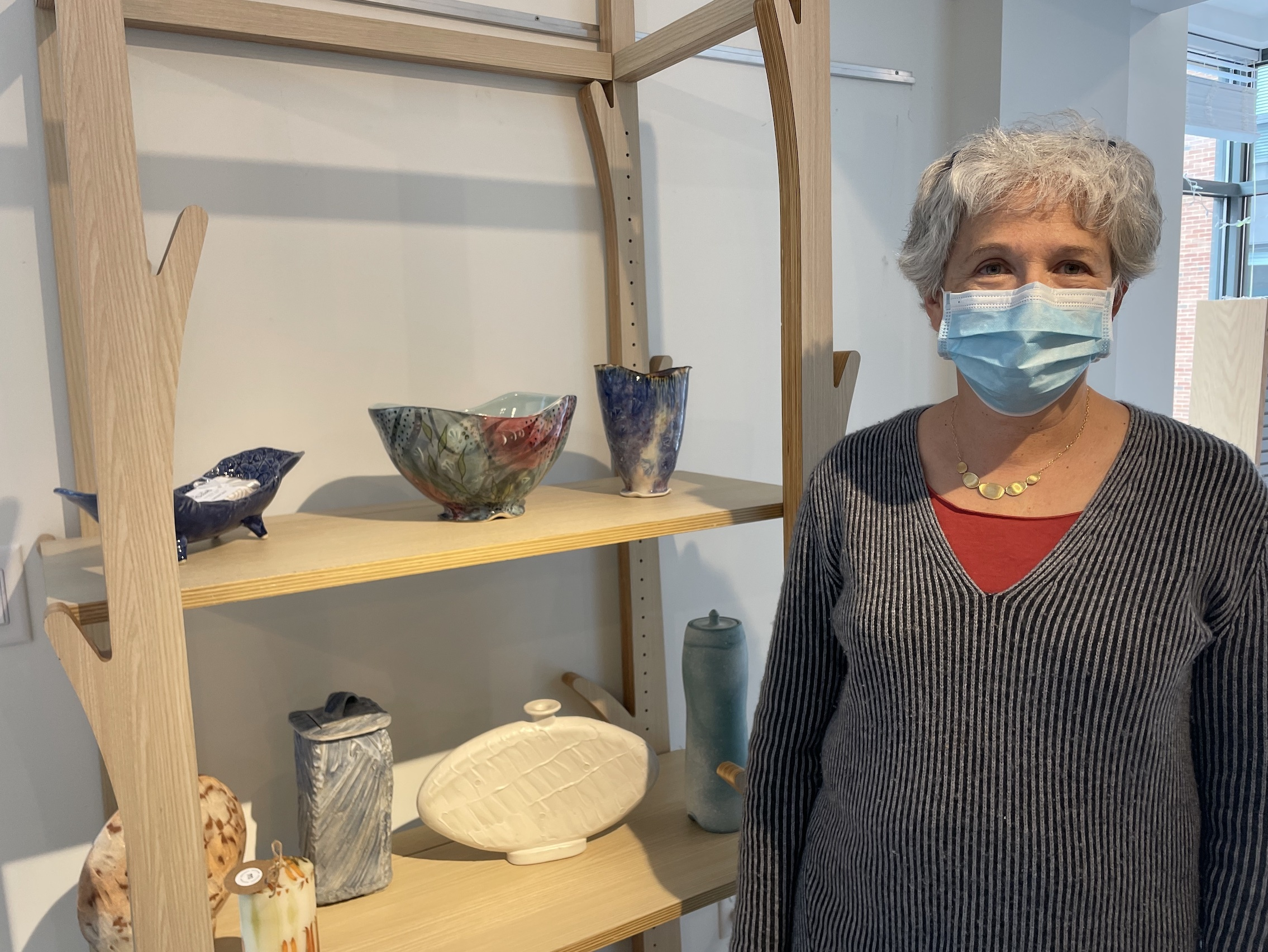
Ellen Weinberg shows her ceramics for sale on the second shelf of a display in the New Art Shop.
Ellen Weinberg shows her ceramics for sale on the second shelf of a display in the New Art Shop.Katherine Hapgood
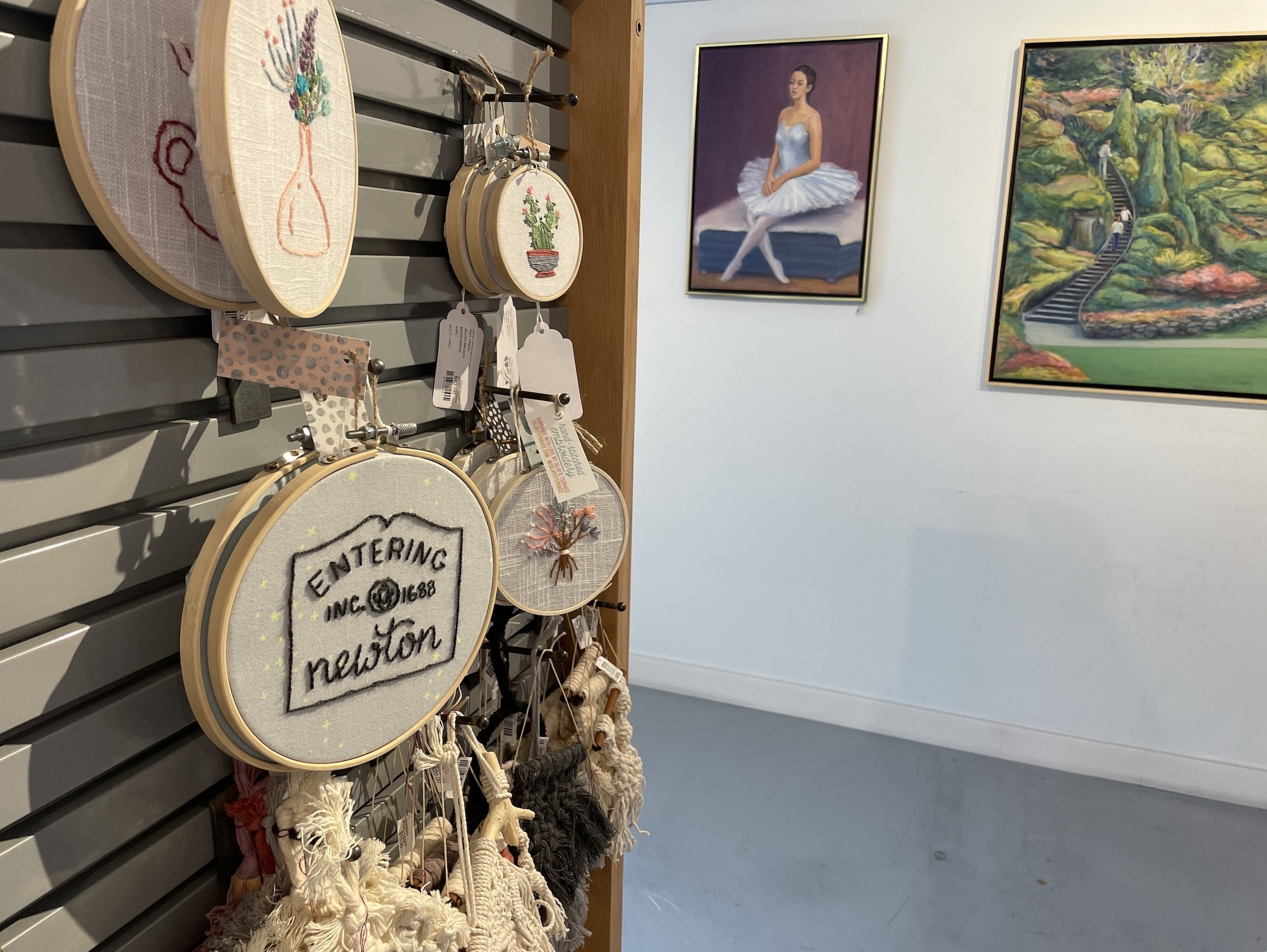
Various wares are available for sale at the New Art Shop.
Various wares are available for sale at the New Art Shop. Katherine Hapgood

New art gallery brings opportunity for artists, art lovers | Local News

OSKALOOSA — Artists in Mahaska County and beyond now have the opportunity to showcase their work at the newly-opened Envision Art Gallery.

Located in Penn Central Mall, the gallery has something for every price point, from $5 prints to $1,000 paintings and everything in between.

Owner Vera Babich decided to open the gallery after noticing a high concentration of artists and art lovers in the area.

“It is a very artistically rich and diverse community,” she said. “Since we moved here in 2009, we’ve met so many talented people and seen so much beautiful art done by them.”

SEGUE

“We needed a place where people can come any time and see [art],” Babich said. “There are so many people I know who do art but they don’t have any way to display it.”

For the artists, Envision is a chance to showcase talents that those around them might not even know they have.

Oskaloosa-based artist Julie VerSteegh is one of the five creators currently on display in the gallery.

Though many who know her know of her talents in graphic design, VerSteegh was surprised at how many people didn’t know she that she is also a multimedia artist.

“I have people who I’ve been friends with in town for 20 years who say ‘oh, I didn’t know you do art,’” she said.

Several of her paintings and illustrations can be found available for purchase at Envision.

The gallery makes it possible for Versteegh and other local artists like her to showcase their work to potential costumers or art appreciators.

The gallery also includes works by Ames-based photographer Igor Kovalenko; colorful illustrator Jane Ryder; watercolor, pastel, oil and acrylic painter Vitali V. Lobov; and Babich’s husband, Sergiu Nagorny. Nagorny’s pieces include metalsmithing, chainmaille, copper decor and “wearable art”.

Though not all of the artists are Iowa-born, each has made Iowa their home. Many of the pieces on display from each of the artists represent or show recognizable Oskaloosa and Iowa scenes.

“A lot of times art means more to people if they have a connection with it,” VerSteegh said.

Whether it be a print of the Oskaloosa City Square’s band shell or a one-of-a-kind jewelry piece, Envision Art Gallery has something for everyone.

“For a small town like Oskaloosa, there’s a lot of things happening in the community to support art,” Babich said. “There are people who create art and there’s just as many people who want to see art. I thought we needed to be that connection between the artists and the audience who is interested in art.”

Ohio Plein Air Society art exhibition highlights artists’ talents and Ohio’s beauty

""

“Gloriously Wild,” painted by artist Angela Gage, is just one of the quite a few works on display screen at “Best of Ohio Plein Air Culture.” Credit rating: Courtesy of Angela Gage

The Ohio Plein Air Culture aims to celebrate the talent of its artists and the attractiveness of Ohio in its newest exhibition.

“Best of Ohio Plein Air Culture,” which will be on screen at the Peggy R. McConnell Arts Middle of Worthington through Dec. 18, options some of the most effective will work of 20 plein air artists from throughout Ohio, Michelle Tavenner, software director at the center, stated. She reported the 43 will work — which ended up painted “en plein air,” or though the artists were outdoor on site — emphasize some of Ohio’s most beloved locations and landscapes.

“When people come in, they’ll be capable to form of experience some major landscapes and structures that they might operate across in their travels throughout Ohio,” Tavenner claimed.

All of the artists highlighted in the exhibition are associates of the Ohio Plein Air Modern society, a nonprofit that delivers with each other Ohio-primarily based artists who share a typical curiosity in outside portray, Debra Joyce Dawson, president of the modern society, reported.

The exhibition options paintings of Ohio areas this sort of as Environmentally friendly Garden Cemetery in Columbus, the Chadwick Arboretum & Discovering Gardens at Ohio State, Lynd Fruit Farm Market place in Pataskala and the Marietta Brewing Company, Tavenner claimed. She explained some guests to the exhibition have been impressed to more examine the state.

“Some visitors have come via and did not understand a distinct location,” Tavenner claimed. “It variety of sparked a minimal little bit extra curiosity in perhaps a working day vacation or touring to a specific space so they can see that in individual.”

To be viewed as for the exhibition, artists ended up essential to comprehensive 95 p.c of their paintings exterior on locale and from direct observation, Tavenner stated. Three jurors then chosen the greatest examples of plein air will work for the exhibition, according to the center’s site.

Dawson, who has several paintings provided in the exhibition, mentioned the plein air painting system, for her, is often a roller coaster of feelings.

“One minute your portray could be likely fantastically and you are just on cloud nine, you know, you are at the large place of that roller coaster,” Dawson stated. “Then you can set a single brushstroke on and you just shed what you experienced.”

Dawson explained she believes portray outside on site is 1 of the finest means to learn how to paint landscapes.

“If you want to develop into a landscape painter, if you truly want to know what mild falling on type looks like, the only way to definitely know that is to go out and see it for authentic,” Dawson stated.

With numerous distinctive plein air artists showcased in the exhibition, Dawson said she hopes viewers will acquire a newfound appreciation for art.

“They’ll see plenty of selection and design and style and handwriting,” Dawson reported. “I hope that they can acquire that in and take pleasure in that and just see how the artists take care of color and structure.”

The exhibition is on screen at the Peggy R. McConnell Arts Heart, which aims to modify life and make recollections as a result of inventive arts experiences like the “Best of Ohio Plein Air Society” exhibition, Tavenner reported. 

The middle and its exhibitions are absolutely free to stop by, which Tavenner claimed highlights its motivation to accessibility within just the arts.

“The arts deliver so a lot joy and reminiscences that improve people’s lives,” Tavenner mentioned. “We want to do every thing that we can to make that probable for the most folks, not just in the community of Worthington, but in the surrounding locations outdoors of Columbus.”

Tavenner mentioned in addition to celebrating the skills of artists in the Ohio Plein Air Modern society and expanding recognition of the center’s providers in just the neighborhood, she hopes the exhibition allows site visitors figure out the natural beauty of their point out.

“We’d like to be in a position to showcase the splendor which is in Ohio and share that with men and women who may possibly or might not get the prospect to travel quite substantially, particularly in these occasions,” Tavenner explained.

“Best of Ohio Plein Air Society” will be totally free to view via Dec. 18 at the Peggy R. McConnell Arts Middle in Columbus. A lot more information and facts can be discovered on the center’s site.

15 Beautiful Children’s Books About Art & The Artists Behind Them

For a whole lot of children, there is nothing far better than sitting down down with some paint, crayons, chalk, or markers to develop their hottest masterpiece. Caregivers can inspire their young ones to lean far more into that curiosity with some children’s publications about artwork. No matter if they want to understand about well-known artists, observe new techniques, or basically get shed in a story about artwork, there are some remarkable publications for them to pick out from.

If you are a caregiver to a kid, you in all probability previously know whether or not your child has a appreciate for artwork (trace: if you have to toss away photos on a daily foundation because they carry residence so several, then it’s harmless to suppose your kiddo is a admirer of art). It is a superb detail for them to be intrigued in simply because it enables them a way to convey their creativeness now and it is also some thing that research have demonstrated can assistance them minimize and manage worry as they develop up. So, if investing in a handful of children’s books about art now will aid retain them thrilled, then it’s definitely worthy of it.

The only problem now is, exactly where accurately can you discover children’s guides about art that are age-suitable and exciting for your little just one? There are a whole lot of possibilities out there, but below are some favorites to aid you get begun with your buying.

We only incorporate merchandise that have been independently picked by Romper’s editorial workforce. However, we may acquire a part of gross sales if you acquire a solution through a url in this write-up.

1

A Tale About Not Remaining An Artist

The Dot follows Vashiti, a minor girl who feels just about anything but innovative and does not even know where by to begin when her instructor sites a blank sheet of paper in front of her. She doesn’t imagine she can draw, which tends to make her angry, so she defiantly lbs . her pencil into the middle of the paper to build a dot. She discovers that the dot is in reality art, since it is an expression of how she feels, and from there, her journey with artwork (over and above a one dot) begins. This tale is so sweet and it is a single that any kid will delight in, whether or not they think they are an artist or not.

2

The Energy Of Polka Dots

Yayoi Kusama is a well-known Japanese artist whose perform was created up of primarily polka dots. This book is a child-friendly biography of Kusama and tells the story of how she dreamt that the globe was produced up of polka dots and woke up and resolved to turn that into a fact by way of her art. In the tale, Kusama travels about the entire world and learns that everyone sees her artwork a minor differently, which can make her polka dots all the additional appealing. Visitors will follow her as she goes from area to place, on a mission to put her mark (or, her dots) all across the globe.

3

An Artist’s Biography

Yet another kid-helpful biography, Henri’s Scissors tells the tale of Henri-Emile Matisse who invested most of his life drawing and portray. He moved to Paris where he was pretty successful and his perform was adored by people today all around the planet. Afterwards in lifetime, nevertheless, he was diagnosed with an health issues that still left him in a wheelchair, creating it tough for him to paint. Alternatively of allowing that be the end of his vocation, he took up a new medium — slash-outs with scissors. As soon as again he was wildly effective, and many think about these to be his greatest get the job done.

4

The Alphabet Via Art

For the really youthful, budding artists, ABCs of Art teaches kids the alphabet though also introducing them to some of the most famous functions of artwork. It contains iconic paintings by Leonardo da Vinci, Mary Cassatt, and Vincent van Gogh as perfectly as other very well-recognised operates of art such as Woman with the Pearl Earring, The Basket of Apples, Drinking water Lilies, and much more. As envisioned, the ebook is entire of beautiful colours (and illustrations, obviously) that will captivate minor kids and the textual content throughout is rhythmic and entertaining. As if which is not ample, the book also delivers interactive opportunities to keep very little ones all the more engaged.

5

Animals Can Make Artwork, Also

Youngsters like adorable animals. Young ones enjoy artwork. Set the two things together and you have this pretty enjoyable and cute reserve. Outside Artwork follows Pine Marten who will get a authentic kick out of observing people in her normal habitat, but she will become specially intrigued when she sees one particular portray (even though she doesn’t know what painting essentially is). Pine finally learns from a different animal that this human is an artist, which qualified prospects Pine to ponder what is an artist and what precisely is artwork? A lot more than that, Pine wants to know if animals can be artists, far too. Spoiler alert: any individual can be an artist, even Pine.

6

Art Can Carry People Jointly

Ángel lives in a neighborhood that is continually buzzing with action. There’s always music participating in, persons dancing, laughter, and neighbors connecting. Despite all of this commotion, there is a big blank wall that Ángel can not assist but recognize, and he has an plan for what to do with it. He desires to flip the wall into a thing wonderful with art, but it’s a task he just can’t do alone so he enlists the help of the people in his neighborhood. This reserve is a sweet story about local community and the ability of art, and it’s just one that the two kids and dad and mom will really like looking at with each other.

7

Issues Can Be Masterpieces

If you ended up a enthusiast of Bob Ross, you know that he said there ended up no faults in art, just “happy mishaps,” and that is just what the message is in Lovely Oops!. The guide changes the narrative all-around problems from something bad into developing an chance for anything new. Throughout the internet pages, kids will see entertaining illustrations of how blunders can essentially make a picture better, like a tear turning into an alligator mouth or a goofy animal created from a spill. What will make this book so good is that in addition to it getting a lesson in artwork it is also a way for caregivers to educate their little ones that it’s all right to make errors sometimes (in truth, it’s a part of everyday living).

8

The Story Of Banksy

Banksy is a single of the most fascinating artists — simply because no 1 is familiar with who he is. However, his do the job (which is typically graffiti) is fascinating and is celebrated throughout the globe. This guide was composed to share his story with little ones. The e-book describes how Banksy results in stunning will work of art by way of graffiti, and how he has managed to do it in mystery for yrs. Audience will master about some of his unique parts as very well as the inspiration behind them, these types of as politics, war, and rats (evidently, he loves to paint rats). Banksy is nonetheless close to nowadays, and persons proceed to scratch their heads wondering who he is and in which he will be up coming, and his tale is proof that any medium of artwork is lovely and can be appreciated.

9

Obtaining Self-assurance By way of Artwork

Published for pre-college-aged little ones, Bob The Artist is about a sweet very little hen who stands out from his friends for 1 explanation: he has skinny little legs. Unfortunately, the other birds are fast to see and make fun of his legs, so Bob wishes nothing at all additional than to figure out a way to in shape in. He attempts every little thing he can think of to make his legs significantly less skinny, but when absolutely nothing appears to be to operate, he takes a prolonged wander and finds himself at an artwork gallery, in which he turns into “inspired.” Instead of seeking to suit in, Bob learns he can use artwork to stand out (for anything other than his legs). The tale is all about embracing who you are and how artwork can create all new perspectives.

10

An Introduction To African Art

Compared with the other textbooks on this list, the story in The Magic Doll is not about art, on the other hand, the reserve nevertheless serves as an introduction to African art. All of the illustrations in the course of the picture book are inspired by traditional African artwork. Furthermore, the story alone revolves about a fertility statue, a very important image in African society. At the close of the guide is wherever audience will get to dive a little deeper into art simply because it introduces readers to some of the essentials of African artwork and provides a lot more info on why fertility statues are idolized in the African culture.

11

Art Is All Close to

In this ebook, a tiny boy spends the working day at an artwork museum, which he finds to be sort of unexciting. He’s much too minimal to see a great deal of the paintings, it truly is crowded, and he can not contact anything at all, so it’s not particularly the most thrilling position for a little child. Around the class of his take a look at, even though, he commences to notice that art will come in lots of far more sorts than just the paintings on the partitions. He notices how light-weight and shadows produce art on the floor, the in depth style of someone’s tattoo, and he starts to value his go to to the museum. In simple fact, by the conclusion of his vacation, he can not assist but smile at the other patrons who are so occupied seeking to drive their way through the museum that they miss out on all of the amazing artwork about them.

12

The Tale Of An Icon

Frida Kahlo is a perfectly-regarded (and legendary) artist, and this e-book is a fantastic way for little ones to understand about her. It tells the story of Frida using artwork as a way to escape her disappointment after she was concerned in a terrible incident. The guide is loaded with pleasurable, gorgeous illustrations and is written for young ones concerning 3 and 11 yrs old. Frida’s tale is a single that will definitely captivate budding artists but is also great for any youngster who is experiencing some sort of obstacle and trying their most difficult to conquer it. Frida finds results, and peace, regardless of her situation, and her tale is truly inspirational.

13

Applying All The Hues In Your Crayon Box

When most of the textbooks on this list look at artwork from the point of view of artists, this one is told as a result of a collection of letters composed by crayons to their operator, Duncan (a boy who occurs to appreciate to colour). The Working day The Crayons Give up follows various crayons after they all determined to go on strike for different explanations. Gray is drained of only coloring fantastic significant elephants and rocks, Black wishes to be anything other than just an outline, Blue is feeling seriously overworked, Pink is indignant for the reason that it hardly ever gets utilized, and Purple is upset that it has to function vacations. By the stop of the ebook, Duncan’s art is wholly reworked because his crayons motivated him to do factors a minimal in another way. It’s a enjoyment book on its personal, but it is also a terrific way to educate youngsters to imagine outdoors the (crayon) box and to try out issues that may well be a tiny unique.

14

An Art Journey

Max and Arthur (or Art) are the best of friends. Artwork is a prosperous painter and even while Max also has a like for painting, he’s at additional of a beginner’s degree. When the pair appear collectively to paint, Max’s rookie-degree paintbrush somehow sends him and Art into a new entire world in which they investigate diverse varieties of art and have a couple of daring adventures alongside the way. In the finish, even with getting new to the whole artwork thing, Max proves that he’s a swift learner and that his passion is potent ample to get the friends again to the authentic earth. Art & Max is a tremendous cute tale about friendship, art, and refusing to enable inexperience keep you back again.

15

Finding Joy In Art

On a excursion to the art museum with her mother, Anna is not satisfied. She has to stick to so quite a few regulations though she’s there and it is genuinely really hard for her to abide by them when she has so considerably energy and just desires to operate all-around and have fun. Following all of her strength results in her almost breaking a vase, she feels seriously very low. That is right until she finds a get the job done location the place someone is cleaning, fixing, and revitalizing old paintings, such as 1 of a lady on the lookout incredibly grumpy and bored (just like Anna). Soon after viewing this photo, Anna finally sees what all of the fuss is about, and learns to value art in its quite a few forms.