The 2022 ASLA Conference on Landscape Architecture unfolded this past weekend at the Moscone Center in San Francisco while nearly 8,000 miles away in Sharm el-Sheikh, Egypt, the United Nations Climate Conference (COP27) was wrapping up its first week of talks. This intersection isn’t all that odd considering both events—the world’s largest landscape architecture trade show and an international climate summit—happen at roughly the same time each year although not always directly overlapping. Taking advantage of a tidy bit of synchronicity, this year the American Society of Landscape Architects (ASLA) used its annual large-scale gathering to unveil what’s perhaps the most consequential goal-based agenda to be produced by the professional association in its 123-year history: a comprehensive Climate Action Plan.
Complemented by a nearly 100-page Climate Action Field Guide that provides best practice guidance and resources to more than 15,000 members, the ASLA Climate Action Plan comes a little over a year after the nonprofit organization served as a co-signatory of the Architecture 2030–organized 1.5°C COP26 Communiqué and ratified a Climate Action Commitment initiated by the International Federation of Landscape Architects (IFLA), which boasts 77 member organizations spread across the globe. Alongside the ASLA, over a dozen fellow IFLA member organizations also moved to ratify, forming an international coalition of roughly 70,000 landscape architects dedicated to advancing climate action. The IFLA Climate Action Commitment was presented at COP26 in Glasgow.
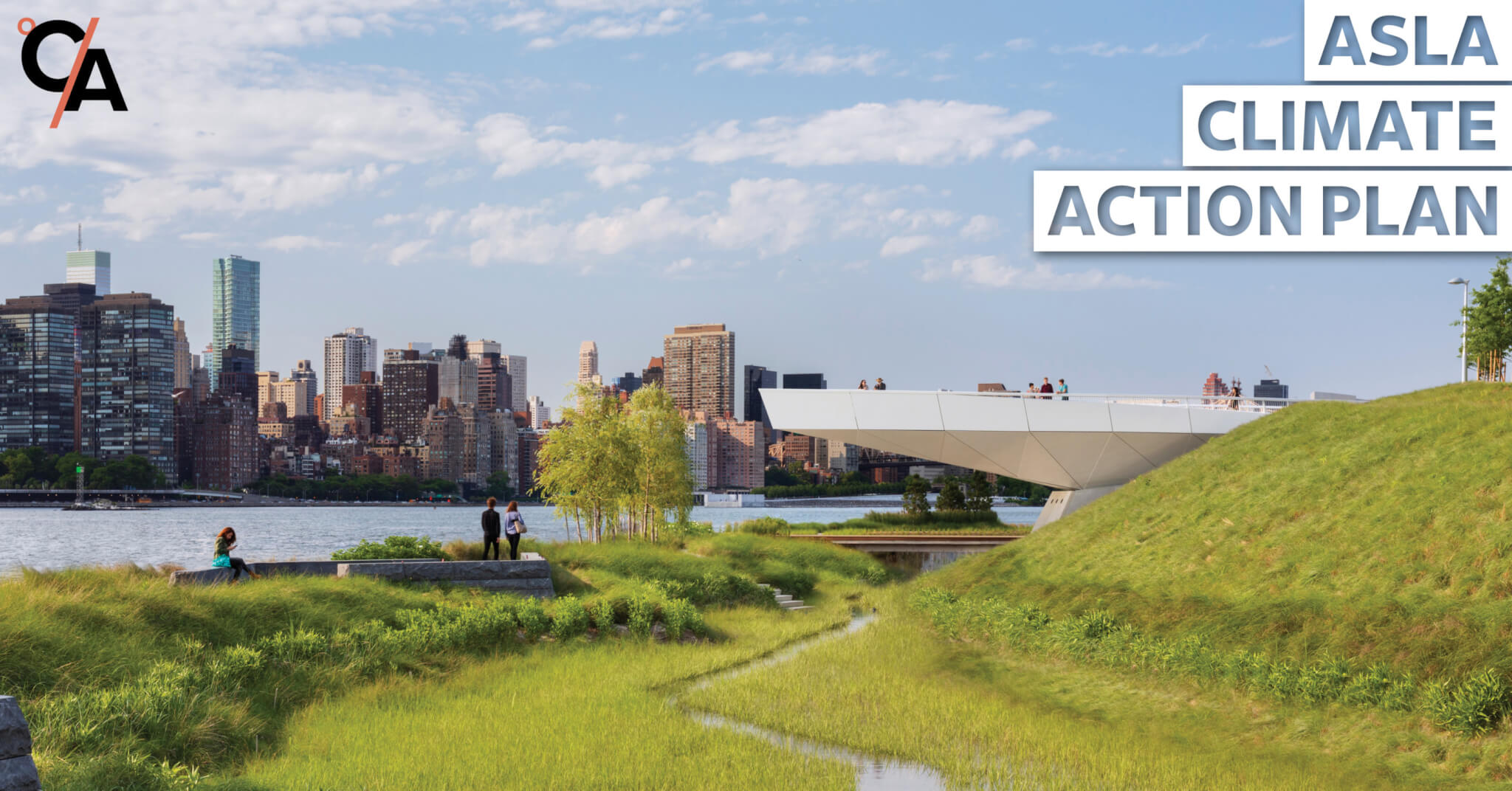
The ASLA Climate Action Plan, a sprawling framework conceived as a pathway for landscape architects to achieve zero emissions in their projects and operations by 2040, serves as a natural (and necessary) next step following the actions of last year. Developed in the “spirt of great optimism,” to quote ASLA CEO Torey Carter-Conneen, the plan puts forth the same three goals (Practice, Equity, Advocacy) and six core initiatives (Carbon Drawdown, Climate Resilience, Climate Agency, Cultural Empowerment, Climate Leadership, Global Alliance) of the IFLA Climate Action Commitment. These goals are propelled via 21 objectives and 71 distinct actions, conceived to be achieved by 2025 with plans for the latter to be revisited and revised every five years until 2040.
Several action items within each goal/initiative category will be prioritized in the coming year for internal and donor-based funding.
The plan was developed by a Climate Action Plan Task Force comprised of five members and chaired by Pamela Conrad, a San Francisco–based landscape architect and founder of the research initiative Climate Positive Design. Conrad, who traveled this week from the ASLA’s big shindig in San Francisco straight to Sharm el-Sheikh to introduce the ASLA’s climate plan as a co-delegate, is also a 2022–2023 Loeb Fellow at the Harvard Graduate School of Design and senior fellow with Architecture 2030.
At COP27, Conrad presented the ASLA’s climate vision and goals alongside Kotchakorn Voraakhom, an International ASLA member and founder of Bangkok-based landscape architecture and urban design studio Landprocess. The presence of Conrad and Voraakhom at COP27 marks the first time that the ASLA has sent a delegation team to the summit. (Conrad also served on the team behind SOM’s Urban Sequoia project, which was presented at COP27 in its latest, ready-to-build iteration.)
A 17-person advisory group also aided in the development of the ASLA Climate Action Plan, with members including, among others, SCAPE’s Kate Orff and Pippa Brashear, Studio-MLA president Mia Lehrer, Matt Williams, planner with the City of Detroit Planning & Development, and Greg Kochanowski, design principal and partner at GGA and founder of The Wild. Speaking to AN, Conrad described the Climate Advisory Group as a markedly diverse cohort with members bringing a wide range of expertise to the proverbial table. They “provided thoughtful feedback through the process that we [the task force] incorporated” into the plan, she said.
Conrad described the ASLA’s move as being “unprecedented from a discipline in terms of starting at an international level” and then, just a year later, “launching and developing a climate action plan as an immediate response.”
“We’ve made this commitment and so now how are we going to take action? How are we going to implement this? And how are we going to support our members in taking this action?” Conrad said of the swift maneuver to turn a sweeping professional pledge enacted on a global scale into a comprehensive vision for the future. “I think this is unique [to the global landscape architecture community] and obviously in response to the pressing crises that we face.”
Conrad also emphasized the collaborate nature of the convergence of various international professional landscape organizations coming together under the IFLA umbrella to work toward a common, urgent goal—or in this case, goals. “We have really come together around this issue, recognizing the global imperative and importance for us to work together,” she said.
While the zero-emissions-by-2040 benchmark provides the core thrust of the ASLA Climate Action Plan, Conrad explained that the framework also aims to double biogenic carbon sequestration from what she called “business as usual” practices. This, she explained, is “unique to our profession’s contributions as our work contains landscapes—trees, plants, and soils that can draw carbon dioxide from the atmosphere.” Conrad also highlighted the plan’s “30×30” commitment to protecting 30 percent of terrestrial, coastal, and ocean ecosystems by 2030 along with a 10 percent biodiversity net gain aligned with the UN Decade of Ecosystem Restoration agenda.
Buoyed by the Climate Agency and Cultural Empowerment initiatives set forth by the IFLA, the equity goal is a particularly salient one that places a sharpened focus on community building and involvement.
“While our profession has always been community oriented, over the last five-plus years, there has been a significant shift towards participatory design within landscape architecture,” explained Conrad.
Conrad pointed out the San Francisco Waterfront Resilience Program, a project that aims to bolster a 7.5 stretch of urban waterfront against seismic activity and sea level rise, as being an example of a major, multiyear effort that places community at the forefront. Helmed by the Port of San Francisco and Jacobs alongside a larger team that includes SITELAB and CMG Landscape Architecture (the firm where Conrad is a principal), the program has been shaped by hundreds of community engagement sessions and the close involvement of historically underserved communities in San Francisco. Adoption strategies are now open for public comment and can be viewed here.
As detailed in the ASLA Climate Action Plan’s executive summary, prioritized action items within the equity goal include developing a workshop series with partner organizations that focus on equitable zero-emission growth and the development of an equity measure/metric that must be checked/applied when executing all goals of the plan.
Relatedly, the ASLA Climate Action Field Guide highlights supporting the Justice 40 initiative, which, as Conrad explained, “helps to start putting metrics to how we will support equity going forward.”
Describing equitable community development as “being at the center of taking climate action,” Conrad went on to note that “all communities should benefit in an equitable way from landscapes that can store carbon, increase biodiversity, have economic opportunities, and improve public health.”
“That’s really what we’re hoping to do–make equity a central and core part of all the work that we are doing,” she added, “especially work that relates to the climate crisis.”
You can view both the full ASLA Climate Action Plan here and the ASLA Climate Plan Action Field Guide here.
It is also worth noting that from an organizational standpoint, the ALSA is also striving to reduce its own operations-based emissions by 20 percent by 2024; the association is also calculating baseline Scope 1, 2, and 3 emissions for the just-concluded 2022 Conference on Landscape Architecture and at its Washington, D.C. headquarters. As noted in a press statement, the organization will “use its own journey to zero as a learning opportunity for its members, EXPO exhibitors, and partner organizations.”
“We are the only design professionals who bring all the pieces together to plan and design what communities need to prepare themselves for a changing world,” elaborated ASLA President Eugenia Martin.
Unlike this year, the 2023 ASLA Conference on Landscape Architecture and 28th United Nations Climate Conference don’t sync up quite so neatly—the former is scheduled for October 27–30 in Minneapolis while the United Arab Emirates will host COP28 from November 6–17. But as demonstrated over the past two years, the landscape architecture profession will no doubt have a voice in the room as global leaders come together to chart the path for a cleaner, greener, and more equitable future.