Whether or not architecture is an art, buildings and spaces shape daily life. Pushing the boundaries of architecture and the categorization of art, contemporary investigations between disciplines are rethinking tradition. As transformations grounded in human experience, these installations and structures share qualities of purpose, function and creative expression. At the same time, they reorient the limitations and possibilities of each profession.
+ 7
Showcasing work that explores the boundaries and potential of architect and artist collaborations, each of the following projects straddle this line. As Camilla Ghisleni has pointed out before, the idea of integration between art and architecture dates back to the very origin of the discipline, but it took on a new meaning and social purpose during the Avant-Garde movement of the early twentieth century. Today, the work expands the definition of architecture to encompass more than buildings, and in turn, broadens our understanding of art.
Art, in general, is produced to be seen or experienced by another, an interlocutor, who, in turn, establishes various relationships with the work. However, this does not appear to be the case with the Bataan Chapel, built by the Swiss artist Not Vital in the Philippines. Punished by constant winds, the work rises on a hill in rural Bagac, a town of just under 30,000 inhabitants located about 50 kilometers west of Manilla. The remote location of the installation makes it difficult to access and makes the journey a task that takes on the air of pilgrimage—part of its grace lies precisely in its inaccessibility.
Ellsworth Kelly died in December 2015 at the age of 92, less than a year after he announced a gift of one of his most lasting creative contributions: plans for the artist’s only building, which had been sitting in his New York studio since 1986. Titled Austin, this 2,715-square-foot work on the grounds of the Blanton Museum of Art on the University of Texas at Austin campus would be his final—and perhaps greatest—effort, an immersive space whose artistic value matches that of the marble panels and sculpture within. Unlike the Rothko Chapel in Houston, in Austin the artist and architect are one, says Carter E. Foster, the Blanton’s deputy director for curatorial affairs.
Gateways was located at the central fountain in Granary Square, King’s Cross. It was designed to celebrate the DesignJunction event, an interior design show by and for the industry, set in challenging industrial sites as part of the greater London Design Festival. The installation was comprised of four bold and unique arches, each characterized by its own profile, patterns, and colors. The four-meter-high arches were clad in vibrant and rich Turkish ceramic tiles designed by artist Adam Nathaniel Furman in collaboration with Turkishceramics. Each of the arches told a different design story.
Korean artist Jazoo Yang completed one of her more iconic pieces, titled “Dots: Motgol 66.” The work covered a home set for demolition in the small Korean village of Motgol, Busan with Yang’s thumbprint. Working for 4-5 hours a day, 3 days a week, “Motgol 66” was the first time Yang was able to realize her project goal, with two previous incidents of homes being demolished early. The work draws attention to the nuances of corruption and apathy in Korea’s housing market. With its economic growth, housing development in Korea continued at an unprecedented rate.
The internationally – and often controversial – acclaimed artist Christo unveiled the “largest indoor sculpture ever made” back in 2013. Prepared to debut in a public exhibition, the inflated “Big Air Package” was designed to occupy a 117-meter-tall former gas tank known as Gasometer Oberhausen in Germany. The 90-meter-high, 50-meter-wide sculpture was made from 20,350 square meters of semitransparent polyester fabric and 4,500 meters of rope, with a total weight of 5.3 tons and a volume of 177,000 cubic meters. The seemingly endless, inflatable installation was conceived in 2010 and was Christo’s first major work after the passing of his wife and artistic partner Jeanne-Claude in 2009.
The highly anticipated “Twilight Epiphany” Skyspace, designed by American artist James Turrell, opened to the public with a sunset light show. The abstract pyramidal structure complemented the natural light present at sunrise and sunset, creating a mesmerizing light show that connected the beauty of the natural world with the surrounding campus. This experience is enhanced by an LED light performance that projected onto the 72-by-72-foot thin white roof, which offered views to the sky through a 14-by-14-foot opening. Additionally, the Turrell Skyspace was acoustically engineered for musical performances and as a laboratory for music school students.
More articles to consider:
This article is part of the ArchDaily Topics: Architecture Without Buildings. Every month we explore a topic in-depth through articles, interviews, news, and projects. Learn more about our ArchDaily topics. As always, at ArchDaily we welcome the contributions of our readers; if you want to submit an article or project, contact us.
ATHENS — “Sea, sunshine and intercourse, with some Greek columns in the history,” mentioned Poka Yio, the artistic director of the Athens Biennale. He was summing up the Greek government’s tourism campaigns in the 2000s as he led a visitor about a rambling former department shop that was a single of the internet sites of the 2021 version. Portion of the inspiration for setting up the biennale in 2007, he mentioned, was to alter that stereotype: “We preferred to place Athens on the modern artwork cultural map.”
Fifteen many years later on, Athens is surely on the worldwide artwork group radar, nevertheless more as a curiosity than a significant hub. Even with the pandemic, 40,000 website visitors attended the monthlong Biennale, which ran via November. According to the organizers, 10,000 of all those came from abroad, and the Greek cash also teemed with world-class exhibitions, like the Neon Foundation’s 59-artist group exhibit “Portals” in a freshly renovated previous tobacco manufacturing facility.
“If the political powers understood how a lot Athens is currently being talked about as a present-day cultural place, they could shell out more attention, for the reason that it suggests revenue and image,” explained Katerina Gregos, the director of the Nationwide Museum of Up to date Artwork, recognised as EMST. But contemporary artwork, she added, is comparatively new to the Greek scene. “We have been living beneath the shadow of the Acropolis for a extensive time” she reported.
Gregos, who was born in Greece and was the founding director of the Deste Basis, prior to afterwards using up the EMST task past summer months, was referring to the cultural dominance of Greece’s classical heritage, which attracts most of the sector’s point out funding.
“We have been dwelling less than the shadow of the Acropolis for a extensive time” mentioned Katerina Gregos, EMST’s director.Credit rating…Panos Kokkinias
“It’s easy to understand,” she explained. “When you have these types of an incredible cultural heritage to safeguard, it’s an huge duty, and we are a little region with finite funds.” She added, “The contemporary Greek country condition was fashioned in accordance to classical ideas, so this consciousness is section of our identity.”
As a end result, she stated, there has been really minimal authorities assist for modern visual art, with no funding physique like the Arts Councils in England, Canada or Australia, or state-funded group to guidance person artists. As an alternative, the hole is loaded by personal establishments like the Deste, Neon, Onassis and Stavros Niarchos Foundations, which hand out grants, host artist residencies and set on exhibitions.
“The huge foundations have performed a massive function in transforming attitudes to modern day artwork by developing an ecosystem,” Yio mentioned. “And Athens has yet another exclusive element, which is little initiatives. So many folks come below now to open up artwork spaces mainly because it’s so affordable.” The 2017 arrival of the just about every-five-12 months Documenta exhibition — the 1st time the key artwork globe party experienced been staged outdoors Germany — was a recreation changer, he additional.
Yet these private sector initiatives, whatsoever their results, do not “substitute the have to have for a public coverage,” Gregos mentioned.
The Greek govt appears recently to concur. In July 2019, Nicholas Yatromanolakis, a Harvard graduate, was appointed secretary for modern lifestyle, just before staying promoted at the start out of 2021 to the tradition minister’s deputy, liable for modern tradition.
Interviewed in his business in the graffiti-strewn central Athens district of Excharcheia, the 46-year-previous Yatromanolakis mentioned that modern lifestyle hadn’t formerly been observed as a major contributor to the economy, or essential to Greece’s international impression and tender electricity.
“The pandemic hit the present-day sector pretty difficult, and I believe the primary minister acknowledged the want to make investments a lot more on that entrance,” he claimed.
A single of Yatromanolakis’s initial tasks was to get EMST open swiftly. The museum, which was established in 2000, was a nomadic operation for 15 a long time just before a 1957 former brewery in central Athens was preferred as its website. But even then, lengthy delays in building and financing, commonly viewed as symptomatic of systemic dysfunction, intended it was not completely operational until just right before the coronavirus pandemic broke out in early 2020.
All over the exact time, Gregos was approached by the tradition ministry to run the museum. She was the two psyched and skeptical about the strategy, she claimed, for the reason that the Greek economic crisis that began in 2009 experienced meant deep cuts in all regions of federal government investing. But she accepted. “It is Greece’s flagship establishment for modern art,” she mentioned. “You couldn’t be provided a extra exciting and challenging occupation.”
Modern cultural initiatives in Greece are presently allocated all around a quarter to a 3rd of the culture spending plan — which has averaged all-around $400 million for the past 7 several years — when the relaxation is allotted to the classical heritage web pages. It is a somewhat modest volume when unfold between heritage assignments, the nationwide theaters and museums, and modern lifestyle, claimed Yerassimos Yannopoulos, a attorney and board member of EMST. (For context, France’s culture budget is all-around $4 billion.)
“The prime minister is incredibly a great deal guiding this concept of promoting modern day lifestyle, and Nicholas Yatromanolakis is a definitely brilliant person, but Greece has been in a dire predicament since the credit card debt crisis,” he mentioned. He additional, “And you can’t change issues about by sticking to the wonderful archaeological legacy.”
Nevertheless Yatromanolakis stated binary pondering can be unhelpful. “I think pitting the classical against the present-day is unproductive,” he mentioned. “It should be collaborative,” he extra, citing as an case in point a 2019 exhibition of performs by the British artist Antony Gormley amid ruins and classical artifacts on Delos island.
In a observe-up email, Yatromanolakis sent the figures for condition funding for small-scale up to date projects, displaying a notable augmentation, from around 50 percent a million bucks in 2015 to all over $11 million in 2020. He also highlighted additional European Union funds from the Recovery and Resilience Facility, set up to mitigate the impression of the pandemic, which delivers yet another half a billion euros to Greece’s society sector, similarly divided concerning heritage and modern day initiatives.
Afroditi Panagiotakou, the director of culture at the Onassis Foundation, stated that the deficiency of focus on modern society in Greece was the rationale for creating the Onassis Cultural Middle. That building, with its two theaters and exhibition spaces, opened in 2011. “We ended up in an financial disaster and the Greek condition merely did not have the indicates,” she said.
But productively supporting modern day art needs far more than just revenue, she extra. “Ultimately the people who alter the scene are the artists by themselves,” she stated. “Our position is to support them, operate with them, be there for them.”
Yatromanolakis claimed that the personal foundations routinely worked closely with the point out, citing the Stavros Niarchos Basis Cultural Centre, which houses the Greek Countrywide Opera and Ballet, and the Onassis Foundation’s funding for a new elevator for the Acropolis. “It’s not a competitiveness,” he said.
He added that the most ambitious venture on his agenda was labor and social reform for freelance artists, whose desires are not taken into account by existing taxation and work legislation. “If we never repair that, we will not have the instruments to enable lifestyle industry experts to stay from their do the job,” he reported. “There was nothing in spot for present-day culture, so you have to get started from scratch,” Yatromanolakis additional. “Despite all the awful factors the pandemic introduced, I believe we can use this as a turning stage on how we do items.”
Athens could not have fiscal ability, reported Yio, the Biennale director, but with its inflow of migrants and artists, it was a rising metropolis, “a counterbalance to the London-Paris-Berlin tripod.” Greeks, he additional, have in no way experienced “a bourgeois understanding” of artwork. “Modernism was missed below, and we are now hoping to make enormous leaps,” he reported. “We don’t have several of the techniques and constructions that other nations have. But this is a quite beneficial matter, much too, and aspect of what would make Athens so seductive. Almost everything is even now attainable in this area.”
When Minneapolis town workers come back to do the job on January 10th — at this time the approach, at minimum in a hybrid perception, depending on the department — they’ll be in for pretty a deal with. Numerous of the 1000’s of persons who (theoretically) operate in the manufacturer new 10-tale Community Assistance Building covering everything from 311 to General public Performs to the Police, have by no means even seen their new workplaces. In place of remaining scattered all all-around office web-sites in a wide range of downtown places, they’ll all be centralized. And waiting around for them will be the biggest debut of city community artwork in Minneapolis background.
“We barely at any time do the job indoors,” admitted Mary Altman, the city’s Community Artwork Administrator, describing the city’s other public artworks. “Usually all of our artwork has to take care of freeze-thaw problems, and be prepared all-around what it would be like to be strike by a car or truck or plow or garden mower.”
That’s not the case for the $2M of artworks that are actually embedded in the new making, funded as a result of the city’s community art ordinance that dedicates 1.5{6d6906d986cb38e604952ede6d65f3d49470e23f1a526661621333fa74363c48} of capital budgets to art.
“There are three essential types of function: artist-intended chicken safe and sound glass, murals designed on glass, and elevator foyer ceilings,” reported Altman. “It’s been genuinely great to be ready to do this. This is a at the time-in-a- life span possibility.”
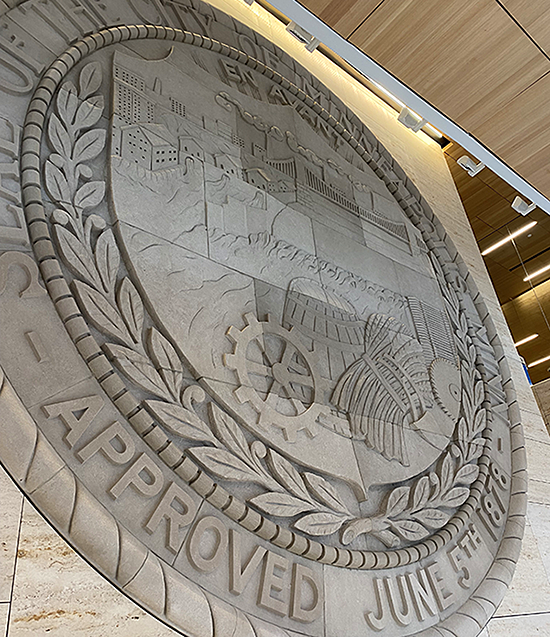
Closeup with the city seal
A historic artwork varieties the eye catching centerpiece of the overall developing: the 26-foot tall foot Seal of Minneapolis, embedded in the centre of the wall welcoming people.
As far as seals go, it is one particular of the far better ones, surely excellent to the blatantly racist state seal or the epically uninteresting seal of St. Paul. Not trying to do much too much, the brand depicting St. Anthony Falls at its industrial zenith, underneath the overdone slogan, “En Avant.” (French for “forward.”)
Visible even from throughout the street, the seal is a impressive bit of historic preservation. It was once component of the aged Minneapolis Auditorium, the substantial historic property to the Minneapolis Lakers, that lasted from 1927 to 1989. It was embedded in the wall there, 5 stories above the sidewalk, whereupon a Minneapolis town staff named Greg Goeke saved it from the rubble, and held it preserved in a farm subject for three a long time.
MinnPost photograph by Monthly bill Lindeke
Protip: from the cantilevered skyway-hooked up walkway above the primary lobby, you can get an up-near view of the seal, and lean in and almost touch the adorable puffs of coal pollution coming out of the mill smokestacks.
In accordance to Altman, lots of of the sixteen artists whose get the job done is now in the building utilised the seal as a partial inspiration for their parts. For most or all of them, the triumphalist European-American industrial vision grew to become something to respond to, a foil for a new vision of 21st century Minneapolis.
Post carries on after ad
Artistic salve for the mundane get the job done of city bureaucracy
Functioning for government has a popularity of currently being a little bit monotonous and repetitive. And If you spend sufficient time between the cubicles of municipal workplaces — as I have — you know that the stereotype is not a entire fabrication processing property setback permits, applying municipal tax codes or signing off on bridge engineering is not exactly captivating perform.
Maybe that is why so a lot of the new art in the Community Services Setting up is dynamic: it modifications during the working day and through the year, as if it is deliberately made to alleviate tedium.
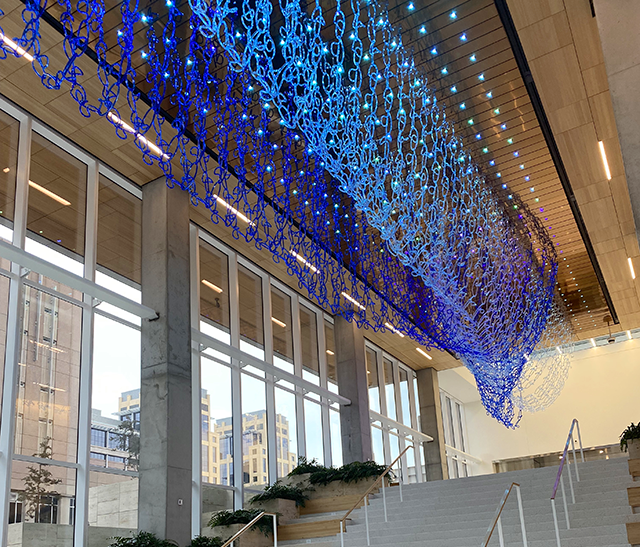
Just take for case in point, the centerpiece of the new will work, the enormous sculpture mounted above the shiny white terra-cotta floors that squeak with each and every move by means of the foyer. Named Present Ailments, Tristan Al-Haddad’s elaborate at any time-altering piece is the most high-priced piece in the setting up, and 1 of two new artworks specifically tied to are living feeds of facts. In this case, the LED lights embedded within the shifting resin depict the current temperature and humidity, organized in a time collection that visualizes the knowledge heading again six months.
MinnPost photo by Bill Lindeke
As Altman describes, the piece’s complexity and mercurial nature is a element, not a bug. It is intended to continue to keep town personnel and visitors interested and engaged, give a thing various value paying interest to, day in and day out.
“There are persons in this creating that are right here every working day, for many years,” spelled out Altman, who, as a twenty-yr-veteran of metropolis govt, should really know. “They see it all the time [so] the art do the job can’t be a single ‘a-ha’ instant, it is received to be some thing exactly where the staff members keep on to see new things over time. A large amount of the artists are performing items in their works in which there’s either great attention to depth or one thing that really captivates folks for the duration of their encounter listed here.”
To that stop, Al-Haddad’s sculpture is probable never ever the same two times. It slowly reconfigures itself through the day, as very well as doing specific “programs” at sunrise and sunset. (These times, throughout the winter season solstice, it would be probable for a town employee to be about for equally of these situations.) It even delivers an artistic silver lining to those unlucky souls who have to function late.
“At night time, it plays a ‘deep indigo’ program,” described Altman. “The terrazzo just picks it up and it’s gorgeous it is really enjoyment to be listed here at evening.”
Post continues after ad
Elevator scavenger hunt
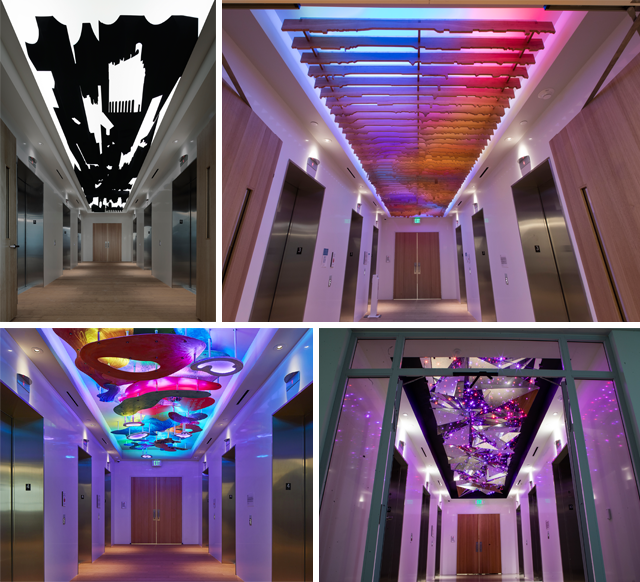
Imagine it or not, the most exciting artworks of the new creating are the ceilings of the elevator lobbies. Just about every of the seven obtainable flooring has a distinctly lit installation that, when seen in blend with the other folks, turns the constructing alone into an immersive working experience that is at least as fantastic as that cloying Van Gogh exhibit that was generating the rounds.
In other words, when you’re acquiring off the elevator on your way all around the business office, be sure to glimpse up.
“We gave the artists a foot of depth to do the job with and a requirement to use programmable LED lights,” described Altman. “They experienced to stick to building code, which was complex, but those people had been the primary parameters.”
Together the way, the artists interviewed employees in the distinctive departments to get a perception of the form of work opportunities they had, what kind of area they would respect, and a record of their fields.
The end result is 7 distinct, innovative areas that make a visit to the Public Assistance Developing a exciting journey for a visitor. In this way, it’s not unlike the lobby of the now-90-year-previous St. Paul Metropolis Corridor, where the 18 tales all have distinct kinds of wooden wall paneling.
Town of Minneapolis
From what I was able to glean from conversing with Altman, the most popular ceiling set up so far is by an artist staff known as LUCITO, named Likeness of an Allegory. Located on the 6th ground, at first look the thick black molding seems a bit harsh and grim for an workplace setting.
But the lengthier you gaze, the a lot more you get started to comprehend the cutout images are a pop-up ebook in reverse. Transferring about the flooring, and adjusting your angle, legendary Minneapolis styles expose themselves. It is a entertaining sport to wait for the elevator as the Stone Arch Bridge, Prince’s silhouette, or [gulp] the Twitter icon expose by themselves in the chaos.
Quite a few of the many others are more refined. I specially liked the 3rd flooring lobby, a perform tied to the currents and drinking water stages of the Mississippi River at St. Anthony Falls, and the 10th flooring foyer, designed by Rory Erler Wakemup, designed to mimic the night time sky. Each individual ground offers a little something various, whole of changing LED specifics value noticing.
Article proceeds after ad
“There are unique moods,” stated Altman, describing the set up by Christopher Harrison on the 4th Flooring. “Here, the artist wanted to generate a tranquil piece, simply because they are informed of the stress that employees are beneath. 311 is a notably nerve-racking occupation. You will see on the law enforcement ground on the health floor that was a aim to guidance worker wellness, and make places that are additional tranquil.”
Double-sided murals
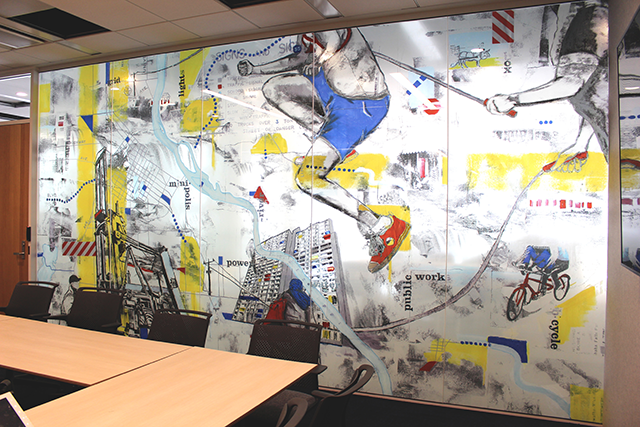
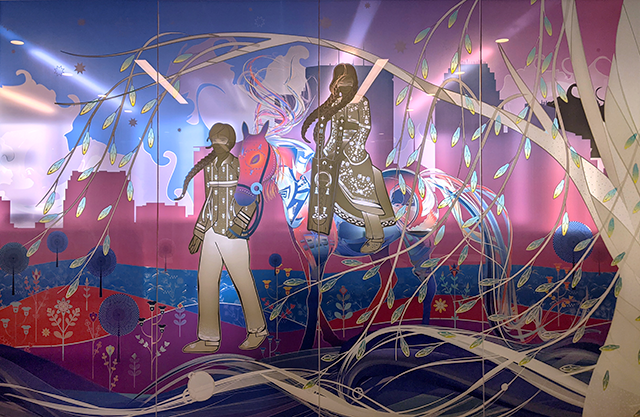
Custom made murals on substantial glass partitions in each individual floor’s meeting place are a different critical aspect of the building’s inventive setting. Created from levels of semi-opaque vinyl in diverse shades utilized to the glass partitions, they give the rooms an inside-outside the house dynamism.
The murals are all distinct and complete of fulfilling element, created far more so by their two-sided mother nature exactly where a single side of the wall bursts with color though the other retains a far more monochromatic outcome. The one that most appealed to my urbanist sensibilities was on the 4th flooring, a operate named “Power and Play” by Witt Siasoco. Drawing on the the colour palette from Ralph Rapson’s Riverside Plaza, it exhibits a palimpsest of maps, the river’s silhouette and photographs of people enjoying diverse online games.
City of Minneapolis
I also liked Dakota artist Marlena Myles’ two-part mural depicting figures about the sacred room of the falls, and Kao Lee Thao’s mural of a Hmong tale fabric artist that adorn the 6th and 5th floors, respectively. They are pretty much adequate to make you want to sit as a result of a two-hour meeting about sewer substitution scheduling.
City of Minneapolis
Acquiring the method right was a demo-and-error and, in some conditions, expected 4 prototype checks to make certain the software mirrored the artists’ vision.
Sci-fi vibes
Taken as a entire, the new making feels a little bit like a science-fiction established, just one from movies like Her or Star Trek. The new making has “smart” temperature and light-weight controls, and even the artworks hanging from the ceiling appear to be alive, shifting to reveal the humidity or the sunset or the temper of the metropolis by itself. But as COVID-risk-free tv screens wait around for users of the community, and a robotic but calming woman voice phone calls out “Now serving T-zero seven four two 7 5,” I wonder if this fiction is fully utopian.
I really do not truly desire for anyone to have to apply for a setting up renovation permit or tax evaluation variance. But if you do, I recommend savoring your time in the new Public Services Making. Changing a parking ramp, it nicely deserves its architectural and style accolades. Going for walks through the doors onto the substantial mat, embossed with san-serif City OF MINNEAPOLIS lettering, feels like eventually stepping into a improved future that we all know that metropolis governing administration can a person day grow to be.
A “leaky dam” is not one thing I’d read of just before coming to Broughton Corridor Estate in North Yorkshire, but, as I uncovered, it truly is quite aptly named.
Leaky dams have been created in streams throughout the estate as portion of a all-natural flood management job.
The “leaky” part is pretty deliberate.
An inspiration from nature
Impression: ‘Leaky dams’ like this acquire inspiration from buildings developed by beavers. Pic: Eden Rivers Believe in
These dams, built from twigs, leaves and natural particles, take care of the flow of h2o downstream although however permitting fish to go.
Slowing the move of water by the estate allows to protect against flooding in communities in close by decrease-lying land.
Some thing identical to these leaky dams would normally be carried out by beavers, but you is not going to uncover them at Broughton these days, they were being hunted to extinction in Yorkshire in the sixteenth century.
Beavers could be reintroduced into English countryside for environmental positive aspects right after 400 a long time
Image: Beavers’ were hunted to extinction hundreds of years ago
Replicating their endeavours is element of a much larger venture on the estate staying overseen by Professor Alastair Driver – an specialist on conservation and rewilding.
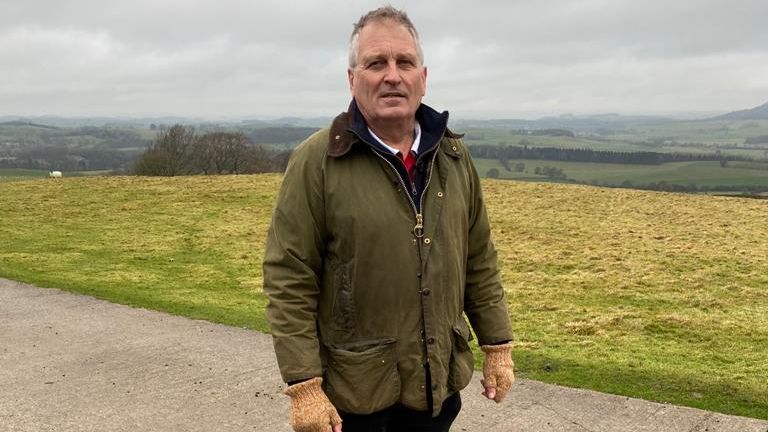
He said: “If you roughen up the landscape with a huge rewilding task and you put into practice these pure flood administration interventions you are going to make a major variation.”
Graphic: Professor Alastair Driver is aiding develop ‘leaky dams’
A history of floods
The methods they are employing listed here to deal with drinking water stream are major for people residing in spots bordering the River Aire, particularly Leeds.
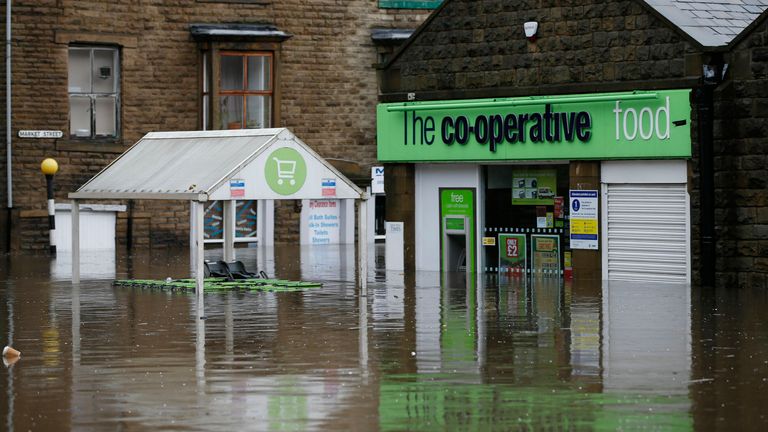
In 2015 Leeds, and other sections of the North of England, professional catastrophic flooding. The Leeds Flood Alleviation Scheme is a £160m project developed to secure 1,048 residences and 474 companies from long run flooding.
Impression: In 2015, flood waters caused millions of kilos of harm in Yorkshire and the north of Terrific Britain
Broughton is a sprawling and gorgeous estate within just the Yorkshire Dales.
The operate there forms section of that scheme, partly by building absolutely sure drinking water has extra room to stream on the estate right before it hits city regions like Leeds. This consists of “daylighting” h2o that has, for numerous several years, been flowing by pipes beneath the estate’s fields.
Broughton Corridor has been owned by the exact family members for virtually 1,000 decades, and sheep farming has been a lengthy-running aspect of the estate’s history.
There are even now sheep in this article today but the land is now currently being applied for other reasons to serve the ecosystem and surrounding communities much more efficiently.
Picture: The grounds of Broughton Hall have been used for sheep farming for hundreds of several years
Professor Driver claims that the water pipes beneath the fields were in all probability created to absolutely free up space previously mentioned floor for grazing.
Searching across this “daylighted” stream, the drinking water seems totally free to obtain its have system.
Professor Driver claims when he final came to see the development of the stream a heron flew out of it. That minute felt symbolic, it reminded him of the importance of the “back again to character” approach they are getting at Broughton.
They are also planting hundreds of hundreds of trees here. Not only will trees enable to minimize the danger of flooding by slowing the circulation of rainwater – they also store carbon.
Picture: Drinking water is now permitted to uncover its possess way through the landscape
Much more to be carried out to counter local climate transform
Combatting local weather adjust is a vital element of the do the job they’re executing on the estate and exhibits how flood management techniques can have other critical gains like lowering emissions.
“We need to be pondering about the wider natural environment, local weather transform, biodiversity, people’s well being and properly remaining. All of these other added benefits need to have to be section of that,” says Professor Driver.
But of study course, there have to have to be incentives for farmers throughout the nation who depend on sheep to make a living.
The governing administration needs farmers to apply for subsidies less than a scheme intended to allocate “community revenue for community goods”, which means they are going to be paid out to use their land to supply environmental rewards.
This is intended to prevent farmers from getting a economic hit from getting to be much more eco-friendly. Professor Driver claims this scheme is desired, but a lot of farmers want to see assurances about lengthy expression funding so that landowners can have self-assurance in investing in more eco-helpful methods and technologies.
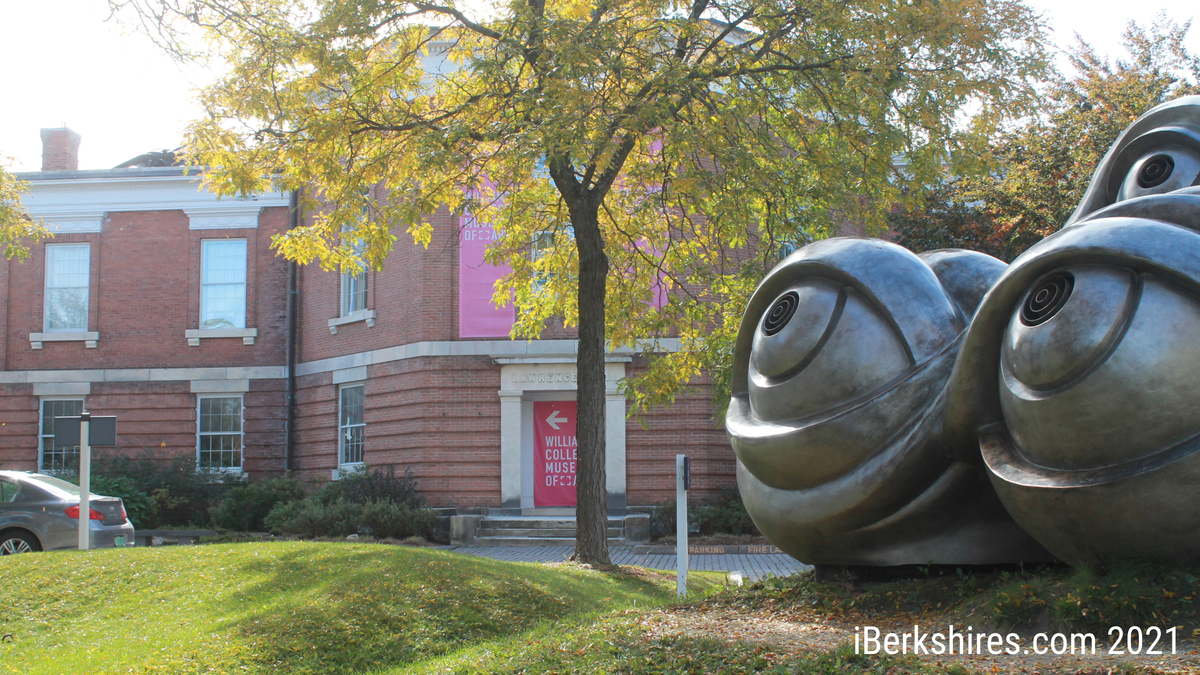
Lawrence Hall on Main Street, the current home of the Williams College Museum of Art. At right, Louise Bourgeois’ ‘Eyes,’ a granite, bronze and electric light sculpture commissioned for the museum’s 75th anniversary and installed in 2001 according to a marker on the museum grounds.
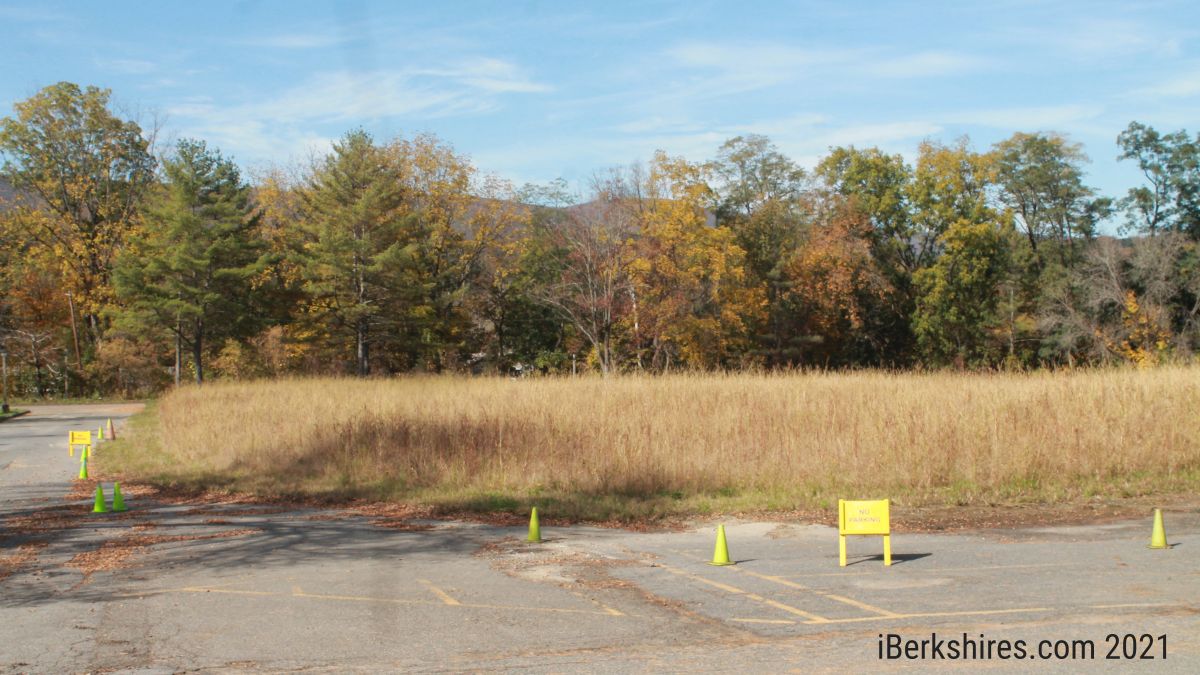
The site of the old Williams Inn will be WCMA’s new location.
WILLIAMSTOWN, Mass. — The Williams College Museum of Art has been in the queue for a new building for years as the college has dramatically revamped its campus over the past two decades.
Now the nearly 100-year-old museum is finally getting its turn at a new facility.
The Board of Trustees vote at its last meeting to enter the design phase marks a significant step forward in relocating the museum from the 1846 Lawrence Hall. The trustees two years ago voted to site any new building at the now vacant lot where the old Williams Inn once stood.
“We have been doing really extensive building programming study and work for the last 22 months, since January of 2020, to come up with the space needs for the museum and the art at the college,” said Pamela Franks on Friday, the Class of 1956 director of the museum. “And now, with the completion of this programming exercise, the decision is to go forward to design.”
The museum has been housed in Lawrence Hall since its founding in the 1920s. The octagon hall on the south side of Main Street was the college’s original library and has been expanded numerous times over the past 180 years, the last in 1986.
The deficiencies in the museum’s infrastructure have been cataloged for some time — there are problems with climate control across the five different buildings that now make up the museum; a lack of classroom, office and studio space; difficulty in accessing the building for pedestrians and motorists; no space for further expansion; and little room for an art collection and faculty that has grown exponentially, particularly over the last two decades.
The collection has meanwhile grown to more than 15,000 items, including more than 1,000 from philanthropist Peter Norton and 340 objects of African art from Drs. Carolyn and Eli Newberger just in this century. The bulk of the collection is stored offsite.
Franks, who came to WCMA from Yale University Art Gallery in 2018, said the pandemic lengthened the amount of time that was spent on developing the programming study that will inform the design. The original 10-month study turned into 22 after the novel coronavirus pandemic struck in March 2020. The work was done in consultation with architecture firm Deborah Berke Partners of New York City.
“We ended up being able to delve even more deeply and it was a really rich and productive discussion of a very consultative project,” she said. “It’s a project with lots of conversations with students, faculty, community members and alumni, and, of course, museum staff.”
The museum also did some outreach with other regional museums, especially with the nearby Clark Art Institute and the Massachusetts Museum of Contemporary Art. The project will really benefit from having that additional time, Franks said.
“And it’s very abstract because it’s not about how the museum will look or what the spaces will look like, but it’s about functions and simply space needs,” she said. “You’re looking at classrooms, you’re looking at gallery spaces, you’re talking about back of house preparation spaces … every kind of function you can imagine.”
Space needs are a priority, and not just for classrooms and offices. There’s specialized furniture for exhibiting art and where does that furniture live when it’s not being used, and where is the art going to be exhibited.
And for instance, the single Rose Object Classroom can be used for displaying pieces of the collection for seminar studies.
“That is extremely popular classroom and it is used really pretty continuously,” she said. “As a college museum, the academic connections are really deep with the Art Department, and then really wide across every department on campus.”
The collection cuts a broad swat across history and culture, with links to every discipline on campus, Franks continued, “so being able to access the collection for teaching is a huge part of what we do …
“Every year there’s math classes, biology classes, chemistry classes, but also for the art classes, art history classes and literature classes … We have this kind of signature course every other year that is both an art course and an economics course, on acquiring art for the museum collection. Our program is very much tied to the educational mission of Williams College.”
The museum is also, of course, open to the public and Franks sees its global and historical range as very complementary to the Clark ‘s largely European focus and Mass MoCA’s contemporary works.
“Gallery space is essential to show the collection” to serve both an academic and public audience, Franks said. “But we also want the museum to be extremely accessible and welcoming for all.”
College President Maud Mandel, in a statement Monday, said the new museum will grow out of the college’s commitment to the arts that has defined it for more than a century.
“Each year, faculty, students, and museum staff incorporate our collections into dozens of courses, ranging from art history to anthropology, biology, environmental studies, and mathematics, while our curators mount exhibitions that engage campus and diverse public audiences,” she said. “The new museum’s educational and exhibition spaces will open up new possibilities for our work with campus and community. In the process, they’ll also create further opportunities for collaboration with the thriving arts community of the northern Berkshires. This is far more than a building. It’s the next step in Williams’ commitment to the vibrancy, relevance, and educational importance of the arts.”
Museum construction is still some ways off. The museum staff knows what it needs to function and now it will be up to finding a designer who can bring that vision to life. The cost is also unknown at this point, but the college spent more than $80 million on the new Sawyer Library seven years ago.
Franks anticipates more campus and town discussion as the plans for the building began to take shape. The building project will proceed on a timeline aligning with WCMA’s centennial year of 2026-27.
The old Williams Inn location had been considered one of two potential spots for a new museum. The other, at the intersection of Main and Southworth streets, was abandoned after pushback for residents in that neighborhood.
The inn was purchased by the college in 2014 and demolished last year after the opening of a new inn at the bottom of Spring Street.
Franks said she was excited to be part of this next stage for WCMA.
“I think we have a real an incredible opportunity to have a building that really works beautifully with not only the campus and the town but with also with the landscape,” she said.



 + 7
+ 7