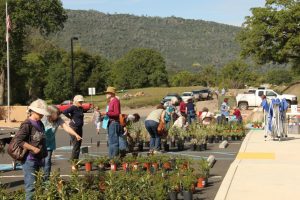
Drought-Tolerant Landscaping Saves Money and Water

Alameda is getting an eco-friendly makeover one drought-tolerant yard at a time

Take a walk around your neighborhood and see how many front lawns are now dry and patchy, turned into yellow straw or dirt. This is no accident, nor are residents too lazy to take care of their yards. Most of them are conserving water. Living in extreme drought has prompted many Alamedans to make major changes in water usage, including converting lawns to drought-tolerant gardens and using drip irrigation systems. Lawns simply have to go in order to plant new landscaping. The initial transition may not always be lovely to look at, but the result can be lush and beautiful—and highly successful at conserving water.

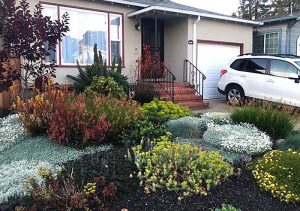
Alameda Post - A Traditional Lawn Alameda Post - Lawn after conversion to draught-tolerant landscaping

Lawn before and after drought-tolerant landscaping. Photos courtesy EBMUD.

Here in the Bay Area, we have reduced our water consumption far more than the average Californian, according to state leaders and Bay Area water agencies gathered this week at the Quarry Lakes Demonstration Garden in Fremont. During the first six months of 2022, we reduced water use to an average of 60 gallons per person per day compared to the state average of 82 gallons, according to East Bay Municipal Utility District (EBMUD). Multiply that by EBMUD’s 1.4 million users and you get a picture of how much we saved by changing our water habits and habitats—at least 72 million gallons a day. “EBMUD customers are phenomenal at conserving water,” EBMUD general manager Clifford Chan said.

Get up to $2000 for making the switch

Transitioning from lawns to drought-tolerant landscaping not only saves water, it also saves money. Less water usage means lower water bills each month. And on top of that, EBMUD issues rebates for lawn conversions of up to $2.50 per square foot, with a maximum of $2,000 for single-family and small multi-family homes, or $15,000 for commercial, municipal, and large multi-family properties. There also are rebates for switching to efficient irrigation systems, using flow meters, and using gray water from indoor sources for outdoor landscaping. Visit the EBMUD website for information about the rebate program and instructions on how to apply.

A lot of Alamedans have already received those rebates. During the past eight years, EBMUD has processed more than 250 lawn conversion rebates, representing more than 380,000 square feet of conversions from lawn to drought-tolerant landscaping within the City of Alameda, according to Nelsy Rodriguez, the water agency’s public information representative. “We’ve also processed approximately 180 rebates for conversion from spray to drip irrigation,” she noted.
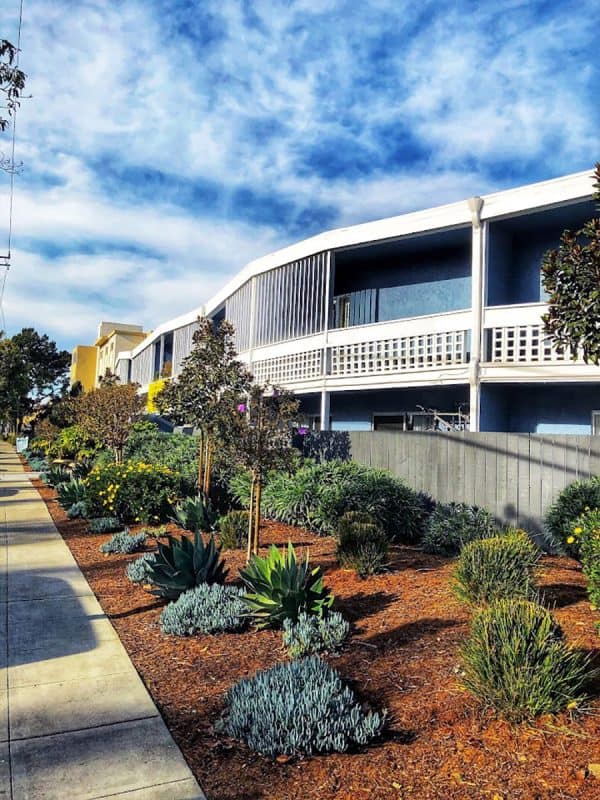
Alameda Post - A Lush Drought-tolerant Landscape at Otis Terrace
Otis Terrace Apartments transformed their sidewalk median into a lush drought-tolerant garden. Photo Google image capture.

It’s not just individual homeowners or renters who are making the switch. Many apartment complexes around town already have converted their lawns to beautiful drought-tolerant gardens. Most of the apartments that line Otis Drive across from the South Shore Center now have drought-tolerant landscaping on their medians between the sidewalk and the street. And the City of Alameda is conserving water as well, not just with City Hall’s new lawn conversion but also with city-owned properties such as Independence Plaza, an apartment complex for people aged 62 and older, which has drought-tolerant, bay-friendly habitat throughout the grounds.
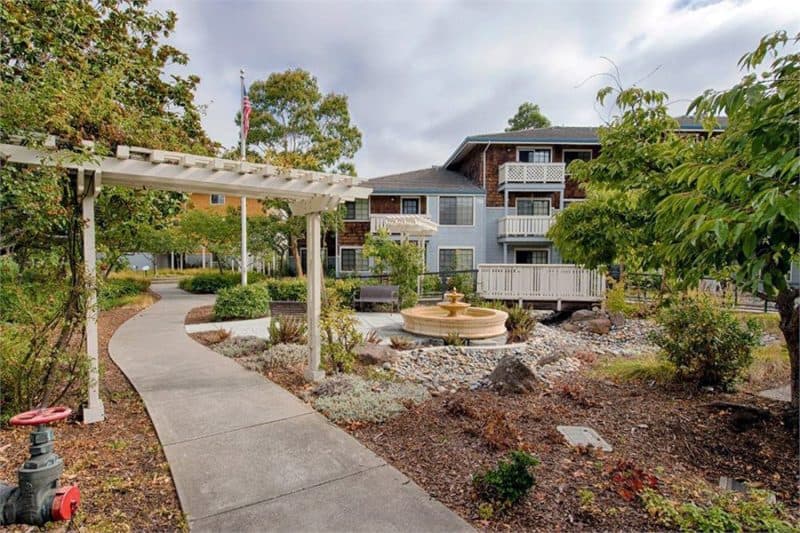
Alameda Post - A Garden with a fountain, rocks, and plants
Independence Plaza’s senior apartment complex features drought-tolerant landscaping. Photo Alameda Housing Authority.

Getting started with a drought-tolerant garden is fairly simple

Ready to convert your yard to a drought-tolerant garden? The first step is to get rid of your lawn in the area you want to re-landscape. The easiest and cheapest way to get started is sheet mulching (see video below).

Start by gathering cardboard boxes, often available from your neighborhood grocery store. Open the boxes out flat, cover your entire lawn with the cardboard, and then cover that with wood chip mulch, or bark. Many tree service companies will deliver free wood chips, and EBMUD will give you coupons for free mulch and compost at nearby nurseries.

Then just wait three to six months to let the cardboard and mulch break down into the soil. The best time to do this is summer or fall, but you can start whenever it is most convenient for you. The key ingredient is patience.

Check out free garden plans

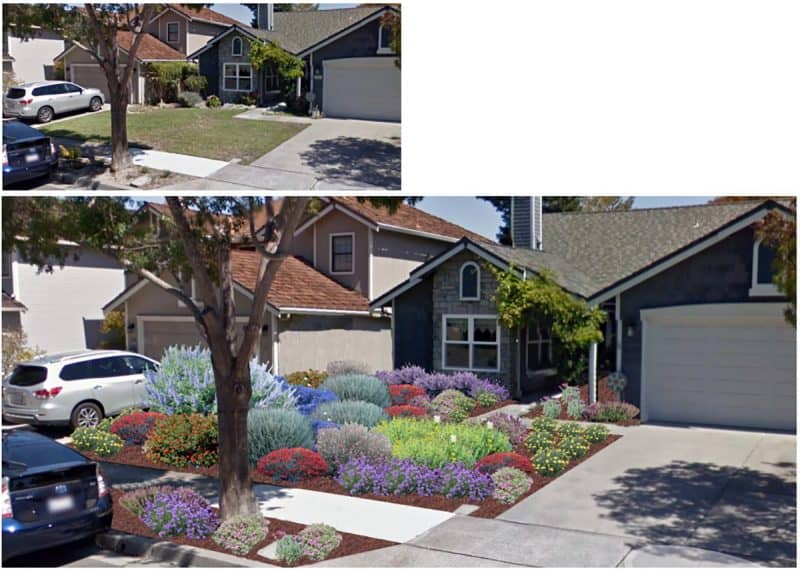
For those of us who aren’t gardening experts, there’s a wealth of information online. The Harbor Bay Isle Homeowners Association (Bay Farm Island) offers free downloadable drought-tolerant landscape plans and lawn conversion guidelines with detailed plans for a variety of different gardens. Take a look at the fully customizable California Native Plant Society garden planner to see plants that are native to Alameda and suit your goals as well as your preferred garden aesthetic.
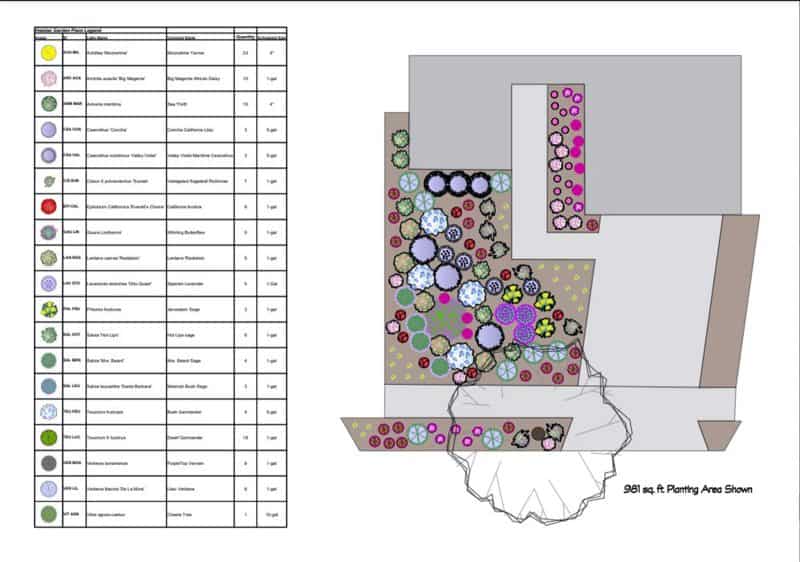
Alameda Post - A birds-eye view of a plan for converting a lawn to a drought-tolerant landscape. The plan includes a map of where all the plants will be placed.
Harbor Bay Isle provides free lawn conversion plans online. Photo HarborBay.org.
Alameda Post - A rendered photo of what a lawn could look like before and after replacing the lawn with a drought-resistant landscape
A rendering of a the lawn transformation using the above plans. Photo HarborBay.org.

Garden Center resources for drought-tolerant plants

And by all means, visit our local nurseries and ask questions. Encinal Nursery (2057 Encinal Ave., open seven days a week) is family-owned and operated and has been here in Alameda since 1946. Their huge variety of beautiful plants is second to none here on the island, and the staff is very helpful. Their greenhouse is filled with cacti and succulents.
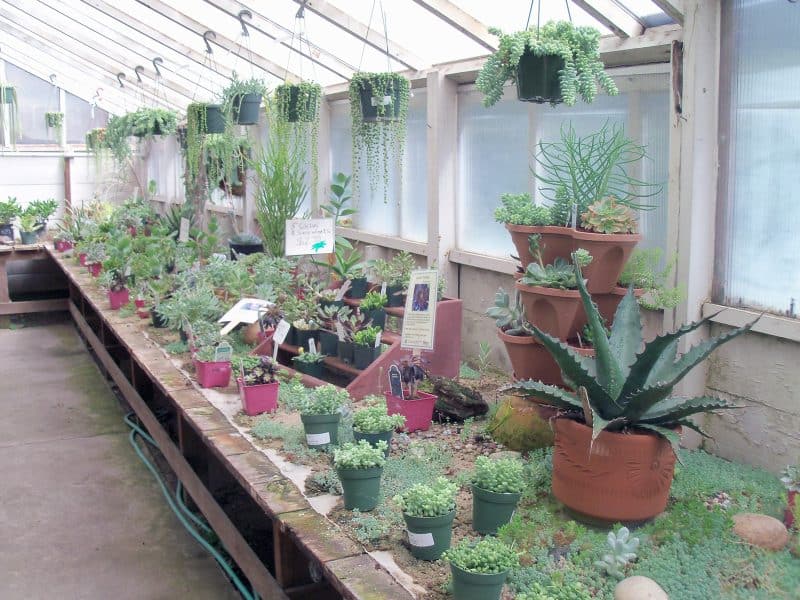
Alameda Post - A wall of different plants available for sale
Encinal Nursery has a wide selection of cacti and succulents. Photo @encinalnursery.

Ploughshares Nursery (2107 Main St., open Wednesday through Sunday), specializes in California native, drought-tolerant, and edible plants. Part of Alameda Point Collaborative (APC), the full-scale nursery has its own demonstration garden and offers hands-on workshops on sustainable landscaping and garden design. Sales from the nursery generate revenue for APC’s supportive housing for the formerly homeless, and the business provides job training to APC residents as well.
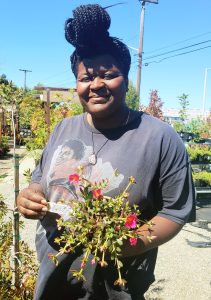
Alameda Post -Ploughshares manager Jordan Taylor smiling and holding a plant
Ploughshares manager Jordan Taylor is happy to help Alamedans with drought-tolerant garden planning. Photo Liz Barrett.

“Many people who come here are looking for heat-lovers and native plants that eventually will take care of themselves as far as water-wise gardening,” said Ploughshares manager Jordan Taylor. “Also, a lot of native plants have natural defenses against pests, so you can avoid using pesticides.”  Walking through the nursery, she noted that although succulents and cacti are beautiful and very popular in drought-tolerant gardens, they’re certainly not the only options. “Native milkweed is amazing,” Jordan said. “Monarch butterflies love milkweed. Echinacea is very popular. And people love passionflower vines. They’re not necessarily native, but they are once established, they are definitely drought-tolerant and very much love the heat. Salvia and most lavender also will be great for your drought-tolerant garden.”  Taylor and her staff are available during business hours and are happy to share advice on garden planning.

Liz Barrett is the Copy Editor of the Alameda Post and writes about the community. Contact her via [email protected]. Her writing is collected at AlamedaPost.com/Liz-Barrett.

Drought-tolerant LA yard thrives after city cease notice

Water-hungry lawns are symbols of Los Angeles’ past. In this series, we spotlight yards with alternative, low-water landscaping built for the future.

Susan and Steve Matloff are doing what they do most days when they are at home: spending time in their front yard with their kids, talking with neighbors, playing with their dog Blue and passing home-grown onions to random passersby.

When they installed raised vegetable beds alongside the sidewalk, they fantasized about living off the land despite warnings from friends that people might steal their produce.

“If someone wants to take a bell pepper, good on them,” says Steve, 49. “My office overlooks the garden, and every day I see people stop and look at our garden. Sometimes I run out there and talk to them. Our daughter Isabelle has been known to pull out a carrot and hand it to people walking by. The conversations start there. It’s part of what we wanted for our yard: to be a statement and community builder.”

The Matloff kids — Daniel, Isabelle and Edie — smile as they show off fresh-picked veggies.

The Matloff kids — Daniel, 12, Isabelle, 16, and Edie, 9 — have been known to share their home-grown produce with passersby.

(Allen J. Schaben/Los Angeles Times)

It wasn’t always this way.

The family of five, plus two dogs, moved from a two-bedroom condo in West Hollywood into the Windsor Square home in 2018, some years after it became too much for Steve’s parents. They renovated the home with climate change in mind.

“We set out to take a 1922 home and rethink it for the next 100 years,” says Steve, who recently co-founded a company called Tradicient — the blend of “traditional” and “efficient” — to do this work on other homes. “We retrofitted it, we achieved platinum LEED status, and the landscaping was a big part of that.” (To achieve LEED certification from the U.S. Green Building Council, a project earns points by demonstrating various improvements that address carbon, energy, water, waste, transportation, materials, health and indoor environmental quality.)

Green bell peppers in a raised garden bed.

Isabelle Matloff, 16, picks a bell pepper from one of the raised beds in her front yard.

(Allen J. Schaben/Los Angeles Times)

An overhead view of the Matloff's garden and concrete pavers.

A “lawn” composed of Carex pansa, or dune sedge, on the left. The water-absorbing swale on the right is filled with riparian native plants and collects storm water from the rooftop, back garden, drive and front walk.

(Allen J. Schaben/Los Angeles Times)

Unbeknownst to the couple, their front yard became a heated topic on Nextdoor during construction before they moved in. “FormLA Landscaping was overseeing the yard and was digging a bioswale and paths for concrete walkways,” recalls Susan, 48, a sports marketing consultant. “A friend sent me a thread on Nextdoor that began, ‘Has anyone seen this house? It looks like they are going to hardscape the entire front yard!’” It was actually going to be a rain garden.”

Shortly after the Nextdoor discussion, the couple came home to find a baffling cease order from the Los Angeles Department of Building and Safety that said they were missing permits they didn’t believe they needed.

“It didn’t identify why,” says landscape designer Isara Ongwiseth, a four-time Sustainable Innovation Award-winner with FormLA. “We didn’t do anything that violated any codes.”

Steve called the building department for weeks and got no response.

So he showed up at the agency’s office downtown. “I literally walked around for two hours with my notice,” he says. He finally got help but was directed to another staffer who works with historic preservation overlay zones, which are city districts with special renovation rules. “The [zone] administrator didn’t see anything wrong with the work we were doing, but the only thing she could do was put us on the agenda for the next [overlay zone] board meeting.” Such boards consist of five to seven local residents who review projects.

At the meeting, Ongwiseth shared detailed, color-coded plans for the yard. The board provided a required letter of support, and the project resumed two months later.

The Matloff's dog sits in a yard surrounded by native plants.

Blue sits in the bioswale surrounded by native red buckwheat, white sage, yarrow and other native plants.

(Allen J. Schaben / Los Angeles Times)

Asked for tips on dealing with historic preservation issues, Steve recommends starting the communication process early and remembering that these boards are made up of neighbors who are handling dozens of projects at once.

Equally important are city employees, Steve adds, who “do all the work to operationalize [overlay zone] boards’ decisions. What boards decide on cannot actually happen until an administrator walks your project through certain processes. But our best advice is to do all you can to stay out of the secondary review and stoppage process entirely; and the best way to do that is to preemptively try to answer and address neighbors’ and passersbys’ possible questions or concerns. If we could have educated the neighbor who submitted the inquiry about our project and process, we might have been able to avoid the stoppage altogether.”

For decades, the Matloffs’ Windsor Square neighborhood has been lined with stately homes bordered by sprawling lawns and sidewalks wet from sprinkler overspray. You could argue that the neighborhood is no different from others in Southern California where lush, green lawns have traditionally been a statement about pride of place. But the pervasive water waste involved in tending to a lawn as drought in California continues prompted the Matloffs to consider their footprint, as well as L.A.’s future water independence.

But it’s not just about the lawn.

Two photos, one showing a hand grabbing an onion from the ground and the other of a lawn, concrete path and native plants.

Isabelle Matloff, 16, picks an onion from the edible planter, left. Even in the triple-digit heat of summer, the Matloff family’s yard, right, is dynamic.

(Allen J. Schaben / Los Angeles Times)

In an unusual move, the Matloffs committed themselves to the LEED process: During renovation, they chose to keep the footprint of the house. They reused wood and concrete on-site. Solar panels on the roof generate twice the power they currently use. When the couple removed the original floribunda and Iceberg roses from the property, they found homes for all of them. “Reuse comes long before recycling,” Steve says. “We filled up our minivan with roses and drove them to my sister in Northern California.”

They had to remove an unhealthy jacaranda tree in the front yard and planted a California live oak in its place. “Although the jacaranda was big and beautiful, we found that it was infested with termites and would eventually cause danger to people and the home,” Ongwiseth says. “We removed it, and the live oak will give back to the community and to nature. It’s a host for so many insect species.”

The driveway's permeable bricks direct water into the garden.

The driveway’s permeable bricks direct water into the garden.

(Allen J. Schaben / Los Angeles Times)

A 270-square-foot bioswale, or rain garden filled with California native plants, was installed to absorb water from the front and back garden, as well as the home’s driveway, walkways and roof. Graywater from the upstairs laundry room feeds a small fruit orchard along the driveway. (Because graywater can contain sediment and bacteria, the couple decided against watering the vegetables and herbs via a laundry-to-landscape system.) Not far from the rain garden, a permeable driveway composed of interlocking brick pavers directs water into the garden and prevents runoff into the street and storm drain and keeps pollutants out of the Pacific. The material also helps control the heat island effect as Los Angeles struggles with rising temperatures and wildfires due to global warming.

Even when it’s hot in Los Angeles, the yard, which is fed by a subterranean low-flow drip system, is in bloom, with dwarf germander, yarrow, red buckwheat pom poms, Canyon Prince, deer grass and Cleveland and white sages. A large front “lawn” composed of native grass-like Carex pansa can transition from meadow to lawn with a simple trim. “A lot of people who want a manicured lawn fall in love with it,” Ongwiseth says.

The yard embodies Steve’s belief that “you’re not giving up anything” by planting drought-tolerant natives, as he puts it. “It functions better,” he says. “Our landscape changes throughout the year. The Cleveland sage turns purple when it blooms. When we don’t mow the Carex pansa, we have a big, flowy landscape that changes the character of the property over time. When we look outside, the rain garden is full. When the reclaimed hardscaping stone is saturated, it takes on different rays.“

Fruit on an apple tree.

The couple planted a fruit orchard alongside the driveway that is supported by graywater.

(Allen J. Schaben / Los Angeles Times)

The Matloff family on their front porch.

The Matloff family added a front porch and an ADA ramp so that Steve’s mother and guests with wheelchairs and strollers can access the home easily.

(Allen J. Schaben / Los Angeles Times)

The couple view their home as something to be shared and open it regularly for tours and other events. When friends and neighbors ask about their drought-tolerant meadow, Steve enjoys relaying how little maintenance it requires. A bench on the front porch provides a comfortable place to sit and commune with family and neighbors. “L.A. is so private in some ways,” Susan says. “No one uses their front yard. Our garden puts a face on our home. We are trying to use our front yard to get to know our neighbors. It’s important for us. It goes back to stewardship.”

White sage and buckwheat.

White sage and buckwheat require little water.

(Allen J. Schaben / Los Angeles Times)

Today, despite some misunderstandings, their neighbors have embraced the yard. (Another longtime neighbor, who was concerned about mosquitoes flocking to the bioswale, has since welcomed the addition). During the COVID-19 pandemic, the couple set up lawn chairs 12 feet apart in their yard, and neighbors joined them. At the height of the pandemic’s chalk drawing moment, some even drew plants from their garden on the street and identified them in pastel pigments.

Steve, who is an unusually upbeat voice for someone trying to save the planet, says his only regret is that he wasn’t able to complete the project before his father, Jack, a noted heart surgeon at Cedars-Sinai Medical Center who died in 2015, could have joined them on the front porch.

What does his mother, Martha, who is 87 and lives in a condo about a mile away, think of the changes? “My mom loves it,” Steve says. “No. 1, because we are here. No. 2, because we didn’t gut the house. And No. 3: It’s comfortable. There is a ramp that goes up from the driveway to the front door so that she and others can walk directly to the house with ease.”

A strip of native plants in between a driveway and a concrete path.

A view of the vibrant native foliage in the garden.

(Allen J. Schaben / Los Angeles Times)

Most striking is how a front yard that started as a family affair ended up as a bridge to connect with others.

“Last week, when I was weeding outside, a woman I’ve never met before stopped to tell me that our garden brings her joy,” Susan says with a smile.

Steve adds: “When we look at our collective footprint, it’s important to find where our resources are being used. It’s no secret that neighborhoods like ours use resources. We all need to be more thoughtful. We are all collectively a part of the solution.”

EBMUD offering prizes for best conversions to drought-tolerant landscaping | News

“These landscape conversions give the earth what it wants — native and drought-tolerant crops – and give our clients what they require — a welcoming place to commune with nature,” Towey claimed. “We are thrilled to celebrate our landscape conversion heroes, in particular with the California drought hanging in the history.”

This is the 2nd I Coronary heart My Backyard garden Picture Challenge. In 2018, extra than 80 prospects entered the inaugural levels of competition and winners ended up showcased in EBMUD publications, which include Consumer Pipeline, and EBMUD social media channels.

This year’s winners will receive prizes, this sort of as an EBMUD award-successful guide, “Plants and Landscapes for Summer months-Dry Climates,” a characteristic on ebmud.com and on EBMUD social media channels, and two absolutely free tickets to the Ruth Bancroft Yard in Walnut Creek.

The utility supplier is including two new contest types: HOA Superstar and Business enterprise Superstar. The new categories boost the point all customers participate in a position in conservation, no matter if they are renters, householders, homeowners’ association associates or corporations.

EBMUD information reveals that virtually 30{6d6906d986cb38e604952ede6d65f3d49470e23f1a526661621333fa74363c48} of drinking h2o is applied by shoppers to drinking water out of doors gardens.

EBMUD features rebates for changing turf with drought tolerant vegetation and upgrading to economical irrigation gear. Dependent on the sizing, form and microclimate of a landscape, customers can save hundreds to thousands of gallons of drinking water just about every working day by switching from nonnative grass to indigenous or drought-tolerant plants.

The company gives inspirational photos, rebates for a variety of facets of a conversion these types of as set up of drip irrigation, discount codes for mulch, digital and onsite landscape audits, and a bevy of how-to video clips, all at ebmud.com/rebates.

Rebates reward residential buyers with up to $2.50 for every square foot for turf substitution up to $2,000 in credit rating on their water payments, and enterprises up to $15,000.

For the contest, there is no time restrict on when the conversion transpired, but it had to materialize within just EBMUD company area. EBMUD drinking water conservation authorities will pick out a best winner for each individual of five categories: Most Inspiring Do-it-yourself (Do It On your own), Most Colourful, Most Remarkable Adjust, HOA Superstar and Company Superstar.

Complete contest guidelines are offered at ebmud.com/IHeartMyGarden. Abide by EBMUD on Fb and Twitter for contest updates and winners to be declared in October.

Learn how to remove grass for drought-tolerant landscaping

Once upon a time, the grounds surrounding the Maryknoll Sisters home in Monrovia were 6.5 acres of lushly green lawn and trees.

They’ll never be that way again — not with water being so rare and expensive these days — but the retired nuns of Maryknoll Sisters of St. Dominic, about 15 former nurses, teachers and social workers in their 80s and 90s, are working with Grow Monrovia and other conservation activists to find a better use for their land.

Their vision involves converting the mostly dead and dying lawns “to something more suitable to the environment here,” said Sister Arlene Trant, 76, coordinator of the order’s retirement facility. Their goals for the new landscape include meadows of native plants, grasses and trees, and community gardens growing food, using methods that conserve water, harvest rainfall and rebuild the soil.

There’s no budget for contractors or laborers though. Rather, they see the transformation as an ongoing series of workshops in water optimization and soil regeneration, where people can participate in the conversion while learning how it’s done.

Bottom line: This small group of elderly nuns who spent most of their lives living and working with people with disabilities and without resources, are relying on the kindness and curiosity of volunteers to complete the first part of this transformation through hands-on workshops in lasagna mulching (a.k.a. sheet mulching) on July 10 and 24 from 8 a.m. to noon both days at 300 Norumbega Drive in Monrovia.

Sister Arlene Trant sitting on a small table in front of shelves of books.

Sister Arlene Trant, coordinator of Maryknoll Sisters retirement residence.

(Alisha Jucevic/For The Times)

The free workshops, organized by the local conservation nonprofit group Grow Monrovia, are led by landscape designer and activist Leigh Adams of Studio Petrichor, a company focused on reversing climate change by rebuilding landscapes with healthy soil and native plants.

Adams created the popular Crescent Farm at the Los Angeles County Arboretum and Botanic Garden in 2015 by using sheet mulching and other techniques to transform an old lawn into a low-water garden of native plants, fruit trees and other foods. Her classes about water optimization and replacing lawns with cardboard and wood chips to create a healthy soil have inspired Trant and given new purpose to the residents, whose community work has been limited the last two years due to the pandemic.

“Saint Francis of Assisi spoke about Brother Sun and Sister Moon,” Trant wrote in a statement about the project. “To me, what we’re doing here is working in solidarity with Brother Worm and Sister Microorganisms, Caring for Mother Earth means joining the birds, butterflies, worms, bees and microorganisms who are all essential workers in caring for our land and nurturing the soil for future generations.”

It’s a new chapter for the facility that the Maryknoll Sisters began as a tuberculosis sanatorium in the 1920s for Japanese patients no other medical centers would treat. It later became a small hospital for the underserved in the San Gabriel Valley, and in the 1970s was converted to a retirement residence for the New York-based order’s nuns.

Trant, 76, spent most of her life working with the Deaf community and people with disabilities in Hong Kong and Macau. Nothing was green in those densely populated cities, she said, so on her brief visits to Monrovia, the shady verdant grounds seemed miraculous.

She loved those “beautiful water-sucking lawns,” Trant said, but she now sees them as unsustainable in Southern California — and far too expensive for her cash-strapped facility to irrigate.

In the spring, with help from Adams and neighbors Rosemary Gavidia and Michele Brooke, the founders of Grow Monrovia and the Maryknoll Sisters started the first part of their project, applying for rebate money to remove 20,000 square feet of patchy grass.

Leigh Adams, a laughing woman with purple-streaked silver hair, purple glasses and a purple T-shirt.

Leigh Adams, a landscape designer for Studio Petrichor, heading up the workshops on lasagna mulching at Maryknoll Sisters facility in Monrovia.

(Alisha Jucevic/For The Times)

Leigh Adams, center, talks with volunteers during a sheet mulching workshop at the Maryknoll Sisters retirement home.

Leigh Adams, a landscape designer for Studio Petrichor, center, talks with volunteers during a sheet mulching workshop at the Maryknoll Sisters retirement home.

(Alisha Jucevic/For The Times)

The rebate money will be useful, Trant said, “but it’s not about the rebate. It’s about the cry of the Earth. We’ve neglected her for so many years, now we want to get in tune to what she’s calling us to do.”

Brooke and Gavidia are excited about the opportunities for getting the public involved in lawn-removal techniques they can apply to their own yards. They have been growing trees to plant around Monrovia for several years, and got involved with the sisters in 2021, after getting Trant’s permission to create a small community garden and tree nursery on a weedy, unused portion of their land, near a grove of oaks.

Gavidia hopes the rebate money can help the sisters continue the project, buying more materials and pay Adams for her landscape designs, but Adams is a huge proponent of community involvement and she says she’s donating her time, in part because Catholic nuns kept her alive after she was born in Hanford, Calif.

When Gavidia told Adams about the Maryknoll Sisters’ project, “I realized it was like a cosmic score card where I could even things out,” Adams said. “These are women who have served their communities all their lives and they need help. I’m not Catholic — I’m not even religious — but 72 years have passed and the reason I’m here and thriving is because some nuns in that hospital took care of me when my mother didn’t. They have a vision to help the Earth and I have a way to organize the community and help them learn.”

Volunteer Ansu John spreads mulch across wet cardboard during a sheet mulching workshop.

Volunteer Ansu John spreads mulch across wet cardboard during a sheet mulching workshop.

(Alisha Jucevic/For The Times)

These workshops are just one of many ways you can get your landscaping squared away. Check out these other plant- and garden-related events and activities in July too. Email events to jeanette.marantos@latimes.com at least three weeks before they happen, and we might include them in the calendar.

More things to do for plant lovers in July

July 2
Monarch Nature Trail Volunteer Day, organized by the UC Cooperative Extension Master Gardeners of Orange County. Learn about Orange County’s butterfly population and the native plants they need to survive while helping to maintain the trail by collecting seeds, mulching, weeding and other activities for children and adults from 9 to 11 a.m. at 5302 Rancho Road in Huntington Beach. Participants should wear tennis shoes and sunscreen and bring a hat and water. Note that no restrooms are available at the site. Admission is free. mgorange.ucanr.edu

July 2-3
The Cactus and Succulent Society of America presents its 55th Cactus and Succulent Show and Sale, 10 a.m. to 5 p.m. both days at the Brody Botanical Center at the Huntington Library, Art Museum and Botanical Gardens, 1151 Oxford Road in San Marino. Free with general admission to the gardens but advance online timed-entry reservations are required on weekends for visitors and members. Tickets are $25, ($21 for seniors 65+, active military and students with ID, $13 for children ages 4-11. Members and children under 4 enter free.)

July 7
Native Plant Maintenance Basics, a walk-and-talk class from 8:30 to 9:30 a.m. at the Theodore Payne Foundation pergola, 10459 Tuxford St. in Sun Valley. Native plant enthusiast Erik Blank, a member of the Theodore Payne Foundation’s nursery staff, provides an overview of summer maintenance practices for California native plants. Participants should bring water and wear sunscreen, long pants and closed-toe shoes for walking on steep and uneven surfaces. Buy tickets online, $15 ($12 members). theodorepayne.org

July 8
How to have a backyard orchard, a free walk-in class taught by the UC Cooperative Extension Master Gardeners of Orange County from 5 to 6 p.m. at the Anaheim Library, 500 W. Broadway in Anaheim. Learn about the best fruit trees for backyard growing and how to plant and care for them. No registration required. mgorange.ucanr.edu

July 9
How to maintain a native plant garden in the summer, a hands-on workshop taught by the California Botanic Garden staff from 8:30 to 10:30 a.m. at the garden, 1500 N. College Ave. in Claremont. Learn how to keep your native plant garden looking good in the summer by pruning, trimming, mulching and weeding. Tickets are $20 ($15 members) Register online. calbg.org

July 16
Plumeria Day at the Los Angeles County Arboretum and Botanic Garden, 301 N. Baldwin Ave., in Arcadia, celebrates all things plumeria from 9 a.m. to 2 p.m. with tours of the Arboretum’s collection of 100 plumeria plants guided by members of the South Coast Plumeria Society, nearly a dozen vendors selling plumeria plants and talks by experts about pruning plumerias (9:30 a.m.), secrets of a professional grower (10 a.m.), plumeria pests and control (10:30 a.m.), fertilizing plumeria (11 a.m.), rooting plumeria cuttings (11:30 a.m.), hints for beginners (12 p.m.) and growing plumeria from seeds (12:30 p.m.). Arboretum members can enter free starting at 7:30 a.m. General admission starts at 9 a.m. and free with a ticket to the Arboretum. Timed entry tickets must be purchased online in advance for $15 ($11 for seniors 62+ and students with ID, $5 children 5-12. Ages 4 and under enter free. arboretum.org

Meet hummingbird experts from the National Audubon Society 9 a.m. to 5 p.m. as part of Roger’s Gardens Hummingbird Summer event at 2301 San Joaquin Hills Road in Corona del Mar. These hummingbird and wildlife experts will be available all day to answer questions, discuss the best plants for hummingbirds and other pollinators, and other tips for creating a hummingbird garden. Admission is free. rogersgardens.com

Vermiculture — How to make compost by raising worms on kitchen scraps, a free presentation by the UC Cooperative Extension Master Gardeners of Orange County from 11 a.m. to noon at the Shipley Nature Center, 17851 Goldenwest St. in Huntington Beach. The class outlines the equipment and materials needed to create a worm bin, how to maintain the proper temperature and how to harvest worm castings, a.k.a. worm poop, to enrich your plants. mgorange.ucanr.edu

July 19
Summer evening stroll through the Fullerton Arboretum opens the grounds for after-hours exploring with light refreshments and live music from 6:30 to 8 p.m. at 1900 Associated Road in Fullerton. Music provided by students from the California State University Fullerton School of Music. Tickets are $10 and available at the gate. Members enter free.

July 20
Create a tropical container for your patio garden, a workshop at Sherman Library & Gardens from 9 to 11 a.m. at 2647 East Coast Highway in Corona del Mar. The garden’s horticultural staff will share tips for patio gardening while helping participants create a container of tropical plants. The workshop is limited to 20 people. Register online for $95 ($85 for members). thesherman.org

July 23
Designing a drought-tolerant garden, a free presentation by the UC Cooperative Extension Master Gardeners of Orange County from 2 to 3 p.m. at Villa Park City Hall, 17865 Santiago in Villa Park. The presentation begins with a definition/description of Mediterranean climate drought-tolerant plants and includes tips for selecting, planting and caring for those plants in your garden. mgorange.ucanr.edu

How to design and plant a California native plant garden, a free walk-in presentation by the UC Cooperative Extension Master Gardeners of Orange County from 5 to 6 p.m. at the Shipley Nature Center, 17851 Goldenwest St. in Huntington Beach. Learn how to reduce water use and chemical fertilization and create habitat for local wildlife by creating a native plant garden “that will rival any other location in color, variety and beauty,” according to the website. All this while reducing water usage, chemical fertilization and increasing local wildlife habitat. mgorange.ucanr.edu

July 28
Garden with California native plants in zones based on light and water, a workshop taught by Peter Evans, California Botanic Garden’s director of horticulture, from 6 to 7:30 p.m. at the garden, 1500 N. College Ave. in Claremont. Learn what native plants are best suited for particular light and water conditions. Participants will learn about the process of selecting plants for the garden’s newly installed Lewis Gamily Forest Pavilion garden, which features four planting areas — a sun garden, shade garden, rain garden and dry arroyo garden. Tickets are $20 ($15 members) Register online. calbg.org

Drought-Tolerant Landscaping Ideas for a Low-Water Yard

Drought-Tolerant Landscaping Ideas

Picture: istockphoto.com

The usual U.S. residence can use 40 to 60 gallons a day on regular just to water lawns and gardens. About half that total is squandered by means of evaporation, wind, poorly made watering devices, or overwatering.

A drinking water-friendly landscape provides various gains. Moreover conserving a valuable resource, it minimizes the expense of that h2o the two to the personal and to the greater community infrastructure, helps get rid of runoff air pollution and erosion, and reduces property maintenance.

A number of principles can be applied as tips as you work with your regional issues, web-site topography, scope, and budget.

Xeriscaping

Photograph: flickr.com

Xeriscaping

Xeriscaping (pronounced “zeer-i-skey-ping”) combines the Greek term for dry (“xeros”) with the word “landscaping”. The Denver Drinking water Division coined “xeriscape” as a way to sector water-conserving landscaping. Its approach focuses on 7 regions: scheduling and layout, soil analysis and advancement, picking out right vegetation, producing simple turf areas, irrigating efficiently, applying mulches, and administering good upkeep.

Xeriscape landscapes normally incorporate:

  • plants with minimal drinking water requirements
  • organic landscaping making use of indigenous plants
  • rainwater harvesting
  • rain gardens

While lots of may well associate xeriscaping with stark visions of cacti, succulents, and rocks, in truth xeriscaping can mean fantastic colour and textures from drought-tolerant vines, groundcovers, grasses, perennials, and shrubs. Photo prostrate rosemary, yarrow, perennial verbena, and sedum.

Vegetation is not minimal to indigenous species but can contain exotics that can manage the soil sorts, temperatures, light, and rainfall. Xeriscaping emphasizes suitable groupings of vegetation with equivalent drinking water requirements. A landscape may well blend more substantial groups of crops that endure on regional conditions or that have to have supplemental watering only from time to time with scaled-down spots that require much more treatment.

Call neighborhood nurseries or extension companies for ideal solutions.

Native Landscaping

Photo: istockphoto.com

Indigenous Landscaping

Yet another route to a h2o-pleasant landscape is with indigenous plants, types that have advanced in an place about hundreds of many years, adapting to the circumstances.

Wild Ones: Indigenous Plants, Pure Landscapes is a nonprofit firm that promotes the advantages of indigenous crops. Commenced in 1977 in Wisconsin, the team now has chapters in 12 states. Executive Director Donna VanBuecken claims the team has noticed continuing membership gains. “With international warming and local weather alter, men and women have turn out to be aware that they have a accountability to the environment,” she claims. “One issue they can be quickly liable for is the surroundings that surrounds their dwelling.”

Productive all-natural landscaping, nonetheless, is not as straightforward as throwing seeds on the floor, she states. The internet site ought to be organized and all non-indigenous species removed. The initial three decades indicate pulling, tilling, and smothering non-natives, weeds, and turf grass.

As soon as founded, while, indigenous plants bring many added benefits. According to the group, native plants do not demand fertilizers, use much less pesticides, call for less water than lawns, really do not need to have to be mowed, offer shelter and food stuff for wildlife, and market biodiversity and stewardship of our organic heritage.

rainwater-harvesting

Photo: istockphoto.com

Rainwater Harvesting

An aged plan is getting new popularity in water-pleasant landscapes. Harvesting the rain is a thought that goes back to historical situations. Nowadays, its added benefits have drawn the fascination of nations, locations, states, and even customized home builders.

Stanton Houses in the Raleigh, NC, region now offers rainwater harvesting systems as a common function in pick out new properties and an option in all new properties. CEO Stan Williams suggests, “With latest drought problems in the Raleigh area, we want to supply solutions to home owners fascinated in methods to maintain gardens and lawns eco-friendly. These programs are effortless to use, and it is astounding how far they can increase h2o use for outside landscaping.”

To make this free on-web site supply an successful way to take care of landscape wants, owners have to have to prepare for how a lot h2o could be out there. The theory is that about six-tenths of a gallon will be gathered per square foot of assortment surface area for every inch of rainfall, so a 500-sq.-foot roof portion directed to 1 downspout could gather about 300 gallons from an inch of rain. Nevertheless, drinking water is normally dropped as rain splashes and the to start with collection of assorted debris is flushed out.

Calculate the square footage of the roof that drains to the downspout you system to faucet. Discover your ordinary rainfall quantities. Possibly sizing your rain barrel appropriately or prepare so overflow can be diverted from your building foundation. Rainwater harvesting companies offer possibilities from solitary rain barrel kits to entire underground methods with pumps and irrigation strains.

Rain Gardens

Picture: annerobertsgardens.com

Rain Gardens

Some parts of the state see feast or famine with rainfall. Rain gardens, yet another selection for a h2o-pleasant lawn, are for the feast days.

Specifically prepared at very low places in the lawn, rain gardens the natural way system the storm or area h2o that is directed or in a natural way rushes there. The garden lets the h2o time to be taken up by flowering vegetation and grasses planted there as nicely as to soak into the soil. Properly developed, the yard does not hold h2o lengthy ample for it to grow to be a breeding floor for mosquitoes. Without a rain backyard, that exact water would rush absent, creating erosion and carrying the pollutants it picks up along the way into public storm drinking water programs or rivers and streams.

With their significance in controlling runoff, rain gardens have become a rallying challenge for quite a few local community teams. One these types of group, 10,000 Rain Gardens, is an initiative in Kansas City, MO, that combines the initiatives of citizens, firms, educators, non-profit businesses, and the federal government. Venture Manager Lynn Hinkle says the “initiative has raised awareness of how just about every one particular of us can strengthen h2o quality in our group when improving the residence values of our properties. Rain gardens are a stunning way to make our town greener, cleaner and more livable.” Hinkle says hundreds of rain gardens have been created considering the fact that the 10,000 Rain Gardens initiative was launched.

“Kansas Town, Mo., has a target to develop into acknowledged as 1 of the EPA’s greenest towns via our attempts to capture far more raindrops where they drop,” states Hinkle. She suggests extra organizations are hunting at rain gardens and environmentally friendly roofs to assist capture rain drinking water. Schools have been the most energetic members and churches have provided to maintain rain back garden instruction periods to encourage stewardship of the earth. Metropolis federal government assignments have started to adopt environmentally friendly options and will evaluate the effect of rain gardens and bio-swales in cutting down the sum of storm drinking water runoff that contributes to flooding and pollution.

With these beautiful, practical and income-saving solutions accessible, it’s straightforward to make your landscape and your higher neighborhood certainly green.

Drought-Tolerant Wildflowers | myMotherLode.com

&#13
&#13
&#13

Here we are in the center of a further California drought. It is been a prolonged, hot, summer and a lot of of us are currently daydreaming of fall, wintertime and spring. So, now is a excellent time to start out evaluating the addition of indigenous wildflowers to your landscape. They are lower routine maintenance, drought-tolerant, and provide colourful natural beauty that blends in with the natural landscape in the Sierra Foothills. In addition, they offer biological diversity to our native ecosystems, which attracts birds and butterflies.

Some versions may possibly be obtained from your nearby backyard center by personal species. Commercially available wildflower seed mixes are out there, but some are not indigenous to the space, so it is smart to do your research in buy to protect against the invitation of invasive non-natives.

Get ready the planting website by weeding, then rake or rototill the soil to a depth of an inch or two. Spread the seeds more than the well prepared soil and cover lightly with soil or compost, which allows lesser seeds to germinate.  Gently pat down the soil.

It is very important to plant wildflowers in the identical circumstances in which they expand the natural way. Retain the soil-protected seeds moist for 4 to six months to allow for germination. Plant in fall in anticipation of precipitation to support the system alongside. Come spring, the wildflowers will start off to bloom, along with other spring flowers in your landscape. Some supplemental watering may well be required if rainfall is restricted thanks to ongoing drought situations. But, when established, minimal supplemental drinking water is necessary.

A handful of of the indigenous wildflowers of the Sierra Foothills consist of:

  • California poppy, Eschscholzia californica
  • miniature lupine, Lupinus bicolor
  • blue dicks, Dichelostemma capitatum
  • farewell to spring, Clarkia amoena
  • 5 place, Nemophila maculata
  • baby blue eyes, Nemophila menziesii
  • Chinese houses, Collinsia heterophylla
  • Western columbine, Aquilegia formosa
  • coral bells, Heuchera
  • snowplant, Sarcodes sanguinea

The California Indigenous Plant Modern society (CNPS.org) and The Stanislaus National Forest (fs.usda.gov) and Yosemite Nationwide Forest (nps.gov/yose) have good info regarding indigenous wildflowers and when and where to view them in our region.

The upcoming time you take a generate, stroll, or hike, cease and acquire a image of a wildflower you could possibly like to plant. You can identify it for future planting by uploading the photo to a person of the plant identification applications, this sort of as iNaturalist or Seek. In that way, you can identify the plant identify and whether or not the seed is out there commercially. You can also variety your site into the app, add the name, or part of the title, of a distinct plant of curiosity and research its commercial availability.

Please preserve in brain, there are implications to poaching native wildflowers and their seed.  They really do not usually endure transplantation, and may well upset the ecosystem by removing them.  The excellent news is we are surrounded by native wildflowers and their splendor, and can just appreciate them in their all-natural environment. It doesn’t get any improved than that!

Ann Arshakuni is a University of California Cooperative Extension Master Gardener of Calaveras County.

UCCE Grasp Gardeners of Tuolumne and Calaveras Counties can remedy home gardening questions. Contact 209-533-5912 or fill out our easy-to-use issue questionnaire listed here. Check out our web-site below. You can also locate us on Fb.