In just a few months this year, abnormally low water levels in rivers led China to shut down factories, and floods inundated one-third of Pakistan, killing around 1,500 people and grinding the country to a halt. A dried-up Rhine River threatened to tip Germany’s economy into recession, because cargo ships could not carry standard loads. And the Las Vegas strip turned into a river and flooded casinos, chasing customers away. It seems that such water disasters pepper the news daily now.
Many businesses have long lobbied against changing their practices to safeguard the environment, by refusing to implement pollution controls, take climate action or reduce resource use. The costs are too high and would harm economic growth, they argue. Now we are seeing the price of that inaction.
With mounting climate-fuelled weather disasters, social inequality, species extinctions and resource scarcity, some corporations have adopted sustainability programmes. One term in this realm is ‘circular economy’, in which practitioners aim to increase the efficiency and reuse of resources, including water—ideally making more goods (and more money) in the process.
But the term has its roots in decades of alternative economic theories—known variously as environmental economics, ecological economics, doughnut economics and steady-state economics. These frameworks recognize that the mainstream economics’ goal of eternal growth is impossible on a planet with finite resources.
These ideas are beginning to filter into the mainstream, a mark of both the persuasiveness of advocates’ arguments and the declining state of the natural world. But the economists and scientists behind these principles say that some businesses and governments are engaging in greenwashing—claiming their actions to protect the environment are more significant than they really are—rather than making the kinds of fundamental change required to move the global economy onto a truly sustainable path.
Because the dominant culture prioritizes human demands, water is generally viewed as either a commodity or a threat. That perspective inspires single-focus problem solving that ignores the complexity and interconnectedness of water’s relationships with rocks and soil, microbes, plants and animals, including humans, inevitably resulting in unintended consequences.
Pumping out groundwater when rivers run low further depletes surface water because the two are linked. Erecting dams to provide water to one group of people deprives other people and ecosystems. Leveeing up rivers and building on wetlands removes space for water to slow, pushing flooding onto neighbouring areas. Paving cities and whisking water away creates localized scarcity.
Some corporations are making ‘water neutrality’ or ‘water positive’ pledges, which are a big step forward but not enough, says Michael Kiparsky, director of the Wheeler Water Institute at the University of California, Berkeley’s Center for Law, Energy and the Environment. “If corporations are really serious about water stewardship, they would throw their political and financial heft behind reform of the governance systems that set up this extractive economy around water,” Kiparsky says.
More than 11,000 scientists from 153 countries agree that tweaks around the margins are insufficient. In a 2019 letter in the journal BioScience they called for “bold and drastic transformations”, including a “shift from GDP growth and the pursuit of affluence toward sustaining ecosystems and improving human well-being”1. In February, the Intergovernmental Panel on Climate Change, agreed, calling for integrating “natural, social and economic sciences more strongly,” in part by conserving 30–50{6d6906d986cb38e604952ede6d65f3d49470e23f1a526661621333fa74363c48} of Earth’s ecosystems (see go.nature.com/3sccm6h).
A growing group of ecologists, hydrologists, landscape architects, urban planners and environmental engineers—essentially water detectives—are pursuing transformational change, starting from a place of respect for water’s agency and systems. Instead of asking only, ‘What do we want?’ They are also asking, ‘What does water want?’. When filled-in wetlands flood during events such as the torrential 2017 rains in Houston, Texas, researchers realized that, sooner or later, water always wins. Rather than trying to control every molecule, they are instead making space for water along its path, to reduce damage to people’s lives.
Broadly speaking, the detectives are discovering that water wants the return of its slow phases—wetlands, floodplains, grasslands, forests and meadows—that human development has eradicated. People have destroyed 87{6d6906d986cb38e604952ede6d65f3d49470e23f1a526661621333fa74363c48} of the world’s wetlands since 17002, dammed almost two-thirds of the world’s largest rivers3, and doubled the area covered by cities since 19924. All these have drastically altered the water cycle. The water detectives’ projects—part of a global ‘slow water’ movement—all restore space for water to slow on land so it can move underground and repair the crucial surface–groundwater connection.
Although the uses of slow-water approaches are unique to each place, they all reflect a willingness to work with local landscapes, climates and cultures rather than try to control or change them. Slow water is distributed throughout the landscape, not centralized. For instance, wetlands and floodplains are scattered across a watershed—an area of land drained by a river and its tributaries—in contrast to a dam and giant reservoir. Around the globe, water detectives are beginning to scale up these projects.
Slow water
For most of California’s state history, groundwater and surface water have been treated as separate resources from both a legal and regulatory perspective. But physically they are linked—by gravity and hydraulic pressure. When river levels run high and spill over into wetlands and floodplains, the flow slows down and seeps underground, raising the water table. Later, that groundwater feeds wetlands, springs and streams from below. “It is hydrologically ridiculous to treat groundwater and surface water differently,” says Kiparsky. “That is as non-circular as you can get.”
That legal separation has resulted in overtaxing California’s water supply. The state’s massive water infrastructure—huge dams, levees and long-distance aqueducts—prevents the great rivers of the Central Valley region from occupying their floodplains and naturally recharging groundwater. Plus, when surface water is scarce, people aggressively pump groundwater. But because the two are connected, that further decreases surface water. This depletion means that people have to drill deeper, more expensive wells to reach water. It can also collapse the land, destroying infrastructure. And pumping groundwater near the ocean can allow seawater to push salt inland.
Since passage of the 2014 Sustainable Groundwater Management Act (SGMA), California has prioritized recharging groundwater by spreading excess winter water and floodwater on land so it filters underground, or injecting it underground through wells. Various state programmes include incentives for farmers to percolate water on fallow fields, flood management that sets back levees, allowing floodplains to once again serve their purpose, and a search for palaeo valleys—special geological features that could rapidly move heavy water flows underground.
But key hurdles remain to seize the bounty of winter floods, says Kiparsky. The main problem is that, despite the SGMA, legal legacies of the artificial divide between surface water and groundwater linger. Colorado is managing this better, he says, because it has integrated the rights systems for groundwater and surface water. Connecting them legally facilitates multipurpose projects such as routing winter water to recharge ponds, which provides habitats for birds and human recreation. The water infiltrates the ground and rejoins the river, effectively making that same water available to farmers later in the year.
Peru is also focused on the connection between surface water and groundwater. Almost two-thirds of its population live on a desert coastal plain that receives less than 2.5 centimetres of rain per year and relies on water from the Andes, including from melting glaciers. In 2019, the World Bank predicted that drought-management systems in Lima—dams, reservoirs and under-city storage—would be inadequate by 20305. Over the past decade, Peru has passed a series of laws that recognize nature as part of water infrastructure and require water utilities to invest a percentage of user fees in wetlands, grasslands and groundwater systems.
One type of investment is the protection of rare high-altitude wetlands called bofedales, or cushion bogs, which slow water runoff that might otherwise cause flooding or landslides, and hold onto wet-season water, releasing it in the dry season. Bofedales are peatlands, which cover just 3{6d6906d986cb38e604952ede6d65f3d49470e23f1a526661621333fa74363c48} of global land area but store 10{6d6906d986cb38e604952ede6d65f3d49470e23f1a526661621333fa74363c48} of freshwater and 30{6d6906d986cb38e604952ede6d65f3d49470e23f1a526661621333fa74363c48} of land-based carbon6. Unfortunately, these bogs have been subject to peat thievery for the nursery trade. Utility investments are introducing surveillance to protect bofedales and restoring damaged wetlands. Scientists have also studied a local practice of carving out more space for water in the landscape to expand the bofedales, and found that these expansions can store similar quantities of water as the original bogs7.
Peru’s water utilities are also investing in a practice innovated by the Wari people 1,400 years ago. In a few Andean villages, Wari descendants still build hand-cobbled canals called amunas. The amunas route wet-season flows from mountain creeks to natural infiltration basins, where the water sinks underground and moves downslope much more slowly than it would on the surface. It emerges weeks to months later from lower-altitude springs, where farmers tap it to irrigate crops.
“If we plant the water, we can harvest the water,” says Lucila Castillo Flores, a communal farmer in the Andes village of Huamantanga above the Chillón River valley in Peru. Their culture of reciprocity, with the landscape and with each other, governs how communal farmers care for the water and share the bounty. Because much of the water they use for irrigation seeps back underground, it eventually returns to rivers that supply Lima. Hydrological engineer Boris Ochoa-Tocachi, chief executive of the Ecuador-based environmental consultancy firm ATUK, and his co-researchers used dye tracers, weirs and surveys of traditional knowledge to calculate the impact of restoring amunas throughout the highlands. Lima already has 5{6d6906d986cb38e604952ede6d65f3d49470e23f1a526661621333fa74363c48} less water than its consumers need. The researchers showed that restoring amunas throughout the largest watershed that supplies Lima could make up that water deficit and give the capital an extra 5{6d6906d986cb38e604952ede6d65f3d49470e23f1a526661621333fa74363c48}, extending availability into the dry season by an average of 45 days8.
Working with wildlife
Taking a holistic approach is also paying off in Washington state and in the United Kingdom, where people are allowing beavers space for their water needs. The rodents in turn protect people from droughts, wildfires and floods. Before people killed the majority of beavers, North America and Europe were much boggier, thanks to beaver dams that slowed water on the land, which gave the animals a wider area to travel, safe from land predators. Before the arrival of the Europeans, 10{6d6906d986cb38e604952ede6d65f3d49470e23f1a526661621333fa74363c48} of North America was covered in beaver-created, ecologically diverse wetlands.
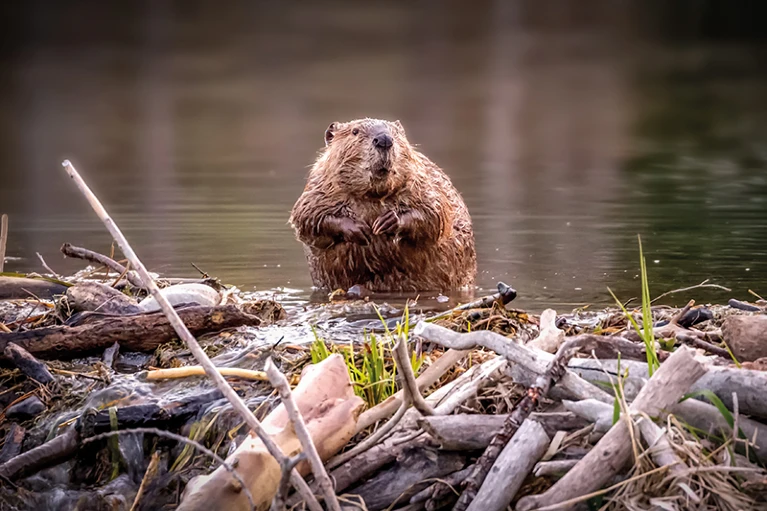
Environmental scientist Benjamin Dittbrenner, at Northeastern University in Boston, Massachusetts, studied the work of beavers that were relocated from human-settled areas into wilder locations in Washington state. In the first year after relocation, beaver ponds created an average of 75 times more surface and groundwater storage per 100 metres of stream than did the control site9. As snowfall decreases with climate change, such beaver-enabled water storage will become more important. Dittbrenner found that the beaver’s work would increase summer water availability by 5{6d6906d986cb38e604952ede6d65f3d49470e23f1a526661621333fa74363c48} in historically snowy basins. That’s about 15 million cubic metres in just one basin, he estimates—almost one-quarter of the capacity of the Tolt Reservoir that serves Seattle, Washington.
Beavers have fire-fighting skills too, says Emily Fairfax, an ecohydrologist at California State University Channel Islands in Camarillo. When beavers are allowed to repopulate stretches of stream, the widened wet zone can create an important fire break. Their ponds raise the water table beyond the stream itself, making plants less flammable because they have increased access to water.
And beavers can actually help to prevent flooding. Their dams slow water, so it trickles out over an extended period of time, reducing peak flows that have been increasingly inundating streamside towns in England. Researchers from the University of Exeter, UK, found that during storms, peak flows were on average 30{6d6906d986cb38e604952ede6d65f3d49470e23f1a526661621333fa74363c48} lower in water leaving beaver dams than in sites without beaver dams10. These benefits held even in saturated, midwinter conditions.
Beaver ponds also help to scrub pollutants from the water and create habitats for other animals. The value for these services is around US$69,000 per square kilometre annually, says Fairfax. “If you let them just go bananas”, a beaver couple and their kits can engineer a mile of stream in a year, she says. Because beavers typically live 10 to 12 years, the value of a lifetime of work for two beavers would be $1.7 million, she says. And if we returned to having 100 million to 400 million beavers in North America, she adds, “then the numbers really start blowing up”.
System change
For the most part, mainstream economics doesn’t take into account the many crucial services provided by healthy, intact ecosystems: water generation, pollution mitigation, food production, crop pollination, flood protection and more.
Value calculations such as Fairfax’s are increasingly tabulated by scientists but usually ignored by the market. One early effort to put a monetary value on those services was a landmark report11 in Nature in 1997, co-authored by Robert Costanza, an ecological economist at the Institute for Global Prosperity at University College London. At the time, global ecosystem services were worth tens of trillions of dollars, more than global gross domestic product (GDP). In an updated paper published in 2014, the global economy had grown but ecosystem services were still worth considerably more12.
Another problem: the degradation of those services is typically not counted against profits; instead, those costs are paid by the environment and people. Hannah Druckenmiller, an environmental economist and data scientist at the non-profit organization Resources for the Future in Washington DC, has calculated that permitting development on one hectare of wetlands incurs property damages of more than $12,000 per year13. That’s because water that has been displaced from an area that used to absorb it floods surrounding communities. Druckenmiller estimates the value of wetlands nationwide, just for flood absorption, to be $1.2 trillion to 2.9 trillion. And that is a conservative estimate, based on flood damage data covering just around 30{6d6906d986cb38e604952ede6d65f3d49470e23f1a526661621333fa74363c48} of households in floodplains.
The overarching problem is that the main measure of economic health, GDP, has a narrow focus on market-based production and consumption and does not accurately measure human well-being, Costanza asserts. “A circular economy that similarly limits itself to production will also fall short,” he says. If the goal is well-being, “the question becomes: should you be producing and consuming all those things in the first place?”. Protecting and restoring natural resources and rebuilding social capital, he says, are more likely to achieve well-being.
One way to do that is to put more natural ecosystems into a common asset trust, or ‘the commons’. Creating state or local parks, hunting reserves, or wildlife refuges can restrict development and provide significant benefits to the community, says Druckenmiller. Communities that invest in protecting a wetland to prevent flood damages will see the benefit of avoided costs quickly, she says, often with a payback period of less than five years.
Another strategy to protect the commons, says Costanza, is the ‘rights of nature movement’, which began in the early 1970s and has gained ground over the past 15 years. It includes enshrinements in the constitutions of Bolivia and Ecuador, local government changes across the United States, and personhood for the Whanganui River in New Zealand, the Ganges River in India and the Magpie River in Canada. That might sound unusual to some people, but in the United States, some corporations have personhood. Granting personhood to a river enables people to argue in court on behalf of its rights. A river’s rights can include freedom from pollution, protection of its cycles and evolution, and space to fulfil its ecosystem functions. The rights of nature movement recognizes that healthy ecosystems make everything work, and “people are part of that system and not separate from it”, says Costanza.
States reforming century-old water rights, utilities investing in wetlands and Indigenous techniques and scientists deploying beavers for their engineering prowess are definitive shifts from business as usual. “We’ve made a lot of progress integrating [natural capital] into the system, where it doesn’t get pushed aside because other things are higher priority,” says Druckenmiller.
But Costanza thinks much deeper change is needed. “A lot of the things that we’re talking about with the circular economy—regenerating wetlands, planting forests, dealing with climate change—are difficult to implement because the underlying goal is still GDP growth, and these things get in the way of that,” he says.
People applying slow-water approaches are doing what they can in the dominant economy. But Costanza says that people can better protect social capital and environmental systems by switching from GDP to metrics such as the Genuine Progress Indicator or one of “literally hundreds” of alternatives, he says.
Changing society’s fundamental goals might seem like a high bar, but some of these metrics have already been adopted by governments in Maryland, Vermont, Bhutan and New Zealand. Such shifts move beyond greenwashed versions of a circular economy and help to facilitate water detectives’ work in caring for water systems so that they can sustain human and other life.
This article is part of Nature Outlook: Circular Economy, an editorially independent supplement produced with financial support from Google. About this content.
References
-
Ripple, W. J., Wolf, C., Newsome, T. M., Barnard, P. & Moomaw, W. R. BioScience 70, 8–12 (2020).
-
Davidson, N. C. Mar. Freshw. Res. 65, 934–941 (2014).
-
Grill, G. et al. Nature 569, 215–221 (2019).
-
Brondízio, E. S., Settele, J., Díaz, S. & Ngo, H. T. Global Assessment Report of the Intergovernmental Science-Policy Platform on Biodiversity and Ecosystem Service (IPBES, 2019).
-
Groves, D. G., Bonzanigo, L., Syme, J., Engle, N. & Rodriguez, I. Preparing for Future Droughts in Lima, Peru (World Bank, 2019).
-
Rezanezhad, F. et al. Chem. Geol. 429, 75–84 (2016).
-
Monge-Salazar, M. J. et al. Sci. Total Environ. 838, 155968 (2022).
-
Ochoa-Tocachi, B. F. et al. Nature Sustain. 2, 584–593 (2019).
-
Dittbrenner, B. J., Schilling, J. W., Torgersen, C. E. & Lawler, J. J. Ecosphere 13, e4168 (2022).
-
Puttock, A., Graham, H. A., Cunliffe, A. M., Elliott, M. & Brazier, R. E. Sci. Total Environ. 576, 430–443 (2017).
-
Costanza, R. et al. Nature 387, 253–260 (1997).
-
Costanza, R. et al. Glob. Environ. Change 26, 152–158 (2014).
-
Taylor, C. A. & Druckenmiller, H. Am. Econ. Rev. 112, 1334–1363 (2022).