Osher Lifelong Learning Institute at Ringling College presents “Celebrating Florida’s Wild Wonders,” a one-day event inspired by the book, The Wilder Heart of Florida, and featuring eight celebrated writers, poets, educators, environmentalists, architects, and artists.
The event is Friday, March 11, 2022, 9 a.m.-5 p.m. at the Ringling College Museum Campus, 1000 S. Tamiami Trail, Sarasota. General admission is $125; registration opens on December 7. The registration fee includes lunch and a complimentary reception. For more information and to register, call 941-309-5111, or visit www.OLLIatRinglingCollege.org.
Julie Cotton, a member of OLLI’s Advisory Council’s Strategic Program Committee, is the creative spark for “Celebrating Florida’s Natural Wonders.” She says that participants will “expand their emotional connection to Florida’s natural treasures and learn about places they never knew existed.” Cotton adds that audience members will have the opportunity to offer their own perspectives and interact with the guest speaker. The day will also include book signings and interactions with local environmental and art groups at display tables. Cotton encourages audience members to prepare for the event by reading The Wilder Heart of Florida, edited by Jack E. Davis and Leslie K. Poole, and The Palmetto Book by Jono Miller.
“This event was inspired by The Wilder Heart of Florida,” says Cotton. “Using the arts as our vantage point via evocative prose, poetry, painting, photography, architecture, and film, we aim to engage hearts and minds in celebrating and safeguarding our precious wild wonders.”
Panelists include: Leslie K. Poole, co-editor of The Wilder Heart of Florida and assistant professor of environmental studies at Rollins College; Gianna Russo, assistant professor of English and creative writing at Saint Leo University, author of several poetry collections, and winner of a Florida Book Award; and Bruce Stephenson, professor of environmental studies at Rollins College and author of John Nolen: Landscape Architect and City Planner.
Other presenters include notable environmental writers, artists, and educators, including: Jean Blackburn, contemporary artist, photographer, and naturalist who celebrates nature and the joy it can bring to human life; Susan Cerulean, multiple award-winning writer, naturalist, earth advocate, and author of three books, including the newly published I Have been Assigned the Single Bird, A Daughter’s Memoir; Pamela Callender, adjunct professor of eco-art history at Eckerd College, who has created a unique landscape design project called “Lifelines, Connecting Nature’s Habitat”; Joe King, the architect/developer who designed River Forest, the unique 26-home neighborhood on the Braden River, set among a lush native plants landscape; and Jono Miller, educator, activist, and natural historian who works to understand and protect wild places in Southwest Florida.
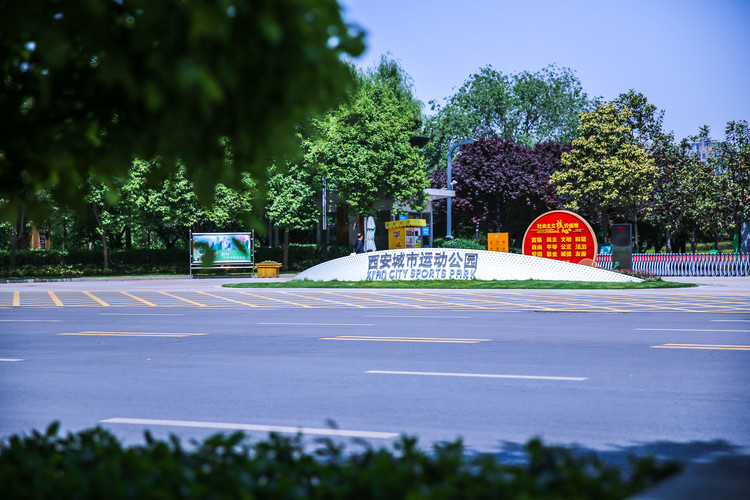
Text description provided by the architects. Xi ‘an City Sports Park, which was built in 2006, is located north of Longshou and close to xi ‘a municipal government. With the 14th National Games to be held in Xi ‘an in 2021 as an opportunity, an exploratory renovation of the Xi’an City Sports Park is underway.
Reshaping the Image (East Entrance, Osmanthus Square, South Entrance). The first step of the design is to rebuild the boundaries based on the characteristics of specific scenarios while retaining the functional space of the passage.
The east entrance faces serve as the main pedestrian entrance during the National Games, it renews the overall landscape of the sports park through the integration of water landscapes and greenery.
The Osmanthus Square serves as a traffic hub and an important visual focal point within the park. Inspired by the ticking clock, the hour pointer of the area changes with gradations of light and shade, indicating the vitality and perpetual movement of sports.
The south entrance was an abandoned water landscape, before the renovation. Through the simple form to reshaping the new appearance. The ivory translucent Logo Wall increases the vitality, publicity, and attraction of the south entrance.
Ecological Rehabilitation (Dredging, Greening). Dredging starts from three aspects: water purification, water ecological restoration, and sediment remediation. A nature-based solution is adopted to improve water flow, restore the underwater ecological base, realize the natural integration of waters and greenery so that every corner of the park will be immersed in a natural, dynamic and ecological atmosphere.
Spur Vitality (Roller Skating Rink, Jogging Path). The original facilities of the roller skating rink are old and creaked. Through spatial analysis, the project decides to update most of the infrastructure, and build a “ZHESUO Gallery” in the surroundings to provide shading to people while adding more vigor to the place. After the renovation, the roller rink has become a popular area of the park.
By analyzing the demands of people’s activities, the functions of the jogging path around the lake are rearranged. Instead of the traditional single and linear design, various functions are added in this area to reorganize the functions, enrich the colors and enhance the vitality.
Space Renovation (Basketball Court). In the basketball court area, the design takes sports demand and spurring vitality and potentials as the fundamental goal instead of following a common style. The renovated basketball court, with the colorful ground and artistic modeling of the surrounding fence, indicates the free and unconstrained temperament of sports.
Function Supplement ((Drinking Water, Marking System). Part of the original facilities in the park is old. In this renovation, the signs of the drinking water area are upgraded and added for daily use.
The new clearly show at the Center East Institute in Washington, DC asks a basic query: why has there been so small recognition of Arab-American artwork in the US?
“If you search at the unique ethnic communities in the US whose artwork scenes have produced major development in the final 20 decades, we would consider of the Asian American local community, the Chicano local community, or the black local community,” suggests Maymanah Farhat, curator of Converging Strains: Tracing the Artistic Lineage of the Arab Diaspora in the US.
“It’s great, in phrases of their remaining even more involved and historicised. But the Arab-American artistic community is nonetheless uncharted territory in just the larger sized American narrative.”
When these teams have experienced obvious centres of activity, this kind of as Chicago amid black artists or Los Angeles between the Chicano local community, Arab American artists have been distribute out across the place, in San Francisco, Los Angeles, Dearborn, Chicago, New York, Washington, DC and somewhere else. They have not coalesced into a singular movement, which tends to make it challenging to credibly draw contours about Arab American artwork.
In its place of exploring for an Arab American “style”, Farhat emphasises the American context in which Arab American artists were operating. It is an astute appreciation of how the reception of get the job done can dominate the way it is noticed. The inclination to portray Arab American artists as Arab instead than a hybrid neighborhood keeps these artists from turning into element of the American tale – and retains them within an Arab identification which tends to be politically colored.
Huguette Caland’s luminous Bribe de Corps collection was influenced as significantly by Southern California as by her indigenous Lebanon. Here, ‘Corps bleu (Bribes de corps)’, 1973. Photo: Huguette Caland Estate
“We’re rendered both pretty seen in conditions of political positioning and profiling, but then also very invisible when it will come to our cultural contributions,” suggests Farhat, who grew up in California and has a Lebanese father.
“Arabs in The usa are seriously impacted by the political discourses of the time. 9/11 was a definitive second of reckoning for so numerous of us for the reason that we had been hit with profiling and hyper visibility. And prior to that, in reveals from the 1990s that took location with Arab American gals artists, a lot were being all around the idea of veiling and these really Orientalist tropes – which is not what the artists on their own ended up interested in.”
The curator Maymanah urges viewers to aim on Kamal Boullata’s use of color in his silkscreen ‘Allah-2’, 1983. Photo: Globe Bank Artwork Application
The display begins with a very carefully drawn examine of a face, section of a ebook venture by Kahlil Gibran, the Lebanese poet and artist who lived in Boston in the early 1900s.Gibran’s inclusion factors to the longevity of the Arab American neighborhood in the US in his famous letter to younger Syrians, from 1926, he talks about the pride of belonging both equally to the location that developed Damascus and Byblos and currently being element of the new American civilisation.
This mixed identity establishes the leitmotif for the present, which progresses generationally onwards through its 17 artists. Two silkscreened prints by late Palestinian artist Kamal Boullata, who was exiled in 1967, are exemplary of his luminous, colour-soaked and mathematically rigorous calligraphy.
His perform is largely seemed at for his innovations in this field or, as at a 2020 meeting at the College of Cambridge, how he sits in the tradition of Arab guide-making (dafatir) and the completely ready crossover concerning poetry and art that is popular in Arab artwork.
The performs in Converging Lines admit these themes whilst also drawing out his American context.
“Kamal Boullata lived in Washington, DC from the 1960s right up until the 90s,” claims Farhat. “He is pretty considerably steeped in the Washington colour school. He did his MFA at The Corcoran College of Art, and you can simply see the vibrancy of Alma Thomas, Gene Davis, Kenneth Noland in his get the job done. But then he was also generating operates that are quite Islamic, and he was pretty very pleased of his individual personalized cultural historical past of remaining from Jerusalem, and all the magnificence of what that implies.”
Equally, for Lebanese artist Huguette Caland who labored in Los Angeles from 1987 to 2013, Farhat points to the influence of West Coast artists this kind of as James Turrell and Ed Moses. Turrell’s try, for instance, to capture the tender California air has very clear parallels to Caland’s amazing skill to render gentle and colour as 3-dimensional, curved and all set to maintain.
Iraqi artist Nazar Yahya painted a diptych in honour of the US artist Cy Twombly. In this article, ‘Homage to Twombly’, Yellow, 2012. Photograph: Nazar Yahya
Other artists in the exhibition mix American references together with Arab types as a suggests of picturing their dual belonging – a intricate of thoughts acquainted to all immigrant family members.
Iraqi artist Nazar Yahya, who now lives in Houston, painted the diptych Homage to Twombly (2012) with streaked drips building their way down the canvas from good, flower-like bursts that evoke Cy Twombly’s Rose collection from the late 2000s.
Guiding the washes of color is the picture of an Iraqi woman, who appears both commandingly present but also effaced by the colours on show.
Chicago-born artist Yasmine Nasser Diaz created a series of collages based on her working experience of browsing her family in Yemen in the 1980s, mixing equally photos of the outdated metropolis of Sanaa with other interests of the time for a 15-yr-aged, these as Salt-N-Pepa and Madonna.
Yasmine Nasser Diaz’s collage ‘Bizarre Adore Triangle’, 2017, demonstrates on her trip to her family’s home of Yemen in the 1980s, with illustrations or photos from Sanaa together with US pop stars. Image: Yasmine Nasser Diaz
There is a slight irony in the actuality the Middle East Institute is underlining the American-ness of these artists, but the result is a enormously enriched knowledge of their do the job. And in recognising the context in which these artists appeared, the clearly show also tackles the staggered and even contrived way they entered the artwork entire world mainstream.
Farhat notes, for example, how Caland and Etel Adnan ended up partly gained as beforehand unknown Arab artists in their new demonstrates at western institutions. A 2015 critique of Caland’s do the job in the journal frieze, for case in point, identified as the get the job done of the artist, then aged 83, a “welcome revelation”. But these artists were being acknowledged for many years to both equally the Arab neighborhood and the American artists among whom they worked. But, says Farhat, they basically lacked advocates.
“There aren’t many curators. There are not a lot of artwork historians,” she states. “When you really don’t have that degree of institutional guidance, and you really don’t have that drive from the industry, from establishments, from activists, from students, it’s hard to make any headway.
“The Arab American literary scene has taken off in the last 10 to 15 yrs, and it is not strange now to see Arab American writers take part in literary festivals in Brooklyn or in Los Angeles. But the visible artists, we just have not had the similar variety of support.”
Lebanese-American curator Maymanah Farhat. Photograph: MEI
This is Farhat’s 2nd exhibition for MEI, a feel tank that opened an art gallery on its floor flooring as element of its cultural programming. It is not at the centre of the art globe and 1 miracles how much this critique will travel further than these who are presently wrestling with its fears.
But the gallery’s programming so significantly – these types of as an exhibition of Beirut protest pictures and a much-desired glance at Syrian up to date artwork, curated by Farhat – has crammed a significant hole in the American institutional landscape and has made the web site an critical, if unpredicted supply of each advocacy and delicate investigation.
Converging Strains: Tracing the Creative Lineage of the Arab Diaspora in the US is at the MEI Art Gallery until finally Wednesday, November 17, 2021




:quality(70)/cloudfront-eu-central-1.images.arcpublishing.com/thenational/UY2IXCYCIZAVNHCOOSFGUNEINQ.jpg)
:quality(70)/cloudfront-eu-central-1.images.arcpublishing.com/thenational/7C6J3N5T4NDBLDMKO56Q3C5YEQ.jpg)
:quality(70)/cloudfront-eu-central-1.images.arcpublishing.com/thenational/DYDGSW6HMBF3XHXZBYDLU36SA4.jpg)
:quality(70)/cloudfront-eu-central-1.images.arcpublishing.com/thenational/QFBC2C3NO5B2XISVVM5AXQZIAE.jpg)
:quality(70)/cloudfront-eu-central-1.images.arcpublishing.com/thenational/KQRN2AWZP6A6R233WD4I7QBMXM.jpg)