
Planting native plants in Palm Beach is ‘just smart landscaping’

I’ve discussed the importance of native plants for the survival of our pollinators and birds, but I haven’t really explained why invasives are so damaging to our environment.

For over a century, we’ve imported plants to South Florida from all over the world. Some were thought to be beneficial while others were just ornamental. Many couldn’t adapt and disappeared, while many more grew nicely here and caused no problems. But some found the environment perfect: they went to seed and spread to new territory, choking out the existing native plants that couldn’t compete with their vigorous growth and, in so doing, displaced the associated pollinators, birds and wildlife.

Once established, invasive species adversely affect native-plant communities, outcompeting and killing the existing native species and damaging natural ecosystems. We need to be proactive in addressing this issue to maintain the health, function and long-term productivity of our landscapes.

Because Florida’s climate is so accommodating, invasive species cause more crises here than anywhere else in the United States. All of Florida’s native habitats marine, freshwater, and terrestrial are threatened by invasives.

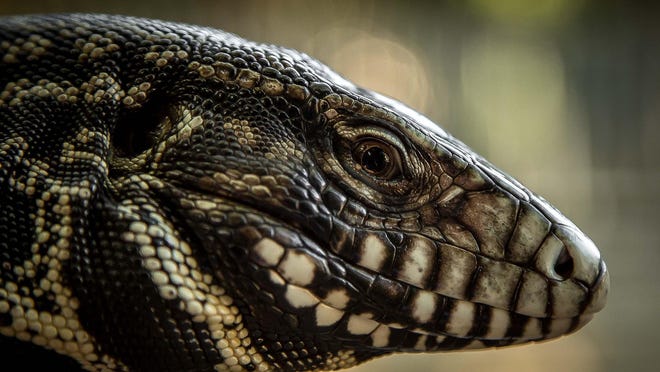
Tegu lizards can grow to 5 feet in length.
  • The omnivorous Argentine black-and-white tegu lizards can grow to 5 feet in length and feast on the eggs of ground nesting birds.
  • Burmese pythons have been spotted swimming from the Everglades to the Florida Keys. These invasive constrictors feed on native species and can grow upwards of 20 feet.
  • Beautiful and exotic lionfish devour smaller species of native fish and have no known predators.
  • Studies have shown that non-native wood boring insects promote disease and reduce a forest’s ability to capture and store carbon.

The cost of managing Florida’s invasive plants is upwards of $100 million every year. The cost of animal management could easily exceed this.

Lionfish devour smaller species of native fish and have no known predators.

Proper IDs

The first step in controlling invasives is identification: you can’t remove them if you don’t know what they are and you need to identify them so you don’t buy them accidentally. A few to be particularly aware of are: Japanese climbing ferns, melaleuca trees, Brazilian pepper, Australian pine, common lantana (Lantana camara), heavenly bamboo (Nandina domestica), Chinese privet (Ligustrum sinense), coral ardisia, and tropical or scarlet milkweed (Asclepias curassavica).

Tropical milkweed, Asclepius curassavica, is widely used and often sold as a native. It can cause monarchs to have a deadly parasitic infection called OE. If you have this milkweed, make sure to cut it back to the ground after monarch caterpillars have eaten the leaves.

Milkweed, you say? Isn’t that the essential host plant for the monarch butterfly? Yes, but it is important that you buy the native species, as the non-native can transmit the deadly OE bacterium to the monarch caterpillars, causing wing deformity, an inability to fly and ultimate death. Plant butterfly milkweed (Asclepias tuberosa) or rose milkweed (Asclepias incarnata): If you have the scarlet milkweed in your garden, as many of us do, make sure you cut it back to the ground after the caterpillars have defoliated it. This will decrease the risk of the OE bacterium.

Unfortunately, many of these invasives are still being sold at nurseries under incorrect names.

Native lantana has yellow flowers and is a low growing, spreading ground cover. It is not poisonous, but the invasive Lantana camara is.

One of the worst offenders is the invasive Lantana camara, often sold as the native Lantana depressa. The best way to avoid the invasive species is to understand the differences between the two.

Lantana camara, native to the West Indies and called shrub verbena, was loved by gardeners for its bright multicolored flowers, but it will dominate understory vegetation and is listed as a category I invasive. It has outcompeted our native Lantana depressa to the point that this is now listed as endangered.

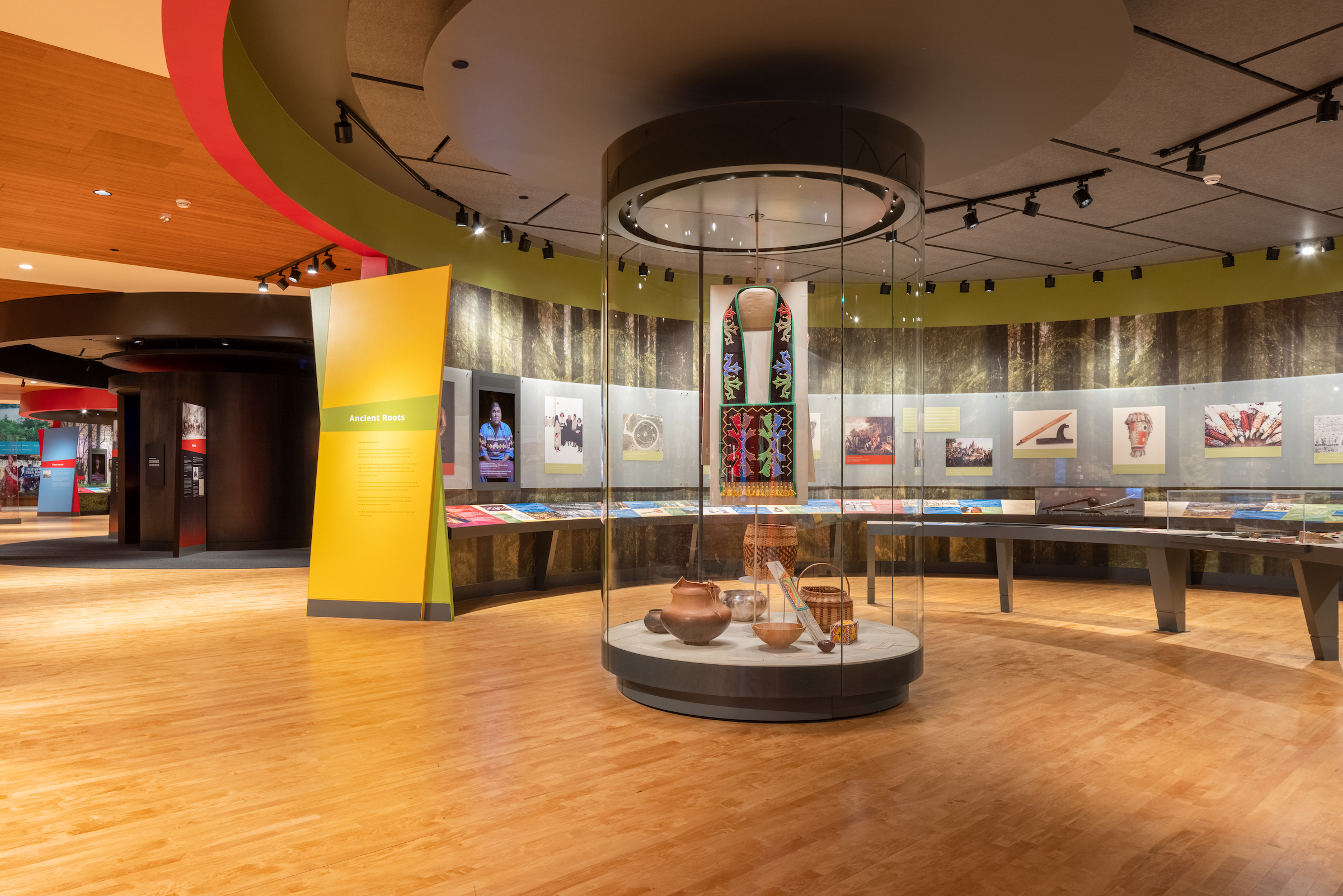
First Americans Museum uses design metaphors of natural elements to honor native worldview

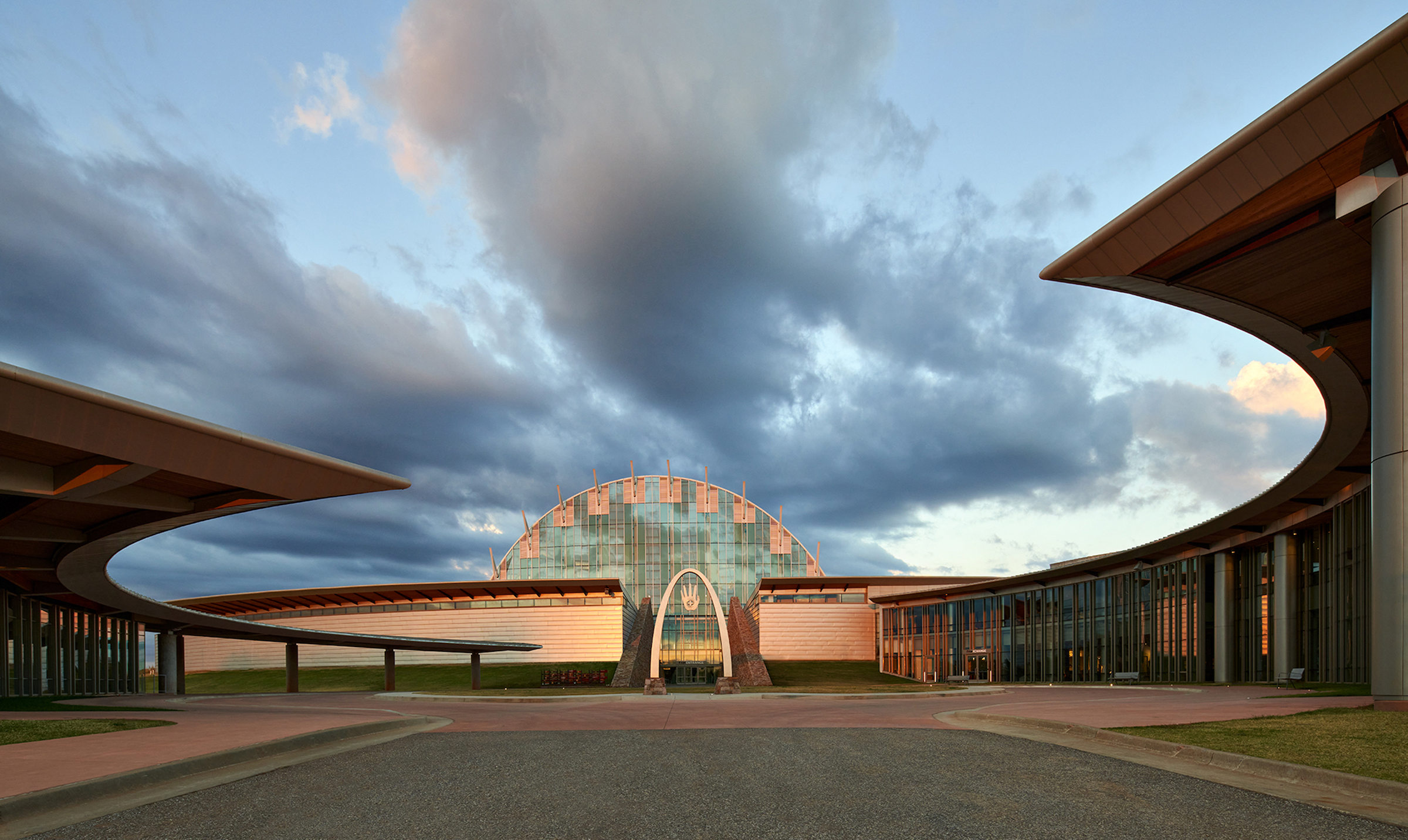
Initial Americans Museum (FAM) in Oklahoma City honors the 39 tribes in Oklahoma now, reflecting their historical past by means of style and design metaphors of nature’s features of earth, wind, water, and fireplace. The layout notion incorporates several circles advised by arcs, reflecting the indigenous tradition of a circular worldview that encompasses the cycle of lifestyle, the seasons, and the rotation of the earth.

The central expression of this strategy is a 1,000 sf diameter spiral earthen mound climbing to 90 ft at its peak. This component was produced with 400,000 cubic yards of red earth fill from nearby building sites. The spiral mound signifies the earth and capabilities a passageway as a result of which the wintertime solstice is marked. The undertaking was created to align with the cardinal instructions and provide as a cosmological clock, commemorating and honoring the specific periods of equinox and solstice.

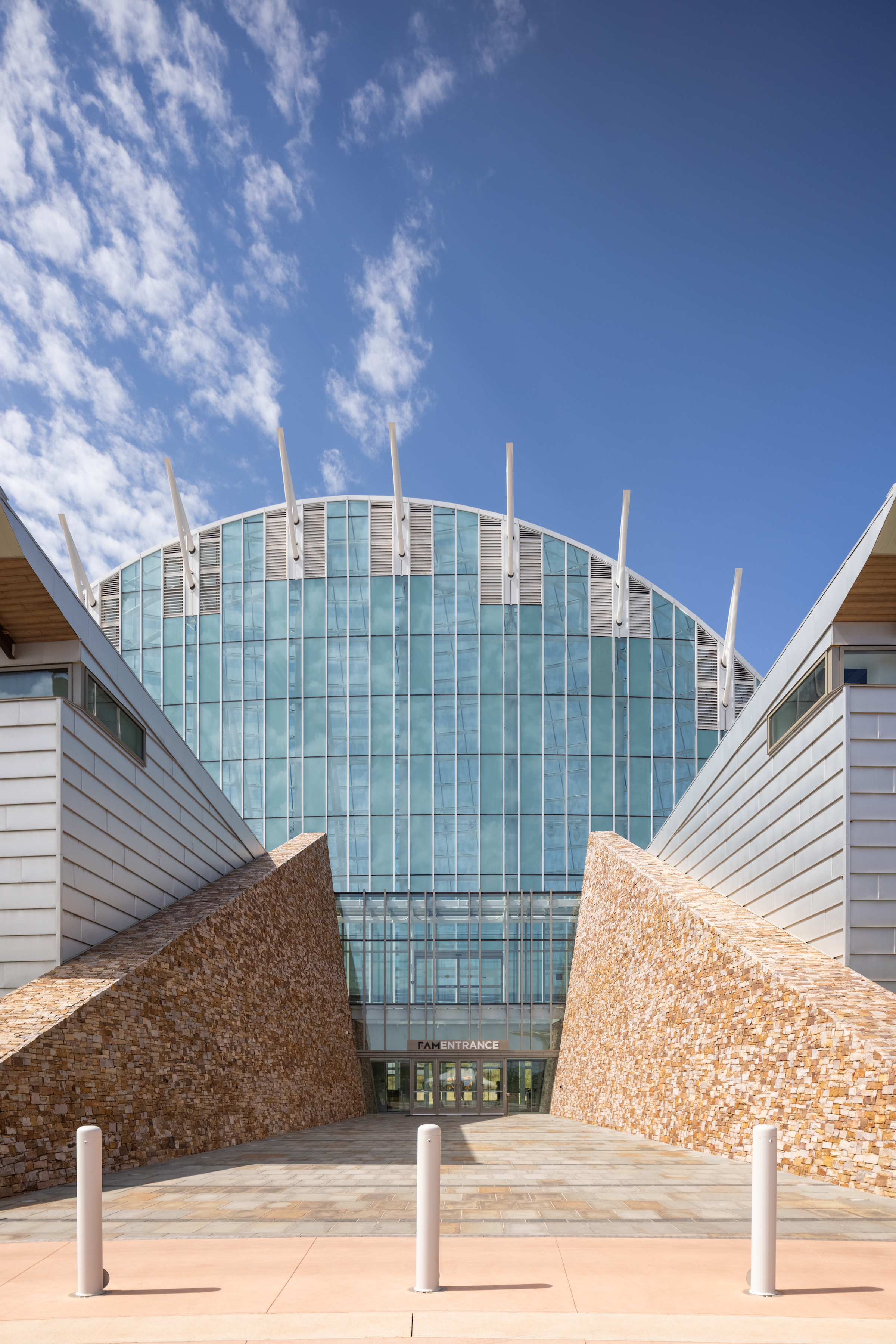
The east-struggling with museum entrance, framed by stone partitions, aligns with the sunrise of the vernal and autumnal equinoxes, with the solar climbing right in the centre concerning the walls. Throughout the winter season solstice, the sunlight sets by the tunnel embedded into the FAM Mound in the course of the summer season solstice, the sunshine sets at the peak of the mound.

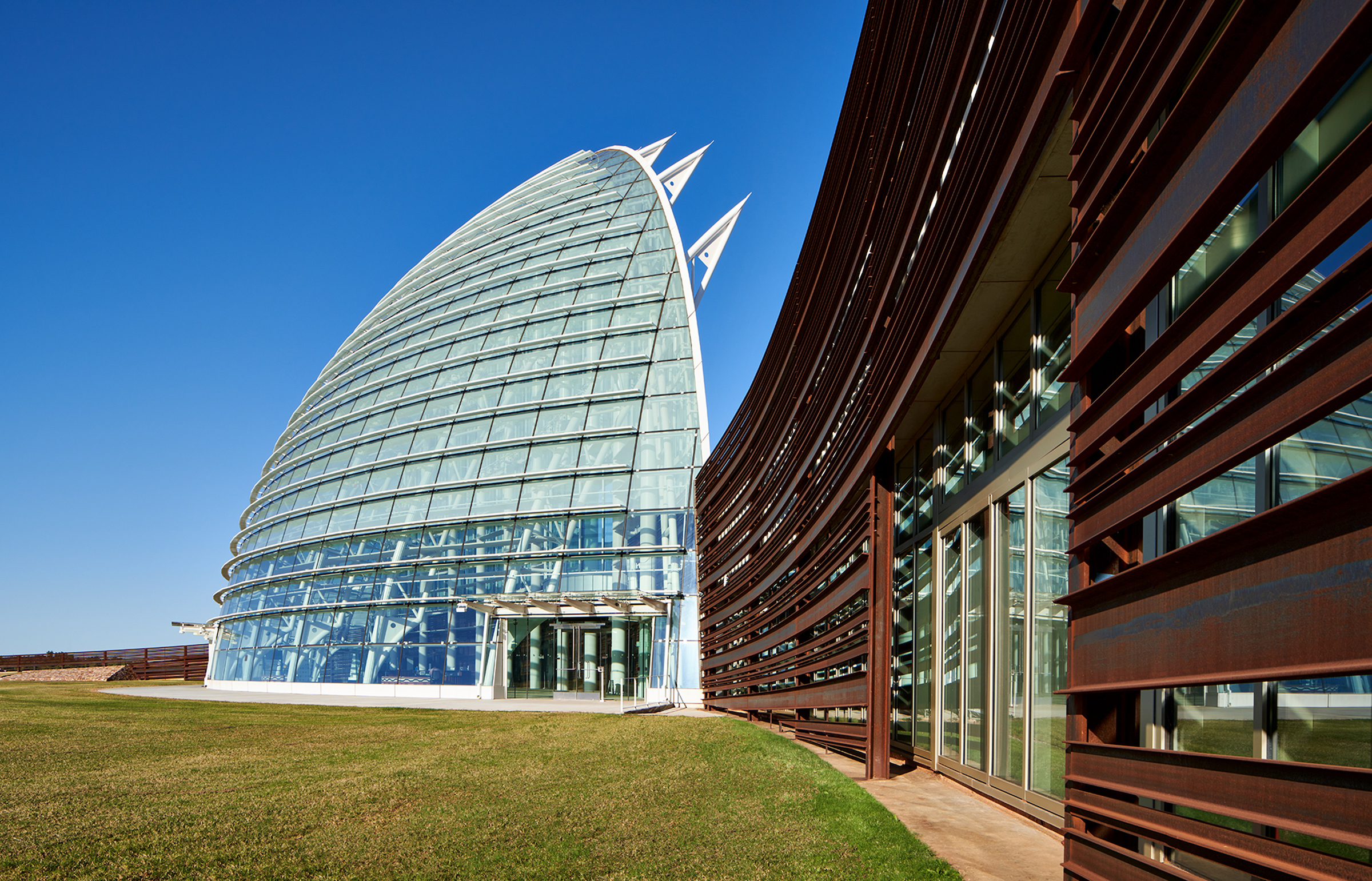
The notion for the 175,000 sf museum making is a spiral that begins in the earth and ascends to the heavens. It is composed of two arcs: the western arc, that includes permanent and rotating exhibitions, and the northern arc that homes theaters, retail, dining, and other providers. The arcs intersect at the 110-foot-tall prismatic glass composition that serves as each a starting place for readers and a central gathering room. A few sky terraces (Sunshine, Moon, Stars) offer views of the Oklahoma River and Downtown Oklahoma Town.

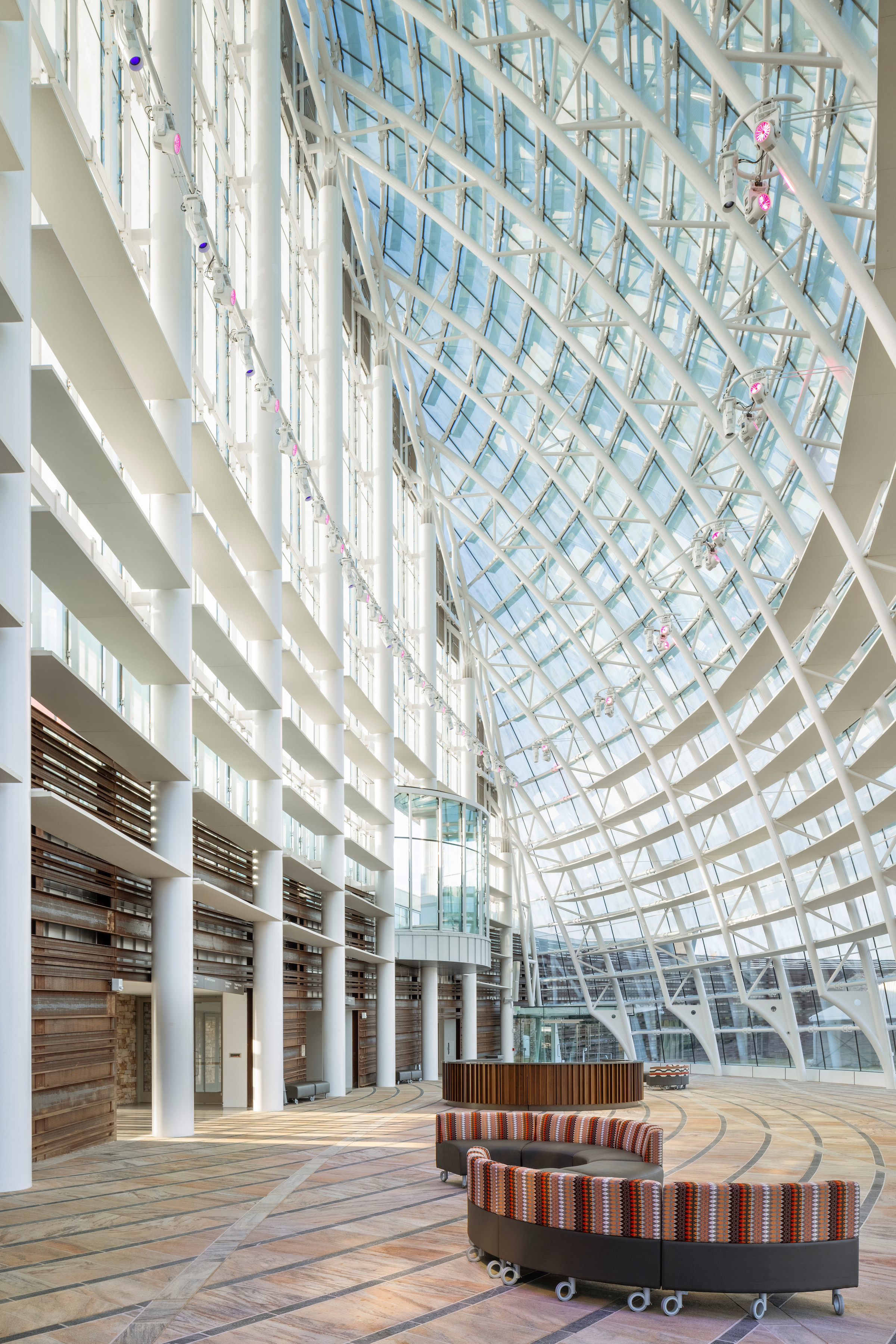
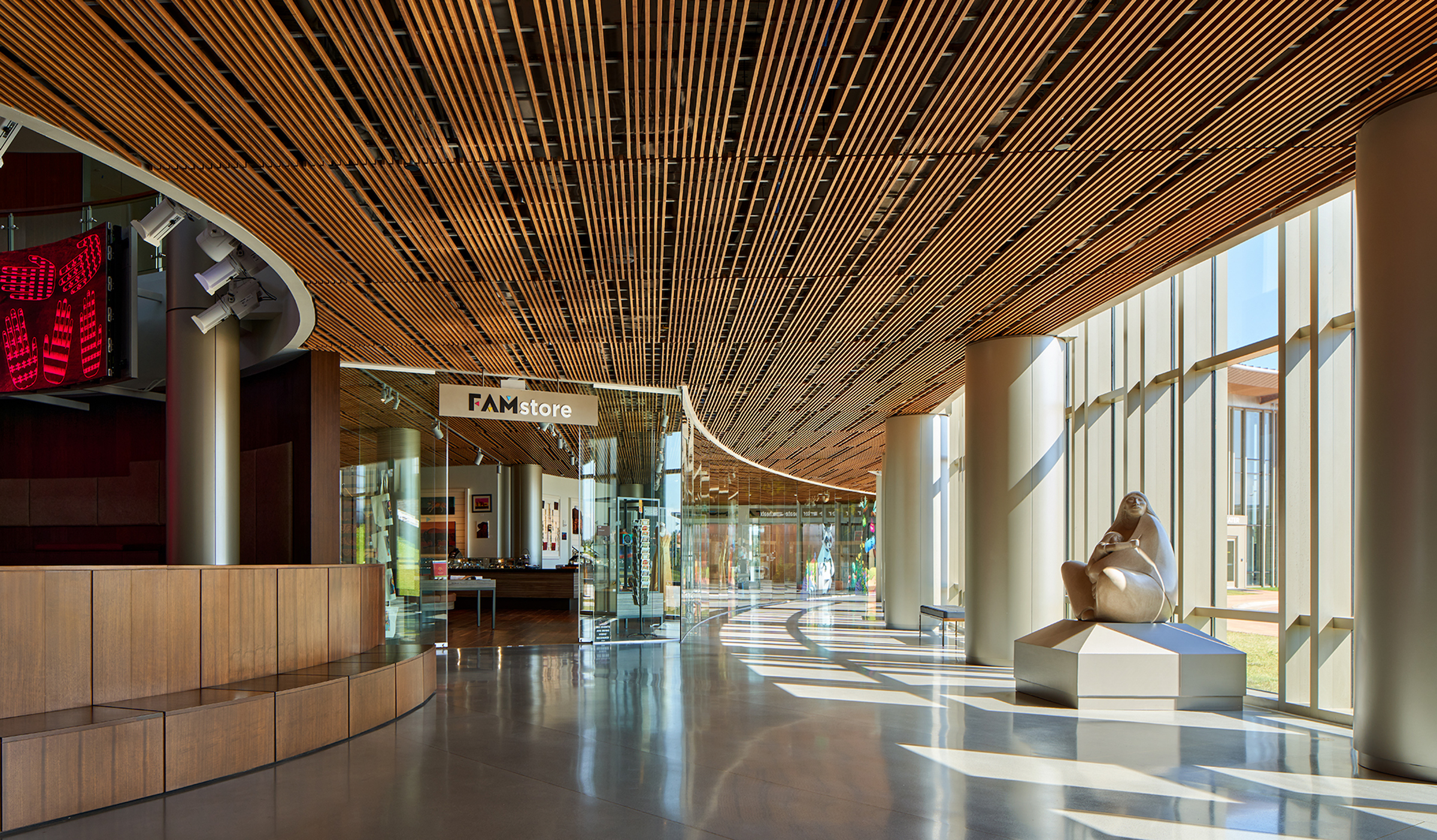
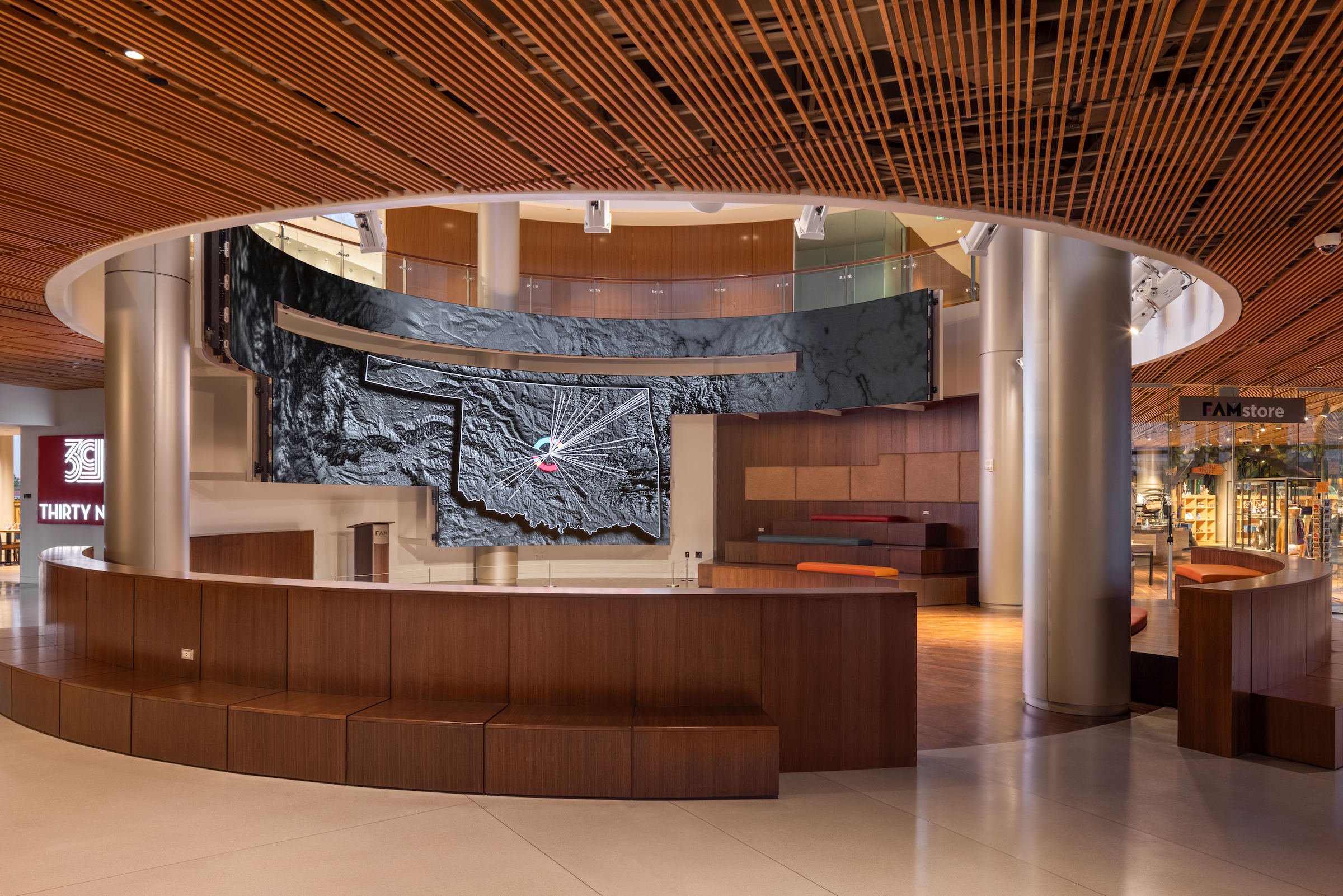
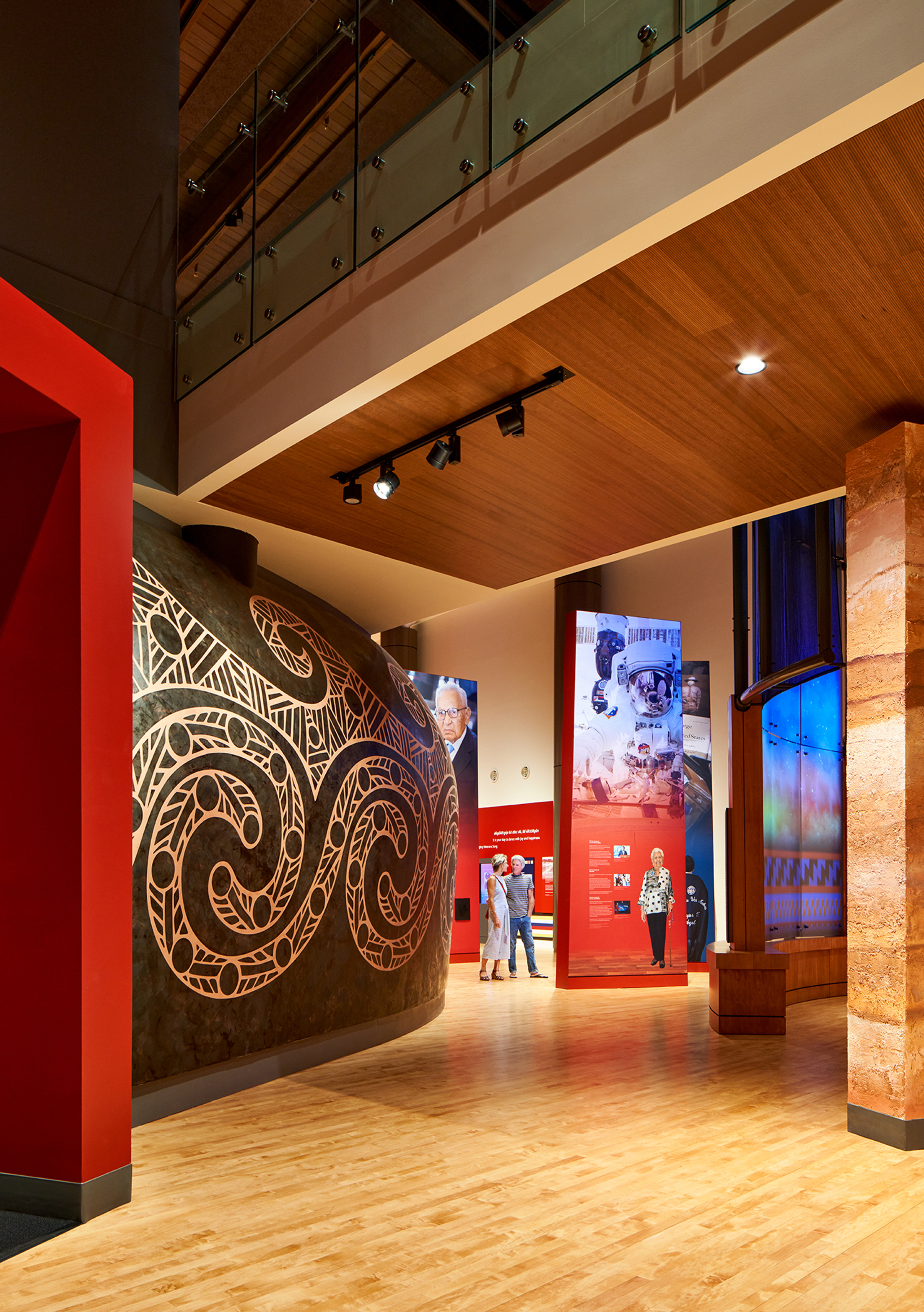
The radial geometries of the inside are arranged to invoke a feeling of curiosity and anticipation in website visitors. General public spaces are bathed in purely natural light-weight by means of comprehensive-height glass walls.  Harmonizing manmade and organic aspects, the museum’s interior palette incorporates warm wood wall paneling, steel-clad circular columns, concrete flooring, and personalized wood-slat ceilings. Arcs and circles show up all through in millwork, seating things, and railings in harmony with the Native American perception that suitable angles entice the spirit.

“We conceived a story about the website that the land had been taken from the native peoples, stripped of its components, and has now been returned to the Indigenous Individuals, who restored it to the way it after was,” states William Fain, Jr., FAIA, Handling Partner and Director of Urban Structure and Organizing at Johnson Fain. “The harmonious partnership in between the developing and the bordering landscape is crucial to telling the reliable Oklahoma Indian story.”

On the venture crew:
Operator and/or developer: American Indian Cultural Heart Basis (AICCF)
Style and design architect: Johnson Fain
Affiliate Architect of file: Hornbeek Blatt
MEP engineer: Darr & Collins, Stantec
Structural engineer: Arup KFC Engineering Nabih Youssef Associates
Typical contractor/design manager: Centennial Builders—A Joint Venture of Flintco and Manhattan

Below is the full statement from the architecture firm and building operator:
20-five several years in the producing, To start with Americans Museum (FAM) in Oklahoma Town is a testomony to mission and perseverance.  It was developed to honor the 39 tribes in Oklahoma now, reflecting their history through design metaphors of nature’s features of earth, wind, water, and hearth.  Los Angeles architecture firm Johnson Fain, along with connected Oklahoma City firm Hornbeek Blatt and New York City-based landscape architect Hargreaves Jones, established a location symbolizing FAM’s mission to teach the general public about the cultures, range, background, contributions, and resilience of Oklahoma’s To start with American Nations. 

Functioning intently with tribal advisors, the structure crew interpreted native traditions into steel, glass, stone, wooden, and sod.  For the design, the architects have been awarded honors by chapters of the American Institute of Architects.  AIA Los Angeles bestowed awards each when the job was on the boards prior to construction and for the realized building—one of a handful of tasks to acquire accolades at both phases.  Closer to house, AIA Oklahoma also awarded the constructed structure.  “The hard process of marrying the vernacular, the indigenous, and the technological is executed with very clear intentions, as a result creating an helpful outcome,” notes the notoriously essential AIA LA jury panel.

First Americans Museum Photo by Scott McDonald, courtesy Johnson Fain
Photograph: Scott McDonald, courtesy Johnson Fain

“At the To start with People in america Museum, regular architectural strategies ended up dissolved by a really iterative system that led to a new vocabulary of variety drawn from an orientation to normal aspects, shared space, and the freedom for guests to go after their personal route of discovery,” suggests Scott Johnson, FAIA, Design and style Husband or wife at Johnson Fain.  “The structure embodies a number of everlasting concepts, these types of as time, generations, shelter, and identity.”

The project’s cultural and heritage advisor, Arizona Condition College professor Donald Fixico, shared with the design and style team the contrast of linear pondering in western tradition versus the holistic, non-linear, “circular” means the natives view the universe.  Whereas western tradition values land as a commodity, native cultures give spiritual value to it.  Reflecting the indigenous tradition of a round earth view—which encompasses the cycle of daily life, the seasons, and the rotation of the earth—the layout progressed out of a number of circles instructed by arcs.  The most important expression of this is the 1,000-square-foot-diameter spiral FAM Mound climbing to 90 feet at its peak, which became the central element of the learn strategy that Johnson Fain began in 1996.  (The company was also initially brought on for internet site range prior to profitable the developing layout.)  A fortuitous gift of 400,000 cubic yards of purple earth fill from area construction websites produced this attainable.

First Us citizens Museum tells the reliable Oklahoma Indian story

The museum’s site was at first Oklahoma Drilling Web page #1 for the extraction of crude oil, hence Hargreaves Jones’ landscape prepare termed for cleanup and enhancement of the web page, which includes the incorporation of indigenous grasses and tree species.  “We conceived a story about the site that the land had been taken from the native peoples, stripped of its components, and has now been returned to the Indigenous People in america, who restored it to the way it as soon as was,” suggests William Fain, Jr., FAIA, Taking care of Husband or wife and Director of City Design and Scheduling at Johnson Fain.  “The harmonious relationship between the developing and the encompassing landscape is essential to telling the authentic Oklahoma Indian tale.”

Even though the spiral mound signifies the earth and mother nature, the structures express gentleman-made systems.  The strategy for the 175,000-sq.-foot museum is a spiral that commences in the earth and ascends to the heavens.  It is composed of two arcs: the western arc featuring long lasting and rotating exhibitions and the northern arc that homes theaters, retail, dining, and other solutions needed in modern-day museums.  The arcs intersect at the 110-foot-tall prismatic glass construction that serves as both of those a starting place for visitors and a central gathering space.  Three sky terraces (Sun, Moon, Stars) give views of the Oklahoma River and Downtown Oklahoma Metropolis.

The normal environment is at the heart of the FAM practical experience, both equally physically and spiritually.  As opposed to a museum conceived about common notions of kind and sequence, FAM acknowledges the things of nature—earth, wind, drinking water, and hearth.  The spiral mound signifies the earth and retains a passageway by way of which the winter season solstice is marked.  The full venture was developed to align with the cardinal directions and serve as a cosmological clock, commemorating and honoring the exclusive moments of equinox and solstice.  The east-struggling with museum entrance framed by the stone partitions aligns with the sunrise of the vernal and autumnal equinoxes, with the sunshine mounting right in the middle concerning the walls.  During the winter season solstice, the sunlight sets by means of the tunnel embedded into the FAM Mound in the course of the summer season solstice, the sunlight sets at the peak of the mound.

First Americans Museum Photo by Mel Willis, courtesy Johnson Fain
Photo: Mel Willis, courtesy Johnson Fain

The radial geometries of the inside are organized to invoke a perception of curiosity and anticipation in people.  Public spaces are bathed in purely natural light by way of full-top glass walls.  Harmonizing manmade and all-natural elements, the museum’s interior palette includes heat wooden wall paneling, steel-clad circular columns, concrete flooring, and personalized wood-slat ceilings.  Arcs and circles seem all over in the kinds of millwork, seating features, and railings in harmony with the Native American belief that correct angles entice the spirit.

The completion of the 1st Americans Museum, like the persons whose stories it shares, was accomplished in part since of the resilience of the venture and the people today driving it to persist in the course of the previous quarter century to assure its existence.  The architecture is intentionally crafted to symbolically enhance the historical context and the occasions that have formed heritage, while also giving a neutral canvas for site visitors to expertise the artifacts, exhibitions, and historical narratives in a new way.

In addition to Johnson Fain (layout architect), Hornbeek Blatt (affiliate architect), and Hargreaves Jones (landscape architect), essential making team associates consist of Ralph Appelbaum Associates (interpretive planner and exhibition designer), Arup (structural engineer), Centennial Builders—A Joint Undertaking of Flintco & Manhattan (building administrators), KFC Engineering (structural engineer), Lights Layout Alliance (lights designer), Lord Cultural Means (establishment and cultural programming), Andrew Merriell Interpretive Organizing and Style (thought exhibition designer), Harriet Spear Studio (wayfinding), Stantec (MEP engineer), Veneklasen Associates (acoustical engineer), David Weiner Layout (lighting designer), and Nabih Youssef Associates (structural engineer), among numerous many others.

ABOUT JOHNSON FAIN:  During the previous 34 many years of expert expertise in the United States and abroad, Johnson Fain has set up itself as an architecture, organizing, and inside design and style business recognized for its resourceful technique to the created setting.  Scott Johnson, FAIA, Style Companion, and William H. Fain, Jr., FAIA, Handling Companion and Director of Urban Layout and Organizing, lead a diversified office of 45 industry experts.  During the past ten years, the American Institute of Architects has recognized Johnson Fain with a lot of awards at the national, condition, and nearby levels, which include the AIA LA Gold Medal and AIA California Firm of the Year.

ABOUT 1st Americans MUSEUM (FAM): FAM originated as a undertaking of the Condition of Oklahoma and was accomplished by a partnership in between the Condition of Oklahoma and The Metropolis of Oklahoma Metropolis, with assistance of a Chickasaw Nation subsidiary, the American Indian Cultural Middle Basis, and numerous donors.  The American Indian Cultural Centre Basis operates the museum on behalf of the Town, and AICCM Land Improvement, LLC, is the developer of the surrounding home.  James Pepper Henry—vice-chairman of the Kaw Nation—is the museum director/CEO.

First Americans Museum Photo by Scott McDonald, courtesy Johnson Fain
Image: Scott McDonald, courtesy Johnson Fain
First Americans Museum Photo by Mel Willis, courtesy Johnson Fain
Photo: Mel Willis, courtesy Johnson Fain
First Americans Museum Photo by Scott McDonald, courtesy Johnson Fain
Photo: Scott McDonald, courtesy Johnson Fain
First Americans Museum Photo by Mel Willis, courtesy Johnson Fain
Photo: Mel Willis, courtesy Johnson Fain
First Americans Museum Photo by Scott McDonald, courtesy Johnson Fain
Picture: Scott McDonald, courtesy Johnson Fain
First Americans Museum Photo by Mel Willis, courtesy Johnson Fain
Photo: Mel Willis, courtesy Johnson Fain
First Americans Museum Site plan courtesy Johnson Fain
Site approach courtesy Johnson Fain
Site section courtesy Johnson Fain
 Site portion courtesy Johnson Fain
Site plan courtesy Johnson Fain
Web page strategy courtesy Johnson Fain
First Americans Museum Basement level courtesy Johnson Fain
Basement level courtesy Johnson Fain
First Americans Museum ground level courtesy Johnson Fain
Floor amount courtesy Johnson Fain
First Americans Museum second level courtesy Johnson Fain
Second degree courtesy Johnson Fain


Palm Beach finds compromise on rules for native plants

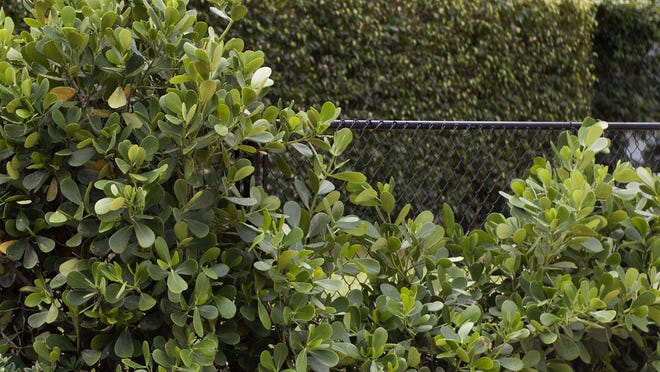
Many homeowners in Palm Beach have removed ficus hedges and other non-native species from their yards and replaced them with native plants. The town last week revised a rule on the number and species of native plants that can be used in landscaping.

Procedures on the selection and species of indigenous vegetation that can be utilized in Palm Seaside landscapes gained a compromise revision past week from the City Council.

In a 4-1 vote, with Councilman Ted Cooney dissenting, the council voted to make a number of variations to the town’s indigenous vegetation ordinance.

Amongst the changes accepted at the Jan. 11 Advancement Critique conference:

  • In any new landscape structure, 30{6d6906d986cb38e604952ede6d65f3d49470e23f1a526661621333fa74363c48} of the plant count need to be native. This most lately experienced been 35{6d6906d986cb38e604952ede6d65f3d49470e23f1a526661621333fa74363c48} below the procedures accredited by the council in November 2021. Prior to that, the percentage stood at 25{6d6906d986cb38e604952ede6d65f3d49470e23f1a526661621333fa74363c48} under rules passed in 2019.

Former protection:Town’s latest native plant need has harvested worries, assist from back garden authorities

Additional:Eco-friendly gardening: Here are some fantastic-wanting natives for your Palm Seashore back garden

NFL spotlights Chicana, Native American artist Lucinda ‘La Morena’ Hinojos for Super Bowl LVII

The NFL has partnered with artist Lucinda “La Morena” Hinojos, the initially Chicana, Native American artist to operate with the league on Tremendous Bowl theme art. She will be the marquee artist of Tremendous Bowl LVII, designing an elaborate, deeply significant piece that will be highlighted on an array of structure activations for the forthcoming Tremendous Bowl LVII in Arizona, which includes Tremendous Bowl tickets, out-of-household (OOH) displays and extra.

Born and lifted in Phoenix, Hinojos, also acknowledged as “La Morena,” and her family members have near ties to the neighborhood of Arizona. She embodies the spirit and background of the metropolis. As a Chicana, Indigenous American artist with multicultural roots from Mexico and the Pascua Yaqui, Chiricahua Apache, White Mountain Apache, and Pima (Akimel O’Odham) Tribes, she utilizes her distinctive id and knowledge to layout an intricate, emblematic piece of art that the NFL will proudly exhibit during Tremendous Bowl LVII.

“I produce artwork to hopefully offer an component of therapeutic, unity and serious human connection, so with this Tremendous Bowl piece, I hope men and women from all more than the earth can have a dialogue about what this painting means to them …and which is what’s beautiful to me,” reported Hinojos. “I’ve often thought that the Super Bowl ticket is the centerpiece of this hallmark event, and for me, as the initial brown indigenous woman to layout the ticket’s artwork, it is wonderful and anything I’m pretty very pleased of.”

The art piece alone functions numerous symbols that signify critical parts of the society and background in Arizona. Reflected on the Vince Lombardi Trophy are the White Tank Mountains, which can be noticed behind Condition Farm Stadium, house of the Arizona Cardinals and Super Bowl LVII. In addition, on each facet of the trophy, Hinojos depicts a Extravagant Scarf dancer and an Azteca dancer to pay back homage to the indigenous tribes in Arizona. Her top purpose with her artwork is to unite and get rid of gentle on underrepresented communities of color in Arizona.

“Lucinda’s perception and direct, private relationship to the wonderful and varied history in Arizona created her the fantastic spouse for this challenge,” reported Marissa Solis, NFL SVP of World wide Model and Buyer Internet marketing. “She is a gifted artist, a soccer mom and a female who authentically signifies her Chicana heritage, and we are so thrilled to use Super Bowl as a system to showcase her stunning artwork and by extension, highlight the neighborhood communities integral to Arizona.”

Another factor of Hinojos’ partnership with the NFL is a substantial mural she will paint in collaboration with Indige Design Collab of Cahokia Socialtech and Artspace, the indigenous-led system for artistic peacekeeping, and fellow Native American artists Randy Barton of Diné/Navajo descent, Anitra “Yukue” Molina of Yaqui descent, and Carrie “CC” Curley of the San Carlos Apache descent. The workforce will collectively make the most significant Tremendous Bowl mural to day at 9500 sq. toes. Painted on the Monarch Theatre, the artwork is a image of indigenous collaboration and emphasizes the narrative of community and unity. It will function meaningful contributions consultant of every artist’s respective backgrounds, like an Apache Girl, a Diné/Navajo rug sample and much more.

NFL lover Wilson is also collaborating with Hinojos on a football design. The ball is motivated by the development of Lucinda’s have particular artistic journey and how significant heritage and group are to her. The ball will be offered for order on http://Wilson.com and at Tremendous Bowl Experience at Phoenix Conference Middle.

The Super Bowl LVII will acquire put on Sunday February 12, 2023, at Point out Farm Stadium in Arizona, exactly where a vast array of activations and encounters including Tremendous Bowl Practical experience, NFL Honors, and more will get position in the course of the 7 days. The artwork produced by Hinojos will also be showcased all-around the point out, culminating in staying displayed on the Tremendous Bowl gameday tickets. For far more info on the Tremendous Bowl, check out www.nfl.com/tremendous-bowl.

Native landscaping program offered to Birch Bay residents again

By Grace McCarthy

Birch Bay owners will have a second opportunity to participate in Whatcom County’s absolutely free indigenous landscaping application immediately after the pilot plan started out last yr.

Birch Bay Watershed and Aquatic Assets Management District (BBWARM) and Whatcom Conservation District (WCD) begun the system to lower h2o runoff, preserve drinking water and boost watershed habitat.

The pilot plan assisted owners with scheduling and permitting, and then method organizers provided mulch and crops to the home owners during a planting operate bash on October 22. Five homes in full, in between Birch Bay Village and Birch Bay Look at, have been picked out of 30 assets house owners, claimed BBWARM method expert Kate Rice. The program hopes to do 10 homes in 2023.

The application is seeking for a cluster of attributes within just a walkable area, these types of as adjacent to 1 a different or getting within just sight distance, Rice stated. The qualities should have 1,000-3,000 square ft of lawn that can be turned into native plant landscaping.

Native landscaping is lower maintenance since it does not demand mowing, and needs small mulching and watering, Rice claimed, including that indigenous plants bring pollinators. Native crops have further roots than grass, so they soak up and filter much more water, lessening air pollution and runoff.

“It rewards the whole group but it also allows the landowner,” Rice said.

About 8,500 sq. toes of indigenous landscaping have been mounted this calendar year, anything Rice states they want to extra than double following year to all around 20,000 square ft.

Members for future year’s system will be chosen in early 2023 and the planting installations will occur subsequent drop. A neighborhood cluster is additional possible to be picked for the system if quite a few neighbors reveal they are intrigued in collaborating.

“Right now, we’re seriously centered on acquiring people signed up and seeing what clusters we have forming in order to make selections next calendar year on what neighborhoods we’re likely to pick,” Rice reported. “If you are fascinated, get signed up now since we will be creating a conclusion in the upcoming couple of months.”

Birch Bay householders who aren’t picked for 2023 will be reconsidered for the program in the long term. For persons who are not selected for the plan, Rice encourages them to go to area plant nurseries and obtain native vegetation for their personal assignments. Whatcom Conservation District will keep its native plant sale Saturday, March 18 at Pioneer Park in Ferndale.

Rice mentioned she anticipates the method continuing as very long as there is funding and local community curiosity.

“The pilot method went perfectly,” Rice claimed. “Because we experienced a ton of interest this calendar year, I would anticipate we will do the software the adhering to yr. As lengthy as there are persons fascinated, I foresee we’ll keep it.”

Birch Bay homeowners who would like to participate in up coming year’s native landscaping method can check out little bit.ly/3Xhwt6U. For much more data, get in touch with the Whatcom Conservation District undertaking supervisor Ryan O’Connor at 360/306-4701 or roconnor@whatcomcd.org.

Local landscaping business turns to native plants in response to the ‘kill your lawn’ trend

It would seem like the liable factor to do, generating the variety of manicured garden and flowerbeds that could get a “yard of the month” award.

But present day landscaping as we know it, awash in orderly patterns and tidy crops, isn’t always good for soil wellbeing and biodiversity. A better strategy, say the founders of the south Louisiana company Swamp Fly, is to integrate native vegetation into household and industrial landscapes to assistance improve sustainability and restore habitats for birds and insects.

“We attempt to use largely indigenous plants, or mix in species that aren’t indigenous, but really do not out-contend other vegetation,” suggests co-founder Caitlin Robbins, who, with enterprise companions Ashley Brackeen and Emily Pontiff, released the native landscape organization Swamp Fly past 12 months.

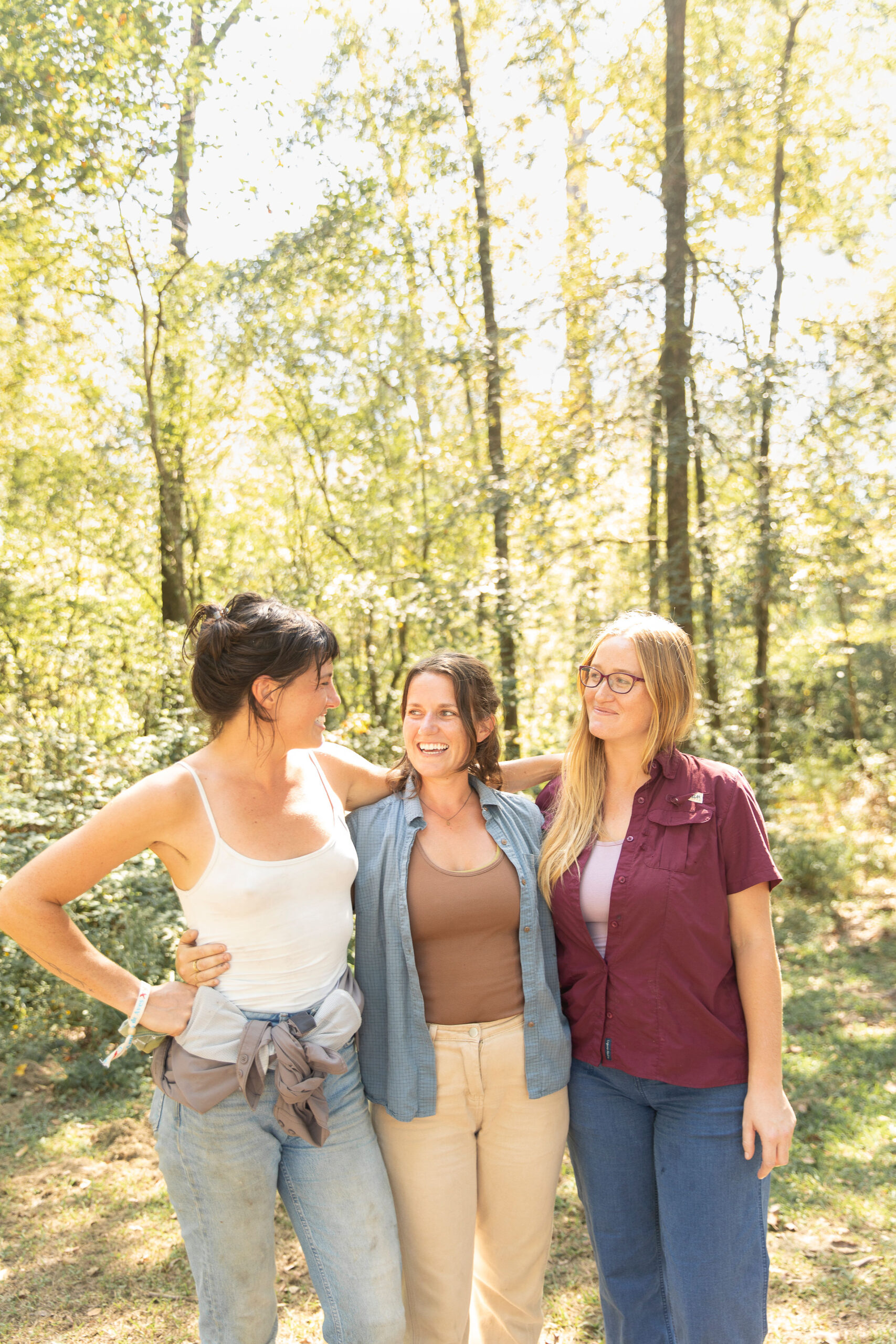
Swamp Fly Landscapes founders Ashlee Brackeen, Emily Pontiff and Caitlin Robbins.

The corporation serves consumers in both equally Baton Rouge and New Orleans, and focuses on regenerative commercial and residential landscaping.

“We never use chemical pesticides or herbicides,” Robbins claims. “Everything we use is natural and will have negligible influence on the bordering ecosystem, mainly because soil overall health and drinking water quality are crucial to human well being and the health of vegetation and animals.”

The concept for opening a complete-services native landscaping business took root just after Brackeen desired to convert her conventional landscaping business enterprise into something extra intentional. She pulled in good friends Robbins and Pontiff, who ended up functioning in various fields, but shared her interests.

The a few started by doing the job on a local community garden undertaking with Cindy Fantastic, a Baton Rouge activist and host of the WHYR radio show, Locals Only. While that challenge was delayed because of to the pandemic, Robbins suggests, the 3 close friends proceeded with a small business concept, launching Swamp Fly in spring 2021.

The business delivers consulting expert services and complete-services structure and set up. It is part of a expanding “kill your lawn before it kills you” movement throughout the nation, in which the return to small-influence landscaping is viewed as a healthful shift for equally crops and folks.

Indigenous landscaping addresses the reduction of “living landscapes” at the hand of urbanization, according to the Countrywide Audubon Society. About 150 million acres of habitat and farmland have yielded to urban sprawl, and the trend reveals no signal of slowing down, according to the corporation, which further more states that “the present day obsession with hugely manicured ‘perfect’ lawns on your own has established a eco-friendly, monoculture carpet throughout the state that addresses over 40 million acres.”

Swamp Fly will shortly be highlighted on the new Kill Your Lawn Venture series in generation by Joey Santore, host of the YouTube channel Crime Pays, but Botany Doesn’t. The documentary will comply with Santore as he explores so-named kill your garden jobs throughout the state, such as just one in New Orleans in which Swamp Fly designed a new, sustainable style and design, Robbins says.

To keep reading through about Swamp Fly and their focus on indigenous crops, examine out the complete tale from 225 Each day e-newsletter. Subscribe right here for extra.