March design news: celebrating council houses and the vulva spaceship | Design

In their introduction to the new book Queer Spaces, An Atlas of LGBTIQ+ Places, author Olivia Laing describes queer space: “It’s not just a physical building to hook up or hang out. Instead it’s an alternate universe, a secret network that runs right around the world.” The idea of a world where you’re allowed to write the rules and experiment is one that many creatives relate to.

In his art book The Council House, photographer Jack Young celebrates the estates that sprung up in London in the idealist post-war era. His contemporary photographs showcase the remarkable architecture of these homes, reminding you of the good intentions behind social planning.

Finally, if you want to find an alternate way to see the universe, sign the petition to get the vulva spaceship into development. A German feminist group is determined to replace the aerodynamically inferior phallic rocket with this new design. Because even in space, equality matters.

Definitely a space where no man has gone before.

For more news on architecture, sustainable living, art, fashion and new ideas, sign up for our monthly newsletter here

The art of fine dressing

Steven Campbell’s Waiting – Paisleycus Byrnicus Virus Invading Mr Gray, 2005
Steven Campbell’s Waiting – Paisleycus Byrnicus Virus Invading Mr Gray, 2005 Photograph: Antonia Reeve

Artist Steven Campbell always loved clothes. During his studies at Glasgow School of Art in the late 70s, he’d buy a suit each week from Oxfam, wear it to paint, to the pub, to lectures, then throw it away and buy a new one the following Monday. He was fascinated by performance artists such as Gilbert & George and Bruce McLean.

Even when painting became his passion – winning him a Fulbright scholarship to New York’s Pratt Institute in 1982 – his vivid works teemed with clothes and sartorial persona. Over the years, his inspirations included film noir, Bram Stoker’s Dracula, PG Wodehouse, Pinocchio and film director David Lynch. His own appearance remained eye-catching, as his Glasgow art tutor Sandy Moffat once wrote of Campbell, he was “a flamboyant figure, often outlandishly attired, [who] looked as if he had arrived from the Paris or Vienna of the late 19th century”.

Campbell was a celebrated painter in 80s New York, where he lived with his wife, Carol – who worked for sculptor Isamu Noguchi – then part of the Scottish art renaissance (known as the New Glasgow Boys, which he hated) when he returned to his homeland. He died far too young, aged 54 of a ruptured appendix in 2007.

New exhibition Dressing Above Your Station looks at the importance of fashion and textiles in Campbell’s work, including his own wardrobe replete with his Comme des Garçons collection, accepted as payment for one of his paintings during his New York days.

This virtual exhibition is curated by fashion designer and co-founder of label Atelier EB Beca Lipscombe and art historian Mairi MacKenzie, two Scottish creatives who relate to Campbell’s desire to make a statement. “The exhibition looks at the role of clothing in Steven and his wife Carol’s life and aspirations,” says Lipscombe. “The importance of leaving and returning home to their sartorial biographies, and what it feels to stick out like a sore thumb in Scotland.”

It’s also a good chance to remember the work of a great painter.

Dressing Above Your Station, is a virtual exhibition which can also be seen as projections in the windows of Tramway Museum and shop windows in Sauchiehall Street, Glasgow, 31 March-26 June

Extraterrestrial equality

Vulva spaceship for WBF Aeronautics by Dr Lucia Hartmann
Vulva spaceship for WBF Aeronautics by Dr Lucia Hartmann Photograph: jasmin mittag

Jeff Bezos, Elon Musk and Richard Branson blasting into space may have been a giant step for white, middle-aged billionaires, but did little to make anyone feel good about equality. As only 12{6d6906d986cb38e604952ede6d65f3d49470e23f1a526661621333fa74363c48} of space travellers have been female and woman has yet to walk on the moon, last year’s space explorers felt depressingly par for the course. But a German feminist group has a plan to change this.

Wer braucht Feminismus? (translation: “who needs feminism?”) was started as an art-based feminism project in 2012 by artist Jasmin Mittag, but has developed into a networking and grass-roots campaigning organisation in Germany. This year, WBF has teamed up with aeronautics expert Dr Lucia Hartmann to form WBF Aeronautics – a space start-up. Hartmann’s main area of research is spacecraft efficiency and she’s created a vulva-shaped craft which is more aerodynamic than the typical phallic rocket.

Hartmann says that the ship’s V-shape makes it surprisingly aerodynamic and also contributes to better fuel efficiency. “There’s less drag than on a conventional spacecraft.” She’s clear about her feminist message, too. In the promotional video for the vulva project, she wonders: “If space is for everyone, is a phallic-shaped rocket really the best way of getting there?”

WBF Aeronautics has launched a petition on change.org to get the European Space Agency to consider the vulva spaceship for development.

“With our mission, we prove that gender equality even has a place in space. We are not only inspiring space travel, but also rewriting the gender narrative,” says Mittag. “In space travel, all the problems that we have on earth are amplified. It’s time for equal opportunities in the entire universe.”

Making craft count

Designer Mac Collins, one of the artists taking part in the Harewood House Biennial, 2021
Designer Mac Collins, one of the artists taking part in the Harewood House Biennial, 2021 Photograph: Dawn Kelly

This month, Harewood House in Leeds opens its doors to artists seeking to answer the question Why Craft Matters. This is the theme of the second Harewood Biennial and, until August, the public can view these creatives’ attempts to address climate change or equality through craft. The Harewood Trust is trying to answer its own question about what makes a stately home relevant in the 21st century and the interesting range of artists involved in the biennial reflects how they’re trying to widen the house’s appeal.

Designer Mac Collins has designed a domino set, games table and stools, inspired by the Caribbean community’s domino-playing culture for Harewood’s Cinnamon Drawing Room. Collins describes their presence in a room full of Chippendale furniture and lined with portraits of the Lascelles family, as a combined act of material and socio-cultural representation.

Textiles artist Celia Pym has set up a “mending desk” and asked Harewood’s staff to bring a garment for her to repair, in exchange for a story of how these individuals care, repair and look after the estate.

Architectural reclamation company Retrouvius. replaces the eight leaves of the table in the State Dining Room with reclaimed materials that mirror the original Robert Adam ceiling (which was taken to the Sir John Soane’s Museum).

Smile Plastics, a Welsh company that recycles household plastic waste into building materials, as worked on a project to create a series of self-assembly, modular seating, which snakes its way around the north lawn of Harewood.

Hugo Macdonald, curator, says: “Radical Acts [Why Craft Matters] brings together an exciting group of creative activists, joined by their commitment to craft as a force for positive impact. The biennial is not so much an exhibition as a call to arms. These are stories and initiatives to inspire us all so that, as individuals, we can make conscious choices that have positive impacts. It is a radical act to take responsibility for our lifestyles and our livelihoods, and to discover that our future is in our hands.”

Harewood Biennial 2022 is at Harewood House, Leeds until 29 August

Celebrating the council house

Dawson’s Heights in East Dulwich by architect Kate Macintosh
Dawson’s Heights in East Dulwich by architect Kate Macintosh Photograph: Jack Young

Jack Young fell in love with London’s council housing during his lunch break. He’d explore Chamberlin, Powell and Bon’s Golden Lane Estate and the Barbican, architectural delights situated near the office where he worked as a product designer. Before long he found himself setting out at weekends to photograph developments and blocks around the capital. An instagram account was born.

He’s devoted to the post-war era, when rebuilding society felt possible and civic planners had big dreams and architects, such as Kate Macintosh and Erno Goldfinger, had a vision of providing quality houses for all. It’s the estates from this era that fill the pages of his new book, The Council House.

Though many of these buildings are now in disrepair, their inhabitants and architects more jaded about utopian ideals, Young’s images capture the best of these estates. In his introduction, he recalls how he was sometimes invited in by residents who watched bemused as he took his photos or that they would laugh at him as he obsessed over a concrete staircase. “But their pride in these estates was joyfully clear,” he writes. “It is my hope that in showcasing and championing the beauty and intelligence in these buildings, I can help to restore some of the rightful pride that was once felt in them.”

The Council House by Jack Young (Hoxton Mini Press, £18.95) is out now

Sign up to the Design Review Monthly newsletter

Sign-up of a monthly dose of creative inspiration, emailed directly to you.

Making art from Artforum

Simon Linke’s Lucio Fontana at Hauser & Wirth, 2021
Simon Linke’s Lucio Fontana at Hauser & Wirth, 2021 Photograph: Darren Flook

Simon Linke has a new exhibition opening in London gallery Darren Flook this week. If you’re a fan of the conceptual artist, you know that his new show will be very like his others. Since the 1980s, when Linke first found fame as an artist and as an inspiration to the YBAs, he has only painted adverts from American art magazine Artforum. Few artists have been so faithful to an inspiration: for 35 years now, his canvases, thick with oil paint, have been ads for gallery and museum shows taken from Artforum. Though in the new show – his first for 10 years – he’s added unexpected texture to the graphic designs.

On YouTube you can still find an excellent segment on Linke from revered 90s British culture TV programme The Late Show. In his interview with critic Matthew Collings Linke first gives monosyllabic answers, then interviews Collings, before finally admitting that in his work “I’ve found something that helps me negotiate the anxiety about what we can do and how we stay relevant”. And, although, looking at his work, there are good points to be made about art, repetition, commerce, history, and the influence of Freud and Warhol, this hard-won quote is still relevant all these years later.

As gallerist Darren Flook, says: “Art and commerce are now so profoundly linked, auction prices are in newspapers and pop stars show off the art they’ve bought on their instagram feeds. It’s incredible to me that in the 80s a British painter really beautifully and quietly pointed it all out. It was so conceptually tight and visually pleasurable – and now – 35 years later, he’s still making them. Like art and money or power, the dance is the same.”

Simon Linke is at Darren Flook, London, until 15 May

A history of LGBTQI+ places

Glasgow’s Category Is Books bookshop, a queer space chosen by Andy Summers for the new book Queer Spaces
Charlotte and Fin Duffy-Scott outside thir shop Category Is Books in Glasgow, a queer space chosen by Andy Summers for new book Queer Spaces Photograph: Category Is Books

“The idea that queerness requires an ecosystem to flourish helps clarify the fundamental importance of queer space,” writes Olivia Laing in the foreword to the new book Queer Spaces, An Atlas of LGBTIQ+ Places and Stories. “It’s not just a physical building to hook up or hang out. Instead it’s an alternate universe, a secret network that runs right around the world.”

It’s a great introduction to this new book by designer Adam Nathaniel Furman and architectural historian Joshua Mardell which shares the stories and philosophy of the different, ingenious places which have served as havens for LGBTIQ+ people throughout time. Though some of these essays celebrate well established institutions which identify as queer (such as bookshops and community centres), there’s also a looking-glass world here, full of Havanan ice-cream shops, Sheffield terrace houses and Spanish train journeys, inventive and secret places created by the queer community.

Designer Adam Nathaniel Furman says he hopes the book will become the resource he felt he missed as a student. “During a lonely and homophobic architectural education, there were no resources where I could find accessible histories and case-studies that showed how I was not alone, how what I was doing had a deep and rich history, full of proud individuals and incredible groups, spaces and communities creating radical spaces and ways of living.”

With Queer Spaces, he’s achieved that.

Queer Spaces, An Atlas of LBBTIQ+ Places and Stories (£40, RIBA books) is available for preorder now and published 1 May

Paris Gets a New Art Fair, RH Launches Its Latest Outdoor Collection, and More News

From major organization changes to noteworthy merchandise launches, there’s often a thing new occurring in the globe of design. In this biweekly roundup, Advert Professional has every thing you have to have to know. 

Products Launches

Martyn Lawrence Bullard Captures Old-Planet Glamour in New Decor Collection

Advert100 decorator Martyn Lawrence Bullard is very well acquainted with all issues luxurious, obtaining designed for the likes of Tommy Hilfiger, Cindy Crawford, Cher, RuPaul, and the Kardashian and Jenner clan. Now, Bullard is placing that abilities to function for SV Casa in a lavish new line of household equipment. The assortment highlights previous-globe glamour, with nods to Hollywood and the Palais Royal in Paris, as very well as 18th-century chinoiserie. The pieces involve a range of bathroom components, ornamental packing containers, and cocktails trays, all readily available at Harrods and LuxDeco.

One particular of the parts from the VidiVixi Lighting Sequence 01.

Image: Rodrigo Chapa 

VidiVixi Launches a New Lighting Line

Mexico City–based studio VidiVixi has entered a new chapter next the departure of its previous artistic director Mark Grattan. So, the launch of a new, 3-piece VidiVixi Lighting Sequence 01—a 3-piece, Artwork Deco–inspired selection marrying glass, resin, and brass—is a momentous occasion for the model as it transitions to a new product of performing with collaborators. The brainchild of studio director Adam Caplow, Lighting Collection 01 released final month at Galerie Philia for the duration of Zona Maco. 

RH Unveils Its 2022 Out of doors Collection

Just in time for growing spring temperatures, on March 17, home furnishings powerhouse RH launched its 2022 outdoor selection. The trove of climate-all set patterns includes wicker seating from Harrison and Nicholas Condos, sculptural, corded chairs from Ann Marie Vering, and teak loungers from Mario Ruiz. Hope a range of chic and understated designs, all of which are really sufficient to stand on their personal, but will not compete with the bordering landscape. The entire selection of products and solutions is now out there on the RH web-site.

Fülhaus Taps Brady Tolbert for Its To start with Designer Collab

Canadian furnisher Fülhaus has announced its very first-at any time designer collaborator: inside designer Brady Tolbert. Curating in excess of 600 parts, Tolbert has culled Fülhaus product or service into 3 collections: Sinuous Types: an Ode to Vladimir Kagan Residency in Marfa and the New Victorian. As its identify suggests, the initially of these lines pays homage to famous designer Vladimir Kagan, and is filled with curvaceous, ’70s- and ’80s-inspired forms in bouclé, suede, and sheepskin. The Marfa collection, meanwhile, works by using vivid materials and leather-based, wooden, and iron to evoke the raw, energetic modernism of Donald Judd’s foundation in the Texas city. For aesthetes more intrigued in a moodier vibe, the New Victorian features layouts in wood, brass, and velvet with black accents. “Brady pushes the envelope of residence design and style, so operating with him felt like a natural suit,” Fülhaus founder Andria Santos states. “With a concentrate on pure supplies, earthy neutrals, and thoughtfully picked out items, Brady’s style aesthetic echoes this generation’s drive to return to the purely natural environment.”

Hästens Debuts Bed and Headboard

Hästens, the purveyor of Swedish luxury beds and headboards, celebrated its 170th anniversary before this week. To mark the situation, the corporation launched its 1st product considering the fact that April 2020. Named Drēmər (and pronounced “dreamer”), the new arrival includes mattress and headboard choices by Ferris Rafauli, the similar designer as the $400,000 Grand Vividus mattress. Four colors are available—Traditional Blue, Black Shadow, Organic Shale, and Phantom Charcoal—as are conventional and tailor made sizing. The Drēmər headboard begins at $27,695 mattress starts at $35,790.

Turn into an Advert Pro Member

Buy now for unrestricted obtain and all of the rewards that only customers get to working experience.

Arrow

Honors

A New Chair of Landscape Architecture at Harvard GSD

USG preps for new Avery Quarry, targets construction this year | News

ALABASTER Twp. – Building upon an already lengthy local history, USG is looking to continue its gypsum operations in Alabaster Township well into the future. To secure the ongoing production, as well as the employment of those in the community who work for USG, the company is completing the steps to establish a new quarry.

USG officials presented their plans at a recent meeting of the Iosco County Board of Commissioners, and noted that construction of the Avery Quarry is proposed for this year. They say that USG will celebrate its 120th birthday in 2022 by opening the new quarry, which is named for its original founder, Sewell Avery.

As previously reported, in 2018 USG purchased nearly 600 acres of state forest land adjacent to its current property, with the expressed intention of continuing to quarry gypsum in the township.

The local reserves were part of the company’s founding more than a century ago, and they’ve steadily produced from this location ever since, says USG Manager Matt Craig. “We are proud of our history in the community, and we’re excited to announce we’re embarking on this new chapter of gypsum production at Alabaster.”

As part of the endeavor, USG has submitted a wetlands permit application to the Michigan Department of Environment, Great Lakes and Energy (EGLE).

Craig says that neighboring property owners and other stakeholders have been notified of USG’s intent, and he assured that those from the company have, and will continue, to answer any questions and address concerns.

In fact, during the recent on-site interview for this story, he said that the plans and designs which have been put forth were done so in a way as to not adversely impact the community.

Further, any land utilized by USG will undergo a reclamation process wherein the property is returned to a natural state. If five acres of wetland are utilized, for instance, the company has to later restore five acres in the same watershed. The reclamation work is ultimately determined by EGLE and the Environmental Protection Agency (EPA).

From home building and cement manufacturing, to agriculture and more, USG states that the Avery Quarry is welcome news to the Michigan industries which depend on gypsum-based products. The essential raw material is used in a wide range of applications, including food additives, animal feed, soil conditioner in farming, fertilizers, drywall and plaster.

Synthetic gypsum, made from emission stack material of coal-burning power plants, has been a key material in industry for decades. However, Craig points out that synthetic sources are rapidly declining as coal-burning plants are retired or shifted to natural gas for energy. So it’s critical to have a local, reliable source of natural gypsum rock for the dozens of industries and hundreds of companies USG serves in Michigan.

Also, the shift away from synthetic gypsum being created as a by-product of power plants has put increased pressure on natural gypsum, and available supplies around the United States are short. This includes the reserves at USG’s existing quarry in Alabaster Township, which is nearing the end of its productive life and will soon be depleted.

In terms of the need for a new quarry, the company states that its ability to supply gypsum has been very limited over the past several years, even as demand for gypsum-based construction products has increased significantly.

Craig, joined by other USG staff, also spoke to this at the March 7 Tawas City Council meeting. “We’re going back to what we did before the power plants produced synthetic gypsum, which is to mine natural rock. And this area has an abundance of natural gypsum, that is part of the deposit that goes throughout Michigan,” he advised. With the local gypsum being so close to the surface, it’s also much easier to access and the most economical to mine. “And that’s why there’s three different gypsum companies in this area.”

Councilman Chuck Klenow said that with the increasing demand, it can probably be assumed that the other local companies will continue to grow, which will also be a benefit to the area. “And I appreciate you bringing this to the council; keeping us apprised of it.”

The Alabaster quarry has been in existence since 1862, and has been part of U.S. Gypsum Company since its formation in 1902. “And [it’s] still the same company today, operating a quarry,” Craig told council members. “We’ve been in continuous operation since then, but business has slowed down; picked up. Our ship loading system shut down in 2000, and portions of it were taken out in 2004.”

The marine bin on Lake Huron was also taken out in 2019, he noted. “But at this point, we are now in the process of growing again.”

With the Avery Quarry, the rock will initially be shipped out by truck. But USG is looking at installing rail again, and is even investigating whether it makes sense to go back on the water at some point. “So all those possibilities exist for us,” Craig said. “We’ve got a very bright future, there’s a lot of demand for the product and a lot of need for it.”

As for an estimated time line, he shared that USG has submitted its application, which is going through the public notice phase, and that technical review of the permit is also occurring. This process will take at least until the end of June, but possibly longer since the state and EPA need an opportunity to review it, look at the numbers, ask questions and so on.

Craig adds that USG has put in a lot of monitoring wells to track surface water elevations, and have also done studies to make sure they don’t drain all the surrounding land in part of that process.

It depends on the permit, but he said that once this in place, USG is anticipating about eight months of work before they can start extracting the first gypsum in the new quarry. “And our plan is that most of the work will be done by the current employees who are there; who are mining the last of the rock out of our current quarry, which we call the Northwest Quarry.”

While awaiting the new quarry, staff continue to work in the meantime. Alabaster Operations Manager Jim Sheehan says that they are still selling some of the rock which exists there and continue to ship it to USG’s plant in River Rouge, as well, where it will go on to be used in agricultural and industrial products, for glass manufacturing, in the creation of fireproof/fire-resistant materials and more.

Workers at the current quarry are also stockpiling shale, which is being used to develop a haul road for the new operations.

Once up and running, the Avery Quarry will produce approximately 500,000 tons of gypsum annually and add full-time, living-wage jobs to the area. Craig says that the company has already started hiring more employees in anticipation of this.

As reported, USG began decreasing its production in 2019, due to the limited reserves of gypsum rock at the existing quarry. It was noted that layoffs were possible for some of the 23 employees who were working there at the time, but the site was running out of gypsum faster than anticipated and production had to be slowed while USG worked to get the next site permitted and operating.

According to Craig, they were down to six employees at one point, but now have 18 workers as the company prepares to open the new quarry. There will be even more hiring to come and, while the thought is to have at least 24 employees, it’s most likely going to grow beyond that.

“The demand for the product is very substantial and 24 is what we’re going to need, on the low end of that scale,” he told council members. “And I don’t think we’ll be that low for very long.”

USG completed its agreement with the Department of Natural Resources (DNR) in 2018 to purchase the 580 acres of land for $3.45 million. The new quarry property sits immediately adjacent to the west boundary of the existing quarry, which is south of Tawas City, and is still in Alabaster Township.

According to representatives, USG is committed to being a good steward of our natural resources. They have applied to EGLE for a permit, which is required any time human activity impacts wetlands.

If USG is unable to open a new quarry, it will likely be forced to use imported material until it can identify and create a new quarry someplace else; however, no other locations in Michigan have demonstrated economically obtainable gypsum. Company officials state that if the Alabaster operations closed permanently, it could have economic ramifications beyond Iosco County. The quarry serves the USG factory near Detroit, which makes Durock brand cement board, as well as a variety of other Michigan businesses.

Craig also said that the gypsum in Alabaster is particularly sought after due to its very high purity level. The local supply is special because of its brightness, as well, which appeals to the customers who want white gypsum, and gives USG the opportunity to serve those markets.

For those who may be wondering why the company doesn’t quarry gypsum away from wetlands, he explained that there really isn’t anywhere else to go, since this is where the rock is.

Simply put, according to information from USG, gypsum occurs where it occurs. It’s a calcium-based mineral located in the ground, so quarries must be developed where the rock is. In the case of Iosco County, more of the landscape is wetland than not. The gypsum reserves on USG’s property are very high quality – some of the finest in the country. Siting a quarry which would not impact wetlands in Alabaster Township is nearly impossible, so the company is working with state regulators on a plan that minimizes wetland disturbance and mitigates the impacts by restoring and protecting wetlands elsewhere in the watershed.

Craig says that in conjunction with working on the permit steps for the future quarry, they have also been designing the replacement wetlands and figuring out other mitigation details that will have to be done for the land used by USG.

Once the new quarry opens, staff will use one section of it at a time, lasting for about 50 years.

Craig elaborated on this, first explaining that a quarry is a broad term for an excavating operation. Within the quarry operation, each pit is called a bench.

Although USG purchased 580 acres to create the Avery Quarry, he said that this includes ample buffer acreage to help them be a good neighbor. The actual quarry footprint for Phase One is closer to 50 acres total. Once that 50-acre bench is depleted, it will be filled and reclaimed, then another quarry bench will be opened and so on. The lakes are then created by the final bench.

“All the planned benches in the quarry over next 50 years or so will total approximately 400 acres,” Craig stated. But for now, the focus is on the Phase One acreage.

As for the expected longevity of the Avery Quarry, he said it depends on a lot of unknown factors, mostly related to market demand for gypsum. However, what is known, is that the new setup will serve the region’s gypsum needs for decades ahead.

When removal of the deposits is complete, the areas are restored to create wetlands, lakes, forests and prairies, which is done according to township ordinances and environmental permits. USG notes that its long track record on the land in Alabaster as visible proof of their commitment to restoring the landscape when the work is done.

For example, USG has been hosting Free Fishing Weekend events at the property for the last few years, welcoming the community to fish the ponds on the reclaimed land of its current quarry, which are teeming with a variety of species.

Craig states that these fish are native species which have migrated in naturally over the past 50-plus years. The only stocking done by USG, was to put local minnows into the lakes a few years ago to see if it would reduce pressure on some of the panfish populations and provide forage for some of the carnivorous species. “Given the popularity of the Free Fishing Weekend events, USG is working to keep the fishery healthy to provide great fishing opportunities for those events.”

He pointed out that all of the water bodies on USG property are former quarries.

This includes a former mining pit that was depleted in 1999, was restored and is now known as Pilot Lake. Sheehan says that the lake has an average depth of about 30 feet.

And because there are no chemicals used in procuring the gypsum, the water bodies can naturalize on their own.

Craig went over this, as well, at the Tawas City Council meeting. He said that they remove the dirt, remove the gypsum and then put the dirt back. “The only thing we discharge is groundwater.” When they dig a hole in the ground, water is going to flow in. “And we have a permit to pump that water out. The water then goes through our lakes, before it enters Lake Huron.”

Staff closely monitor the quantity and quality of water and regularly report that data to the state of Michigan. The state also tests to make sure that no sediment from the operation enters Lake Huron.

For the actual collection of gypsum, because the reserves in Iosco County are close enough to the surface, they can be obtained through a quarry process, which is different from an underground mine. Surface soils and clays are cleared until the gypsum layer is exposed, and machines similar to road resurfacing equipment essentially mow rows of gypsum approximately 12 inches thick. The materials are crushed and sorted by size on-site, and transported by truck to manufacturing operations and other businesses across Michigan and North America.

USG officials say that this process does not harm the environment. Gypsum is a very safe mineral, quarrying it is sustainable and its removal entails a mechanical process which does not use chemicals or create pollution.

When USG closes a gypsum quarry, they backfill the earth, create a natural landscape, plant native trees and welcome wildlife into the space. The company is already reclaiming large sections of its existing quarry with wetland creation and enhancement, timber management and control of invasive species.

Craig, who also works at the River Rouge plant, says it’s interesting to see some of the historical areas that were mined more than 100 years ago in Alabaster, and how active they are today with wildlife, lakes, fish and so forth.

A group of whitetail deer is one example witnessed by this reporter, during the recent tour.

Some have questioned if there will be blasting as part of the new quarry, and the company reports that limited blasting is needed in their operations today. On average, they blast three to eight times per year to create holes to collect water from the quarry or access the deeper layers of gypsum. No explosive materials are kept on site, and are brought in only as needed.

Tawas City Mayor Pro Tem Brian McMurray, during the council meeting, commented that he was surprised at how infrequent the blasting occurs.

Craig said that part of their process involves opening a bench, and these are about 200 feet wide by 1,000 feet long. They dig down to the surface of the gypsum, which is mined with what he likened to a converted road planer. “But as part of that process, we have to deal with water.”

So the workers go to the lowest point of the bench and blast a hole, which allows them to collect the water and pump it out. They typically do two blasts per pit, and Craig said that currently, they go through maybe one pit every two years. “But the plan with the new quarry would be two pits a year. So that would be four blasts. And these are relatively small blasts.”

He noted that the outside company which brings in the materials to perform the blasting also sets up seismic equipment to monitor the activity, so that USG knows if there were any shock waves that went out and would have disturbed anybody. “And typically for us, the seismic devices do not record anything.”

Company officials state that USG has a documented, century-long record as a responsible custodian of the natural resources entrusted to them. They work in close partnership with local, state and national authorities to respect environmental concerns and restore impacted areas to a natural state.

“We started here and we want to stay here” is an adage that has been expressed by both Craig and other USG representatives. Although they had a temporary production slowdown during the past couple years, they are now eagerly looking forward to developing the new quarry that will secure gypsum reserves – and permanent jobs to the community – for years to come.

As for what USG intends to do with the existing quarry once it’s no longer operating, Craig says they currently plan to keep and maintain it, and that the priority will be the reclamation work.

Along with what has already been mentioned, USG says that some of the other benefits which will come with the development of the Avery Quarry include, meeting the state’s goal of supporting and strengthening the resource-based economy; putting nearly 600 acres of land back on regular tax rolls to support local public services and schools; supporting the DNR’s conservation projects in the region; and contributing to the economic recovery from the pandemic, by providing building supplies to a booming construction market.

The continuation of quarrying gypsum locally will also allow for the continuation of USG’s public engagement. In addition to hosting the Free Fishing events, employees are involved in the community, attend local governmental meetings and support area businesses.

The company has also teamed with Michigan Sea Grant, Michigan State University Extension, Project Fish and others to explore development of an ongoing summer youth fishing program to encourage recreational fishing and educate children about the natural environment and ecosystems.

Additionally, Craig says that when USG purchased the land in 2018, they immediately put a total of 1,000 acres into public access through the state’s Hunting Access Program (HAP). “We realize outdoor recreation is important to people in the area. As a landowner, we support that as best we can.”

Further, USG has contributed to Habitat for Humanity, the American Red Cross, United Way, Huron Pines, the Tawas City Fire Department, the Iosco County Historical Museum and more.

Staff have given tours to a number of different entities and individuals, as well, including school groups, Sunrise Side Lifelong Learning members, local officials and those from the public.

“I highly recommend you go. It’s very interesting,” Tawas City Manager Annge Horning told council members at their meeting, after Craig confirmed that tours of the facility will again be provided.

Councilman Ed Nagy added that the handouts shared by USG for the meeting were very informative and well put together. “Having lived here a long time, I didn’t know a lot of this stuff. Thank you.”

More workers and more land in support of the Avery Quarry also means that more equipment is needed, and USG has already tackled a big chunk of this task. For example, the company recently purchased three Volvo A60H trucks, which are the largest articulated haulers in the world.

In reference to the quarry’s namesake, Craig said that Avery’s father was a timberman who purchased the Alabaster quarry site in about 1895. Avery and his brother were running the quarry when USG formed in 1902, upon merging several manufacturing/quarry sites.

Avery became the president of USG – a position he held for 30 years – and helped grow the company during that time, even throughout the Great Depression.

According to representatives, USG has grown into an international company, with 6,900 employees across North America and operations around the world. The business is a leading manufacturer of building products and innovative solutions, with one of its most well-known products being Sheetrock® drywall.

Virtual native landscaping webinar series offered | News

St. LOUIS — Householders can contribute significantly to generating their neighborhoods and communities greener by planting indigenous crops.  To aid them get commenced, the Missouri Division of Conservation (MDC) and the Partners for Indigenous Landscaping have teamed up with St. Louis County Library to present the Partners for Indigenous Landscaping Spring Webinar sequence of no cost digital native landscaping workshop classes.  The purpose of the sequence is to inspire and support people make gardens that are not only stunning, but are also habitats for indigenous wildlife.

A whole of 9 classes will acquire area beginning March 10 and operate via April 5.  Particular person periods will contain the keynote “Let it Be an Oak” by celebrated indigenous landscaping author Doug Tallamy, “A Three-Calendar year Suburban Landscape Makeover,” “Life in the Soil,” “Native Plant Gardens Provide Pollinators,” “Rainscaping with Native Vegetation,” “Investing in Native Shrubs and Trees,” “Gardening for Backyard Wildlife,” and much more. 

The seminars will be led by authorities in the area like MDC’s Erin Shank, Dave Tylka of the St. Louis Audubon Modern society, Jean Ponzi from the Missouri Botanical Backyard garden, and Shaw Character Reserve’s Scott Woodbury.

Every Associates for Native Landscaping Spring Webinar session is free and these fascinated may well attend as lots of as they select even so, sophisticated on the net registration is needed.  Much more details about the collection and a entire list of plans and registration links can be identified at https://shorter.mdc.mo.gov/4oh.  Webinars will be carried out by way of Zoom.  Contributors will receive Zoom information through electronic mail instantly soon after registering.  Programs will also be recorded and accessible on YouTube within a few small business days.

Much more info can also be found at PartnersForNativeLandscaping.org/.

The workshop collection is sponsored jointly by MDC, Shaw Nature Reserve, St. Louis Audubon Modern society, St. Louis Group College or university, the St. Louis Chapter of Wild Ones, BiodiverseCity St. Louis, Metropolitan Sewer District’s Undertaking Distinct Stormwater, Expand Native!, and hosted by the St. Louis County Library.

Indigenous crops have evolved in Missouri’s landscape. They are superior acclimated to our weather circumstances than unique crops and are resistant to community pests and conditions.  This translates into significantly less time, effort, and expenses eaten by watering, fertilizing and insecticide use. 

Also, native Missouri wildlife has advanced to coexist and use native crops for deal with, meals, and habitat, so, raising native plants also tends to boost desirable wildlife, like birds, butterflies and pollinators.

This Associates for Native Landscaping digital workshop sequence is section of MDC’s dedication to function with house owners to maintain healthful and greener communities for both equally people today and wildlife.

Digital and NFT art reigns at Art Dubai | Arts and Culture News

Dubai, United Arab Emirates – Back with the to start with total-scale truthful considering the fact that the COVID-19 pandemic started, the 15th edition of Artwork Dubai is exploring new frontiers with the launch of its new portion highlighting digital and NFT (non-fungible token) art.

Alongside the common modern and modern day showcases, Art Dubai Electronic collected 18 galleries from March 10-13 at Madinat Jumeirah, some of which were being only launched in the previous several many years. The new segment was designed in response to a critical change in the worldwide art scene, which has noticed escalating desire in digital mediums and the rise of NFT art.

“We’ve been observing how the electronic universe has been building and possessing a much better voice all through lockdown,” Art Dubai inventive director Pablo del Val said.

“What we intended is to put alongside one another one thing that could be a 360-degree task, that could turn out to be a bridge amongst the electronic and the physical, the place both worlds can get with each other.

“Taking into thought that Dubai has grow to be a crypto money, it’s a area where by some of the most exciting minds and assignments are coming,” he added.

“NFTs at the instant are like an total universe by itself – a universe that people today are frightened of getting into since persons really do not have expertise of this universe. I believe this is an version that is stepping up, that is bringing some thing new.”

An astronaut nesting doll in the COSMODREAMS exhibit
An astronaut nesting doll in the Cosmodreams exhibit [Maghie Ghali/Al Jazeera]

‘Beyond the canvas’

Solo exhibition “Cosmodreams” by artist Marina Fedorova has bridged common art and electronic engineering, incorporating virtual reality (VR) and augmented reality (AR) into her paintings and sculptural installations.

The exhibition displays how engineering can be used to make art much more interactive and immersive. Her is effective seize the natural beauty of outer place and how fashionable technological innovation has influenced our world.

Viewers can use their smartphones to see the animated AR capabilities on the paintings and sculptures, or acquire pics with the functions.

“If the smartphone absorbs our contemporaries’ focus solely, why not glance at paintings by way of the cellular phone display and study a story past the canvas?” Fedorova mentioned.

“We are adapting to new problems in several spots our lifetime becomes electronic. The pandemic served as a catalyst, it produced us assume of ways to make it attainable for people today to take a look at museums when keeping at dwelling, about the kinds of practical experience we can permit as a result of the screens.

“Ironically, as a painter I was in opposition to any technological advancement in the beginning. I considered that there was absolutely nothing improved than paper or canvas with some paint on it,” she added. “However, these times adjusted my opinion drastically, manufactured me have an understanding of that new systems are just a new software in the artist’s palette.”

Contact screens, QR codes and VR headsets invited consumers to participate in the will work and movies, altering them from viewer to participant.

The electronic area not only released these NFT artists and galleries to the set up establishments, but also demystified the technological innovation and terminology – this sort of as cryptocurrency, minting and blockchain – to likely collectors and artists intrigued in broadening their horizons.

A sequence of talks by Bybit was also element of the programme. Campus Artwork Dubai – a longrunning non-revenue arm of the reasonable that runs education programmes for art pupils – this yr partnered with NFT artwork market Materia for an eight-7 days workshop for UAE-based artists.

The resulting NFT artworks had been exhibited at the truthful. Blockchain is a procedure of recording data, such as electronic assets, in a way that helps make it complicated to alter or hack.

Minting is the act of turning a digital asset into an NFT, by recording it in blockchain.“Digital artwork is not easy to exchange devoid of needing a system or USB but when it is registered on blockchain, you don’t will need to be dependent on physical products,” Materia co-founder Patricia Ezpeleta told Al Jazeera.

“Blockchain also enables you to have traceability of the artworks, which is really useful for artists, as they can gain from royalties on resales of their artworks.

“NFTs enable artists and entrepreneurs to demonstrate that it is the primary variation,” she additional. “For collectors, they can prove that they own the original file and at times you get folks stealing other people’s work off the net and saying it is theirs, but with NFT it can be proven fake since the registry is community.”

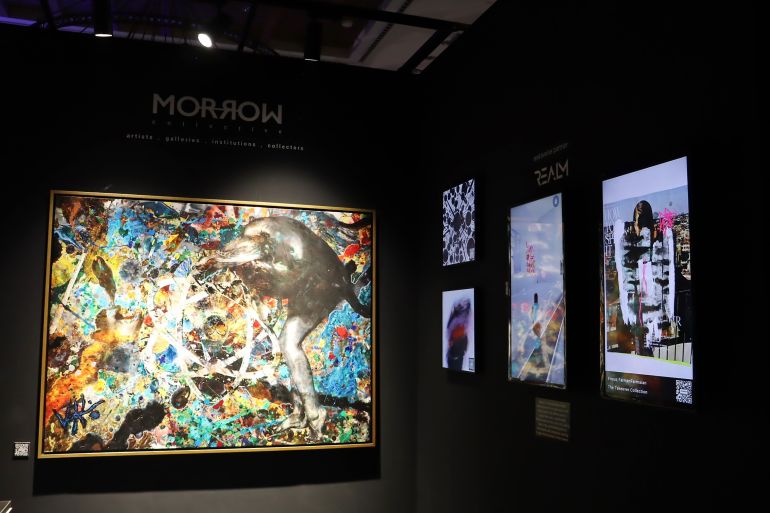
The MORROW Collective booth at Art Dubai Digital
The Morrow Collective booth at Art Dubai Digital [Maghie Ghali/Al Jazeera]

‘Beautiful metaverse galleries’

Morrow Collective, a UAE-centered NFT curatorial system started past calendar year, desires to make the NFT practical experience more partaking, through curating exhibits. Tablets lined the walls of their booth, exhibiting colourful, slightly animated artworks, various from hyper-sensible portraits to pop artwork digital drawings.

“I’ve been an NFT artist because 2020 and I recognized in my time in NFTs that there was seriously not a whole ton of curating,” Morrow co-founder Jen Stelco stated.

“It was all on the lookout like a minor bit of a mess and it was really hard to come across what we take into consideration to be the great art, or the art that has some material.

“Since then we’ve occur alongside one another to curate NFTs, uncover techniques of serving to of getting them to convey to tales and have dialogue amongst them and presenting them in a distinctive way, alternatively than just on an NFT platform in which you’re scrolling, substantially like Instagram or Google Photos,” she added.

“We have these beautiful metaverse galleries … and we curate them into art exhibitions in our galleries, to make far more of a accurate to lifestyle artwork working experience, but digitally.”

A large amount of the NFT artwork is mostly experimental, seeing what can be realized with the know-how, relatively than creating art with a meaning or reason. Trends or common themes have but to emerge.

New territory

For a lot of artists employed to doing the job with paint or creating images, electronic NFT art is new territory that requires learning, before they can implement thought at the rear of the information by itself.

Digital artist Lawrence Lek has had the benefit of doing the job in film, new music and open-environment video game style for 10 decades. Presented by virtual gallery Horizons, in partnership with NFT market So-Far and digital gallery Aora, Lek’s “Nepenthe Valley” offers a mystical alternate planet to take a look at, which promotes restorative meditation. Lek unveiled four out of 9 approaching fictional ruins positioned in serene landscapes.

The exhibit, curated by Jenn Ellis, is 50 {6d6906d986cb38e604952ede6d65f3d49470e23f1a526661621333fa74363c48} 3D-printed architectural models of the ruins, and 50 {6d6906d986cb38e604952ede6d65f3d49470e23f1a526661621333fa74363c48} NFT electronic renditions of the locations, full with neon accents, soothing soundscapes and dynamic weather conditions and lighting.

“I was drawing a large amount from the suggestions of elegant landscapes and spots that are much more involved with healing and expanded consciousness,” Lek advised Al Jazeera.

“A significant impact for me quite typically is science fiction and Napenthe Valley is to do with these locations that are in involving the future and a damage of the past. So like thinking about locations that may well evoke a form of classical architecture, but at the same time, they are neon lit.

“[Healing] is a little something which is addressed in another way in video video games, since you can regenerate your self, you can select potions and elixirs that heal you,” he additional.

“In the valley, I have designed static details of view wherever people today can sit and meditate, like how you would climb a mountain to see the see at the best, as a location that is apart from your each day truth.”

Irrespective of NFTs staying produced in 2015, it is only in the past 12 months that they have come to be portion of mainstream dialogue. NFT artwork could possibly not nevertheless be broadly acknowledged or recognized, but with establishments these types of as Art Dubai spotlighting them, it will not be extensive ahead of they are proven on the artwork scene.


Landscape architect creates Lego models of Madison to connect with community | Local News

For local landscape architect Aaron Williams, building with Legos has become more than just a hobby.

The white, plastic blocks — formed into mini models of Madison businesses and buildings, particularly those on Monroe Street — are a way for him to connect with other residents, become “completely absorbed in something” and gain a greater appreciation for the neighborhood that he loves.

A resident of the Dudgeon-Monroe neighborhood, Williams said he was sad to see the restaurants, coffee shops and stores he enjoyed along Monroe Street shutter at the start of the COVID-19 pandemic.

One of the restaurants, Fairchild, had just opened, but it closed up due to COVID before Williams got a chance to go. He decided to build it with Legos instead.

“That’s what really started all this stuff. If you go back to the first post that I did, the series was called, ‘Can’t go so we build,’” Williams said. “It was about the places that we frequented, and that were the backdrop of sort of my daily existence, but now were shuttered or silenced.”

People are also reading…

Now roughly two years later, Williams has created almost 60 Lego miniatures of Madison buildings, the vast majority of them businesses along Monroe Street.


Lego models

Aaron Williams shows a photo of the facade of Crescendo Espresso Bar and Music Cafe as he works on a Lego model of the building. Williams starts each of his models by taking photos of all sides of the actual building. Then he develops a scale — usually one Lego brick for one door frame — and uses trial and error to replicate the building. 


He begins by taking photos of all sides of the actual building out in the community. Then he develops a scale — usually one Lego brick for one door frame — and starts doing trial and error to replicate the building, but pint-sized. The process is something that he enjoys. It comes easily and is a way for him to get into a “zone” where he feels fully present in the moment.

“Being present, that’s the hardest thing to get into and reside in,” he said. “And that’s what Lego allows me to do.”

Once the build is done, Williams snaps some photos and posts it to his Instagram, aw_legoarchitecture, with a brief description of the business and what it brings to the Madison community. Williams said he wants to bring attention to places that have struggled because of the pandemic.

After posting, Williams would deconstruct the model and reuse the bricks for the next creation to save money on Legos and have “the past” help build the future.


Know Your Madisonian: Sam Li goes to aerial heights to 'celebrate the Midwest'

As interest in his project has grown, however, Williams has started to keep some of the models. His work was featured during a gallery night at the Madison Museum of Contemporary Art in the fall. He’s also sold some of the models, but hasn’t made a profit.

“If there’s a way to monetize it, I haven’t figured it out,” Williams said, noting that’s maybe part of why people are connecting with the buildings. He’s not trying to make money off them.


Lego models

A Lego model of the UW Field House created by landscape architect Aaron Williams. The Field House is one of the largest models that he’s created from a set of 1,200 white and translucent Lego pieces his wife gave him a few years ago. He says the monochromatic color edits the buildings “down to their essential qualities” and heightens their architecture. 


Williams said his main goal is to “enhance the experience of the everyday.” To Williams, that means taking something ordinary and looking at it in a different way. A way that “allows you to grow and see the world differently,” he said.

Williams, 42, is an assistant campus planner at UW-Madison and is also the founder of Aaron Williams Landscape Architecture. He lives a few blocks off Monroe Street with his wife and their 8-year-old twins, a boy and a girl. He grew up in Antigo, a farming town in northern Wisconsin, but has lived in Madison for the last 20 years.

Aside from being a landscape architect and building these Lego creations, what do you like to do for fun?

I enjoy outdoor activities and spending time with my family. Partaking in the typical Madison things. Going to sporting events. We’re big into basketball and golf, soccer, tennis, swimming. Maybe get back to travel at some point. Haven’t done much of that in the last two years.

Have you designed anything in the Madison area that people would know of?

A number of streetscapes (in) Cambridge, Grafton, Burlington, Middleton, Stoughton. Robinia Courtyard (829 E. Washington Ave.) is probably one of the more popular ones right now. I started that when I was with SAA Design Group. I’ve done work for Lucille up on the Square.

You started the Lego project as a way to connect to businesses that you couldn’t go to. Do you think that the message of this project has changed over time now that you can go to these businesses again? How has it evolved?

I know these businesses. I personally know them visually as a much richer experience. But now I know many of the owners or the inhabitants of these buildings (because of how they’ve interacted with the Lego project). When I go to these businesses, Madison becomes that much smaller. That’s what you want to hope for a place that you live, right? You want to be of the place. I’ve felt I’ve become more of the place.


Lego models

Williams shows his signature displayed on his Lego model of Crescendo Espresso Bar and Music Cafe. He says he doesn’t consider himself a “real artist” even though his models were featured during a gallery night at the Madison Museum of Contemporary Art last fall. 


Was there a reason why you picked white for the color?

In 2015, my wife had bought me the Lego architecture set, which is a set of 1,200 white and translucent pieces only. I got (it) out, and decided, “Let’s see if I can build Fairchild,” which was the first build I did.

Besides really the practicality reason … having that absence of color makes you more aware of everything around you. I’m less interested in reflecting what the buildings look like from a true color standpoint. I’m more (interested in) editing them down to their essential qualities. I’m kind of heightening them in a sense by creating them in a monochromatic color. And then allowing you to make an interpretation for yourself.

You said a bit ago that you didn’t really think of yourself as an artist. Do you feel like an artist now? It feels like that is what this project has become.

I suppose. I’m not trained in that sense. I don’t want to offend real artists. It’s not my livelihood by any means. But there’s definitely an artistic quality to it. Art’s in the eye of the beholder. Mine just happens to be little white bricks.