

‘Lake Tahoe has a people problem’: how a resort town became unlivable | California

Late last year, Lake Tahoe earned a spot on an exclusive travel guide. But the mountain destination, famed for its cobalt blue waters and Olympic-quality ski resorts, wasn’t there for the reason you’d think.

Fodor’s “No list” highlighted beloved getaways that needed a break, and Tahoe was up there with the neediest. Citing a pandemic influx of remote workers, second home buyers, traffic gridlock and packed beaches, the guide concluded “Lake Tahoe has a people problem”.

While not everyone agreed with the guide’s blunt recommendation, the superlative spoke to a reality that’s become impossible to ignore: Tahoe had changed significantly in the pandemic years and many locals say not for the better.

Signs of the region’s popularity are evident all around its tree-lined shores in the form of endlessly booked short-term vacation rentals and for sale signs that popped up outside modest family cabins and multimillion-dollar chalets alike. As Covid surged, new residents had flocked to the towns and cities along the lake, sending real estate prices soaring to staggering highs. Prices doubled and even tripled in some areas – median home prices in the basin climbed from $345,000 in 2012 to $950,000 in 2021, according to a report from the Tahoe Prosperity Center.

Crowds of people wearing masks walk around a resort town at dusk.
During the pandemic, tourists flocked to communities like South Lake Tahoe, California, bringing traffic and packed beaches. Photograph: Bloomberg/Getty Images

Homeowners cashed in on the demand. Rents rose and the housing shortage grew more severe, pushing locals east to more affordable cities such as Reno and Carson City. In turn, local businesses struggled with a depleted workforce. Ski resorts looked to campgrounds and tiny homes to house workers while short-staffed restaurants reduced their opening hours.

“It’s been getting progressively worse,” Clay Kuecker, a lifelong resident, said while sitting at the bar of a restaurant on the lake’s north shore. “The market is so tight and the demand is so high [sellers] get whatever they want. Renters cross [their] fingers and hope the owners don’t sell.”

The story of Lake Tahoe is a microcosm of what’s happening in communities across California and the US, where longstanding housing problems have been intensified by the pandemic. The resulting upheaval has fueled fear and uncertainty about Lake Tahoe’s future, and forced the area to confront a difficult question: who is Tahoe for?

“It’s hard to stay here,” said Heidi Hill Drum with the non-profit Tahoe Prosperity Center. “The only way to get our community back is to build housing for people who are the backbone of our economy: the tourism workers. We’re not helping them right now – not enough.”

Constant stream of tourists

Every year about 15 million people travel to Tahoe to enjoy the lake or snowboard and ski at the area’s world-class resorts – a larger number of visitors than Disneyland, Yosemite national park or Napa Valley wine country. On a recent December day, the snow-covered streets were filled with large groups of tourists on their way to the shores of the lake or pizza joints and Mexican restaurants after hitting the slopes.

Tahoe also serves as a playground for the rich and famous – Kim Kardashian, Justin Bieber and members of the Real Housewives are among its most famous visitors. The constant stream of tourists keeps communities around the basin, which straddles five counties across California and Nevada, bustling year-round.

Pope Beach on Lake Tahoe is crowded with people swimming and basking in the sun.
The millions who visit Lake Tahoe every year are sustained by a population of just 56,000 residents. Photograph: Bloomberg/Getty Images

The millions of visitors are sustained by a population of just 56,000 residents who keep the community running by working in law enforcement, fire departments and at local hospitals, staffing restaurants and ski resorts and teaching students. Those who have settled here permanently were usually drawn to the area’s natural beauty and outdoor lifestyle. Countless residents share stories of coming for seasonal jobs and deciding to stay, despite the intense winters, limited job opportunities and housing challenges.

People have continued to settle here even as environmental pressures have mounted, including fast-moving wildfires that have threatened entire towns and severe winter storms that have knocked out power and cut the area off from the outside world for days on end.

“The winters can be rough. We joke we have some of the most overeducated bartenders and servers in the nation. It’s a choice you make to live up here, to just make it work,” said Alicia Barr, the co-founder of FiftyFifty Brewing in Truckee.

A group of people wearing cross country skis set out on a trip.
Often those who came to Lake Tahoe for seasonal jobs and decided to brave the intense winters, limited job opportunities and housing problems. Photograph: Mario Tama/Getty Images

But, by design, growth in Tahoe has been relatively slow, and the region’s housing challenges started before the Zoom town boom or the rise of short-term rentals. There is a limit to how much housing can ever be constructed in the basin, as well as height and coverage regulations to preserve the natural landscape. Those factors make it challenging to complete projects in the region, said Meea Kang, an affordable housing developer who has worked in Tahoe – a perspective shared by other developers.

“We have extremely high land costs, compound that with some of the highest construction costs in the whole country and you have limited actual locations for those projects. It makes it extremely difficult,” said Daniel Fraiman, a developer in Tahoe.

In the mid-20th century, when the area served as a getaway for stars such as Frank Sinatra and Marilyn Monroe, planners envisioned a city the size of San Francisco on the shores of the lake with freeways around the basin and bridges across the bay. At the time the area was growing rapidly, and haphazardly, with developers filling in wetlands and the clarity of the famously clear lake quickly declining, said Jeff Cowen with the Tahoe Regional Planning Agency. The planning agency was established in 1969 to regulate development in the basin and protect the environment of the lake.

People sit near a fire pit in the resort town of South Lake Tahoe.
Lake Tahoe’s population was on the decline for 20 years, but reached a record 60,000 in 2000. Photograph: George Rose/Getty Images

Still, Tahoe managed to grow, its population reaching a record 60,000 in 2000. At that point, unlike some other famed resort communities, homes in the area hadn’t yet surged to unaffordable levels.

“When I moved here in the early years, you could find a house pretty easily. You could go on to Craigslist and ask around and rent a place,” said Fraiman, who is also a planning commissioner in Truckee. “You used to be able to find a room in a house that somebody who was making a regular wage could afford,” he said. “The property values have not come back down and I don’t know if they ever will.”

The area’s population was on the decline for 20 years, particularly after the great recession in 2008, but the area’s housing challenges began to pile up amid strict housing regulations and vocal opposition to affordable housing projects. Between 2012 and 2021, the region expanded its housing inventory by only 1{6d6906d986cb38e604952ede6d65f3d49470e23f1a526661621333fa74363c48}, most of which were large, expensive homes for second-home owners.

Drum and others point to both the opposition to affordable housing efforts and strict rules around development to explain the shortage. Tahoe has struggled to balance its efforts to preserve the environment and support those who live there.

“We don’t have a good track record of doing both. We talk about the triple bottom line: economy, the community and the environment. But we don’t have a good track record of balancing that,” Drum said.

“We haven’t built enough homes for our workers, for our local residents. We haven’t kept pace for what our community needs,” she said.

A woman standing with a group of people near a traffic roundabout holds a sign over her head that reads ‘Stay home’.
Brenda Heermann holds a sign discouraging tourists from visiting Meyers, California, a community near Lake Tahoe. Photograph: San Francisco Chronicle/Hearst Newspapers/Getty Images

More than 3,000 people moved to the basin in 2020 at the height of the pandemic – the largest one-year population increase on record – and the need for housing was greater than anyone had prepared for. Longtime residents found themselves with nowhere to go when their landlords announced they would sell their properties.

For businesses such as Las Panchitas, a Mexican restaurant in Kings Beach, the crisis has manifested as a scramble for staff. The 40-year-old eatery, housed in a wood building with a rock facade on the lake’s north shore, has been short-handed for two and a half years, the owner Alex Brambila said.

Las Panchitas is an institution where Brambila greets most customers by name: “Everybody’s famous in Kings Beach,” he jokes. “We all know each other.” Most of the restaurant’s staff has been there for years, Brambila said, but the high cost of housing has made it increasingly difficult to find workers. Standing behind the bar while preparing a margarita, Brambila says his business is now open six days a week, one day less than they were two years ago, and he works additional hours so that employees can have some time off. “There’s no lodging and housing went up almost double. My guys … they have to work like crazy to pay rent.”

Seated at the tile-covered bar, Clay Kuecker, who was born and raised in the area, commiserated with Brambila about the changes. As costs have risen, friends and family members have gotten priced out of the region, he said, migrating to more affordable areas and then spending hundreds of dollars a month to commute back to Tahoe for work. “My brother got forced out of Tahoe. He’s had to move a lot,” he said. “It really sucks. It’s just tough.”

The region needs tourism to survive – something Kueker, who builds custom homes, knows personally. “We’re a resort town – we rely on that money. All my clients are from out of town,” he said. But without more affordable housing, “[Tahoe] will only be for the wealthy.”

Change … but not overnight

Twenty minutes from the lake’s north shore lies a vision of what a more sustainable Tahoe could look like.

It’s a collection of 40 new three-bedroom homes with crisp white paint and large windows that frame a snowy field dotted with firs, and a starting price of $577,500. Daniel Fraiman, the housing developer, hopes this neighborhood, where homes can only be sold to and occupied by local workers who make no more than 180{6d6906d986cb38e604952ede6d65f3d49470e23f1a526661621333fa74363c48} of the area median income, can help alleviate the area’s housing shortage.

“What we’ve attempted to create here is a little bit of a community,” he said while pointing out how the duplexes in Hopkins Village provide room for families and have garages with room to store skis and snowboards.

The project is designed to serve locals who couldn’t otherwise afford a home in the area, but make too much to qualify for affordable housing.

A man pulls on a rope securing transparent kayaks on a boat.
Ludovic Fekete, an employee with Clearly Tahoe, checks on the transparent kayaks aboard the company’s new boat at the Tahoe Keys Marina in South Lake Tahoe. Photograph: Jane Tyska/AP

Developments like Hopkins Village play an important role in chipping away at the housing crisis, Fraiman said, as the area continues to grapple with the changes that came with the pandemic.

Officials warn turning the tide will take time, and a multi-pronged approach – they have put forward solutions that include down payment assistance, deed-restricted housing, restrictions on short-term rentals, and cash incentives for second-home owners who rent to locals. Sugar Pine Village, which Kang developed, will bring 248 units of affordable housing to South Lake Tahoe, the largest single development approved by the Tahoe Regional Planning Agency.

More housing developments like these are needed, a process that – due to high costs, tight regulations and limited available building space – will take years.

“This is not an overnight change. This has been happening for, say, 20 years. It may take us 10-20 years to really make significant strides in this,” said Cindy Gustafson, a Placer county supervisor who works closely on housing issues. All of her sons had to leave the area to afford homes, and the continued exodus out of the area hurts the fabric of the community, she said.

Without meaningful change, quickly, Drum fears Tahoe will lose that social fabric, and there won’t be much left for those who live here, or for tourists.

“There won’t be a restaurant like Las Panchitas where you walk in, you know people. Snow removal will take a lot longer. It’ll be hard to find somebody to babysit your kids when you want to have date night,” she said. “ I don’t think it’ll be as fun of a place to visit. There won’t be a community.”
Jun 25 | Parks, Plants and People The Impact of Jens Jensen on Evanston’s Natural Landscape

Be part of The Evanston Public Library, Jens Jensen Gardens, and the Evanston Backyard Club on Saturday, 6/25 for Jens Jensen Day ’22, a celebration of the loaded native plant and gardening record of Evanston.

The software will aim on 3 influential Evanstonians: Anna Rew Gross, Donn Werling, and Margery Taylor Carlson, and will consist of shows at the library adopted by a tour of the Lighthouse Beach front gardens.

Gross, Werling and Carlson have been all influenced by the do the job of famed Danish-American landscape architect, Jens Jensen, whose design and style operate can be found in both of those the metropolis of Chicago (Garfield Park, Humboldt Park, and Douglass Park amid many others) and in Evanston. Jensen’s most noteworthy design and style in Evanston was the Shakespeare Back garden (the initially of its form in the United States) on the grounds of Northwestern College and the Wildflower Trail on the grounds of the Grosse Position Lighthouse. The two had been commissioned by the Backyard garden Club of Evanston. His largest and most bold landscape in Evanston was the 4.7 acre landscape made in 1927 for the Harley Clarke mansion, positioned at 2603 Sheridan Road.

The keynote speaker, Dr. Donn Werling, was the 1st and only human being with the official title of City of Evanston Naturalist. He also served as Director of the Ladd Arboretum, Evanston Ecology Heart, and the Lighthouse Character Center from 1973 – 1982. He is now retired from the University of Michigan where by for 19 a long time he served as Director of the Henry Ford Estate, a single of Jensen’s major and most regarded performs.  Donn is also advisor to Jens Jensen Gardens in Evanston.

In 1915 a friendship in between Anne Rew Gross (1864 – 1946) and Jens Jensen (1860-1951) grew into a skilled connection that improved the aim of household plantings from nonnative vegetation species to patterns centered all-around the use of indigenous crops. In May well 1916 the to start with plant sale was held in Raymond Park and has ongoing to be an once-a-year event to this day. 

Margery Carlson (1892 – 1985), an early member of the Garden Club of Evanston and the initial complete time lady faculty member of Northwestern College, was another influential Evanstonian who will be celebrated.  She traveled throughout the entire world collecting botanical samples (some of which are still archived at the Subject Museum), arranged Victory Gardens, and was 1 of the founders of the Ladd Arboretum. Her legacy carries on to enrich our life today. 

The Program will start out at 10:00 AM in the community area of the key department of the Evanston Community library. There will be a lunch break from 12:00-1:00 and at 1:15 on web site contributors will travel by bus to Lighthouse Park the place the method will continue on with extra discussion and Q&A with Donn Werling. Excursions of the landscape rehabilitation work underway, native plant demonstration backyard garden, Alfred Caldwell Stonework, and waterfall will be provided. Users of the Garden Club of Evanston will be on website to conduct guided excursions of the historic Lighthouse wildflower stroll (built by Jensen in 1937). Light-weight refreshments will be supplied.

Even further data can be received by emailing info@jjge.org or on the website   www.JenjensengardensinEvanston.org.

Robert Pho Wins Hearts By Getting People Inked With His Beautiful Art!

Robert Pho with his impeccable creative imagination has manifested a legacy by defying the odds and is producing a name for himself. Pores and skin Design and style Tattoo Inc., his tattoo parlor is the new speak of the city as people all about the globe vacation to get their tattoos performed by him.

When we speak about business people, the initial kinds that arrive to our minds are market-based mostly entrepreneurs. Having said that, these days entrepreneurs are also increasing in the creative fields and producing a title for them selves with their artwork. Robert Pho is 1 this kind of tattoo artist who fought all odds and successfully carved a title for himself. He also has a tattoo studio named Pores and skin Layout Tattoo Inc. Pho’s wonderful techniques have manufactured sounds all in excess of city and individuals fly abroad just to get their tattoos finished by him. He has been in the industry due to the fact 1989 and has accomplished 33 entire several years. Even now he constantly learns and evolves with the new market developments and changes and it is his resolve and enthusiasm that have served him develop a name for himself.

Whosoever sees Robert Pho’s lifestyle now may wonder how best it is, but what they are unaware of is the struggles he faced along the way. He was born a handful of decades prior to the Khmer Rouge rule of Cambodia and experienced to flee to France when he was just two many years old. Then he and his family members moved to Los Angeles, California in 1980, exactly where he had to experience a ton of racism. Regretably, because of to gang culture and other difficulties, he was dealing with a existence sentence but the judge decreased it to 14 a long time and tried using him as an grownup, but he fought and bought relieved in seven a long time. But even though staying in jail, he discovered the artwork of tattooing and utilised this ability to survive. The initial-at any time tattoo he made was his gang’s name that much too on his very own knees and afterwards on, he commenced earning in the prison by charging his other inmates all over $60-$80 per tattoo.

Soon after receiving introduced in the year 1995 he believed of using his techniques and turned a tattoo artist by profession. Right after a whole lot of challenging work and perseverance, he successfully opened a tattoo studio in the 12 months 1998 identified as Pores and skin Layout Studio. These days, the studio is one particular of the major tattoo shops in the business and has seven stores in 6 distinct states. The Pores and skin Structure Studio has been flourishing in the marketplace even when there was a economic downturn in 2008 and a global Pandemic in 2020, at that time also nothing stopped them from developing. Other than that, all all through his profession, he achieved several milestones like receiving featured in many reputed magazines given that 2000 and now several renowned website pages are also covering his story. He has also been honored with quite a few awards.

Conversing far more about his journey Robert Pho shares, “My everyday living journey has undoubtedly been a rollercoaster ride but all these yrs of perseverance have been worth it. Now when I just sit and think, I realize how considerably I have appear. From a boy producing tattoos on his cellmates to a man building tattoos on individuals from around the planet, the journey has been a phenomenal a single. My tattoo studio, Skin Design and style Studio is surely my happy location and I only want it to mature much more and extra. In the in close proximity to long term, I aim to broaden my Studio’s horizons across worldwide borders and make a identify for alone in the worldwide current market. One past issue I would like to say is that it is by no means too late to improve for superior and having the right state of mind can support you do miracles.”

Robert Pho’s daily life journey has been almost nothing but an inspiration for all. If we sit and feel then we will comprehend that it is not straightforward to get away from a violent surroundings and start off a little something so big. However, he did that and currently his studio and its branches have been giving people with each and every sort of tattoo they motivation. In the long term, Pho aims to produce a ebook and make a documentary or a truth display.

‘Alice Neel: People Come First’ Review: Imperfect Beauty at de Young

And while the paintings in Folks Come 1st are undeniably Alice Neel paintings, the individuals depicted are also wholly them selves an equivalent feeling of personhood is granted to each of her sitters. Some are domestic names (artist Robert Smithson), whilst other people are regarded to us only because Neel painted them (a Black Vietnam War draftee named James Hunter).

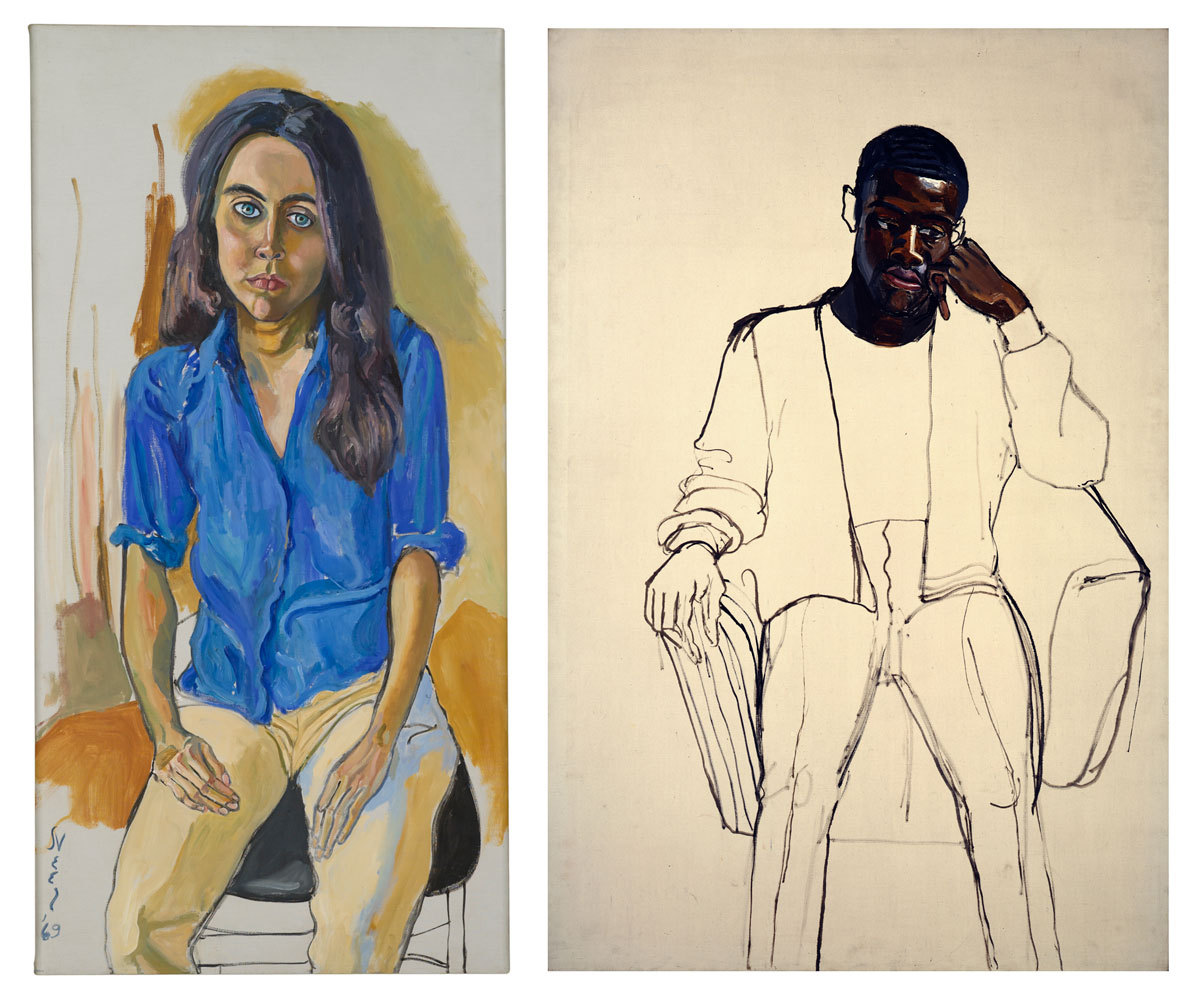
To me, it is the directness of Neel’s painting that helps express that humanity. She seldom relied on preliminary drawings, as an alternative placing down lines (usually with blue paint) at the start off of each and every session. A highlight of the de Young exhibition is the pairing of Ginny in a Blue Shirt (1969), designed although viewing her son Hartley and his long run wife in San Francisco, and a silent film shot by Hartley that demonstrates its building. “When she hung the painting up on the wall, I experienced a incredibly unusual feeling of being there on the wall and in my physique,” Ginny later claimed. “She caught anything I identified in myself.”

A painting of a woman in blue shirt and very unfinished painting of man in chair
L: Alice Neel, ‘Ginny in Blue Shirt,’ 1969 R: ‘Black Draftee (James Hunter),’ 1965.
(Both equally pictures © The Estate of Alice Neel. Courtesy The Estate of Alice Neel and David Zwirner)

Though at some levels in her everyday living Neel decried summary and non-goal artwork as remaining “against human beings,” she used various stages of abstraction in practically all her do the job. She still left sections of her paintings unfinished, flattened styles into sound shade and omitted details in get to zero in on specific expressions, objects and obviously relished cloth styles. (A blue-and-white striped chair seems again and once more.)

That thrilling mixture of illustration and abstraction is so present-day, it’s probable to now acquire the radicalness of Neel’s do the job for granted. But one particular require only to search at Childbirth (1939), imagined to be just one of the very first Western paintings to symbolize a woman giving birth, to realize how Neel’s desire to depict all features of everyday living produced her get the job done so extraordinary. She would continue to paint nude expecting females, and women with their youngsters, all over her career.

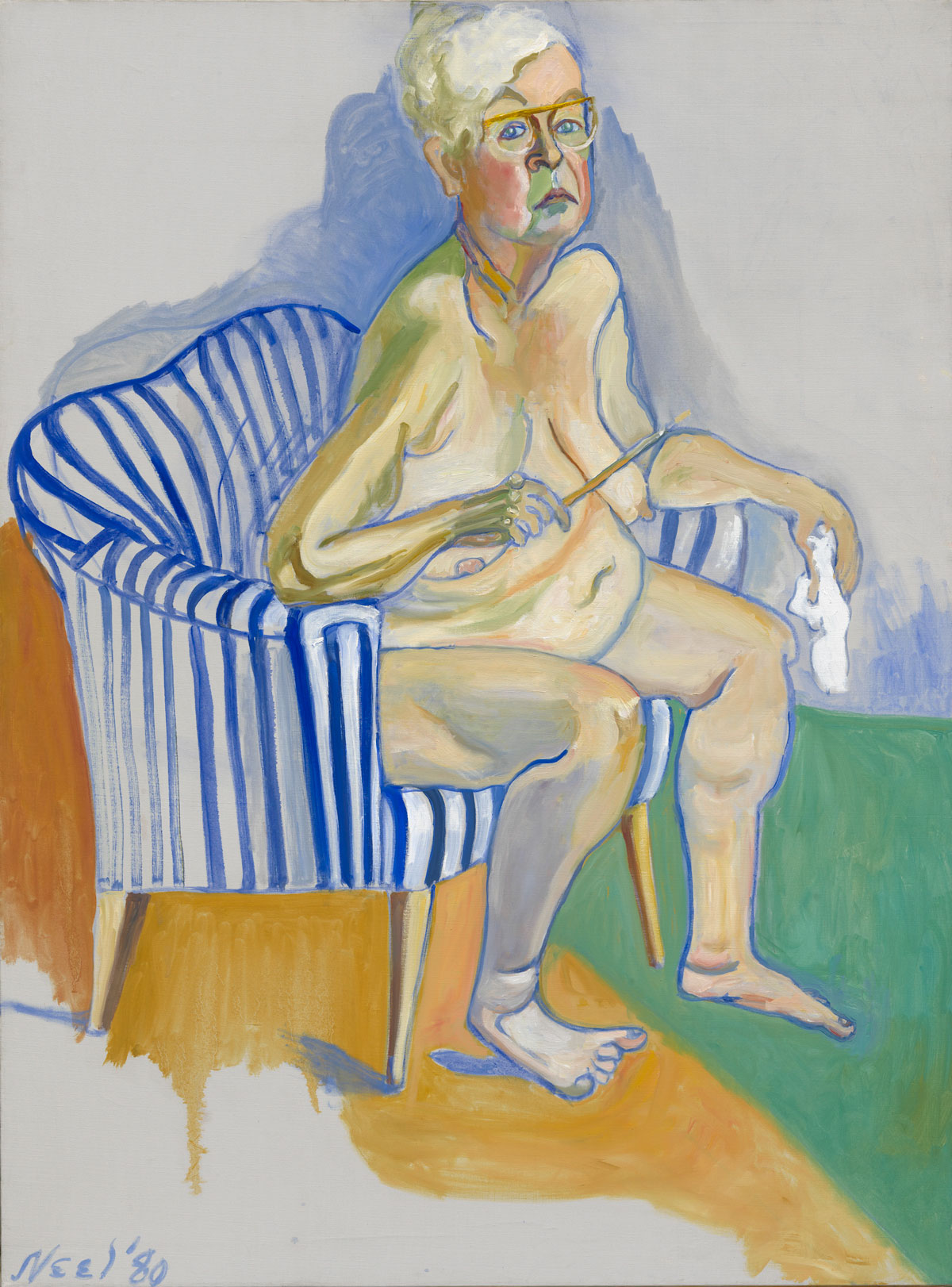
Elevating two sons largely by herself, portray at residence, Neel did not sugarcoat her depictions of motherhood, presenting the labor alongside the like. She struggled with the twin roles of artist and mother in her have daily life she only observed her daughter Isabetta 2 times in her childhood. I see Neel’s one particular and only self-portrait as a continuation of her do the job to honor the at any time-altering physicality of women’s bodies. At 80, Neel gazes out, bare on her striped chair, with the exact same unidealized depth existing in her 1964 painting Expecting Maria.

Painting of nude older woman holding paint brush in striped chair
Alice Neel, ‘Self-Portrait,’ 1980. (© The Estate of Alice Neel, 1980 Impression courtesy Nationwide Portrait Gallery, Smithsonian Institution)

Starting off in the 1960s, Neel eventually got the awareness she’d long sought when the counterculture opened up new audiences for her function. Feminist curators and critics rallied about her, and the Whitney mounted a survey in 1974. When she died in 1984, Neel was greatly identified as the artist she experienced often been. Critic Jillian Steinhauer has published about this phenomenon of “rediscovering” older girls artists, which tends to clarify absent their earlier deficiency of achievement by proclaiming they were somehow out of sync with artistic tendencies. “By definition, women of all ages, in particular women of all ages of shade, by no means fit into their situations, for the reason that the periods are not built for them,” Steinhauer writes.

It’s critical that we not fall into that very same trap in our contemplating about Neel’s legacy. The undertaking of currently being an “anarchic humanist,” as Neel explained herself, calls for that we not regard Neel as a martyr for her art, a single who labored in obscurity until eventually she at last received her due. To do so would erase the artist’s personal humanity, which was as messy and imperfect as her wonderful and critical depictions of standard existence.

Olmsted’s Legacy, Bringing People Together Through Landscape Architecture | News

An 1850 take a look at to Birkenhead Park in Liverpool, England, was a lightbulb second for Frederick Regulation Olmsted Sr. The person who would turn out to be recognized as the father of landscape architecture was encouraged by the restorative character of the general public inexperienced area.

“I was completely ready to confess,” wrote Omsted, “that in democratic The united states there was very little to be assumed of as comparable to this People’s Yard.”

8 years later, Olmsted partnered with English architect Calvert Vaux to gain a structure competition for New York City’s Central Park. Olmsted would go on to launch his very own design and style agency that concluded more than 500 jobs, like dozens of community parks, landscapes at national monuments, the non-public landscape of the 12,500-acre Biltmore Estate in western North Carolina and, notably, in this article in Moore County, the village of Pinehurst.


Pinehurst historical photo 2

Historical picture of Pinehurst courtesy of Tufts Archives


Pinehurst was made with an egg-formed village inexperienced anchoring the then-100-acre town’s curvilinear program of streets named Azalea, Magnolia, Chinquapin, Woodbine, Laurel, Palmetto, Dogwood, Orange, Holly, Elm, Beech, and Sycamore. His layout contained no straight lines or sharp angles. In its place the looping mother nature of the streets upon the landscape proposed “leisure, contemplativeness, and delighted tranquility,” according to documentation submitted with the Nationwide Park Service’s National Sign up of Historic Locations, dated Aug. 14, 1973.

Olmsted’s agency experienced been employed by James Walker Tufts to layout a New England-design and style village. Tuft’s eyesight was a wintertime vacation resort that men and women of different suggests could go to to recuperate from respiratory and other illnesses, which shortly shifted to more of a leisure vacation resort. Architects from Boston developed the motels, boarding houses and cottages, and in late 1895, the first guests arrived at the Holly Inn – strategically located at the best of the village environmentally friendly. 

“Olmsted saw the capability of landscape design and style to have beneficial impacts, regardless of whether it is physical health and fitness or mental health and fitness. He considered landscape layout as a way to provide individuals jointly,” said Dede Petri, president and CEO of the National Affiliation for Olmsted Parks. 


Dede Petri

Dede Petri, president and CEO of National Association for Olmsted Parks


For the duration of his life span, Olmsted saw a modern society that had speedily become  city in mother nature. Individuals living in near quarters developed community health requires, notably related to sanitation, and the country was however deeply divided by the Civil War.

“Landscape grew to become his hoped for option to bring alongside one another American individuals to address just about every other with civility and respect,” Petri said. “Clearly his landscape style function is crucial, particularly as we come out of this pandemic dealing with our individual divisions. The strategies that he was contemplating about, the full idea of the psychological added benefits of landscape design have an remarkable relevance in our time.”

On Friday, March 4, at 11 a.m., Women of all ages of the Pines welcome Petri for a special speaking engagement at Pinehurst Village Corridor that is open to the community. The function is part of Olmsted 200, a nationwide bicentennial celebration of Olmsted’s 200th birthday in 2022. The Countrywide Association for Olmsted Parks, started in 1980, is committed to advancing the life and legacy of Frederick Regulation Olmsted.

Petri has authored or co-authored reports which include Restoring the Olmsted Woods, Washington Countrywide Gardens: A Tutorial for Families and Profiles, Handbook of American Women’s History and Getting rid of America’s Memory. A magna cum laude graduate of Harvard Higher education with an A.B. in American history and literature, Petri also graduated from Harvard Legislation School, wherever she was the initial lady president of the Harvard Journal on Legislation.

Petri served as basic counsel and congressional liaison for the National Endowment for the Humanities and as senior vice president of the Recording Business Association of The united states. She held management roles in a vary of companies which include serving as the 42nd president of The Yard Club of America, a national nonprofit founded in 1913, with 18,000 club members all over the nation. Petri also served on the boards of the Pals of the National Arboretum, U.S. Capitol Historical Modern society, Casey Trees and the Paine Artwork Middle and Gardens, and was chairman of the backyard committee of All Hallows Guild, Washington National Cathedral, where she spearheaded the restoration of the Olmsted Woods. Petri currently serves on the advisory board of the Woman Fowl Johnson Wildflower Centre and on the boards of the Aldo Leopold Basis and Mount Vernon Ladies’ Affiliation.

“He seriously did see landscape design for its social and cultural impacts, as perfectly as its natural beauty. He brought an aesthetic sense and a scientific perception,” stated Petri. “We are hoping people today will feel of 2022 as an Olmsted pilgrimage calendar year. We are encouraging parks and landscapes, and communities like Pinehurst, to take the complete 12 months to check out the legacy of Frederick Olmsted.”

Known to a lot of as the father of American landscape architecture, Olmsted to start with visited the South as a journalist for the New York Situations. He afterwards served as an administrator for New York’s Central Park, then with the U.S. Sanitary Fee and, later on, the Mariposa Mining Enterprise in California. In 1865, he devoted all of his attempts – and activities he’d acquired along the way.

Olmsted was the initial to choose on landscape architect as a skilled title, and considered his perform not just as a craft, but as good artwork. 

Petri was very first exposed to Olmsted’s legacy even though she was a higher education university student. Later, when she was involved with the National Cathedral’s All Hallows Guild, in Washington, D.C., and restoring five acres of woodlands that Olmsted made for the grounds, she mentioned she grew to become fascinated with his total everyday living tale. 


Pinehurst historic photo

Historic impression of Pinehurst courtesy of Tufts Archives.


“I read through as numerous books as possible about his lifestyle and perform. I grew to become mesmerized. He was these kinds of a multi-faceted individual. It wasn’t just landscape design but also his information reporting, analyzing slavery and other problems, and his get the job done in sanitation and as a scientific farmer experimenting with drainage,” Petri mentioned. “He had all of the aspects, and when he was 43 a long time old, he melded all these experiences into bringing landscape architecture into our social, cultural and environmental realm.”

Petri reported she was questioned to communicate in Pinehurst about “A wander in the park, that is the phrase we use. Olmsted was revolutionary about park-making, he thought parks need to belong to all People in america as aspect of the pursuit of pleasure.”

Also in 2022, the Pinehurst, Southern Pines, Aberdeen Area Conference and Readers Bureau (CVB) is creating two commemorative coins to honor Olmsted and Donald Ross, as element of the yearlong celebration of what would have been Ross’s 150th birthday and Olmsted’s 200th birthday. Ross is the famed golf architect who built Pinehurst No. 2 and hundreds of other courses throughout the state. In addition, Retain Moore County Attractive will be keeping a exclusive cleanse-up function on April 26, Olmsted’s birthday.

PEOPLE AND PASEOS | Landscape Architecture Magazine

People today AND PASEOS

As portion of an ongoing energy to make written content more accessible, LAM will be making choose tales obtainable to audience in Spanish.


It’s likely a fantasy of any range of landscape architects: designing an complete community with out owning to consider a solitary motor vehicle. Housing blocks divided not by vast, traffic-choked streets but by light, shaded paseos, or promenades. Flats opening onto European-type courtyards. Every sq. foot of open house devoted to people today.

Kristina Ground, FASLA, is developing that desire. For the past two years, she and her crew at Floor Associates, which is based in Phoenix, have been major the web site style for Culdesac Tempe, a 16-acre, 761-unit mixed-use improvement in Tempe, Arizona, in which non-public autos are prohibited. Produced up of two- and a few-tale apartment structures arranged all over courtyards, the progress has no garages, no “parking podiums”—the latest city do the job-all around that stashes all the parking on the to start with several degrees of an in any other case banal development—and nothing at all you’d even phone a street, which, as it turns out, leaves a lot of home for persons house.

“What occurs on so a lot of tasks, with the total of parking you have to place in, is that most of your landscape is perimeter landscape or parking-whole lot landscape,” Flooring states. At Culdesac, which is underneath building and will open in summer time 2022, Floor says they’re “designing spaces for people today.”

Housing pods are grouped close to shared courtyards that element desert-tailored plants and decomposed granite. The the vast majority of the website is permeable. Picture courtesy Culdesac.

Culdesac Tempe is aspect of a increasing movement amongst metropolitan areas to rethink how much parking they require. New Haven, Connecticut, and St. Paul, Minnesota, each a short while ago voted to eliminate mandatory parking minimums, which have extended been noticed as a hurdle to both equally making reduced-price tag housing and weaning Americans off their dependence on automobiles. And throughout the nation, existing avenue infrastructure is currently being retrofitted to create energetic transportation networks—at good price tag to metropolitan areas. Culdesac signifies an opportunity to layout for car or truck independence from the get-go.

The only auto parking at Culdesac is for the retail and professional spaces. The relaxation of the growth is motor vehicle-free. Image courtesy Culdesac.

Located straight adjacent to a end on the region’s Valley Metro gentle rail line, the improvement will present people a “mobility suite,” together with free of charge limitless rides on the mild rail and subsidized premiums for electric scooters, rideshare, and carshare. The layout, carried out in collaboration with the Berkeley, California-dependent city style firm Opticos, locates retail and industrial makes use of in the corner nearest the rail station (to which a new crosswalk will soon be added) and organizes the web site all-around a central paseo. The paseo winds its way by means of the internet site, connecting again to the bordering avenue grid through a warren of secondary legal rights-of-way.

The consequence is a manufacturer-new local community that feels settled, reminiscent of the centers of more mature European cities, a vibe the design and style group embraced. “The idea was to make it experience like it is been below for a while,” Ground states. This result is partially reached by way of the intensive use of decomposed granite, the hardscape materials of alternative for every little thing from the oasis-like household courtyards to the parking locations for the retail companies. Far more than fifty percent of Culdesac Tempe is open up house, and of that, 85 {6d6906d986cb38e604952ede6d65f3d49470e23f1a526661621333fa74363c48} is permeable. “We have zero asphalt on the overall web-site,” says Lava Sunder, Culdesac Tempe’s common manager.

Landscape also plays a position in wayfinding. Aiding inhabitants and people navigate the community, which has much more than a dozen household “pods” of eight to 10 structures every and no avenue names, was a challenge. “You’re not usually arriving by car, and there is not a front door. It’s obtained a thousand entrance doorways,” Ground claims. “So we had to be cognizant of, how can we help guidebook men and women to wherever they want to go?” In addition to the use of shade and architectural detailing, a plant palette of desert natives (in distinction to a lot more lush plantings in the courtyards) and other landscape cues support denote major circulation routes.

Kristina Ground, FASLA, participates in one of quite a few three-day design charrettes with the Culdesac Tempe crew. Photograph courtesy Culdesac.

These and other concerns have been explored by means of a sequence of charrettes Opticos hosted in Berkeley. The design team sketched, crafted designs, tested strategies. It was an unusually cost-free-form exploration of how a place ought to glance and truly feel and function, without the need of discussions about sq. footage or return on financial investment, Floor states. “I cherished that. I was like, this is how I want to do each and every job going ahead.”
