Full Proposal Due Date: Thursday, April 20, 2023, by 11:59 p.m. Eastern Time
OVERVIEW
The National Fish and Wildlife Foundation (NFWF), in partnership with the U.S. Environmental Protection Agency (EPA), the U.S. Fish and Wildlife Service (FWS), and the federal-state Chesapeake Bay Program (CBP) partnership, is soliciting proposals through the Chesapeake Bay Stewardship Fund to protect and restore water quality and habitats of the Chesapeake Bay and its tributary rivers and streams.
NFWF is soliciting proposals under two distinct programs through this request. Through the Small Watershed Grants (SWG) Program, delivered in partnership with EPA and the CBP partnership, NFWF is soliciting proposals for projects within the Chesapeake Bay watershed that promote voluntary, community-based efforts to protect and restore the diverse and vital habitats of the Chesapeake Bay and its tributary rivers and streams. Through the Chesapeake Watershed Investments for Landscape Defense Grants (WILD) Program, delivered in partnership with FWS, NFWF is soliciting proposals for projects that conserve, steward, and enhance fish and wildlife habitats and related conservation values in the Chesapeake Bay watershed.
For the SWG Program, NFWF will award funding through two distinct funding opportunities. All SWG Program proposals must directly align with one or more of the SWG PROGRAM PRIORITIES outlined further in this Request for Proposals.
- SWG Implementation grants of $75,000-500,000 will be awarded for projects that result in direct, on-the-ground actions to protect and restore water quality, species, and habitats in the Bay watershed.
- SWG Planning and Technical Assistance (SWG-PTA) grants up to $75,000 will be awarded for projects that enhance local capacity to implement future on-the- ground actions, consistent with SWG Program priorities, through community-based assessment, planning, design, and other technical assistance-oriented activities.
For the WILD Program, NFWF will award funding through two distinct funding opportunities. All WILD Program proposals must directly align with one or more of the WILD PROGRAM PRIORITIES outlined further in this Request for Proposals.
- WILD Implementation grants of $75,000-$750,000 will be awarded for projects that result in direct on-the-ground conservation, stewardship, and enhancements of fish and wildlife habitats and related conservation values in the Bay watershed.
- WILD Planning and Technical Assistance (WILD-PTA) grants up to $75,000 will be awarded for projects that enhance the capacity of local and regional partners to implement future on-the-ground actions, consistent with WILD Program priorities, through community-based assessment, planning, design, and other technical assistance-oriented activities.
Further details for each program, including associated PROGRAM PRIORITIES, FUNDING AVAILABILITY AND MATCH, and ELIGIBILITY CRITERIA are provided throughout this solicitation. In developing and submitting applications, prospective applicants should select the most appropriate program based on the details of their proposed project and alignment with associated program details. Applicants are encouraged to review the CBSF 2023 SWG/WILD Quick Reference Guide for further insight in selecting the appropriate funding opportunity based on their proposed project.
While NFWF does not require consultation prior to application, we strongly encourage interested applicants to contact NFWF staff or its contracted field liaisons (Contact information on page 18) to discuss their proposed project to gather constructive feedback in developing a competitive proposal, and to obtain guidance on the most appropriate program and funding opportunity for project consideration. Interested applicants may schedule virtual project consultations with NFWF staff here.
Including funds made available through the Bipartisan Infrastructure Law, NFWF estimates awarding $10 to $25 million in grants through the SWG Program in 2023, subject to administrative action and contingent on the availability of funding, through major funding provided by the EPA CBP Office. NFWF estimates awarding up to $10M in grants through the WILD Program in 2023, contingent on available funding, through major funding provided by the FWS. Other important contributions to both programs are provided by Altria Group, the U.S. Department of Agriculture Natural Resources Conservation Service (NRCS), and the U.S. Forest Service.
GEOGRAPHIC FOCUS
All projects must occur wholly within the Chesapeake Bay watershed. Priority consideration will be provided to projects located within priority subwatersheds or habitat units based on the unique opportunities to maximize multiple goals and outcomes for water quality, species and habitats, and communities. NFWF has developed a CBSF Applicant Toolbox with resources to help applicants target proposed actions to understand and maximize outcomes and benefits for associated program priorities.
JOINT PROGRAM PRIORITIES
For both the SWG and WILD Programs, NFWF will prioritize proposals from applicants that have directly and meaningfully engaged local communities in the identification, prioritization, selection, and implementation of proposed actions. Examples of direct and meaningful engagement include:
- Co-creating project with community members
- Empowering community members with knowledge and decision- making authority
- Ensuring the project team includes community members and leads to collaborative management with the community
- Including specific, active engagement strategies such as workshops, classroom activities, field trips, and volunteer opportunities
- Addressing a specific and localized harm such as pollution, flooding, or fires
- Creating jobs in the target community or performing job training and certification
- Directly engaging in specific cultural activities with the community
Proposals from applicants or partnerships directly representing or resourcing historically underserved communities will receive priority consideration, especially those that align established interests of local communities with SWG/WILD program priorities. NFWF also explicitly encourages applications from community-based organizations as key project partners, regardless of an environmental or conservation-related mission, in order to ensure that a broad spectrum of community interests are represented and reflected in proposed activities. Furthermore, NFWF encourages more traditional environmental and conservation organizations and entities to use grant funding to enhance their internal capacity to engage with, mentor, and support diverse community partners.
This focus is consistent with the Chesapeake Bay Program Diversity, Equity, Inclusion, and Justice Strategy Implementation Plan. See the Chesapeake Bay Stewardship Fund’s DEIJ webpage for a glossary of key terms related to DEIJ efforts under the NFWF’s Chesapeake Bay Stewardship Fund.
SWG PROGRAM PRIORITIES
Consistent with the CBP partnership’s 2014 Chesapeake Bay Watershed Agreement, the SWG Program supports efforts to achieve water quality improvement, restoration, and protection of key Chesapeake Bay species and their habitats, and the fostering of an engaged and diverse citizen and stakeholder presence that will build upon and sustain measurable natural resource improvements.
In addition, through funding provided by the Bipartisan Infrastructure Law, NFWF is encouraging proposals that implement of one or more of the following selected natural and nature-based watershed and habitat restoration practices. Critically, these natural and nature-based practices provide multiple watershed restoration and habitat benefits including long-term pollution control, improved habitat, and enhanced climate resilience for human and wildlife communities. These practices include:
- Riparian forest buffers, including associated livestock exclusion fencing, crossings, and watering systems;
- Tidal and non-tidal wetland creation, rehabilitation, or enhancement;
- Floodplain restoration that reconnects incised streams to their floodplains and floodplain wetlands;
- Shoreline management; and
- Urban tree planting and maintenance of existing and enhancement of existing urban tree canopy
NFWF is soliciting proposals through the SWG Program that align with SWG Program Priorities outlined below that provide measurable contributions for selected goals and outcomes of the Chesapeake Bay Watershed Agreement, NFWF’s Chesapeake Bay Business Plan, and SWG Bipartisan Infrastructure Law funding. NFWF places priority emphasis on projects that meaningfully and materially contribute to multiple SWG program priorities.
SWG PROGRAM PRIORITY 1. Managing Agricultural and Urban Runoff
- Managing Upland Agricultural Runoff through Farm-Scale Conservation Systems and Solutions: Includes efforts to reduce water quality impacts while simultaneously maintaining or increasing profits and farm management benefits of the region’s farms by implementing best management practices that reduce nutrient and sediment pollution at the farm scale. Generally, applicants should seek first to utilize existing federal, state, and local agricultural cost-share and incentive programs to finance implementation of water quality improvement practices, with NFWF funding used to strategically fill gaps in existing funding programs. Where NFWF funding is sought to cover all or a large portion of costs for practice implementation, describe why other public programs are insufficient or otherwise inappropriate for financing proposed practice implementation.
- Managing Upland Urban Runoff through Green Stormwater Infrastructure Improvements (GSI): Includes efforts to reduce stormwater runoff on developed lands by implementing GSI practices that capture, store, filter, and treat stormwater runoff through systems and practices that mimic natural hydrologic processes.
- Accelerating Innovation in Watershed Management: Includes in-field application of new technologies and management approaches with the potential to reduce costs, increase nutrient removal efficiencies, and to more effectively control emerging nutrient and sediment pollutant sources.
SWG PROGRAM PRIORITY 2. Improving Water Quality and Stream Health Through Riparian Restoration and Conservation
- Restoring Riparian and Freshwater Habitats through Forested Buffers, Livestock Exclusion, and Stream Restoration: Includes efforts to mitigate local stream impairments, improve stream health, and maintain or enhance benthic macroinvertebrate populations through establishment of riparian forested buffers (minimum standard of 35 ft. wide), livestock exclusion fencing (including stream crossings and off-stream watering systems where appropriate), and stream restoration and floodplain reconnection. Proposed stream restoration and floodplain reconnection efforts must be consistent with qualifying conditions and design and crediting protocols established by the CBP partnership for creditable nutrient and sediment load reductions under the Chesapeake Bay TMDL (see Recommendations of the Expert Panel to Define Removal Rates for Individual Stream Restoration Projects and associated protocol updates to determine project eligibility).Beyond creditable load reductions, competitive projects will be part of a larger watershed restoration effort and be able to demonstrate enhanced stream function and optimize co-benefits for ecosystems and affected communities. NFWF does not advocate for or disallow any commonly used stream restoration methodology over others. Stream restoration and floodplain reconnection projects are capital- intensive and highly site-specific interventions with potential for significant impacts on existing natural resources. These proposals will accordingly undergo enhanced scrutiny in the proposal review and evaluation process. As a result, to be considered for SWG Program funding, all proposals seeking funding for qualifying stream restoration and floodplain reconnection practices must complete a pre-application site visit with appropriate NFWF field liaisons. Site visits must be scheduled via email with appropriate NFWF field liaison(s) by April 1, 2023 and completed prior to April 20, 2023 (see APPLICATION ASSISTANCE below for field liaison contact information). In addition, these proposals must complete and upload the accompanying “Stream Restoration Narrative Supplement” (APPENDIX B) to be submitted with the standard full proposal narrative. Additional information and resources are available in APPENDIX D.
- Conserving High-Quality Riparian Corridors: Includes long-term protection and preservation of riparian and floodplain ecosystems by strategically leveraging federal, state, and local land conservation programs through assistance with transaction and due diligence costs, bonus payments for high-value riparian conservation easements and land acquisitions, and incorporation of riparian protection into existing agricultural land preservation programs. Please note that EPA funding provided through the SWG Program cannot be used for direct land acquisition or easement costs. See WILD Program Pillars below for expanded opportunities to support direct land acquisition or easement costs.
SWG PROGRAM PRIORITY 3. Enhancing and Protecting Freshwater Habitat for Eastern Brook Trout
- Increasing Habitat Integrity and Population Viability for Eastern Brook Trout: In conjunction with efforts to manage polluted runoff and restore and conserve riparian and upland forest habitat, includes improving connectivity within and between stronghold eastern brook trout population patches through dam removal, repair and replacement of culverts, and other fish passage improvements in order to increase populations and increase occupied habitat. In- stream habitat enhancements not otherwise creditable under the Chesapeake Bay TMDL may also be appropriate where instream habitat quality, cover, and structure can be identified as limiting factors to viable local populations. NFWF will prioritize projects working to protect and enhance selected stronghold populations most likely to persist under future climate conditions and considering local land use (see Trout Unlimited’s Chesapeake Bay Watershed Priority Brook Trout Stronghold Conservation Analysis Mapping Application more information on identified stronghold patches and associated habitat improvement opportunities).
- Conserving Upland and Riparian Forests in Eastern Brook Trout Strongholds: Includes long-term protection and preservation of upland and riparian forest ecosystems in identified Eastern brook trout strongholds by strategically leveraging federal, state, and local land conservation programs through assistance with transaction and due diligence costs, bonus payments for conservation easements and land acquisitions for high-quality upland and riparian forest, and incorporation of forestland protection into existing rural land preservation programs. Please note that EPA funding provided through the SWG Program cannot be used for direct land acquisition or easement costs. See WILD Program Pillars below for expanded opportunities to support direct land acquisition or easement costs.
SWG PROGRAM PRIORITY 4. Enhancing and Protecting Tidal and Estuarine Habitat
- Restoring and Conserving Wetland and Tidal Marsh Habitat for American Black Duck: Includes restoration of degraded tidal and non-tidal wetland habitats and strategic conservation of existing high-quality wintering and nesting habitats for American black duck. To address threats to habitat from sea level rise, NFWF will further support strategies that seek to create corridors for future marsh migration through strategic land protection, restoration, and management. Applicants are encouraged to use the Black Duck Joint Venture’s Black Duck Decision Support Tool and associated Chesapeake Bay watershed priorities to support decisions on wetland restoration and conservation activities that maximize black duck habitat benefits. Please note that EPA funding provided through the SWG Program cannot be used for direct land acquisition or easement costs. See WILD Program Pillars below for expanded opportunities to support direct land acquisition or easement costs.
- Managing Shoreline Erosion and Marsh Loss: Includes implementation of non-structural or hybrid living shoreline restoration practices, particularly those that reduce sediment loading to priority oyster reef restoration sites, establish and expand emergent or submerged aquatic vegetation, and/or help to protect adjacent marsh systems documented as important habitat for American black duck.
- Restoring Large-Scale Oyster Reefs: Includes assisting efforts to restore and protect large-scale oyster reefs strategically identified by the Maryland, Virginia, and the CBP by leveraging funding from federal and state agencies to support oyster larvae and spat production, development of sustainable reef substrate supplies, and reef construction efforts in established oyster reef restoration tributaries.
- Restoring River Herring Habitat Connectivity: Includes efforts to increase connectivity and access to spawning habitat along priority migratory corridors for alewife and blueback herring through dam removal, repair and replacement of culverts, and other fish passage improvements. NFWF will prioritize cost-effective connectivity enhancements that provide access to the greatest amount of quality habitat at the lowest cost.
SWG PROGRAM PRIORITY 5. Enhancing Nature-Based Resilience for Human Communities
- Protecting and Enhancing Natural and Nature-Based Solutions to Improve Community Resilience: Includes efforts to protect and enhance natural and nature-based solutions to help protect coastal and inland communities from the impacts of storms, floods, and other natural hazards and enable them to recover more quickly.
SWG PROGRAM PRIORITY 6. Building Capacity for Landscape-Scale Watershed and Habitat Planning, Design, and Implementation
- Regional-Scale Partnership Development: Includes activities that scale up restoration outcomes through enhanced partnership and coordination across organizations at broader regional and landscape scales. Interested applicants should consider appropriate models and frameworks for their own partnership efforts.
- Improving Delivery of Outreach and Technical Assistance: Includes support for conservation districts, nonprofits, local and state governments, and private sector partners to provide technical assistance necessary to achieve NFWF’s habitat restoration, conservation, and management goals through field positions, development of targeted outreach strategies such as community-based social marketing, and enhanced coordination and partnership among technical assistance providers to improve efficiency and reduce administrative bottlenecks.
- Assessing Local Watershed and Habitat Restoration Needs and Opportunities: Includes watershed and habitat assessments, watershed implementation planning, and other planning and prioritization efforts to maximize conservation impact. Priority will be placed on efforts to translate Bay pollution reduction goals to local implementation plans, along with efforts to identify habitat restoration opportunities for NFWF’s priority species at a local level. Examples include small watershed restoration plans, property or farm-level conservation and stormwater management plans, patch-level population and habitat assessments for Eastern brook trout, culvert and barrier assessments in priority rivers for river herring, and wetlands restoration and protection assessments to maximize black duck population outcomes.
- Designing and Permitting Watershed and Habitat Improvements: Includes strategic assistance to local partners for costs associated with design and permitting for high-impact restoration and management actions. NFWF has specific interest in design approaches that integrate multiple species and/or habitat objectives and therefore provide meaningful contributions to multiple programmatic goals and outcomes.
- Leveraging Social Science to Advance Behavior Change: Includes efforts to conduct applied social science research to understand and apply frameworks to influence behaviors of individual landowners, homeowners, watershed residents, businesses, and institutions in support of watershed restoration and protection outcomes, as well as integration of best practices in social science program evaluation to measure success of engagement and behavior change programs.
WILD PROGRAM PRIORITIES
- Consistent with the Chesapeake WILD Framework, developed by FWS in partnership with the Chesapeake Conservation Partnership, the WILD Program supports efforts to conserve, steward, and enhance fish and wildlife habitats and related conservation values in the Chesapeake Bay watershed. NFWF is soliciting proposals through the WILD Program that align with the WILD Program Pillars outlined below.
WILD PROGRAM PILLAR 1: Fish and Wildlife Habitats
NFWF is soliciting proposals that conserve, steward, and enhance important Chesapeake Bay watershed habitats and ecosystems for imperiled species, including headwater forests and contiguous forest areas, grasslands, riparian forest buffers, nontidal wetlands and tidal marshes, and submerged aquatic vegetation.
Imperiled species include state-listed or federally listed threatened or endangered species, Tribal listed species, NE Association of Fish & Wildlife Agencies Regional Species of Greatest Conservation Need, and species listed in State designated Species of Greatest Conservation Need.
Proposals should incorporate conservation prescriptions identified in associated Tribal Wildlife Plans, State Wildlife Action Plans, Recovery Plans for Federally Listed species, and specific plans for Regional Species of Greatest Conservation Need. Emphasis will be placed on projects that enhance and expand existing hubs and corridors of contiguous habitat for associated species. Associated priorities include:
- Increasing habitat connectivity, conservation, and restoration for imperiled fish and wildlife species: Includes efforts to connect, conserve, and restore habitat quality and resiliency for associated species. Proposals should seek to implement one or more of the following activities:
- Land conservation (i.e., fee simple purchase or permanent conservation easement) as a means to preserve existing high value habitats and improve habitat connectivity for imperiled species, including through planned or future opportunities to restore or otherwise enhance habitat condition on conserved lands.
- Terrestrial and aquatic conservation actions and investments that restore degraded habitats, migration stopover areas, and corridors, which support movement of imperiled species as climate and land uses change.
- Effective land use and land conservation planning to protect high-quality areas for habitat connectivity, conservation, and restoration to benefit imperiled species.
- Address science knowledge gaps and research needs to effectively connect, conserve, and restore habitat quality and resiliency for imperiled species.
- Building capacity for Tribal and Indigenous conservation, stewardship, and enhancement of fish and wildlife habitat: Includes efforts that support Tribes and Indigenous people of the Chesapeake in the conservation, stewardship, and enhancement of fish and wildlife habitats on the land they hold or steward. Proposals should seek to implement one or more of the following activities:
- Tribal or Indigenous-led technical support to foster the development of wildlife and land management plans for the lands they hold or steward, including how those lands factor into respective watersheds and the larger landscape.
- Tribal or Indigenous-led projects that incorporate Traditional Ecological Knowledge and Indigenous Science in planning and implementing terrestrial and aquatic habitat connectivity, conservation, and restoration.
- Capacity-building investments such as staff, conservation, and restoration science expertise, and grant administration training and support, that strengthen the ability of Tribal and Indigenous peoples to self-determine the conservation and management of fish and wildlife habitats on the land they hold or steward.
WILD PROGRAM PILLAR 2: Climate Change
- Protecting and enhancing nature-based resilience for critical habitats: Includes efforts to protect, restore, or reconnect important natural habitats for imperiled species that may be negatively impacted by climate change, as well as resilience, conservation, and investment planning activities to further long-term habitat resilience efforts
- Emphasize habitats that help protect coastal and inland communities from the impacts of storms, floods, and other natural hazards and enable them to recover more quickly (e.g., tidal marshes, nontidal wetlands, riparian areas, and floodplains).
WILD PROGRAM PILLAR 3: Community Partnership
- Building capacity for diverse partnership development: Includes activities that scale-up habitat connectivity, and restoration outcomes for imperiled species through enhanced engagement, communication, and coordination across organizations at local, regional, and landscape scales. Proposals should seek to implement one or more of the following activities
- Emphasize capacity-building, organizational development, community engagement, and outreach for Tribal and Indigenous peoples and historically underserved communities in the Chesapeake Bay watershed.
- Enhance existing conservation partnerships or develop new partnerships that will evolve projects, further social equity, develop different ways of thinking, and spur innovation.
- Leverage other funding opportunities to strengthen public-private partnerships in support of actions to connect, conserve, and restore habitats for imperiled species.
- Improving delivery of outreach and technical assistance: Includes efforts that build and enhance partner capacity to provide technical assistance and deliver habitat connectivity, conservation, and restoration outcomes for imperiled species. Proposals should seek to implement one or more of the following activities:
- Provide technical assistance (e.g., field positions, assistance with permitting processes, developing, and implementing targeted outreach strategies) to help conservation partners, particularly Tribal and Indigenous peoples and historically underserved communities across the Chesapeake Bay watershed, achieve habitat connectivity, conservation, and restoration goals.
- Leverage other funding opportunities to strengthen public-private partnerships that enhance coordination and partnership among technical assistance providers to improve efficiency and reduce administrative bottleneck.
WILD PROGRAM PILLAR 4: Public Access
- Maintaining and enhancing recreational opportunities and equitable access compatible with the conservation of natural resources: Include efforts that promote the economic, quality of life, and health benefits provided by equitable access for all individuals to a healthy Chesapeake Bay watershed. Proposals should seek to implement one or more of the following activities:
- Prioritize actions and investments that make public lands and open spaces more welcoming and accessible to diverse communities and user groups.
- Develop new low or no-cost public access points and wildlife-associated recreation opportunities in the watershed through collaborative projects and programs that engage historically underserved communities.
- Conserve lands (i.e., fee simple purchase or permanent conservation easement) in order to increase equitable public access and participation in wildlife-associated recreational activities (e.g., hunting, fishing, wildlife viewing).
- Increasing public awareness of the recreational, educational, and economic contributions made by the Chesapeake Bay and its ecosystems: Proposals should seek to implement one or more of the following activities:
- Emphasize experiential learning and actions to strengthen stewardship ethic by involving place-based or local communities in fish and wildlife habitat connectivity, conservation, and restoration planning and implementation.
- Create new or enhance existing interpretive programming focused on the watershed’s natural history, especially emphasizing traditional, place-based, and/or Tribal Ecological Knowledge and Indigenous Science.
- Invest in resources and services to engage historically underserved communities.
WILD PROGRAM PILLAR 5: Water Quality
- Improving water quality for imperiled fish and wildlife species: Includes efforts that protect and maintain water quality and quantity needed to support imperiled fish and wildlife species, associated habitat functions, and other ecological services. Proposals should seek to implement one or more of the following activities:
- Prioritize floodplain reconnection and restoration actions that provide direct benefit for imperiled species, as well as providing flood mitigation and water quality benefits to human and wildlife communities.
- Emphasize water conservation and management measures with direct benefits to imperiled species.
- Reduce otherwise unregulated point and nonpoint source pollution, including nutrients and sediment, toxic contaminants, and other pollutants of concern, for the direct benefit of imperiled species.
PROJECT METRICS
To better gauge progress on individual grants and to ensure greater consistency of project data provided by multiple grants, the Chesapeake Bay Stewardship Fund has a list of metrics in Easygrants for proposal applicants to choose from for future reporting. For projects proposing to implement water quality improvements for the purposes of nutrient and sediment load reduction, awardees will be required to report both project-level metrics via Easygrants and more detailed site and practice-level data via FieldDoc (see “Nutrient and Sediment Load Reductions” on page 15 for more information), as applicable.
We ask that applicants select only the most relevant metrics from the list for their project (all possible program metrics are shown in the table in APPENDIX C). NFWF also developed a metrics guide available here). If you do not believe an applicable metric has been provided, please contact Carley Morton at carley.morton@nfwf.org or (202) 857-0166, to discuss acceptable alternatives.
ELIGIBILITY
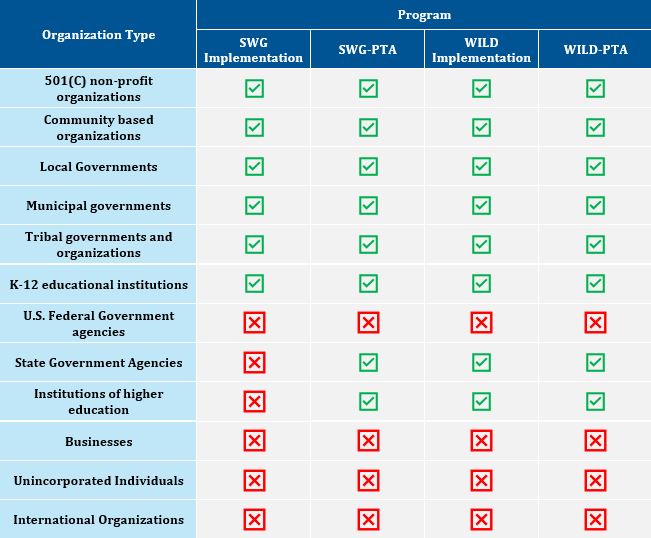
For Planning and Technical Assistance proposals:
- Non-profit organizations, local and municipal governments, Tribal governments and organizations and K-12 education institutions seeking potential service providers may visit our website for an updated listing of technical service providers operating in the region.
- State government agencies and institutions of higher education are eligible to apply for Planning and Technical Assistance proposals but must document support and/or request for proposed activities by appropriate non-profit organizations, local and municipal governments, Tribal governments and organizations and/or K-12 education institutions.
Ineligible Uses of Grant Funds
- Equipment: Applicants are encouraged to rent equipment where possible and cost-effective or use matching funds to make those purchases. NFWF acknowledges, however, that some projects may only be completed using NFWF funds to procure equipment. If this applies to your project, please contact the program staff listed in this RFP to discuss options.
- Federal funds and matching contributions may not be used to procure or obtain equipment, services, or systems (including entering into or renewing a contract) that uses telecommunications equipment or services produced by Huawei Technologies Company or ZTE Corporation (or any subsidiary or affiliate of such entities) as a substantial or essential component, or as critical technology of any system. Refer to Public Law 115-232, section 889 for additional information.
- NFWF funds and matching contributions may not be used to support political advocacy, fundraising, lobbying, litigation, terrorist activities or Foreign Corrupt Practices Act violations.
- NFWF funds may not be used to support ongoing efforts to comply with legal requirements, including permit conditions, mitigation and settlement agreements. However, grant funds may be used to support projects that enhance or improve upon existing baseline compliance efforts.
FUNDING AVAILABILITY AND MATCH
NFWF estimates awarding $10 to $25 million in grants through the combined SWG Program and up to $10 million in grants through the combined WILD Program in 2023.
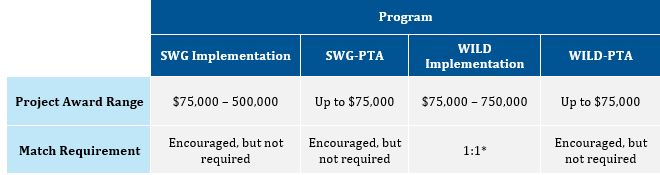
*Up to 50{6d6906d986cb38e604952ede6d65f3d49470e23f1a526661621333fa74363c48} of WILD Implementation grants match requirement may be met through federal match from non-Department of Interior Sources
All proposed projects must begin on or after September 1, 2023, to facilitate necessary grant contracting, quality assurance, and environmental compliance activities. In order to qualify, match must be expended during the proposed period of performance.
EVALUATION CRITERIA
All proposals will be screened for relevance, accuracy, completeness, and compliance with NFWF and funding source policies. Proposals will then be evaluated uniquely based on the extent to which they meet the following criteria:
Criteria #1 – Conservation Outcomes
- SWG Implementation and WILD Implementation:
- Project will clearly and demonstrably result in meaningful on-the-ground implementation of conservation and/or restoration actions that contribute to one or more of the identified program priorities. Where possible and appropriate, the proposal simultaneously contributes measurable and meaningful implementation actions supporting multiple priority outcomes.
- SWG-PTA and WILD-PTA:
- Project will result in the delivery of planning and technical assistance products and services that meaningfully advance potential conservation or restoration implementation efforts that would contribute to one of more of the identified program priorities. In considering who benefits from requested services, there is a demonstrated need for services and a clear commitment to utilize services to support future implementation efforts.
- All Funding Opportunities:
- Project incorporates meaningful engagement of affected communities, furthers established community interests, and incorporates community members and stakeholders in project activities.
- Project supports new and existing partnerships working to advance conservation and restoration actions in the Chesapeake Bay watershed.
- Project incorporates plans and approaches to implement, verify and sustain conservation and restoration actions and outcomes beyond the timeframe of the grant.
Criteria #2 – Budget
- The quality and level of detail in the budget and budget narrative provide a clear and detailed understanding of the proposed funding request.
- Proposal demonstrates cost-effectiveness in achieving its proposed outcomes, considering both direct and indirect costs in the proposed budget.
- Proposed costs are reasonable based on the work plan, local or regional costs for similar activities, and commensurate with project outcomes.
- Budget clearly indicates the degree of partnership in conducting the proposed work, including funding for project partners, stakeholders, and community members, as appropriate.
- Proposed funding request is well leveraged by the partners and other contributors through cash-, in-kind, and other match.
- The federal government has determined that a de minimis 10{6d6906d986cb38e604952ede6d65f3d49470e23f1a526661621333fa74363c48} indirect rate is an acceptable minimum for organizations without a negotiated indirect cost rate agreement (NICRA), as such NFWF reserves the right to scrutinize ALL proposals with indirect rates above 10{6d6906d986cb38e604952ede6d65f3d49470e23f1a526661621333fa74363c48} for cost-effectiveness.
Criteria #3 – Technical
- Project is technically sound and feasible, and the proposal sets forth a clear, logical, and achievable work plan, milestones, and timeline. All proposed projects must begin on or after September 1, 2023 to facilitate necessary grant contracting and quality assurance activities.
- Project engages appropriate technical experts throughout project planning, design and implementation to ensure activities are technically sound and feasible. Proposal demonstrates an understanding of necessary permitting and environmental compliance requirements and the ability to obtain necessary approvals consistent with the proposed work plan and timeline.
- Applicant organization has demonstrated an ability to manage and implement similar projects on time and within budget.
OTHER
Partnership and Community Impact – The applicant organization partners and engages collaboratively with diverse local community members, leaders, community-based organizations, and other relevant stakeholders to develop and implement the proposed project. This ensures long-term sustainability and success of the project, integration into local programs and policies, and community acceptance of proposed restoration actions. Non-traditional partners or communities are enlisted to broaden the sustained impact from the project. Describe the community characteristics of the project area, identify any communities impacted, describe outreach and community engagement activities and how those will be monitored and measured. Use demographic data to support descriptions and submit letters of support from community partners and/or collaborators demonstrating their commitment to the project and engagement in project activities as proposed.
Quality Assurance – If a SWG Program project involves monitoring, data collection or data use, grantees will be asked to prepare and submit quality assurance documentation. This includes any data collection activities described in the proposal as provided by match and partner activities. Examples of data collection or use which requires a Quality Assurance Project Plan (QAPP):
- New data collection.
- Existing data use (a new use for data collected for a different purpose, whether by the same or different groups).
- Data collection and analysis associated with development or design of plans and projects e.g. fish passage, watershed or water quality/habitat restoration project plans etc.
- Water or other environmental monitoring.
- Model development or use etc.
- Citizen or community based scientific data collection, monitoring etc.
Applicants must budget time and resources in their CBSF proposal to complete this task. No data collection or use may begin until a QAPP is approved and on file. Reimbursement for project activities, including non-data collection activities, may be delayed until quality assurance compliance requirements are complete. Plan to submit the draft QAPP to NFWF within three months of award. The timeline for receiving review feedback and comments and subsequent submittal for EPA approval is dependent upon the quality of the draft QAPP submission and may involve several iterations. General assistance will be available to grantees to help with scoping and review of the draft QAPPs. For more information, follow the link to EPA QA and CBSF Quality Assurance Project Plan Guidance. Please contact Joe Toolan (joe.toolan@nfwf.org) if you have any questions about whether your project would require a QAPP. Applicants interested in details of NFWF’s quality assurance approach can visit our “Tools for Current Grantees” webpage.
Compliance Requirements – Projects selected may be subject to requirements under the National Environmental Policy Act, Endangered Species Act (state and federal), and National Historic Preservation Act. Documentation of compliance with these regulations must be approved prior to initiating activities that disturb or alter habitat or other features of the project site(s). Applicants must budget time and resources to obtain the needed approvals. As may be applicable, successful applicants may be required to comply with additional Federal, state, or local requirements and obtain all necessary permits and clearances.
Nutrient and Sediment Load Reductions – All projects proposing to implement water quality improvements for the purposes of nutrient and sediment load reduction must provide credible estimates of associated load reduction outcomes. To assist applicants, NFWF has partnered with The Commons and Maryland Department of Natural Resource to develop FieldDoc, a user-friendly tool that allows consistent planning, tracking, and reporting of water quality improvement activities and associated nutrient and sediment load reductions from proposed grant projects.
FieldDoc currently includes functionality for a significant share of water quality improvement practices approved by the CBP for the purposes of TMDL crediting. NFWF expects all projects proposing to implement on-the-ground water quality improvements to utilize FieldDoc to calculate estimated load reductions included in their application. When setting up proposed projects in FieldDoc, You must include your application’s 5-digit Easygrants number in the FieldDoc project title.
Upon grant award, NFWF will require all projects submitted under this solicitation to utilize FieldDoc for tracking and reporting of applicable water quality improvement activities during the course of their grant project. For technical support on FieldDoc utilization during the proposal development process, please contact the Commons at support@fielddoc.com. Further help documentation can be found on our website.
Practice Specifications – Unless otherwise noted, all water quality improvement practices implemented must conform to established and recognized standards and practice specifications (e.g., NRCS practice standards, state stormwater manuals and retrofit guidance, approved CBP BMP Expert Panel reports). Applicants must note where proposed practices will deviate from established standards and provide reasonable justification for why an alternative is necessary.
Monitoring – NFWF may implement independent monitoring efforts in the future to measure the environmental outcomes from projects funded under this solicitation. Award recipients may be asked to facilitate granting of access to project sites for NFWF or its designees for future environmental monitoring purposes. Applicant implementing community and/or habitat resilience are encouraged to review NFWF’s broader resilience monitoring approaches, standard metrics and protocols in building their own potential resilience monitoring activities.
Applicant Demographic Information – In an effort to better understand diversity in our grantmaking, NFWF is collecting basic demographic information on applicants and their organizations via a voluntary survey form (available in Easygrants). This information will not be shared externally or with reviewers and will not be considered when making grant decisions. For more details, please see the tip sheet and the Uploads section of Easygrants.
Budget – Costs are allowable, reasonable and budgeted in accordance with NFWF’s Budget Instructions cost categories. Federally-funded projects must be in compliance with OMB Uniform Guidance as applicable.
Environmental Services – NFWF funds projects in pursuit of its mission to sustain, restore and enhance the nation’s fish, wildlife, plants and habitats for current and future generations. NFWF recognizes that some benefits from projects may be of value with regards to credits on an environmental services market (such as a carbon credit market). NFWF does not participate in, facilitate, or manage an environmental services market nor does NFWF assert any claim on such credits.
Intellectual Property – Intellectual property created using NFWF awards may be copyrighted or otherwise legally protected by award recipients. NFWF may reserve the right to use, publish, and copy materials created under awards, including posting such material on NFWF’s website and featuring it in publications. NFWF may use project metrics and spatial data from awards to estimate societal benefits that result and to report these results to funding partners. These may include but are not limited to: habitat and species response, species connectivity, water quality, water quantity, risk of detrimental events (e.g., wildfire, floods), carbon accounting (e.g., sequestration, avoided emissions), environmental justice, and diversity, equity, and inclusion.
Matching Contributions – Matching Contributions consist of cash, contributed goods and services, volunteer hours, and/or property raised and spent for the Project during the Period of Performance. Larger match ratios and matching fund contributions from a diversity of partners are encouraged and will be more competitive during application review.
Procurement – If the applicant chooses to specifically identify proposed Contractor(s) for Services, an award by NFWF to the applicant does not constitute NFWF’s express written authorization for the applicant to procure such specific services noncompetitively. When procuring goods and services, NFWF recipients must follow documented procurement procedures which reflect applicable laws and regulations.
Publicity and Acknowledgement of Support – Award recipients will be required to grant NFWF the right and authority to publicize the project and NFWF’s financial support for the grant in press releases, publications and other public communications. Recipients may also be asked by NFWF to provide high-resolution (minimum 300 dpi) photographs depicting the project.
Receiving Award Funds – Award payments are primarily reimbursable. Projects may request funds for reimbursement at any time after completing a signed agreement with NFWF. A request of an advance of funds must be due to an imminent need of expenditure and must detail how the funds will be used and provide justification and a timeline for expected disbursement of these funds.
Permits – Successful applicants will be required to provide sufficient documentation that the project expects to receive or has received all necessary permits and clearances to comply with any Federal, state or local requirements. Where projects involve work in the waters of the United States, NFWF strongly encourages applicants to conduct a permit pre-application meeting with the Army Corps of Engineers prior to submitting their proposal. In some cases, if a permit pre-application meeting has not been completed, NFWF may require successful applicants to complete such a meeting prior to grant award.
Federal Funding – The availability of federal funds estimated in this solicitation is contingent upon the federal appropriations process. Funding decisions will be made based on level of funding and timing of when it is received by NFWF.
TIMELINE
Dates of activities are subject to change and contingent on the availability of funding. Please check the Program page of the NFWF website for the most current dates and information (http://www.nfwf.org/chesapeake).
Applicant Webinar (Registration) Friday, March 3rd, 1:00p, ET
FieldDoc Webinar (Registration) Thursday, March 9th, 1:00pm ET
Proposal Due Date Thursday, April 20th, 11:59pm ET
Proposal Review Period April – August
Awards Announced September (anticipated)
HOW TO APPLY
All application materials must be submitted online through National Fish and Wildlife Foundation’s Easygrants system.
- Go to easygrants.nfwf.org to register in our Easygrants online system. New users to the system will be prompted to register before starting the application (if you already are a registered user, use your existing login). Enter your applicant information. Please disable the pop-up blocker on your internet browser prior to beginning the application process.
- Once on your homepage, click the “Apply for Funding” button and select this RFP’s “Funding Opportunity” from the list of options.
- Follow the instructions in Easygrants to complete your application. Once an application has been started, it may be saved and returned to at a later time for completion and submission.
APPLICATION ASSISTANCE
A Tip Sheet and quick reference guide is available for review while you are working through your application. These documents can be downloaded at http://www.nfwf.org/chesapeake. Additional information to support the application process can be accessed on the NFWF website’s Applicant Information page.
For more information or questions about this RFP, please contact Jake Reilly (jake.reilly@nfwf.org) or Joe Toolan (joe.toolan@nfwf.org) via e-mail.
For issues or assistance with our online Easygrants system, please contact:
Easygrants Helpdesk
Email: Easygrants@nfwf.org
Voicemail: 202-595-2497
Hours: 9:00 am to 5:00 pm ET, Monday-Friday.
Include: your name, proposal ID #, e-mail address, phone number, program you are applying to, and a description of the issue.
NFWF also offers on-demand, field-based project and partnership development support through field liaisons, providing broad geographic coverage across the Bay region for agricultural conservation, urban stormwater management, wetland and watershed science, and habitat experience and expertise relevant to Bay restoration goals. Applicants may also contact these field liaisons using the information below to discuss potential projects: