

The large paintings are based on old French postcards depicting life in Senegal. They’re displayed in a replica of the courtyard of a traditional Senegalese home. It’s part of a re-creation of Senegal’s past from Senegalese artist Alioune Diagne, pictured above inside his Biennale exhibition at the Grand Théâtre National in Dakar.
Carmen Abd Ali for NPR
hide caption
toggle caption
Carmen Abd Ali for NPR
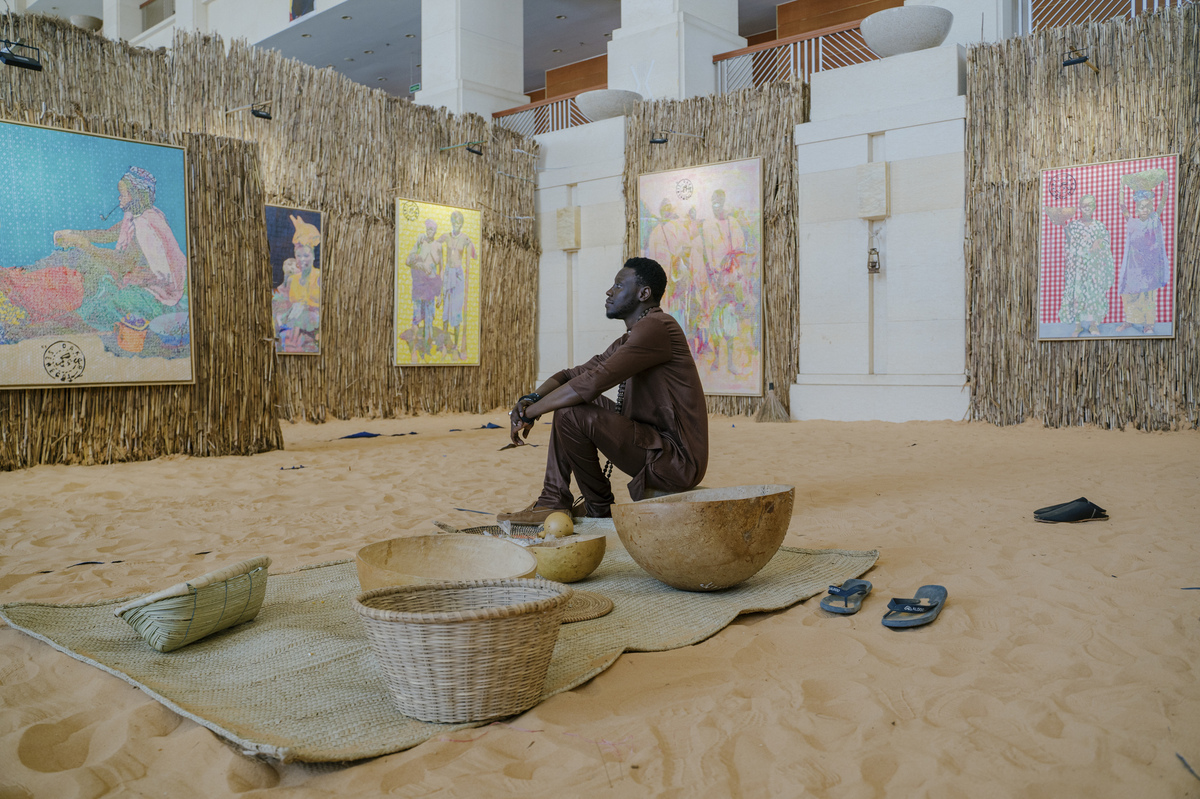
The large paintings are based on old French postcards depicting life in Senegal. They’re displayed in a replica of the courtyard of a traditional Senegalese home. It’s part of a re-creation of Senegal’s past from Senegalese artist Alioune Diagne, pictured above inside his Biennale exhibition at the Grand Théâtre National in Dakar.
Carmen Abd Ali for NPR
Outside, the afternoon heat has given way to the cool evening air. Bats swirl among the towering palm and baobab trees on the lawn of the Douta Seck cultural center in the bustling Medina neighborhood, just north of downtown Dakar. Inside, in the exhibition rooms, it’s humans flitting about, waltzing from one piece of art to the next – lingering at a painting here, a tapestry there.

They’re here for the Dakar Biennale, West Africa’s top contemporary international arts festival, which takes over the Senegalese capital every two years. Concerts, gallery openings, lectures, dance performances, and films are premiering across the city almost every day, from mid-May to mid-June.

You might think of sugar as merely a sweetener. Congolese artist Hilary Balu turns it into art. His sculpture shown above depicts tombs of the kings of Congo and is called “Kongo, Banza.” Balu uses sugar to reference the past enslavement of Africans to work on sugar plantations. He won’t reveal how he turns sugar into art!
Carmen Abd Ali for NPR
hide caption
toggle caption
Carmen Abd Ali for NPR
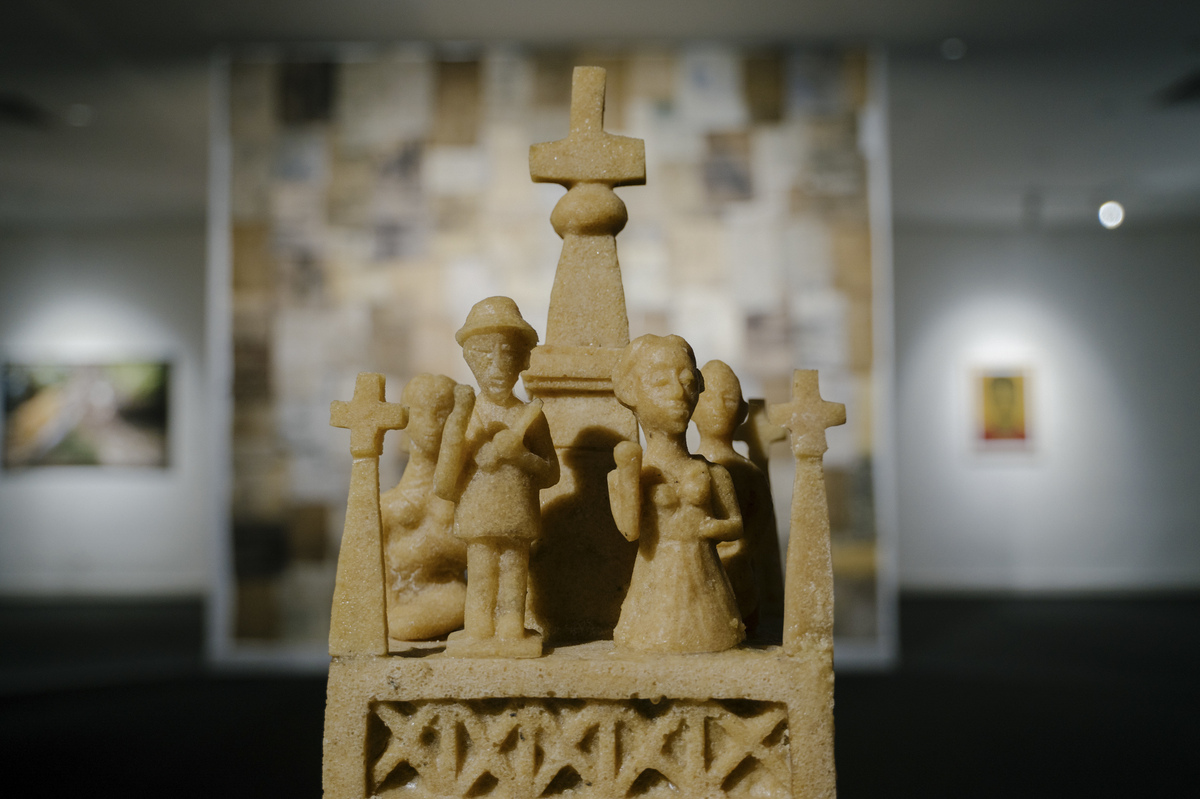
You might think of sugar as merely a sweetener. Congolese artist Hilary Balu turns it into art. His sculpture shown above depicts tombs of the kings of Congo and is called “Kongo, Banza.” Balu uses sugar to reference the past enslavement of Africans to work on sugar plantations. He won’t reveal how he turns sugar into art!
Carmen Abd Ali for NPR
Your sculptures are made out of … what?
Upon reaching the beige sculptures of Hilary Balu, patron after patron at the center pauses to ponder the intricate, ancient-looking works of art – a replica of a sword and a helmet, sculptures of a lion and a monkey – all carved out of … out of what, exactly?
“What’s it made out of?” multiple people wonder aloud.
“Sucre!” interjects Balu, who’s mingling with the crowd.
Sugar.
Most of the statues represent goods made by or traded by the Portuguese during their expeditions in the 15th and 16th centuries to the Kingdom of Kongo, located in present-day Democratic Republic of Congo and Angola, prior to Africa’s colonization.

A view of the sugar tombs sculpted by Congolese artist Hilary Balu.
Carmen Abd Ali
hide caption
toggle caption
Carmen Abd Ali
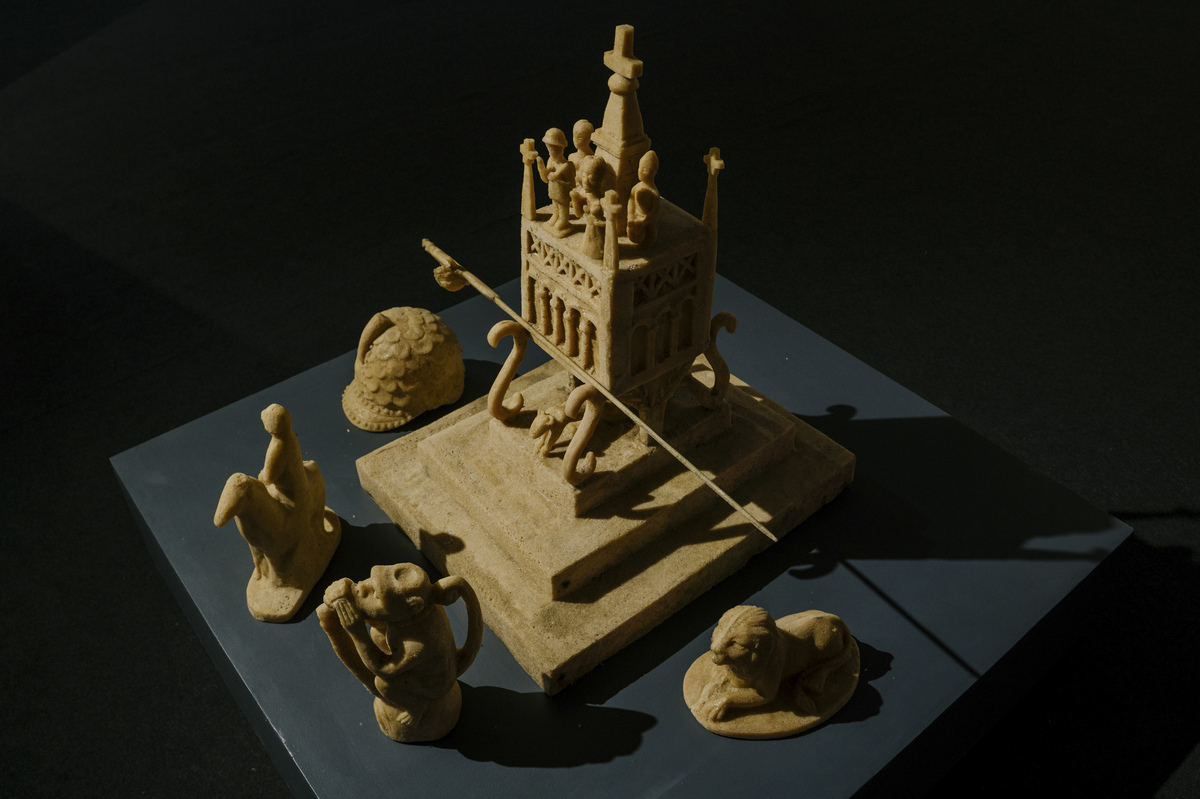
A view of the sugar tombs sculpted by Congolese artist Hilary Balu.
Carmen Abd Ali
Kongo was quick to adopt Christianity during this period. Balu’s replica of a tomb for the Kongolese king, adorned with crosses, shows how the two cultures mixed as they engaged in commerce and diplomacy. But the arrival of Europeans proved disastrous for Kongo. Their quest in that era for trade, slaves, and ultimately colonial domination led to the demise of the Kingdom of Kongo.
And why make statues out of something that could be destroyed by an errant cup of tea? Balu, a visual artist from Congo’s capital, Kinshasa, chose the medium carefully. He explains that the enslaved people were sent to labor on sugar plantations in Portuguese colonies and beyond and helped build the grandiose wealth of European empires. The legacy of this era lives on in the economic inequality between the global north and south today, he points out.
The objects he sculpted “represent the trajectories that these people [taken from Central Africa] took to end up being slaves in Brazil,” Balu says. “[Enslaved people] were used like tools, like an instrument, for sugar exploitation.”
When buying sugar at the supermarket in Kinshasa to make the statues, he bought local sugar, but also found imported sugar from Brazil. When forming the sculptures – using a secret method he will not divulge – he mixed the two products together, just like “the history of the two countries.”

A detail from “Kongo, Banza” by Congolese artist Hilary Balu. The statue is made of sugar.
Carmen Abd Ali for NPR
hide caption
toggle caption
Carmen Abd Ali for NPR
Balu is one of hundreds of artists from around the world presenting at the biennale, which is expected to draw some 250,000 visitors. Originally set for 2020 but sidelined by the pandemic, this year’s festival marks the 14th edition of the fair, which traces its roots to a literary festival launched in Dakar in 1990.
“For this Biennale, it’s an invitation to create new forms, new models, new relations,” said Elhadji Malick Ndiaye, the artistic director. The theme of this year’s festival is “Ĩ Ndaffa,” a word in the local Serer language that means “to forge,” or “out of the fire.” It’s the artist’s job, Ndiaye said, to propose “new ways to see the world.”

Fishermen haul in a fishing net in the eastern central Atlantic off Senegal. Belgian photographer Pierre Vanneste documents commercial fishing in his black-and-white photos.
Pierre Vanneste for NPR
hide caption
toggle caption
Pierre Vanneste for NPR

Fishermen haul in a fishing net in the eastern central Atlantic off Senegal. Belgian photographer Pierre Vanneste documents commercial fishing in his black-and-white photos.
Pierre Vanneste for NPR
Documenting how we hunt for fish
For Belgian artist Pierre Vanneste, who splits his time between Brussels and Dakar, the Biennale offered a chance to show his photography and video exhibit documenting the commercial fishing industry, a project that stretched from Brittany in northwestern France to Senegal.
His intimate black and white photos show Senegalese men fishing the Atlantic in the country’s famous, often brightly-painted wooden pirogues. Vanneste also snapped photos aboard massive commercial fishing boats – the kind favored by European and Asian firms often accused of overfishing which, along with climate change, is causing West African fish stocks to plummet.

A fishing stall in Dakar. Overfishing has threatened local fish stocks.
Pierre Vanneste for NPR
hide caption
toggle caption
Pierre Vanneste for NPR

A fishing stall in Dakar. Overfishing has threatened local fish stocks.
Pierre Vanneste for NPR

Photographer and documentary video maker Pierre Vanneste depicts modern-day fishing: the lives of those who fish, especially Senegalese, and the toll of fishing.
Carmen Abd Ali for NPR
hide caption
toggle caption
Carmen Abd Ali for NPR

Photographer and documentary video maker Pierre Vanneste depicts modern-day fishing: the lives of those who fish, especially Senegalese, and the toll of fishing.
Carmen Abd Ali for NPR
“Fish is the last wild resource that man hunts industrially, in order to be sold afterward industrially,” says Vanneste, whose photographic work concentrates on people’s relationship to nature. He’s hoping viewers start to question the environmental toll of mass-scale fishing and fish consumption, and the role that European and Asian trawlers – but also the Senegalese fishing industry, which itself is starting to expand and modernize – plays in it.

Senegalese artist Alioune Diagne wanted to capture the long ago life of his homeland. He found a trove of old postcards in France that show colonial-era live and created paintings based on the cards.
Carmen Abd Ali for NPR
hide caption
toggle caption
Carmen Abd Ali for NPR
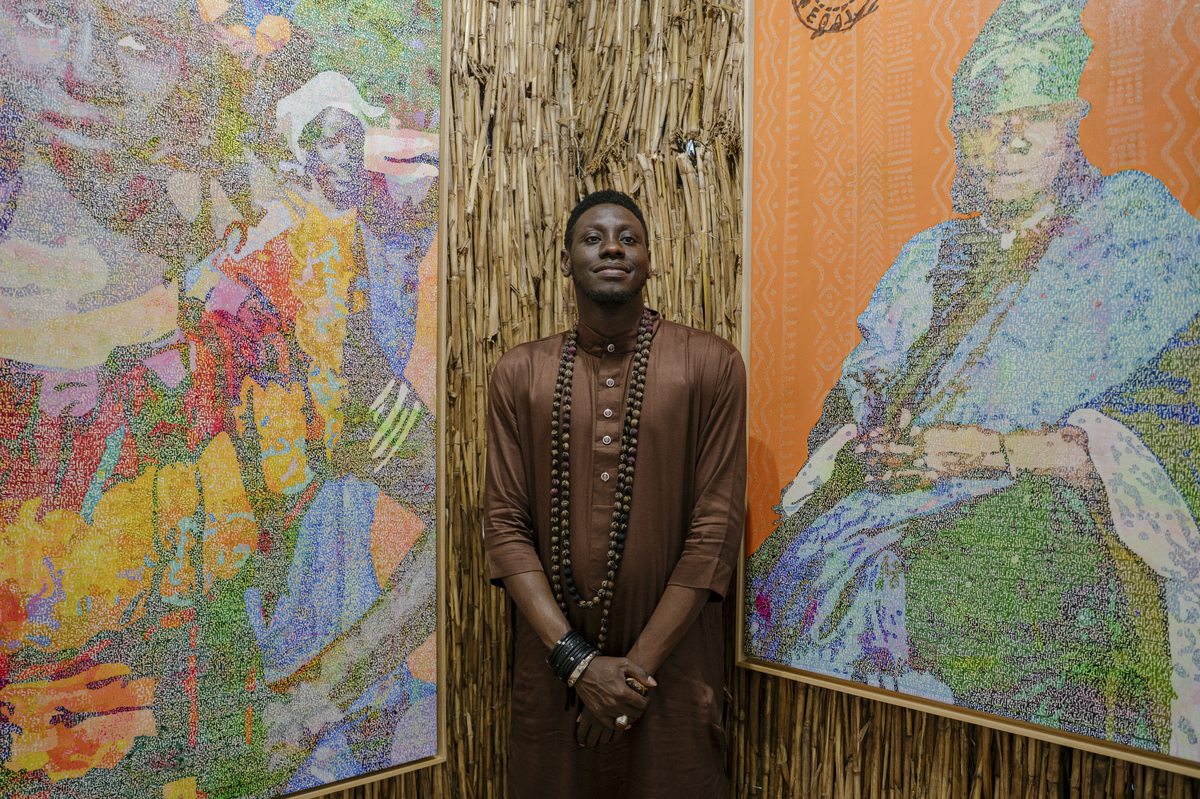
Senegalese artist Alioune Diagne wanted to capture the long ago life of his homeland. He found a trove of old postcards in France that show colonial-era live and created paintings based on the cards.
Carmen Abd Ali for NPR
Reviving classic village homes and colonial era postcards
A few blocks away, at the Grand Théâtre National, a wall of dried millet stalks greets visitors coming to see Senegalese painter Alioune Diagne’s show entitled “Ëttu Ker—Inner Courtyard.” Stepping through the wall’s open threshold, onto the sand covering the floors, they’re transported from the ornate, chandelier-adorned theater into a space resembling a typical Senegalese compound in the countryside. The stalks fence in a sandy, open courtyard, a type of home design that still dominates in rural areas today.
“My heart is cold,” says Baye Gora Mbaye, using a phrase in the local Wolof language to express happiness. He works in Dakar as an art talent manager but grew up in a small village a few hours away, and is passing through the exhibition on a way to a conference for his profession. “I’m back in the village,” he tells Diagne.

The paintings created by Alioune Diagne were inspired by old postcards and photographs of Senegal made by Europeans in the late 19th and early 20th centuries. It’s Diagne’s way of capturing the vanished images of the past.
Carmen Abd Ali for NPR
hide caption
toggle caption
Carmen Abd Ali for NPR
Inside Diagne’s carefully constructed replica compound – with cooking utensils, mats, and traditional wooden bowls filled with millet and corn to add an authentic touch – hang bright paintings inspired by a trove of colonial-era postcards depicting life in Senegal in the 1800s and 1900s he found while visiting France.
“In Senegal, history was [mostly] done in an oral fashion,” Diagne says. “We don’t have a lot of images – so I said to myself, I wanted to try to do this collection about the memory of Senegal, and bring it back to the source.”
His paintings recreate those postcards, transforming them from small pieces of paper to large, pastel-colored canvases. The country’s full history, Diagne says, is important for young Senegalese to know – including how people ate, dressed and lived in the past.

This painting by Alioune Diagne shows a hairdresser working on the street.
Kem Photography
hide caption
toggle caption
Kem Photography
“If we try to think back to this history, it can give us an idea today of how we can live again in solidarity and how we can also keep our values,” he says, noting that as the country urbanizes, communal courtyards are being replaced with private homes and apartments. “Because values start to disappear over time, people become more and more selfish, people become more and more individualistic.”
And in its own way, the biennale itself is a way of capturing a sense of intimate community: Inside the galleries, the massive city of 3 million-plus suddenly shrinks away as strangers come together over art. Back at Douta Seck, an international crowd mixes among the paintings, sculptures and photos. A performance from Nigerian rapper Teni bleeds into the night, leaving patrons with only a brief respite before they pick back up tomorrow with more gallery openings to go to than can possibly be attended.
Nick Roll is a freelance journalist based in Dakar.