Across the country, landscapers are reporting that labor remains a major challenge. That’s one reason why Environmental Management Inc. (EMI) headquartered in Plain City, Ohio decided to turn to the Department of Defense (DOD) SkillBridge Program. This program provides Service members an opportunity to gain civilian work experience during their last 180 days of service.
According to Joe Lewis, LIC, growth and development manager for EMI, it has been a great experience all around.
Lewis, who is a retired Marine himself, says that he learned about the program from Zach Rohr, who at the time, was nearing retirement after 24 years in the Marine Corps. He asked Lewis about coming to work at EMI as an intern.
“It’s really a win for everyone,” says Lewis. “The employer benefits by gaining an intern who is still being paid and receiving benefits from their active service. The service member who is transitioning out benefits by learning a new trade.”
During that six-month internship period, Lewis says that Rohr made an immediate impact.
“This was an individual who was retiring at the highest rank and had essentially become a master trainer,” Lewis says of Rohr. “He is someone who knows how to work with people, to build a team, and to train. These are skills that absolutely translated into his work here with us.”
Learning new skills
Lewis says that the time period where service members are transitioning out can sometimes be stressful. They might not feel like they have transferable skills. But he says that many of the things they’ve learned in the military make them excellent in the Green Industry.
“These are hard-working, highly trainable individuals,” Lewis says. “We can teach the skills they need to succeed in the Green Industry. But what’s great is that they already have that amazing work ethic and desire to win.”
Another thing that most service members also have, says Lewis, is the ability to adapt to stress.
“Generally speaking, most members of the military can handle stress—these are people who have been through some of the toughest conditions,” Lewis says. “They can definitely handle the fast pace of our industry.”
On top of that, Lewis says that most military folks are incredibly loyal.
“Veterans like us tend to be crazy loyal,” he says. “If you treat us well, you can be sure we’ll take care of you.”
More talent coming
Lewis says that EMI has been so happy with the program that they continue to use it. They’ve also brought in a Naval Lieutenant and a Navy Officer. And, they have a few Marines they’re currently looking at who are close to retirement.
“A program like this can really bring in some high-level talent,” Lewis says. “And then we can teach the landscaping skills. In the end, everyone wins.”
Crews removed the statue of Confederate General Robert E. Lee from its perch in Charlottesville, Virginia, in July 2021. Controversy over the statue’s fate sparked the violent “Unite the Right” rally in 2017. Photo by John McDonnell / The Washington Post / Getty Images
Last summer, Black Lives Matter protests sparked by the murder of George Floyd spurred communities across the globe to remove or dismantle the racist public art decorating their government halls, museums, parks and city squares. Many of these monuments were tucked away in storage facilities. Others, such as the American Museum of Natural History’s Theodore Roosevelt statue and the toppled bronze likeness of an enslaver in Bristol, England, found new homes in museums.
In Charlottesville, Virginia, lawmakers decided to transform one torn-down monument entirely, reports Teo Armus for the Washington Post. Instead of storing a statue of Confederate General Robert E. Lee, officials will melt down the 1,100-pound bronze monument into metal ingots—raw material that can then be used to create new art.
City council members approved the proposal unanimously on Tuesday morning, reports Ginny Bixby for the Charlottesville Daily Progress. Put forth by the local Jefferson School African American Heritage Center (JSAAHC), the plan was one of six considered by lawmakers during months of deliberation.
According to JSAAHC’s proposal, organizers plan to hold community listening sessions in barbershops, places of worship, schools and other businesses throughout Charlottesville. With community input, the “Swords Into Plowshares” team hopes to select an artist or artists to design a new public artwork by 2024.
The museum has already raised more than half of the $1.1 million required to bring its project to fruition and is continuing to fundraise online. Proceeds will be used to donate the transformed statue back to the city, where it will go on display by 2026.
JSAAHC executive director Andrea Douglas tells the Post that the project “will allow Charlottesville to contend with its racist past.”
She adds, “It really is about taking something that had been harmful and transforming it into something that is representative of the city’s values today.”
In a JSAAHC video describing the proposal, the director says, “I think this project offers a road map for communities who are also grappling with what to do with their statues.”
The statue of Lee on horseback has sat in storage since July, when it was removed from Market Street Park by city officials. The work was installed in 1924 as one of hundreds of similar statues commissioned by white authorities across the United States in the 19th and 20th centuries.
Particularly in the Jim Crow South, these Confederate monuments paid “homage to a slave-owning society and [served] as blunt assertions of dominance over” Black Americans, wrote Brian Palmer and Seth Freed Wessler for Smithsonian magazine in 2018.
Controversy over the Charlottesville statue reignited in 2017, when it was became a “focal point” of the infamous “Unite the Right” rally, as Armus reported for the Washington Post in July.
Responding to calls for the statue’s removal, white supremacist groups organized a protest that quickly turned violent. A man drove his car through a crowd of counter-protesters during the two-day-long demonstrations, injuring dozens of people and killing 32-year-old Heather Heyer.
Council members will likely reconvene on December 20 to decide the fates of two additional statues removed in July. One depicts Confederate general Thomas “Stonewall” Jackson, while the other portrays explorers Meriwether Lewis and William Clark and Lemhi Shoshone interpreter Sacajawea, per the Daily Progress.
According to Monument Lab’s National Monuments Audit, a recent survey of more than 48,000 statues, plaques, parks and obelisks across the country, Lee is the sixth-most represented historical figure in the American commemorative landscape. As a general for the Confederacy, Lee led thousands to their deaths in a war waged in the name of preserving slavery. He personally enslaved multiple people and, as executor of his father-in-law’s estate, oversaw almost 200 enslaved people on three Virginia plantations.
Elsewhere in Virginia, authorities in the state capital of Richmond recently dismantled a separate equestrian statue of Lee. Standing 21 feet tall and weighing nearly 12 tons, the monument was the largest Confederate sculpture in the United States prior to its removal in September.
Historian Jalane Schmidt, director of the University of Virginia’s Memory Project, worked with JSAAHC to develop the proposal. Her organization develops public engagement around issues of public memory as they relate to the Charlottesville rally.
In the JSAAHC video, Schmidt notes that “Swords Into Plowshares” will offer locals the opportunity to heal from or reckon with the events of 2017 and beyond.
“Our community will confront white supremacy with creativity,” the scholar adds. “Beauty will heal the ugliness of the past.”
Saulteaux and Anishinaabe artist Robert Houle was leading a group of journalists around “Red Is Beautiful,” the new retrospective at the Art Gallery of Ontario devoted to his half-century-long career, when he stopped in front of his 1998-99 work “Sandy Bay.”
Houle, an uneasy public speaker, took a moment to steady himself before addressing the abstract and figurative piece, which bares his reflections of the residential school where he spent weekdays throughout his childhood.
In viewing “Sandy Bay” in light of the recent discovery of thousands of unmarked graves near residential schools, Houle explained, he now sees in its assemblage of photographs and large canvases a divergent path his life could have taken. “I had tuberculosis,” he recalled, and it was only by the grace of his mother’s connections that he was able to get to the hospital in time.
“Otherwise,” he said, “that could have been me.”
Since 1970, Houle has made the evolving reckoning between Indigenous and Western culture a cornerstone of his work. Throughout the retrospective — titled after the artist’s 1970 abstract painting, his first to be sold to a museum — over 90 pieces offer not only an overview of one of the most important contemporary Canadian artists, but also a unique modernist lens through which to view that ever tenuous bond.
“I think it’s really important that people see the massive contribution (Houle) has made,” said Wanda Nanibush, the AGO’s curator of Indigenous art. “He created a new trajectory in modernism: towards the organic, towards the feminine, towards the Indigenous. That’s something that no one did before him.
“Also, because he’s covered all the major events that have happened in our country, (the retrospective) is a good way to look back at the history of this place,” she added.
As an example, Nanibush points to Houle’s 1992 multi-canvas work “Kanata,” in which he reframes Benjamin West’s “The Death of General Wolfe” by dulling the scene in bistre wash then reanimating the First Nations figure in red and blue conté crayon, and flanking the image with monochromatic red and blue canvases, representing the British and French, respectively.
“In thinking about how he centres the native figure and stripes everybody else of colour, he gave us a whole new way of thinking about Indigenous understandings of the history of the country,” Nanibush said. “But also the colours are amazing; they’re gorgeous, you could just bathe in them. So it’s also just physically inspiring.”
For his part, Houle says he was skeptical when Nanibush approached him about the retrospective two years back, but the pair found themes, groupings and pairings they felt were representative of the now 74-year-old artist’s artistic evolution, from ascribing a new voice to abstract expressionism to works of historical reclamation and political interaction, all guided by what Nanibush describes as “the way in which (Houle) understands the spiritual nature of colour itself.”
Walking through the finished exhibition, which follows its time at the AGO with engagements at Contemporary Calgary and the Winnipeg Art Gallery before spending a year at the Smithsonian’s National Museum of the American Indian, Houle said he was finally able to find a well-earned calm amongst his works of turmoil.
“I actually relive the anxiety, the abuse and the racism that is geared toward who I am,” he said. “But (I am no longer the child) that is forced to go to confession for worshipping a false god. I’m an adult. I can talk about it.”
Likewise, Nanibush said, “Red is Beautiful” is proof that the art world has become “more welcoming” of Houle’s and, indeed, Indigenous art in general.
“It’s a completion,” Houle agreed. “It’s a realization that you’ve not only established yourself as a serious artist but also that you can attract an audience who will look, appreciate and understand your work.”
Robert Houle’s “Red Is Beautiful” is at the Art Gallery of Ontario, 317 Dundas St. W., until April 18, 2022.
JOIN THE CONVERSATION
Anyone can read Conversations, but to contribute, you should be registered Torstar account holder. If you do not yet have a Torstar account, you can create one now (it is free)
Sign In
Register
Conversations are opinions of our readers and are subject to the Code of Conduct. The Star does not endorse these opinions.
Whether you’re delivering products to your customers or relying on deliveries and inventories of those goods, supply chain disruptions and skyrocketing costs are impacting every garden center business. Regardless of where they lay in the supply chain, disruptions are taking a heavy toll on independent retailers, many of which have few resources to absorb or push back on price increases, and even less leverage to pass those higher costs to customers.
A whopping 44{6d6906d986cb38e604952ede6d65f3d49470e23f1a526661621333fa74363c48} of small businesses recently reported temporary shortages or other supply chain problems, according to a survey of approximately 800 companies by Vistage Worldwide Inc., a coaching and advisory organization for small businesses. Fortunately, even this far into the disruptions, planning, increased supply chain management, adding potential suppliers and increased technology can help every independent garden center retailer cope with, or even profit from, rising prices and the supply chain disarray.
Coping with a volatile supply chain
Garden centers develop supply chains so they can reduce their costs and remain competitive. An efficient, optimized supply chain is extremely important in the fulfillment of customer orders. However, it can also result in lower costs and a more efficient production or sales cycle when managed correctly.
Supply chain management, or SCM, is the umbrella term that covers product development, sourcing, production, procurement, logistics and more. Without SCM, an independent garden center runs the risk of losing customers and its competitive edge.
SCM isn’t just about creating an efficient process; it’s also crucial to mitigating risk and ensuring everything runs smoothly. After all, many elements make up the supply chain from manufacturing sites to warehouses to transportation, inventory management and order fulfillment. So it should come as no surprise that managing the supply chain, along with agile and efficient adoption of technologies, is creating a new way of operating.
Without an optimized SCM process in place, the chain can fall apart from the very beginning. A dynamic approach to managing supply chains exists and provides everything a garden center needs to create a more robust supply chain. Apply agile strategies toward real-time disruptions, use powerful analytics that address and resolve root causes, and find management practices that pave the way for long-term growth.
Flexibility vs. resilience
When it comes to coping with disruptions and changes, flexibility and resilience are critical traits for success with a volatile supply chain. A resilient supply chain can weather the storm if one of its suppliers has to shut down production. And a flexible supply chain can adapt to market trends and conditions in the blink of an eye.
With the rate of disruptions continuing and, in many cases, increasing, change management is required. It is important to focus specifically on dealing with disruptions and, if at all possible, avoiding them (via flexibility). This will be a largely operational hurdle involving establishing strategies for particular events or changes — often with the help of digital technology.
Just in time
While there is no single best way to create a winning supply chain strategy, a popular option among those with inventories is so-called “just-in-time” management for inventories of raw materials, supplies, goods and products. Just-in-time management cuts final producers’ costs while redistributing some of those costs to intermediate producers, who wind up either holding extra stock or finding other ways to cope with demand-side fluctuations.
Unfortunately, the major problem of relying too heavily on just-in-time is glaringly evident in the industry credited with inventing it. Automakers have been crippled by a shortage of computer chips — vital car components produced mostly in Asia. Without enough chips on hand, automobile plants around the world have been forced to halt assembly lines.
Still, today’s shortages raise the question of whether some garden center retailers have been too aggressively reaping savings by slashing inventory. Despite their role in the supply chain however, many key players say they don’t want to replace just-in-time entirely because the savings are too great.
Alternate suppliers
Many businesses have been using alternate suppliers to combat rising inflation, supply chain disruptions and labor shortages. Relying on backup suppliers to battle shortages or shipping delays is rapidly becoming the “new norm” for many garden centers.
Shifting suppliers allows a business to “optimize costs.” An alternate supplier allows an IGC to quickly respond to supply chain disruptions, minimizing the impact on their bottom lines. Unfortunately, few are completely immune to supply chain disruption and are forced to hike prices if only to keep ahead of rising inflation.
What’s more, maintaining multiple potential suppliers, however, requires planning — and a great amount of work. Of course, every business relying on numerous suppliers has a certain amount of flexibility when supply chain breakdowns occur. That has allowed them to better shield themselves from the impacts of COVID-19 outbreaks, extreme weather events and other supply chain disruptions.
Spot bidding
It’s no secret that supply shortages and disruptions have led to a record number of canceled contracts and the rise of “spot bidding.” When supply and capacity are strained, previously negotiated contracts and agreements are all-too-frequently thrown out the window, leaving little alternative to the incredibly inefficient spot bidding.
Spot bidding requires many of the same, time-consuming, repetitive steps as the original process to reach out to potential carriers or suppliers, collect data and make new award declarations.
Far too many within the industry failed to anticipate the sheer volume of canceled contracts or the rise of spot bidding, among other economic challenges. Complicating matters today, when an outsourcing need arises, many are turning to what is familiar and ignoring the impact of new problems with old, outdated processes and technology.
Since it is often conducted outside of a formal sourcing process, spot bidding often introduces bias, where the business favors certain suppliers in the interest of speed, reducing the competitive tension that might have resulted in better offers.
Understanding that in order to remain competitive and guard against disruptions, integrating new suppliers — and identifying which supply lines no longer hold value — is imperative. A garden center that overlooks emerging suppliers to preserve incumbent relationships does so at the expense of innovation and resiliency.
According to many experts, a lack of a cohesive strategy and technology are the biggest hurdles to building future-ready supply chains. Fortunately, in an effort to upgrade these methods, many businesses are overhauling their old systems and attempting to streamline processes using optimization and automation technology for a more modernized supply chain.
A fundamental way of achieving preparedness is to optimize processes wherever possible — especially in the procurement function. Optimization makes it possible to balance cost and speed objectives, give suppliers flexible bidding options and eliminate “lowest price wins” awards.
With the right solution, the IGC retailer has the capability to handle everything from spot bids to large-scale RFPs, with a supplier-friendly interface that improves the operation’s direct materials, supplies or service award decisions. One such solution involves automation.
Automation
A computerized sourcing process can establish spot bidding and mini-tender events within minutes, managing and automating everything from inviting carriers and collecting bid data to generating award recommendations based on a set of criteria. A computerized system goes beyond cost savings by creating more efficiency.
By reducing time-consuming, monotonous tasks, optimization and automation technology allows the garden center’s key personnel to do what they do best — focus on supplier relationships, accomplish broader goals for the operation and drive innovation.
A problem without an answer
With price hikes already common, inflation expectations are posing potential problems for some retailers. Pandemic buying and supply shortages exposed flaws in many supply chains that will continue to be exploited in the months ahead.
Although many retailers learned how to cope with on-the-fly solutions (duct tape and chewing gum?), most postponed long-term investments while grappling with more immediate issues.
Today, IGCs can utilize past lessons and move forward. For some, that will mean stockpiling more inventory and forging relationships with additional suppliers. Unfortunately, for far too many garden center owners and managers, the pursuit of cost savings will once again trump other considerations.
Disruptions in the supply chain aren’t going away any time soon. The bottom line is that there is no single best way to create a winning supply chain strategy. However, by leveraging optimization and automation to create a future-ready supply chain, retailers can leave antiquated approaches behind and progress to modernity. The operation’s future may depend on it.
The author is a business writer based in Pennsylvania. His tax and financial features have appeared in business magazines and trade journals for more than 25 years. Reach him at MEBatt12@Earthlink.net
In the far north of Ghana, the landscape is increasingly pressured by climate change. Seasons occur as they haven’t before, with prolonged drought now often followed by heavy flooding. The Sahel – a semi-arid region between the Sahara Desert to the north and lush tropical terrain to the south – is expanding southward into the country’s greener reaches.
“We don’t have a rainy a season anymore. It’s three months of rain and then nine months of dry season,” said Daniel Debrah, a forester who helped found Ghana’s GLFx Bawku chapter. Named for the town of Bawku in Ghana’s Upper East Region, GLFxBawku is a part of a Global Landscapes Forum (GLF) initiative to implement restoration activities in landscapes around the world. The chapter is so far one of five in the greater Sahel region, each funded by a EUR 5,000 grant from the Robert Bosch Foundation.
On top of the seed funding, the chapter received a major boost after a local chief, Puafadir Ziem Mon Naaba Alumbil, agreed to donate 3,200 square meters of his land for a tree nursery in the semi-arid Yarigungu community near Ghana’s northeast border with Burkina Faso.
The tree nursery on the donated land will sit on gently sloping ground that is well-drained and less than 500 meters from freshwater. Mango trees, neem trees and a mahogany tree are already on the site to provide shade and enable the tree seedlings to grow.
The Bawku chapter selected native species suitable for the soil, and the seedlings include more mahogany (Khaya), endangered rosewood (Pterocarpus erinaceus), the culturally significant baobab (Adansonia) – which also has an edible pulp – and shea (Vitellaria paradoxa), which contains a nut used to produce shea butter. Seedlings will also be distributed to the community to allow individuals to plant them near their homes.
Developed through a community consultation process, the restoration also aims to regenerate a landscape that has been badly depleted in the past two decades. Home to broad savannah grasslands and baobab trees, many areas of Upper Ghana have no tree cover due to unsustainable agricultural practices, bushfires, desertification, over-grazing and the clearing of trees for fuelwood and through controlled burning, which can spark bushfires given the dry conditions.
With the regional economy heavily dependent on agriculture and livestock, the landscape degradation and increasingly unpredictable weather have made agricultural livelihoods more uncertain. The global pandemic has also added to socioeconomic pressures, with many migrants returning home to their villages.
“There is a lot of tree loss across the landscape,” said Debrah. “Water is a serious problem, and food security is a big problem since it is difficult to grow rice, sorghum and millet.”
Ghana has already experienced one of the world’s highest rates of deforestation in recent years – much of it in the humid tropical forests in the south of the country. According to Global Forest Watch (GFW), the West African nation experienced the world’s highest increase in the rate of primary rainforest loss in 2018 compared to 2017. In 2020, GFW determined that Ghana lost 136,000 hectares of natural forest, equivalent to emitting 82.2 metric tons of carbon dioxide, based on remote sensing and satellite data from the University of Maryland.
Clearing for cocoa plantations, as well as road building, logging for mahogany and other trees, climate change and gold mining have all contributed to Ghana’s deforestation. One study cautioned that “at the current rate of deforestation, the country’s forests could completely disappear in less than 25 years.”
The GLFx Bawku chapter’s landscape restoration initiatives are part of a broader movement in Ghana to reverse this tree loss – one that has a ripple effect on human well-being and natural ecosystems. For example, the NGOs Green Republic and Youth Icons Ghana partnered to plant thousands of trees in the country. And as part of the AFR100 initiative, an effort to restore 100 million hectares of land in Africa by 2030, the Ghanaian government pledged the restoration of 2 million hectares. Across the continent, the African Union’s Great Green Wall initiative aims to restore and green the Sahel through tree plantings and other vegetation.
The donation of land in Bawku by Chief Alumbil also shows the level of restoration and innovation possible at the local level.
“When you plant a tree, you have given life and added property that will live into the future,” said Alumbil in a video commentary. “This is property no one will forget when they enjoy the tree’s shade or its fruit.”
In addition to tree plantings, restoration activities by the GLFx Bawku chapter will include training students and farmers on nursery development and compost preparation, establishing COVID-19 memorial plantings in schools and training students to become citizen scientists.
“The donated site will provide employment for five community members at the nursery and serve as a distribution center for tree seedlings to farmers for on-farm planting,” said Debrah. “The planting of trees helps strengthen the soil and also the people.”
The handmade painting company provides excellent artwork for those who need to add something special to their home.
Are you looking for the next big focal point for your sitting room? Need a piece that echoes the color scheme of your bedroom? We know the frustrations of trawling through catalogs to find suitable artwork to suit you. For the connoisseur, it might be enjoyable, but when you’re not an art critic – how do you know when you have found something good?
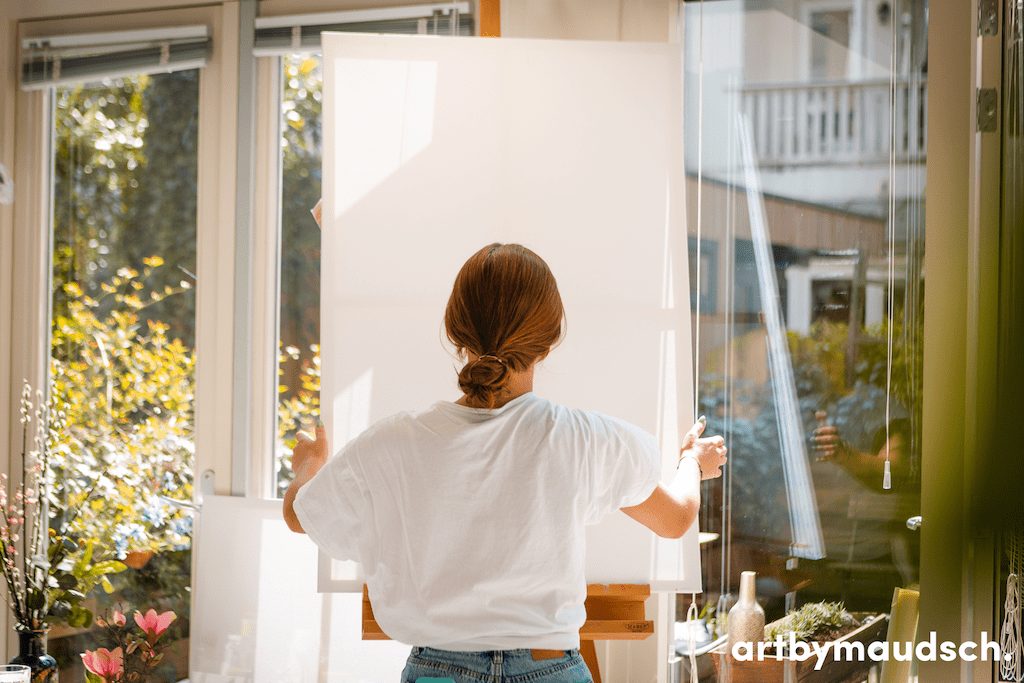
Enter the artistic flair of Art by Maudsch. This talented team creates hand-painted artworks which suit any space. They have been tipped as the next important thing in interior décor in 2022 since their pieces are highly adaptable to your needs. Its artwork is tailored to your specifications. Here is how it all works.
Handmade Paintings for Your Home
Art by Maudsch uses expert artists to hand paint each piece they sell. They use a mixture of mediums, either oil or acrylic paints. In addition, they use high-quality cotton canvases to create paintings using their network of professional artists.
Paintings are created to match your needs, then shipped worldwide free of charge. You can view and approve your painting online before committing to buy it. They have already gathered over three thousand satisfied clients, who each now own a piece of unique Amsterdam artwork.
How does it Work?
The artworks are produced as original pieces and listed on the site with this seller. You can browse through the different sections to find art that matches your theme, space, or color scape. Next, you select the piece you would like to buy, and an artist paints it for you. Paintings are made entirely to order, and a painting purchased from Art by Maudsch is far more unique and exciting than mass-produced prints from any other outlet.
Framed by professionals
If you choose a framed painting, which we recommend you do, it will be framed by skilled professionals. The framing facility used by Art by Maudsch is also located in the Netherlands and produces frames from the highest-quality Czech pine wood. The framed pieces are delivered to your doorstep, ready to hang.
Canvas Sets from Art by Maudsch
Canvas sets are the ultimate way to decorate a designer home. They allow you to mix one art piece throughout several rooms or place many canvases on the wall to make up a single picture. Canvas sets are increasingly popular, allowing a pop of creative expression in any home. But, of course, the best part about a canvas set from this team of designers is that they are unrivaled in taste and style. They have been handmade for you by some of the finest modern artists in the world. Art by Maudsch is shipped to you from one of the best-known artistic cities on the planet.
Amsterdam & Art, a great combination, fueled by ArtbyMaudsch.
What is the first thing that comes to mind when you hear ‘Amsterdam’? Maybe it’s the canals, the tolerance, or even the Red Light District! But did you know that Amsterdam was, in the Dutch Golden Age, the epicenter of world-renown art? Famous master artists like Rembrandt van Rijn, Johannes Vermeer, Frans Hals, and of course Vincent van Gogh all lived and worked in this beautiful city. With many museums and statues to honor them around the city, their vision, expertise, and philosophy reverberate throughout older and future generations.
Spread the message
Art By Maudsch, based in Amsterdam, saw the big positive impact that art had on the population and the city. They acknowledged that art can be the bearer of timeless ideas and values and blissful beauty. Art can inspire people, spark new ideas or create a conversation between different people. With the many merits that art has to offer, Art By Maudsch felt the urge to share these with the whole wide world!
Personal Adjustments
By offering handmade, original art pieces at fair prices online, they make pure, handmade art available worldwide. Sure, a printed painting is nice and affordable, but a real handmade artwork is something different! With a great communication center, available day and night, and even an option to make personal adjustments to the pieces, Art By Maudsch feels personal and as if you are in direct contact with the artists themselves.
Canvas Sets
Because art is subjective, different people like different styles of art, the possibility to make personal adjustments can really help you find the exact piece for your home interior. And Art By Maudsch takes it even one step further, offering a variety of Canvas Sets. These sets consist of multiple, separated artworks with the same atmosphere, that you can freely adjust and style accordingly to match the atmosphere of your home interior perfectly.
Art By Maudsch is therefore more than just an online gallery, it is an experience where the professional team takes you by the hand in the search of your ultimate, handmade art piece. From the city where it all started, right to your doorway and without any costs whatsoever!


:focal(2188x1542:2189x1543)/https://tf-cmsv2-smithsonianmag-media.s3.amazonaws.com/filer_public/0a/c9/0ac912c2-3c8a-451e-adcb-8ec542fd2c2a/gettyimages-1233952196.jpg)