The Art of Japandi – Kitchen & Bath Design News

Kitchens

Scandinavian and Japanese aesthetics meet in this minimalistic, yet elegant, style.

authors
Lis King | November 29, 2021

Sometimes two great styles are better than one. That’s what happens when the raw functionality of Scandinavian design fuses with Japanese nature-suffused simplicity, and it’s a look that fits American kitchens like a glove. Designers say it creates wonderful zen, with some famous Scandi and Japanese variants adding warmth and interest to sleek minimalism.

At first glance it may seem an unlikely design union, since Japan and Scandinavia are on opposite sides of the globe. But, in actuality, their design sensibilities are remarkably similar, and Denmark, especially, has had a close trade relationship with Japan for hundreds of years. The Danish design museum in Copenhagen even devotes exhibit space to Japanese design.

Thomas Lykke of OEO Studio in Copenhagen, Tokyo and Kyoto applauds the design fusion of the two countries, but dislikes that it’s dubbed a trend.

“Trends tend to pass by,” he says. “The Japanese-Danish connection goes far beyond that. I call it shared DNA. Meticulous craftsmanship and attention to details, simplicity and timelessness are deep-rooted in both countries’ culture. We want design that will be relevant 50 years from now. And we are, in our hectic lives, looking for meaningful ways to live, through craftsmanship and rituals, whether that’s a tea ceremony in Kyoto or a coffee break in Copenhagen. Also, neither country has vast natural resources, so we respect what we have and work with it.”

Although Japandi at its roots is the epitome of minimalism, two special concepts set it apart. One is “hygge,” a Danish word now known by designers everywhere, meaning cozy comfort. In Scandinavia this is achieved with lots of textures and touches of color. The other is wabi sabi, the Japanese concept of finding beauty in something imperfect. This could be a well-loved heirloom, perhaps a piece of furniture or a well-used utensil. Although Scandinavians don’t talk about wabi sabi, they, too, love to let the patina of something old and well-loved add charm to a space.

Cabinetry in a Lykke kitchen is always the main event. In one kitchen, for example, cabinets aspire to be more a piece of furniture that fits naturally into living environments rather than a stand-alone kitchen. It combines simplicity and refined, contrasting materials. Lykke calls it “a quality culinary space rather than merely a show kitchen.” Another kitchen features modular cabinets, a popular concept in European homes. The modules are sectioned using slender metal dividers and sit on metal plinths creating a light, floating look.

A tiny concrete cave of a New York City apartment is turned into a work of art by architect Andrew Mikhael, who used walnut not just for cabinetry but also for structural elements. The concrete ceiling couldn’t accommodate recessed lighting, so he installed LED tape lights in channels and then surrounded them with walnut slats. The angled walnut wall was designed to reference a drawn-back curtain revealing the sculptural space.

Modern Nostalgia

When a 30-something guy bought a tiny, concrete cell of an apartment on New York City’s Upper East Side, he turned to architect Andrew Mikhael for help. The client showed Mikhael photos from his grandmother’s home, a place that inspired wonderful memories. When Mikhael saw the grandmother’s Danish serve ware and the simple, elegant mid-century furnishings, he knew exactly what to do.

“Since he loves to have people over and cook and bake for them, I knew the kitchen should be an unexpected centerpiece,” reports Mikhael, “a functional work of art. We removed the wall between the galley kitchen and the living room to combine the spaces. We also extended the kitchen into the entryway space, thus expanding the kitchen from 56 square feet to 87 square feet. Next, we installed an angled walnut wall that recalls a partially pulled-back curtain, dramatically revealing the sculptural kitchen.”

Mikhael used walnut throughout the kitchen as an homage to the client’s grandmother. He even wrapped a structural column that couldn’t be moved in walnut. The remarkable workmanship morphs and blends, wraps and anchors, and ultimately hammers out a rhythm.

Lighting was a problem in the apartment. “Because the ceilings were concrete, lighting couldn’t be recessed into them,” explains Mikhael. “As a result, LED tape lights were mounted in long channels one inch below the ceiling, and we then used wood slats to give them a home. The slats don’t just shield the lighting channels, they also hide the unsightly concrete.”

Cabinetry is frameless with simple finger pulls to keep the look minimalist, countertops are matte black Corian, the range and hood are wrapped in stainless steel, and backsplashes are backlit glass.

Mikhael warns that a meticulous carpenter is needed for this kind of work. “I asked my contractor if he minded if I worked with the carpenters at Conex Interiors directly,” he relays, “and he gave me his blessing. They did an incredible job.”
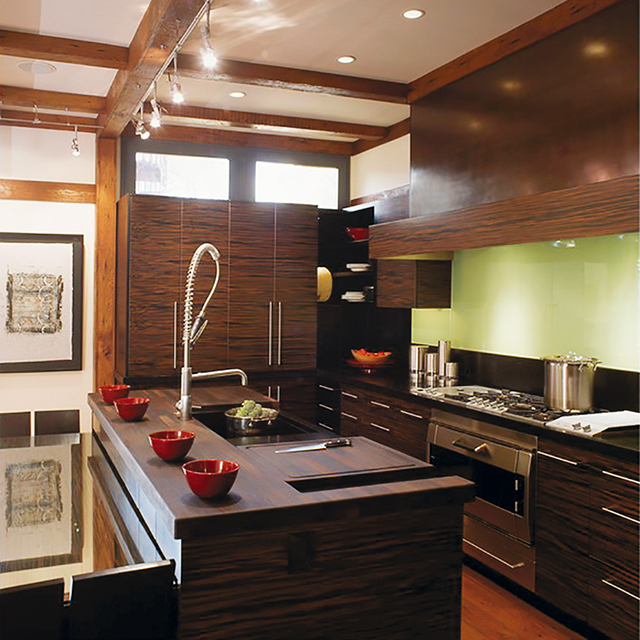
Designer Jennifer Gilmer proves that Japandi minimalism can be elegant and timeless, designing this kitchen with cabinetry crafted from Macassar Ebony, an engineered veneer.
Photos: OEO Studio

Japandi Meets Bungalow

Jennifer Gilmer, an award-winning kitchen and bath designer and principal of Jennifer Gilmer Kitchen & Bath with showrooms in Maryland and Virginia, says that she tells clients, jokingly, that she designs “Western Feng Shui” kitchens. “But I am really quite serious,” she remarks. “The more I learned about Feng Shui, the more I realized that I was unwittingly doing just that. It has become my signature style. So no matter what the design is, and they are all very different, the one thing they have in common is that they make you feel good. That’s Feng Shui.”

Japandi fans will testify to its built-in Feng Shui, so it’s no surprise that Gilmer chose modern Japanese design as the look she wanted for her own home. “This was a Sears bungalow,” she tells. “It was a far cry from the elegant minimalism of Japanese design, but my architect magically made my aspirations possible with a modern addition at the back of the house. There, I got the beautiful and functional space I had visualized for cooking, family life and entertaining.”

Knowing that the cabinetry would be the main focus of the kitchen, Gilmer sought out Premier Custom-Built Cabinetry, which has developed its Mizuki style inspired by Japanese folk houses and traditional Tansu cabinetry.

“We chose an engineered veneer crafted to look like Macassar Ebony,” relays Gilmer. “The wood grain is horizontal, and the ‘striped’ look is so striking that everything else in the kitchen was chosen to complement the cabinetry. No other element was allowed to distract from its beauty. For example, honed black granite was used for the countertops and wenge for the island wood detail. Wenge is similar to cherry, but turns dark over time. The backsplash behind the cooktop is backpainted glass, the farmhouse sink sits on black granite to protect the cabinets from water damage, and dishes are kept on floating shelves.”

She’s especially fond of the pantry, with its retractable bi-fold doors. They open to reveal a countertop, and it houses a steam oven as well as a plethora of cooking accessories. When not in use, the doors are shut so the pantry looks beautiful when entering the kitchen.

The gnarly irregularity of the unclaimed wood floors and beams contrasts with the clean, sleek cabinets, creating precisely the kind of juxtaposition that’s quintessentially Japanese. “So, yes, modern Japanese design and American Bungalow can mix well,” concludes Gilmer. “This space will never go out of style because it honored and melded two very tasteful styles that have proven the test of time.”
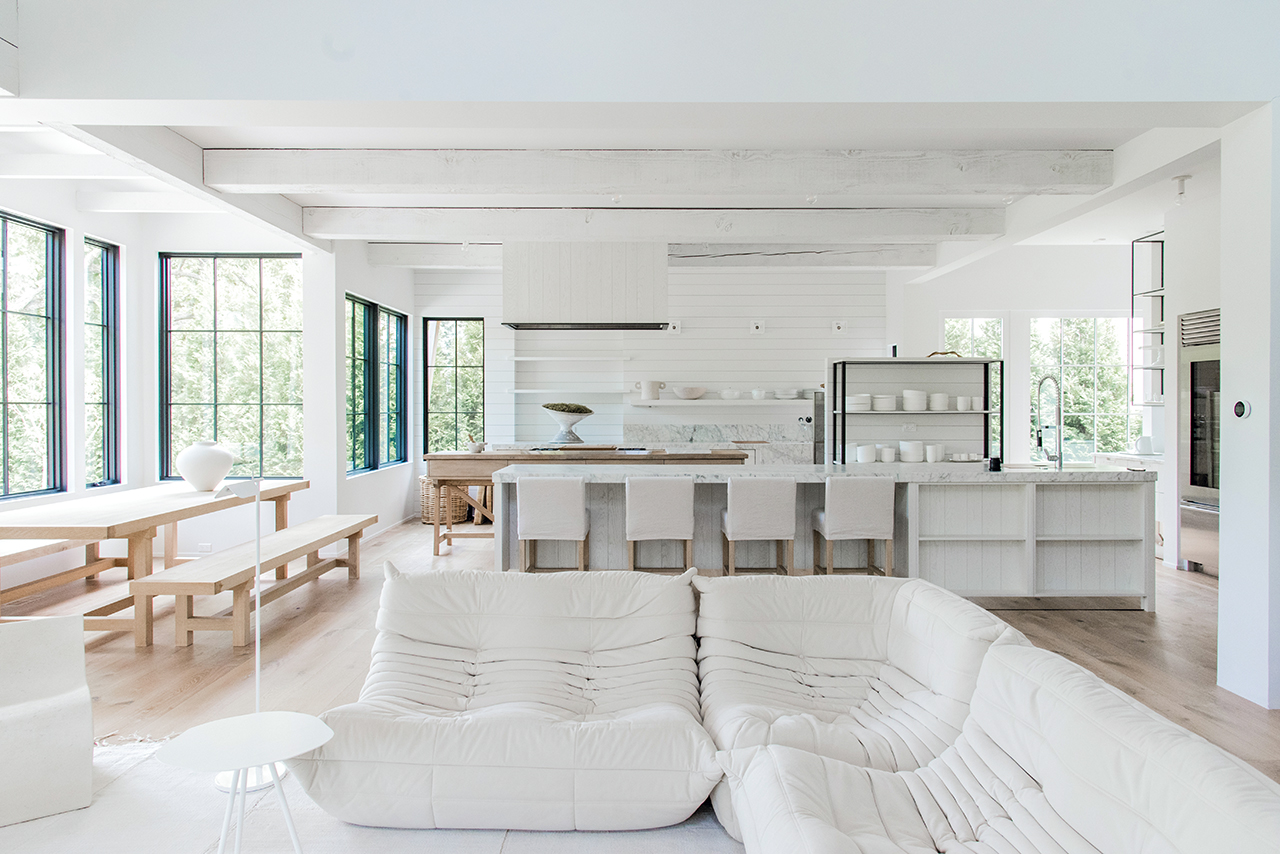
Neutral colors but strong texture contrasts of this Winnetka, IL open kitchen/family room/ dining area by Mick De Giulio reflect the design aesthetics of both Scandinavia and Japan.
Photo: Belen Aquino

Detailed Minimalism

Mick De Giulio, principal of de Giulio Kitchen Design in Chicago, IL, pays visits to near and far locales, and those influences have a way of creeping into his kitchen designs. Japanese and Scandi aesthetics may appear in a design here and there, but in typical De Giulio fashion, inspirations remain just that. From there they are carefully curated and translated into one-of-a-kind designs.

Such is the case of a kitchen he designed in Boston – a classic 19th-century Victorian with a modern addition in the back. “It was just right for a family friendly kitchen,” notes De Giulio. “It’s a contemporary, clean-lined space, but it blends seamlessly with the old part of the house, he remarks. “The design emphasizes asymmetry and horizontals, and the layout is straightforward. Materials play an important role in keeping the space serene. We used light walnut in an organic, almost natural color that we nicknamed ‘Norwegian’ for its sun-bleached, Scandinavian look.”

Of course, everything that De Giulio designs is actually not that simple. A kitchen may look minimalistic, but it’s sure to include exquisite details that don’t shout. The Boston kitchen’s cabinetry, for example, is framed in bronze and contrasts subtly with brushed Iceberg quartzite. The edges of the quartzite counter were mitered to make the slab look extra thick, and a stair-step design at one end provides room for extra seating. The quartzite is repeated on the backsplashes and wrapped the range area.

In another kitchen in Winnetka, IL, De Giulio, worked the wood, creating cabinets with seemingly unfinished, textured surfaces. The space was a riff on a style that the client called Belgian farmhouse, but it is also a look that’s beloved in Scandinavian and Japanese farmhouses. De Giulio achieved it using white oak, cross-cut against the grain. To emphasize the casual, freewheeling look of the light-filled space, he installed legs on the island and placed the cooktop on a table made of reclaimed wood. Finally, he introduced some freestanding stainless steel cabinets for a bit of an industrial vibe.

“There’s nothing sleek about this space,” comments De Giulio. “It is full of textures and juxtapositions. Nobody ever heard of Japandi when this kitchen was designed, but I think it plays into the style. It’s a strong style, especially because it is so adaptable.”

Marcus Otten calls the Royal Ebony veneer used for the cabinets in this kitchen the most beautiful he has ever seen, with unique colors and patterns that dictate that the cabinetry should be the key element.
Photos: Kimberly Gavin

Globetrotting Style

How do a couple of world travelers get a kitchen that reflects their global style, works as a canvas for treasures from many countries and yet functions for everyday life? They get together with award-winning designer Marcus Otten of Exquisite Kitchen Design in Denver, CO. Otten is known for a singular motto: “There are 10,000 different ways to do things, but only one way to do it right.”

For the world travelers, he designed a space where everything tells a story and brings up memories. The couple’s objets d’art are displayed throughout the space, including on floating shelves. The most stunning element, however, is the cabinetry featuring Royal Ebony veneer.

“It’s the most beautiful material I have ever seen,” remarks Otten. “It features unique color patterns and is very rare. There simply are no more logs. This African tree grows slowly and can only be turned into lumber when it’s 100 or so years old.”

Rift-cut oak for other cabinets and the island plus steel accents provide the layers and textures that Otten favors. Altogether, the space contains a lot of the Japandi influence: meticulous craftsmanship, beautiful wood, thoughtful contrasts and artistic accents.

Japandi’s elements are expected to continue to resonate with designers, who find its sophisticated minimalism warmed by craftsmanship and artistry endlessly adaptable. Many homeowners also understand and embrace the concepts of hygge and wabi-sabi, which Japandi fans call “yin and yang” at its best. Gilmer’s reference to it as “great Feng Shui” reflects its staying power in design. ▪

Locals react to Rockford native, fashion designer Virgil Abloh death

ROCKFORD — Local residents took to social media Sunday to remember Virgil Abloh, a Rockford native who went on to become one of the most influential and creative figures in modern art, fashion and design.

Abloh died Sunday at the age of 41. According to his verified Instagram account, he was privately battling a rare form of cancer for the past two years.

Virgil Abloh poses for photographers upon arrival at the Nike Celebrates The Beautiful Game event, in London on Wednesday, Feb. 7, 2018.  Abloh, a leading fashion executive hailed as the Karl Lagerfeld of his generation, has died after a private battle with cancer. He was 41. Abloh's death was announced Sunday, Nov. 28, 2021 by LVMH Louis Vuitton and the Off White label, the brand he founded.

As news of Abloh’s death spread across the globe Sunday, Abloh’s alma mater, Boylan Catholic High School in Rockford, released the following statement:

“The Boylan Catholic High School community is deeply saddened to learn of the passing of our 1998 alumnus, Virgil Abloh, a 2019 Alumni Excellence Awardee. Virgil Abloh was an amazing force in all he did and made an incredible impact on the world.

“He was a groundbreaking artist on a global stage, daring collaborator and an inspiration and advocate for new artists. Our prayers are with his wife, children, parents and sister. Rest in peace. Once a Titan always a Titan.” 

The Rockford Area Convention & Visitor’s Bureau posted the following message on Facebook:

“Here in his hometown, we join the global community to share our deepest condolences to Virgil Abloh’s family and loved ones after hearing of his passing today.

He was a courageous visionary, and his legacy will continue to be a bright light inspiring others to break barriers with creativity and valor. Please take a moment with us to remember this Rockford native and honor him today and always.”

Fake Food Is Trendy Again

While a minimalist interior may have represented an aspirational environment only a few years ago, it seems that intermittent lockdowns and supply-chain-induced shortages have led people to re-evaluate the aesthetic of an empty Home Garden USA.

The result is a resurgence of maximalist home décor that embraces pattern, color and ornamentation. Cabinetry that may once have been wood grain is now jewel-toned; streamlined furniture has given way to all things squishy and wiggly; trends like “cottagecore” and “grandmillennial” aim to elevate items that are handmade, chintzy and secondhand.

Is it any wonder that fake food is back, too?

Charcuterie and cheese candles, resin-cast croissants and Jell-O salad lamps are hot items. Retro-style fake cakes are big on Instagram. The high-end jewelry brand Mociun sells faux glasses of spilled wine and melting ice cream cones alongside $10,000 engagement rings. And Yukiko Morita’s Pampshade lamps, which are made from real baked goods that have been preserved, can sell for around $80 apiece.

For John Derian, the founder of an eponymous home décor and decoupage line, the resurgence of fake food is very welcome. Mr. Derian has had a fake cake sitting on his kitchen counter at home for 14 years, he said, and he estimates that he has been selling food-themed items in his store for about 20 years, starting with a stuffed doll made by Nathalie Lete that had sausages for arms and a steak for a head.

“I do love funny things,” he said.

These days, Mr. Derian also offers more elegant fake food items for customers who are less interested in kitsch, including stone bananas and cherries carved in Tuscany using marble from the same quarry that Michelangelo favored.

For about 10 years Mr. Derian has also been selling food-shaped candles by Cereria Introna, an Italian company that has been around since 1840. (This year, Cereria Introna, which makes all of its candles by hand and supplies many other design shops including East Fork and Fruit and Flower Shop, saw demand for its food candles in the U.S. increase to the point where it was unable to fulfill all of its orders.)

Mr. Derian often displays the paraffin wax beauties, which include doughnuts, cakes, cupcakes and pies, in the front window of his shop.

“Everyone responds to them with joy,” he said. “Sometimes I move them around the shop, but I keep putting them in front because they’re just something bright and colorful and cheerful.”

In recent centuries, fake food has remained popular in more utilitarian settings. In Japan, fake food, or sampuru, is displayed in the windows of restaurants, and can cost hundreds of dollars for artisans to custom make. In the U.S., fake wedding cakes can help preserve a visual tradition of a layered confectionary, while helping to cut down on the price of the real cake served during the reception.

But when it comes to fake food as objets d’art in the American home, Sarah Archer, a design and culture writer and the author of the 2019 book “The Midcentury Kitchen,” suggests looking back to the 1950s and 1960s, when fake food became a midcentury trend.

“Blown glass fruit was super popular in the ’50s and ’60s, especially after World War II when it was more affordable and kind of interesting or enticing for middle class Americans to travel abroad to Italy,” Ms. Archer said in a recent interview. American tourists would return from their journeys with glass apples or pears as souvenirs.

Fake fruits made of wax and plastic were also popular, although fake fruits made of those materials could be construed as kitschy, depending on the audience.

“It kind of represents domesticity and a certain middle class effort at beautification, but it’s also kind of tacky at the same time,” Ms. Archer said. “It occupies a sort of nebulous status.”

For some of the artisans and brands that sell fake food today, the question of taste — or of questionable taste — is what drew them to the trend in the first place.

Leanne Rodriguez, an artist in Oakland, Calif., who goes by Elrod, began making fake gelatin salad lamps during the pandemic; in a recent interview, Ms. Rodriguez said she wanted the effect “to be a little on the disgusting side.”

Using recipes for gelatin salads from midcentury cookbooks as inspiration, Ms. Rodriguez suspends hot dogs, vegetables and chopped fruit made out of clay in sparkly resin. Her creations, which she has branded Mexakitchen and sells as part of her Mexakitsch line of artwork, emanate an eerie glow from LED lights inside. Ms. Rodriguez said that a fascination with kitsch is what drew her to make the lamps in the first place, and the more she makes them, the more opulent they get.

“A lot of people don’t get it,” said Ms. Rodriguez, whose creations cost between $100 and $3,500. “And the ones who do get it really love it.”

The joy that fake food can bring to a home is something that Jazmine Rogers, a content creator in San Diego, was familiar with from her childhood.

Her grandmother had a collection of fake fruit made out of cardboard, and when Ms. Rogers was decorating her own home in San Diego, she made sure to seek out fake food pieces to display. In addition to a glass ear of corn and a glass orange in her home office, she bought a fake cake made of cardboard and spackling paste to hang on the wall.

“There’s something about it that just feels really homey to me,” Ms. Rogers, 25, said. “It’s kind of like playing with your food, it’s like your food’s in places that it’s not supposed to be. There’s something fun about it.”

Ms. Rogers’s fake cake was made by Jasmine Archie, an artist in Austin, Texas, who has been surprised and delighted by the market for her eccentric, color-saturated confectionary-inspired creations.

“People freaked out,” Ms. Archie, 25, said about the first few fake cakes she made. “It’s already on the market, but it was so untapped with my generation in my opinion. And I was like OK, I could totally market this and see what could happen.”

Ms. Archie believes that part of the reason her pieces are so popular is because of what cakes, especially colorful and lavishly decorated ones, represent.

“When I see a cake, I always think something celebratory is happening,” Ms. Archie said. “I think when people look at a cake, and in my case, it just brings them happiness.”

It’s this happiness and playfulness that inspired Mociun, the fine jewelry brand, to begin selling fake food in their boutique in 2018. Caitlin Mociun, the designer and founder of the company, which is based in Brooklyn, had a personal collection of fake food that the brand would use as props in product shoots and as display items in their store. So many customers asked if the fake food items were for sale, that Mociun began offering them alongside ceramics and glassware.

“I think the humorous aspect of it is definitely appealing to a lot of people,” said Marney Zaslav, the director of buying and operations. Especially in the last few years, fake food has become a distinct category for Mociun; items can range in price from $15 to $400.

“A lot of these things, even if we just put them in our window in the store, they definitely stop people in their tracks when they walk by,” Ms. Zaslav said.

Lately, consumers haven’t just been window-shopping; they have been seeking out fake food items online.

According to Etsy, there has been a 36 percent increase in searches for faux cakes on the site in the last three months, compared to the same time the previous year.

There has also been a 32 percent increase in searches for food-inspired candles and a 16 percent increase in searches for food or fruit-inspired ornaments over the same time period. (Also: a 1,133 percent increase in searches for cereal candles — perhaps the hottest new thing in fake food home goods, thanks to TikTok.)

Dayna Isom Johnson, a trend expert at Etsy, attributed the uptick in searches for these items to two factors. “The first is that shoppers are looking for creative and playful ways to add brightness and vibrancy to their space. Faux food is an easy way to inject a sense of freshness into any space, while lasting longer than the real thing,” she wrote in an email.

“The other is the influence of social media,” she added. “Etsy sellers can react quickly to emerging trends faster than big-box retailers so we’re constantly seeing emerging inventory that reflects something we’re seeing in the zeitgeist — in this case, the cereal-inspired candles.”

Ms. Archer, the design and culture writer, said that she thinks consumers are craving interior design choices that are as comforting as they are whimsical.

Fake food is “a relatively inexpensive, easy and creative way to make your home joyfully wacky,” she said. “I definitely think that there is a desire for a sense of play.”

Visit : https://homegardenusa.com/

A Design Lover’s Guide to Atlanta, Georgia

Atlanta’s skyline is dominated by John Portman’s iconic neo-futuristic buildings, but zoom in and you’ll find a city striking the balance between preserving history and embracing exciting design. “The beauty of Atlanta is change and progress. We’re not stuck in the past, and God forbid that we would be,” says Vivian Bencich, an interior designer and founding principal of Square Feet Studio, a firm that has designed some of Atlanta’s most beloved restaurants like The General Muir and Kimball House, Business Law.

The city has gained recent notoriety for its role in national politics and has a well-earned moniker as the Hollywood of the South. But it has long been a city of design interest as the home to such institutions as the Atlanta Decorative Arts Center (ADAC) and counts powerhouses like Suzanne Kasler and Michele Smith Boyd among its roster of interior designers.

Atlanta is made up of vibrant neighborhoods lined with craftsman bungalows juxtaposed with mixed-use developments, and there is no shortage of independent coffee shops and seasonally-driven restaurants. Atlanta also happens to have the Hartsfield-Jackson airport, one of the busiest in the world, making it easily accessible to travelers. The next time you find yourself in Atlanta, these are the best places to stay, eat, drink, and visit : Business Law.

The lobby at The Bellyard.


Photo: Mark O’Tyson

Where to stay

The heart of the city is arguably Old Fourth Ward. It’s where historic treasures like the birthplace of Martin Luther King Jr. and modern attractions such as the BeltLine trail are located—and the recently opened Wylie Hotel gives you a chance to immerse yourself in Old Fourth Ward. The boutique hotel is situated on the main drag of Ponce de Leon avenue, and has been many things in its lifetime since the 1920s: A hotel that housed Atlanta’s first gay bar, the dance club MJQ’s first location, and student housing. Today, the interior has been reimagined by designers Kendal Rogers and Maria Garza Gossett of Pixel Design Collaborative who gave it a residential feel with Art Deco flair. Just down the street is the Hotel Clermont which came roaring back to life with eclectic guest rooms and a rooftop bar in 2018 after sitting vacant for years (though the famed lounge downstairs has never quit).

The Bellyard opened its doors in May and brings luxe hotel rooms to the ever-evolving neighborhood of West Midtown. Part of the Interlock, a work-meets-play property, the hotel’s design subtly pays tribute to the stockyards and railroads that once made up the landscape of the neighborhood (look up at the ceiling in the lobby restaurant Drawbar and see lighting in beams reminiscent of railroad tracks).

Home Decorating
Travel Tips
Classic Car

In Brussels, a Designer’s Home Awash With His Own Vibrant Creations

WHEN THE SWISS textile designer and artist Christoph Hefti worked for the Belgian fashion designer Dries Van Noten in Antwerp from the late 1990s to 2010, he was involved in many parts of the process, from fabric design to budgets to collaborating with Italian printmakers. “It was rewarding,” says Hefti. “As part of the team, we built a vision with a great deal of concentration and mutual understanding.” When Hefti left the company to freelance, he eventually became frustrated — he found himself missing Van Noten’s holistic approach: “I design the fabric but someone else develops it into the final product, and I began to realize that wasn’t enough. I wanted to make something that was completely mine.”

In an attempt to recharge, he embarked in 2011 upon a five-week trip to Latin America, from Argentina up through Mexico; everywhere he traveled, he found himself noticing carpets, which were ubiquitous and had been mostly created for tourism purposes. “All of them were sized to fit a suitcase,” he says, “and in the tourist markets, they all looked more or less the same.” But one day in La Paz, Bolivia, he spotted an unusual, unexpectedly abstract rug, which appeared as if it had been pleated into a pattern of Art Deco-inflected waves. When he asked about it, the boutique’s salesperson told him that it was woven by “a crazy lady in the mountains who never follows the rules,” he recalls. “She said that she had only purchased the carpet because she felt sorry for her. I immediately bought it, and that was the moment I knew I wanted to make carpets.”

Hefti, 54, shares this story from the dining room table of his 750-square-foot apartment in Brussels’s Saint-Gilles neighborhood. Despite the flat’s size, each small, square room — a bedroom, a kitchen and a living/dining room — resembles an immersive theater set, filled with the designer’s vibrant custom textiles, from the curtains hanging in several windows that line the front of the Beaux-Arts five-story building to the carpets, which cover nearly every inch of the wooden floors. In the living room, which is dominated by a wildly overgrown dragon tree and a Monstera deliciosa plant, a large, rectangular carpet depicts six huge blue hands throwing and catching lemons. “For some time, I kept drawing landscapes [that were] indirectly inspired by all the magical realism I was reading while traveling through Latin America,” Hefti says. Along with the carpets, the shelves and mantels are lined with ceramic objects, including 1970s-era French tea sets and thickly glazed ceramic sculptures made by his friend the Belgian ceramist Gregory Georgescu.

ALTHOUGH IT WAS South America that inspired his now eight-year-old carpet enterprise, Hefti produces his pieces in Nepal, with two artisanal firms run by descendants of Tibetan exiles who live in Kathmandu. “There is always an exchange,” he says of his manufacturers. “I propose a design, and we discuss the technical possibilities from there.” The pieces are sold in the Brussels design gallery Maniera, which is co-owned by two of Hefti’s friends, Amaryllis Jacobs and Kwinten Lavigne. “The rugs are an explosion of color and texture, but they’re not just about beauty. There is always something disturbing about them,” says Jacobs, referencing their uncannily lifelike motifs, among them human faces and wild animals.

Most of Hefti’s creative work is done at his studio in a converted industrial warehouse on the Brussels Canal, but he spends his downtime between his apartment and a place he keeps in Zurich. The designer regularly commutes between the two cities by train, stopping over in Paris to create textiles for fashion houses like Mugler. Switzerland is where he takes care of himself, swimming in Lake Zurich, while Brussels is “the interesting, messy place that inspires my work. I meet creative people, have unexpected encounters, work until 11 p.m. and eat French fries for dinner.” The city’s avant-garde theater and dance scene regularly influences his work, in particular shows by the contemporary dance troupe Ultima Vez and the performance artists Diederik Peeters and Miet Warlop, both of whom fuse elements of horror and absurdism in their practices.

Late last year, Hefti held his own show at Dries Van Noten’s gallery, Little House, adjacent to the brand’s new Los Angeles boutique. In addition to his rugs, Hefti created a surrealistic curtain with facial parts floating in woodlands and poufs upholstered with fabrics pulsating with psychedelic colors, all of which are now installed in his living room. The exhibit allowed Hefti to completely manifest his vision, and was made all the sweeter by the fact that it was facilitated by his mentor. “I look around now and see that I have built a space of objects that’s entirely of my own making,” he says, adding that, despite his recent success, he still thinks of his rugs as “monsters on the floor with whom you become friends. They are often the strangest element in an apartment — but I have found that the carpets make friends with the rest of the room very quickly.”

Miami Art and Design Week 2021: Everything You Need to Know

Art is, of course, the focus of Art Basel, and this year, 253 galleries from around the world will have a presence. Meridians, devoted to large-scale sculptures and paintings, installations, video projections, and live performances in a dedicated space on the main show floor, is once again curated by Magalí Arriola, director of Museo Rufino Tamayo in Mexico City. This time around, Meridians spans creations by Brazilian artist Maxwell Alexandre, as part of his Pardo é Papel series depicting favela life, from Rio de Janeiro gallery A Gentil Carioca, as well as U.S.–and Ghana-based artist Todd Gray’s Sumptuous Memories of Plundering Kings, a complex 14-part, 30-foot-long piece shown by David Lewis Gallery that meditates on European colonialism, slavery, and the African diaspora.

Curated exhibitions from emerging and established artists are the focus of Art Basel’s Kabinett platform, which ranges from Dusseldorf gallery Sies + Höke’s rare early drawings by Sigmar Polke and Gerhard Richter to Roberts Projects’ paintings from Ghanaian artist Otis Kwame Kye Quaicoe that consider the relationships between identity, materiality, and race.

Dimore Studio’s interpretation of the Dior Medallion Chair.

Photo: Valentin Hennequin

There are sure to be other highlights too. At the recently opened Superblue Miami gallery in Allapattah, Dior Maison’s “Dior Medallion Chair” exhibition (on view November 30–December 5) will reveal versions of the Louis XVI–style seat reimagined by such designers as Dimore Studio, India Mahdavi, and Pierre Yovanovitch.

Another luxury icon will be celebrated in the Design District too: In honor of the centennial anniversary of Chanel No. 5, London artist and stage designer Es Devlin collaborated with the fashion house’s resident perfumer, Olivier Polge, on Five Echoes, the transformation of Jungle Plaza into a temporary forest of more than 1,000 plants, shrubs, and trees punctuated by a multisensory sculptural labyrinth enlivened by light, color, and sound.

Louis Vuitton is also getting in on the action: Expanding their Objets Nomades collection of travel-inspired designs, the luxury fashion house will transform its stores in the Design District with work from the Campana Brothers, Raw Edges, Marcel Wanders, and Patricia Urquiola on display.

With buzzy new hangouts like Pharrell Williams’s Goodtime Hotel offering sanctuary from the barrage of installations, Design Miami and Art Basel are sure to conjure an aura of prepandemic conviviality. And for those spending time in Miami in the lead-up to the festivities, the international art, music, and culture festival Art With Me will make landfall in Miami from November 26 to 28 at Historic Virginia Key Beach Park, running from noon to 2 a.m. each day. Expect concerts, art installations, wellness programming, and even activities for kids.

A rendering of Es Devlin’s design for Five Echoes, which celebrates the centennial of Chanel No. 5.

Rendering courtesy of Es Devlin