Do You Understand the Place? — Landscaping Twin Peaks

Landscapes are key to understanding our body-minds and by extension our Twin Peaks. The show employs familiar landforms that deeply resonate with our collective unconscious, and whose “coordinates” direct important events in the series. For example, clues lead Cooper to Owl Cave—a chamber protecting “coordinates” to a circular pit surrounded by trees deep in the heart of Glastonbury Grove. Other coordinates lead to another pit marked by a single sycamore tree—an extraction point to the Fireman’s Fortress. Others lead to a deadly boulder—a target for the arrow of an entire plotline.

It turns out archetypal and real-life doppelgängers of these landforms direct the events of major religions as well. Let’s spelunk into each one.

Caves

Caves, with their shadowy twilight zones, are a great place to start any mythic journey as they are womb-like and occupy a very, very, very special place in the American religious imagination. Jesus was born in a cave and resurrected in one; Elijah spoke to his creator outside a cave on Mount Carmel; St. Francis of Assisi meditated naked in Eremo della Carceri; Saint John received his epic dream vision in the Cave of the Apocalypse on Patmos Island; Muhammed met his creator inside the Cave of Hira; Joseph Smith received the plates that would become the Book of Mormon near the Cave of Chomora, and then hid them there, “along with other sacred treasures” like the Sword of Laban; Bodhidharma, after igniting Zen Buddhism and all martial arts at Shaolin Temple, meditated inside a nearby cave for so long (nine years) that his arms and legs fell off and his eyes dried out! Commemorative eyeless dolls in Japan called Daruma look like black, white, and red eggs. It’s customary to color in one of the empty eyes as a form of good luck magic, and then burn the doll every new year.
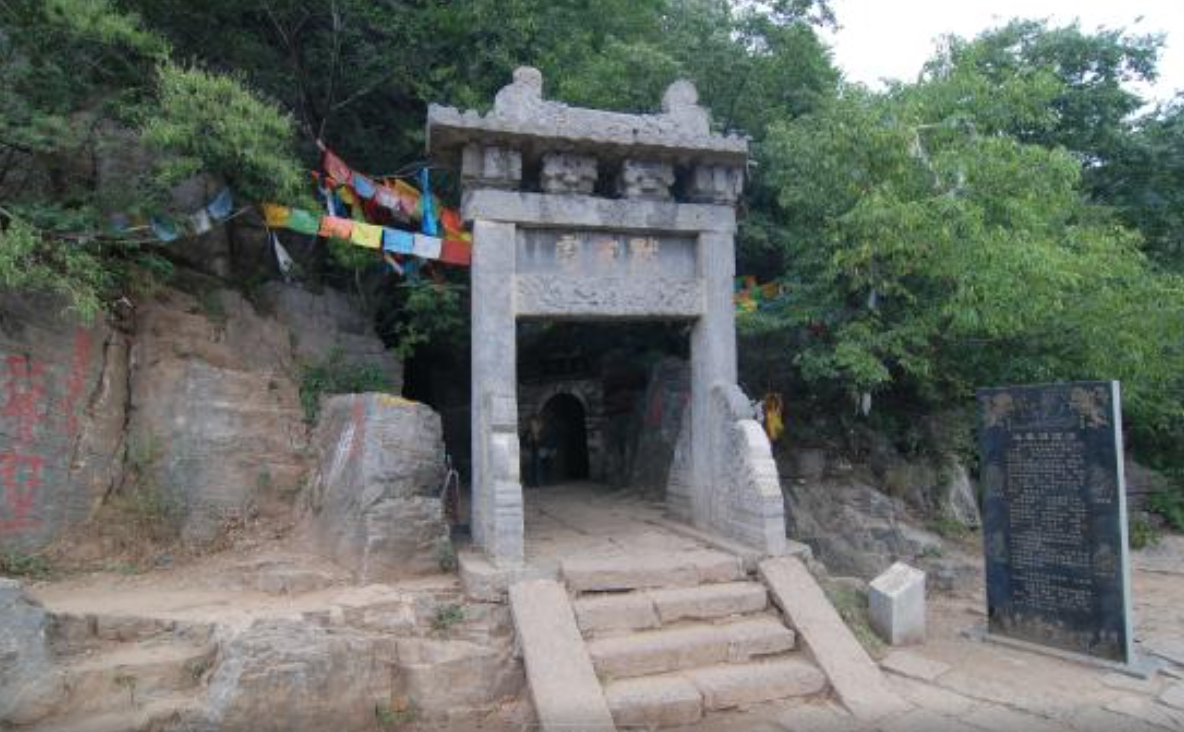
Mouth to Bodhidharma Cave near Shaolin Temple.

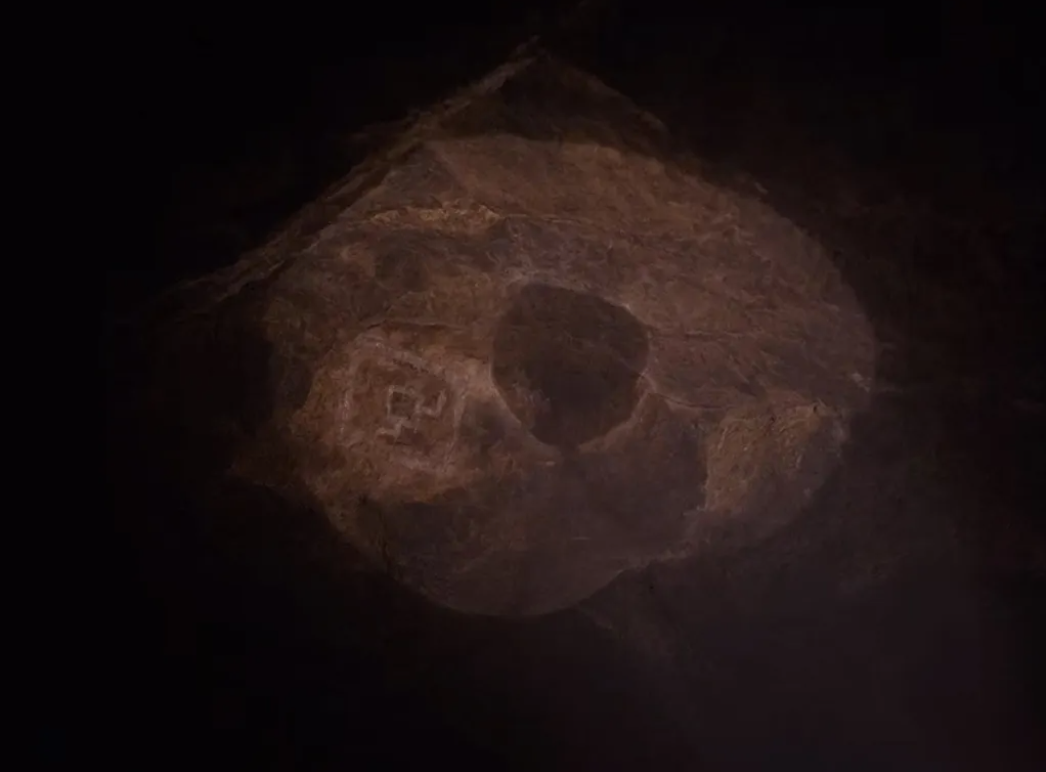
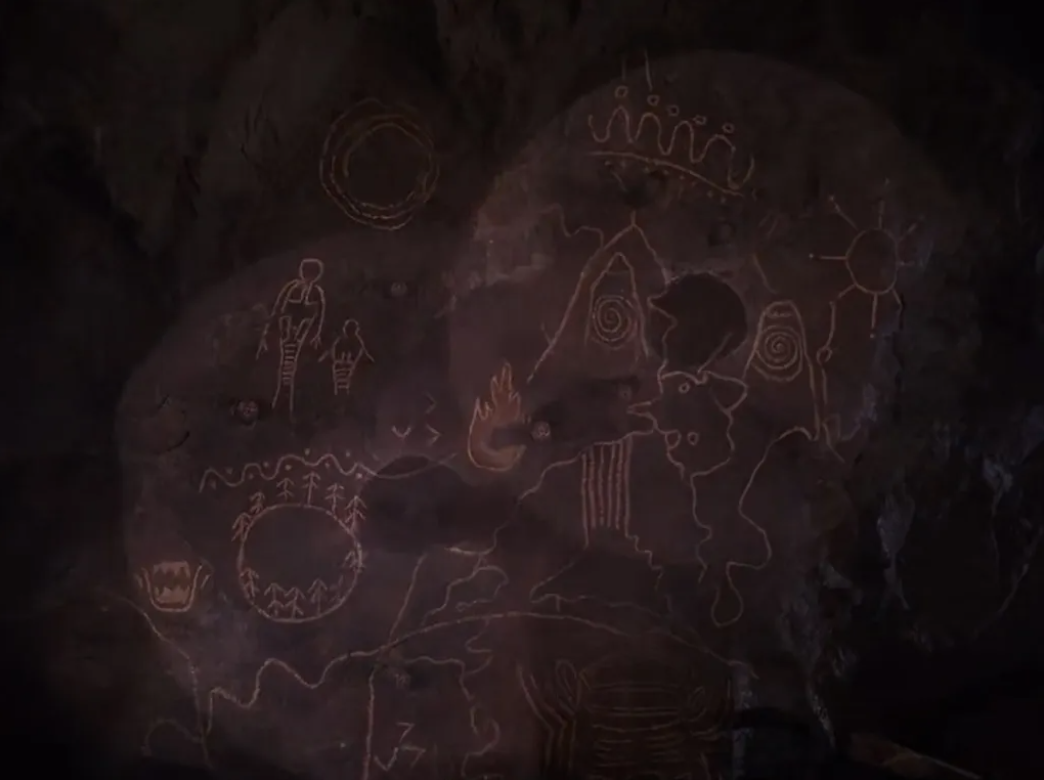
People pilgrimage to Bodhidharma’s cave and to the others. We’d go to Owl Cave if we could! Lynch/Frost filmed some of the Owl Cave scenes at Bronson Cave in Los Angeles, itself a movie star of sorts, and they also used sets—the cave lifted up out of the “real” and into the abstract.

COOPER: Where is the symbol?

HAWK: This way.

Owl cave scene from Season 2.

Here are some still shots from Steven Miller’s deep dive into Owl Cave. Notice the pre-staging of Phillip Jefferies’s scene in Season 3 Part 17: a ring of light, 8, owl symbol, and a “map” of Twin Peaks.
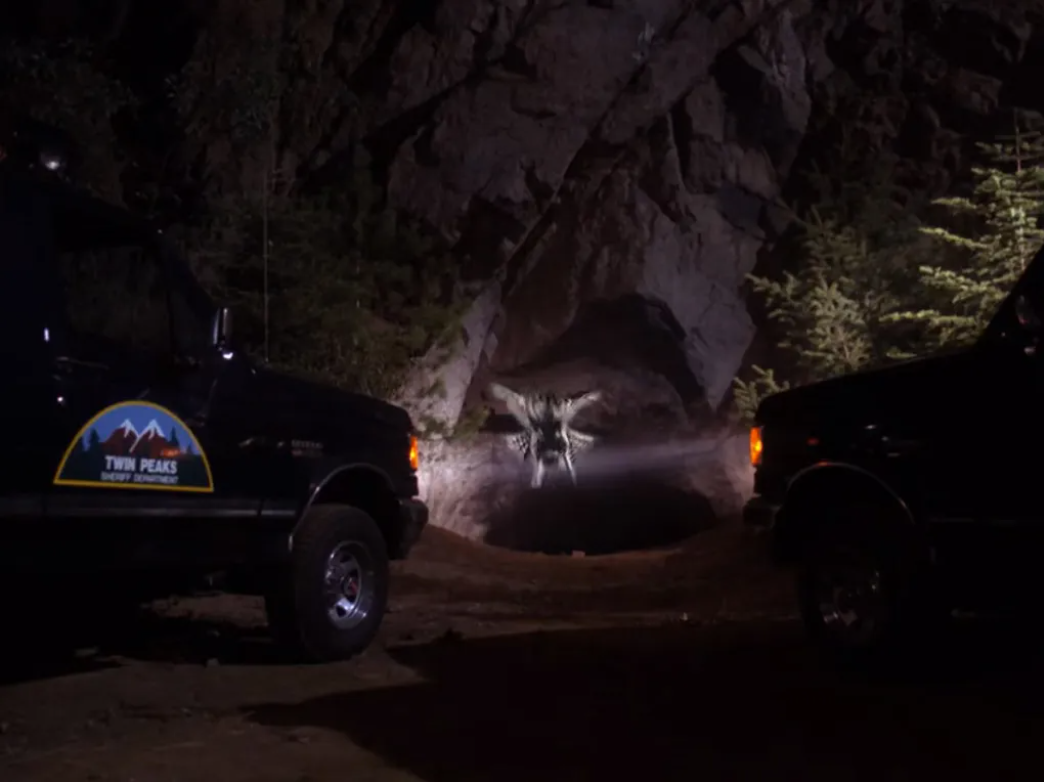
The owl leaving Owl Cave at the end of On The Wings Of Love.
An owl leaves Owl Cave at the end of On The Wings Of Love.

There are a lot of fictional and true horror stories about getting trapped in caves, and a whole genre called “subterranean fiction” that spans Dante’s Divine Comedy (where Hell is a system of caves) to The Three-Body Problem, Broken Earth Trilogy, LOTR, The Matrix, The 100, Kipo and the Age of Wonderbeasts, American Horror Story: Apocalypse, Lost, and so on. As we now move into homes designed with “Zoom Rooms,” we have to wonder if our technology is preparing us for this epochal transition underground already. The 10,000-year Clock of the Long Now is going to be kept in a cave. This collection of “underground wonders” are examples of possible locations.

What other movies or stories focus on caves? Frozen II for sure, with caves lifted from places in Iceland, maybe pointing to feminist themes in the movie? As they say, yonic is the new phallic!

Aronofsky’s film mother! features a secret cave and a classic “woman in trouble” scenario. At one point, the “mother” fingers a red stain on her floor that opens into a hidden cave where she finds her secret power: fire.

Caves also embody what feminist Elaine Showalter (1992) calls the “female wild zone.” It’s a place where women can harness and unleash their power. Considering the etymologies of “cunt”—a rabbit hole, a wedge, a Hindu goddess?—of course a “cave” protects a coded map to the mythical “Black Lodge.”

Perhaps all openings are caves are vaginas are sources of knowledge. Performance artist Carolee Schneeman famously explored these links in Interior Scroll (1975), versions of which took place inside actual caves. She speaks of a “translucent chamber of which the serpent was an outward model.” Bjork likes to sing in caves.

Caves within caves, openings within openings. Fire and oil are somehow involved. Micheal Garfield:

…my eyes the fire projecting shadows of imagination on the cave walls of my unborn and undying consciousness.
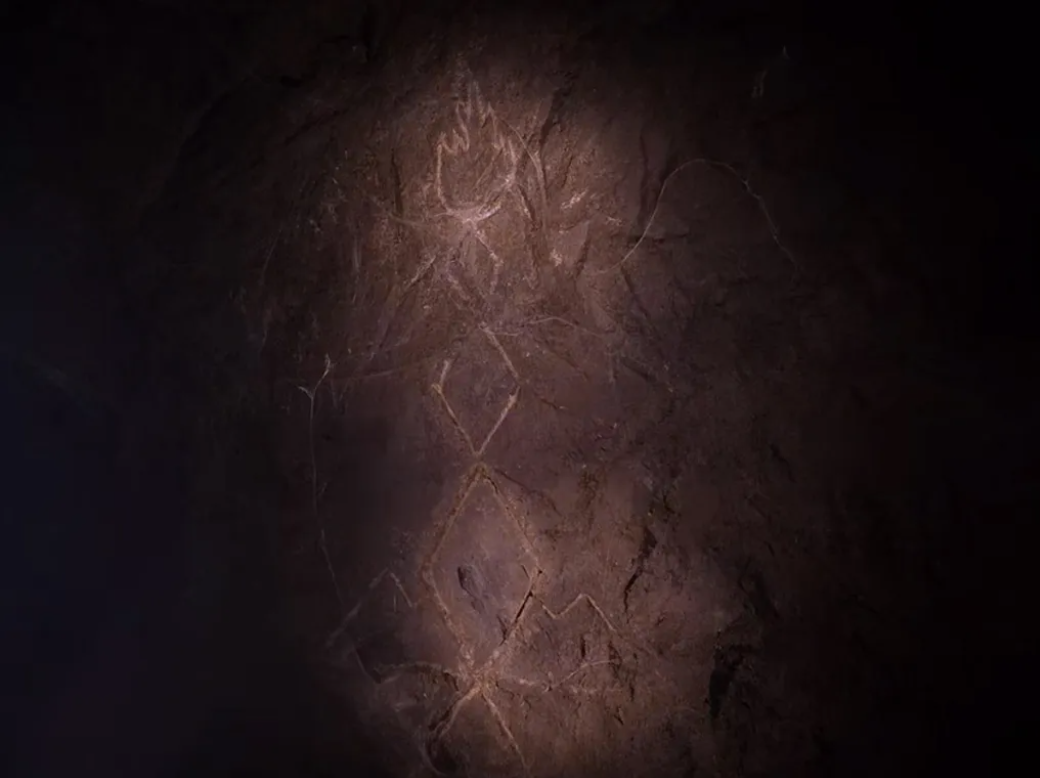
Owl cave scene from Season 2.

Grottoes

In any case, within art history, caves are where the strange is both hidden and spotlighted. There is a genre of oil painting, Grotto painting, that features chiaroscuro dramas in caves, where the mouth acts as a spotlight and the cave walls are curtains. What is staged often reflects a queerer or more alien—literally “grotesque” which derives from grotto and from Emperor Nero’s cavernous 16th-century palace, Domus Aurea, decorated with frescos representing bizarre motifs inspired by Ovid’s Metamorphoses—harpies, alien plants, women transforming into architecture, and more!

These decorative patterns—grotesques—are part of the history of surrealism, horror, fantasy, and are sacred vocabulary: wide-mouthed masks and puking gargoyles are used to decorate churches. Tangentially, Mikhail Bakhtin calls the mouth specifically a main feature of the grotesque (see The Monster in the Garden: the Grotesque and the Gigantic in Renaissance Landscape Design, 2016). Philip Thomson in The Grotesque: The Critical Idiom, points out aspects of “grotto-art” that we can spot in Twin Peaks: disharmony, abnormality, unresolved conflicts (“the payoff is that there is no payoff“), comedy, extremeness, the terrifying, the supernatural, and the disgusting.  Like actual grottoes, grotesques and Twin Peaks are “unstable,” they could collapse at any second, and they are always reflecting something in the middle of a transformation. Susan Bowers, describing grotesques, sounds like she is describing Twin Peaks:

It is a flamboyant art form, brimming over with exaggeration, hyperbole, and excess, perhaps because exaggerated forms with exaggerated emotions are more symbolic and conducive to evoking the numinous, the uncanny, or the horrible.

The show isn’t just a “moving painting,” it’s a moving grotesque! Bowers: “The grotesque is a marvelous hybrid: it celebrates the body, but it also expresses psychic currents underneath the surface of the unconscious.” Twin Peaks and grotesques connect through another concept, the carnival. Nihat Can Kantarcit specifically compares HBO’s Carnivàle to Twin Peaks as they’re both about a settler town constructed as “a sacred site of the American repressed.” Quoting Bakhtin:

Filled with the spirit of carnival, the grotesque liberates the world from all that is dark and terrifying (…) All that was frightening in ordinary life is turned into amusing or ludicrous monstrosities.

Grottoes also refer to fake caves built for gardens and parks to evoke the spiritual. They are symbolic but also merely aesthetic: dark places contain deeper colors. Junichiro Tanizaki in his famous essay In Praise of Shadows even argues that shadows are the foundation of a human house: “In making for ourselves a place to live, we first spread a parasol to throw a shadow on the earth, and in the pale light of the shadow we put together a house.” Check out this kickass episode of Weird Studies Podcast about Tanizaki.

The Brain on Caves

A cave’s darkness, the “dark zone,” does things to us. Caves create conditions like sensory deprivation and Ganzfeld effects (akin to a James Turell light installation) that force the brain to deviate from its normal waking state. According to historian Yulia Ustinova, this is why, in ancient Greece, entering caves was a requirement for visionary or prophecy-giving experiences. I’m thinking of that part of Aronofsky’s film Noah, where Methuselah (Anthony Hopkins) lives in a cave, and Noah (Russel Crow) sees it in a dream and travels there to receive psychoactive tea that helps him envision the ark.

Apparently, after just a few days of total darkness, the human brain produces more DMT, the endogenous “spirit molecule” partially responsible for dreams and mystical experiences. More, studies using eye-tracking glasses indicate that eye-movement patterns during darkness resemble those during activities involving abstract and divergent thinking. Darkness seems to provoke creativity. Studies also suggest even just brief periods of darkness cause the brain to retrieve ambient magical consciousness. Professor Holley Moyes who studies the archaeology of religion thinks darkness not only makes us hallucinate, it promotes “magical thinking.” In her 2012 study, volunteers sitting in a dark room were more likely to answer questions in a “supernatural” way, while people sitting in a well-lit room answered the same questions more rationally—questions like: If you wake up and smell the pipe smoke of your dead grandfather, what is your first explanation? Check out Moyes’s TED talk.

It’s the darkness, but it could also be toxic fumes that alter our minds in caves. Some scholars think poisonous cave gasses were responsible for Greek histories and myths. It was probably ethylene, a gas that “produces feelings of aloof euphoria” (see For Delphic Oracle, Fumes and Visions). Ethylene plus a spike in DMT plus sensory deprivation effects? Given our four-dimensional selves, this all could have helped people foresee a future. Nevertheless, even when completely sober:

We do not behold a passive, inert scene but are immersed in a pulsing space, in the currents and energies of a world-in-formation, even in the darkness, and the light or lack of it is entwined with our sensing bodies, blurring distinctions between outside and inside. – Tim Edensor

Caves are important destinations for enlightened revelation, and if you don’t live near one, you can still “retreat” by closing yourself up in a dark room or closet, as we see in the Tibetan practice of a dark retreat. You can recreate some of the conditions of a cave, however, the dangers that heighten the body’s awareness cannot be replicated in a dark closet.

Leonardo’s Cave

As drug-laced sacred destinations, caves help information from the margins of consciousness get felt by the mind and transformed into art. Leonardo Di Vinci famously had a powerful experience with a cave as a young man. He stumbled upon one in the forest that caused him to feel two contrary emotions at once, fear and desire, “ — fear of the threatening dark cavern, desire to see whether there were any marvelous things in it.” He went in, and after that episode recorded in his diary, Leonardo started drawing helicopters, tanks, and advanced geometry. Ancient Aliens wonders if inside that cave Leonardo was beamed visions from elsewhere. Maybe he fell into a portal to the future, or to his own 4D “long self.” Around this time, he also went missing for two years! Alien abduction? Maybe, or maybe he was just laying low after being charged with sodomy—I think he was 24—a traumatic event he never got over. Leonardo remained celibate for the rest of his life.

What else do caves represent?

It’s not the world in which we live our daily lives, but the unseen, underground world where people live out their fantasies that has power. Forbidden desires and fantasies…  ~ Virgil Ortiz

In Episode 25, the owl seen leaving the cave is different from the one who attacks Andy and the others. Did Andy release someone? I have a theory: maybe ancient people caught the owl/alien and walled it up in the cave with a map to the lodge so that, “In case owl is released, go here.”  Or maybe whoever was trapped in there was good, which is why Andy was included as one of the chosen people.

I wonder if the large owl released from the cave is symbolic of another story. The nuclear radiation symbol found on Briggs’s neck that helps lead Cooper to the cave looks like a ceiling fan. Bluefrank over at the Twin Peaks Gazette thinks it’s the sigil for Chronozon, a “guardian” part of the Tree of Life (which is shaped like an 8). Intuition noticed that the entire symbol is a version of the Mystic Tetrad.
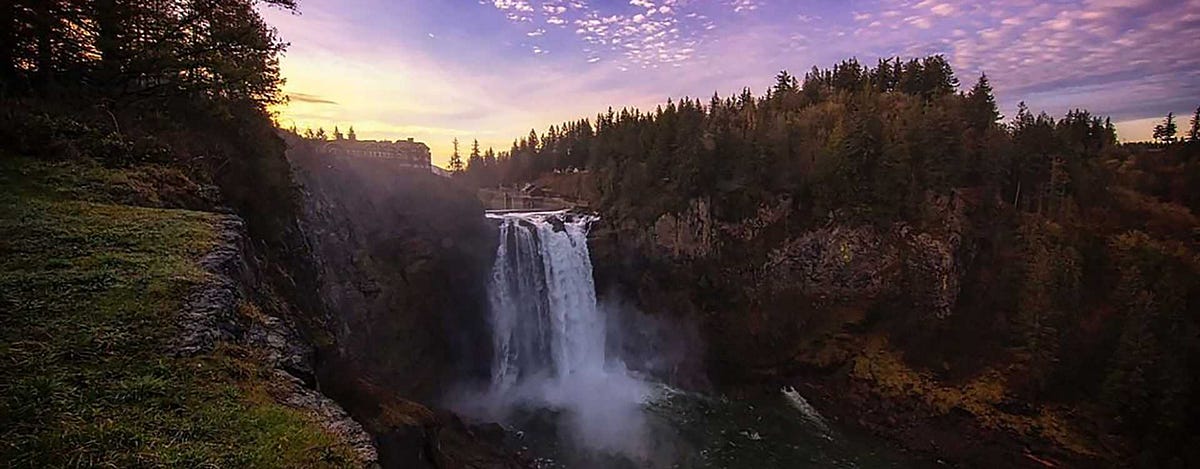
Waterfall

White Tail Falls

Eliade: “The discovery or projection of a fixed point—the center—is equivalent to the creation of the world.”

Twin Peaks is marked on the inside by Owl Cave and on the outside by the breathtaking White Tail Falls, which is a real place called Snoqualmie Falls, one of the tallest and most powerful waterfalls in the now-USA. Comparable to Niagara Falls (it’s actually taller than Niagara), some call it a Garden of Eden because it’s where, in the Snoqualmie myth-histories, the first humans emerged.

Can you imagine being able to visit the place where your people first emerged or landed? There is a pagan emergence place in Caesarea Philippi known as The Gates of the Netherworld, but Eden is lost to Christians. It’s “hidden,” but they couldn’t return there anyway because of the two angelic monsters guarding the entrance with their spinning swords of fire. Who are those guys? I like to think this image of a hidden garden and spinning gates of fire is a metaphor for the anaerobic bacterial now living in our guts—our cousins forced down into the muck by the fiery sword of the sun. Maybe, when oxygen began to fill the atmosphere, the ones who could “eat” and metabolize it were thrown out of “the garden,” destined to live above ground. Eden, our evolutionary birthplace, is now carried inside our bodies, as the ocean is carried inside of animal eggs.

Anyway, this Garden of Eden, Snoqualmie Falls, is now sacred for a second set of reasons. It’s one of the most popular pilgrimage sites for Peakers. Interestingly the falls are never really addressed in the show, which focuses instead on building a mythology around Owl Cave. I wonder if this was a way to respect the symbolic power of the actual site.

When you live next to your culture’s origin place, you get to visit there on class field trips and special occasions. Japanese people mark the top of Takachiho mountain on Kyushu their origin place, and the last time I was there I was surrounded by schoolchildren playing and taking pictures. Inversely, the Hopi and other Southwest tribes believe they emerged from the bottom of The Grand Canyon, specifically from a “sipapu” near the otherworldly blue waters of the Little Colorado. Rainbow Falls is the emergence place for the Zuni, Havasu Falls for the Havasupai. These sites are forbidden to outsiders, and backpackers who seek them out report strange accidents. Related, Sipapu is the name of the oldest Ski Resort in Northern New Mexico, opened by a white settler named Lloyd Bolander, “one of the last true pioneers.” Of course he named his hotel after a sacred Native American site.

Pits

Since pits are important landmarks in the show, let’s consider the concept of a sipapu. It’s a circular hole that marks “a portal between worlds.” What’s that? Frank Waters in The Book of the Hopi recalls stories about the first humans being led through a series of “Cave Worlds” before exiting into our world through the sipapu. Apparently, when we stepped outside of the pit, we morphed from lizard-like beings into human forms. Ontogeny recapitulates phylogeny, and according to Larry Torres, the word sipapu in Uto-Aztecan refers to “the womb of the Earth.”

Clay also comes from pits by the river, and archaeologists like Ian Hodder talk about a near-universal “Age of Clay,” (aka the Neolithic) when humans lived in clay houses and through clay vessels. There are also a ton of humans-from-clay creation stories, like the Judeo-Christian one, where “Adam” is Hebrew for dirt.

Waterfalls and caves make pits, but pits are also dug. In northern New Mexico, there is a church, El Santuario de Chimayo, one of the most-visited holy sites in the US, which enshrines a circular pit famous for its “miracle dirt.” Like many religious art installations, the temple was built around the sacred place, which, of course, predates human settlement in that area. But in this case, it’s not the specific dirt so much as the spot that “charges” the dirt. According to Olsen Brad, the church replaces the dirt from the nearby hillsides every day, but as Belden Lane puts it, far from being a repudiation of the sacredness of the site, this transfer of dirt is proof of how the sacred extends itself into the profane (2001: 62).

Believers speak of a legendary light emanating from deep in the ground at Chemeyo, and how Bernardo Abeyta on Good Friday in 1810 dug into the light and miraculously found The Black Christ of Esquipulas. The site today, according to Lane, “is abuzz with the anguish of stored lament,” an atmosphere he can only compare to the Wailing Wall in Jerusalem.
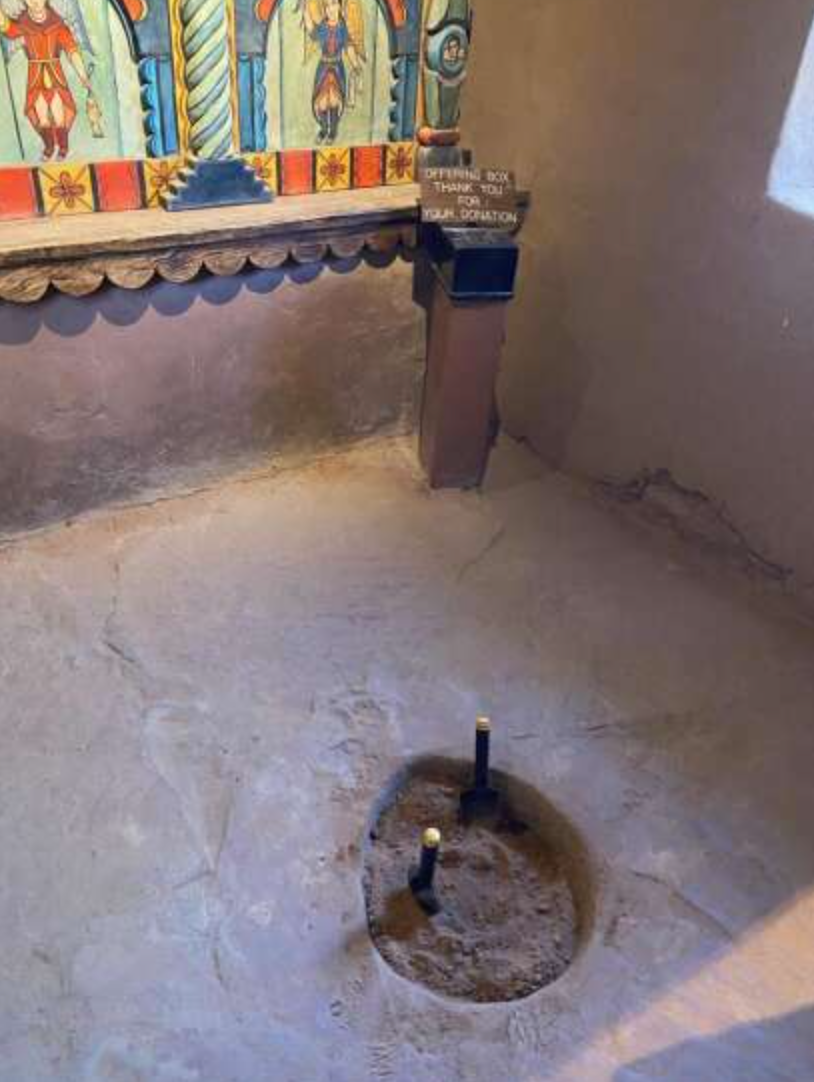
Pit of magic dirt at El Santuario de Chimayo

The setup at El Santuario de Chimayo reminds me of art collective Postcommodity’s 2012 installation Do You Remember When, where they opened up a square pit of dirt in the middle of the gallery floor to create a sipapu.
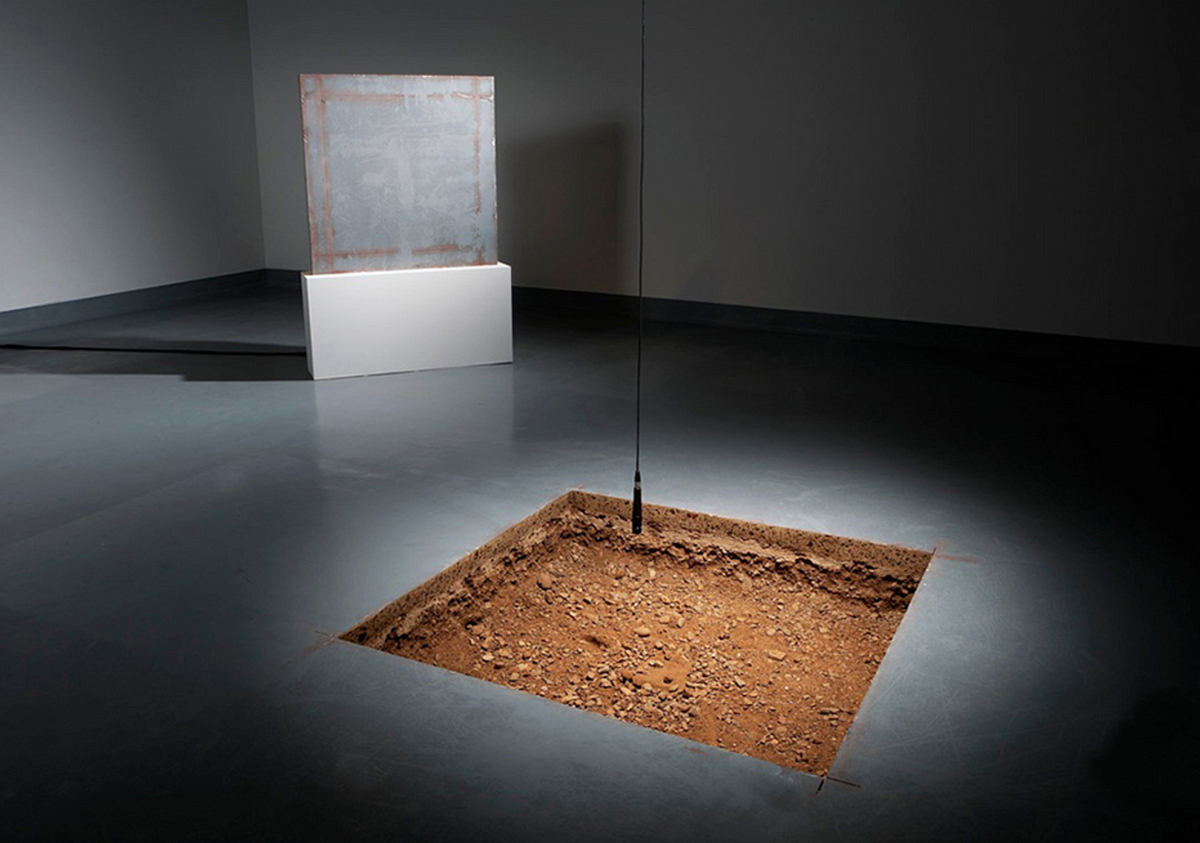
Art installation with pit by Postcommodity

The circular pit at Chimayo also resembles the pit enshrined in Bethlehem marking the exact site where Jesus was born.
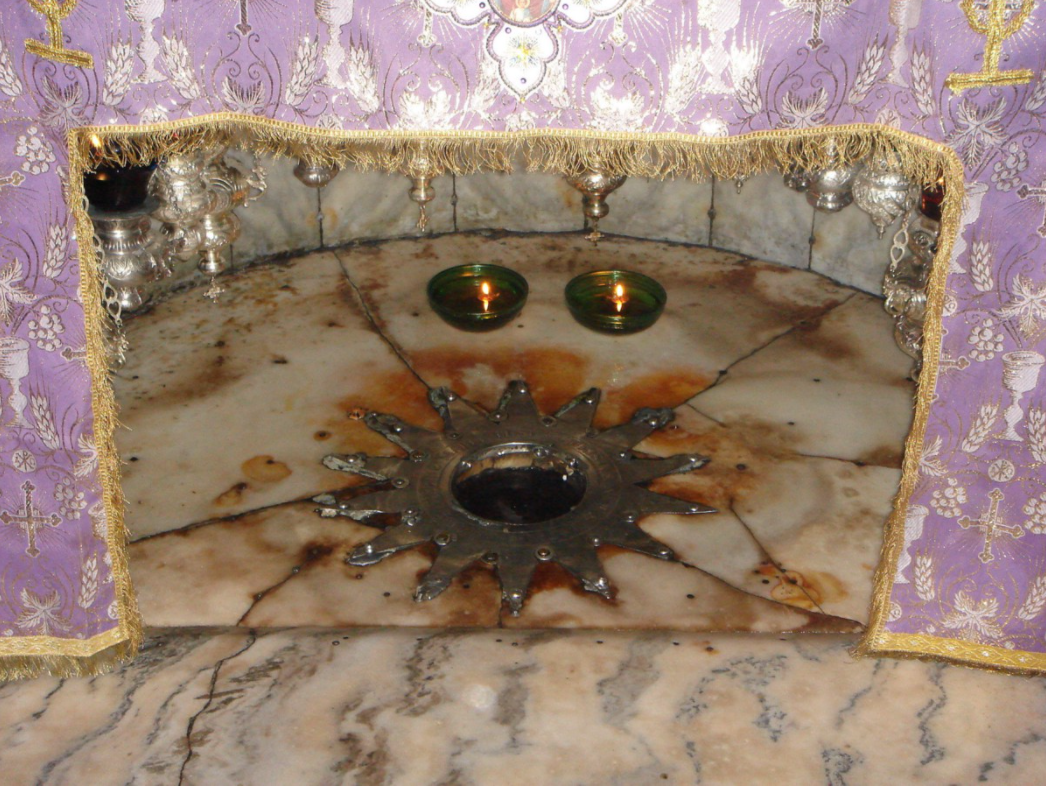
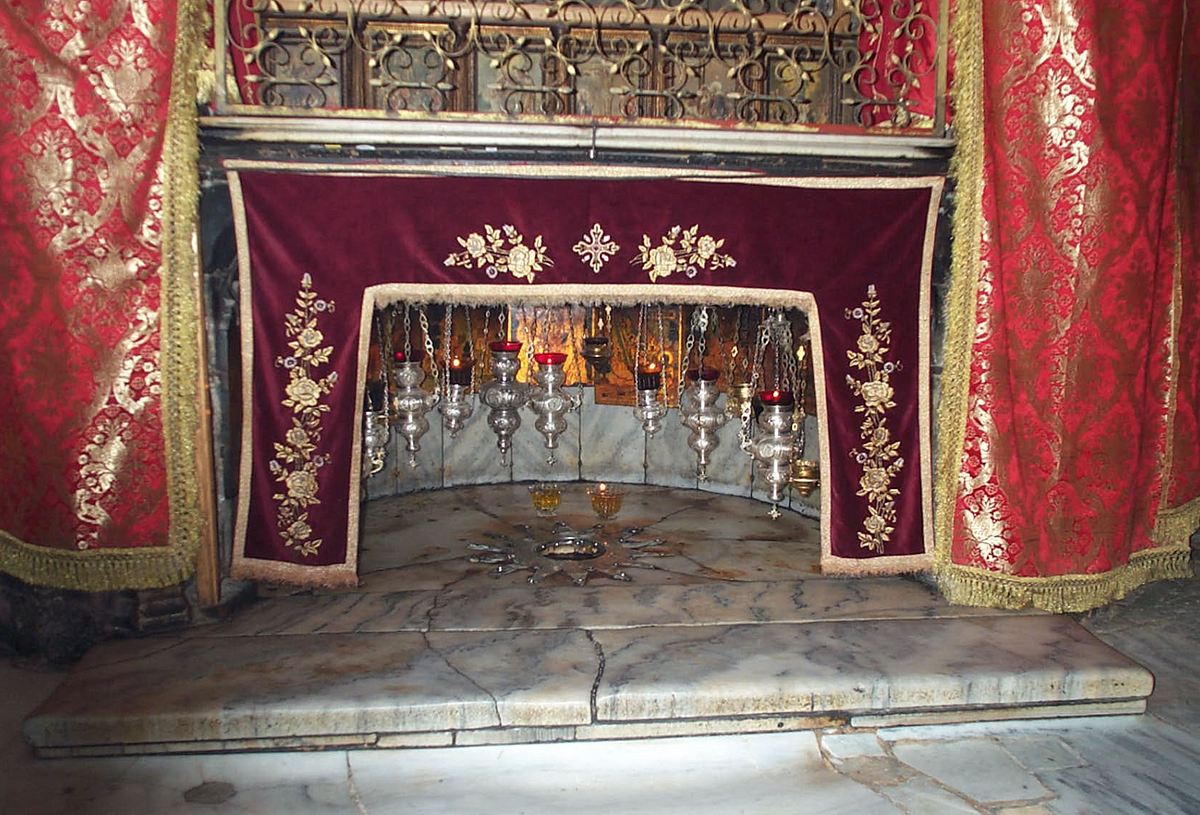
Grotto of the Nativity, Church of the Nativisty, Bethlehem, Palestine.
Grotto of the Nativity, inside the Church of the Nativity, Bethlehem, Palestine. In the myth-histories, this star marks the place where Jesus was born. See also the cave-like "Door of Humility" in Bethlehem.
Grotto of the Nativity, inside the Church of the Nativity, Bethlehem, Palestine. In the myth-histories, this star marks the place where Jesus was born. See also the cave-like “Door of Humility” in Bethlehem.

A simulated sipapu is created in the bottom of a pueblo house or kiva directly across from the fire pit. There are also two pits in Twin Peaks, one surrounded by 12 sycamore trees, and the other marked by just one, perhaps the legendary 13th Sycamore that Cooper was, and was not, warned about by the Fireman. One pit is black and the other is gold.

Lastly, sacred pits famously configure the lives of the Bimin-Kuskusmin of Papua New Guinea. This tribe worships the oil that comes out of a pit in the forest. They believe the oil flows under the landscape itself in “the realm of the spirit world.” F.J.P. Poole (1986) quotes the tribe’s leader: “The oil is our blood, our semen, our bone, our heritage from our ancestors…our life.” This association makes the entire forest a realm of immense ritual and spiritual importance. A ten-year initiation is required before anyone can even set foot near the sacred pit.

Pits can be scary and are associated with quicksand, swamps, tar pits, and black goo. They can also refer to people and situations. In their episode on Part 14, Diane podcast remarks on how “Sarah feels like a pit,” and her face opens up like a dark pit or cave.

Back to the Falls

Slavoj Zizek famously marked Lynch’s universe the “ridiculous sublime,” and Allister MacTaggart, in Lynchian Landscapes and the Legacy of the American Sublime, points out that Lynch grew up in and around the landscapes of the Pacific Northwest, and this might explain the show’s “Emersonian transcendentalism.”

Waterfalls are classic symbols for the sublime, maybe also for America. Abraham Lincoln visited Niagara Falls in 1848 and brilliantly described it through geological, psychological, and philosophical perspectives. He said, for example, that “all the water constantly pouring down is supplied by an equal amount constantly lifted up by the sun.” Then Lincoln describes a kind of all-American myth-time that the waterfall opened up inside of him:

But still there is more. It calls up the indefinite past. When Columbus first sought this continent—when Christ suffered on the cross—when Moses led Israel through the Red-Sea—nay, even, when Adam first came from the hand of his Maker—then as now, Niagara was roaring here. The eyes of that species of extinct giants, whose bones fill the mounds of America, have gazed on Niagara, as ours do now… fresh today as ten thousand years ago.

“Giants.” In evolutionary anthropology, there is a theory that waterfalls (like boulders, caves, and pits) are a key to understanding the origin of religion. Jane Goodall recorded chimpanzees “dancing with excitement” around waterfalls, and she remarks how they will sit in the water at the base and stare up at them as if in a state of aesthetic appreciation. This could be due to the water’s sublime and symbolic power (water is life), but it could also be due to the trippy aftereffects that staring at the constantly moving water has on the brain. The “waterfall illusion” is when we hallucinate movement when we look at something stationary after staring at something moving in one direction for some time. This can also mess with our sense of time. 

Waterfalls also symbolize orgasms, and according to philosopher Sara Heinamaa, they “frame crucial romantic encounters in several popular movies,” like The Lion King and Avatar. “They allude to sexual climax, which thus appears as an explosive or overflowing event.” Maybe on some level, the opening credits of Twin Peaks: The Return give us subliminal orgasms: music swells, water gushes, curtains billow, world spins. Similarly, waterfalls may represent vomiting and other cathartic expulsions.

Waterfalls have been used to explain a property of black holes. Bill Unruh theorizes that light crossing the horizon of a black hole is like sound passing over the edge of a supersonic waterfall. It cannot escape. “The analogy turned out to be more accurate than Unruh initially thought. Eight years later, in 1980, he realized that the equations of motion for sound in the waterfall analogy were identical to those describing light at the horizon of a black hole.”

Lastly, we should note that New Zealand just recently granted The Whanganui River the status of a legal person with rights and responsibilities. Alas, waterfalls and other rivers are people, too. In Getting Dirty, Anishinaabe scholar Melissa Nelson points out that there is an entire genre of Indigenous oral stories from the Pacific Northwest and elsewhere about intimate relationships between humans and other-than-human entities like logs, rivers, stars, even winds. People form relationships with geological formations as well, especially irregular stone outcroppings in the landscape.
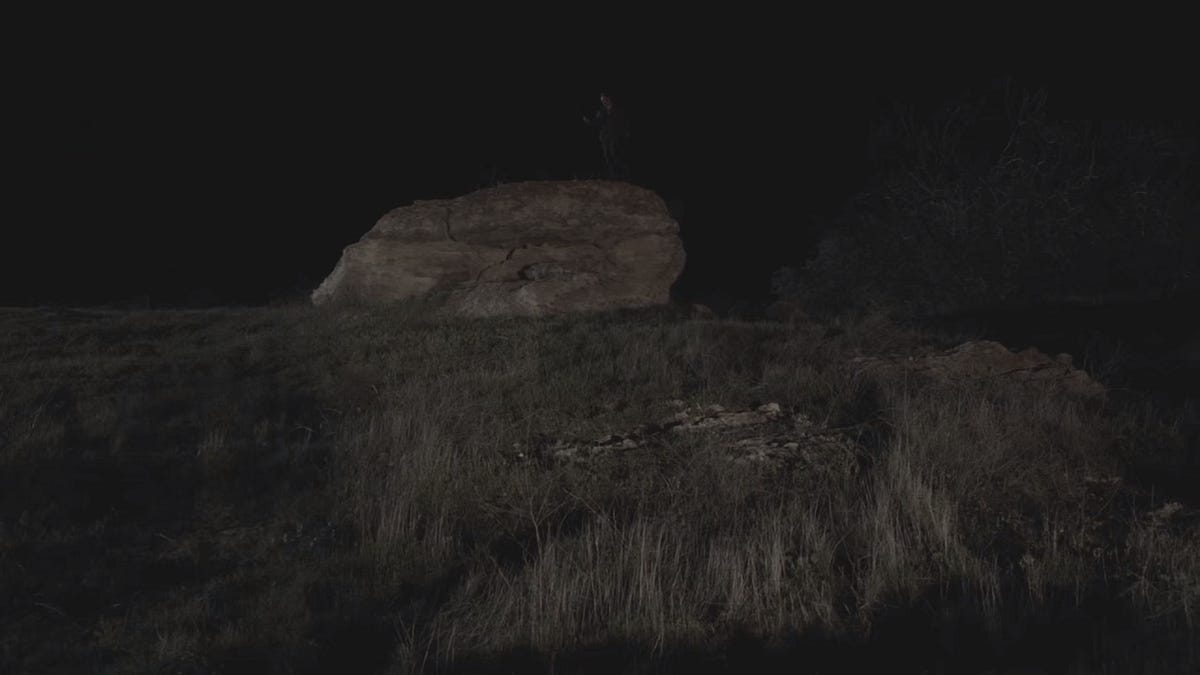
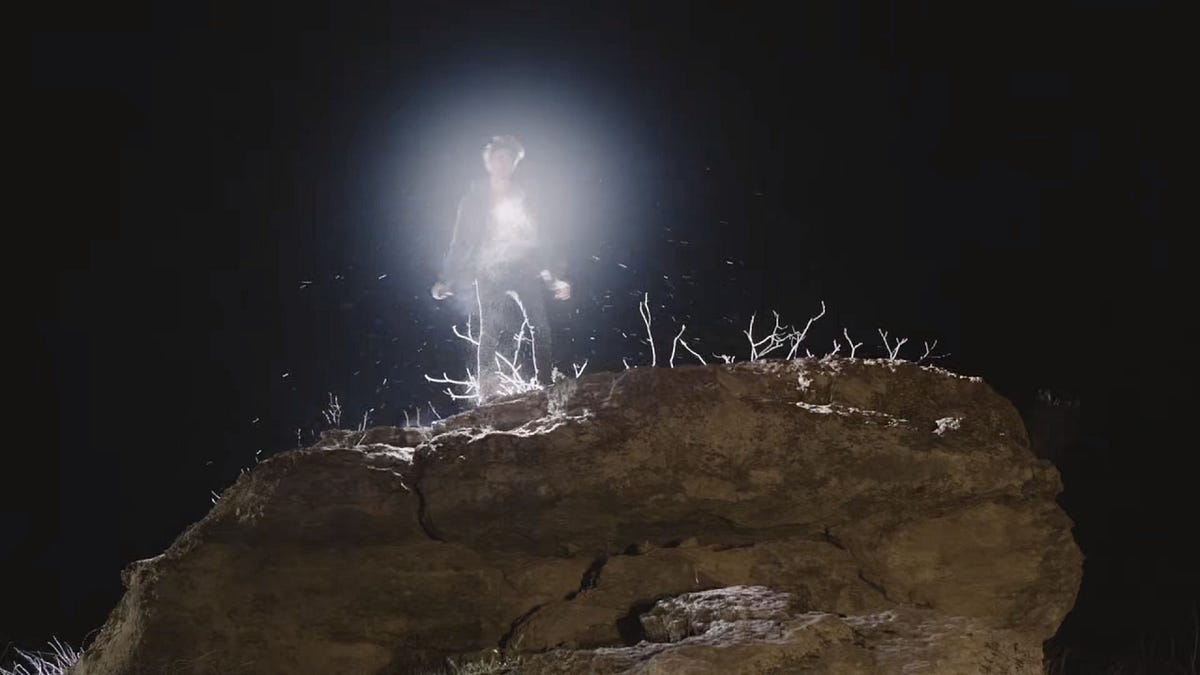
Boulder in Part 16
Richard alight on boulder in part 16

The Boulder

Standing on this rock, therefore, we may fancy a magic power ushering us into the presence of our fathers. – James Thacher, History of the Town of Plymouth, 1835

Like waterfalls, caves, and pits, boulders are a big deal in our collective unconscious. Archaeologist Christopher Tilley (2004) argues that our prehistoric identities were created predominantly near and by boulders in the landscape. Irregular stone outcroppings were landmarks and social sites — pegs and attractors within our cognitive maps of the world. Viewing boulders was an important process by which we could tap into ancestral powers at specific locations, and it helped us anchor identity in those powers and locations (see Keith Basso’s Wisdom Sits in Places about Apache boulders that tell stories and keep people connected to their ancestral languages and morality). More, researchers in the field of spatial psychology propose Prospect-Refuge theory (Appleton, 1975; Dosen and Ostwald, 2016) suggesting humans evolved to seek out higher and safer vantage points. Alas, Richard’s path up to that boulder was laid down by millions of years of hunter-gatherer instinct.

Humans also, in theory, seek out landscapes with physical characteristics that support certain psychological dimensions.
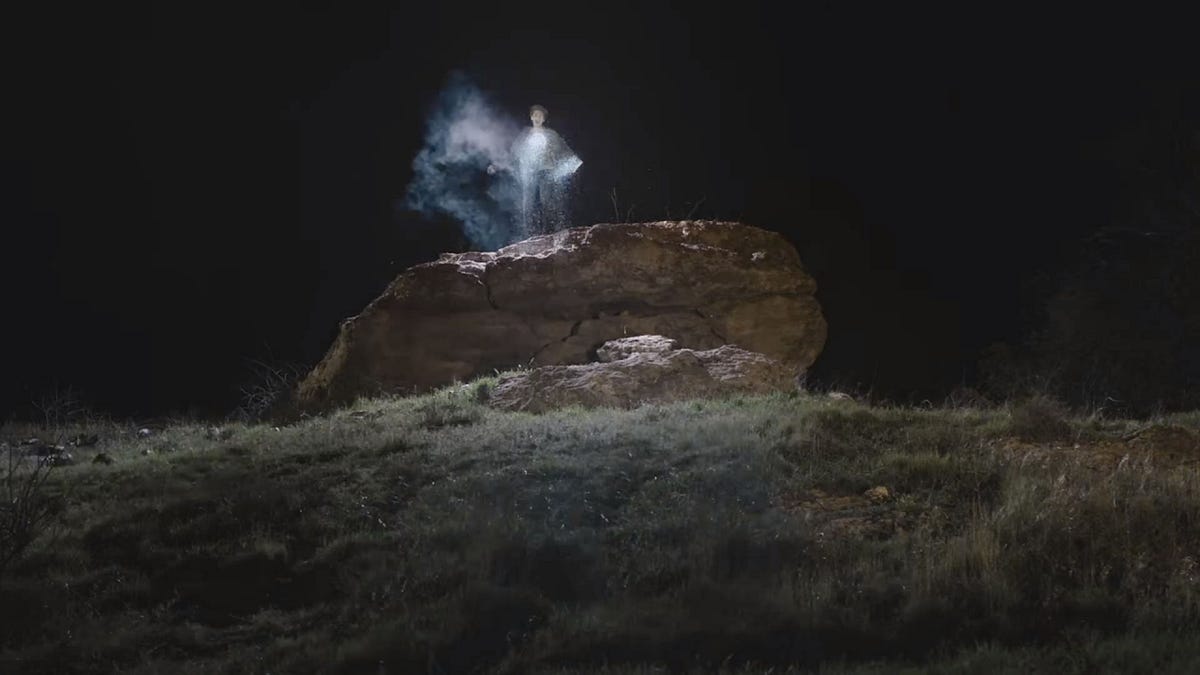
Richard alight on Boulder in part 16.

Erratics

Boulders become vantage points, landmarks, sites for cultural transmission, art, and, in Twin Peaks, they become a site for killing doppelgangers and murdering sons. This resonates with the Biblical “Binding of Isaac,” where Abraham takes his son to die atop a large stone on Mount Moriah.

This boulder looks out of place, an erratic, glacially transported here and thus probably the center of a local legend. Indigenous stories abound of boulders that were once giants, monsters, gods, even human people that turned into stone and may one day turn back, such as the Lakota Standing Rock, the Paiute Stone Mother, and the Navajo Shiprock. Celtic landscapes are likewise filled with magical boulders, like Lia Fáil, a coronation stone that was said to roar or shriek when a true king sits upon it. Another legend says it roars only when a false king sits on it. Is this what happened to Richard? There is also the great Cat Stone aka Stone of Divisions near Ireland’s geological center, on the Hill of Uisneach, that marks where the goddess Éire (Ireland’s namesake) is said to be buried. 

Large stones are found in the center of all major religions. Interestingly, the Abrahamic God is called a “rock” many times in the Bible. The Black Stone, Hajal al Aswad, is enshrined at the Cube or Kaaba in Mecca. In the myth, this meteorite was dropped into Eden as the first altar. There is also the Christian “Stone of Anointing,” Japanese Iwakura or Ishigami stone gods—the Sessho-seki, a stone said to kill anyone who comes into contact with it, recently made news by cracking open on March 5th, 2022; the Stone of Scone, The Blarney Stone, Excalibur’s stone, and more. No doubt a stone’s silence, indifference, and durability make it a perfect receptacle for our dreams of transcendence.

Boulders are mini-mountains, and in settler histories of what we now call the US, the most famous one is Plymouth Rock, where the original Pilgrims first landed. Originally, this boulder was the same size as the one we see in Twin Peaks, but like the body of a saint, fragments were carved off, venerated and distributed far and wide. “Its very dust is shared as a relic,” says Alexis de Tocqueville in 1835. Over the course of 400 years, it went from a 200-ton boulder to a five-by-six-foot rounded fragment which is now enshrined in what looks like a Roman temple in Massachusetts. Indigenous American activists sometimes bury Plymouth Rock, as it is also “a monument to murder, slavery, theft, racism and oppression.”

Steven Miller found the location of the boulder from Part 16, what he calls “False Coordinates Rock”—it’s in Big Sky Movie Ranch in Simi Valley, California, “the largest ranch inside the Los Angeles Studio Zone.” It turns out the boulder, like the cave, is a movie star!

Conclusion

There is an unaccountable solace that fierce landscapes offer to the soul. They heal, as well as mirror, the brokenness we find within. – Beldan Lane

The interior landscape is influenced by the exterior. Twin Peaks encourages us to overflow like a waterfall, go spelunking in our souls, feel like a pit, and disintegrate atop an ancient boulder. It employs familiar landscapes that resonate deeply with our bodies and minds.

Like many of us, I want to know to what extent Twin Peaks is linked to our religious ideas and narratives of place in the “real” world. How does Twin Peaks shape our lived and imagined landscapes? “The eyes see only what the mind is prepared to see.” Conversely, how do our lived landscapes shape our experience of Twin Peaks? We can glean insights from Landscape Studies.

The history of the concept of landscape is tied to painting,  photography, phenomenology, the study of visual perception, geography, and religion. When approaching landscapes of the sacred, theologian Beldan Lane thinks we should move away from the comfortable “cognitivism” of people “in” space, and towards a “non-dualistic phenomenology that recovers the wholeness and nonduality of place.” He says,

A sacred place is not simply a unique site magically “possessed” by chthonic forces. Nor is it a topographical wax nose that can be culturally twisted into anything one makes of it. A difficulty with both approaches is that the perceiver largely ignores the actual particularities of the place itself. It becomes a blank slate on which divine or human meanings are arbitrarily inscribed — by means of luminous revelation on the one hand or cultural construction on the other.

I believe Twin Peaks encourages us to consider a more non-dual “enactive approach to cognition,” where we can transcend the inside-outside, subject-object split. We can see through the dream of an autonomous, disembodied soul or witnessing consciousness “just aware” of everything, and feel how perception is really a cooperative, interactive process—a handshake between the organism and its environment.

Subject and site inter-act, so much so that different characters construct different worlds through their embodied interactions with it. Likewise, living lodge spaces and the actual physical locations engage with each other, “not as independent entities per se by as agents within a material matrix of becoming” (Vasquez 315). As Tim Ingold puts it, “Organism plus environment should denote not a compound of two things, but one indivisible totality.”

A human’s experience and an owl’s experience of the same cave will be very different. Nicole Boivin talks about a water bug “enacting” the water not as a place to swim, but as a place to walk, thus pointing out how engagement with the environment even constructs its material properties to a degree. For those of us who spend a lot of time “in” Twin Peaks, we may want to pay attention to this intimate reciprocity.

We live in the storied place as it lives inside us. Religions like Twin Peaks are external and internal landscapes, processess, or what Thomas Tweed calls sacrospaces: they move and impel us to move. Maybe we should approach Twin Peaks not as a story but as an ecological, corporeal, and semiotic-cognitive-numinous process—aka a sacred landscape, a religion. Tweed (2006: 79): “As spatial practices, religions are active verbs linked with unsubstantial nouns by bridging prepositions: from, with, in between, through, and most important, across. Religions designate where we are from, whom we are with, and prescribe how we move across.

Mr. C and Richard look at the boulder in the distance.

Your Concise New York Art Guide for April 2022

This month, bodies are everywhere — even when they’re not. Exhibitions across New York City delicately dissect the omnipresence of the body in abstract and virtual space, address corporeality’s constructed or collaged nature, explore the political potential of bodies in dialogue, and revel in the sheer absurdity of moving through the world in one of these things. Take care out there and enjoy.

***

Richard Hawkins, “Legend” (2022), collage, oil and pencil on paper, paper: 14 1/2 x 12 1/2 inches, frame: 19 7/8 x 18 inches (courtesy the artist and Greene Naftali, New York; photo by Zeshan Ahmed)

When: through April 23
Where: Greene Naftali (508 West 26th Street, Ground Floor, Chelsea, Manhattan)

A bait fisherman by day and painter by night, Forrest Bess (1911-77) made symbolic abstractions inspired by an elaborate personal philosophy that tied hermaphroditism to immortality and prompted him to explore body modification. For The Forrest Bess Variations, contemporary artist Richard Hawkins, whose work grapples with bodily taboos via (counter)cultural reference points, probed Bess’s lexicon through a research deep dive, hypnagogia, and Jungian Active Imagination. Hawkins’s painted and collaged variations on Bess’s work incorporate legends that interpret the meaning of specific colors — white means “penetrable” — and shapes — a black line is a “prostate stimulator” and “sounding rod.”

Morgan Bassichis, “Pitchy #3” (2020), single channel video (color, sound), commissioned by the Renaissance Society for Renaissance TV. Filmed by and featuring Max Silver. Captioning by Isaac Silber. 4:27 (© Morgan Bassichis, courtesy the artist and Bridget Donahue, NYC)

When: through April 23 (Performance dates: April 1, 8, 14, 22 at 7:30pm)
Where: Bridget Donahue (99 Bowery, 2nd Floor, Chinatown, Manhattan)

“Why were you so curt in your appointment reminder text?” comes a whisper from the hidden speaker in a potted plant by an analyst’s couch. Comedic musical performer and obsessive list-maker Morgan Bassichis brings their subversive hilarity into a solo show context with offerings spanning videos (“My father told me one day I’d grow up and have a line of saunas,” Bassichis informs us), informational pamphlets (“Questions to Ask Before Visiting Marfa”), and to-do lists (“To do: Silent meals (conversation is peer pressure)”). The show will also feature a live solo performance, “Questions to Ask Beforehand,” directed by Tina Satter.

Frida Orupabo, “Comfort” (2022), collage with paper and pins, 65 1/2 x 57 1/2 x 2 1/2 inches (© Frida Orupabo, courtesy the artist and Nicola Vassell Gallery; photograph by Adam Reich Photography)

When: through April 30
Where: Nicola Vassell Gallery (138 10th Avenue, Chelsea, Manhattan)

Taking its evocative title from Gayle Jones’s Corregidora (1975), a novel on intergenerational trauma, Closed Up Like A Fist features a group of 16 haunting collages and digital prints by Norwegian Nigerian artist and sociologist Frida Orupabo. Pinning together cut-up imagery, much of it culled from colonial archives, Orupabo constructs anonymous, fragmented Black women subjects, sometimes with White body parts. These figures variously spread their sweeping batwings, crush Black and White dolls underfoot, stare out from behind chairs, or hold out an apple as if it were a pistol in a Western shootout — or a gift.

Detail of Uuriintuya Dagvasambuu, “Zoom Meeting” (2021), acrylic on canvas, 55 1/8 x 55 1/8 inches (courtesy Sapar Contemporary and the artist)

When: through May 7
Where: Sapar Contemporary (9 North Moore Street, Tribeca, Manhattan)

A master of contemporary Mongol Zurag, Uuriintuya Dagvasambuu hails from a generation of Mongolian artists that revived a style of pictorial painting on secular and nationalist themes that was suppressed for the bulk of the 20th century under Soviet influence. Dagvasambuu’s fantastical, hyper-detailed paintings capture some of the surreality of the pandemic, remote work, and life online: A blue deity wears a protective mask on each of its many faces; a dachshund stretches across two Zoom screens, simultaneously inhabiting the deep sea and a meadow; icons from a phone’s home screen float above a roiling tumult of horses and sheep.

Rose Nestler, “Three Tongues” (2022), velvet, carved soapstone, fabric, thread, batting, wood, staples, epoxy, 29 x 24 x 5 inches (courtesy Mrs. and the artist)

When: through May 7
Where: Mrs. (60-40 56th Drive, Maspeth, Queens)

In her sculpture-centric show too bad for heaven, too good for hell, Rose Nestler takes on the freakiness of femininity with discerning wit and a wicked sense of body humor. Wooden hands lift a tulle skirt to reveal a young woman/old woman optical illusion; a massive florid cone bra presides over a bent, phallic red candle; a parade of red high-heeled shoes circling around a frilly centerpiece evokes Hans Christian Andersen’s twisted fairy tale The Red Shoes. The exhibition also features a new video work exploring the phenomenon of women-produced TikToks dedicated to the satisfaction of playing with slime.

Cameron Welch, “Gravity Chasm” (2022), marble, glass, ceramic, stone, spray enamel, oil, and acrylic on panel, 120 x 288 inches (courtesy the artist and Yossi Milo Gallery)

When: through May 7
Where: Yossi Milo Gallery (245 Tenth Avenue, Chelsea, Manhattan)

In historically scaled mosaics made from marble, stone, glass, paint, found objects, and tile (some of which is cheekily printed to mimic marble), Brooklyn-based artist Cameron Welch brings a contemporary collage- or graffiti-style aesthetic to an ancient art form that has similarly prized flat, graphic imagery at many points in its history. These monumental mosaics are densely packed with a temporally and thematically diffuse iconography of cartoonish figures — ranging from a cross-eyed cowboy to an anti-police protester to a Modigliani-style nude — along with animals, handprints, ceramic pots, skulls, blood, and masstige clothing.

Theresa Hak Kyung Cha, still from Permutations (1976), 16mm film, black and white, silent; 10 min (Collection University of California, Berkeley Art Museum and Pacific Film Archive; gift of the Theresa Hak Kyung Cha Archive)

When: April 6–September 5
Where: Whitney Museum of American Art (99 Gansevoort Street, Meatpacking, Manhattan)

Hotly anticipated and only slightly delayed, the 80th edition of the Whitney Biennial is the brainchild of Whitney Museum curators David Breslin and Adrienne Edwards, who elected to follow a “series of hunches” about the present moment rather than a unified theme.” The presentation features an artist list that is as interdisciplinary as it is intergenerational: The works of long-established artists such as Tony Cokes, Ralph Lemon, and Yto Barrada can be found alongside those of relative newcomers such as Aria Dean and Andrew Roberts, and several figures often more associated with literary arts — including Theresa Hak Kyung Cha, N.H. Pritchard, and Steve Cannon — are also given room to shine.

Raphael Montañez Ortiz, “The Memorial to the Sadistic Holocaust Destruction of Millions of Our Ancient Arawak-Taino-Latinx Ancestors Begun in 1492 by Columbus and His Mission to, With the Conquistadores, Colonize and Deliver to Spain the Wealth of the New World No Matter the Human Cost to the New Worlds Less Than Human Aborigine Inhabitants…” (2019-2020), mixed media, overall display dimensions 76 x 94 x 21 inches (Collection of El Museo del Barrio, New York, gift of the artist, 2020; artwork © Raphael Montañez Ortiz; image © El Museo del Barrio, New York; photography by Martin Seck)

When: April 14–September 11
Where: El Museo del Barrio (1230 Fifth Avenue, East Harlem, Manhattan)

More than fifty years ago, artist and educator Raphael Montañez Ortiz, along with a coalition of community members, founded El Museo del Barrio to counter a dearth of local arts representation for Latinx and Caribbean creators. Now, the museum is honoring Ortiz with a survey spanning six decades of his work as an artist and activist. The exhibition includes early films and sculptures resulting from destructivist performances and deconstructions of everyday objects, reclamatory work springing from ethnoaesthetics, and later participatory performances rooted in ritual and breathwork.

Basel Abbas and Ruanne Abou-Rahme, Still from May amnesia never kiss us on the mouth, 2020-ongoing (courtesy the artists)

When: April 23–June 26
Where: online & MoMA (11 West 53rd Street, Midtown, Manhattan)

Through multimedia installations and live performances, collaborators Basel Abbas and Ruanne Abou-Rahme create non-linear narratives that explore the politics of bodies in our endless — and endlessly catastrophic — present. The duo’s evolving project May amnesia never kiss us on the mouth (2020–ongoing), which can be viewed as a multichannel video installation at MoMA or experienced online via Dia Art Foundation, grew out of an extensive collection of found online recordings of singing and dancing in public space in Iraq, Palestine, and Syria, and features new performances that the artists made in tandem with Ramallah musicians and a dancer.

Kazuko Miyamoto, “Plant Kimono” (1991) (courtesy the artist and Zürcher Gallery, New York/Paris)

When: April 29–July 10
Where: Japan Society (333 East 47th Street, Midtown East, Manhattan)

Not long after moving to New York in her twenties in 1964, Tokyo-born artist Kazuko Miyamoto became Sol LeWitt’s studio assistant, joined the women-led nonprofit A.I.R. Gallery, and, within a decade, secured her debut New York City solo show at 55 Mercer. Marking the first institutional survey of Miyamoto’s pioneering post-minimalist oeuvre, the Japan Society exhibition spans early paintings, string construction drawings, conceptual performances, and performalist kimono pieces, tracing the artist’s evolution and increasing interest in exploring her own intersectional identity in her work.

Reddit Brought The World Together With A Collaborative Massive Art Project

Reddit receives a poor rap. When included in the push, the media focuses on members submitting and pumping meme stocks or deriding people in the r/antiwork team accusing them of being lazy anti-capitalists.

There is anything gorgeous that transpired about the weekend. Close to 5 million associates of the r/area 2022 subreddit united the earth jointly and established an artwork project.

Starting last Friday, Reddit consumers collectively created a significant collaborative piece of artwork that turned a viral phenomenon. The open up canvas allowed associates to put up a one, tiny, coloured pixel each individual 5 minutes. Much more than 72 million tiles had been placed by in excess of 6 million people, at the fee of 2.5 million tiles put for each hour. Communities exterior of Reddit, this sort of as Discord and Twitch, assisted with the challenge also.

The slogan from the group—which has practically five million members— reads, “Some have visited a canvas right before. / A place in which togetherness produced more. / Now in quantities significantly higher, having extra place, / It falls on you to develop a greater place.”

The undertaking was started out by Josh Wardle, the guy who created the ubiquitous addicting entire world activity Wordle, again in 2017 on April Fool’s Day. The preliminary experiment lasted 72 hrs. Far more than a single million users edited the canvas, putting a whole of approximately 16 million tiles.

The way it is effective is that a individual could spot a tile each individual 5 minutes. The time limit is set to keep away from any a person individual or group dominating the collective artwork installation. It is really a collaborative work, although there is competition involving teams to get their possess work observed.

The consequence was a chaotic still gorgeous and significant collective piece of artwork. With all the dislike, anger and violence permeating our globe, it’s pleasant to see people close to the environment nearly coming jointly to make one thing unique.

In gentle of the Russian invasion of Ukraine, the website welcomed r/PlaceUkraine to assist manage and create the Ukrainian presence on r/Place. Nomad, a moderator, together with other people, aided to ensure that Ukraine was nicely represented. An alliance was formed to shield their do the job. Since r/Spot is “extremely Chaotic,” there had been teams that devolved into tribalistic actions and tried using to attack some countries’ contributions.

Nomad wrote, “In order to Protect the house we have, we have to have to do the job with other communities to assistance ensure that we have folks shielding our space at all hours of the working day. This arrives down to negotiations extremely similar to authentic lifetime, where by we may possibly supply something, and get a little something in return. Trust me, it really is not pleasurable.”

He included, “r/Put is a area of compromises and teamwork, these who do not get the job done with other folks are attacked by communities like The Void, and just place, we do not want for any of the artwork designed by our amazing designers to be ruined,” and “let us get the job done together to the frequent goal of symbolizing Ukrainian Lifestyle as finest as feasible, and educating the world on what is likely on.”

Trump appointee Rodney Mims Cook Jr. exits U.S. Commission of Fine Arts

On March 23, the Biden administration declared the supposed appointment of Lisa Delplace, principal and CEO of Washington, D.C.–based landscape architecture agency Oehme, van Sweden (OvS), to the U.S. Fee of Wonderful Arts (CFA). This news signaled an conclusion to a around-unprecedented—albeit comparatively brief—period in which the impartial, seven-member federal agency billed with providing skilled guidance on style and design and aesthetics pertaining to architectural growth in the nation’s capital was without a landscape architect in its ranks.

The American Culture of Landscape Architects and other groups that had previously urged the White Home to proper the lapse by appointing a landscape architect to the CFA applauded the information. “The Fee and our country will advantage enormously from Lisa’s broad expertise throughout various scales of landscape architecture and her working experience with federal jobs,” claimed ASLA President Eugenia Martin in a statement.

On the other hand, a person problem remained: which sitting down member of the commission would Delplace exchange?

AN has learned that Delplace will just take the seat of Rodney Mims Cook dinner Jr., a developer and designer who serves as founder and president of the Countrywide Monuments Basis. The Atlanta-centered nonprofit firm has overseen the structure and construction of many monuments such as Atlanta’s Millennium Gate and Earth Athletes Monuments, also acknowledged as the Prince Charles Monument, because it was first conceived in 1999.

Appointed to the CFA in January 2021, Cook dinner was one particular of a few remaining Trump-appointed associates of the commission along with Duncan G. Stroik and James C. McCrery, II, the two of whom were appointed in December 2019.

Prepare dinner, Stroik, and McCrery maintained their appointments pursuing a major May 2021 shakeup in which the four other Trump appointees on the commission—chair Justin Shubow, Chas Fagan, Steven Spandle, and Perry Guillot, who was the CFA’s sole landscape architect at the time—were questioned by the Biden administration to post their resignations. These 4 members ended up replaced with Biden appointees Billie Tsien, Peter D. Prepare dinner, Justin Garrett More, and Hazel Ruth Edwards. Tsien at present serves as chair of the fee, the initial lady in the 112-year background of the CFA to do so, with Edwards performing as vice-chair. The commission’s 4 newest associates had been sworn in for 4-12 months conditions in June of previous yr.

As relayed to AN by architect Thomas Luebke, who has served as Secretary of the CFA considering that 2005, Cook’s assistance on the fee finished on March 23.

Cook’s appointment came to an stop following the White House formally requested that he post his resignation—well in advance of the standard four-12 months time period. Related to the past Trump appointees who did not voluntarily resign when asked for to do so, he was in the long run terminated.

Delplace will be formally appointed to fill the emptiness on the commission remaining by Cook in the coming months. An formal announcement from the CFA pertaining to her appointment is forthcoming.

Per his official CFA bio, Prepare dinner, in addition to his work with the National Monuments Foundation, is the designer of the Newington Cropsey Museum of Artwork in Hastings-on-Hudson, New York, and co-designer of a opposition entry for the Dwight D. Eisenhower Nationwide Memorial that was awarded the Commendation prize of the Nationwide Civic Artwork Modern society in 2011.

Extra not long ago, Prepare dinner was instrumental in the realization of Rodney Cook dinner Sr. Park, a new 16-acre Atlanta green place named in honor of his late father, a longtime Atlanta alderman and Republican member of the Ga Residence of Reps from 1966 by way of 1973. Positioned in the historic Vine City neighborhood adjacent to Mercedes-Benz Stadium and along the Atlanta Liberty Trail, the park opened to the community final June. Cook dinner also sits on a variety of boards and is a founding trustee of the Prince of Wales’s Basis for Architecture, a founding board member of the Institute for Classical Architecture and Artwork, and a constitution signer of the Congress for the New Urbanism.

Update 4/5/22: In response to Cook’s compelled departure, Justin Shubow, president of the Nationwide Civic Artwork Modern society and earlier chair of the CFA, despatched AN the pursuing statement: “By terminating a fifth member of the Wonderful Arts Fee, Biden has established that he is dealing with commissioners, who are statutorily intended to act independently of the president, as mere political appointees to be taken out at will. By violating the legislation and precedent heading back again in excess of 100 a long time, Biden has opened the floodgates. I would not be shocked if long term administrations switch all commissioners as soon as they appear into business. There will be a deleterious deficiency of continuity on the fee.”

“Tree of life” could help slow climate change

Mauritia palm fruit

graphic: Mauritia palm fruit
see more 

Credit history: Dael Sassoon

Switching the way fruit is collected from a “tree of life” could have hugely constructive environmental and economical impacts in Amazonia, in accordance to a new study.

An global exploration workforce, jointly led by the University Leeds and the Peruvian Amazon Investigate Institute (Instituto de Investigaciones de la Amazonia IIAP) have shown for the initial time the widespread hurt prompted in Peru by slicing down the palm tree Mauritia flexuosa in order to harvest its fruit.

The scientists examined where by and why the trees ended up felled, developing in depth maps and assessment to expose the extent of the environmental and economic destruction caused by slicing down the palms.

Gabriel Hidalgo, lead author of the study who conducted the analysis as a postgraduate student at Leeds’ College of Geography while dependent at IIAP, said: “Cutting down feminine palm trees to harvest the fruit has halved the whole manufacturing of fruit of this palm that is available to nearby communities.

“This is a clear instance of the impact of individuals on purely natural resource ranges, in an ecosystem that, on initially seem, appears undamaged.

“However, altering the way the fruit is harvested can improve both of those the selection of fruit-bearing palms trees, and the value of these Amazonian peatland ecosystems to persons.”

Their examine, released in Nature Sustainability, uses information from 93 web sites throughout the palm swamp forests that are located on the comprehensive lowland tropical peatlands in north jap Peru. Mauritia flexuosa is the most frequent species of tree in these peatland ecosystems that have the maximum concentration of carbon of any aspect of the huge Amazon region.

The palm tree’s fruit, known as aguaje, is greatly applied in food stuff and consume planning, and is an vital portion of the north Peruvian economic system. The place at the moment harvested, sale of its fruit represents 15–22 {6d6906d986cb38e604952ede6d65f3d49470e23f1a526661621333fa74363c48} of household incomes.

The species is dioecious – there are both female and male trees – with the woman bearing the fruit.

But for the reason that numerous of the feminine trees are minimize down to harvest their fruit, lots of forests mostly have male trees and thus deliver very little fruit.

The investigate crew uncovered that the couple spots exactly where an alternate harvesting technique is utilized – climbing the trees to acquire the fruit – have a bigger range of fruit-bearing woman trees.

Climbing avoids killing the trees, which get about 10 several years to attain maturity, increasing up to 40 metres in top.

The exploration staff, which also involved experts at the University of St Andrews and Wageningen University in The Netherlands, estimated that by switching to tree climbing to acquire the fruit, the total harvest could increase by 51{6d6906d986cb38e604952ede6d65f3d49470e23f1a526661621333fa74363c48}, and create $62 million a yr for the regional financial system.

Dennis del Castillo, head of the PROBOSQUES investigate group at IIAP mentioned: “This study displays that fiscally, around the lengthy term, the opportunity benefit of the palm fruit ‘aguaje’ for this area of Peru is equivalent in worth to things to do this sort of as logging and oil extraction. Sustainable palm fruit harvesting could thus present a genuine financial choice for regional people today.”

Rising the price of these intact forests would also deliver sizeable environmental advantages: globally, tropical peatlands are one of the most carbon-loaded landscapes, and holding this carbon in the ground is important for reducing the sum of greenhouse gases emitted into the ambiance.

These forests also deliver a huge range of methods and have superior cultural value for indigenous communities and the fruit of Mauritia flexuosa, described as the “tree of life” by 19th century explorer Alexander von Humboldt, also offers a food stuff resource for birds, fish and mammals.

Co-writer Dr Euridice Honorio started measuring the proportion of feminine trees as an indicator of the effect of resource extraction on the wellbeing of these ecosystems though doing work at IIAP. Dr Honorio, who is now a NERC Understanding Trade Fellow on tropical peatlands at the College of St Andrews, mentioned: “This is the to start with estimate of the overall price of this source to communities in this area and will assistance to encourage sustainable fruit harvesting by communities.”

Tim Baker, Professor of Tropical Ecology and Conservation at Leeds’ School of Geography stated: “Reducing deforestation of tropical forests is a world-wide precedence to mitigate weather alter. Achieving achievement is dependent on growing the price of standing forest to people today who are living in these landscapes. This research demonstrates a pathway to do this in 1 of the most carbon-wealthy landscapes on the planet.”

Even further information and facts

“Sustainable palm fruit harvesting as a pathway to preserve Amazon peatland forests” is published Date in Character Sustainability, DOI: https://doi.org/10.1038/s41893-022-00858-z (link will turn out to be dwell the moment the embargo has handed)

The main funder of this research was the Gordon and Betty Moore Basis, with further funds offered by Peru-British isles Newton Fund grants.

Photograph credits

Mauritia canopy. Credit: Ximena Tagle

Mauritia palm fruit. Credit score: Dael Sassoon

For further more information, make contact with Ian Rosser, Media Relations, University of Leeds, via i.rosser@leeds.ac.british isles

Finishes


Disclaimer: AAAS and EurekAlert! are not liable for the precision of news releases posted to EurekAlert! by contributing establishments or for the use of any info by the EurekAlert technique.

Tour a Modernist Scull House in the Hamptons

Exterior: Architect Paul Lester Wiener built the courtyard glass-and-steel house for Robert and Ethel Scull in 1962. Lisa Perry discovered it for sale on Instagram and was determined to save it.
Photo: Jordan Tiberio

In the middle of the pandemic, a bit restless in her country home in North Haven, Lisa Perry was itching for a new project. “I wasn’t looking to buy another house; that was the last thing I needed,” the designer and collector told me. “But I wanted somewhere to go that was creative and inspirational and just an office studio.” Then one day, while scrolling real-estate agent Esteban Gomez’s Instagram account, she found a challenge she was uniquely suited for in the form of a listing: “While it’s in need of repairs and restoration, the qualities of the design, the provenance, and its history really do give it merit for you to tackle this assignment.”

The modernist glass-and-steel courtyard home in question was designed by architect Paul Lester Wiener, a German-émigré architect and planner whose projects included the high modernist slabs of Washington Square Village. He and his family spent summers on Long Island during the ’50s up to his death in 1967; it was there that he designed elegant glass pavilions for clients including longtime Vogue editor Beatrice Simpson (known as Babs) in 1963.

This one was originally designed for the influential Pop Art collectors Ethel and Robert Scull in 1962 — great pedigree given that Lisa and her husband, Richard Perry, are themselves collectors. Not only that but the design had an uncanny resemblance to the house Perry grew up in, with its glass walls and steel beams. “It made me feel like I was home,” she says.

Another less attuned buyer might not have respected the house, but “I decided to stay true to the original architecture and design as much as possible,” Perry says. She did expand a kitchen and created a breakfast area by taking over of one of the bedrooms. She also repurposed the dilapidated laundry and storage room into guest quarters too, adding a kitchen there.

Perry decided to use it as a gallery and artist in residency for women creatives and named it Onna House, which is open by appointment. The mid-century Hamptons was full of artists, but it was a male-dominated scene. “How about they were setting up the shows!” Perry says, referring to artists Lee Krasner and Elaine de Kooning. “They were doing their own work at that time and they weren’t able to show it.” The work Perry is exhibiting includes pieces from a mix of local and international artists, including Almond Zigmund, Toni Ross, Kelly Behun, Nodoka Yamaura, and Nina Cho.

Perry’s enclave of artists keeps growing thanks in part to the help and guidance of friends including Russ Steele, an antiques dealer in East Hampton; Tripoli Patterson, who runs the Tripoli Gallery; Joh Siff; and Patricia Assui Reed, the owner of Matriark in Sag Harbor.

The Living Room has many of its original details including the aluminum sliding doors. “The lighting you see here, the beautiful black sconces, the little shelves that the sculptures sit on, the floors — they’re all original,” says Perry. The table, chairs, and backbench at the far wall are by Anna Karlin; the hand-knotted rug was designed by Anni Albers; and the freestanding bench is by Charlotte Perriand. Mary Little did the white textile on the back wall. 

The Tea Room: In the tearoom, Janine Abraham designed the sculptural ’60s rattan chairs; the silk-and-bamboo wall hanging is by Mitsuko Asakura (2016). The porcelain teapot is by Isabel Rower.

The Gallery: Kyoto-based artist Nodoka Yamaura’s piece, Circle of Life (2021), made with panels of Japanese mulberry/kozo paper, is in the center of the window. Lisbeth McCoy’s Epistrophy (2021), black collage on board and wood, is on the right wall, and behind that is her hanging sculpture, Bumppo II (2017), in the corner, made of plaster on burlap, wax, paper, painted wire, and string. Nina Cho’s Recess Table (2020) is beneath Lisbeth McCoy’s You Needn’t (2021), which is paint on wood panel, mounted on canvas.

The Kitchen: The site-specific installation between the windows was done by Almond Zigmund, applying mulberry paper and acrylic paint directly on the walls. The 1970s ebonized ash table and chairs are Charles Rennie MacKintosh designs, made by Cassina.

The working side of the kitchen features a regimen of open shelving and an edited palette.

The Guest Quarters features Natalie Munk’s Little Blue Dragon (2005), acrylic and enamel on canvas to the left of the bed, and her Carmen (2002) to the right.

The other side of the guest quarters has a new kitchen. The artwork on the wall is by Bastienne Schmidt.

Photographs by Jordan Tiberio

See All