This year’s Art Basel saw a number of luxury fashion houses eager to show off their new … chairs? Chairs. Of course, high fashion’s fascination with furniture design isn’t exactly new. Rei Kawakubo started making (mostly nonfunctional) chairs in the ’80s, while Fendi launched Fendi Casa, an actually usable home collection, in 1988. Louis Vuitton and Hermès ventured into furniture some 30 years later, with the former inaugurating Objets Nomades — its furniture and design store — a year after Hermès debuted its first furniture collection at Milan’s design week in 2011. More recent years have seen the inception of Gucci Décor (2017) and Maison Dior (2019), the brands’ respective home-goods ventures, while Balenciaga and Miu Miu showed their own questionable furniture collaborations at Art Basel in 2019.
But back to these chairs. Yes, the pandemic led to substantial growth in sales of home furnishings, but even without that, the fashion world’s infatuation with our Sitzfleisch makes sense; fancy furniture has the same aspirational bent as fancy shoes, and if a brand can’t be on your body, surely it would like to be in your home, even if it’s not something you can actually sit on.
That was the case for quite a few of the chairs that fashion houses debuted at this year’s Art Basel and Design Miami, where Dior, Louis Vuitton, and Fendi revealed their latest experiments in furniture (or, one could argue, sculpture). Below, some of our favorite fashion chairs from this year’s events.
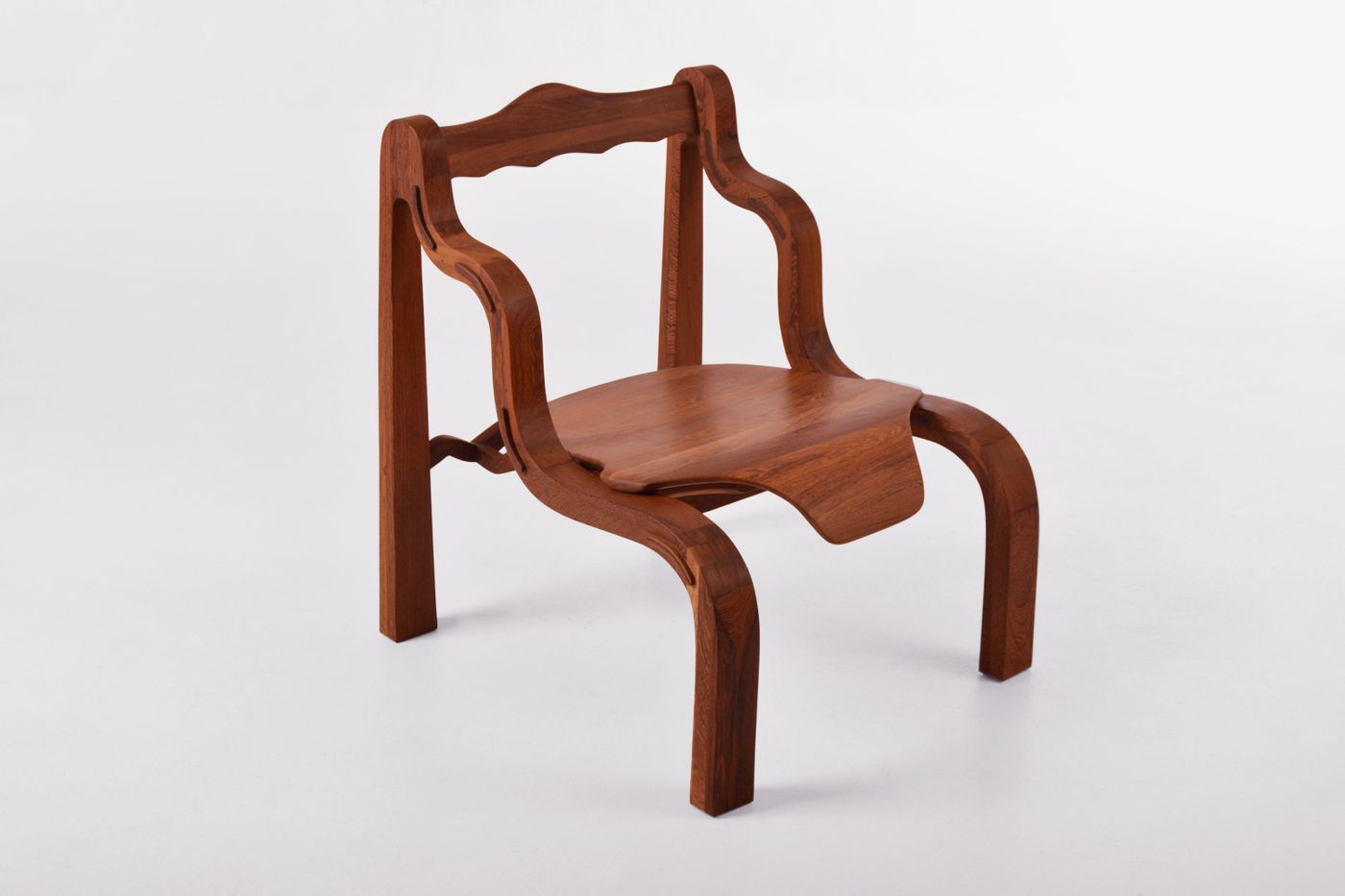
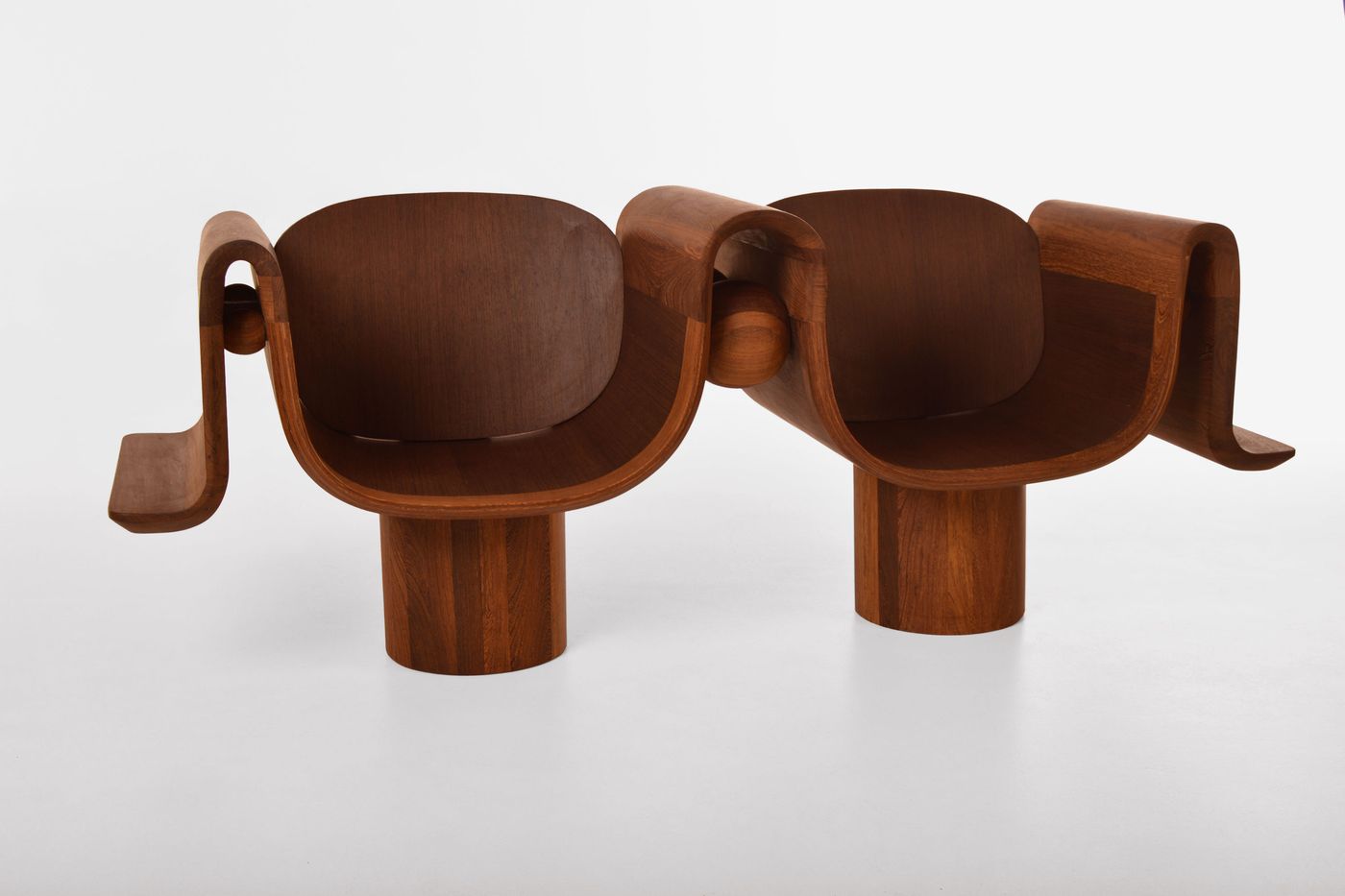
At Design Miami, Fendi’s artistic director, Kim Jones, called upon the Botswana-based furniture brand Mabeo to curate the ten-piece installation “Kompa.” The pieces (including the Foro chair, pictured above) were all handmade by artisans across Botswana using old woodworking techniques to reinterpret the Italian brand’s history of distinct style. Photo: Courtesy of Peter Mabeo/Fendi
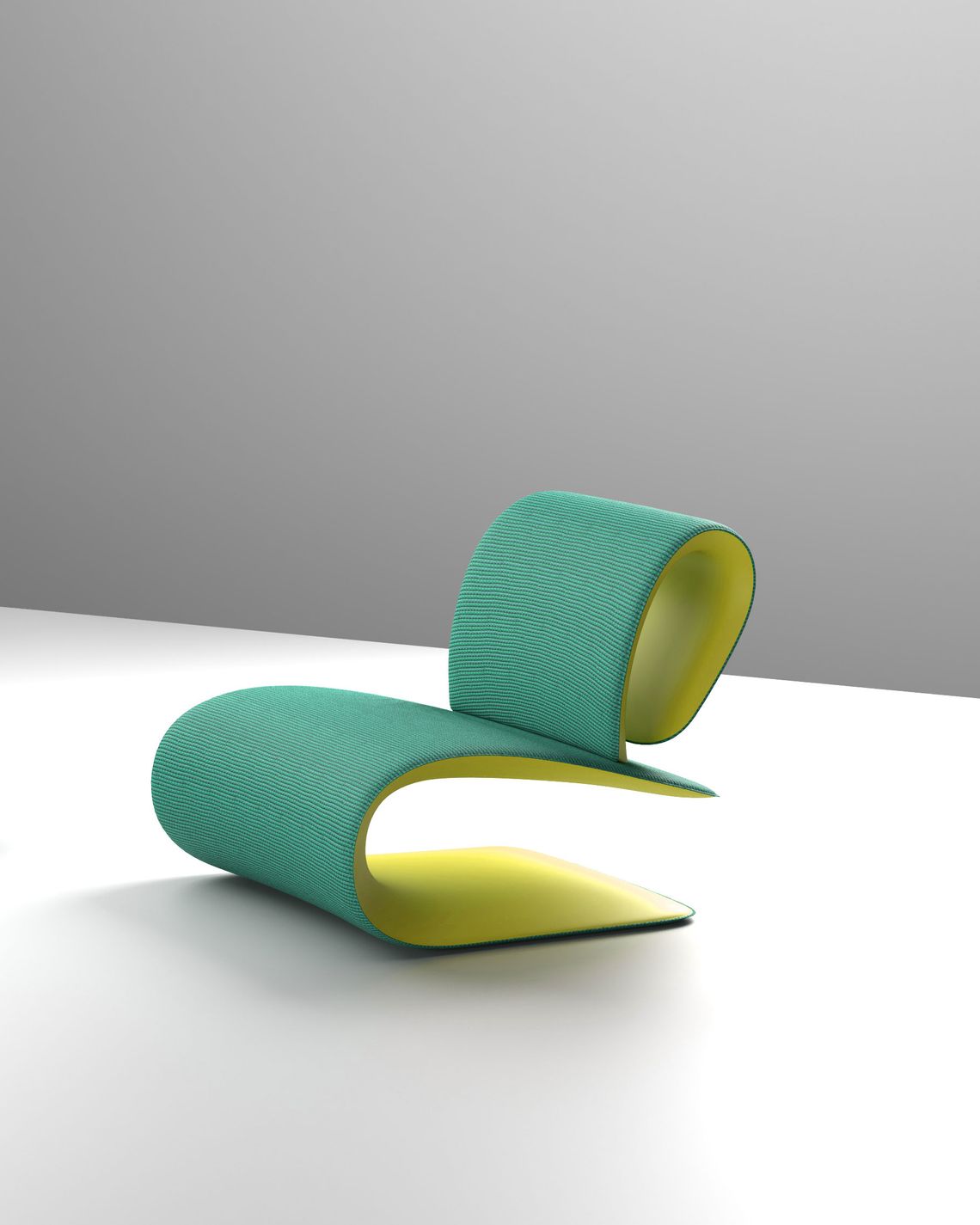
Since 2012, Louis Vuitton has brought together renowned international designers to create furniture and objects for its design venture, Objets Nomades. Above is Marcel Wanders studio’s Petal Chair, which, according to a press release, features calf-leather cushions “in three special Miami colourways (light pistache, neon yellow, coral and cream).” Photo: Marcel Wanders studio/Louis Vuitton Objets Nomades
Mabeo’s Maduo chair is made in Botswana’s Mmankgodi village and takes inspiration from a piece of Fendi jewelry designed by Delfina Delettrez Fendi with its series of interlocking F shapes. Photo: Courtesy of Peter Mabeo/Fendi
Objets Nomades debuted five pieces from Chinese designer Frank Chou. Above is his signature armchair, “inspired by terraced fields in China and desert rock formations in the USA.” Covered in Brio fabric, it’s the first Objets Nomades piece designed for exterior use. Photo: Courtesy of Frank Chou/Louis Vuitton Objets Nomades
The Shiya seat, made of panga panga wood and plywood, from Mabeo’s collaboration with Fendi. On the whole, the collection is a departure from a history of the sleek, sexy furniture typical of the Italian brand. Photo: Courtesy of Peter Mabeo/Fendi
Woody’s Custom Landscaping in Battle Ground is preparing for a steady stream of business this holiday season. The landscape construction company, which has been in business for over 30 years, specializes in pavers, retaining walls, landscape construction, waterfalls, ponds and more.
The company uses individual paving stones for driveways, when requested, which include a “10-inch gravel base and one-inch bedding layer of sand, with two and a half inches of a paving stone that stands up to vehicular traffic.”
Owner Darren Knippelberg said they are booked through the winter season and are currently reserving jobs for spring of 2022. Knippelberg said his crew typically takes off for two weeks during the holidays and gets back together in January.
He has worked for the company for 17 years and became the owner after James Woodhead retired earlier this year and offered him the position, which he has so far enjoyed.
“It’s pretty good,” said Knippelberg. “James came to me six or seven years ago and asked me if I wanted the opportunity to own the company after he retired, so he taught me how to do parts of his job like estimates and billing a little bit at a time. So once I did finally take over, there was no added stress or anything like that.”
Knippelberg said the greatest obstacles his company faces are jobs located on a hillside where they can’t get their equipment in. The geographic challenge requires his crew to get a few materials in at a time and work their way up, working on the project one day at a time.
Woody’s Custom Landscaping jobs range from $500 up to $300,000, “so there’s no job that’s too big or too small,” Knippelberg said. He added the work requires the company to take pride, craftsmanship and quality over speed. They’re also a small local company with under 10 employees.
The jobs that average up to $300,000 entail large water features, driveways, planting, new lawns, irrigation systems, custom woodworking, outdoor lighting and firepits. Jobs of that size typically require a design beforehand. Knippelberg said he’ll meet with a client, go over what they are looking for and then comes up with a bid for the project.
“When we start construction as a team, we’ll paint out the design on the ground and start tackling each section in order, deciding whether we start at the pond or maybe we need to start at the driveway to gain access to other areas,” he said. “After we do our excavation, then we typically run our irrigation piping, and then we start building our process from there, whether it’s our patio or our soil maintenance or planting and we work our way up.”
One job Knippelberg is proud of is a recent project the company completed in the Heisson Bridge area where they crafted a custom koi pond and a metal gazebo with a gravel passageway.
The COVID-19 pandemic has not impacted the business much. Knippelberg said the company will communicate with customers online who may be sick and wear masks on the job when it’s necessary.
Over the years, Woody’s has built up a base of satisfied customers.
One customer, named Julie B., left the company a positive review.
“We recently contracted with Woody’s Custom Landscaping to re-do a retaining wall that had fallen down,” Julie stated. “They did a marvelous job on reconstructing this wall and even put in a set of stairs to the upper yard. Woody’s crew was great and I would definitely hire him again.”
Russian President Vladimir Putin took a tour this week of a century-old power plant, which has just reopened as a contemporary art center after a major, years-long renovation.
The GES-2 House of Culture, the newest home of the V-A-C Foundation, is an ambitious new cultural center set in the heart of Moscow, just opposite Russia’s formidable seat of power. It hopes to become a world-ranking cultural attraction and bring new creative energy to the Russian capital, though it has had to face down a pandemic as well as growing tensions between Russia and the West over Ukraine.
Nevertheless, GES-2 is well on its way to becoming a world-class institution. The museum welcomed international press last weekend to its first exhibition and its ultra-modern new home designed by Renzo Piano, who maintained as much of the early 20th-century structure as possible. Sprawling over a 328-foot-long stretch of the main gallery are its inaugural exhibitions and a new “living sculpture” by Icelandic artist Ragnar Kjartansson, comprised of a live film set with actors and a crew who are working over the next months to reshoot 98 episodes of a popular post-Soviet-era soap opera, Santa Barbara.
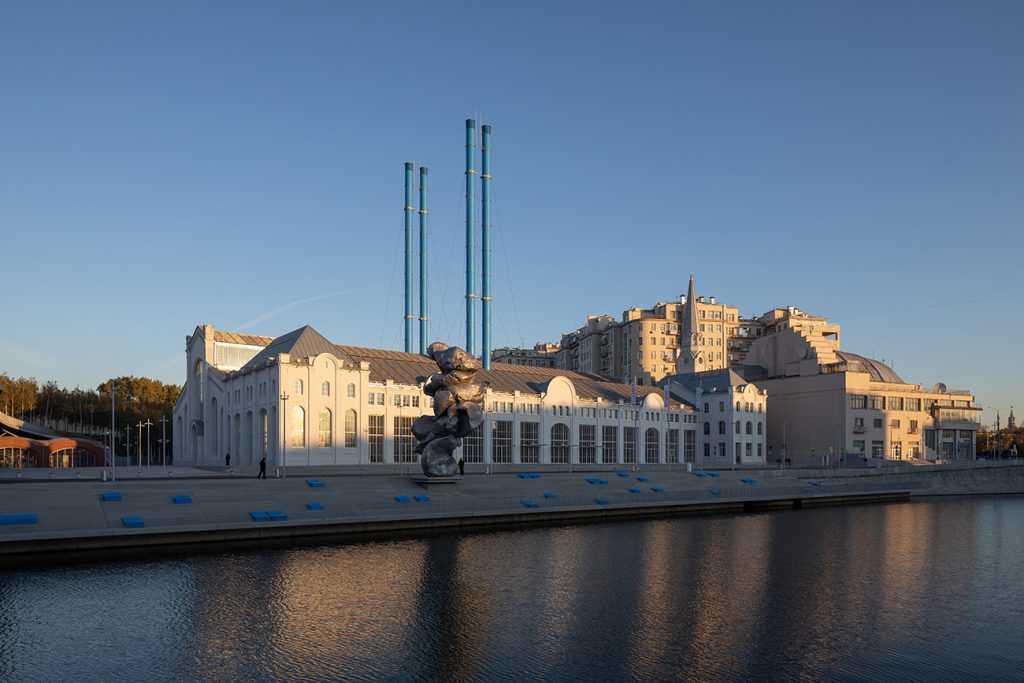
The 440,000-square-foot disused electrical facility has been under renovation for several years to transform it into an airy and futuristic meeting place for art, performance, and culture. The restoration included redoing its roof with large glass panels and windows on all sides, in order to flood the galleries with light, but also to give a sense of openness and accessibility. On the banks beside the river just outside stands Urs Fischers Big Clay No. 4. Inside, there’s an indoor cinema, areas for artist workshops, and a library, as well as large exhibition spaces.
The institution’s new location has been paid for by Leonid Mikhelson, the billionaire behind Russia’s largest private gas group and cofounded V-A-C foundation alongside its director, curator Teresa Iarocci Mavica. The privately-financed project has not disclosed its costs, though it was last stated in 2018 that the GES-2 may cost at least $300 million. No updated figure has been given, though V-A-C Foundation director Mavica told Moscow Times that it was “incredibly expensive.” Entry will be free of charge.
GES-2 House of Culture. Photo: Ivan Erofeev, 2021
“Culture is the process of learning about the world around us, the world of other people, the world within oneself. In other words, culture is a means of direct communication between everyone and everyone, in the most diverse forms,” said Mikhelson, the financial backer and founder of the V-A-C, in a statement, calling the GES-2 “a space of cultural communication open to all.”
Kjartansson’s inaugural exhibition, which is called “Santa Barbara – A Living Sculpture” is a performance piece that takes over the main hall of the museum. Each day of the exhibition, the crew will shoot another episode, to be started and completed that day and shot in one take.
In another part of the museum, his artistic partner Ingibjörg Sigurjònsdottír curated a group show called “To Moscow! To Moscow! To Moscow!” which includes artists Roni Horn, Theaster Gates, and Carolee Schneemann. The projects are both part of the first “season” of the museum’s program, which explores a larger story that the GES-2 has set out to explore, called “Holy Barbarians, or Both Are Worse.” This topic hopes to address the complexities of post-Soviet Russia and its relationship to the West.
And though it sets a jovial tone in some the darkest months of the year, the launch comes as the region is living through its second pandemic winter, but also amid escalating political tensions between Russia and the West. (Nearly 100,000 Russian troops were sent to the Ukrainian border this week, and NATO allies, including the U.S. and the U.K., have threatened Putin that they would retaliate should an invasion take place.)
Some also wonder how much freedom of expression there really will be at GES-2. One gallerist told the Moscow Times that the venue could run into problems given that the Russian government has reportedly said it would like to follow a “Chinese model where they completely freeze any political developments.”
After a couple of years on pause, life is busy once again. Streets are bustling with anticipation and conversation. It’s easy to get caught up in a stream of events without taking a minute to appreciate the small, beautiful moments in life. The question is, how do we find the time to do so?
To create an ode to Switzerland’s majestic landscapes, serenity, and the sublime, the skincare brand La Prairie has collaborated with Taiwanese new media artist, choreographer, and dancer Wen-Chi Su to create an immersive and contemplative performance. On December 1st and 2nd, at sunrise and sunset, Su presented “Moving Towards the Horizon,” a stunning 10-minute performance embodying the encounter of light and water.
In her performance, created exclusively for La Prairie, Su brings Switzerland’s serene landscape to the Miami coast. The city’s oceanfront waves offered the ideal stage for the immersive outdoor installation. La Prairie and Su served as guides through a journey to discover a pure moment of beauty in nature. The goal was to encourage the audience to consider a pause for self-contemplation.
A perfect fusion of art and science
La Prairie’s pioneering approach to skincare intertwines creative intention and rigorous innovation to offer a perfect vision of timeless beauty. While art is often abstract, fluid, and influenced by the imagination, and science is exactingly precise, the two disciplines have more similarities than you would think. That is why Su’s alliance with La Prairie is a harmonious and instinctive meeting of minds. For Su, dance is an art form steeped in science and precision. Influenced by her residency with the prestigious Accelerate@CERN program, she highlights the common links between scientists and artists. “Art and science are not two separate notions. We are honest to each other’s methods, but both our goals are to create something beautiful.”
Su compares the scientific language of graphs, fractions, and calculations to the language of dance, with its reliance on the art of abstraction and the creation of “techniques, shapes, movements considering weight shift and energy control.” She believes research and imagination both aim “to create a common language of understanding.” The performance was a unique opportunity to experience the intersection of these two linguistic expressions.
Read our exclusive Q&A with Wen-Chi Su below.
La Prairie
La Prairie
On how she defines her work
“My work is about bringing two very different genres of art—performing art together with new media art—to facilitate and encourage a new process of thinking. By colliding these two worlds together, we trigger something new for the artists involved in the process but also a new experience for the audience.”
On how her dance interacts with new media
“New media is a new form of art which emerged about fifteen years ago. Dance has been present for millennia. Bringing a new form of art together with dance allows [one] to question the way the body interacts with the world.”
On what message she wants to convey through her art
“Through my works, I want to create moments of calmness and beauty so that people take a moment to step back from the hectic world to reflect on different aspects of life and its associated elements. This means focusing on the body itself and its connection with nature.”
La Prairie
On her collaboration with La Prairie
“When La Prairie approached me with an opportunity to work together, I appreciated the proposition of an exchange. I find my inspiration through true collaboration. Having a community like the one at La Prairie has been very enriching for me to conceptualize and create the experience around the theme of light and water.”
On how she brings these elements together on stage
“I was very much focused on translating the essential elements of light and water into a dance performance. The stage—the light, the sound, the choreography—all come together to recreate these moments where time and light flow.”
“Moving Towards The Horizon” is an ode to La Prairie’s upcoming launch, White Caviar Essence Extraordinaire, an exceptional essence that pushes the boundaries of science, inspired by the magical encounter of light and water and delivering a glimmering luminosity on the skin.
This content is created and maintained by a third party, and imported onto this page to help users provide their email addresses. You may be able to find more information about this and similar content at piano.io
A native plant nursery roves the streets of Northern California.
On a sunny September morning, a black box truck rolled into a suburban California neighborhood playing a catchy jingle of insect sounds. The truck stopped and, within minutes, transformed into a verdant plant nursery: The rear door rolled up and its sides folded out, revealing a pop-up shop bursting with native ferns and forbs, saplings and starts. With the addition of decomposed granite, yellow loungers, and recycled crates, a curbside neighborhood hub emerged. Over the course of the day, the quiet residential street came alive with dog walkers, bicyclists, and neighbors interested in buying plants and learning about native vegetation.
The idea for the nursery came about in 2019 as a low-cost and flexible alternative to traditional retail spaces. Miridae, a landscape architecture and construction firm based in Sacramento, California, purchased a graffiti-covered produce truck and slowly started converting it into a plant shop on wheels. Then came COVID-19. “We saw this immense and urgent need for community and super-localized shopping, so we fast-tracked the project,” says Billy Krimmel, Miridae’s founder. In six weeks, the team transformed the truck into a fold-out nursery equipped with misters, irrigation, solar panels, and rows of shelves for showcasing an inventory of native plants sourced from local wholesale growers.
Krimmel says that since launching in the spring of 2020, the Miridae Mobile Nursery has held some 70 events in the region, selling more than 2,600 plants (their best seller list includes Salvia apiana,Bouteloua gracilis, and Elymus condensatus). Miridae employs professional ecologists and landscape architecture students at the University of California, Davis, to staff the truck and provide customers with localized gardening advice. “Our goal is to promote habitat restoration at the neighborhood scale by bringing people together through plants and gardening,” says Kate Hayes, ASLA, Miridae’s design principal. “The mobile nursery provides communities with opportunities to introduce native systems into urban areas where there typically isn’t a lot of biodiversity.”
According to Krimmel, the mobile nursery is all about accessibility to build support for native habitat in neighborhoods and to create community through that. Profits from the nursery help fund the work of Miridae Living Labs, the firm’s nonprofit arm focused on native plant and arthropod research. “Ultimately, we aim to design experiments into all of our projects,” Hayes says, “and to take the data from these experiments and bring it back into our design and build work so that we are continuously learning and adjusting our design process with the findings.”
The Miridae Mobile Nursery and parklet in Davis, California, grew out of a project for a flexible, low-cost plant shop. Photo by Emily Schlickman.
Emily Schlickman is an assistant professor of landscape architecture and sustainable environmental design at the University of California, Davis.
Like this:
LikeLoading…
Posted in ECOLOGY, EDUCATION, ENVIRONMENT, GARDENS, PLANTS, PRACTICE, STUDENTS, THE BACK, WILDLIFE | Tagged biodiversity, California, Davis, Emily Schlickman, Miridae, Miridae Living Labs, Miridae Mobile Nursery, native plantings, NURSERY, plant, retail, truck, University of California | Leave a Comment
Editorial: How North Carolina can prepare for the COVID omicron variant
There’s yet another coronavirus variant out there that could pose a new threat.
The World Health Organization has designated the B.1.1.529, or omicron, variant as a “variant of concern,” its most serious designation for a COVID-19 variant. Officials say the variant, which was first detected in South Africa, hasn’t reached the United States yet, but it’s already in Canada and could reach the U.S. soon.
It’s not time to panic, but it is time to prepare. Scientists aren’t quite sure how transmissible — or how severe — omicron is just yet. Even ahead of the variant’s arrival, COVID cases are rising again throughout the state and are predicted to increase further as people gather for the holidays.
“We need to pay attention to those mitigation strategies that people are just really sick of, like wearing masks when you’re indoors with other people who might not be vaccinated, and keeping that social distance,” Dr. Francis Collins, director of the National Institutes of Health, told CNN. “I know, America, you’re really tired of hearing those things. But the virus is not tired of us. And it’s shapeshifting itself.”
After fighting this pandemic for nearly two years, we know what North Carolina can do to brace for this variant and mitigate what could very well be a winter spike in cases. That starts, of course, with getting North Carolinians vaccinated. Unlike with the delta variant, children ages 5 to 11 can now get a COVID vaccine, and anyone 18 and older can get a booster shot for an additional layer of protection against the virus. Still, the state’s vaccination rates aren’t where they should be — just 57{6d6906d986cb38e604952ede6d65f3d49470e23f1a526661621333fa74363c48} of the total population is fully vaccinated, according to the N.C. Department of Health and Human Services dashboard.
“If ever there was a reason for the people who were vaccinated to get boosted, and for those who were unvaccinated to get vaccinated, it’s now,” Dr. Anthony Fauci told NBC News.
At some point, North Carolina may want to consider re-implementing cash incentives for vaccinations, which slowed the decline in vaccine rates by half at the clinics they were offered, a study found. (The vaccine lottery, on the other hand, had virtually no impact.) But we can’t fight this pandemic with vaccines alone — especially if not everyone is vaccinated. North Carolina and its cities and towns should be prepared to enact measures to contain the spread of the omicron variant if need be, just as they’ve done in the past.
In addition to flexibility and responsiveness, transparency should be a top priority. People are tired of following the rules and will likely be wary of new ones. That means tying things like face mask mandates to local coronavirus metrics, such as the positivity rate, rather than issuing a blanket mandate for an indefinite period of time. In Mecklenburg County, for example, the mask mandate will be lifted if the daily COVID-19 positivity rate remains below 5{6d6906d986cb38e604952ede6d65f3d49470e23f1a526661621333fa74363c48} for seven days.
Gathering restrictions and stay-at-home orders should be considered only as a last resort. In the meantime, cities should discourage indoor gatherings by providing reasonable alternatives. Earlier in the pandemic, many cities allowed restaurants to convert sidewalks and dedicated parking spaces into temporary outdoor dining. It may be getting colder, but outdoor dining can still be an option — well-ventilated, tented spaces with heat lamps can offer a safe, yet comfortable, solution.
It’s also possible that the omicron variant could affect our schools. The delta variant arose over the summer, when the traditional school calendar wasn’t yet in session. Now, the school year is in full swing, and every school system should have a plan to keep students in classrooms learning safely. It may be time to consider regular testing or vaccine mandates for both students and teachers, and once again require masks in the 39 districts that have voted to make them optional.
The pandemic is not over, and now is not the time to give up on trying to curb it. Strong preventative and mitigation measures can help us get ahead of this variant. North Carolina should start preparing for omicron now, rather than waiting for it to strike.
___
Fayetteville Observer. Nov.27, 2021.
Editorial: : Fayetteville City Council shows civility in censuring one of its own
On Monday, the Fayetteville City Council addressed an ugly incident that happened at a committee meeting earlier in November. Necessary awkwardness notwithstanding, the council handled the matter swiftly and professionally.
On Nov. 9, City Councilman Johnny Dawkins blew up at Councilwoman Yvonne Kinston during an appointments committee meeting. During what he himself later called a “tirade,” Dawkins swore at Kinston.
He apologized to her at the council’s regular meeting on Monday.
“I want to apologize to you for losing my cool in the appointments committee meeting,” Dawkins said. “Very respectfully, I ask for your forgiveness.”
Later, Mayor Mitch Colvin, who was also present at the appointments meeting, issued his own apology to Kinston.
“Although I was not in charge of the meeting, I was in the room and allowed the environment to get to a point that it did,” he said.
He said he supported the right of council members to express themselves, but “we’re not going to tolerate any type of disrespect or profanity.”
Kinston said in an interview a couple of days after the appointments meeting that an apology from Dawkins should have come at the same meeting in which he blew up, or immediately afterward.
At Monday’s meeting, she made a motion that he be censured. It was seconded by Councilwoman Shakeyla Ingram.
“I do accept council member Dawkins’ apology, and yes council member Dawkins I have already forgiven you for that,” she said.
But she said she sought the censure on grounds of professionalism and accountability.
We agree with Kinston.
It is important for city leaders to model the concept of respectful debate. Fewer leaders these days are willing to take on that role, but it is as vitally important as ever. We are in an era where civility among political leaders can no longer be taken for granted. Kinston’s actions are important in reminding us that civility and professionalism still matter.
The council voted in favor of the censure at the meeting’s end. Dawkins, who had voted against adding the item to the agenda, did not vote as the issue concerned him.
Just prior to the Nov. 9 blowup, the appointments committee had been discussing the nomination of Carl Manning to the Fayetteville-Cumberland Economic Development Board. Dawkins inquired whether Manning was African-American; he said in an interview later he asked the question so he could make sure diversity was included in the names sent forward to the full council.
Kinston, who is African-American, appeared to scoff at the question. After the meeting, she wrote in an email to council members that Dawkins, who is white, has made comments before that were racial, biased and disrespectful and said his behavior had “progressively gotten worse.”
After the censure vote, Colvin complimented both Kinston and Dawkins for how the matter was handled.
“This was a tough conversation to have tonight,” the mayor said. “I think both of you handled it like professionals and adults. Appreciate it. I look forward to us working together. Thank you, council member Kinston.”
We agree that it was handled well and brushed up the image of a City Council that is looking somewhat frayed at the edges. The exchange between Dawkins and Kinston happened to occur on the same day that Tisha Waddell, the District 3 representative, chose to resign from council on unrelated matters.
It was important to see those acts of civility at Monday’s meeting.
Also on Monday: The full council voted to approve Manning and William Hedgepeth to the Fayetteville-Cumberland Economic Development Board.
___
Winston-Salem Journal. Nov. 29, 2021.
Editorial: Observing the Pilot Mountain fire
It’s the kind of spectacle that people will talk about for decades: They saw the mountain on fire.
As we write, about 30 firefighters from the N.C. Forest Service and the N.C. Division of Parks and Recreation are at Pilot Mountain State Park. They’re fighting a blaze that began on Saturday, the Journal’s Lisa O’Donnell reported on Monday. The fire has since grown to 500 acres — fortunately, confined to state-owned property. All areas of the park have been closed, including sections by the Yadkin River and parts of the Mountains-to-Sea Trail, and firefighters have built containment lines and are taking steps to prevent damage to the park’s visitors center, which opened in 2020, as well as other structures in the park.
The fire’s power has been exacerbated by dry and windy conditions, the Journal reported.
Fortunately, no nearby residents have had to be evacuated.
“We plan on holding the fire to the mountain,” Jimmy Holt, the Guilford County ranger for the N.C. Forest Service, told the Journal. The firefighters seem to know what they’re doing.
“Right now there’s pretty much fire all around the top of the mountain basically,” Holt said.
Many observed from a safe distance as the fire spread, leaping from tree to tree and across hiking trails and roads. Fire, such a destructive force, can be beautifully mesmerizing.
But aside from the spectacle, there’s a serious and even melancholy aspect to the burn.
Pilot Mountain is a popular park; in 2020, it received 1,045,160 visitors. The number increased from the previous year’s 844,858, to some degree, as a reaction to COVID sequestration. But that just shows how much we appreciate our parks as places of respite and refreshment.
Many residents have a deep attachment to this natural treasure. Many who live nearby have expressed a sense of sadness, seeing the forest consumed by fire. There’s also been a loss of wildlife as well as wildlife habitat.
So word to the wise: The fire has doubtlessly led to a panicked migration. Deer, foxes and other animals will be fleeing for days yet. Drivers on local roads and U.S. 52, which passes by the park, should exert all proper caution to avoid deadly and costly collisions with fleeing animals.
Wildfire is always a danger to forests; over the years, firefighters have conducted prescribed, limited burns and established fire lines in our state parks to reduce the threat of raging, out-of-control conflagrations. One was established at Pilot Mountain following a wildfire that burned nearly 800 acres in 2012.
But nature is resilient and will spring again from the ashes.
“Fire can rejuvenate a natural landscape and improve native habitat,” the state forest service says in educational material. “Many species in the Southeast depend on fire for survival, such as the chestnut oak, red-cockaded woodpecker and pine snakes, to name a few.
“Fires break down organic material much faster than decomposition, thus renewing soil nutrients more quickly. This triggers a rebirth of forest, helping to maintain native plant species. It provides more fertile soil and opens up the forest canopy, promoting vitality and the luscious growth of grasses and forbs.”
When it’s safe to open the gates again, we’re sure that visitors will flock to Pilot Mountain to assess the damage and recovery for themselves.
In the meantime, monetary donations to supply firefighters with food and drink, to help them stay energized and hydrated, can be made in person at Town Hall in Pilot Mountain, over the phone at 336-368-2247, Ext. 0, or at pilotmountainnc.org.