

21 Questions With Landscape Architect Signe Nielsen

Photo-Illustration: Curbed; Photo: U Shin Kim

New York’s “21 Questions” is back with an eye on creative New Yorkers. Signe Nielsen is a landscape architect who has practiced in New York for over 40 years. Her firm, MNLA, designed Hudson River Park; Little Island, in collaboration with Heatherwick Studio; and the Governor Island master plan, in collaboration with West 8. Nielsen is the president of the city’s Public Design Commission.

Name: Signe Nielsen
Age: 71
Neighborhood: Tribeca
Occupation: Landscape architect

What’s hanging above your couch?
It’s a south-facing window covered in plants. Because I can control my own heat, I have Mediterranean plants growing: bougainvillea, jasmine, citrus, an olive tree, and an epiphyllum which produces a giant flower that only blooms at night and lasts for a day. I lived in Greece for a while and I’ve also spent a lot of time in that area of the world. It just struck me as the kind of plants that like it cold at night and warmer during the day so, why not?

What’s the first job you had in New York? 
I was a nurse’s aide at Lenox Hill Hospital when I was in high school. I don’t believe hospitals have these jobs anymore. I believe the term was a candy striper. I mostly made beds, cleaned bed pans, and picked up food. What else is a 15-year-old gonna do?

What color are you always drawn to? 
Purple. It’s the only color of flowers that bloom in our climate from March to November. I teach a course in planting design at Pratt Institute and when we get to the discussion of color, I talk about monochromatic and polychromatic and complimentary colors. And I said, let’s take the color purple as an example. Based on my experience with clients, many people have a different view of what the color purple is. Some tend toward the pink, even the fuschia, to periwinkle. I like the entire spectrum.

What art or artifact are you most surprised you own?
I have a piece by the British artists LoveJordan called Yellow Fever. It’s large — maybe two by three feet — and full of small one-and-a-half-inch tall bottles filled with yellow powders that have crazy, wacky names like “Cat Piss,” “Banana Daiquiri,” and “Yellow Submarine.” I don’t normally own things that are that orderly and all of the bottles are perfectly lined up. What attracted me to this was the incredible imagination about the color yellow.

Which New Yorker would you want to hang out with?
Michael Bloomberg. He appointed me to the Public Design Commission and as a result I got to know him reasonably well in his administration. I have great respect for his leadership, his thinking about climate change is incredible, and I find him to be a very enjoyable person to talk to.

What’s the last thing you made with your hands?
I helped build a model for a presentation. Computer programs and three dimensional computer programs have displaced physical models, and while architects build models all the time, landscape architects are less inclined to because sites are huge and you can’t convey the sense of scale then. But in this case it was a job interview and we felt that we needed to do something that would distinguish ourselves. We built a model of the entrance to the site.

Is there one thing you own multiple versions of?
I collect small bud vases. I usually get one in every country I go to since it’s something that displays a craft. I’ve got glass, stone, ceramic — every culture has a different kind of ceramic, so there’s Oaxacan pottery, Japanese vases with beautiful glazes, and many more. I have them displayed on a shelf in my home office. Whenever I go to the farmers’ market and pick up flowers, I look for the vase that will complement them.

What New York City museum do you always go back to?
I would have to say the Met. And why? Because I just like to get lost. I’ll go to the Greek collection, then I find myself in some medieval room, then I walk through Chinese pottery. It’s not as crowded as many museums are and if it is crowded, you can always go somewhere where it’s not crowded.

What do you always have next to your computer? 
A bottle of water, a stand for my laptop, drawings by my grandkids, not a hell of a lot!

Where is the best view of the city?
I’m going to be a little personal and say that for me, the best view is from the high point of Little Island. It’s important that people remember that we’re on an island and that we are surrounded by water. From that vantage point, you can see all of lower Manhattan, the shoreline of the West Side, the Statue of Liberty, New Jersey, and up the Hudson River. It’s taken us years and decades to reclaim our waterfront and I think we should recognize that.

What building or object do you want to redesign every time you see it?
We’re about to find on our streets in New York very large structures for the 5G network. The network needs to see from tower to tower so they’re going on top of light poles. I think it’s going to be about the ugliest thing in our streetscape that you can possibly imagine. Even though they’re not on the street yet, they will be soon and it’s going to be a horrible imposition. They’re about six feet tall and 30 inches in diameter, completely out of proportion to the light pole itself. We have many different kinds of light poles in the city and some are benign, some are somewhat attractive, and some are ugly. But to see this object on top of a light pole that’s already 30 feet in the air? It’s kind of a clunky, top-heavy object.

What’s one thing you would change about your field? 

I wish there were more opportunities for young people entering landscape architecture to have more exposure to what it is that we’re designing. I would be discouraged by the fact that you’re mostly behind a computer and your ability to be outside in nature is pretty constrained.

If you could live anywhere in New York City, where would it be?
I’ve lived in the same building in Tribeca for 45 years and I would definitely stay here. I live in a rent controlled building and it’s a ridiculous amount of space. It’s a historic district. The afternoon sunlight is very beautiful. I know my neighbors. I feel comfortable. There aren’t many tourists. I like how Tribeca has evolved. When I moved in, it was all warehouses and trucks. There was no dry cleaner, no shoe repair, no schools. As I grew up, so to speak, the neighborhood started to grow up. There are art galleries, clothing designers, and practical things like a dry cleaner, liquor store, and shoe repair.

What would you hoard, if it stopped being produced?
I would hoard paper. I write a lot and draw a lot. But with that, I’d also have to hoard colored pencils.

What do you do to get out of a creative rut? 
I look at pictures. When I’m starting a new project, I might just Google Image search for different places I know and it sort of leads me. I also like the thesaurus. I never use the same word twice in a sentence or certainly not in a paragraph, so I’m always looking for another word to say the same thing or to say something more precisely. The thesaurus stimulates me when I write and images stimulate me when I draw.

Where was your first NYC apartment and how much was the rent? 
I lived on West 16th Street between Seventh and Eighth. It was a New-Law Tenement walkup and the rent was about $250.

Where in the city do you go to be alone?
I walk along the Hudson River. Okay, I designed most of it and I just love to see people use the spaces. I have a whole collection of pictures of people using spaces that I designed in ways that I never imagined. It’s incredibly inspiring. There’s an undulating section of the boardwalk in the Tribeca area of the park and I turned around a curve and saw a whole wedding party. The bridesmaids were wearing peach and the bride was obviously in white and I just lost myself.

What’s the worst piece of career advice you’ve ever gotten? 
Nobody ever gave me bad advice, honestly. I had a phenomenal mentor, Nicholas Quenell, and he always gave me incredible advice. The only bad advice I ever received was from myself when I decided to start my own business. When I think back on it, I didn’t know anything. I didn’t know what I was doing. I had a young child and thought I’ll just do this for a couple of years and then I’ll go back and work for somebody else. And you know, here I am, 40-something years later.

What have you given away to someone that you wish you could get back? 
I can’t think of anything, really. When I give things away, it’s usually because someone needs it more than I do. I’ve loaned my daughter some paintings that are probably on “long-term loan” but if I wanted them back, I could always ask her for them.

What’s your favorite NYC restaurant and regular order?
My favorite restaurant is Takahachi, in my neighborhood. I go there like twice a week and my favorite order is the box-pressed salmon.

What descriptive phrase do you want on your obit headline?
I’ve essentially devoted my life and my firm to public service, so something about that — making people happier when they’re outside.
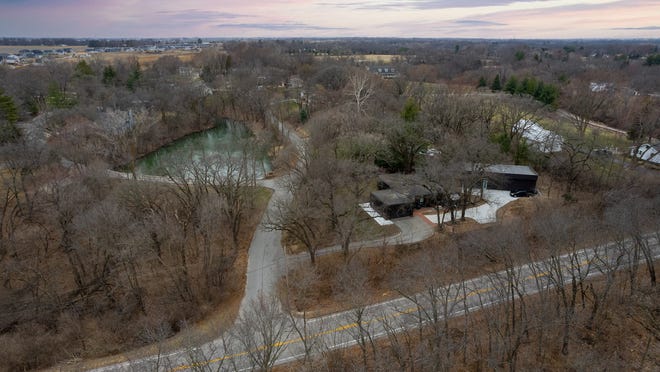
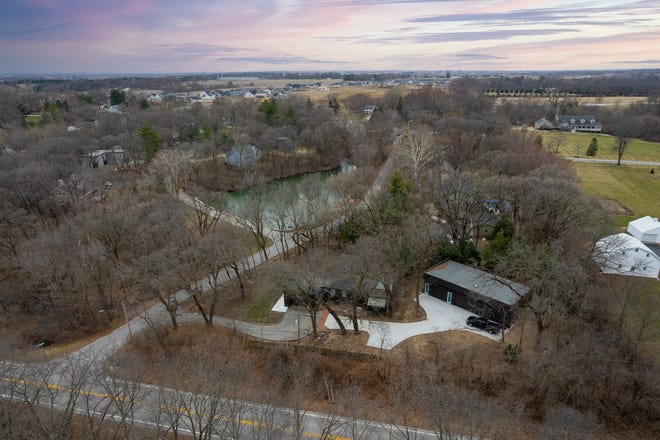
$699K home features striking midcentury design, mystery architect

2025 SE Brown’s Woods Ln., West Des Moines

A key instance of mid-century modern-day architecture is for sale in West Des Moines, developed in 1964 for a previous director of the Des Moines Artwork Centre

Situated throughout from the 486-acre Brown’s Woods, Iowa’s biggest city forest, the a few-bed room, a few-toilet, 1,939-sq.-foot ranch residence is concealed from check out on its possess .76-acre, tree-loaded lot.

Restored around the previous two several years, previous Des Moines Art Heart director Thomas Stansbury Tibbs at first laid declare to the hanging structure. But despite ongoing endeavours looking archives, city information and local architectural data, no paperwork to again up his assertion has however been observed.

“It’s a quite unfamiliar mystery,” mentioned Rhiannon Barbour, who is representing the vendor.

Home of former Des Moines Art Center director for sale at 2025 SE Brown's Woods Lane.

Admitting the home’s type appeals to an special sector of the sector, Barbour is assured the proper homebuyer will at some point be located.

“I adore the simplicity, how understated it is, but it is attractive,” she reported.

Tibbs was the Artwork Center’s director from 1960-68 and was instrumental in choosing New York Metropolis architect I.M. Pei to build a $1.6 million addition to the Art Middle. Pei’s 18,000-square-foot wing debuted in Oct 1968, that includes an uncovered concrete exterior that provided an immediate distinction to architect Eliel Saarinen’s 20-calendar year old creating.

21 Questions With Architect Deborah Berke

Photo-Illustration: Curbed; Photo: Winnie Au

New York’s “21 Questions” is back with an eye on creative New Yorkers. Deborah Berke is the founder of Deborah Berke Partners, the architecture firm behind 40 East End Avenue, the 21C Museum Hotels, the Yale School of Art, and the interiors at 432 Park Avenue. She has been the dean of the Yale School of Architecture since 2016 and is the first woman to hold the position.

Name: Deborah Berke
Age: 68
Neighborhood: Yorkville
Occupation: Architect

What’s hanging above your couch?

There are windows above my couch, and I live in a ground-floor maisonette, so what’s above it are people and dogs walking by.

What’s the first job you had in New York? 

Back in the day, the National Endowment for the Arts had a program called Artists and Schools. It would pay young architects, designers, and artists of all kinds — poets, dancers, choreographers — to go into public schools and teach. After architecture school, I taught “architectural principles” to young children in Flatlands, Brooklyn.

What color are you always drawn to? 

I like the palest imaginable aquamarine blue. I have a thing about the water, not so much the color of water but the color of light on the surface of the water. In the most unique kind of sunsets, the color right at the horizon is actually neither pink nor blue — it’s this pale aquamarine with a hint of green that is mysterious and beautiful.

What art or artifact are you most surprised you own?

When I was a very little girl, we lived in a house in Flushing, Queens, that had been built by a man who was a plaster artisan who made the decorative motifs you might see in the Plaza Hotel — the garlands, the curlicues, the 3-D musical instruments that were all made out of plaster and put on the walls. The basement of the house was filled with boxes of ornamental plaster. I saved a few pieces when we moved out. I’ve had this garland of roses that’s two inches wide and 16 inches long and very fragile. If you know my architecture, there’s nothing ornamental about it at all, which is why this is unusual for me.

Which New Yorker would you want to hang out with?

Laurie Anderson — she’s totally cool and inspirational and endlessly creative. I want to know how she inhabits her life.

What’s the last thing you made with your hands?

My mother died last year at age 99 and lived in the same house for 60 years. She saved everything. I found an architectural model I made in school in the attic. It’s an eccentric dome made out of wood. It was broken, so I glued it back together. Now, we 3-D print components and assemble them together, and I’m not involved in that anymore. It was so much fun to repair the model, that I told my husband I need a studio not for architecture but just to make stuff.

Is there one thing you own multiple versions of?

I own so much glassware. I’ve inherited some from my mother, mother-in-law, and grandmother. I buy glassware at yard sales — the thin Finnish stuff and the colorful Italian pieces. I could throw a party and every person would have a different glass.

What New York City museum do you always go back to?

I go back again and again to the Museum of the City of New York. It’s always, in some way, about New York, but you’re constantly learning something, whether it’s about the island of Mannahatta before colonists arrived or jazz or hip-hop or dollhouses. It’s a very focused look at enormously broad things.

What do you always have next to your computer? 

Three things: Coffee, a pad, and a pencil. I find typing responses to emails deeply and profoundly unsatisfying. The only satisfying thing about email is deleting it. So I’m always writing notes to myself or sketching an idea. I need a pencil in one hand to balance out the screen.

Where is the best view of the city?

There’s a certain flight pattern when you’re typically coming from somewhere in the rest of the United States that goes down the Hudson River and you’re flying parallel to the avenues. If you’re sitting on the east side of the plane, you can look down the crosstown streets. I love that view of New York. I have endless photos of it in my phone, just me gawking out the window at that pattern.

What building or object do you want to redesign every time you see it?

Am I only allowed to have one answer?! There are lots of abandoned power stations around New York. Some of them, sadly, have been torn down. But there’s one on the south side of 31st Street between Seventh and Eighth Avenues. It probably had something to do with Penn Station. I don’t want to redesign it; I just want to come up with something fun, whimsical, and playful for people to do before getting on or after coming off a train. It would be a shame not to do something great with that building.

What’s one thing you would change about your field? 

Anybody who wants to be an architect should be able to become one. I think there are many hurdles on that path. One of them being the cost of architectural education and what it takes to get into the field. So what I would change about my field is to make it more accessible. There would be a more diverse group of people practicing architecture and thinking about architecture and the built environment. If people had greater access to understanding the making and shaping of the built environment, they wouldn’t feel helpless or that they have no voice. They could be among the makers and creators, or they could be articulate critics and participants.

If you could live anywhere in New York City, where would it be?

In the 79th Street Boat Basin, in a boat I would design.

What would you hoard, if it stopped being produced?

Blackwing pencils, for sure. The eraser is a rectangle, even though the pencil is round. The outside of it is a shiny black and the lead is the perfect softness.

What do you do to get out of a creative rut? 

I walk by the water.

Where was your first NYC apartment, and how much was the rent? 

I grew up in New York, but my first apartment on my own was on Spring Street between Mott and Mulberry, in what was then Little Italy. It was a little three-story brick house built in the 1820s. I rented the top floor, which was literally inside the roof. It was awesome. It had wooden beams and tiny dormer windows and a deck in the back. I paid $300. It was owned by an older woman who was an artist. The building was torn down a while ago.

Where in the city do you go to be alone?

Well, if I lived on a boat in the 79th Street Boat Basin and wanted to be alone, I would just sail down the river and I’d be really alone. Since I don’t yet have my boat in the boat basin, I walk along the East River. I’m not alone, but if I look at the water, I can be alone in my thoughts.

What’s the worst piece of career advice you’ve ever gotten? 

“Wear a skirt.” It was from an elderly relative who said, “You always have to look good when you go to work.” It was presented as career advice, but it was sexist and presumptuous.

What have you given away to someone that you wish you could get back? 

I gave my father’s tiny gold pillbox to a not very good guy who was my boyfriend at the time. It’s not like I need a pillbox, but it would be nice to have a small thing that was my father’s that I could hold onto for a physical connection.

What’s your favorite NYC restaurant and regular order? 

There’s a neighborhood Italian place not far from my apartment called Nica Trattoria. It probably has six tables inside and maybe four outside since COVID. It’s tiny, and the guy who owns it has a big personality. It’s a classic New York experience. Every time I go there, I get the cauliflower as a starter.

What descriptive phrase do you want on your obit headline?

Generous.

What would Frederick Law Olmsted, storied Gilded Age landscape architect, say of today’s Berkshires? | Columnists


Aerial photo of Elm Court

Elm Courtroom in Lenox, demonstrated by way of drone in 2019, is among the the a lot of Gilded Age cottages in the Berkshires that Frederick Regulation Olmstead assisted to build. 


About the London tomb of Sir Christopher Wren — architect, polymath and the person who intended St. Paul’s Cathedral (and substantially else in the city) right after the Good Hearth of 1666 — are carved these text: “If you seek out his monument, search close to you.”

The identical could — and should really — be mentioned about a male who is the closest matter to America’s version of Wren: Frederick Regulation Olmsted, whose 200th birthday we rejoice this year.

He invented fashionable landscape style, encouraging generate New York’s Central Park, Boston’s Emerald Mile and at minimum 30 Gilded Age estates in the Berkshires, including Wheatleigh, Cranwell, Elm Courtroom, Shadow Brook and 4 spreads for the Crane relatives. Oh, and Williams Faculty, Skip Hall’s School, Pittsfield Cemetery and Camp Becket.

Fairly aside from that, Olmsted — like Christopher Wren — had a single exceptional everyday living.


Portrait_of_Frederick_Law_Olmsted

Frederick Regulation Olmsted, inventor of modern-day landscape layout, served produce New York’s Central Park, Boston’s Emerald Mile and at least 30 Gilded Age estates in the Berkshires.


He was born in Hartford to a relatives who’d been in The usa given that the 1600s. About to enroll at Yale, he was briefly blinded by an experience with poison sumac and never ever did go to higher education. As a substitute, he went to sea on a service provider ship, then labored as a farmer on Staten Island.

Olmsted very first obtained fame as a journalist. His sequence for the New York Instances about how slavery was ruining the financial state of the South was released as a guide in the U.S. and England. He became a organization abolitionist.

A reporting vacation to England in 1850 changed his life. There he identified the all-natural elegance of “English” gardens, as distinct from the extra regimented “French” model (a choice he shared with his Lenox acquaintance Edith Wharton, a yard skilled herself). In addition, close to the town of Liverpool he encountered Birkenhead, the world’s initially publicly financed civic park, open to all.

With no qualified coaching, Olmsted aided a New York Metropolis good friend, the architect Calvert Vaux, enter the 1857 layout contest for a civic protect in the centre of Manhattan. They received. Olmsted was put in demand of creating Central Park.

When the Civil War broke out, he headed to Washington, D.C., to turn out to be head of the U.S. Sanitary Commission, a forerunner to the American Red Cross. He also raised three regiments of black soldiers for the Union Army. However, he was itchy for new chances to deploy his restless strength.

Just before the war ended, Olmsted left for California to run a gold mine. It unsuccessful, but he grew to become an early chief of the conservation motion getting form in the American West. He aided persuade Congress to help you save California’s Yosemite and the sequoia-wealthy Mariposa Grove, and he joined the fight to maintain japanese treasures like the Adirondacks and Niagara Falls. His 1865 report to Congress is credited with placing the federal federal government in the conservation business.

He and Vaux opened the world’s to start with landscape architecture organization. (Later on taken over by Olmsted’s two sons, it lasted right up until 1980). The group built parks for the men and women of Brooklyn, Buffalo, Chicago, Milwaukee, Springfield, Mass., and dozens of other towns, as very well as higher education campuses for Stanford, Wellesley, Mount Holyoke and Yale. The firm created the country’s first prepared group, Riverside, Ill., and reconfigured the grounds of the U.S. Capitol.

Olmsted’s models favor harmony and the improvement of purely natural features. He believed character ought to be preserved, not engineered. He turned down a Michigan park task, complaining that it would incorporate too quite a few “artificial objects.” As Daniel Burnham, then the country’s top city planner, reported of him: “He paints with lakes and wooded slopes, with lawns and banking companies and forest-coated hills, with mountainsides and ocean sights.”

Like Christopher Wren, Olmsted was motivated to reclaim and protect a landscape harmed by a calamity. For Wren, it was the Good Fireplace of London. For Olmsted, it was the rampaging industrial revolution of the late 19th and early 20th generations, which was threatening all-natural splendor across an The usa still in denial about the selling price of prosperity.

He is a person for our time as well. Financial development is however threatening the attractiveness of God’s development, and currently its extremely survival. Olmsted would no question say we require to protect the world, not monetize it.

He would also urge us to shield his beloved Berkshires from unwise enhancement in its present-day renaissance. The passionate advocate of prudent land use would no question be a fixture at neighborhood setting up meetings.

Exactly where is Olmsted when we have to have him? He lies in Hartford’s Aged North Cemetery, a bucolic landscape he did not design and style. But he realized sufficient to depart it on your own.

Retired Landscape Architect Mary Hughes Honored With Jefferson Elm

About 70 men and women collected Wednesday in entrance of Pavilion III underneath a softly overcast sky to honor Mary Hughes, the retired landscape architect for the College of Virginia.

Hughes joined the ranks of luminaries honored at the College with trees as residing monuments – in her case, with a Jefferson elm.

“I am deeply moved to have a tree planted on the Garden in my honor,” stated Hughes, who retired in January. “I never ever envisioned this and continue to can rarely imagine it’s taking place.”

On Founder’s Day each and every calendar year, the University president officiates at the tree planting, with the Arboretum and Landscape Committee picking the honorees. Through the Wednesday ceremony, President Jim Ryan spoke of Hughes’ contributions to the University.

“When you ask her good friends about Mary Hughes, they say that she is wise, faithful and feisty, with an unmatched expertise of Grounds,” Ryan explained. “And they also say she has a wicked feeling of humor.”

Ryan praised Hughes for incorporating stewardship with becoming a visionary chief who managed the initial landscape learn program of the Grounds. He also explained she deepened the being familiar with of the background of the Grounds as a member of the President’s Fee on Slavery and the College, she assisted form the Memorial to Enslaved Laborers, which was formally devoted a calendar year in the past.

Ryan mentioned that Hughes, who commenced serving as UVA’s landscape architect in 1996, is a 1987 graduate of the University of Architecture. A fellow of the American Modern society of Landscape Architects, she served as co-director of the Historic Landscape Institute, an adult education and learning program jointly sponsored by UVA and Monticello, featuring the Jeffersonian landscapes of Central Virginia as laboratories for implementing historic horticulture and preservation tactics.

“While at UVA, she expanded recognition of the landscape outside of the Academical Village, the two created and wild lands,” Ryan claimed. “She secured funding for a multiyear exploration venture on the history of land-use and landscape layout of the University Grounds, which resulted in summertime internship alternatives for UVA landscape architecture students and enriched the cultural landscape curriculum.”

Ryan cited her desire in record, and how Hughes encouraged study and archaeology on the background of a cost-free Black settlement established in the 1830s by Katherine “Kitty” Foster, adjacent to and beneath the Academical Village. This study resulted in a structure commission for the public spaces of the South Garden task.

At Hughes’ urging, the University done a extensive research of the waterways and storm drinking water process of the University’s lands, which resulted in a stormwater grasp strategy made by Andropogon Associates, and an American Society of Landscape Architects award-successful layout undertaking for the Dell, a public park and stormwater management program intended by Warren Byrd of Nelson Byrd Woltz.

Hughes was co-editor, with Charles Birnbaum, of the e-book “Design with Tradition: Proclaiming America’s Landscape Heritage,” which chronicled the origins of the landscape preservation movement in the United States. In 2012, Hughes gained the Lagasse Medal from the American Modern society of Landscape Architects for conservation and stewardship of the general public landscape.

Considering the fact that retiring, Hughes is a whole-time vintner, jogging Leap Mountain Vineyards in Rockbridge Baths, an organization she began in 2006 with her spouse, David Vermillion, a retired technological analyst in UVA’s Data Know-how Companies who also attended the ceremony.

Hughes explained she was hugely honored to be selected by the Arboretum and Landscape Committee.

“The accumulating of the UVA ‘family’ to plant a tree collectively is this sort of a coronary heart-warming and optimistic motion, affirming the perception that the University will keep on to prosper just as this tree will bestow its positive aspects on generations of pupils for many years, and ideally hundreds of years, to appear,” Hughes said. “It is even additional unique to me for the reason that this tree will build a third generation of trees on the Lawn, just as the College is entering its 3rd century.”  

Hughes reported the very first trees on the Lawn had been black locusts, a nitrogen-fixing pioneer species that does properly in fatigued agricultural land, but is quick-lived. By the mid-19th century, they ended up getting replaced by ash and maple trees. But now, with ash trees threated by the emerald ash borer, Hughes noted it was prudent to expand the types.

“I am hoping it will be the tallest tree on the Garden,” she reported of the Jefferson elm. “I want to be remembered as tall and slim.”

Deserving Martin, an affiliate professor of laptop or computer science in the School of Engineering and the chair of the Arboretum and Landscape Committee, also spoke at the ceremony, outlining the history of the Jefferson elm, a cultivar of the American elm. Planted all through the Frederick Law Olmsted Jr. structure/development interval of the Nationwide Mall in the 1930s, the tree was decided to be resistant to the Dutch elm condition that devastated elm trees across the region.

In the 1990s, the tree was vegetatively propagated and genetically cloned. Specimens were grown in the Nationwide Arboretum, where by the clones have been inoculated with the Dutch elm ailment to improve their resistance to an infection. These clones ended up unveiled by the U.S. Office of Agriculture to the nursery marketplace in 2005 under the identify “Jefferson elm” – so named due to the fact the authentic tree on the Nationwide Mall stood in the vicinity of the Jefferson Monument.

“I have lengthy admired the Jefferson elm and hoped it could be planted listed here one day – not only mainly because of its title, but because it has proved its merit as a tough, city tree that has survived and flourished on the Mall in Washington, D.C., for numerous several years,” Hughes mentioned in advance of the ceremony. “If it survives all the gatherings that acquire place in our national ‘front lawn,’ it must be ready to endure Remaining Workouts and a couple of Frisbee online games and hammocks.”

The treasured shade tree grows immediately into a vase shape. The stately tree has darkish inexperienced leaves that turn golden in the tumble. It is chilly-hardy, broadly adaptable and tolerates city conditions and periodic drought.

“I feel the elm will be a great choice,” Hughes reported. “It grows tall and branches high with the typical elm ‘vase form,’ so it will not obscure sights of the Pavilion facades. It has also proved to be tolerant of soil compaction from foot traffic and other impacts, which is a perennial dilemma on the Lawn.”

Healdsburg landscape architect frames and highlights the view

Just before he dives into any structure, landscape architect Mike Lucas consults the land.

He explores it and observes it, returning multiple situations to expertise and go through it at diverse moments of working day, in diverse temperature, most likely in diverse seasons. It is an financial investment of time that can make all the variance, he says, in producing a at ease outdoor setting that will welcome shoppers outdoors.

“That is so integral to all of our tasks, and so essential to how he will work,” says Jennifer Lucas, the other half of the husband-and-wife workforce of Lucas & Lucas.

He is skilled in landscape architecture, she in architecture. They achieved in graduate school at Cal Poly Pomona, and alongside one another they are the rules in a Healdsburg firm that strives to design environments that combine the web page format and buildings with the land alone in a way that feels natural, natural and unforced.

“He (Mike) is quite a great deal an intuitive,” Jennifer claims. “He’s able to tease out what shoppers want and make perception of what they’re indicating, which is not generally a straight route. But he’s also tuned in to the land. I feel our jobs are very a great deal of their location, and each and every 1 is diverse due to the fact every single website is distinctive. So they genuinely relate to what’s heading on their internet site — the (residence) architecture, the views, the wind and the sun.”

Time, claims Mike, is the “best portion.”

“Everyone tends to want it yesterday,” he suggests. “The better assignments are individuals the place I have more time on the site.”

New guide, useful tips

Lucas shares this and other design insights in a new e book, “Architectural Gardens: Within the Landscapes of Lucas & Lucas,” posted by Princeton Architectural Press.

Co-writer Thad Orr, a former editor of “Garden Design” journal, unpacks the Lucas’ prevailing and animating thoughts as they show up in 10 of their landscapes in the Sonoma County and Napa spots.

Just about every is distinctively various still has the Lucas stamp in typical. They pay back close focus to how gentle performs with shadows on a pathway or strikes a particular plant or drinking water function. Pathways invite people to explore other places on the residence. Site strains draw the eye to sights or focal factors that could possibly if not be missed with no good “editing” of plants and trees.

Lucas was encouraged by his mentor Gary Ratway, the renowned North Coastline landscape designer and co-founder of Digging Doggy Nursery in Albion. From Ratway, he acquired how to utilize crops to develop distinctive areas, soften architectural characteristics and spotlight views. Lucas came to embrace Ratway’s way of fitting the landscape to the architecture of the property and generating gardens that are structured without having getting extremely official.

The new guide, he states, is “more than the classic monograph” with a brief little bit of text that’s large with “architecture converse.”

It is richly illustrated with photos by Caitlin Atkinson and Marion Brenner, but it also includes for a longer period narratives on each challenge prepared in distinct language available to viewers exterior the style career, along with breakouts featuring simple guidance that could be utilized to many tasks.

The guiding topic of an “architectural backyard garden,” Mike Lucas maintains, is to build “a union involving the land and home, the indoors and outdoors, the organic and constructed” and stability individuals factors in a way that is the two attractive and practical.

At the identical time they are checking out the land, the Lucases are receiving to know the requirements and tastes of their shoppers, so they’ll conclusion up with not just a quite spot but a space they will use.

In some cases, alternatives aren’t always evident at 1st.

In a project in Santa Rosa’s rural Bennett Valley, Mike observed in his explorations of the internet site that the place in the vicinity of the house, in which the house owners wanted to set up a pool, was chilly and windy. But he also noticed that in a additional significantly-flung location on the residence, the microclimate at the very same time could be heat and sunny.

“The place exactly where I confident them to do the pool was on the west facet of the house,” Mike claims. “They needed a pool by the home. But it was generally acquiring the wind. The fog would roll out in the summer time. The winds would blow. It didn’t sense right for the pool.”

He produced two peaceful oak-shaded pathways that beckoned persons from the house to the pool, located in a huge meadow still tucked in and secured from winds although featuring vistas unseen from the dwelling. Other paths split off to a bocce courtroom and a trampoline established on a knoll.