Expanding the Scope of ‘Latin American Art’

You don’t need to know anything about art to be stopped in your tracks by what’s on the walls of El Museo del Barrio these days: the fantastic ballpoint pen drawings by Consuelo (Chelo) González Amézcua (1903-1975), a Mexican immigrant to Texas; the stupefyingly intricate collages of Felipe Jesus Consalvos, who was born in Havana and died in Philadelphia, where in 1983 his life’s work was found in a garage sale; and the pictographic paintings of Puerto Rican-born Eloy Blanco (1933-1984), who came to New York City to study art and learned from fellow Latinos about the Indigenous Taino culture of his homeland — a culture he ended up making the wellspring of his work.

This season has brought a bounty of historical shows of Latin American and Latino art, two cultural categories that are closely related without being interchangeable. Latin American is generally understood to designate art originating in the southern hemisphere of the Americas. Latino (with its Latina and Latinx cognates) refers to work by artists of Latin American descent working in the United States. But both terms are spacious and mutable.

The two meet in a pair of exhibitions at El Museo del Barrio. The larger, “Popular Painters and Other Visionaries,” spotlights work by 35 artists — González Amézcua, Consalvos and Blanco among them — born in the first half of the 20th century. Most are from Latin America; and many are self-taught, which means that much of the work doesn’t adhere to the mainstream market definition of “Latin American art” as work influenced, and elevated, by an association with elite European modernism.

Organized by El Museo curators Rodrigo Moura and Susanna V. Temkin, working with Ash Cortes, an intern, the show offers a counterargument from the start, with a display of three banners, glinting with sequins, and embroidered with mystical symbols. They were made by Antoine Oleyant (1955-1992), a Vodou priest from Haiti, and represent a distinctive local art tradition, one with clear Afro-Atlantic sources.

Other pieces, many culled from El Museo’s permanent collection, support the case for an expanded view of Latin American art, one that incorporates 1950s paintings of Yoruba myths by Rafael Borjes de Oliveira, a Brazilian policeman and Candomblé devotee, along with Asilia Guillén’s stitch-fine depictions of scenes from Nicaraguan history; but also the work of Latinx artists like Consalvos and Blanco, who were born in Latin America but spent their creative years in the United States.

Consalvos is thought to have died around 1960, on the cusp of a decade of intense Latino activism in North American cities, in reaction to racist neglect and aggression. As always, New York’s Puerto Rican community had to see to its own survival, which included preserving its history. To this end, in 1974, three young photographers — Charles Biasiny-Rivera, Roger Cabán and Felipe Dante — formed En Foco, a collective devoted to documenting Latino life from the inside. And the second exhibition at El Museo, “En Foco: The New York Puerto Rican Experience, 1973-1974,” displays the group’s inaugural portfolio, made up of images of daily life in the streets and schools of the barrio, and among Latino laborers in and outside the city.

In 1969, another volunteer grassroots start-up, Taller Boricua, also called the Puerto Rican Workshop, set up shop in a public school classroom. It’s still in operation and maintains a modest gallery in the Julia de Burgos Latino Cultural Center at 106th Street and Lexington Avenue, where a founder, the artist Marcos Dimas, has installed a not-to-be-missed show.

It’s titled “Temporal Chronology,” and that’s exactly what it is: a year-by-year timeline of the Workshop’s history mapped out on the gallery walls in hundreds of pieces of printed ephemera: exhibition posters, letters, protest signs, newspaper clips. The wraparound archive also doubles as a half-century document of unbroken community activism, which persists even as the community changes. And it’s a personal record of Dimas’s career as artist-worker and political witness. (What’s on the walls has been stored in his apartment.) The city should honor him with a medal, and give Taller Boricua an extra shot of funding.

Dimas’s name gets a mention in an ambitious group exhibition called “This Must Be the Place: Latin American Artists in New York, 1965-1975” at Americas Society.

The narrative here is of artists from South and Central America coming to New York City, a newly hot international cultural center, some to explore career opportunities, others to escape political repression. Most didn’t think of themselves on arrival particularly as “Latin American,” never mind “Latino.” And while the show acknowledges the longtime presence of Latino artists in the city, there seems to have little interchange between them and the newcomers.

Race and class played a role in this, and differing senses of investment in the city. To Latino artists it was both home and battleground. To Latin American transplants it was a stage where a politics of aesthetics was playing out in new avant-garde styles and forms: Minimalism, Conceptualism, video and performance. And what extraordinary artists the experiments brought to New York: temporarily, Hélio Oiticica from Brazil, Marta Minujín from Argentina, Zilia Sánchez Dominguez from Cuba; permanently, Luis Camnitzer from Uruguay, Juan Downey from Chile, Freddy Rodríguez from the Dominican Republic.

They are among some 40 artists and collectives in the show, organized by the Americas Society curator Aimé Iglesias Lukin, with Mariana Fernández, Tie Jojima and Natalia Viera Salgado — which comes in two parts, one through this Saturday, Dec. 18, the other, with different work by the same artists, opening Jan. 22.

Work by Latin American artists who produced art in the United States can also be found in galleries. A small show called “José Antonio Fernández-Muro: Geometry in Transfer” at the Institute for Studies on Latin American Art (ISLAA), on the Upper East Side, surveys work from the late 1950s and early 1960s, when the Argentine artist moved, with his wife, the painter Sarah Grilo, to New York from Buenos Aires. In South America he was associated with an ethereal and utopian strain of geometric abstraction. In New York, the quietist impulse hit a bump: paintings were based on rubbings he made of Manhattan sewer grates and manhole covers. The show, organized by Megan Kincaid, an instructor at New York University, gives us both before and after work, equally beautiful.

Also on the Upper East Side, Henrique Faria Gallery, which specializes in Latin American art, is showing work by the Swiss-born Venezuelan photographer Luis Molina-Pantin, who calls himself “an urban archaeologist.” On visits to New York from 2001 to 2006, he photographed (with a hidden camera) the back room offices of big-deal Chelsea galleries, sterile, high-ceilinged, art-free spaces that suggest mortuaries. During the same decade, disguised as a real estate agent, he was shooting Disneyesque drug-baron mansions in Colombia, one a miniature version of the Taj Mahal. In the show, it’s hard to decide which version of power architecture is weirder.

And a few blocks away, at Hunter College’s Bertha and Karl Leubsdorf Gallery, “Life as Activity: David Lamelas” is celebrating the career of the veteran Argentina-born conceptualist, focusing on two of his films. The longer one, “The Desert People,” is a rough and interesting pseudo-documentary about researching Native American life, made in 1974 in Los Angeles. “The Invention of Dr. Morel” was made in Europe in 2000. It’s polished and spooky and has a hologram — a kind of proto-NFT? — for a heroine. The exhibition was developed by students in a Hunter graduate seminar led by Harper Montgomery, a professor, with the artist participating via Zoom.

Hunter College is home to the invaluable Center for Puerto Rican Studies (Centro de Estudios Puertorriqueños). And the Hunter East Harlem Gallery at 119th Street and Third Avenue has given significant exposure to Latino art, as it is doing now with “Lina Puerta: Migration, Nature, and the Feminine,” a compact midcareer survey of sculpture by an artist raised in Colombia and created during her time as an East Harlem resident. Puerta’s assemblages, with their fake tropical greenery, faux fur, lace, rhinestones and sexualized forms, represent the exoticism that some Latin American Conceptualists were rejecting, but that has, in Puerta’s hands, a critical politics (eco-feminist, anti-colonialist) of its own. As conceived by Klaudia Ofwona Draber and Arden Sherman (the gallery’s director), the show is too much, and proud.

A final strong exhibition is far downtown at South Street Seaport, in a new gallery named Calderón. Its debut show features two New York painters, Shellyne Rodriguez and Danielle De Jesus, who focus on the different Latino worlds they’ve been part of.

De Jesus spent her childhood in Bushwick, Brooklyn, and paints memory-portraits of people there. Many lived and died in poverty, or were pushed out of their homes as real estate values rose. Rodriguez grew up in the Soundview section of the Bronx. Her color pencil drawings are portraits too, but they’re not sad; they’re sassy. And in compositions based on vintage hip-hop fliers, figures are surrounded by words: song lyrics, advertising slogans, Bronx street names, quotes from Frantz Fanon. This is a world that may partly exist in the past, but it’s jumpily noisy, and still alive.

Latino/Latina/Latinx continues to defy easy definition, but attempts to do so keep coming, the latest being the Winter 2021 “Latinx” issue of Aperture magazine, guest-edited by Pilar Tompkins Rivas. In 17 essays it circles and probes the subject from many angles. What comes through in the end is not consensus but a kind of wild richness. Why try to pin down, and narrow, a concept that has, after all, always contained multitudes?


Popular Painters and Other Visionaries, and the historical photo show En Foco: The New York Puerto Rican Experience, 1973—74. Through Feb. 27, El Museo del Barrio, 1230 Fifth Avenue, at 105th Street, Manhattan, (212) 831-7272; elmuseo.org,

This Must Be the Place: Latin American Artists in New York, 1965—1975

Part 1 through Dec. 18; Part 2, Jan. 19 through May 14; Americas Society, 680 Park Avenue at 68th Street, Manhattan, (212) 249-8950; as-coa.org.

Temporal Chronology

Taller Boricua Gallery, 1680 Lexington Avenue at 106th Street, (212) 831-4333; tallerboricua.org.

Lina Puerta: Migration, Nature, and the Feminine

Through Feb. 5, Hunter East Harlem Gallery, 2180 Third Avenue at 119th Street, Manhattan; (212) 396 7819; huntereastharlemgallery.org

Life as Activity: David Lamelas

Through Dec. 18, Hunter College Bertha and Karl Leubsdorf Gallery, 132 East 68th Street, Manhattan, leubsdorfgallery.org.

José Antonio Fernández-Muro: Geometry in Transfer

Through Feb. 12, ISLAA (Institute for Studies on Latin American Art), 50 East 78th Street, Manhattan, www.islaa.org. .

Luis Molina-Pantin: Everything Must Go

Through Feb. 12, Henrique Faria, 35 E. 67th St., Manhattan, (212) 517-4609; henriquefaria.com.

Danielle De Jesus and Shellyne Rodriguez

Through Jan. 22, Calderón, 106 South Street, Manhattan, (929) 624-2878; calderon-ny.com.

The New Art of Waiting for a Package

When the sun set on my birthday, I had spent 12-plus hours on my couch, looking out my living room window, waiting for a package that required my signature. It never came. Now I’m dead inside.

I am 54. How did my life come to this? Let’s pull up my tracking number and see!

Oct 12, 2021 (4:02 pm) Picked up in Brooklyn, N.Y. My package—let’s not concern ourselves with what it contains; all you need to know is that technology is involved, that the expensive device contained therein has improved specifications, that I desire it, that it will make my monotonous, stupid life worth living again—is on its way.

Oct 13 (8:31 am) At destination sort facility in Dallas. A day ahead of schedule! I’d paid $39 for two-day delivery, because I have no impulse control and must hold this device in my hands as soon as possible. Am I retaining water? My fingers look fat. In any case, my package might arrive on my doorstep in one day! Will modern wonders never cease?

Oct 13 (2:11 pm) At local facility in Irving. Weird. What’s the difference between a “destination sort facility” and a “local facility”? Who knew there was such variety in facilities? Not to be confused with the multiplicity of Felicities. Ah, well. I’m sure I’ll see my package soon. It’s not due until tomorrow, anyway.

Oct 13 (2:58 pm) At local facility in Irving. Right. Heard you the first time. But good to know.

Oct 14 (9:00 am) On vehicle for delivery in Irving. See you soon, Packy! I’m working on my laptop from the couch today because I knew you were arriving. I cleaned up a bit. Sharpened my favorite package-opening knife. Cleared the space in my closet where I can hide the device from my girlfriend, who might ask awkward questions like “How much was that?”

Oct 14 (12:55 pm) Delay – Customer not available or business closed. WHOA HEY HO WAIT! I’m still on the couch, right by the door! [Sprints outside. No sign of delivery vehicle. No note on door.] Not true! Erroneous, erroneous on both counts! Customer was extremely available!

Oct 14, 2021 (1:32 pm) At local facility in Irving. What the hell? This can’t be happening. Plans have been made. Money has changed hands. I spend four hours on the internet and phone, talking to customer service from a company that shall not be named but that once crashed a plane carrying Tom Hanks into the ocean. The unnamed company’s representative promises it will be here tomorrow. Simple misunderstanding.

Oct 15, 2021 (3:30 pm) At local facility in Irving. Why is the system breaking down? Is this the supply chain I’ve heard about? Can’t I just drive to Irving and pick up Packy? More calls and DMs to customer service. I apologize more than once for my language.

Oct 15, 2021 (5:06 pm) At local facility in Irving. This is starting to feel personal.

Oct 16, 2021 (11:04 pm) At local facility in Irving. FedEx. It’s effing FedEx.

A sad weekend occurs. I’d planned to spend much time with the device inside Packy. We were to go on a walk around White Rock Lake. There is a birthday party Saturday evening at which I was going to nonchalantly take it from my bag. “Oh, this? I just got it. No, no. [slight chuckle] This is the upgraded version.” Instead, I brood. I eat cake. I drink wine. I gain 4 pounds.

Oct 18 (8:44 am) On FedEx vehicle for delivery in Irving. I sit all day on the couch, passing the time. I listen to Foreigner 4, track four. I watch YouTube videos about my long-lost device. My mind drifts: what is Packy doing all day on the delivery vehicle? Is her abductor kind? Is it fun for her? Is the delivery driver like one of the parking attendants in Ferris Bueller’s Day Off? Does Packy get to ride shotgun? Is she enjoying Irving at 120 mph? Do they make a run to Fort Worth for some barbecue from Goldee’s? I just want her to be happy. I cancel my birthday reservations.

Oct 18 (10:09 pm) At local FedEx facility in Irving. This is the Democrats’ fault. They’re in power. Use it.

Oct 19 (8:21 am) On FedEx vehicle for delivery in Irving. I sleep on the couch now. I live there. I am a couch-dweller.

Oct 19 (7:31 pm) At local FedEx facility in Irving. “That’s how it is on this bitch of an earth.” —Samuel Beckett, Waiting for Godot

Oct 20 (8:26 am) On FedEx vehicle for delivery in Irving. Midday, my phone dings with a text: “Dude. We need your story. Did you get your package?”

Asheville City Council approves purchase of new ART buses with combination of federal, local funding


Three new buses will be added to the Asheville Rides Transit (ART) fleet, under action taken by Asheville City Council. At their December 14 meeting, Council approved a resolution to purchase three 30-foot Gillig diesel buses to replace buses in the fleet as they near their useful service life.

During the last five years, the City of Asheville has purchased 16 transit buses to replace vehicles in the fleet that have met its useful service life. The buses purchased include five electric buses, seven hybrid-diesel buses, and four diesel buses. The three buses being purchased will also use diesel fuel. Included in this bus purchase are transit accessories and features such as bike racks, fareboxes, and transit security cameras.

This $1.6 million purchase is part of the annual bus purchases undertaken by the City to replace existing buses that have met their useful service life per the Federal Transit Administration’s (FTA) service-life policy and guidelines for transit buses and vans. This FTA policy establishes the minimum number of years (or miles) that transit vehicles purchased with federal funds must be in service before they can be retired without financial penalty. The minimum useful life for ART’s buses is 350,000 and/or 10 years.

The City uses a combination of funding sources to fund its bus purchases, which includes federal transit capital assistance, funds awarded by the French Broad River Metropolitan Organization (MPO), and the City’s General Funds. In addition to the annual transit federal formula funds allocated to the City, staff also applies for and uses competitive federal funds if awarded. For instance, in 2018, the City applied for and was awarded funding from the FTA’s Low No Emission grant funds that was used along with local funds to buy the five electric buses purchased in 2018. Additionally, federal flex funds received from the MPO were used to pay for the eleven buses that have been purchased to date. Some of the remaining MPO funds will be used for the buses being purchased in this fiscal year.

Upon receiving the buses, the Transit Planning staff will work with the City’s Contractor to complete required federal inspections before placing them in service. As recommended in the Transit Master Plan (TMP), staff plans to use the new buses to improve frequency on bus routes in the transit system. Specifically, this will help with plans to increase the frequency on the S3 and S6 Routes which serves residents in south Asheville. Planning efforts are currently underway to improve and increase the bus frequency on both routes from 90 minutes to 45 minutes. As such, the additional buses will assist with ongoing plans to improve and increase service reliability for ART riders.

The City believes that frequency and speed of service are the keys for current ART riders to continue using the transit service for their mobility needs, as well as attract new riders to use ART.  We also believe this investment will help make ART convenient and more attractive as much as possible. 

To read the staff report to Council, visit this link.


About ART bus service

Asheville Rides Transit provides bus service throughout Asheville and to Black Mountain from 5:30 a.m. to 10:30 p.m. Monday through Saturday and 8 a.m. to 6 p.m. Sundays/holidays. 

The ART Station is at 49 Coxe Ave. ART serves 19 routes with an annual ridership of 2.3 million, per pre-Covid data.

  • It costs $1 to ride the bus.  A ticket booklet (11 rides) costs $9 and a monthly pass costs $20. Both are available for purchase at the ART Transit Center, 49 Coxe Ave.
  • The ART Transit Station, 49 Coxe Ave., has been completely renovated, including improvements to the interior of the station/lobby, additional outdoor seating, and upgraded lighting, as well as new lighted digital displays boards and public wi-fi.

If you haven’t already, we invite you to download the Transit app to your smart device, to help plan your trip for better efficiency. Visit the City of Asheville Transit webpage for more information or stop by the ART Transit Center.


For La Prairie, 2021 Was Defined by the Beauty of Art Collaborations and a Sense of Blue

Clearly, La Prairie’s patronage of the arts is much more than skin-deep. In 2021, the luxury Swiss skincare brand supported a range of cultural initiatives; from New York and Miami to London and Switzerland, each was as memorable as the next.

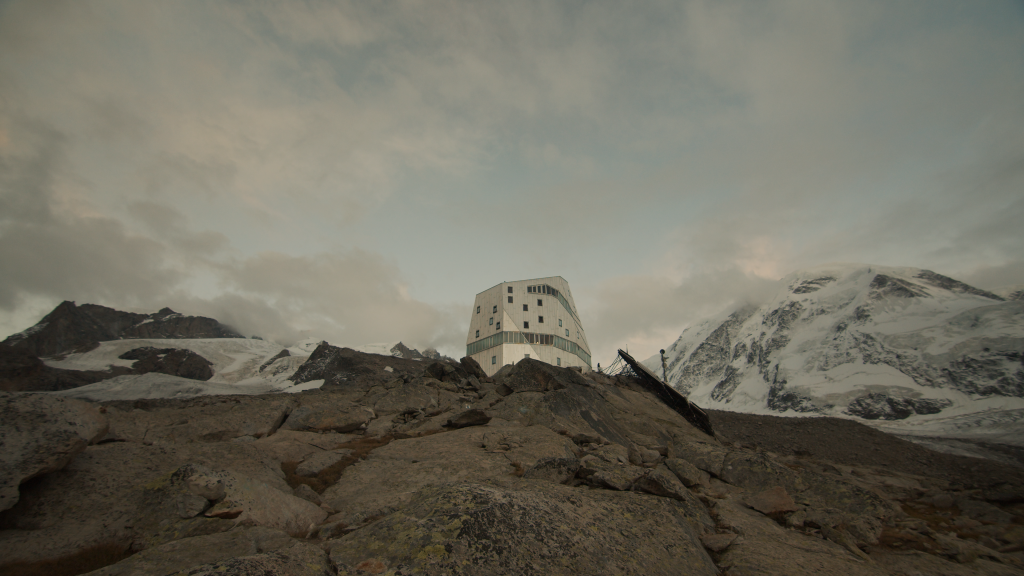
In May, when Frieze made its return to New York for the first time since 2019, La Prairie teamed up with Hong Kong and Berlin–based new media artist Carla Chan, whose practice explores the notion of time, inviting viewers to palpably witness and reflect on its passage. Her contemplative Frieze New York commission, Space Between The Light Glows, was inspired by the ever-changing sunlight during her recent stay at the Monte Rosa Hut, La Prairie’s very first residency, situated in the heart of the Swiss Alps.

The Monte Rosa Hut, La Prairie's new art residency in the Swiss Alps. Courtesy of La Prairie.

The Monte Rosa Hut, La Prairie’s new art residency in the Swiss Alps. Courtesy of La Prairie.

“I am interested in creating a feeling of ambiguity, which allows the audience to wander in their own thoughts and imagination,” Chan said in a statement from the brand. “In this particular piece for La Prairie, I try to play with light and shadow, to fill in the imaginative space between the lights to leave a trace of nature.” The video installation recalled sun-dappled Swiss landscapes; without a clear sense of space or time, it created a much-needed moment of respite for fairgoers.

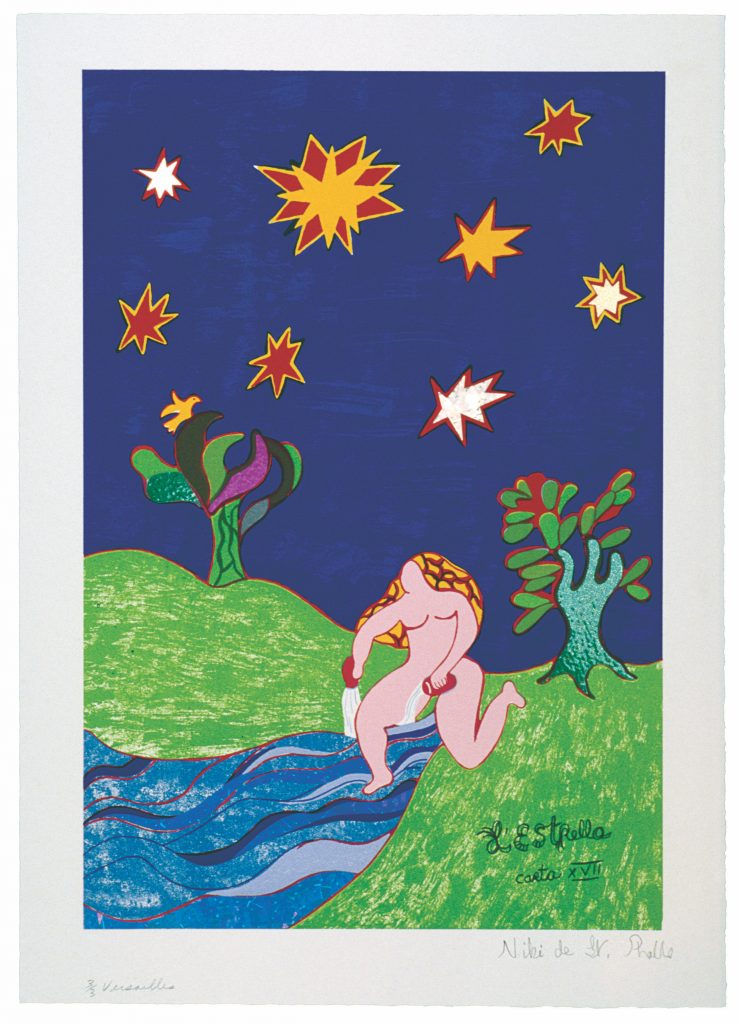
In the meantime, across town, one of MoMA PS1’s most adored exhibitions of the year came to life with integral support from La Prairie. “Niki de Saint Phalle: Structures for Life” brought together more than 200 works from the legendary French-American multimedia artist. With its diverse array of sculpture, drawings, videos, and paintings, the retrospective stood out as an overdue look at her highly influential and ahead-of-its-time oeuvre.

Niki de Saint Phalle, <i>L'Estrella Carta No. XVII (The Star)</i>, 1997. © 2021 Niki Charitable Art Foundation.

Niki de Saint Phalle, L’Estrella Carta No. XVII (The Star), 1997. © 2021 Niki Charitable Art Foundation.

“Several years ago, I was doing research on women artists who made large-scale work and realized that Niki de Saint Phalle was really one of the first women artists to embark on such a monumental scale,” said the show’s curator, Ruba Katrib, in an interview with La Prairie. “Looking into this aspect of her practice further, I learned more about her ground-breaking strategies for realizing her artistic visions, all of which require a holistic approach between concept and the modes of production.”

“Structures for Life” showcased de Saint Phalle’s steadfast attempts to spark joy, despite her traumatic upbringing and an adult life marked by emotional turmoil. The artist’s works elicit a duality that honors the importance of playfulness, while also drawing attention to social and political issues.

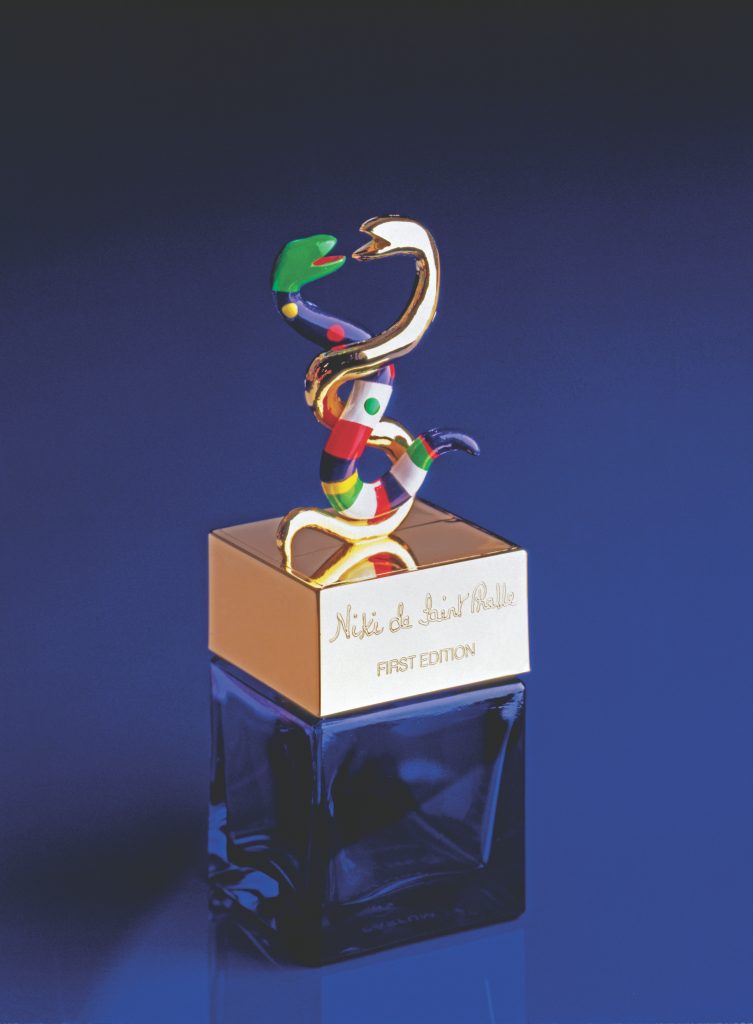
Niki de Saint Phalle, <i>Flaçon de parfum</i>, 1982. © 2021 Niki Charitable Art Foundation.

Niki de Saint Phalle, Flaçon de Parfum, 1982. © 2021 Niki Charitable Art Foundation.

A cunning businesswoman, de Saint Phalle funded her practice through many out-of-the-box enterprises. One such initiative proved highly influential for La Prairie: the artist’s own perfume, Flacon de Parfum. Set in the same cobalt blue that graces many of de Saint Phalle’s works, the bottle’s color was the direct inspiration for the design of La Prairie’s Skin Caviar collection.

Meanwhile, since 2017, La Prairie has lent its platform to emerging artists at Art Basel fairs around the globe. This year, the house staged activations during the Basel, Switzerland and Miami editions.

The Skin Caviar collection uses the cobalt blue that graces many Niki de Saint Phalle artworks, also the inspiration for Maotik's recent La Prairie commission. Courtesy of La Prairie.

The Skin Caviar collection uses the cobalt blue that graces many Niki de Saint Phalle artworks, also the inspiration for Maotik’s recent La Prairie commission. Courtesy of La Prairie.

For the Basel fair in September, as well as Frieze London the following month, French digital artist Mathieu Le Sourd—also known as Maotik—was tapped to create Sense of Blue, an immersive installation that plummeted viewers into the dark of night. Using the same cobalt blue made famous by de Saint Phalle and adopted by La Prairie, Maotik’s virtual and augmented reality work allowed viewers’ movements to alter their environment through a shifting façade of light.

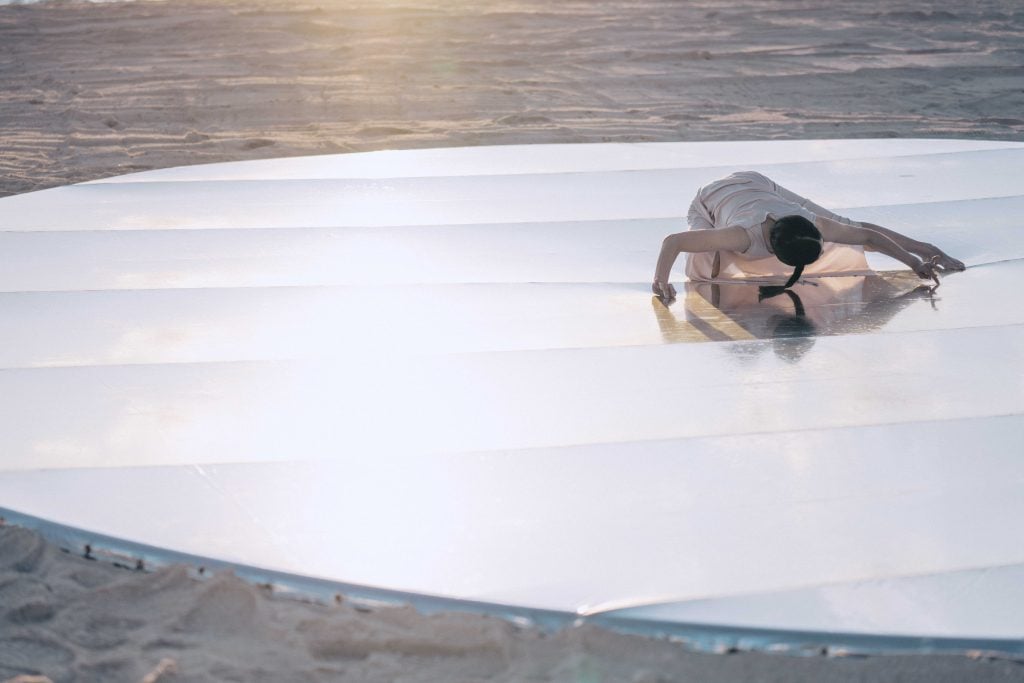
And this month, at Art Basel Miami Beach, La Prairie hosted its latest artist commission—Wen Chi Su’s Moving Towards the Horizon, which the Taiwanese dancer, choreographer, and new media artist performed on the sands of Miami Beach.

Wen Chi Su, <em>Moving Towards the Horizon</em>, commissioned by La Prairie for Art Basel Miami Beach. Courtesy of La Prairie.

Wen Chi Su, Moving Towards the Horizon, commissioned by La Prairie for Art Basel Miami Beach. Courtesy of La Prairie.

Su’s performance, which took place as the sun set over the Atlantic Ocean, encapsulated the effect of light against water. Inspired by a trip she took in the summer of 2021 to study lakes across La Prairie’s home country of Switzerland, the artist physically embodied the natural elements, creating a sense of “liquidity” through her dynamic movements.

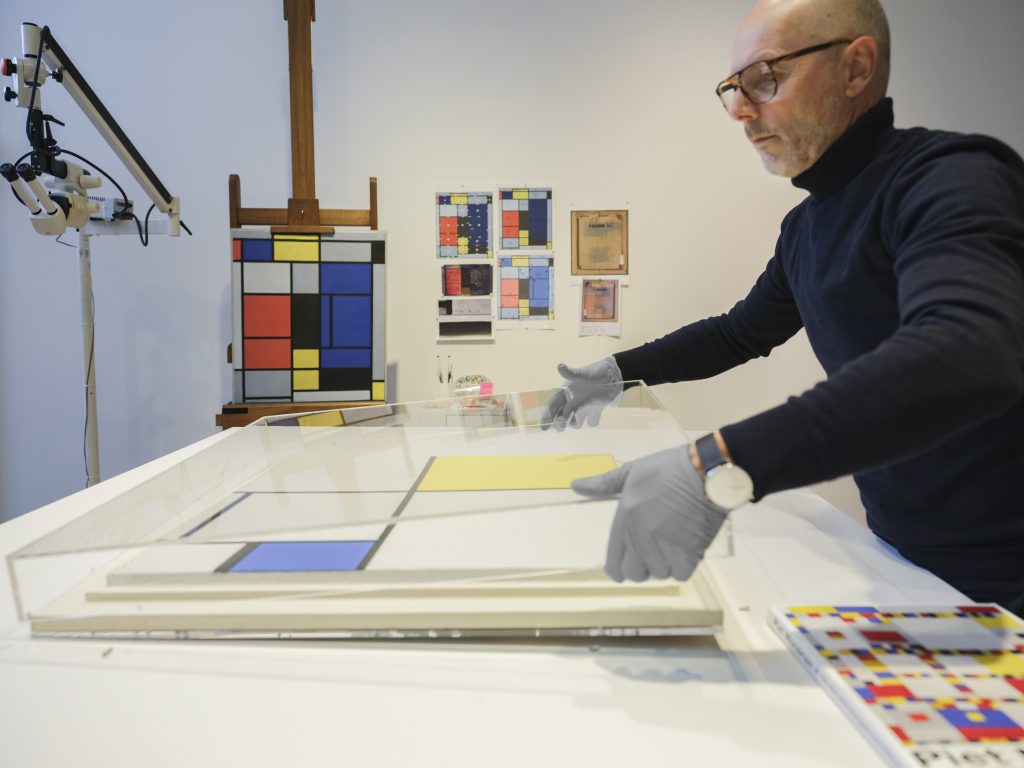
Many of La Prairie’s artistic endeavors have lives that extend beyond one-time experiences. Such is the case in their ongoing conservation project with Fondation Beyeler, Switzerland’s most visited museum, to restore four seminal works by Piet Mondrian, created between 1921 and 1938: Tableau No. I; Composition with Yellow and Blue; Composition with Double Line and Blue; Lozenge Composition with Eight Lines and Red.

With Switzerland's Fondation Beyeler, La Prairie has supported the restoration of fourPiet Mondrian masterpieces. Courtesy of La Prairie.

With Switzerland’s Fondation Beyeler, La Prairie has supported the restoration of fourPiet Mondrian masterpieces. Courtesy of La Prairie.

With La Prairie’s support, the institution has employed a renowned team of researchers, scientific experts, and Mondrian scholars from the Kunstmuseum in The Hague, which houses the world’s largest collection of the Dutch painter’s works. The project began in 2017 and will culminate in a major retrospective of the Mondrian masterpieces at Fondation Beyeler next year.

Markus Gross, the institution’s chief conservator, said in an interview with La Prairie, “This unique opportunity to give something back to the world of art and culture, and also pay homage to the brand’s artistic heritage—greatly inspired by Mondrian’s minimalist aesthetic, geometric precision, and purity of form—is unrivaled.”

Just as Mondrian daringly explored the fundamental elements of art, the emerging artists that La Prairie champions today are also fearless innovators in their fields. With its ongoing efforts to help push the boundaries of culture, the brand promises to broaden and bolster the canon for years to come.

Follow Artnet News on Facebook:


Want to stay ahead of the art world? Subscribe to our newsletter to get the breaking news, eye-opening interviews, and incisive critical takes that drive the conversation forward.

Local artist says anyone who has an imagination can create art


landscape of abstract art piece covered in blue, green, pink, and black paint

An example of Haunani Hess’s artwork.

Photo provided by Haunani Hess

Bold colors and found paper, similar to collage art, make up the work of local artist Haunani Hess, who said she is directly inspired by the nature and culture surrounding her on Oahu. Her pieces are filled with mountains, aquatic scenes and photography, demonstrated in bright watercolors on the background of found pages from books.

“I am native Hawaiian. My work is an expression from the core of my being, and not solely as a reaction to external circumstances,” she said. “I am a Hawaiian artist, whereas non-Hawaiians who live here are sometimes mistakenly called, ‘Hawaiian artists.”

Hess is a local, self-taught, self-employed artist who said she has been doing art her whole adult life. Hess owns her own studio in Honolulu, where she is originally from. She explained she sells her pieces privately, and to get more coverage in the community, also at local markets on Oahu two times per month.

A BYU–Hawaii alumnus from Brisbane, Australia, and freelance artist and designer on the North Shore of Oahu, Sam Mangakahia says Maori tattoo art, or ta moko, inspires his artwork.

“[My] strong interest in moko wasn’t just in the beauty of design, it was in the process of learning people’s stories and sharing that through indigenous design,” Mangakahia shares on his website, Hamiora.com. He said he hand-carves culture pieces on almost anything, such as leather journals, phone cases and instruments. On his website, he showcases his style and technique.

According to Mangakahia, each piece showcases his Maori culture by representing the nature of New Zealand, Australia and Oahu. He uses bold lines and curved figures that look like waves, leaves, flowers and turtles.

A freshman from Papenoo, Tahiti, studying psychology, Edelweiss Chonger said she started doing art when she was 6 years old. She credited her inspiration and exposure to different styles of art to her mother, who is a pianist; her uncle, who is an artist; and her grandfather, who is an architect.

She said the exposure to different types of art has allowed her to experiment with different mediums like spray paint, acrylic art and collage. “I think today, my style has changed a little in the sense that I love trying new things every time,” Chonger said.

The creative process 


Hess described her art as multi-layered with different colors and forms. She said she uses different lines and figures to represent the mountains and the landscape of Oahu. “My style is to be in a state of ease, flow and intuition,” she said. “I am led by the creative process, rather than pushing for a specific outcome.”

Hess explained her process starts by collecting the appropriate materials and having an organized space. “I am constantly gathering materials, be it found paper, magazines, old books, fabric swatches or any material that calls my attention,” she explained.

Throughout her life, Hess said she has experienced art through a more technical lens, which was not something pleasurable for her. She explained she has also interned in different parts of the United States. One place was Austin, Texas, where she learned from artist Reggie Thomas, who specializes in glass blowing.

She compared the experience of forcing a style of art on herself to doing countless push ups. As time passed, Hess said she grew away from doing tedious work and began exploring more abstract forms and doing what felt good to her as an artist.

She encouraged other artists to do what they love, emphasizing they should try and challenge themselves within the zone they enjoy while not participating in a style that is painful for them.

Mangakahia said creating becomes much easier for him when the tools he is used to using are readily available for him. “I like to have tools I can work with, whether that is an iPad, a drill, a paint brush or pens. I make sure I have these things around me so when I have a thought and I want to bring out my imagination, I can [quickly] before the thought or the inspiration leaves me.”


portrait of Sam Mangakahia crouched in front of blank white wall holding guitar he carved

Photo by

Chalei Crane


He continued, “Anyone can do art. Anyone who has an imagination can do art. There’s no set way of how you’re supposed to do it.” He said timeless and meaningful art has a strong base in the elements and principles of art.

Chonger expressed throughout her journey with creating art, she has learned more about herself. “Art is not just about painting, or doing graffiti or drawing. It is about [artists] leaving [their] comfort zones to better discover [their] strengths and weaknesses. … I want to be authentic. Even though what we do is never really completely unique because a lot of people can do the same, I still think it’s important to try to be different.”

History depicted through art


During an internship in New Zealand, Mangakahia said he collaborated with local artist Rangi Kipa, a New Zealand sculptor and carver, on the interior design of a local airport. As they worked, Mangakahia said he learned how the narrative and meaning behind a piece of art is just as important as the final product.

“What inspires me is the meaning behind the art and how you can create emotion from pieces of art. I want to inspire others to live a better life or be happier … when they view a piece or think about how they connect with the piece through family and culture,” he shared.

Mangakahia said the experience of working with Kipa impacted how he thought about his creative process and how he could use art to teach specific history lessons. He said having messages embedded in his work will allow more people to understand New Zealand roots and heritage. “Art can make everyone culturally adapt and familiar with these markings [ta moko] and bring culture back as the main source of visual communication, helping to decolonize New Zealand.”

As a child, Hess said she traveled to different states because her father was in the U.S. military. While traveling, she said she was exposed to different places and people where she learned how to adapt.

Hess explained how the layering of her childhood experiences can be seen in the layering done in her artwork. “In a way, every place I’ve lived has stuck with me,” she said. “My work has a lot of layers and textures and nuance. I love mixed media for the rebellious aspect of using whatever materials to create. I think traveling so much as a child taught me how to be adaptable, resilient and resourceful.”

Nature’s impact on creating


During a local art show in Honolulu, Hess described a time when driving home from work where she was awestruck by the natural creations surrounding her. “The mountains are always in the background. It’s not even like I have to remind myself to look at them and to recognize the beauty of nature,” Hess said. “It stuns me every day, stuns me all the time, and I’ve lived here almost my whole life.”

While on his internship, Mangakahia said he learned an important lesson from Kipa. He asked Kipa how inspiration can come to artists and how they could be re-inspired. Mangakahia said Kipa responded, “It’s everywhere. It’s in the ocean. Have a look. You just need to look. Look at the patterns and the shape of the sea urchins.”

Mangakahia said, “What I feel like he was saying is God is the ultimate creator, and all you need to do is look around at the leaves and trees. Look at how you were created. Look at your muscles and ratios within yourself. That’s how I gain inspiration.”

Chonger said the many cultures at BYUH have helped her create new pieces because she incorporates their energies into her work. For example, she explained how the Indonesian culture, which she has learned about through friends, can give her energy, while the Hawaiian culture grounds and relaxes her.


portrait photo of newspaper collage art with female face and vase of green leaves

An example of Edelweiss Chonger’s artwork.

Photo by

Photo provided by Edelweiss Chonger


“The people on the island are very relaxed and chill, which is a completely different culture from Indonesia. It’s an interesting concept that I try to find a balance in and mix together in my artwork through color and pattern,” Chonger said smiling.

You can find Mangakahia’s leather journals and phone cases on https://shakatribeshop.com/.

You can find Hess’s artwork on https://www.haunanihess.com/

Half Moon Bay officials approve new art policy | Local News

Half Moon Bay has approved its first public art policy to guide how the city will manage funding, submission, evaluation and removal of public art, as the city looks at maintaining and removing several art pieces.

The City Council unanimously approved a resolution of the policy at its Dec. 7 meeting following community outreach. Issues of funding, commission, submission, evaluation, installation, approval, maintenance and removal of art are specified in the plan. The new policy will clarify what artwork is placed on public property and provide guidance for financial help for the maintenance and acquisition of artwork. The city previously had no public art policy, which led to art being put up and selected haphazardly over the years, with no plan or process for maintenance or changes.

The city has made several policy improvements to its art policy in the past year. In April, the city adopted a Public Art Deaccessioning Policy to address removing or relocating art. The city in August temporarily removed the Half Moon Gateway Sculpture at the south end of Main Street and Highway One in Half Moon Bay, with plans to use the new policy to direct the future placement of the art piece. Construction on the Highway 1 area near the statue would limit visibility approaching Half Moon Bay and cause area redevelopment, necessitating its removal.

The new policy will also help address the potential removal of art pieces and statues in Carter Park and Kitty Fernandez Park.

The Half Moon Bay Parks and Recreation Commission will run the Public Art Program in the city and make art recommendations to the council. Additional committees may provide oversight if needed. Artists will go through a rigorous process for application submission and include references, letters of interest, presentations of work and reviews from various government bodies. Site section policy will be based on location, theme, relevance to the community, and compatibility. The art installation is the artist’s or sponsor organization’s responsibility, while routine maintenance will be the city’s job. The city is establishing a fund for public art projects. A public art fund will hold contributions made by the City Council, gifts, grants, donations and art revenue. The funding will be used for materials, artist fees, art installation and various related needs. The city will also begin keeping records of public art.

The Black Lives Matter mural displayed on the Half Moon Bay City Hall building would fall into the category of public art. However, it would be subject to different rules because of the City Council resolution that governs the piece of art, Assistant City Manager Matthew Chidester said. The City Council in August 2020 unanimously approved the 7-foot-by-10-foot mural on the side of the building facing the parking lot after community members proposed the art. The mural is considered temporary, with no timeline for how long it will be up.

“This policy wouldn’t necessarily apply to that specific piece of artwork,” Chidester said.