James Cameron on New Art Book, The Future of the ‘Avatar’ Franchise

As a kid growing up in Chippawa, Ontario, James Cameron used to run to the drugstore every Friday after getting his allowance and blow it all on Mountain Dew and Marvel comic books. He’d then race home, tear through the new comics, and take out a notepad and try to create his own. “I would never re-draw panels,” Cameron tells Rolling Stone, “but I’d look at them and then do my own. That was always the process. Even at that time, I was trying to distinguish copying from original art.”

His art from back then, which was also inspired by horror and science fiction films, included a comic he called Space Mummy, a freakish pumpkin-headed creature, and a cyclops battling a dragon with a sword. Over the years, his collection grew to include more sophisticated drawings like Albert Einstein, astronauts, and the human anatomy. And once he started making his own movies, it features early sketches of the Terminator, the Alien Queen from Aliens, and even Jack Dawson’s drawings from Titanic.

Most of these works have never been seen by the public — but that will change, on December 14th, with the release of Tech Noir: The Art of James Cameron. The book features drawings from the filmmaker’s entire life, though it concentrates on work he created for his films. Cameron provides commentary for all of the art, and there’s a foreward by Guillermo Del Toro.

Cameron called us up from Wellington, New Zealand, where he’s hard at work on the upcoming Avatar movies to talk about the book. He also assured us that Avatar 2 is indeed coming out next year, and that it will be very different than the original one.

How are things going down there in New Zealand?
Great. We’re living the dream down here. We were Covid-free for about 18 months, but now it’s in the country. It’s not effecting us in the country now other than we’re being cautious.

Why did you feel like now was the time to share all your art?
I was talking to my colleague Maria Wilhelm, who was the architect behind the book. I can’t really take credit. Working with her friend, the designer Kim Butts, they put together a show of all my deep ocean notes and technical drawings from the sub. That’s a touring show that’s in Edmonton, Canada, but it started in Australia.

Some of my artwork was put into that show, including some of my Titanic sketches. It just came up. “What else have you got?” I was like, “I’ve got stuff going back to third grade, basically. A lot of design work done for the films, especially the early films. Like on Terminator, I didn’t have any money for a top designer, so I just drew everything myself.”

I was like, “It’s all in boxes. You’d have to go through it.” Kim literally curated the whole mess. She went through and literally photographed everything. You can see from what’s collected in the book that she included phone doodles and all sorts of back-of-the-envelope type stuff. I said, “You think there’s a book?” We had a good relationship with Raoul Goff at Insight [Editions] because we had done a book with him called Exploring The Deep. He said, “Hell yeah, there’s a book.” And they just got to work on it.

What compelled you to save all this stuff? Most people don’t have their art from high school, let alone third grade.
[Laughs] I don’t know. I just always saved my art. I never really thought it would be valuable other than to me, just as a kind of record of my chain of ideas. I literally had a box and just shoved all my artwork into it. I’d love to say “all of it,” but I probably saved just about half of it.

In your teenage years, did you ever think about working as a comic book artist?
Yes, absolutely. My art education comes from Marvel comics, it comes from the artists of that time. That’s how I learned to draw figures. You can see a lot of it is influenced by Jack Kirby and [Jim] Steranko and those guys, and Spiderman comics and Fantastic Four comics.

https://www.youtube.com/watch?v=ysrN6HnmzD8

The book has many drawings from your 1979 short film Xenogenesis. It’s amazing to see, in 12 minutes and on a super low budget, all these ideas you later explored later when you had the means to make them into something more.
We didn’t know what we were doing — we were teaching ourselves filmmaking at the same time as we were doing it. Of course, it was wildly ambitious. What we were mainly teaching ourselves was visual effects. I wasn’t wasting a lot of time on character development. We couldn’t afford actors. The actor in it is Bill Wisher; I worked with him later on the writing of Terminator 2. He’s a screenwriter now. I don’t know if the young lady [Margaret Umbel] ever went on to acting. I suspect not.

We were just interested in visual storytelling, visual narrative. It was, “How do we take our art and turn it into something?” We were using stop motion and paintings on glass and all the tricks I had read about in books. We were trying to figure out how to do it.

I was looking at your Terminator drawings, and I was thinking it was such a clever idea — but it would be so hard to sell today since it wasn’t based on existing IP. Do you think it would impossible to sell that movie now?
I’m not sure that a first-time filmmaker and writer could sell a wholly original ideal. I think you can have an established director select a new piece of IP, or create one. It would require a slightly different combination.

The key to it back then was we just did it for nothing. The movie was made for four million dollars below the line. We were pulling out every trick we could think of, including some I learned on Xenogenesis, and everything I learned working for Roger Corman. The trick to it was we just did it cheap.

I think audiences are a little more selective these days in terms of the minimum requirements for visual effects. We certainly couldn’t get away with a lot of those tricks now. We’d have to do it visually. But on the other hand, the visual tools are much more democratized now than they were in the early days. When I founded Digital Domain in 1992, it required practically supercomputers to do that stuff. It was giant graphics. Now you can do them in relatively cheap apps on your laptop. So if people are willing to put in the time, they can do pretty incredible effects today. I want to think you can do that sort of thing pretty low budget today.

It’s interesting in your drawings and early movies that women are often the center of the action, and not just eye candy as they were in most movies and TV shows of the era.
Yeah. A lot of those drawings were done between the ages of 14 and 18, so there was a fair amount of objectification going on there. But I also think what you’re not seeing is [Alberto] Vargas girl pin-up type imagery. You’re seeing Amazon warriors and superheroes and that sort of thing, strong characters. There are portraits of women as interesting people mixed in.

I guess I just always liked strong female characters, whether that was in comics or science fiction novels that I was reading. I’d read a book a day back then, literally, since I was on a one-hour bus trip into town in the morning and back. I’d have two reading hours a day, every single day of high school. I’d read a book a day.

Do you think you really benefited by growing up before video games, before cellphones, before the Internet — since you were forced to use your imagination more and draw more instead of just staring at a screen all day?
I want to say “yes.” But I don’t want to take a holier-than-though stance of, “I was born back in the day when men were men, and we had more imaginations.” I think kids today have a lot more imaginative stimulation. It could have the effect of giving some young artist an almost overwhelming sense that, “I’ve got nothing to say since it’s all been said. Everything I can imagine in my head, I can already see. I can go somewhere in a game and see utopian worlds, dystopian worlds.”

We were hungry for anything then. Science fiction book covers, comics were very important…Movies didn’t come along that often that really blew you away with imagery. You had to create your own. For me, it was the reading process. I remember very distinctly when I saw Star Wars. I didn’t think, “Wow, this is something I never could have imagined.” I thought — and I don’t want to take anything away from George Lucas, because that single act of creation spawned a whole generation of visual effects movies and artists — but what I saw on the screen was what I had seen in my head already. I was seeing space dogfights. I was seeing laser battles. I was seeing stuff blowing up. And I was listening to fast, electronic music — keyboards by Rick Wakeman, Emerson, Lake, and Palmer, really fast electronics stuff.

I used to play Battleship with a friend of mine in high school in math class or when we were bored to death in history class. The battleship we did was, we took grid paper and we drew space destroyers and space stations and fighter craft and all that sort of thing. He’d signal across to me the coordinates and the weapon and I’d plot it on my graph. If he hit my battlecruiser, I was toast. We literally were doing our version of Battleship as a science fiction movie.

[So} when Star Wars came along…of course I was blown away since nothing like that had ever existed before. But I was also blown away by how right I was. “Hey, that shit I was seeing in my head for the past few years, people are buying it! People are loving it! Maybe I better got off my ass and start doing something.” It was the kick in the pants for me to actually become a practitioner.

The Spider-Man drawings in the book for the movie you nearly made in the Nineties are fascinating. Do you regret the fact you didn’t get the chance to make it?
I don’t know. Look, it’s a very healthy franchise. Would I have done something so weird and twisted that it wouldn’t have taken off? I don’t know. I had a very specific take on it. Stan Lee liked it. He and I got to be fast pals around it. I’m not saying we were drinking buddies or anything, but he was always friendly with me and he enjoyed where I took it with the biological spinneret on the wrist being a metaphor for puberty. That’s because he’s not Spider-Man — he’s Spider-Kid. It took them a long time to catch up with that idea.

Do I regret it? No. I don’t regret much. I’m pretty happy with how things worked out. I think if I had done that, I wouldn’t have done Avatar, for example. That’s a complete act of creation from a blank page. There’s a point where you want to stop laboring in someone else’s house and get on with your own stuff.

I’m fascinated by your approach to sequels — Terminator 2 and Aliens are two of the greatest sequels ever. What pitfalls do you think most filmmakers fall into when they make sequels?
I think what you see with most sequels is they’re thinking...Harry Potter kind of messed it all up because now everybody is thinking in five parts or seven parts. Maybe that’s not all bad if people want to see them, but get they get more risk adverse in how much they want to shake the tree of what the original one was. In a sense, they’re kind of getting high on their own supply. “Everybody loved our characters and our story, let’s do one just like it. Let’s continue those characters.”

That’s opposed to, “Let’s knock it over. Let’s knock over the beehive and see what happens.” Aliens was different than what Ridley [Scott] did, though within it I tried to pay homage to his cinematic style. But it’s a very different story starting from a very different premise — one of PTSD, one of potential revenge or facing one’s fears. It was highly militaristic, it was much more action-oriented. It was a very, very different film.

At the same time, I tried to use the DNA of the first film in terms of the color palette, the spookiness when it needed to be spooky, how he moved the camera. I went to school on him, but I told a different story. It’s the same thing with T2. I tried to honor the style of the first film, but just write it large, and turn it on its head and make the Terminator a hero.

I think you have to create this dynamic equipoise between the audiences expectations and the element of surprise. How do you give them what you want, but still take them somewhere they didn’t expect. It’s a tricky piece of business. I’m doing it again now with Avatar 2. I think I’ve found that balance. I may lose some people in the curves, [but] I may gain others. We’ll have to see.

I think people are assuming it’ll be the same general story as the first Avatar, even though that’s never been your approach.
Oh, it is so not the same story as the first Avatar. It is not boy meets girl in the rain forest. It’s not that.

I have a vivid memory of the build-up to the release of Titanic, when all the articles were about how it was over-budget, months late, and would probably sink like the ship. It was the same with Avatar: “It looks weird. It’s just these blues creatures…”
“Smurfs. ThunderCats”….

Does any part of you almost enjoy people doubting you, so you can turn around and surprise them?
I just hope…all I’ll say is that I hope I have enough people betting against Avatar 2 for it to be a success. [Laughs] So far, there doesn’t seem to be any dearth of them. If that’s part of the equation, then we’re well on track.

Is the release date of December 2022 firm?
It’s so firm. It would probably take a comet hitting the Earth, or for example, a global pandemic [laughs], just a wild science fiction scenario out of the blue, for that not to happen.

And is Avatar 3 firm for December 2024?
Yeah. I would say that’s a good pin in the calendar for right now. We’ll see how Avatar 2 does and where it takes us. Our original plan was for us to work in parallel on A2 and A3 at the same time. We are, to some extent: Weta Digital is already working on Avatar 3, so we’ll see how much bandwidth I have over the coming year to meet our schedule on A3.

Clearly, A2 is the priority. We get that right, and everything else will fall like dominoes in its own time because the story is all there. Part of the big delay was me writing four scripts. I literally wrote four shooting scripts. They all exist. They’re all in a file drawer. We’ve already shot A2 and we’ve shot A3 and we’ve shot a bit of four. But we’ve got to shoot the rest of four and all of five. These are gigantic and hugely-ambitious films.

But let’s talk about the art book. I don’t want this to just be a weaselly way of getting me to talk about Avatar. [Laughs]

That’s fair. Tell me about the Titanic drawings in the book. I don’t think most people realize just how many drawings you see in the movie were actually created by you.
Well, Jack’s portfolio was just me imagining that I was Jack at that point in time. I looked at some of the art of the time, but it’s just my drawing, my style, which would probably have been a little iconoclastic at that time. But there was a lot of iconoclasm going on at that time with Picasso and artists like that, which I even mention in the film.

A lot of people, like art aficionados, they went “Well, we happen to know where that Picasso is. It didn’t sink with the ship.” But it’s not, if you look carefully. It’s not Les Demoiselles d’Avignon. It’s painted as if it were a study or something in a series inspired by that one. We wanted it to be recognizably Picasso. And so the art aficionados — they can go to hell. [Laughs]

Charlottesville’s Robert E. Lee Statue Will Be Melted Down, Transformed Into New Art | Smart News

Construction crews transport a greenish bronze statue of Lee on horseback past a crowd of onlookers on a truck bed
Crews removed the statue of Confederate General Robert E. Lee from its perch in Charlottesville, Virginia, in July 2021. Controversy over the statue’s fate sparked the violent “Unite the Right” rally in 2017.
Photo by John McDonnell / The Washington Post / Getty Images

Last summer, Black Lives Matter protests sparked by the murder of George Floyd spurred communities across the globe to remove or dismantle the racist public art decorating their government halls, museums, parks and city squares. Many of these monuments were tucked away in storage facilities. Others, such as the American Museum of Natural History’s Theodore Roosevelt statue and the toppled bronze likeness of an enslaver in Bristol, England, found new homes in museums.

In Charlottesville, Virginia, lawmakers decided to transform one torn-down monument entirely, reports Teo Armus for the Washington Post. Instead of storing a statue of Confederate General Robert E. Lee, officials will melt down the 1,100-pound bronze monument into metal ingots—raw material that can then be used to create new art.

City council members approved the proposal unanimously on Tuesday morning, reports Ginny Bixby for the Charlottesville Daily Progress. Put forth by the local Jefferson School African American Heritage Center (JSAAHC), the plan was one of six considered by lawmakers during months of deliberation.

According to JSAAHC’s proposal, organizers plan to hold community listening sessions in barbershops, places of worship, schools and other businesses throughout Charlottesville. With community input, the “Swords Into Plowshares” team hopes to select an artist or artists to design a new public artwork by 2024.

The museum has already raised more than half of the $1.1 million required to bring its project to fruition and is continuing to fundraise online. Proceeds will be used to donate the transformed statue back to the city, where it will go on display by 2026.

JSAAHC executive director Andrea Douglas tells the Post that the project “will allow Charlottesville to contend with its racist past.”

She adds, “It really is about taking something that had been harmful and transforming it into something that is representative of the city’s values today.”

In a JSAAHC video describing the proposal, the director says, “I think this project offers a road map for communities who are also grappling with what to do with their statues.”

The statue of Lee on horseback has sat in storage since July, when it was removed from Market Street Park by city officials. The work was installed in 1924 as one of hundreds of similar statues commissioned by white authorities across the United States in the 19th and 20th centuries.

Particularly in the Jim Crow South, these Confederate monuments paid “homage to a slave-owning society and [served] as blunt assertions of dominance over” Black Americans, wrote Brian Palmer and Seth Freed Wessler for Smithsonian magazine in 2018.

Controversy over the Charlottesville statue reignited in 2017, when it was became a “focal point” of the infamous “Unite the Right” rally, as Armus reported for the Washington Post in July.

Responding to calls for the statue’s removal, white supremacist groups organized a protest that quickly turned violent. A man drove his car through a crowd of counter-protesters during the two-day-long demonstrations, injuring dozens of people and killing 32-year-old Heather Heyer.

Council members will likely reconvene on December 20 to decide the fates of two additional statues removed in July. One depicts Confederate general Thomas “Stonewall” Jackson, while the other portrays explorers Meriwether Lewis and William Clark and Lemhi Shoshone interpreter Sacajawea, per the Daily Progress.

According to Monument Lab’s National Monuments Audit, a recent survey of more than 48,000 statues, plaques, parks and obelisks across the country, Lee is the sixth-most represented historical figure in the American commemorative landscape. As a general for the Confederacy, Lee led thousands to their deaths in a war waged in the name of preserving slavery. He personally enslaved multiple people and, as executor of his father-in-law’s estate, oversaw almost 200 enslaved people on three Virginia plantations.

Elsewhere in Virginia, authorities in the state capital of Richmond recently dismantled a separate equestrian statue of Lee. Standing 21 feet tall and weighing nearly 12 tons, the monument was the largest Confederate sculpture in the United States prior to its removal in September.

Historian Jalane Schmidt, director of the University of Virginia’s Memory Project, worked with JSAAHC to develop the proposal. Her organization develops public engagement around issues of public memory as they relate to the Charlottesville rally.

In the JSAAHC video, Schmidt notes that “Swords Into Plowshares” will offer locals the opportunity to heal from or reckon with the events of 2017 and beyond.

“Our community will confront white supremacy with creativity,” the scholar adds. “Beauty will heal the ugliness of the past.”

Art by Maudsch Tipped As 2022’s Best Interior Design Trend

The handmade painting company provides excellent artwork for those who need to add something special to their home.

Are you looking for the next big focal point for your sitting room? Need a piece that echoes the color scheme of your bedroom? We know the frustrations of trawling through catalogs to find suitable artwork to suit you. For the connoisseur, it might be enjoyable, but when you’re not an art critic – how do you know when you have found something good?

Enter the artistic flair of Art by Maudsch. This talented team creates hand-painted artworks which suit any space. They have been tipped as the next important thing in interior décor in 2022 since their pieces are highly adaptable to your needs. Its artwork is tailored to your specifications. Here is how it all works.

Handmade Paintings for Your Home

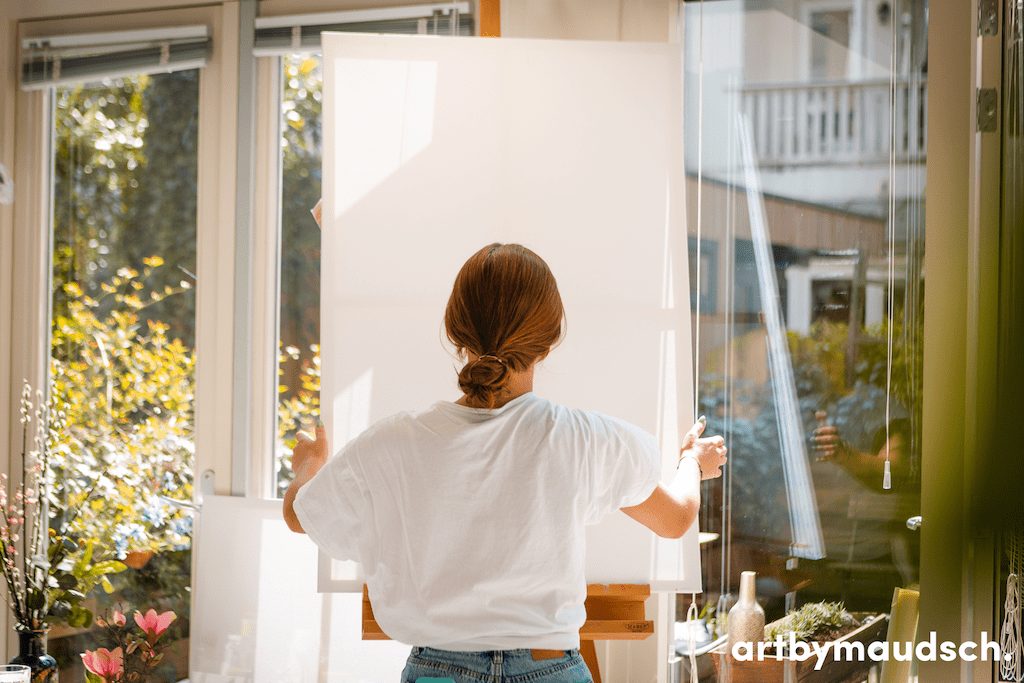
Art by Maudsch uses expert artists to hand paint each piece they sell. They use a mixture of mediums, either oil or acrylic paints. In addition, they use high-quality cotton canvases to create paintings using their network of professional artists.

Paintings are created to match your needs, then shipped worldwide free of charge. You can view and approve your painting online before committing to buy it. They have already gathered over three thousand satisfied clients, who each now own a piece of unique Amsterdam artwork. 

How does it Work?

The artworks are produced as original pieces and listed on the site with this seller. You can browse through the different sections to find art that matches your theme, space, or color scape. Next, you select the piece you would like to buy, and an artist paints it for you. Paintings are made entirely to order, and a painting purchased from Art by Maudsch is far more unique and exciting than mass-produced prints from any other outlet.

Framed by professionals

If you choose a framed painting, which we recommend you do, it will be framed by skilled professionals. The framing facility used by Art by Maudsch is also located in the Netherlands and produces frames from the highest-quality Czech pine wood. The framed pieces are delivered to your doorstep, ready to hang.

Canvas Sets from Art by Maudsch

Canvas sets are the ultimate way to decorate a designer home. They allow you to mix one art piece throughout several rooms or place many canvases on the wall to make up a single picture. Canvas sets are increasingly popular, allowing a pop of creative expression in any home. But, of course, the best part about a canvas set from this team of designers is that they are unrivaled in taste and style. They have been handmade for you by some of the finest modern artists in the world. Art by Maudsch is shipped to you from one of the best-known artistic cities on the planet.

Amsterdam & Art, a great combination, fueled by ArtbyMaudsch. 

What is the first thing that comes to mind when you hear ‘Amsterdam’? Maybe it’s the canals, the tolerance, or even the Red Light District! But did you know that Amsterdam was, in the Dutch Golden Age, the epicenter of world-renown art? Famous master artists like Rembrandt van Rijn, Johannes Vermeer, Frans Hals, and of course Vincent van Gogh all lived and worked in this beautiful city.
With many museums and statues to honor them around the city, their vision, expertise, and philosophy reverberate throughout older and future generations.

Spread the message

Art By Maudsch, based in Amsterdam, saw the big positive impact that art had on the population and the city. They acknowledged that art can be the bearer of timeless ideas and values and blissful beauty. Art can inspire people, spark new ideas or create a conversation between different people. With the many merits that art has to offer, Art By Maudsch felt the urge to share these with the whole wide world! 

Personal Adjustments

By offering handmade, original art pieces at fair prices online, they make pure, handmade art available worldwide. Sure, a printed painting is nice and affordable, but a real handmade artwork is something different! With a great communication center, available day and night, and even an option to make personal adjustments to the pieces, Art By Maudsch feels personal and as if you are in direct contact with the artists themselves. 

Canvas Sets

Because art is subjective, different people like different styles of art, the possibility to make personal adjustments can really help you find the exact piece for your home interior. And Art By Maudsch takes it even one step further, offering a variety of Canvas Sets. These sets consist of multiple, separated artworks with the same atmosphere, that you can freely adjust and style accordingly to match the atmosphere of your home interior perfectly.

Art By Maudsch is therefore more than just an online gallery, it is an experience where the professional team takes you by the hand in the search of your ultimate, handmade art piece. From the city where it all started, right to your doorway and without any costs whatsoever! 

Dave Verhoeven

Amsterdam

ArtbyMaudsch

Written in partnership with Aggrandize

YNACIO Releases Two New Art Pieces

HARDIN, Mont., Dec. 9, 2021 /PRNewswire/ — Ynacio, an artist from eastern Montana, gives us a rare glimpse into his soul as he explains the journey that led him here and the inspiration for his unique artwork. He says, “As I begin to paint I’m looking at the kitchen counter of my double-wide trailer asking God, what are you sending me tonight? As I paint, I’m pursuing what God put into me. I put Him first in my life and everything I do, my gift comes from Him and Him alone. I’m self-taught, I’ve never taken an art lesson in my life.”

“I was homeless for years,” he goes on, “eating free bread or nothing, living with no heat or water, in an abandoned building at -40 degrees, and today I’m a homeowner. I was an alcoholic, drinking until I blacked out, but I’m clean and sober today. Now I help other recovering alcoholics to fight their demons. I was sexually abused for years as a child by evil men who were supposed “men of faith”. All of this about destroyed me, but the human will to live and God kept me alive.

Today I talk with people about what I went through and I believe it helps them. Why? Because I truly understand their situations. I hope others can find the same healing and peace I have through God and my artwork.

When you look at these two pieces or my other work online, remember what you see is being finger painted in the dark, by a 50-year-old guy who’s gone through hell and back, praising almighty God because He’s in control.”

Displayed here are two of his pieces with descriptions given in his own words:

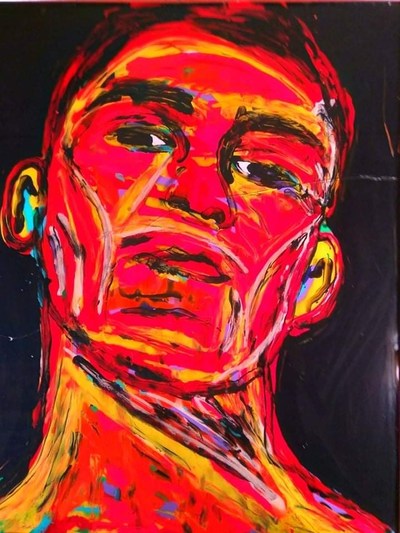
“His whole life, Broken has been told he would never be anything and he’s accepted it. Although he was created by a God who gave him so much potential he listens to the voices in his head and that’s what broke him. Broken is like many of us; he believes it’s easier to fade away than to fight. He is absolutely worth fighting for but he doesn’t see it in himself. Look into his eyes. Feel his pain. Let him speak to you. But don’t become him. I love Broken and I know the world will love him, he just doesn’t love himself.”

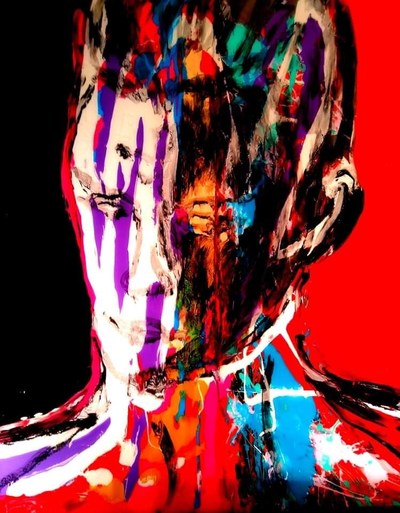
“When this piece came to life he didn’t say anything. He just walked out of the darkness as you see him. I poured my soul into this piece and felt nothing in return. Some pieces speak and some pieces just remain still and I feel nothing. “Man” was that piece. Look at Man and take what you want, or give to him what you choose. But honestly, he doesn’t care either way, he’s just Man.”

To learn more about the artist, view a wider variety of his work, or speak with a sales representative please join us on social media pages or visit our website.

Instagram: ynacioart

Facebook: ynacio

Website: Ynacio.com

Media Contact:
Devin Foy
801-404-4721
[email protected]

SOURCE YNACIO

The Art of the Deep Fake

“MY WORK IS about telling the truth, about capturing it, about showing it and about presenting it,” writes the Norwegian photojournalist Jonas Bendiksen in an introductory essay to The Book of Veles, his latest volume of photographs. “The truth is what you see, and it’s the essence of photography.”

In 2019 and again in early 2020, just before the onset of the pandemic, Bendiksen traveled to the small city of Veles on the Vardar River in North Macedonia. The trips were inspired by a series of press reports, beginning in the late stages of the 2016 US presidential campaign, which revealed that Veles was a major source of the fake news stories flooding Facebook and other social media sites. Scores of young people in the impoverished city had discovered that they could make a decent living by fabricating and circulating stories celebrating Donald Trump and denigrating Hillary Clinton.

In his essay, Bendiksen reports on meeting several of the most successful scammers, some of whom were working out of small offices with teams of colleagues. None of them expressed any interest in, much less regret about, the social ramifications of their work. To them, the fractious political situation in the United States was just a convenient opportunity to attract an online audience and earn ad revenues. “I support Trump for a few reasons,” a young man named Alex explained to Bendiksen. “One, he makes money. Two, he makes Americans happy. Third, he makes money quickly.”

Any attempt to curb fake news is doomed to fail, Alex went on to say. “There are too many haters on the net, and too many fake news sites, and fake news is the new truth. The main thing is that we believe in freedom of speech.”

Bendiksen’s book presents dozens of haunting images of the city and its inhabitants. A man leans out of a window of a large apartment block, a pair of satellite dishes hanging nearby. A woman sits on an unmade bed, gazing into the screen of a laptop. Two lovers embrace under a highway overpass. Soldiers stand smoking behind a barbed-wire fence. A bear wanders past a graveyard at the edge of town. Another bear drinks from a dirty stream.

Grainy and dimly lit, the images are eerie, poignant, and beautiful. They’re also fake.

Bendiksen did make two trips to Veles, but he didn’t photograph any people. He shot pictures of empty buildings and deserted cityscapes, and when he returned home to Norway he used video-game-production software to transform the images into three-dimensional renderings. He then downloaded digitized, 3D images of models from the web and placed them inside the scenes, carefully adjusting their poses, clothing, and lighting to make everything look as realistic as possible. Finally, he transformed the renderings back into two-dimensional images. The “photographs” that appear in the book are, essentially, screen grabs from a video game that doesn’t exist.

Bendiksen’s introductory essay, too, is a fake. He didn’t write any of it. Instead, he fed existing news stories about Veles and social media fraud into GPT-2, a software program that employs machine-learning algorithms to generate fake text, and used a variety of prompts to get the program to spit out made-up stories on the topics he wanted to cover. He pieced bits of the stories together, including the entirely fictional interview with “Alex,” to produce the essay. “My work is about telling the truth”: those words aren’t Bendiksen’s; they’re the words of a computer.

When The Book of Veles appeared in July, Bendiksen assumed that readers would see through his ruse. He went out of his way to circulate the book and its images among professional photographers, confident that they would quickly realize the photos were fabrications. He was wrong. His work earned praise but not suspicion. Anxious to come clean, he created a fake Twitter account under the name “Chloe Miskin” and, in early September, used it to raise doubts about his photographs. That didn’t work, either. Finally, in an interview posted on the website of his agency, Magnum Photos, in late September, he confessed to the deception. He also explained his motivation:

I started to ask myself the question — how long will it take before we start seeing “documentary photojournalism” that has no other basis in reality than the photographer’s fantasy and a powerful computer graphics card? Will we be able to tell the difference? How hard is it to do? How skilled will our own community of photographers and editors be in sniffing out what are deep fakes and what is real? I was so frightened by what the answers would be that I decided to try to do this myself.

When you read The Book of Veles now, knowing it’s a fake, the artifice jumps out at you. The facial features of the people in the photos look slightly plastic, and many of their poses feel unnatural, as if their bones were flexible rather than rigid. Some of the pictures, such as one of a girl floating across an otherwise abandoned public swimming pool on an inflatable unicorn in winter, come off as ludicrous. Bendiksen’s essay reads like a cut-and-paste job, marked by clumsy phrasing and ungainly transitions. And, in the book’s concluding acknowledgments section, the author slyly lists the image-manipulation tools he used. “What fun toys,” he comments.

The fact that no one spotted the forgery underscores just how easy it is to fool people, even experts. We humans want to believe whatever’s presented to our senses through the media, particularly when it takes the form of images. “Photographs furnish evidence,” wrote Susan Sontag in her 1977 classic On Photography. “A photograph passes for incontrovertible proof that a given thing happened. The picture may distort; but there is always a presumption that something exists, or did exist, which is like what’s in the picture.” Take away that presumption, and our ideas about existence get tenuous fast.

¤

“Images are powerful,” writes Noah Giansiracusa, a Bentley University mathematics professor, in How Algorithms Create and Prevent Fake News; “altering images is a method to alter reality and history.”

As Giansiracusa shows, image manipulation has been around as long as images have. A widely circulated photograph of Abraham Lincoln taken during the presidential campaign of 1860 was subtly altered by the photographer, Mathew Brady, to make the candidate appear more attractive. Brady enlarged Lincoln’s shirt collar, for instance, to hide his bony neck. In a portrait made to memorialize Lincoln after his assassination, the artist Thomas Hicks, working from earlier pictures, transposed Lincoln’s head onto a more muscular man’s body to make the fallen president look heroic. The body Hicks used was that of the pro-slavery zealot John C. Calhoun.

In 1950, in the midst of the Red Scare, Senator Joseph McCarthy’s staff circulated a fabricated composite image purporting to show Senator Millard Tydings, a fierce critic of McCarthy’s, in close conversation with the leader of the American Communist Party, Earl Browder. Historians suspect that the photo contributed to Tydings’s defeat in his reelection campaign that year.

Opponents of John Kerry’s 2004 presidential bid pulled a similar stunt. They made a composite photo showing Kerry standing beside the controversial actress Jane Fonda at a rally opposing the Vietnam War. The photo was widely accepted as real, even earning a mention in a New York Times article about Kerry’s youthful activism. Early this year, after Kerry joined the Biden administration, the same picture began circulating again, this time on Facebook.

Photos don’t need to be doctored to mislead. They need only be placed into a false context. During the Black Lives Matter protests in 2020, the Trump reelection campaign posted an ad featuring two side-by-side pictures. One showed the president meeting with police officials, with the caption “Public Safety.” The other showed police being attacked by a mob, with the caption “Chaos & Violence.” The timing of the ad implied that the latter photo was taken at a BLM protest, but it was actually taken at a pro-democracy rally in the Ukraine in 2014. The out-of-context ploy works equally well with videos. Giansiracusa points to a horrifying clip of a person being burned alive that’s been used, inaccurately, to back up claims of atrocities in at least four countries.

Such examples of images that are altered or otherwise falsified using traditional techniques are now referred to as shallow fakes. That’s to distinguish them from the deep fakes being generated by computers using machine learning and other artificial-intelligence techniques. The process of creating a deep fake is complicated, to say the least. In simple terms, it begins by teaching a computer to identify an object in a digitized image — a human face, say — by showing it many examples of that object. (The computer doesn’t actually learn what a face looks like, of course; it learns to recognize a pattern of pixels — a statistical pattern — that has a high probability of being a face.) The computer can then alter the appearance of a face, by changing the pattern of pixels, while ensuring that it will still be recognized as a face. It can also replace one person’s facial features and expressions with another person’s. And it can generate an image of an entirely new face — a face that has never existed — by producing a new array of pixels that fits the statistical model.

Deep fakes began to appear on social media about five years ago. Transposing a celebrity’s face onto a porn star’s body proved to be the most popular early use of the technology, with the resulting photos and videos appearing widely on sites like Reddit. Giansiracusa points to a 2019 survey that found that 96 percent of the deep fakes on the net at the time were “face-swap pornography.” Since then, deep fakes have proliferated — and become much more convincing. On TikTok, a series of videos featuring a strikingly realistic, but completely fake, Tom Cruise has been watched by millions.

The high-tech forgeries are also becoming much easier to create, thanks to technical advances and a welter of free production apps. No longer restricted to titillation and entertainment, deep fakes are starting to be used in politics, crime, and espionage. In March of this year, the FBI warned that “malicious actors” would soon begin using “synthetic content” as a tool for propaganda and cyber attacks.

Machine learning is also being applied to the production of bogus text, as Bendiksen’s essay illustrates. By scanning the internet’s enormous repository of prose, a computer can learn how words fit together to create sentences and paragraphs. It can build an ever more accurate mathematical model of how language works. Again, the computer’s understanding is purely a matter of statistics — it has no sense of meaning — but that’s enough to enable it to manufacture natural-sounding writing on any topic in any style. Give the machine a simple prompt — a headline, say, or a few introductory sentences — and it will in an instant output a reasonable facsimile of a human-penned article. Research cited by Giansiracusa suggests that most people can’t distinguish text written by GPT-3, the much more powerful successor to Bendiksen’s GPT-2, from the work of actual writers. And GPT-4, which will be much more powerful still, is already in development.

The spread of ever more realistic deep fakes will make it even more likely that people will be taken in by fake news and other lies. The havoc of the last few years is probably just the first act of a long misinformation crisis. Eventually, though, we’ll all begin to take deep fakes for granted. We’ll come to take it as a given that we can’t believe our eyes. At that point, deep fakes will start to have a very different and perhaps even more pernicious effect. They’ll amplify not our gullibility but our skepticism. As we lose trust in the information we receive, we’ll begin, in Giansiracusa’s words, to “doubt reality itself.” We’ll go from a world where our bias was to take everything as evidence — the world Sontag described — to one where our bias is to take nothing as evidence.

The question is, what happens to “the truth” — the quotation marks seem mandatory now — when all evidence is suspect?

¤

Bendiksen borrowed the title of his book from an ancient manuscript, written on thin wooden boards bound together with leather straps, that dates back more than a thousand years. The manuscript is said to have been discovered by a soldier in a bombed-out castle in the Ukraine in 1919. The soldier later gave it to a Russian scientist named Yuriy Mirolubov, who restored the boards, photographed them, and translated their words into modern Russian. The manuscript provides accounts of the god Veles, a prominent deity in Slavic mythology. Known as a shapeshifter, a magician, and a trickster, Veles would often visit the mortal world in the form of a bear, making mischief wherever he went.

The ancient Book of Veles shares something else with its namesake: it’s a fake. Historians now believe the manuscript was forged, probably by Mirolubov, sometime in the middle of the 20th century. Some members of contemporary neo-pagan cults nevertheless continue to consider the book a holy text.

In his own Book of Veles, Bendiksen intersperses passages from the old manuscript among his photographs. He generated the passages the same way he generated the essay: with GPT-2. Technically speaking, they’re deep fakes of shallow fakes, or deep shallow fakes. On one level, the passages are just another of Bendiksen’s tricks — more mischief. As he explains in his Magnum interview, “Stuff like this always gets me interested: when stories start layering up and weaving themselves together in surprising ways.” But the references to the pagan god also add an unexpected resonance to the photos. By drawing mythology into his work, Bendiksen is suggesting something profound about the nature of truth and the representation of reality.

Myths are works of art. They provide a way of understanding the world that appeals not to reason but to emotion. What’s most pleasing to our sensibilities — what’s most beautiful, in other words — is what’s true. Though it may have been shoved aside by the Enlightenment’s stress on rationality and objectivity, mythology’s subjective and fundamentally aesthetic way of defining what’s true never went away. Now, after a few centuries on the periphery, it seems to be moving back into the mainstream. Once again, truth is becoming an aesthetic construct.

Think about the growing popularity, in QAnon circles and elsewhere, of extraordinarily strange conspiracy theories. They only make sense when understood as myths. Believing that Washington politicians are vampiric pedophiles operating out of a neighborhood pizza parlor, or that world leaders like George W. Bush and Queen Elizabeth II are extraterrestrial “lizard people” bent on enslaving the human race, is no different from believing that a chaos-sowing god stalks the Earth in the form of a bear. When all the evidence presented to our senses is unreal, then strangeness becomes a criterion of truth. The more uncanny the story, the more attractive and convincing it becomes.

In creating beautiful photographs that subvert the documentary tradition of photography and call into question our assumptions about how we perceive reality, Bendiksen has opened a door onto a weird and unsettling future. “Beauty is truth,” wrote Keats, and as we all know, beauty is in the eye of the beholder.

¤

Nicholas Carr is the author of several books on technology and culture, including The Shallows, The Glass Cage, and Utopia Is Creepy. He is a visiting professor of sociology at Williams College.

Best Art Books of 2021

In a lockdown year, with travel reduced, there was no movable feast quite like an art book. Art is made by all sorts of people, everywhere, all the time, along many different paths, some of which are illuminated by these intriguing publications chosen by our critics, Pay Per Touch.


The maverick American artist Ray Johnson (1927-1995), who managed to be nowhere and everywhere in the art world through his invention of Mail Art, was lucky in his longtime friend William S. Wilson, to whom, over 60 years, he gave thousands of letters, collages, drawings and clippings. Wilson saved every last scrap, and a jampacked sampling of them makes up this gold mine of a book, edited and curated by Caitlin Haskell with Jordan Carter. Funny, biting, morbid, it’s a page-turner for sure, and accompanies a show at the Art Institute of Chicago through March 22). (Art Institute of Chicago, distributed by Yale University Press)

Edited by the curator Valerie Cassel Oliver, this catalog for one of the outstanding exhibitions of the season — originating at the Virginia Museum of Fine Arts, it’s now in Houston — proposes that the culture of the African American South, as defined by music and vernacular art, is the bedrock of American culture itself, with a strong influence on new art today. The book vividly illustrates and deepens the show’s powerful argument. (Virginia Museum of Fine Arts, distributed by Duke University Press)

This book lovingly excavates the career of a Greek modernist painter who designed sets for Maria Callas and kept a Greek Classical figurative tradition alive in paintings of homoerotic nudes. Tsarouchis (1910-1989) was both too radical and too conservative for the art world of his time and fell into oblivion outside of Greece. Edited by Niki Gripari and Adam Szymczyk (and including a selection of the artist’s writings, this tender tribute brings him back. (Sternberg Press)

The London exhibition by this name reunited six major mythological paintings that Titian produced for the Spanish court. One of them, “The Rape of Europa,” belongs to the Isabella Stewart Gardner Museum in Boston, where the show, now called“Titian: Women, Myth & Power” is making its final stop (through Jan. 2.) A slender Gardner-issued publication devoted to that picture is an indispensable companion volume to the handsome London catalog. (National Gallery, London; published by Yale University Press)

Edited by Christine Macel and Karolina Ziebinska-Lewandowska and produced for a major show at the Centre Pompidou, Paris, this book documents the contributions of more than 100 female painters, sculptors, photographers and performers to the history of modernist abstraction and, by including artists from Asia and South America, demonstrates that abstraction itself has always been a global phenomenon. That many worthy figures aren’t included only makes the case for a continuing corrective art history stronger. (Thames and Hudson)

Edited by Howie Chen, this compendium brings together archival documents related to the formation, in New York City in 1990, of Godzilla, a collective of artists and curators intent on pointing out the exclusion of Asian American artists from the contemporary art world and pushing for their presence in that world. The book includes protest letters, news releases, and the minutes of group meetings. The result is a how-to in advocacy politics, a study in the complexities of identity politics, and a chorale of treasurable voices. (Primary Information)


Following the Guggenheim’s 2018 reveal of the mystical abstractions of Hilma af Klint, the Museum of Modern Art, Kunstmuseum Basel and Tate Modern further expand the mostly male ranks of European modernism to include Sophie Taeuber-Arp, one of its greatest polymaths (and colorists), whose egalitarian view of art and craft proved that abstractions in woven wool can trounce the oil on canvas kind. Edited by Anne Umland and Walburga Krupp. (Museum of Modern Art/Kunstmuseum Basel)

The painting on the cover of this exceedingly large volume recently set an auction record for the artist, but don’t let that spoil it for you. This lavish book, edited by Luis-Martín Lozano, contains many rarely seen paintings bolstered by numerous drawings, extensive photographs from her life and reproductions of related works by other artists. (Taschen)

This catalog, with a leading essay by the curator Katherine Jentleson, accompanies the largest show of the great visionary Nellie Mae Rowe (1900-1982), painter, sculptor, doll-maker, environment-builder and Christian, at the High Museum of Art in Atlanta (through Jan. 9). Some of her drawings announce “God is Not Dead,” in bold colorful cursive writing. Rowe is the fourth great American outsider artist to receive a major catalog since 2007, after Martin Ramírez, Bill Traylor and Joseph Yoakum. May the trend continue. (DelMonico Books — D.A.P., New York)

This small cornucopia of a book, edited by Alison M. Gingeras, accompanies the first American exhibition of the formidable Polish artist and activist Erna Rosenstein (1913-2004) at Hauser & Wirth (through Dec. 23). It shows the stunning variety of her work, not just its many shades of Surrealism and biomorphic abstraction, but also its affinities with Fluxus, Nouveau Realism and Art Povera. Her life and work are detailed against the vivid tapestry of postwar Eastern European history — itself an education. (Hauser & Wirth Publications)

Doris Lee (1905-1983) worked simultaneously as a fine and a commercial artist, illustrating “The Rodgers and Hart Songbook,” while exhibiting paintings with the still-extant AAA Galleries in Manhattan. The paintings, which combined Grandma Moses with the textured color fields of Milton Avery cheerfully reflect this duality. This catalog, by Melissa Wolfe, and a traveling show at the Westmoreland Museum of American Art in Greensburg, Pa., (through Jan. 9) should begin to end her obscurity. (Westmoreland Museum of Art and Giles Ltd., London)


This year’s unhappy Tokyo Olympics at least leave an architectural legacy: the lean, low-impact New National Stadium, made of the unfinished cedar that Kengo Kuma has made his authorial and ecological signature. This immense architectural tome — spanning three decades, weighing in at 11 pounds — establishes once and for all that sustainability and style need not be set at odds. New photography highlights his serene Nezu Museum and brawny V & A Dundee; temporary experiments in New York and Milan; and a Fukuoka storefront whose 2,000 intersecting cedar struts frame the world’s most elegant Starbucks. (Taschen)

He first declared a bicycle wheel to be a work of art in 1913, but it took nearly half a century — with the 1959 publication of Robert Lebel’s catalogue raisonné of his early painting, his ready-mades and his cryptic notes — for the New York art world to crown the discreet and debonair Duchamp as King Marcel. Long out of print, it’s now been re-editioned and bundled with a supplement that maps the influence of Lebel’s book over the decades, all housed in a handsome slipcase. (Hauser & Wirth Publishers)

Few photobooks have the mythic status of “Chizu” (“The Map”), first published in Tokyo in 1965, for which the Japanese photographer Kikuji Kawada shot worn flags, dented Lucky Strike boxes and the walls of the Atomic Bomb Dome in Hiroshima as haunted abstractions in blown-out, high-contrast black-and-white. The 1965 edition is a single volume with gatefolds — but a maquette in the New York Public Library shows that Kawada initially conceived “Chizu” as a two-volume project. The N.Y.P.L. curator Joshua Chuang and the historian Miyuki Hinton have overseen this painstaking reproduction, while a new bilingual supplement offers further perspectives on this rarest and most mysterious artistic response to the nightmare of World War II. (Mack)

Statues also die; some get a second life. The year’s most beautiful exhibition, at the Capitoline Museums in Rome, brought to public view the world’s finest privately owned Greek and Roman sculptures — and its catalog, edited by the archaeologists Salvatore Settis and Carlo Gasparri, is as handsome as it is learned. But if it’s Roman grandeur you’re after, get the lush coffee table book “Villa Albani Torlonia,” for which Massimo Listri photographed the aristocratic family’s Neoclassical mansion, its chipped goddesses and rusting heroes standing against acres of trompe l’oeil marble and gold leaf. (Both, Rizzoli)

The Impressionists were gripped by social life at the opera, the cafe, the seaside; the Nabis, two decades later, saw just as much modernity at home. This catalog of an exhibition at the Cleveland Museum of Art and Portland Art Museum (through Jan. 23) presents the sometimes tender, sometimes stifling domestic imagery of Maurice Denis, Félix Vallotton, Pierre Bonnard and — above all — Édouard Vuillard, whose dense, crosshatched scenes in the boudoir or at the kitchen table captured what one critic called “the daily tragedy and mystery of ordinary existence, and the latent poetry of things.” The curators Mary Weaver Chapin, Heather Lemonedes Brown and other contributors offer insight into domestic music performances, home garden design, and even pet ownership in fin-de-siècle Paris. (Yale University Press)

The seventh continent is not frozen but in constant flux — and changing faster than ever thanks to us. Probe the 1,000 engrossing pages of this landmark publication, edited by Giulia Foscari and UNLESS and inaugurated at this year’s Venice Architecture Biennale, and you will learn everything you never knew you needed to know about human society on an uninhabited landmass: Antarctic law enforcement, Antarctic communication technology, Antarctic water management. Terra Australis stands here as a nearly utopian built environment, and the book concludes with an indispensable “Archive of Antarctic Architecture,” with site plans and photography of more than a century’s efforts to inhabit the most extreme of environments. (Lars Müller Publishers)

Kara Walker offers an extraordinary tome: some 650 drawings, sketches and texts from her archive since the 1990s. It’s all here — Trump, Obama, the plantation, sexual demand and degradation, all the American phantasmagoria of her famous silhouette works and monumental installations; but also clippings, notecards, dream diaries, the artist wrangling with the fetters of prominence and racial expectations. In an essay, Walker wonders why she kept all this stuff; there must have been “some urge to talk about it later, an urge toward radical openness that any proper and studied artist would prefer to keep in check.” It’s a treasure. (JRP Editions)

This volume showcases 17 photographers from nine countries, graduates of a 2008-18 mentorship program founded by Simon Njami, a respected curator (and co-editor of this book, with Sean O’Toole). A few have become recognized — Sammy Baloji, Lebohang Kganye — while others, like Gosette Lubondo, are emerging just now into the continent’s photo vanguard, with a full spectrum of documentary and conceptual approaches. Here, 13 essays by critics approach the subject by theme — “Knowledge,” “Fiction,” “Desire”— and broaden their discussion to other emerging photographers as well as the archive. It’s a generous approach that proposes African photography as a fertile and expansive field of collective inquiry. (Kerber)

In an exhibition this year at MoMA, Black architects and designers imagined interventions in 10 American cities that would not only make visible but repair the effects of anti-Black planning, policy and spatial violence. It was an important show, if dense and all-too-brief. Fortunately, the catalog (edited by Sean Anderson and Mabel O. Wilson) supplements these propositions with texts by prominent scholars and critics that give the project an open feel and cross-disciplinary weave. In preparing for the exhibition, the architects and designers formed the Black Reconstruction Collective, modeling the self-determination and liberation values they insist are necessary. (MoMA)

Shahzia Sikander is known for disruptions of the Indo-Persian miniature painting tradition, which she expanded compositionally and infused with feminist and political themes. Rich with essays and conversations (edited by Sadia Abbas and Jan Howard), this catalog accompanies an exquisite exhibition on her early career (1987-2003). It follows her training in Pakistan, move to the United States in 1993, and navigation of U.S. social and racial realities; it leaves off in the frenzy of the War on Terror. It proves instructive to re-examine those years through Sikander’s keen grasp and artistic choices. (Distributed for Hirmer Publishers by University of Chicago Press)

VISIT : https://paypertouch.com/