Beautiful Lies: The Art of the Deep Fake

“MY WORK IS about telling the truth, about capturing it, about showing it and about presenting it,” writes the Norwegian photojournalist Jonas Bendiksen in an introductory essay to The Book of Veles, his latest volume of photographs. “The truth is what you see, and it’s the essence of photography.”

In 2019 and again in early 2020, just before the onset of the pandemic, Bendiksen traveled to the small city of Veles on the Vardar River in North Macedonia. The trips were inspired by a series of press reports, beginning in the late stages of the 2016 US presidential campaign, which revealed that Veles was a major source of the fake news stories flooding Facebook and other social media sites. Scores of young people in the impoverished city had discovered that they could make a decent living by fabricating and circulating stories celebrating Donald Trump and denigrating Hillary Clinton.

In his essay, Bendiksen reports on meeting several of the most successful scammers, some of whom were working out of small offices with teams of colleagues. None of them expressed any interest in, much less regret about, the social ramifications of their work. To them, the fractious political situation in the United States was just a convenient opportunity to attract an online audience and earn ad revenues. “I support Trump for a few reasons,” a young man named Alex explained to Bendiksen. “One, he makes money. Two, he makes Americans happy. Third, he makes money quickly.”

Any attempt to curb fake news is doomed to fail, Alex went on to say. “There are too many haters on the net, and too many fake news sites, and fake news is the new truth. The main thing is that we believe in freedom of speech.”

Bendiksen’s book presents dozens of haunting images of the city and its inhabitants. A man leans out of a window of a large apartment block, a pair of satellite dishes hanging nearby. A woman sits on an unmade bed, gazing into the screen of a laptop. Two lovers embrace under a highway overpass. Soldiers stand smoking behind a barbed-wire fence. A bear wanders past a graveyard at the edge of town. Another bear drinks from a dirty stream.

Grainy and dimly lit, the images are eerie, poignant, and beautiful. They’re also fake.

Bendiksen did make two trips to Veles, but he didn’t photograph any people. He shot pictures of empty buildings and deserted cityscapes, and when he returned home to Norway he used video-game-production software to transform the images into three-dimensional renderings. He then downloaded digitized, 3D images of models from the web and placed them inside the scenes, carefully adjusting their poses, clothing, and lighting to make everything look as realistic as possible. Finally, he transformed the renderings back into two-dimensional images. The “photographs” that appear in the book are, essentially, screen grabs from a video game that doesn’t exist.

Bendiksen’s introductory essay, too, is a fake. He didn’t write any of it. Instead, he fed existing news stories about Veles and social media fraud into GPT-2, a software program that employs machine-learning algorithms to generate fake text, and used a variety of prompts to get the program to spit out made-up stories on the topics he wanted to cover. He pieced bits of the stories together, including the entirely fictional interview with “Alex,” to produce the essay. “My work is about telling the truth”: those words aren’t Bendiksen’s; they’re the words of a computer.

When The Book of Veles appeared in July, Bendiksen assumed that readers would see through his ruse. He went out of his way to circulate the book and its images among professional photographers, confident that they would quickly realize the photos were fabrications. He was wrong. His work earned praise but not suspicion. Anxious to come clean, he created a fake Twitter account under the name “Chloe Miskin” and, in early September, used it to raise doubts about his photographs. That didn’t work, either. Finally, in an interview posted on the website of his agency, Magnum Photos, in late September, he confessed to the deception. He also explained his motivation:

I started to ask myself the question — how long will it take before we start seeing “documentary photojournalism” that has no other basis in reality than the photographer’s fantasy and a powerful computer graphics card? Will we be able to tell the difference? How hard is it to do? How skilled will our own community of photographers and editors be in sniffing out what are deep fakes and what is real? I was so frightened by what the answers would be that I decided to try to do this myself.

When you read The Book of Veles now, knowing it’s a fake, the artifice jumps out at you. The facial features of the people in the photos look slightly plastic, and many of their poses feel unnatural, as if their bones were flexible rather than rigid. Some of the pictures, such as one of a girl floating across an otherwise abandoned public swimming pool on an inflatable unicorn in winter, come off as ludicrous. Bendiksen’s essay reads like a cut-and-paste job, marked by clumsy phrasing and ungainly transitions. And, in the book’s concluding acknowledgments section, the author slyly lists the image-manipulation tools he used. “What fun toys,” he comments.

The fact that no one spotted the forgery underscores just how easy it is to fool people, even experts. We humans want to believe whatever’s presented to our senses through the media, particularly when it takes the form of images. “Photographs furnish evidence,” wrote Susan Sontag in her 1977 classic On Photography. “A photograph passes for incontrovertible proof that a given thing happened. The picture may distort; but there is always a presumption that something exists, or did exist, which is like what’s in the picture.” Take away that presumption, and our ideas about existence get tenuous fast.

¤

“Images are powerful,” writes Noah Giansiracusa, a Bentley University mathematics professor, in How Algorithms Create and Prevent Fake News; “altering images is a method to alter reality and history.”

As Giansiracusa shows, image manipulation has been around as long as images have. A widely circulated photograph of Abraham Lincoln taken during the presidential campaign of 1860 was subtly altered by the photographer, Mathew Brady, to make the candidate appear more attractive. Brady enlarged Lincoln’s shirt collar, for instance, to hide his bony neck. In a portrait made to memorialize Lincoln after his assassination, the artist Thomas Hicks, working from earlier pictures, transposed Lincoln’s head onto a more muscular man’s body to make the fallen president look heroic. The body Hicks used was that of the pro-slavery zealot John C. Calhoun.

In 1950, in the midst of the Red Scare, Senator Joseph McCarthy’s staff circulated a fabricated composite image purporting to show Senator Millard Tydings, a fierce critic of McCarthy’s, in close conversation with the leader of the American Communist Party, Earl Browder. Historians suspect that the photo contributed to Tydings’s defeat in his reelection campaign that year.

Opponents of John Kerry’s 2004 presidential bid pulled a similar stunt. They made a composite photo showing Kerry standing beside the controversial actress Jane Fonda at a rally opposing the Vietnam War. The photo was widely accepted as real, even earning a mention in a New York Times article about Kerry’s youthful activism. Early this year, after Kerry joined the Biden administration, the same picture began circulating again, this time on Facebook.

Photos don’t need to be doctored to mislead. They need only be placed into a false context. During the Black Lives Matter protests in 2020, the Trump reelection campaign posted an ad featuring two side-by-side pictures. One showed the president meeting with police officials, with the caption “Public Safety.” The other showed police being attacked by a mob, with the caption “Chaos & Violence.” The timing of the ad implied that the latter photo was taken at a BLM protest, but it was actually taken at a pro-democracy rally in the Ukraine in 2014. The out-of-context ploy works equally well with videos. Giansiracusa points to a horrifying clip of a person being burned alive that’s been used, inaccurately, to back up claims of atrocities in at least four countries.

Such examples of images that are altered or otherwise falsified using traditional techniques are now referred to as shallow fakes. That’s to distinguish them from the deep fakes being generated by computers using machine learning and other artificial-intelligence techniques. The process of creating a deep fake is complicated, to say the least. In simple terms, it begins by teaching a computer to identify an object in a digitized image — a human face, say — by showing it many examples of that object. (The computer doesn’t actually learn what a face looks like, of course; it learns to recognize a pattern of pixels — a statistical pattern — that has a high probability of being a face.) The computer can then alter the appearance of a face, by changing the pattern of pixels, while ensuring that it will still be recognized as a face. It can also replace one person’s facial features and expressions with another person’s. And it can generate an image of an entirely new face — a face that has never existed — by producing a new array of pixels that fits the statistical model.

Deep fakes began to appear on social media about five years ago. Transposing a celebrity’s face onto a porn star’s body proved to be the most popular early use of the technology, with the resulting photos and videos appearing widely on sites like Reddit. Giansiracusa points to a 2019 survey that found that 96 percent of the deep fakes on the net at the time were “face-swap pornography.” Since then, deep fakes have proliferated — and become much more convincing. On TikTok, a series of videos featuring a strikingly realistic, but completely fake, Tom Cruise has been watched by millions.

The high-tech forgeries are also becoming much easier to create, thanks to technical advances and a welter of free production apps. No longer restricted to titillation and entertainment, deep fakes are starting to be used in politics, crime, and espionage. In March of this year, the FBI warned that “malicious actors” would soon begin using “synthetic content” as a tool for propaganda and cyber attacks.

Machine learning is also being applied to the production of bogus text, as Bendiksen’s essay illustrates. By scanning the internet’s enormous repository of prose, a computer can learn how words fit together to create sentences and paragraphs. It can build an ever more accurate mathematical model of how language works. Again, the computer’s understanding is purely a matter of statistics — it has no sense of meaning — but that’s enough to enable it to manufacture natural-sounding writing on any topic in any style. Give the machine a simple prompt — a headline, say, or a few introductory sentences — and it will in an instant output a reasonable facsimile of a human-penned article. Research cited by Giansiracusa suggests that most people can’t distinguish text written by GPT-3, the much more powerful successor to Bendiksen’s GPT-2, from the work of actual writers. And GPT-4, which will be much more powerful still, is already in development.

The spread of ever more realistic deep fakes will make it even more likely that people will be taken in by fake news and other lies. The havoc of the last few years is probably just the first act of a long misinformation crisis. Eventually, though, we’ll all begin to take deep fakes for granted. We’ll come to take it as a given that we can’t believe our eyes. At that point, deep fakes will start to have a very different and perhaps even more pernicious effect. They’ll amplify not our gullibility but our skepticism. As we lose trust in the information we receive, we’ll begin, in Giansiracusa’s words, to “doubt reality itself.” We’ll go from a world where our bias was to take everything as evidence — the world Sontag described — to one where our bias is to take nothing as evidence.

The question is, what happens to “the truth” — the quotation marks seem mandatory now — when all evidence is suspect?

¤

Bendiksen borrowed the title of his book from an ancient manuscript, written on thin wooden boards bound together with leather straps, that dates back more than a thousand years. The manuscript is said to have been discovered by a soldier in a bombed-out castle in the Ukraine in 1919. The soldier later gave it to a Russian scientist named Yuriy Mirolubov, who restored the boards, photographed them, and translated their words into modern Russian. The manuscript provides accounts of the god Veles, a prominent deity in Slavic mythology. Known as a shapeshifter, a magician, and a trickster, Veles would often visit the mortal world in the form of a bear, making mischief wherever he went.

The ancient Book of Veles shares something else with its namesake: it’s a fake. Historians now believe the manuscript was forged, probably by Mirolubov, sometime in the middle of the 20th century. Some members of contemporary neo-pagan cults nevertheless continue to consider the book a holy text.

In his own Book of Veles, Bendiksen intersperses passages from the old manuscript among his photographs. He generated the passages the same way he generated the essay: with GPT-2. Technically speaking, they’re deep fakes of shallow fakes, or deep shallow fakes. On one level, the passages are just another of Bendiksen’s tricks — more mischief. As he explains in his Magnum interview, “Stuff like this always gets me interested: when stories start layering up and weaving themselves together in surprising ways.” But the references to the pagan god also add an unexpected resonance to the photos. By drawing mythology into his work, Bendiksen is suggesting something profound about the nature of truth and the representation of reality.

Myths are works of art. They provide a way of understanding the world that appeals not to reason but to emotion. What’s most pleasing to our sensibilities — what’s most beautiful, in other words — is what’s true. Though it may have been shoved aside by the Enlightenment’s stress on rationality and objectivity, mythology’s subjective and fundamentally aesthetic way of defining what’s true never went away. Now, after a few centuries on the periphery, it seems to be moving back into the mainstream. Once again, truth is becoming an aesthetic construct.

Think about the growing popularity, in QAnon circles and elsewhere, of extraordinarily strange conspiracy theories. They only make sense when understood as myths. Believing that Washington politicians are vampiric pedophiles operating out of a neighborhood pizza parlor, or that world leaders like George W. Bush and Queen Elizabeth II are extraterrestrial “lizard people” bent on enslaving the human race, is no different from believing that a chaos-sowing god stalks the Earth in the form of a bear. When all the evidence presented to our senses is unreal, then strangeness becomes a criterion of truth. The more uncanny the story, the more attractive and convincing it becomes.

In creating beautiful photographs that subvert the documentary tradition of photography and call into question our assumptions about how we perceive reality, Bendiksen has opened a door onto a weird and unsettling future. “Beauty is truth,” wrote Keats, and as we all know, beauty is in the eye of the beholder.

¤

Nicholas Carr is the author of several books on technology and culture, including The Shallows, The Glass Cage, and Utopia Is Creepy. He is a visiting professor of sociology at Williams College.

Inside Alicia Keys and Swizz Beatz’s Art Collection That Places a ‘Beautiful Black Face’ in Every Room of Their Home

Alicia Keys and her husband Swizz Beatz, whose real name is Keenan Dean, are one of entertainment’s hottest power couples. The pair are both heavily invested in music, and their synergy in creating long-lasting hits has solidified their names in the industry. Keys and Dean, who got married in 2010, share two children. The duo goes to great lengths to ensure their children see a bit of themselves in every part of the house.

Alicia Keys and Swizz Beatz ensure their children see a Black face in every room

Keys recently sat down with Marie Claire to talk about her longstanding music career while giving the publication a tour of her luxurious home. The architectural masterpiece boasts views of the Pacific Ocean as part of its appeal. It is also rumored to have been the inspiration behind Tony Stark’s bachelor pad in Iron Man.

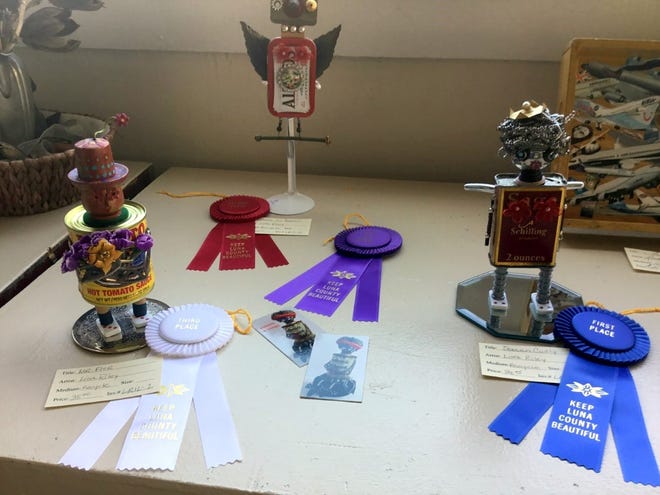
Keep Luna County Beautiful releases winners of Recycled Art Show

The Deming Art Council has announced the winners of this year's Keep Luna County Beautiful Recycled Art Show at the Deming Art Center, 100 S. Gold Street.

DEMING – Keep Luna County Beautiful and the Deming Art Council have grown in marriage with two goals in mind.

1. Bring art and culture to the communities of Deming, Columbus and Luna County.

2. Organize and execute beautification projects in Luna County in conjunction with the state-wide “Toss No Mas” campaign.

The Deming Art Council has provided a vehicle over the years for the KLCB program to showcase art work created by using recycled materials. In November, the DAC presents the KLCB Recycled Art Show at the Deming Art Center located at 100 S. Gold Street.

The center exhibits the art entries throughout the month of November and each artist must use 90 percent of recycled materials when creating each piece. Each artist can enter as many as three pieces of artwork and the show is judged by a panel of KLCB members.

When is a scientific experiment like a beautiful work of art?

There is a long tradition among scientists of comparing scientific models, images, theories and experiments to works of art. We are told that Albert Einstein’s theory of relativity, the double helix structure of DNA molecules, and images of colliding particles are beautiful, and that, just like works of art, they evoke in us aesthetic responses. Scientists themselves, like artists, are praised for their creativity, originality and aesthetic sensibility. Einstein, for one, regarded the American physicist Albert Michelson, who with Edward Morley co-designed the experiment to measure the velocity of Earth relative to the ether, as ‘the Artist in Science’, claiming that not only did Michelson care for devising a good experiment, he wanted his creations to be beautiful too.

So what does it mean for an experiment to be beautiful? Let us start with the example of Foucault’s pendulum, which allows us to illustrate three important ways in which an experiment can be beautiful. In 1851, the French physicist Léon Foucault devised a way of demonstrating that Earth rotates on its axis. He hung a heavy metal weight from a long cable fixed to the inside of the dome of the Panthéon in Paris. When he set this pendulum in motion, it slowly swung back and forth, tracing lines in sand placed beneath it. After some time, it became clear that the traces were not all in one line because of Earth’s rotation beneath the pendulum.

This pendulum was beautiful in an obvious visual sense – as a kind of kinetic sculpture with an almost mesmeric, slow, back-and-forth movement. Scientific equipment can indeed be beautiful, and often is. Take, for instance, chemical retorts, prisms, microscopes and complicated structures built in laboratories. Museums house beautifully crafted scientific instruments and equipment from the past because we can appreciate their aesthetic features. The phenomena we study in the experimental setup – such as copper sulphate crystals, rainbows produced by prisms, and the microscopic structure of cells – can be beautiful too. But what made Foucault’s pendulum a beautiful experiment is more than its visual beauty. Far more importantly, it showed the effects of Earth’s rotation, something important that hadn’t been demonstrated before, and it did this in a clever, imaginative and elegant way. The pendulum itself was beautiful, but the ultimate beauty of the experiment is a combination of its significance and its design.

It’s hard to identify the most beautiful experiment in science, but one of the most beautiful in biology was designed by the American geneticists Matthew Meselson and Franklin Stahl to discover how DNA replicates. What is it about this experiment that makes it beautiful? To understand this, first let us reflect on what the experiment set out to do. It was performed only a few years after one of the most exciting scientific breakthroughs of the 20th century: the discovery in 1953 of the double helix structure of DNA. With the structure of DNA established, the next question the scientific community needed to address was how DNA replicated. There were already three different hypotheses proposed: 1) conservative replication, according to which each of the two strands of the parent DNA molecule are replicated in the new one; 2) semi-conservative replication, according to which one strand of the parent DNA is conserved in the daughter DNA; and 3) dispersive replication, according to which the parent DNA chains break at intervals, with the parental segments combining with new segments to form the daughter DNA. Meselson and Stahl set out to give an answer to the question of how DNA replicates by designing an experiment that would decisively discriminate between the three proposed hypotheses.

In 1958, the two scientists published the results of that experiment. What they had done to determine the correct hypothesis on DNA replication was to feed bacteria nutrients containing a heavy nitrogen isotope that gets incorporated into the bacterial molecules through metabolising. They studied the genetic material through the next generations, knowing the rates at which bacteria multiply. Instead of using radioactive labelling of the DNA strands, which was common at the time, they decided to use density, and separated the heavy DNA from the light using density-gradient centrifugation. By studying the ratios of light, heavy and hybrid DNA that they obtained, Meselson and Stahl were able to eliminate the conservative and dispersive replication hypotheses, confirming that DNA in fact replicates semi-conservatively.

A further aspect of its aesthetic value is not only what this research taught us but also how it did so

One of the reasons why this experiment is celebrated in science is because it is an example of an experimentum crucis, or a ‘crucial experiment’. Such experiments are important; they deliver a decisive answer to a question. Usually, an experiment is considered crucial when it confirms a hypothesis among alternative competitors, and thus settles a dispute. It is from this ability to deliver a decisive answer to the question of how DNA replicates that the Meselson-Stahl experiment can be considered to derive its beauty. The results are taken to have been clear and straightforward, to have decisively spoken in favour of one of the contender hypotheses, and to have dismissed the alternatives. In his book Beauty and the Beast (1999), the German historian of science Ernst Peter Fischer argues that ‘the Meselson-Stahl experiments speak … for themselves and made all further commentary superfluous’. In his history Meselson, Stahl, and the Replication of DNA (2001), Frederic Lawrence Holmes further argues that the simplicity and clarity of the result makes this experiment easily presentable even to students, serving as an exemplar experiment for science education.

The above considerations focus on what the Meselson-Stahl experiment did, the significance of its results, but a further aspect of its aesthetic value is not only what this research taught us but also how it did so, and this later consideration concerns its design. The Meselson-Stahl experiment is regarded as having an elegant and apt design that is optimally suited for the purpose it set out to achieve. Following the reasoning behind their experimental setup reveals the ingenious beauty of the design that the scientists created. By making the genetic material initially heavy and then light, Meselson and Stahl could extract and measure its weight through the next generations. It is this idea that makes their design original and elegant, and they used the optimal materials and techniques for the job. As such, their simple experiment integrates innovative and creative thinking, and shows aptness by delivering on what the elegant experiment was designed to do, by conclusively deciding which hypothesis was correct.

Having established that the beauty of experiments lies in the elegance and simplicity of their design, the significance of their results and the creative thinking of their designers, I now want to consider whether these aesthetic ideals have carried over to contemporary experiments in science.

There is a clear asymmetry between experiments of a century ago and experiments today. Past experiments, such as the Meselson-Stahl experiment, often involved a few scientists in a room, relatively cheap equipment, and generally the results could be perceived or established without lengthy interpretative work. Experiments today look rather different. Take, for instance, CERN’s experiments at the Large Hadron Collider (LHC) near Geneva, which not too long ago made one of the most significant discoveries in the history of particle physics: the detection of the Higgs boson that was predicted by the Standard Model. This experiment involves highly complex machinery (which has its own kind of beauty) and data analysis; it is the result of collaborative work between thousands of scientists; and the very boundary of the experiment transcends the borders of countries. Given their complexity and size, do large-scale experiments fit with previous aesthetic ideals? Have they become aesthetically disvalued, or can they still be praised for their aesthetic features?

It is undeniable that such contemporary experiments are highly complex: from the machinery they use to the data they produce, they can overwhelm with their size and setup. However, perhaps there is still scope to assign a similar aesthetic value to them as to experiments from a century ago. It seems to me that, despite the complexity behind large-scale experiments, design and aptness continue to be the subject of aesthetic appreciation, and so is the creativity and originality exhibited in the experiment’s design. This is despite the fact that the creativity exhibited in the experimental design is now better ascribed to the collective thinking of the community, rather than necessarily to a specific individual, and the optimality and aptness of the design is concealed beneath the complexity of the experimental setup and the machinery involved.

The appreciation of beauty in science, and in art, is not necessarily immediate to us

Even if we could make the argument that similar aesthetic features get praised during different experimental traditions, there is a further difference between experiments from a century ago and those of today that perhaps should force us to reconsider the claim of similarity. The difference concerns the way in which we arrive at experimental results. As mentioned earlier, one of the aspects we can appreciate in the experiments on DNA replication is their immediacy: we can observe the results in a ‘singular historical event’, as Holmes noted. Such immediacy was characteristic of many, although certainly not all, early experiments. Let’s go back to the experiments that natural philosophers performed with the air pump, which allowed them to study many phenomena with a newly invented instrument that could extract air from a cylinder.

As the painting An Experiment on a Bird in the Air Pump (1768) by Joseph Wright of Derby depicts, one could immediately perceive the effect on the living creature when the air from the cylinder was extracted using the air pump, which in turn generated a variety of responses in the audience, from fascination and awe to terror. Similarly, we can see the rainbow through Isaac Newton’s prisms, and we can see the bands of light-, heavy- and intermediate-density genetic material in the Meselson-Stahl experiments.

An Experiment on a Bird in the Air Pump (1768), by Joseph Wright of Derby. Courtesy the National Gallery, London

But is there anything immediate when it comes to detecting particles and forces in a huge particle accelerator such as those detected by the LHC? Is there any sense in which the experimenter perceives the result in a ‘singular historical event’? Large-scale experiments often involve lengthy statistical data analysis before the experimental scientists can agree whether the data collection indicates an ‘event’ and whether the event constitutes a discovery. But this asymmetry between experiments with immediately perceivable results and those whose results involve time-consuming analysis, while noteworthy, is not surprising. It simply shows us that the appreciation of beauty in science, and in art, does not always involve perceptual features, and the aesthetic response is not necessarily immediate to us. After all, while many paintings and sculptures might evoke in us an immediate aesthetic response, this is certainly not necessary, and is certainly not the case when we consider artworks such as novels and concertos. We need some time and work to get through an entire novel or a concerto before we can fully appreciate its beauty and aesthetic significance more generally. Similarly with the results of many, especially very complex, experiments, it is ultimately the appreciation of the interplay between design and the significance of the result that provokes the aesthetic response.

So far, we have seen that design is an integral part of our aesthetic appreciation of experiments, but we also seem to value those experiments that did something important: whose results helped to confirm a theory or to make a discovery. A final point I want to explore is how we can understand the significance of experiments that produce null results – can such experiments be beautiful too? Both the abovementioned experiments – the Meselson-Stahl and the Michelson-Morley – were highly original and elegant in their design. But while the former helped confirm the nature of DNA replication, the latter did not deliver on what it was designed to do: the interferometer never detected ether drift, despite continued attempts. Is the Michelson-Morley experiment then disqualified from being beautiful, because of the null results?

I have argued that our understanding of what qualifies as a successful experiment needs to be much broader than simply its confirmation of a hypothesis or its discovery of a predicted particle. For example, the existence of the ether was once an undisputed assumption, until Michelson and Morley set up their incredibly careful experiment, which showed creativity and imagination in its elegant design. Even though it turned out that there is no such thing as an ether, their null results challenged accepted beliefs at the time and prompted the exploration of a new paradigm. So the Michelson-Morley experiment is beautiful because it offered the most elegant way to achieve its goal: the two scientists exhibited original and creative thinking, inventing one of the period’s most precise measurement devices, and delivering an experiment of insurmountable scientific import.

Contrary to Meselson and Stahl, who did deliver an answer aligning with scientific expectation, the results of the Michelson-Morley experiments were disruptive. But it is this disruptive nature of their results that prompted the identification of the limitations of our knowledge and opened the door to revisit and reformulate our physics, leading to the acceptance of Einstein’s special theory of relativity and the abandonment of the Newtonian framework. The design was beautiful, the setup careful and original, and the results were disruptive, surprising and awe-provoking. Just like many artworks that challenge our fundamental assumptions about ourselves and our place in the world, beautiful experiments can deliver results that prompt us to reconsider our working assumptions. Their aesthetic significance is intricately related to our state of understanding, and illustrates the diverse nature of the aesthetic experiences that scientific products and artworks can elicit.

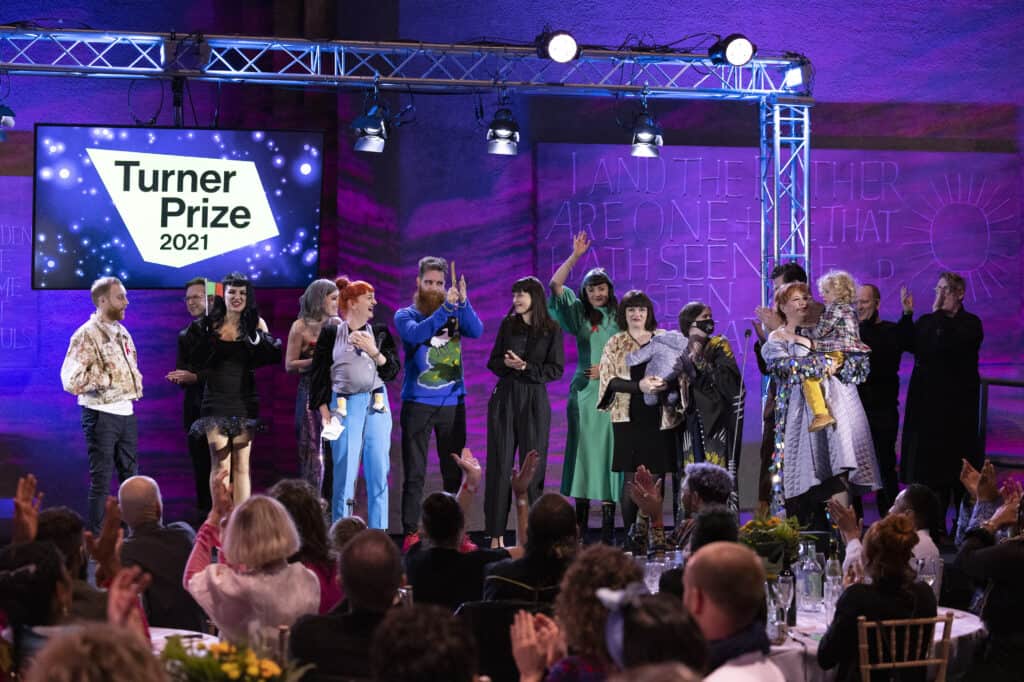
Array Collective win Turner Prize with humourous, serious, beautiful artwork focussed on Northern Ireland’s political, social issues.

Array Collective are announced as the winner of Turner Prize 2021, the leading international award for contemporary art, at Coventry Cathedral. Picture date: Wednesday December 1, 2021. The Turner Prize exhibition at the Herbert Art Gallery & Museum is a highlight of the city’s year-long tenure as UK City of Culture. Photo credit should read: Matt Alexander/PA Wire

The Turner Prize 2021 has been awarded to Array Collective. The £25,000 prize was presented by Pauline Black, the lead singer of 2 Tone pioneers, The Selecter, during a live broadcast on the BBC. A further £10,000 was awarded to each of the other nominees. This year the Turner Prize exhibition is being held at the Herbert Art Gallery & Museum in Coventry as a highlight of its City of Culture year.

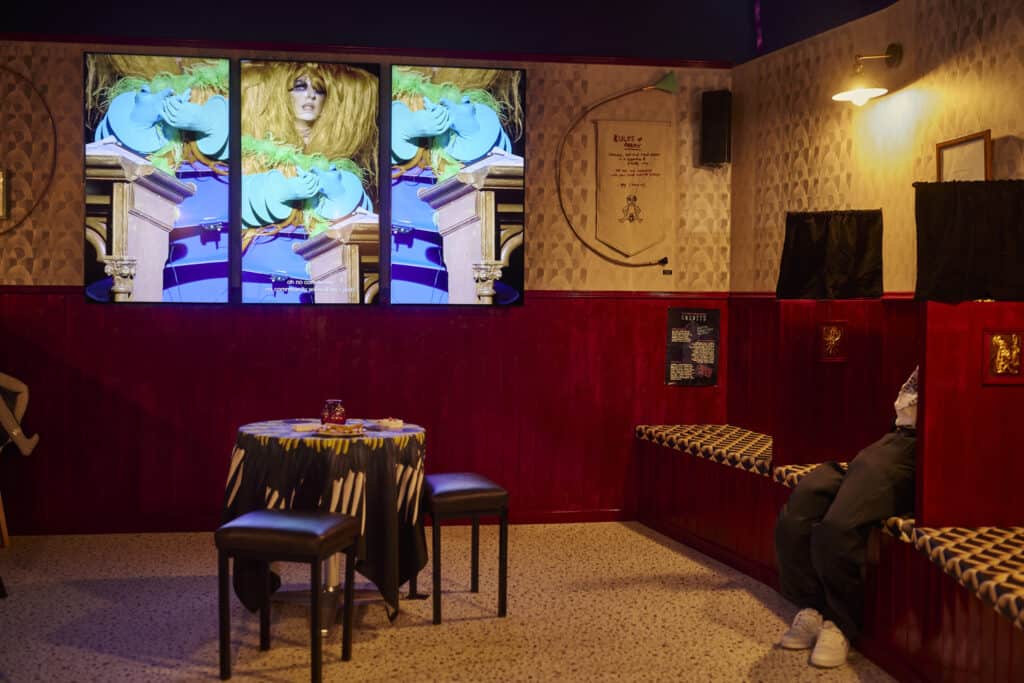
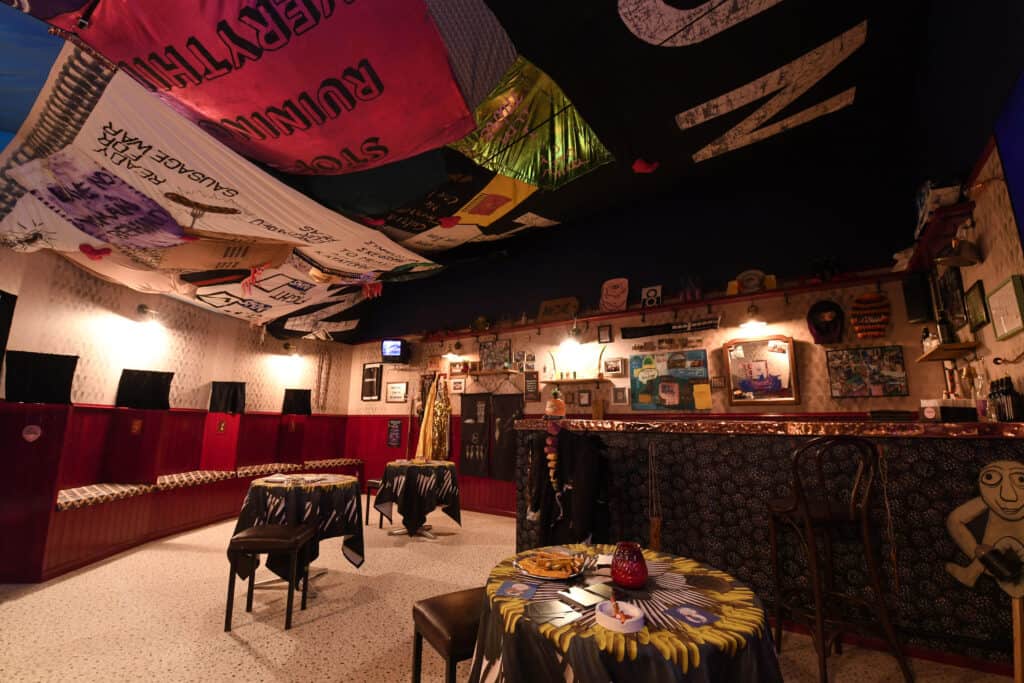
The jury awarded the prize to Array Collective for their hopeful and dynamic artwork which addresses urgent social and political issues affecting Northern Ireland with humour, seriousness and beauty. The jury were impressed with how Belfast-based Array Collective were able to translate their activism and values into the gallery environment, creating a welcoming, immersive and surprising exhibition. The jury commended all five nominees for their socially engaged artworks, and how they work closely and creatively with communities across the breadth of the UK. The collaborative practices highlighted in this year’s shortlist also reflect the solidarity and generosity demonstrated in response to our divided times.

Details and installation shots of The Druithaib’s Ball, by Array Collective. The Turner Prize 2021 Exhibition. The Herbert Art Gallery and Museum. Coventry. Photograph by David Levene 24/9/21.

One of the world’s best-known prizes for the visual arts, the Turner Prize aims to promote public debate around new developments in contemporary British art. For the first time, this year’s Turner Prize jury selected a shortlist consisting entirely of artist collectives and artist-run projects: Array Collective, Black Obsidian Sound System, Cooking Sections, Gentle/Radical and Project Art Works.

General views at The Herbert Art Gallery and Museum in Coventry as the Turner Prize Shortlist is announced. Picture date: Friday September 24, 2021. Photo credit: Doug Peters/ PA Wire

The members of the Turner Prize 2021 jury are Aaron Cezar, Director, Delfina Foundation; Kim McAleese, Programme Director, Grand Union; Russell Tovey, Actor; and Zoé Whitley, Director, Chisenhale Gallery. The jury is chaired by Alex Farquharson, Director, Tate Britain.

The exhibition is a highlight of Coventry’s UK City of Culture 2021 celebrations. Herbert Art Gallery and Museum champions Coventry’s culture, city and arts and is one of the UK’s leading regional museums. As part of its preparations for City of Culture 2021, the museum underwent a major redevelopment of its gallery spaces in anticipation of the Turner Prize exhibition. In parallel to the Turner Prize exhibition, Coventry also hosts ‘Coventry Biennial 2021: Hyper-Possible’ across Coventry and Warwickshire.

Turner Prize 2021 12th January 2022 Admission free Herbert Art Gallery & Museum, Jordan Well, Coventry CV1 5QP

About the artist

Array Collective is a group of 11 artists who create collaborative actions in response to socio-political issues affecting Northern Ireland. The collective has been working together more actively since 2016, motivated by the growing anger around human rights issues happening at the time. Their intention is to reclaim and review the dominant ideas about religio-ethnic identity in Northern Ireland. Working as constituents or allies of the communities they protest with and make art about, Array Collective aims to create a new mythology for the growing number of people who do not prescribe to embedded sectarian dichotomies.

Recent initiatives and works include: Jerwood Collaborate!, Jerwood Arts, London (2019), a-n Artists Council’s Artists Make Change (2020), as well as organising projects in response to issues such as queer liberation, abortion rights, mental health, gentrification, eco-politics, social welfare and Northern Ireland’s fractured past.

Array Collective playfully use performance, protest, photography, print, installation and video. They work with a range of other creative people and organisations to create a combination of artistic expression, direct action and public interventions in the city and online. Their recent project As Others See Us (2019), for example, centred on three fictional characters drawn from the pre-Christian myths and folklore of ancient Ireland: ‘Ban Bidh: The Sacred Cow’, ‘An Scáth Fada: The Long Shadow’ and ‘An Mór Ríoghain: The Morrigan’. These characters have since shape-shifted through crowds at Belfast Pride and up the banks of the River Thames in a series of interventions and performance protests.

Array Collective was nominated for their use of DIY sensibility to tackle issues facing Northern Ireland. The jury commended recent projects, including public artworks in support of the decriminalisation of abortion, challenging legislative discrimination of the queer community in Northern Ireland, and participation in the group exhibition Jerwood Collaborate! in London in late 2019.

Array Collective comprises: Sighle Bhreathnach-Cashell, Sinéad Bhreathnach-Cashell, Jane Butler, Alessia Cargnelli, Emma Campbell, Mitch Conlon, Clodagh Lavelle, Grace McMurray, Stephen Millar, Laura O’Connor and Thomas Wells. The collective is based and predominantly works in Belfast. arraystudiosbelfast.com

.

Categories

Tags

Author

Mark Westall

Mark Westall is the Founder and Editor of FAD magazine Founder and co-publisher of Art of Conversation and founder of the platform @worldoffad

Delhi-Based Artist Creates Beautiful Art Work On Olive Ridley Turtles With Message To Curb Plastic Menace In Oceans

Bhubaneswar: On the closing ceremony of the METIS Initiative on Plastics and Indo-Pacific Ocean 2021 at Utsha Foundation here this evening, the grant-winning artist Manveer Singh shared his experience at the month-long residency and also displayed a short film on his journey in Odisha in transforming his ideas to create beautiful art from plastics and also generating awareness among people and especially among the youth and students.

Today’s installation by Manveer at Utsha created a wall of Olive Ridley turtles hanged from net and the artist has the concept to tell to the visitors, how human activities like fishing are killing the turtles. The tiny ones consuming plastics are also facing life threat near the coastline and especially adjacent locations near the mass nesting grounds. The work today at Utsha, thus explained all the challenges behind the lifecycle of the Olive Ridley turtles, which are in love with the Odishan coast.

The wonderful event on art and sustainability was attended by Consulate General of France Kolkata Mr. Talpain, Regional Director South Asia AgenceFrançaise de Développement (AFD) or French Development Agency Mr. Jacky Amprou, Director AFD India Mr. Bruno Bosle and Sector Portfolio Manager AFD Mrs. Fanny Ragot and Founder of Utsha Foundation and eminent artistJagannath Panda, among others.

Congratulating Manveer, the Consulate General of France Mr. Talpain said ‘’this artistic food for thought is the reminder that art and artists have the power to influence the way we think about the environment. I strongly believe that artists have the power not just to raise awareness about critical issues, but their work is also the key to creating real world impact.’’

Delhi-based artist Manveer Singh’s concept “From Plastic to Art” was selected from 26 applicants. During his stay for the Utsha Residency in association with AFD, Manveer visited various institutions and offices and distributed 40 habit changer boxes to collect the layered plastics to make the tiny turtles for his art work. He also organized a workshop with 28 Peer Leaders (PragatiSathis) of the Bhubaneswar Smart City so that the concept of “From Plastic to Art” is translated to action by others in the society. Peer Leaders are youth and student leaders of Bhubaneswar Smart City to create public awareness among the 100 slums across the Temple City. The workshop was organized at BDA City Centre (NICCO Park) where the Quick Win project under City Investments to Innovate, Integrate and Sustain (CITIIS) is under implementation in Bhubaneswar.

Manveer also conducted a workshop for students at Unit VI Girls High School in which 50 students participated. He also interacted with more than 15 families residing in Government quarters near Utsha Foundation. His installation on Puri sea beach also attracted more than 5,000 visitors on November 24.

The artist, popularly known as “Plastic Wallah’’ in Delhi, has dedicated his works in creating awareness on the menace of plastics in and around the human habitations. However, as the marine ecology is going to be severely affected by plastics by 2050, the artist feels, the awareness level should also get more attention so that the oceans and their ecosystems would be less affected by the plastics and their derivatives.

The METIS initiative is part ofAFD celebrating its 80th Anniversary on December 2, this year and for this the agency has planned events across the Indo-Pacific Region including India, Mauritius and Indonesia. AFD has decided to launch a global initiative METIS, to create a global public opinion on marine debris and pollution.

While this has encouraged participation of artists in India to express their ideas relating to plastic waste production, management and its ill effects on the fragile coastal ecosystem, in Mauritius and Indonesia music and comics respectively were used to create the public awareness.

Currently, AFD is also funding the CITIIS Programme in Bhubaneswar and 11 other cities of India through the Smart City Mission. AFD is funding CITIIS Programme here, supported by Ministry of Housing and Urban Affairs, European Union and National Institute of Urban Affairs, New Delhi and the Government of Odisha.