
How Can Arts Organizations Reduce Their Carbon Footprint? Here Are 6 Takeaways From a New Art-World Climate Conference

Is the art world going to save the warming planet? Yes, according to novelist and poet Ben Okri, for art deals with vision, which is needed to paint the picture of a sustainable future amid the urgent calls for change. “Don’t talk yourselves down,” he told the art-world audience members at the Gallery Climate Coalition (GCC) conference “Decarbonising the Art World” at London’s Barbican Centre on November 24.

Okri’s words were not empty. The GCC, a confederation of some 600 dealers, has set the ambitious goals of reducing the art world’s carbon emissions by 50 percent (from 2018 and 2019 levels) and achieving zero-waste operations by 2030. The conference marked the official launch of the detailed, 43-page Decarbonisation Action Plan, which offers concrete tips and a step-by-step guide to help its members (consisting primarily of art galleries and artists in Europe and the Americas) to transform pledges into action. 

The goal is aligned with those set out by the Paris Agreement, and the conference at the Barbican Centre was intended as a follow-up to the recently concluded United Nations Climate Change Conference (COP26) in Glasgow, which lacked discussion of culture on the agenda, said Lucia Pietroiusti, a curator and strategic consultant for ecology at the Serpentine Galleries.
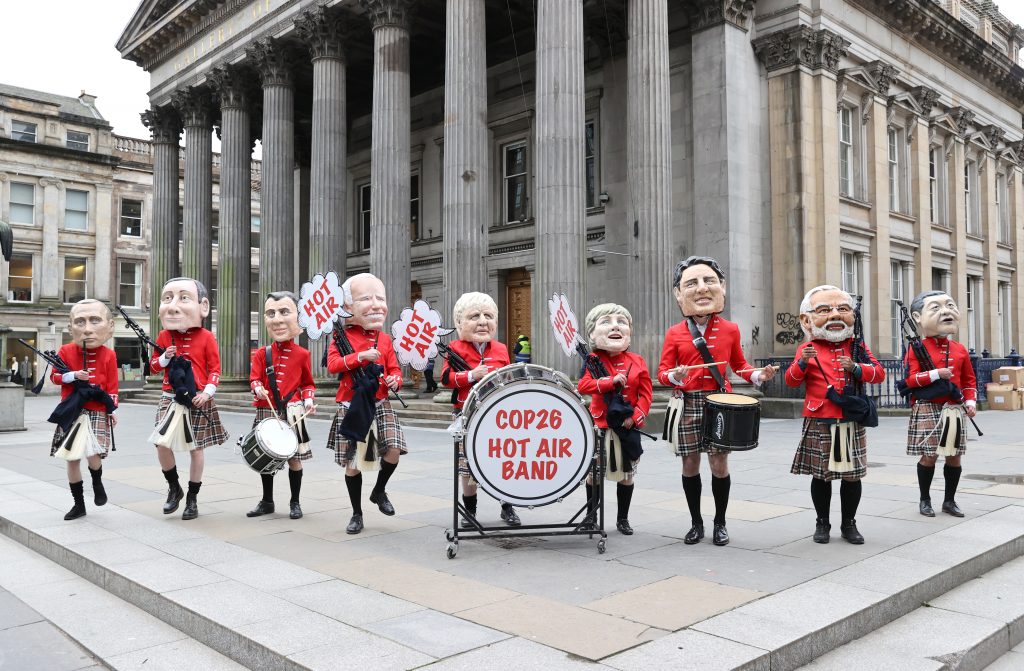
An Oxfam demonstration outside Glasgow’s Gallery of Modern Art on November 1, 2021. Photo: Chris Jackson/Getty Images.

“Compared to five years ago, there’s so much more activism and people are more outspoken,” Danny Chivers, an environmental researcher and advisor who played a key role in drafting the GCC’s Decarbonisation Action Plan, said at the conference. “If you talked about 50 percent [reduction in carbon emissions], people would be like, ‘Oh God!’ but now, people would say, ‘Let’s have that conversation.’ We are in a different space.”

Experts and some art-world leaders believe the goal is achievable—particularly those who have already taken action, following the coalition’s guidelines and plan.

Here are six simple steps proposed by GCC’s Decarbonisation Action Plan for the art world to kickstart reducing carbon emissions:

1. Appoint a ‘Green Team’

The GCC encourages art organizations are encouraged to form an internal group dedicated to making changes to reduce environmental impact. The team should be in charge of setting and reviewing targets, organizing meetings, and drafting a timeline for the organization to implement the action plan.

2. Do a Carbon Audit

“It’s like a tax return,” the London-based dealer Kate MacGarry said at the conference. Reduction goals cannot be set without calculating the baseline emissions in the first place, according to experts. The GCC has developed an online carbon calculator for its members, who are encouraged to do the carbon audit annually.

3. Analyze Data and Make Changes

In MacGarry’s case, emissions from business travels and art transport accounted for nearly 45 percent of the gallery’s total carbon emissions between 2018 and 2019. This year, the dealer decided to go to Art Basel by train. She has also given up bubble wrap and plastic for art packaging.

4. Set Targets for 2025 and 2030

The GCC action plan suggests art organizations divide their reduction goal into several stages. Those aiming to reduce carbon emissions by 50 percent in 2030 can start with a 25-to-30 percent reduction from the baseline by 2025. Those who are aiming for a 70 percent reduction by 2030 can set themselves a higher bar, at a 30-to-40 percent reduction by 2025.

5. Setting a Year-on-Year Milestone 

As a follow-up to step four, art organizations can look at their year-on-year annual carbon dioxide allocation, which should show a gradual reduction in carbon emissions every year. It’s almost like setting a financial goal and creating an annual financial budgeting that allows one to achieve this goal within a period of time, says the action plan.

For instance, a 30 percent reduction of carbon emissions by 2025 will require an average of five percent cut per year from 2019 to 2025. Then an art organization can look into the various areas of its operation, from travels to energy consumption and shipping, and decide what actions to take in order to achieve the reduction goal.

6. Action Time

Once you have done your carbon audit and set your goals, now it’s time to take action. The GCC has come up with a list of 50 effective actions to give art organizations ideas for changes to make, from smaller, manageable tasks to ambitious jobs that may require a little more research and planning. These actions are divided into six categories: shipping, travel, energy, packaging and materials, waste and recycling, as well as exhibitions and gallery spaces.

Regarding shipping, for example, the GCC asks its members to prioritize land and sea freight over air. (“Collectors need to be understanding as well, and not hurry the works,” said MacGarry.) The coalition also asks members to reconsider non-essential travel and avoid flying—whenever possible, taking a train rather than a plane. It also recommends hiring local teams to install international exhibitions remotely and avoiding single-use plastics in packaging.

This article was updated on November 26.

Follow Artnet News on Facebook:


Want to stay ahead of the art world? Subscribe to our newsletter to get the breaking news, eye-opening interviews, and incisive critical takes that drive the conversation forward.

World’s cities shift focus to climate action as experts’ review habitat — Property — The Guardian Nigeria News – Nigeria and World News

To attain sustainable urbanisation that features opportunities for greater residing ailments with no adversely influencing the organic natural environment, the worldwide local community will this early morning mark Globe Habitat Working day (WHD) 2021.

WHD is noticed on the initially Monday of Oct each yr. This yr, it is getting observed on Oct 4 across the planet. The day is recognised by the United Nations and observed to mirror the state or condition of towns and towns and promote the essential ideal of enough shelter or housing for all.

Following the UN, towns are responsible for close to 70 for every cent of worldwide carbon dioxide emissions with transport, properties, energy and waste management accounting for the huge bulk of urban greenhouse fuel emissions. This day will amplify the global race to zero marketing campaign and UN-Habitat’s ClimateAction4Towns and encourage community governments to produce actionable zero-carbon strategies in the run-up to the global-local climate adjust summit COP26 in November this calendar year.

In Nigeria, urban town gurus and environmentalists will be at a conference to examine the theme, Accelerating City Action for a Carbon-Free of charge Earth, and ally to be certain environmentally friendly changeover positive aspects, anyone, especially the most vulnerable, and generates new work opportunities.

In his statement to mark the day, the UN-Habitat Executive Director, Ms Maimunah Mohd Sharif reported: “The local climate disaster is greatly recognised as the range a single risk going through the planet nowadays. And it is our towns and towns, which are responsible for significantly of the weather transform, ensuing in devastating floods, droughts and violent storms.

By her, “unless we choose urgent action, the greenhouse gases developed by at any time-increasing city centres, will go on to press global air temperatures larger.
“And this calendar year, in the run-up to the international local weather alter summit COP 26, we require immediate action in producing and utilizing zero carbon designs. The restoration from the COVID-19 pandemic is a chance for the world’s metropolitan areas, to set climate action on prime of their agenda, Travel Tips.

She stated: “We need clean up, source-economical power, to switch fossil fuels. We require vitality-economical infrastructure to stimulate going for walks and cycling,” she additional.
The President, Nigerian Institute of City Planners (NITP), Mr Olutoyin Ayinde said: “Creating that carbon-neutral, livable and sustainable foreseeable future relies on our ability as stakeholders to collaborate and make the right actions take place by liable living.

“We must go again to the principles of preparing. Livability and sustainability rest on the principles of planning. The physical arranging of our human settlements will make fixing troubles in the created ecosystem much easier.”
Ayinde called on governments to become alive to their responsibility for arranging even though building use of the awareness, knowledge and abilities of city planners to enable them in transforming various visions, guidelines and plans into blueprints as grasp plans, sector strategies, district designs, and action strategies that will produce settlements that are conducive for a dwelling if the options are carried out.

The professor of City Planning and Lecturer in the Department of City and Regional Scheduling, Federal College of Technology, Minna, Mustapha Zubairu, stated the emerging global consensus is that “there will have to be deliberate work to embark on reduced-carbon advancement that will, finally, result in the decarbonisation of our economies.
Zubairu, who is also the Challenge Manager, Niger Point out Urban Help Programme, urged the authorities to embark on gradual decarbonisation of the city economic climate using the scheduling of new towns and metropolitan areas and transforming present ones, with a concentrate on the adoption of the environmentally friendly grasp organizing process that lowers the use of automobiles encourages social and financial harmony gives a basis for producing livable, walkable, compact and economical metropolis preservation of the organic ecosystem and incorporating purely natural ecosystems into urban places, to host local wildlife.

He also termed for the style and design of new structures centred on biophilic and bioclimatic architecture and zero and passive electrical power design ideas to include purely natural lights, ventilation and organic landscape functions, and prioritising power efficiency and small-carbon progress
A city planner, Mr Moses Ogunleye mentioned cities are turning carbon-weighty. He urged the authorities to offer green regions by planting trees and developing far more gardens.

“There need to be demanding enforcement of tree felling regulations. Allow the community transportation program to be improved. The reduction of private cars on the roads will suppress emission,” he added.

Visit : https://tourismelillerois.com/

The art exploring the truth about how climate change began

The art exploring the truth about how climate change began

(Image credit: Louis Henderson/ Courtesy of the artist)

(Credit: Louis Henderson/ Courtesy of the artist)

A new art exhibition offers a fuller, more rounded view of humanity’s impact on the Earth – by tracing its link with colonialism. Precious Adesina talks to the artists.

I

It has been more than three decades since climate change became front-page news. In 1988, The New York Times ran an article titled “Global Warming Has Begun, Expert Tells Senate”. Ever since, discussions on the crisis have predominantly focused on how the state of the world has been affected by humans since the Industrial Revolution in the West – and with good reason. The Earth’s temperature has increased by 0.07C every decade since the late 19th Century, a rise that has been linked to the mass burning of fossil fuels. Yet a new exhibition of work by various artists suggests that we must look further back in time and analyse the issue from a non-Western perspective in order to get a fuller picture of the current emergency.

More like this:

–          Why we need powerful symbols

–          Climate change clues hidden in art

–          Facing up to a horrifying history

The group show We Are History: Race, Colonialism and Climate Change opened to coincide with 1-54 Contemporary African Art Fair at London’s Somerset House. Through the lens of 11 artists who have a personal relationship with the Caribbean, South America and Africa, the exhibition looks not only at the roots of global warming, but also at how it impacts the developing world. By looking back, the link between the world’s environmental issues, colonialism and slavery is highlighted. Also explored is how these problems still have a disproportionately negative impact on certain countries. A study released in 2020, published by two archaeologists, revealed how colonisation forced residents in Caribbean communities to move away from traditional and resilient ways of building homes to more modern but less suitable ways. These habitats have proved to be more difficult to maintain, with the materials needed for upkeep not locally available, and the buildings easily overwhelmed by hurricanes, putting people at greater risk during natural disasters. 

From the forest to the concrete (to the forest) by Alberta Whittle explores the legacy of colonialism (Credit: Courtesy of the artist and Copperfield, London)

From the forest to the concrete (to the forest) by Alberta Whittle explores the legacy of colonialism (Credit: Courtesy of the artist and Copperfield, London)

Among the exhibits is Barbadian-Scottish artist Alberta Whittle’s film from the forest to the concrete (to the forest), 2019, which directly explores this topic, documenting the effects of Hurricane Dorian in the Bahamas. The 10-minute-long film is stamped with the date 09.09.19, nine days after the disaster. “Africa produces 4{6d6906d986cb38e604952ede6d65f3d49470e23f1a526661621333fa74363c48} of the world’s greenhouse gases, the whole continent, but yet it is so at the front line,” Whittle told culture magazine The Skinny. The artist wants people in the UK to see the disparity between their own comfort and the relative lack of comfort of their non-Western counterparts. She intertwines a number of performances with footage of destruction. “[There was] a terrible hurricane that moved through the Bahamas last week,” she said at the time of its premiere. “But what I see in the weather in the news in the UK, is ‘Oh isn’t this wonderful, we are about to go through a period of sunshine’.”

What this exhibition asks is: who we are really talking about when we question how our collective actions are having an effect on the environment? According to the curator of the exhibition, Ekow Eshun, if we don’t allow the people in emerging countries to speak for themselves, we force them out of the conversation and into one that isn’t consistent with the facts. “Otherwise we end up repeating the same narrative that we’ve repeated for a long time that somehow people in the developing world are supporting characters in the drama, rather than communities that are directly affected [by climate change],” Eshun tells BBC Culture. 

Louis Henderson's video installation is an adaptation of the poem The Sea is History by Derek Walcott (Credit: Courtesy of the artist)

Louis Henderson’s video installation is an adaptation of the poem The Sea is History by Derek Walcott (Credit: Courtesy of the artist)

Similarly, British filmmaker Louis Henderson focuses on how the West is primarily responsible for the disruptions to the natural world that humans have caused in his almost 30-minute long video The Sea is History, 2016. Henderson adapts the poem of the same name by Caribbean poet Derek Walcott. In his poem, Walcott discusses the effects of colonisation on a community’s culture, and claims that the history of these places is hidden in the sea. The footage in Henderson’s piece features mesmerising shots of Lake Enriquillo, a lake in the Dominican Republic that often floods due to rises in sea temperature.

Through this, the artist explores how the exploitation of the island for its natural resources, the genocide of the indigenous population and the importation of enslaved people have contributed to the global emergency. “I am interested in identifying Columbus’s 1492 arrival on the island of Ayiti/Kiskeya (nowadays known as Haiti and the Dominican Republic) as a potential starting point for the climate crisis the world is facing today,” Henderson tells BBC Culture. “I believe it’s important to continually analyse and attempt to understand the effects of the afterlife of transatlantic slavery, both on a local and a global scale, and how it impacted the Earth’s geology and its ecosystems.”

Hidden history

Much like Whittle and Henderson, the collaborative duo Jennifer Allora and Guillermo Calzadilla explore how outsiders have impacted the Caribbean, but they take a different approach. Their screen-printing method for the series Contracts uses layers of black ink to taint the beautiful scenery they depict. “What seem to be conventional pictures of a beautiful destination are disrupted by a layer of a single colour ink, shrouding the idyll partly or completely,” say the duo. “We live and work in Puerto Rico, a Caribbean island that, since the colonial period, has been systematically exploited for its natural resources… As climate change makes weather events more severe, from droughts to hurricanes, the already vulnerable island is put in an even more heightened state of precariousness.”

Artists Jennifer Allora and Guillermo Calzadilla explore climate impact (Credit: Courtesy of the artist/ Galerie Chantal Crousel, Paris/ Sebastiano Pellion di Persano)

Artists Jennifer Allora and Guillermo Calzadilla explore climate impact (Credit: Courtesy of the artist/ Galerie Chantal Crousel, Paris/ Sebastiano Pellion di Persano)

Contract (AOC L), 2014, shown at the exhibition, is a piece that is part of the larger series. In it, the pair catalogue sites in Vieques, Puerto Rico, where palm trees were used as markers by the US military to highlight where hazard waste was disposed. The areas are now managed by the US Department of Interior, Fish and Wildlife Service as conservation zones, according to the artists. “This paradoxical designation denies the underlying environmental and health risks of the dumps –  so toxic that in 2005 they were placed on the US Environmental Protection Agency’s Superfund National Priorities List,” they say.

Colombian artist Carolina Caycedo says that the only way to truly move forward is to listen to the people who are explicitly affected by these changes to the ecosystem. “We urgently need to look at what communities that are actually on the frontlines are proposing on a grassroot level, since they are the people who are directly impacted by the climate crisis,” she tells BBC Culture. Her research-based art project, Be Dammed, investigates the environmental and social consequences of dams throughout Latin America. “By [looking at] different case studies in the Americas, I’ve had a chance to collaborate with some of these communities to highlight alternatives to these large infrastructures,” she says.

A Universal History of Infamy by Carolina Caycedo is among the exhibits at the new show We Are History (Credit: David de Rozas/ Museum Associates, LACMA)

A Universal History of Infamy by Carolina Caycedo is among the exhibits at the new show We Are History (Credit: David de Rozas/ Museum Associates, LACMA)

While none of these artists offer a hyper-specific call to action, collectively they show how climate change has affected the countries they belong to, or associate themselves with, and the importance of putting global issues into perspective. As Eshun puts it: “I think it’s important that those voices and those perspectives are heard and not simply as victims but heard as people who have agency and autonomy, and in this respect they’re heard through the voice of artists.”

We Are History: Race, Colonialism and Climate Change is at Somerset House, London, until 6 February 2022.

Black History Month takes place throughout October in the UK.

If you would like to comment on this story or anything else you have seen on BBC Culture, head over to our Facebook page or message us on Twitter.

And if you liked this story, sign up for the weekly bbc.com features newsletter, called The Essential List. A handpicked selection of stories from BBC Future, Culture, Worklife and Travel, delivered to your inbox every Friday.

Google and volcanoes do some good, and climate prophets win the Nobel

Past yr, the fossil fuel industry benefited from USD 5.9 trillion in subsidies.

In the amount of money of time that it’ll consider you to read through this write-up, it’ll rake in wherever involving USD 30 to 50 million, relying on your studying velocity.

This 7 days on Landscape Information, we unpack what that indicates for a world that’s hurtling toward 3 levels Celsius of warming by 2100. As well as, greenwashing, Google climate advertisements, nourishing volcanoes and substantially much more.

LANDSCAPE News

https://www.youtube.com/observe?v=U9E-t57akWU

Sustainable investing is taking above the entire world of finance. Could it help us deal with the climate and biodiversity crises? Discover out in this new episode of Landscape Television.

Are carbon marketplaces definitely the response to our local weather woes? We posed the dilemma to professional Paul Burgers in this GLF Are living.

The local weather crisis is sparking a psychological wellbeing crisis, and it is affecting youthful folks in specific. Here’s what renowned psychologist Susan Clayton has to say about this burgeoning difficulty for human rights.

And, if you consider the Amazon is a wide wilderness, consider once more. Here’s how Indigenous peoples have been residing in harmony with the biome while utilizing it to endure for thousands of many years.

Plan

Glasgow’s Buchanan Street in 2018. Artur Kraft, Unsplash

The COP26 local weather meeting is just a handful of weeks away – but delegates from the World South will have to soar through various COVID-connected hurdles just to make it to Glasgow.

(We’ll now just take this chance to point out that you can sign up for GLF Local weather, alongside the COP, digitally from wherever you are in the entire world.)

And with expenditures up to 30 percent greater than at COP25, even people who make it could end up being priced out of internet hosting a pavilion.

Turkey has eventually ratified the Paris Arrangement, although it has protested becoming classified as a developed nation.

And now, even Russia’s climate modify-denying president Vladimir Putin is lastly modifying his tone on climate action.

Local weather

These images show projected future sea levels at State Hermitage Museum in St. Petersburg, Russia due to human-caused global warming under two different scenarios. Courtesy of Climate Central
These visuals present projected long run sea levels at State Hermitage Museum in St. Petersburg, Russia due to human-triggered worldwide warming underneath two distinctive situations. Courtesy of Weather Central

We’re a extended way from achieving web-zero emissions. If nations around the world never boost their local climate pledges, carbon emissions will only decrease by just 40 percent by 2050.

In preparing for a hotter environment, new graphics exhibit what coastal towns will glimpse like if worldwide warming reaches 3 levels Celsius. It’s not so great.

Irrespective of the point that the local climate crisis could currently be influencing 85 {6d6906d986cb38e604952ede6d65f3d49470e23f1a526661621333fa74363c48} of the world’s population, climate scientists based in the World-wide South are having difficulties to get their get the job done released.

Persons

A health professional in Ethiopia with a COVID-19 vaccine issued by COVAX. UNICEP Ethiopia, Flickr
A well being experienced in Ethiopia with a COVID-19 vaccine issued by COVAX. UNICEP Ethiopia, Flickr

The COVAX program was meant to vaccinate the Worldwide South from COVID-19 – but 98 {6d6906d986cb38e604952ede6d65f3d49470e23f1a526661621333fa74363c48} of individuals in minimal-revenue nations stay unvaccinated. The place did it all go mistaken?

Three researchers have acquired the Nobel Prize in Physics for predicting the weather disaster as it unfolded above the very last 60 a long time.

Four of Australia’s nationwide parks have been returned to their regular entrepreneurs, the Jap Kuku Yalanji people today, who will get more than controlling the world’s oldest tropical rainforest therein.

In the 32 years considering that it was ratified to restore the ozone layer, the Montreal Protocol could have prevented 443 million instances of cancer.

Planet

Tropical corals reefs, such as this in Belize, are rapidly being lost to bleaching and disease, linked to increasing water temperatures. US Geological Survey
Tropical corals reefs, this kind of as this in Belize, are quickly currently being shed to bleaching and sickness, linked to increasing water temperatures. US Geological Survey

Get that scuba fit on while it is still worth the effort: about 14 {6d6906d986cb38e604952ede6d65f3d49470e23f1a526661621333fa74363c48} of the world’s coral reefs have died out since 2008.

Nature has been a valuable source of medicines for generations. But by destroying the organic globe, are we wiping out the medications of the potential before they are even invented?

Volcanoes may perhaps be a menace to human beings and other everyday living on land, but they can be a godsend for maritime lifestyle by fertilizing the ocean with nutrient-abundant lava.

Organization

Google’s new ad rules coincide with COP 26 in Glasgow next month. Nathana Rebouças, Unsplash
Google’s new advert principles coincide with COP 26 in Glasgow following month. Nathana Rebouças, Unsplash

Google has banned advertisements that spread climate alter denial, though disinformation nevertheless operates rife on Fb.

Environment leaders need to get bigger measures to defend and restore mother nature ahead of future year’s U.N. biodiversity summit, say 12 leading business executives in an open letter.

As Europe cracks down on greenwashing, asset managers are stepping absent from making use of the term ‘ESG’ – a well known buzzword with no exact definition.

How Oregon gardeners can adapt their landscapes to changing climate

This yr, Oregon gardeners have observed a shift from the state’s traditional Mediterranean climate. Severe weather ailments, ranging from an ice and windstorm to a record-breaking heatwave, have wreaked havoc on landscapes and gardens.

As the local weather proceeds to change, there are techniques gardeners can apply to better adapt, secure and put together their crops for other serious, incoming situations.

“There’s excellent proof that local weather modify is happening and impacting factors here in Oregon on a broad scale, and it involves, particularly, bigger and bigger probability of excessive climate events. And we’ve viewed some illustrations of that just lately,” explained Weston Miller, local community and urban horticulturist for Oregon State University Extension Services and Multnomah County Grasp Gardener Program manager.

Miller will handle such events and their consequences in “Adapting Your Backyard and Landscape for Climate Modify,” a digital course on Tuesday, Oct. 12. (Sign up listed here for the cost-free function.) The presentation is element of the Escalating Oregon Gardeners: Level Up Sequence by means of the OSU Extension Assistance Master Gardener Plan.

Historically, the local weather west of the Cascades is made up of moist, cool winters and scorching, dry summers, Miller claimed. When drought transpires seasonally and is to be anticipated, he explained springs and summers have been drier and snow is melting a lot quicker.

Oregon is “leaning to regional scale drought that you’re commencing to see in California already,” he claimed.

Greg Shepherd, co-proprietor of Xera Crops in Portland, claimed that Oregon’s climate is altering more rapidly than a lot of people today have been adapting to with their landscapes.

“A great deal of crops you would consider to be a great plant for whole sunlight and dry in Portland, the flowering currant for instance, they ended up really fried and destroyed,” he stated as he assessed the earlier summer time. “It’s just a little something which is happening so quick, a great deal of persons in the marketplace and gardeners are heading to be struggling to maintain up with what to do future.”

What we know about native vegetation is modifying

Hunting at indigenous vegetation and climate transform more than the past 50,000 yrs, Shepherd explained that several native plants have migrated as the local weather bit by bit adjusted. The issue now is that temperature and precipitation styles are switching more quickly than the crops can migrate.

An “important matter with indigenous plants for gardeners is supporting them adapt and preserve the populations right until they have a opportunity to migrate to where they’ll have to go in the long term,” he claimed.

When so lots of indigenous plants have been damaged through very last summer’s warmth dome, Paul Bonine co-operator of Xera Crops mentioned that it was a “big shock to everyone that the indigenous plants would have reacted that way.” As a end result, shoppers were commencing to rethink their landscapes.

“People are sick of watering,” Bonine said. “It’s costly and they want their landscapes to thrive, so they are having out a great deal of higher-h2o crops and changing them with vegetation that can get along with pure rainfall.”

Shepherd mentioned that each working day a shopper will come to Xera Vegetation seeking for lessen drinking water use crops. Even though he stated the answer “isn’t 100{6d6906d986cb38e604952ede6d65f3d49470e23f1a526661621333fa74363c48} distinct however,” individuals are on the lookout for qualities like warmth tolerance and drought resistance.

With the nursery’s concentrate on rising naturally local weather-tailored and West Coastline indigenous plants, Shepherd mentioned they are wanting at their products line and analyzing what they will proceed to increase and how they will increase their choices.

“There’s some attention-grabbing matters out there that we haven’t relied on, and this is starting to appear like a new actuality. People today are heading to want to experiment with items they know will do the job,” he reported.

Miller said he endorses people just take a extended perspective of their landscape and take into account the opportunity effects of extended drought and water limits that might be place in spot.

“I’d say people today who are both re-landscaping or changing vegetation, that they look at buying drought-tolerant vegetation in the initially area,” he claimed. “Drought-tolerant vegetation are ready to endure and bloom usually after an institution period, and continue to look quite superior even with out supplemental drinking water.”

Bonine provides that gardeners also should not be fearful to attempt new points in their landscapes.

“You have a good deal extra options than you feel to get the aesthetics that you want and nonetheless have it be small-water,” he stated.

Shepherd additional that it also does not have to be all cactuses: “You can basically have a lush looking garden that doesn’t require any use of drinking water if you plan your vegetation cautiously.”

Bonine claimed that right after this year’s intense temperature, gardeners will have to have to target on resilience in the potential.

“The least comprehended portion about gardening is the climate,” he claimed. “The local weather is going to be transforming really quick, faster than people today foresee and so we’re just heading to enjoy it by ear typically and see what transpires.”

8 actions gardeners can acquire to assistance plants and trees adapt to climate alterations

Prepare the soil. When planting, dig down deeply more than enough (a foot down for a 5-gallon shrub, for instance) and perform in compost so the roots have a thing to expand into. “When roots have greater proven root devices, they are better capable to extract drinking water,” Miller reported. “If men and women just dig a hole in their difficult, compact clay soil with no really getting ready a larger sized planting location, plants are often going to go through simply because the roots are shorted by the compacted soil.”

Look at plant locale carefully. Some backyard garden favorites, like hydrangeas, rhododendrons and azaleas favor shade Miller reported, and if they are planted in comprehensive sunlight they will be underneath a lot more anxiety. Generally, crops will show indicators of severe warmth when found on the southwest aspect of a residence or in an region struggling with a patch of asphalt or concrete. Gardeners can also select a lot more heat-tolerant species of their water-loving crops such as hydrangeas that can superior experience out warmth waves. Oak leaf and smooth hydrangeas are two species to take into consideration.

Back garden in zones. Shepherd implies gardening in zones by grouping with each other large-h2o and small-drinking water crops. He explained it is far more effective and will help constrict water use.

“So, say you want a lot more drinking water intense perennials, you team them in the vicinity of the hose as a substitute of putting them out,” he said. “Having perimeters of your home be reduced-h2o will make routine maintenance a good deal easier.”

Observe for freezing patterns in winter season. Miller explained with the unpredictability of local weather alter, it is not just acquiring crops that are drought tolerant, but cold hardy as nicely. “It may be truly heat all the way up to Thanksgiving and then it receives really chilly the subsequent week and the crops have not genuinely acclimatized,” he said, introducing that gardeners need to master to acknowledge the signals of chilly harm and consider a wait around-and-see method. “In 6 months, you can see if a little something is lifeless or not and then prune out dead stems at that time.”

Seem at drought-tolerant indigenous vegetation: Shepherd recommended manzanita, a West Coast native that is dry tailored and doesn’t like drinking water in the summer months, as well as other indigenous annuals that really don’t want summertime irrigation and assist area pollinators, these as clarkia, madia and gilia. One more great option is the serpentine sunflower, a Southern Oregon indigenous that seeds itself and does not require much summer time drinking water. He also advised bulbed crops these kinds of as the harvest lily. “Whether native or non-native, (bulbed plants) are acclimated to summer season drought,” Shepherd stated. “So they’re a superior matter to plant for that seasonal flowering with out the help that comes with a great deal of summer time perennials.”

Imagine Mediterranean for drought-tolerant crops. Miller explained to decide crops from decrease Mediterranean like climates, where herbs these types of as lavender, rosemary and thyme thrive. Other suggested plant origins include South Africa, south Australia and Chile. “Plants from those origins also are accustomed to that wet winter and summertime drought situation,” he claimed.

Deep watering. For trees like conifers and Western purple cedar that are enduring drought strain, Miller’s primary suggestion is to drinking water deeply each two weeks (during the dry year) to preserve trees wholesome. One facet impact that Miller has found in stressed trees is insect attraction and destruction, issues that can be prevented by maintaining trees balanced via deep watering.

Prune branches selectively. For the two conifers and deciduous trees, Miller advised removing branches that are destroyed or pruning to counteract the sail impact (wind drag), where by a trees’ foliage receives caught in the wind and weighs the tree down. That pruning can enable reduce hurt in circumstance of an ice or wind storm, he said. He also recommended coming up with a pruning system with an arborist.

Check with an arborist. When it comes to trees, Miller stated the first two points people must contemplate are fireplace hazard — particularly individuals at the urban-rural interface — and how a wind or ice storm would influence the residence. “I would most likely assume about proactively possessing an arborist arrive to one’s property and check out various issues,” Miller mentioned, including that this is a process that takes spot in excess of yrs and involves setting up a dependable relationship. “Trees feel like a fantastic concept on an city residence but they’re high priced to deal with,” he said.

— Aliya Corridor, for The Oregonian/OregonLive

Study Extra