In the huddle of Greek islands known as the Argo-Saronic Gulf, sun-soaked Hydra has long been a place where creative minds have gathered. Henry Miller, Lawrence Durrell and Leonard Cohen were all captivated by the salt-white houses and the sense of total disconnection (the island was without phone lines until the mid-1960s and remains car-free to this day).
More recently, the island formed the backdrop for a project by photographer Annemarieke van Drimmelen and her partner, the painter Jasper Krabbé, which is the subject of a new book, June, with an exhibition scheduled for later this year. Named after their three-year-old daughter, the photographs record the mundane objects and scenes that caught her attention on family outings around the island and elsewhere. The images have then been overlaid with strokes of paint and snippets of poems to create a series of hybrid, collaged artworks that seek to show Hydra through a child’s gaze. “Her view was so optimistic, beautiful and innocent,” says van Drimmelen. “She can see a whole paradise in a galloping horse or a piece of string.” AH June by Annemarieke van Drimmelen and Jasper Krabbé is published by Libraryman in an edition of 500 copies. In October, it will go on show at the new Institute Huis Vasari, Amsterdam
In a surreal sequence in Federico Fellini’s The Temptation of Dr Antonio, a sequin-clad Anita Ekberg steps out of an advertising billboard and proceeds to bait the prudish Dr Antonio with an array of tantalising delights, chief among them a fridge full of ice-cold drinks. According to the critic Gianni Canova, Ekberg’s seduction could be taken for a burlesque of an advert by Campari, which has often used sensuality to sell.
His new illustrated history, Campari and Cinema, looks at how film has been inspired by the carmine spirit, and vice versa. Examples from Campari’s long history of image-making run from its 1901 poster depicting a couple kissing under a crimson light to the 1926 poster showing a bottle protruding from a drinks table, “almost reproducing the motion of a film camera”, to Paolo Sorrentino’s provocative, noirish 2017 campaign film Killer Red, which opens with a red-nailed hand holding the stem of a curvaceous cocktail glass. Using these, plus close readings of films – including the on-screen depiction of pleasure in When Harry Met Sally – Canova analyses the invention and artistry behind one of the world’s most loved aperitifs. BS Campari and the Cinema, edited with a text by Gianni Canova, is published by SKIRA, €50
“Just as there are key moments in the family album, constituted by ceremonies, there are also less intense moments of everyday life,” wrote the artist Luigi Ghirri in 1991, “which are still depicted there because they document the unfolding of an existence.”
This chronicling of both the mundane and the ceremonial defines Puglia, a photographic account of Ghirri’s relationship with the southern Italian region, featuring many previously unseen images. He captures the spectrum of life there, from a pile of bitter puntarelle sprouts drying in the sun to a young girl dressed in her frothy white confirmation gown on her way to the church. It’s all, as the subtitle tells us, tra albe e tramonti (“between sunrises and sunsets”). BS Puglia: Tra Albe e Tramonti by Luigi Ghirri is published by Mack, £45
Traditionally the subject of still-life paintings, the flower has a rich history in art photography too, from Fox Talbot’s ghostly floral photograms of the 1830s to Lee Friedlander’s thorny monochrome stalks of the 1990s. A new book, the second instalment of a series started in 1991, surveys contemporary contributions to the genre.
This edition includes Robert Mapplethorpe’s suggestive stems of the 1980s, Maisie Cousins’ super-enlarged studies of a slimy, decaying bouquet, and Pedro Almodóvar’s characteristically chromatic still-lifes, which juxtapose wilting flowers against sleek jewel-toned vases – a further example of the filmmaker’s fascination with ageing. As Danaé Panchaud writes in her essay, this compendium shows that “the alleged fixed symbolic meanings of flowers, peddled by keen Victorian marketers and based on a very narrow range of examples, are consistently being disproved by new, and often unexpected, allegories and symbols”. BS Flora Photographica: Masterworks of Contemporary Flower Photography by William A Ewing and Danaé Panchaud is published by Thames & Hudson, £45
Ever since the Belle Epoque, when new train lines opened up the south of France, the Cote d’Azur has attracted photographers and artists with its sapphire waters and near-tropical light.
Here, curator Sophie Wright and photography expert Geneviève Janvrin chart the photographic history of the Riviera – from Robert Capa’s shots of a holidaying Picasso to Lee Miller’s sultry summer in Cannes. Wright approvingly quotes Matisse, who said of his own time there that “everything was fake, absurd, amazing, delicious”. BAS Light on the Riviera: Photography of the Cote d’Azur by Sophie Wright and Geneviève Janvrin is published by teNeues, £50
Mallakhamb – translated from the Sanskrit for “wrestler pole” – is known as the mother sport of ancient India, dating back to the 12th century: it was used by warriors and wrestlers to train in the absence of an opponent. The gravity-defying art combines yoga poses and wrestling grips with the athleticism of gymnastics, the fluid sequences producing a form of aerial acrobatics.
Under British rule, Mallakhamb’s popularity dwindled – but in recent years it has undergone a revival, and it is now recognised as one of the fastest growing sports in the world.
In his new book, London-based photographer and regular HTSI contributor Vivek Vadoliya captures the aspiring performers at the Shree Samarth Vyayam Mandir institute in Mumbai. Vadoliya’s vibrant work, rich in hues of ochre and red, explores notions of identity and community. “I was captivated by the expression and language of the movement,” he says. “In their gestures we recognise poses from yoga, which for me are not only mesmerising but inherently Indian.” Vadoliya’s work, which draws from his experience as a second-generation British Indian, is a celebration of the brown body and a love letter to his once-forgotten ancestral exercise. AH Mallakhamb by Vivek Vadoliya is published by Antihero Press, £35
Filmmaker David Ondaatje takes readers on an aerial journey over the world’s waters in his new book. In a fishing community in British Columbia, the rivers run deep grey, almost black in September; in Tuscany, off Punta Ala Beach, the water glows algae-green, while a giant lilo transports a group of swimmers through the calm waters; and in Montana, once-teeming spring creeks are now peacefully free from fishermen, following an intervention by conservationists.
Ondaatje showcases the myriad uses of these waters while also documenting their increasing overuse, as well as the risks they face from global warming and agricultural exploitation. BS Water Views: Rivers, Lakes, Oceans by David Ondaatje is published by Monacelli at $45
Dubai, United Arab Emirates – Back with the to start with total-scale truthful considering the fact that the COVID-19 pandemic started, the 15th edition of Artwork Dubai is exploring new frontiers with the launch of its new portion highlighting digital and NFT (non-fungible token) art.
Alongside the common modern and modern day showcases, Art Dubai Electronic collected 18 galleries from March 10-13 at Madinat Jumeirah, some of which were being only launched in the previous several many years. The new segment was designed in response to a critical change in the worldwide art scene, which has noticed escalating desire in digital mediums and the rise of NFT art.
“We’ve been observing how the electronic universe has been building and possessing a much better voice all through lockdown,” Art Dubai inventive director Pablo del Val said.
“What we intended is to put alongside one another one thing that could be a 360-degree task, that could turn out to be a bridge amongst the electronic and the physical, the place both worlds can get with each other.
“Taking into thought that Dubai has grow to be a crypto money, it’s a area where by some of the most exciting minds and assignments are coming,” he added.
“NFTs at the instant are like an total universe by itself – a universe that people today are frightened of getting into since persons really do not have expertise of this universe. I believe this is an version that is stepping up, that is bringing some thing new.”
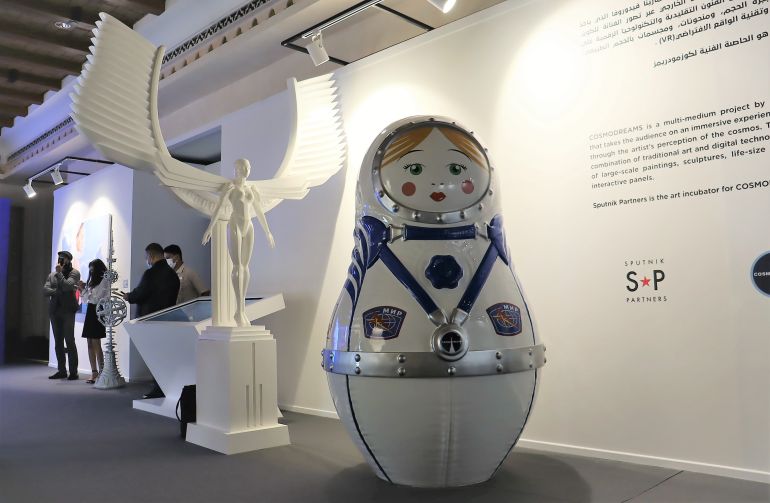
An astronaut nesting doll in the Cosmodreams exhibit [Maghie Ghali/Al Jazeera]
‘Beyond the canvas’
Solo exhibition “Cosmodreams” by artist Marina Fedorova has bridged common art and electronic engineering, incorporating virtual reality (VR) and augmented reality (AR) into her paintings and sculptural installations.
The exhibition displays how engineering can be used to make art much more interactive and immersive. Her is effective seize the natural beauty of outer place and how fashionable technological innovation has influenced our world.
Viewers can use their smartphones to see the animated AR capabilities on the paintings and sculptures, or acquire pics with the functions.
“If the smartphone absorbs our contemporaries’ focus solely, why not glance at paintings by way of the cellular phone display and study a story past the canvas?” Fedorova mentioned.
“We are adapting to new problems in several spots our lifetime becomes electronic. The pandemic served as a catalyst, it produced us assume of ways to make it attainable for people today to take a look at museums when keeping at dwelling, about the kinds of practical experience we can permit as a result of the screens.
“Ironically, as a painter I was in opposition to any technological advancement in the beginning. I considered that there was absolutely nothing improved than paper or canvas with some paint on it,” she added. “However, these times adjusted my opinion drastically, manufactured me have an understanding of that new systems are just a new software in the artist’s palette.”
Contact screens, QR codes and VR headsets invited consumers to participate in the will work and movies, altering them from viewer to participant.
The electronic area not only released these NFT artists and galleries to the set up establishments, but also demystified the technological innovation and terminology – this sort of as cryptocurrency, minting and blockchain – to likely collectors and artists intrigued in broadening their horizons.
A sequence of talks by Bybit was also element of the programme. Campus Artwork Dubai – a longrunning non-revenue arm of the reasonable that runs education programmes for art pupils – this yr partnered with NFT artwork market Materia for an eight-7 days workshop for UAE-based artists.
The resulting NFT artworks had been exhibited at the truthful. Blockchain is a procedure of recording data, such as electronic assets, in a way that helps make it complicated to alter or hack.
Minting is the act of turning a digital asset into an NFT, by recording it in blockchain.“Digital artwork is not easy to exchange devoid of needing a system or USB but when it is registered on blockchain, you don’t will need to be dependent on physical products,” Materia co-founder Patricia Ezpeleta told Al Jazeera.
“Blockchain also enables you to have traceability of the artworks, which is really useful for artists, as they can gain from royalties on resales of their artworks.
“NFTs enable artists and entrepreneurs to demonstrate that it is the primary variation,” she additional. “For collectors, they can prove that they own the original file and at times you get folks stealing other people’s work off the net and saying it is theirs, but with NFT it can be proven fake since the registry is community.”
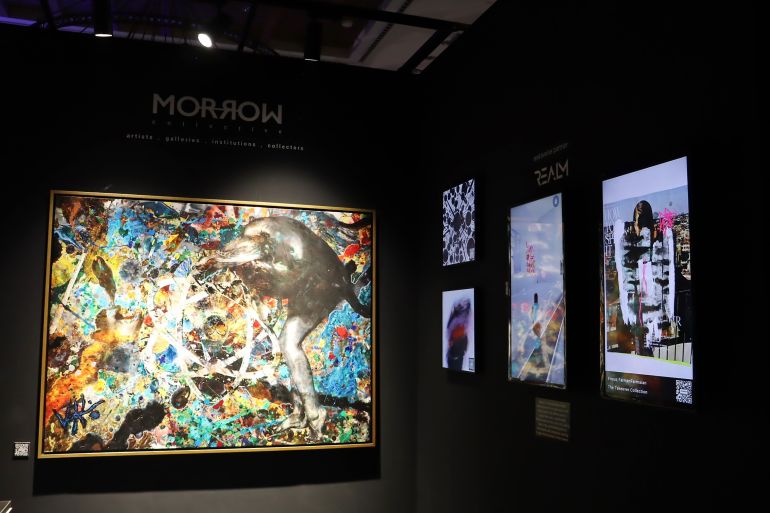
The Morrow Collective booth at Art Dubai Digital [Maghie Ghali/Al Jazeera]
‘Beautiful metaverse galleries’
Morrow Collective, a UAE-centered NFT curatorial system started past calendar year, desires to make the NFT practical experience more partaking, through curating exhibits. Tablets lined the walls of their booth, exhibiting colourful, slightly animated artworks, various from hyper-sensible portraits to pop artwork digital drawings.
“I’ve been an NFT artist because 2020 and I recognized in my time in NFTs that there was seriously not a whole ton of curating,” Morrow co-founder Jen Stelco stated.
“It was all on the lookout like a minor bit of a mess and it was really hard to come across what we take into consideration to be the great art, or the art that has some material.
“Since then we’ve occur alongside one another to curate NFTs, uncover techniques of serving to of getting them to convey to tales and have dialogue amongst them and presenting them in a distinctive way, alternatively than just on an NFT platform in which you’re scrolling, substantially like Instagram or Google Photos,” she added.
“We have these beautiful metaverse galleries … and we curate them into art exhibitions in our galleries, to make far more of a accurate to lifestyle artwork working experience, but digitally.”
A large amount of the NFT artwork is mostly experimental, seeing what can be realized with the know-how, relatively than creating art with a meaning or reason. Trends or common themes have but to emerge.
New territory
For a lot of artists employed to doing the job with paint or creating images, electronic NFT art is new territory that requires learning, before they can implement thought at the rear of the information by itself.
Digital artist Lawrence Lek has had the benefit of doing the job in film, new music and open-environment video game style for 10 decades. Presented by virtual gallery Horizons, in partnership with NFT market So-Far and digital gallery Aora, Lek’s “Nepenthe Valley” offers a mystical alternate planet to take a look at, which promotes restorative meditation. Lek unveiled four out of 9 approaching fictional ruins positioned in serene landscapes.
The exhibit, curated by Jenn Ellis, is 50 {6d6906d986cb38e604952ede6d65f3d49470e23f1a526661621333fa74363c48} 3D-printed architectural models of the ruins, and 50 {6d6906d986cb38e604952ede6d65f3d49470e23f1a526661621333fa74363c48} NFT electronic renditions of the locations, full with neon accents, soothing soundscapes and dynamic weather conditions and lighting.
“I was drawing a large amount from the suggestions of elegant landscapes and spots that are much more involved with healing and expanded consciousness,” Lek advised Al Jazeera.
“A significant impact for me quite typically is science fiction and Napenthe Valley is to do with these locations that are in involving the future and a damage of the past. So like thinking about locations that may well evoke a form of classical architecture, but at the same time, they are neon lit.
“[Healing] is a little something which is addressed in another way in video video games, since you can regenerate your self, you can select potions and elixirs that heal you,” he additional.
“In the valley, I have designed static details of view wherever people today can sit and meditate, like how you would climb a mountain to see the see at the best, as a location that is apart from your each day truth.”
Irrespective of NFTs staying produced in 2015, it is only in the past 12 months that they have come to be portion of mainstream dialogue. NFT artwork could possibly not nevertheless be broadly acknowledged or recognized, but with establishments these types of as Art Dubai spotlighting them, it will not be extensive ahead of they are proven on the artwork scene.
As part of the Desert X international contemporary art exhibition, the second edition of the Desert X AlUla features 15 contextual installations across the Saudi Arabian desert that explore “ideas of mirage and oasis”. This year’s exhibition is curated by Reem Fadda, Raneem Farsi, and Neville Wakefield, under the theme of Sarab (arabic for ‘Mirage’), and invites artists to address the history and culture of the desert, its contemporary significance, and the dichotomy between the natural and man-made world.
+ 17
Installed across the Al-Ula desert in the Al Mutadil Valley from February 11th until March 30th, the curators invited local and international artists to consider ancient concepts of the desert, responding with installations that address keywords such as: dreams, camouflage, fiction, dis/appearance, extraction, illusion and myths.
Read on to discover the 15 participating artists, along with their installations.
Related Article
19 Contemporary Installations Dotted Across the Coachella Valley Desert
I Have Seen Thousands of Stars and One Fell in AlUla by Shadia Alem
Alem’s sculptural installation takes inspiration from the art of Origami to create geometric forms that reference to the Arabian mathematics, literature, and mythology.
The installation explores globalization, water, and migration through crafted tapestries draped around slabs of rocks, made from yellow kufour gallons, which are used in Ghana for water storage and transportation.
The installation explores the relationship between the desert and nearby Red Sea through a pair of coral-like forms. Its temperature-sensitive surfaces reflect the effects of climate change and humans’ struggle to find a sustainable relationship with a rapidly changing ecosystem.
The artist intersected technology and nature in an installation of an underground greenhouse, hinting at the lush sanctuary of native plants. Below, solar panels are mounted onto the desert floor, creating an energy feedback loop where the sun’s energy is captured, stored, and transformed through photosynthesis.
The steel-made inflated structures are wedged in the voids of rocks, tensely balanced within the landscape to create a silent yet imposing composition suspended in inertia.
The artist created a mirage of of olive trees, which stand in the desert as living things displaced from their indigenous as an exploration of territory, survival, and citizenship.
The soundscape installation sits in a rocky cavern, and comprises horizontal sculptural wires and an audio projection of music, voices, and footsteps, that add to the chimes of nature.
The sculpture is inspired by the vernacular architecture of AlUla, mimicking the form of a concave geometric sculpture that references the Nabataean tombs, surrounding mountains, caverns, and rock formations.
A progression of imposing walls are laid out within the natural order of the AlUla canyons, each displaying a section of a larger algorithmic pattern related to the waveforms of the desert.
The artist created drawings with interlocking patterns that translate the shifts in magnitude and scale of the desert and how humans position themselves within the vastness of unbounded spaces.
The desert kite-shaped mud structure features mirrors on the façade to create the look of a mirage, and an urn-like sculpture embossed with four protective symbols traditionally used on Nabatean tombs.
The structures frame the natural artefacts that the artist encountered in the desert. Kwade rearranged and supplemented the linear frames to create constantly changing perspectives that highlight the dichotomy between reality and illusion.
The piece references theories of light refraction, linking back to the early days of desert civilization, with stainless steel plinths that interact with the light and create a radiant space.
The sculpture speaks to AlUla’s historical position as a hub and passage of trade, along with its recent cultural revival. The artist used heritage rails from the Hejaz railway that ran from Damascus to Medina, and transformed them into giant dried grasses that resemble the possibilities of growth and transformation.
One day when Barrett Klein was a young boy, he found a dead butterfly in the driveway of his family’s house and marveled at its beauty. It was a transformative moment. “At age five I had a nebulous epiphany in which I knew that insects would be the core of my existence,” says Klein, who is now an entomologist at the University of Wisconsin-La Crosse. He’s also an artist, and insects feature prominently in his art.
Throughout history and across many cultures, insects have inspired artists and artisans. Moth larvae, bees and beetles have provided silk, wax, dyes and other art media. Some insects leave traces on their environment that artists capture, while others in effect become collaborators as their natural behaviors are incorporated into art. “With all of their myriad forms, you’ve got exquisite behaviors as well as colors and shapes to choose from, or be mesmerized by,” says Klein, who recently reviewed the role of insects in art in the Annual Review of Entomology.
Much of this work plays on the conflicting feelings we humans tend to have toward insects — we’re simultaneously fascinated by their strange biology and unfamiliar lifestyles and repulsed or frightened by their stingers, toxins and the diseases they may (or may not) carry. Not to mention their sheer scuttling, swarming numbers.
“They don’t live like us. They don’t look like us. They do the things that we do in such bizarre and wild ways that it’s just endlessly intriguing,” says artist Catherine Chalmers. “They offer a very, very different perspective on life on Earth.”
From ancient cricket etchings to beetle shawls
One of the oldest known examples of insect art is an engraving of a cricket carved into a fragment of bison bone found in a cave in southern France and thought to be about 14,000 years old. Ancient people were great observers of the natural world, says Diane Ullman, an entomologist and cofounder of the Art/Science Fusion Program at the University of California, Davis. Insects are found everywhere humans live (they’re scarce near the poles of the Earth and absent only in the ocean’s depths), and they show up in artifacts from Mesoamerica to Mesopotamia. “Insects became part of the cultural and spiritual stories of people all over the world,” Ullman says.
Images of scarab beetles, for example, are common in the religious art of ancient Egypt, where their habit of rolling balls of dung across the ground (to provide food and shelter for their brood) symbolized the god Khepri rolling the sun across the sky each day. In the Navajo creation myth, Ullman says, cicadas lead people to emerge into the world, mirroring their own life cycle of periodic emergence from underground.
The varied use of insect parts and products in art includes (from left to right), lac bug–derived shellac decorating a piece of Tibetan horse armor, iridescent beetle elytra incorporated in an ear ornament made by the Awajún people of South America, and red pigment derived from cochineal insects in a painting by the Flemish artist Anthony van Dyck.
Metmuseum.org/Public Domain; B.A. Klein, taken with permission in the collections of the Field Museum of Natural History; A. Van Dyck/Public Domain
Insects have long provided artists with material for their work. Shellac, derived from the resinous secretions of the female lac bug, has been used for more than 3,000 years. It helps give the sheen to ornate Tibetan armor, among many other examples. Carmine, a brilliant crimson dye derived by crushing up cactus-sucking cochineal bugs and used by the Aztecs and Mayas, commanded exorbitant prices in 16th century Europe, where it was coveted by artists and textile makers. It made reds pop for Rembrandt and other Dutch master painters.
Some cultures use insects themselves, or at least parts of them. The Zulu people of southern Africa string the tiny bodies of immature scale bugs into elaborate necklaces (the insects coat themselves in protective wax that makes them look a little like pearls). Fireflies add “living jewels” to clothing in India, Sri Lanka and Mexico.
Another striking example is the singing shawls made by the Karen people of Myanmar and northern Thailand, says Jennifer Angus, who teaches textile design at the University of Wisconsin–Madison. These woven garments, so named because they’re worn at funeral ceremonies where mourners sing around the clock for several days, sometimes have a fringe made from the shiny, iridescent elytra, or hard outer wings, of jewel beetles. Angus, who grew up in Canada, had never seen anything like it. “I really had trouble believing that it was real,” she says.
The discovery inspired Angus to start incorporating insects into her own work. Her first installation was at a storefront gallery in Toronto, where she arranged hundreds of weevils into a wallpaper-like pattern on the walls. When people walked up to take a closer look, Angus says, “literally, I saw them take a step back as they realized the wallpaper was composed of insects.” The piece created tension, she says, between what people expect when they see a pattern they associate with domestic spaces and the realization that the pattern is composed of bugs, which most people don’t like to find in their homes.
This time-lapse video shows how artist Jennifer Angus transformed an entire room of the Renwick Gallery at the Smithsonian American Art Museum with patterns of carefully arranged insects and a pink wash made from the cochineal insects used in carmine dye. (Credit: Smithsonian American Art Museum)
Angus continues to exploit that tension in her work. “A lot of people don’t like insects, but they’re OK with them when they’re put in patterns, because a pattern is ordering and it’s asserting a kind of control,” she says. “When I put them into something that’s sort of like a swarm, people find that very disturbing because that’s mimicking what they actually do in the wild.”
Making art from insect creations
Experimental designer Marlène Huissoud says she’s had a similar reaction to some of the objects she creates from products made by bees and other insects. “A lot of people, when they see the pieces, they say they are very attractive … but at the same time there’s something a bit scary to them,” she says.
Huissoud grew up around bees — her father was a beekeeper in the French Alps — and her work applies methods that are commonly used with industrial materials to products made by insects. In some projects, for example, she’s used glassblowing methods to work with bee propolis, a resinous substance that bees use to build and repair their hives. (To make it, bees gather plant resin from leaf buds and bark and process it with saliva and secretions from their wax glands). Huissoud says she can harvest 50 kilograms of propolis a year from her father’s 700 hives — a small haul compared to the roughly 20,000 kilograms of honey they extract.
Huissoud devised a low-temperature kiln to work with propolis, which melts at around 100° Celsius (212° Fahrenheit), compared with 1200°C or so (about 2200°F) for glass. But from there the process is similar: building up layers of melted resin on a rotating rod and allowing it to cool slightly before blowing it. In her Of Insects and Men series, she used both bee propolis and actual glass to “disturb the eye of the audience” and challenge notions about what’s a natural material and what’s an industrial material. The bee propolis binds the shards of black glass together. “It’s only when you see them in real [life] that you actually realize it’s pure resin because it’s really smelling like in the beehive.”
Other artists work with the traces that insects leave behind. Seattle-based artist Suze Woolf first noticed evidence of bark beetles while hiking in the forests of the Cascade mountains near her home. Bark beetles are small insects that lay their eggs under the bark of trees. In the process, they excavate tiny tracks through the phloem, the vessel-laden tissue that distributes sugar and nutrients made by the leaves to other parts of a tree. These squiggles caught Woolf’s eye when she saw them on bits of bark that had fallen to the ground. “They look very much like a strange script that we just can’t read,” she says.
The resemblance to written language inspired Woolf to create a series of 36 (and counting) unconventional books that incorporate bark beetle tracks in different ways. One, called Survivorship, was inspired by the chemical warfare that takes place between mountain pine beetles and the trees they choose as hosts. The trees release aromatic compounds called terpenes to deter the beetles, but the beetles are able to convert some terpenes into a pheromone that attracts more beetles and can initiate a mass attack. The cover of Survivorship is an actual slice of log engraved with mountain pine beetle tracks; the pages contain ink reproductions of beetle tracks overlaid on the genetic code for monoterpene synthase, one of the enzymes that trees use to generate defensive chemicals.
On the pages of her work Survivorship, one in a series of bark beetle books, artist Suze Woolf printed the genetic sequence for one of the defensive chemicals used by trees to fend off bark beetle attacks, overlaid with the pattern made by the insect. The cover is made from a log engraved by mountain pine beetles.
Photo courtesy of Suze Woolf
Woolf says Survivorship was inspired in part by research by University of Montana entomologist and ecologist Diana Six, who has been searching for genetic variations and differences in trees’ chemical defenses that might explain why some trees survive beetle outbreaks and others don’t. Other books in Woolf’s series incorporate other bits of scientific data — graphs showing the spread of bark beetles through forests in British Columbia and Alberta, for example, or satellite images that show the resulting damage to trees — gleaned from conversations with scientists and from reading their research. “They teach me things I didn’t know,” Woolf says of her scientific collaborators. “I get ideas I wouldn’t otherwise get.”
Science, not art, was what initially motivated Walter Tschinkel to make casts of underground ant nests, something he’s been doing for decades. “I thought I knew what they looked like underground just from having dug them up,” says Tschinkel, a myrmecologist (an entomologist specializing in ants) and emeritus professor at Florida State University. “It turned out I hadn’t really imagined it correctly.”
As he recounts in his 2021 book, Ant Architecture: The Wonder, Beauty, and Science of Underground Nests, Tschinkel tried several materials, including latex and dental plaster, before finally settling on molten aluminum. The tricky part, naturally, is heating aluminum beyond its 660°C (1220°F) melting point in the field and pouring it into an ant nest without hurting yourself. To do this, Tschinkel developed a portable kiln fired by charcoal. He used the bottom half of a steel scuba tank as a crucible. Sometimes he uses zinc, which has a lower melting point than aluminum and stays liquid longer, penetrating further into finely structured nests. Once the metal cools, it can take hours to dig out the cast of a large nest and clean it up. (A video of Tschinkel’s process has been viewed more than 370,000 times on YouTube.)
Myrmecologist Walter Tschinkel stands next to a plaster cast he made of a Florida harvester ant nest. The 8.5-foot-long sculpture captures the intricate structure and depth of the underground nest.
Photo by Charles F. Badland/Wikimedia Commons
The molten metal captures the intricate chambers and passages of the nest, which turn out to be a lot less random and more organized than Tschinkel had realized. Tschinkel describes it as a “shish kebab” structure, with many horizontal chambers connected by long vertical tunnels. “Practically all nests have that basic structure, which tells me that the ancestral ant a hundred million years ago probably dug a simple nest … and from that basis all other nests have evolved.”
Harvester ant colonies can live for 30 or 40 years and, when possible, Tschinkel waits for a colony to move to a new nest before making a cast, to avoid killing the inhabitants. “I’m very fond of them,” he says. He estimates he’s made several hundred casts over the years, including the nests of about 40 species, most of them native to Florida. “I think they’re beautiful objects,” he says. “That’s part of the joy of doing this kind of work.”
Artist-insect collaborations
Insects may be unwitting collaborators in the work of Woolf and Tschinkel, but some artists see them as collaborators in a more literal sense. One colorful illustration of this is the French artist Hubert Duprat’s work with caddisflies, a group of insects related to butterflies and moths. Caddisfly larvae feed on decaying leaves and other detritus in rivers and streams. They encase themselves in a protective layer of silk, which they adorn and reinforce with grains of sand, pieces of twigs and other materials in their environment.
Duprat wondered what the larvae could do with more glamorous materials. So he raised some in an aquarium, giving them access only to flecks of gold, tiny pearls and bits of precious stones. The insects fashioned new, blinged-out cases for themselves. “The work is a collaborative effort between me and the caddis larvae,” Duprat says in a video segment on the project. “I create the conditions necessary for the caddis to display their talents.” Last year, Duprat published a book on his caddisfly collaboration, The Caddisfly’s Mirror.
A caddisfly larva has constructed a bejeweled case for itself, using materials supplied by artist Hubert Duprat.
Photo H. Del Olmo/Courtesy Gallery Art Concept, Paris
Insect behavior itself becomes the art in the work of Catherine Chalmers. In one long-running project, she photographed and filmed leafcutter ants in Costa Rica. These ants cut bits of leaves from high in the forest canopy and carry them back to their underground nests to provide a substrate for the fungi they cultivate as food. They use airborne chemical signals and vibrations to coordinate their activities, and their colonies can sustain millions of individuals. The eminent biologist E.O. Wilson called leafcutters “the most complex social creatures other than humans.”
In a series of works Chalmers describes on her website as intended to “blur the boundaries between culture and nature,” she carted 300 pounds of camera gear to Costa Rica each winter to create works based on the ants’ natural behavior in ways that draw parallels to our own. In one series, called War, she captured gruesome scenes from a three-week battle between two colonies in which many ants were dismembered and killed. Chalmers placed white plastic sheets around the area where the ants were fighting before filming them (the ants quickly habituated to the sheets and resumed their nightly battle). A video from the series looks like it was staged and filmed in a studio, even though Chalmers filmed it in the field. This somehow makes it more disturbing to watch than if it looked more like a nature documentary.
A cockroach in an electric chair is part of Catherine Chalmers’s Executions series, which challenges viewers to reexamine their attitudes toward these widely despised insects.
Catherine Chalmers
Chalmers doesn’t kill the insects in her work, although sometimes that’s how it looks. In a series called Executions, she placed cockroaches purchased from a biological supply company and kept in her New York City apartment in scenes of a hanging, an electrocution, a gas chamber and so on. In one, she filmed a live cockroach tied to a stake (she blew on it to make it move), then swapped in a cockroach that had died of natural causes before setting the stake on fire. The series elicited varied reactions, Chalmers says, from someone in San Francisco who ran out of the theater, to a man at her show in Boise urging her to kill as many cockroaches as possible.
“In her executions series, she really stirred emotions — you could argue in surprising ways — from people who might not think twice about spewing pesticide or squashing cockroaches,” says Klein. The series raises an interesting question, he says: Does seeing a cockroach play the part of a human condemned to die change how you feel about the cockroach? “Do you extend your circle of empathy … to a hexapod?”
Other artists have gone further, implanting computer chips in living insects or staging live fights, as in Chinese artist Huang Yong Ping’s controversial workTheater of the World. For Klein, the latter, at least, is a step too far. “I think that’s a gratuitous display of gladiator-style entertainment,” he says. “You’re purposely throwing organisms together to cause harm to each other, and I don’t see much value in that, but others might and others have. I think all of us draw our own lines.”
In his antiwar piece captioned “Withus Oragainstus,” the UK-based street artist Banksy militarized a Harlequin beetle with airplane wings, missiles and a satellite dish. The framed specimen was surreptitiously displayed for a short time by the artist in the insect collection at the American Museum of Natural History in New York City.
Many artists hope their work with insects will raise awareness of the important roles the creatures play in the environment and provide a lens through which to reexamine our own influences on the natural world.
“The longer I’ve worked with insects, the more I’ve learned about them,” says Angus. “I’ve come to an understanding of just how important insects are to, frankly, our wellbeing on this planet.” Insects pollinate plants, including many food crops, and they play integral roles in diverse ecosystems as decomposers of waste and as parts of the food chain. Some of them may be sentinel species for the impacts of climate change — the mountain pine beetles Woolf has worked with, for example, are expanding their range northward and taking a bigger toll on trees made more susceptible to attack by the stress of longer, hotter springs, summers and falls.
There is still tremendous untapped potential for artists interested in working with insects, says Klein. He examined 164 works of insect art for his recent review article and found that the majority involved just two orders of insects, Hymenoptera (which includes bees) and Lepidoptera (butterflies and moths). Even within those two orders, the two species with the most extensive history of human exploitation — honeybees and silkworms — were heavily overrepresented. “What about the other 183,000 described species of Lepidoptera?” Klein asks. In addition to new silks and dyes, there may be other materials artists could use — like chitin, the tough, lightweight material that forms much of the exoskeleton of insects. Engineers have considered chitin for building structures on Mars, he says, but the artistic possibilities have scarcely been explored.
With many millions of insect species (only about a million of which have been named) and 10 quintillion individuals, the world is literally crawling and buzzing with possibilities.
Knowable Magazine is an independent journalistic endeavor from Annual Reviews.
Edi Matsumoto came to the U.S. from Japan for a nursing plan. She turned a nursing assistant, a registered nurse and a nurse practitioner. And then 15 a long time back her spouse, a neighborhood medical professional, acknowledged a major artist in her and transformed the trajectory of her life.
Soon after 28 a long time in her past situation, Matsumoto just lately retired and can invest all working day in the studio room she is leasing from the Church of the Wayfarer in Carmel. Its huge windows search out at a solar-crammed church yard. “They appreciate artists listed here,” she claims. At present there are 5 artists in the major constructing at Lincoln and 7th.
In the late ’80s, when Matsumoto was a teen in Japan, she examine about the operate of Mom Teresa. Moved, she made a journey to Kalighat, a hospice for the sick, destitute and dying, where she volunteered to feed individuals. Soon she wished to be ready to provide far more, and made the decision to analyze nursing.
But becoming a nurse is not the be-all and conclude-all for Matsumoto. Her husband, Alfred Sadler, inspired her to paint following seeing a sketch she made. “He is an awesome person,” she suggests of Sadler.
It took her seven a long time to get her master’s from the Academy of Artwork in San Francisco, performing in the hospital and transferring through one particular class for each semester.
“I guess I knew it was someplace in me,” she says about her artwork. “My terrific-grandfather was a qualified Japanese artist.”
Her 1st show was a presentation of her thesis. Titled Clinical Professions, it showed the pressure and psychological stress on overall health professionals.
Her 2nd and most latest show, Goddesses and Warriors, was motivated by the Me Much too motion. It opened briefly in March 2020, but closed soon after a week – postponed for much healthier, greater periods. Matsumoto needed to build photos of robust girls, wonderful “inside and exterior,” who are not scared to stand up towards discrimination. A person this kind of development is La Guerrera, an impression of a young woman Matsumoto satisfied in Bora Bora in the South Pacific. “She is symbolizing this untraditional natural beauty,” the artist claims. “She is solid and determined, strolling by the ocean, splashing h2o, and has this goddess quality.
“I’m even now battling with this title,” Matsumoto says of La Guerrera, which means woman warrior. She understands the limits – she is a Japanese woman portray a South Pacific female with a Spanish title. But she desired a solitary phrase and suggests English doesn’t present any. Aside from, she doesn’t thoughts the worldwide vibe. “I’m an artist, I’m a nurse, I’m Japanese and I’m American,” she states. “I think about all the things. My name is Edi Matsumoto and I consist of every little thing.”
KINGSTON, R.I. – Sept. 23, 2021 – The University of Rhode Island’s 29th yearly Landscape Architecture Lecture Series opens Thursday, Sept. 23, with a presentation by Patricia O’Donnell, a preservation landscape architect and urban planner whose organization has worked on such legendary projects as the Nationwide Mall and the Woodstock Festival Web-site as properly as advancing the valued landscape heritage of various cultures.
The slide lectures will discover the indicating of history and lifestyle in the operates of experienced landscape architects, claimed William Inexperienced, professor of landscape architecture and collection organizer. The sequence returns to an in-individual structure this semester with lectures Thursdays at 7 p.m. in the Ernest Mario Auditorium (space 170) in Avedesian Corridor, 7 Greenhouse Road, on the Kingston Campus. The lectures are cost-free and open up to the public. All attendees will have to put on a face masking.
O’Donnell, founder of Heritage Landscapes LLC in Charlotte, Vermont, will talk about “Cultural Landscapes for Planetary Justice – How Does Heritage Contribute” in her virtual communicate, which will be broadcast in the Earnest Mario Auditorium, followed by a issue-and-solution session. (Speakers for the remainder of the tumble plan are anticipated to be in individual.)
Because its start off in 1987, Heritage Landscapes has completed far more than 500 commissions that foster preservation and market financial, environmental and societal sustainability for valued public spaces. The corporation was honored with the American Modern society of Landscape Architects’ prestigious Firm Award in 2019 for 32 decades of preservation operate.
Emily Humphrey ’15
On Oct. 7, alumni Emily Humphrey ’15 and Ramón Ibarlucea ’14 will be the showcased speakers. Humphrey, an affiliate of Michael Van Valkenburgh Associates in Cambridge, Massachusetts, will talk on “Uncovering the Multifaceted Record of the Toronto Port Lands.” Ibarlucea, an affiliate in the business Stimson Associates, also of Cambridge, will talk about “Historical Fiction: Collecting Inspiration from Context and Website Background.”
Humphrey’s layout perform was influenced by the simple and tactile characteristics of the land as a high-quality gardener and farmhand whilst at URI, as nicely as a a few-month highway vacation all-around the U.S. to pay a visit to countrywide parks. At URI, she also assisted in study on sea level rise and its impression on coastal communities, and took aspect in a permaculture structure internship in Hawaii.
Ramón Ibarlucea ’14
At URI, Ibarlucea was intrigued in studio and investigate assignments that centered on mitigating the impact of local weather modify and sea degree rise on coastal communities. With Stimson, he has labored on these kinds of initiatives as developing outside the house spaces for learners at Babson College, and building landscape interventions and acquiring the landscape for a new doing arts center, both of those at Brown University.
On Oct. 28, Thaïsa Way, software director of yard and landscape experiments at Dumbarton Oaks Analysis Library and Collection in Washington, D.C., will emphasis on “Race and Gender in the Emergence of Landscape Architecture.”
Thaïsa Way
Way, who holds a Ph.D. in architecture and landscape background from Cornell College and a master’s degree in architectural historical past from the College of Virginia, is a fellow of the American Academy in Rome and a member of the American Culture of Landscape Architects, as very well as an urban landscape historian teaching and looking into heritage, principle, and layout in the Section of Landscape Architecture at the Higher education of Constructed Environments at the University of Washington.
On Nov. 18, Danielle Desilets ’99, a senior affiliate at Kyle Zick Landscape Architecture (KZLA) in Boston, will talk about “Shifting Perspectives: Correcting the National Report.”
Danielle Desilets ’99
In her 20 a long time as a landscape architect, Desilets has focused on historic and cultural landscape preservation, along with serving as a job supervisor on initiatives together with park learn preparing and recreation style, path technique organizing and design and style, campus planning, and layout for accessibility and sustainability. At KZLA, Desilets has labored with the U.S. Section of Condition, the Nationwide Park Service, the Massachusetts Division of Conservation and Recreation, and municipalities throughout New England and New York State. She has documented and prepared historically considerable landscapes for jobs these kinds of as the U.S. Chancery & Chief of Mission Home in New Delhi, India, and the U.S. Embassy Compound in Rome.
Closing out the fall semester are Eric Kramer and Beka Sturges, companions at Reed Hilderbrand Landscape Architects in Cambridge, Massachusetts. On Dec. 2, they will converse on “Designing Histories – Voices, Claims, and Reconciliation.”
Eric Kramer
By way of works that contain Boston’s Central Wharf Plaza and the Alamo Plaza Interpretive Master Prepare in San Antonio, Kramer has designed various landscapes involved with the renewal and enrichment of campuses, towns and establishments. Kramer attained his master’s diploma in landscape architecture at Harvard Graduate College, in which he been given the Charles Eliot Fellowship.
As head of Hilderbrand’s New Haven place of work, Sturges’ new assignments consist of Yale University, Storm King Artwork Centre, and phase a single of the Mill River Path, a 4-acre linear park jogging by the center of New Haven. Her perform is recognized for its highly effective spatial demonstration of the cultural and environmental worth of landscapes. Sturges also teaches at Yale College of Architecture and Connecticut Higher education.
Beka Sturges
For far more data, email William Inexperienced at wagre@uri.edu or contact (401) 874-2983. All presentations will also be accessible around Zoom by emailing Environmentally friendly for a hyperlink to the lecture.
The collection is sponsored by the Rhode Island Chapter of the American Modern society of Landscape Architects, URI School of the Setting and Lifetime Sciences, College Libraries, the departments of Landscape Architecture and Art and Artwork History, and the Gaetano and Pasqualina Faella Endowment.





__photo_by_Lance_Gerber_.jpg?1645611319)


/https://tf-cmsv2-smithsonianmag-media.s3.amazonaws.com/filer_public/8a/79/8a793c74-d398-4342-9b52-854d8271a51b/p-art-using-insect-parts.jpg)
/https://tf-cmsv2-smithsonianmag-media.s3.amazonaws.com/filer_public/9f/51/9f510a31-539f-4c87-9a8c-a05c45474540/media_p-survivorship-woolf.jpeg)
/https://tf-cmsv2-smithsonianmag-media.s3.amazonaws.com/filer_public/fe/79/fe797cfc-9872-4340-8702-4ce4c4aff1d6/media_p-pogonomyrmex-badius-tschinkel.jpeg)
/https://tf-cmsv2-smithsonianmag-media.s3.amazonaws.com/filer_public/30/67/30671815-ba4a-49bc-a572-39c0ae9c3f87/media_p-caddisfly-larvae-jeweled-duprat.jpeg)
/https://tf-cmsv2-smithsonianmag-media.s3.amazonaws.com/filer_public/03/78/0378a033-c683-4646-a4a8-dc8ed910f6ce/media_p-executions-chalmers.jpeg)
/https://tf-cmsv2-smithsonianmag-media.s3.amazonaws.com/filer_public/e8/17/e817ca78-6494-4a13-9273-74573beaef3f/media_p-withus-oragainstus-banksy.jpeg)