
Recruiting from the military for your landscaping business

Across the country, landscapers are reporting that labor remains a major challenge. That’s one reason why Environmental Management Inc. (EMI) headquartered in Plain City, Ohio decided to turn to the Department of Defense (DOD) SkillBridge Program. This program provides Service members an opportunity to gain civilian work experience during their last 180 days of service.

According to Joe Lewis, LIC, growth and development manager for EMI, it has been a great experience all around.

Lewis, who is a retired Marine himself, says that he learned about the program from Zach Rohr, who at the time, was nearing retirement after 24 years in the Marine Corps. He asked Lewis about coming to work at EMI as an intern.

“It’s really a win for everyone,” says Lewis. “The employer benefits by gaining an intern who is still being paid and receiving benefits from their active service. The service member who is transitioning out benefits by learning a new trade.”

During that six-month internship period, Lewis says that Rohr made an immediate impact.

“This was an individual who was retiring at the highest rank and had essentially become a master trainer,” Lewis says of Rohr. “He is someone who knows how to work with people, to build a team, and to train. These are skills that absolutely translated into his work here with us.”

Learning new skills

Lewis says that the time period where service members are transitioning out can sometimes be stressful. They might not feel like they have transferable skills. But he says that many of the things they’ve learned in the military make them excellent in the Green Industry.

“These are hard-working, highly trainable individuals,” Lewis says. “We can teach the skills they need to succeed in the Green Industry. But what’s great is that they already have that amazing work ethic and desire to win.”

Another thing that most service members also have, says Lewis, is the ability to adapt to stress.

“Generally speaking, most members of the military can handle stress—these are people who have been through some of the toughest conditions,” Lewis says. “They can definitely handle the fast pace of our industry.”

On top of that, Lewis says that most military folks are incredibly loyal.

“Veterans like us tend to be crazy loyal,” he says. “If you treat us well, you can be sure we’ll take care of you.”

More talent coming

Lewis says that EMI has been so happy with the program that they continue to use it. They’ve also brought in a Naval Lieutenant and a Navy Officer. And, they have a few Marines they’re currently looking at who are close to retirement.

“A program like this can really bring in some high-level talent,” Lewis says. “And then we can teach the landscaping skills. In the end, everyone wins.”

Master Gardener: Landscaping with nature in mind | Lifestyles

Landscaping with nature in mind

The garden has been put to bed and is ready for a blanket of snow. The last of the garden ornaments are in storage, containers have been emptied, fall bulbs are planted and trees that didn’t find a home are healed in. Fences to keep hungry critters from nibbling on new trees have been erected. The gardener and garden are ready for a rest. The ladybugs, bumble bees, fireflies and butterflies are also at rest, finding shelter in leaves, old stems, rock piles, rotting logs and underground spaces. The birds that are spending the winter have been busy in the garden eating seeds left standing for them, checking out tree bark nooks and crannies for tasty insects and occasionally visiting the filled feeders and a heated water source.

I love my garden and I love it even more when it’s busy with singing birds, buzzing bees, blinking fireflies and butterflies gliding from flower to flower. This has been a work in progress for over 25 years. I started years ago trying to make my yard more appealing to birds as bird watching is another interest of mine. That got me interested in adding native flowering plants, grasses, and trees to help attract birds to the yard. I told visitors that the back of the yard was habitat, not garden, because people expected your garden to be weed free, no sign of insects and mulched. Wildflowers might not have been what they were looking for. Everyone wanted to ooh and ahh your hostas, daylilies, and plants whose origins were from far away.

And what about your lawn? You let your dandelions bloom? You don’t wipe out every weed that dares to grow? How come it’s not perfectly shorn and short? I call that the lawn syndrome. Americans have a love affair with the perfectly groomed lawn. No room for birds or bees there. Considering that residential yards account for 25 to 60{6d6906d986cb38e604952ede6d65f3d49470e23f1a526661621333fa74363c48} of the total green space in US cities, maybe we need to change our tune a bit. A 2014 study showed that homeowners who mowed their lawns once every 2 weeks (vs once a week) had a 60{6d6906d986cb38e604952ede6d65f3d49470e23f1a526661621333fa74363c48} increase in bee species. Those who mowed once every 3 weeks had a 300{6d6906d986cb38e604952ede6d65f3d49470e23f1a526661621333fa74363c48} increase in bee species. Not mowing allows those small “weeds” to bloom. Some of those flowers are especially helpful to bees that come out in early spring when nectar and pollen sources are limited.

The state of Minnesota has started a “Lawns to Legumes” program. They are encouraging the installation of pollinator-friendly native plantings in residential lawns. They are even willing to pay homeowners to help share the cost of establishing pollinator habitat in their yards. Why? Maybe it is because Minnesota’s state bee, the Rusty Patched Bumblebee, has been listed as endangered. In the last 20 years its population has declined by 87{6d6906d986cb38e604952ede6d65f3d49470e23f1a526661621333fa74363c48} and it is probably only still found in 0.1{6d6906d986cb38e604952ede6d65f3d49470e23f1a526661621333fa74363c48} of its historical range (which includes New York).

Why should you care that one bumblebee is in decline? Unfortunately, it’s not just one. Many insect populations, including bees, butterflies, fireflies and other beneficial insects have been in decline worldwide. Two common reasons are habitat loss and pesticide usage. Since most people think that all insects are pests or a nuisance this doesn’t sound like any reason to be alarmed, but insects play a greater role in ecosystems. They pollinate plants, not just our food plants, but native plants that provide food for many wild animals and birds. They are also food for many birds, reptiles, bats, and other animals. Many insects are decomposers or even predators of actual insect pests. We need insects.

Fortunately, most insects don’t need acres upon acres to thrive. Many native bees never travel more than a couple hundred feet from their home nest. Making changes to an area the size of your yard, or a portion of your yard, can have a huge impact on local insect populations. One place to start is to include native plants in your garden. Native plants support native insects as they evolved together. Many of the ornamental plants that have become standards in landscape plantings don’t support our native insects as there is no history between them. Some of these ornamental plants have also become invasive and have invaded what is left of our “wild” areas.

Just like our garden plants, not all native plants will grow just anywhere. It still comes down to the “right plant in the right place.” There are native plants for dry, sandy, sunny conditions just as there are native plants for shade or wet, soggy spots. Spend the winter doing some research on what native plants would be at home in your yard. If you have room, add a native tree to your yard. Trees give you a lot of bang for your buck. They can support a lot of caterpillars (baby bird food) and you’ll hardly notice if leaves are chewed on. If space is limited, concentrate on native plants that bloom in the fall. This is an important time of year, especially for bumblebee queens as they get ready to hibernate and it is an important time of year for migrating Monarch butterflies. Both need plentiful flowers to provide much needed nectar supplies.

Unfortunately, many will see your new habit as “messy” because it doesn’t conform with their vision of what a garden or lawn should be. You’ll probably have to educate your friends, family and neighbors. Try hanging a pollinator habitat sign in your front yard to announce to all that your garden is a haven for bees, butterflies and beneficial insects to forage, nest and spend the winter. Before you do a large conversion, check your local ordinances. In some areas there are height restrictions to observe and even restrictions against what you can plant in your front yard. Hopefully past aesthetic tastes will catch up with the fact that we need pollinators and other insects. Make 2022 the year you started to share your landscape with the little things that make the world go round.

Resources for this article include: Lawns to Legumes, Homegrown National Park, and OSU Pollinators in the City series (Policy Dimensions of Insect Pollinator Conservation).

Orleans County CCE will be offering Master Gardener training in 2022 for anyone interested in becoming an MG volunteer. This will be a new hybrid training, a combination of online and in-person classes. Training will start Jan. 13 and end April 7. Registration deadline is Dec. 22. Cost for the training is $200, but there is a 50{6d6906d986cb38e604952ede6d65f3d49470e23f1a526661621333fa74363c48} discount for the first 10 people to register. If internet accessibility is an issue, participants can utilize office hours at the Orleans County CCE Education Center. For more information or to register, contact Katie Oakes at (585) 798-4265 ext 125 or email klo54@cornell.edu.

Woody’s Custom Landscaping gets ready for a busy winter

Sebastian Rubino / sebastian@thereflector.com 

Woody’s Custom Landscaping in Battle Ground is preparing for a steady stream of business this holiday season. The landscape construction company, which has been in business for over 30 years, specializes in pavers, retaining walls, landscape construction, waterfalls, ponds and more. 

The company uses individual paving stones for driveways, when requested, which include a “10-inch gravel base and one-inch bedding layer of sand, with two and a half inches of a paving stone that stands up to vehicular traffic.”

Owner Darren Knippelberg said they are booked through the winter season and are currently reserving jobs for spring of 2022. Knippelberg said his crew typically takes off for two weeks during the holidays and gets back together in January.

He has worked for the company for 17 years and became the owner after James Woodhead retired earlier this year and offered him the position, which he has so far enjoyed. 

“It’s pretty good,” said Knippelberg. “James came to me six or seven years ago and asked me if I wanted the opportunity to own the company after he retired, so he taught me how to do parts of his job like estimates and billing a little bit at a time. So once I did finally take over, there was no added stress or anything like that.”

Knippelberg said the greatest obstacles his company faces are jobs located on a hillside where they can’t get their equipment in. The geographic challenge requires his crew to get a few materials in at a time and work their way up, working on the project one day at a time. 

Woody’s Custom Landscaping jobs range from $500 up to $300,000, “so there’s no job that’s too big or too small,” Knippelberg said. He added the work requires the company to take pride, craftsmanship and quality over speed. They’re also a small local company with under 10 employees.

The jobs that average up to $300,000 entail large water features, driveways, planting, new lawns, irrigation systems, custom woodworking, outdoor lighting and firepits. Jobs of that size typically require a design beforehand. Knippelberg said he’ll meet with a client, go over what they are looking for and then comes up with a bid for the project. 

“When we start construction as a team, we’ll paint out the design on the ground and start tackling each section in order, deciding whether we start at the pond or maybe we need to start at the driveway to gain access to other areas,” he said. “After we do our excavation, then we typically run our irrigation piping, and then we start building our process from there, whether it’s our patio or our soil maintenance or planting and we work our way up.”

One job Knippelberg is proud of is a recent project the company completed in the Heisson Bridge area where they crafted a custom koi pond and a metal gazebo with a gravel passageway.

The COVID-19 pandemic has not impacted the business much. Knippelberg said the company will communicate with customers online who may be sick and wear masks on the job when it’s necessary. 

Over the years, Woody’s has built up a base of satisfied customers. 

One customer, named Julie B., left the company a positive review.

“We recently contracted with Woody’s Custom Landscaping to re-do a retaining wall that had fallen down,” Julie stated. “They did a marvelous job on reconstructing this wall and even put in a set of stairs to the upper yard.  Woody’s crew was great and I would definitely hire him again.”

One Analyst’s Earnings Estimates For Green Landscaping Group AB (publ) (STO:GREEN) Are Surging Higher

Shareholders in Green Landscaping Group AB (publ) (STO:GREEN) may be thrilled to learn that the covering analyst has just delivered a major upgrade to their near-term forecasts. Consensus estimates suggest investors could expect greatly increased statutory revenues and earnings per share, with the analyst modelling a real improvement in business performance.

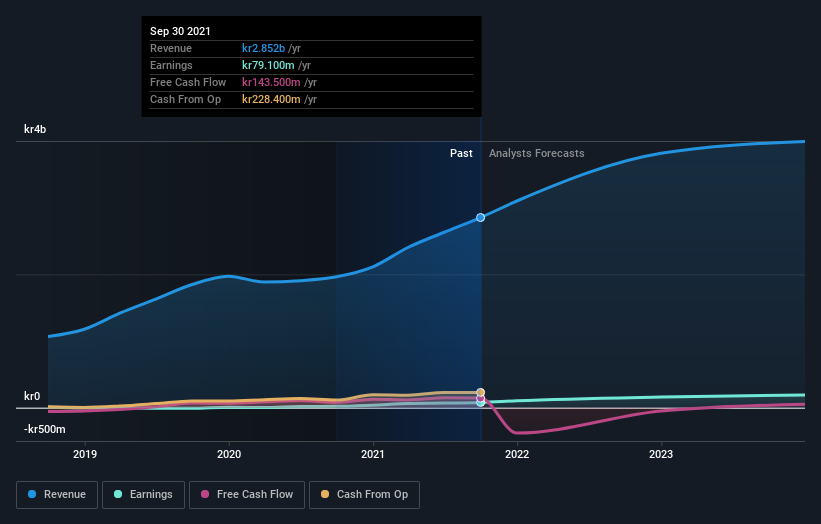
Following the upgrade, the latest consensus from Green Landscaping Group’s solo analyst is for revenues of kr3.8b in 2022, which would reflect a substantial 34{6d6906d986cb38e604952ede6d65f3d49470e23f1a526661621333fa74363c48} improvement in sales compared to the last 12 months. Per-share earnings are expected to shoot up 96{6d6906d986cb38e604952ede6d65f3d49470e23f1a526661621333fa74363c48} to kr2.95. Previously, the analyst had been modelling revenues of kr3.3b and earnings per share (EPS) of kr2.52 in 2022. There has definitely been an improvement in perception recently, with the analyst substantially increasing both their earnings and revenue estimates.

Check out our latest analysis for Green Landscaping Group

earnings-and-revenue-growth
OM:GREEN Earnings and Revenue Growth December 8th 2021

One way to get more context on these forecasts is to look at how they compare to both past performance, and how other companies in the same industry are performing. The period to the end of 2022 brings more of the same, according to the analyst, with revenue forecast to display 26{6d6906d986cb38e604952ede6d65f3d49470e23f1a526661621333fa74363c48} growth on an annualised basis. That is in line with its 28{6d6906d986cb38e604952ede6d65f3d49470e23f1a526661621333fa74363c48} annual growth over the past five years. By contrast, our data suggests that other companies (with analyst coverage) in a similar industry are forecast to see their revenues grow 6.9{6d6906d986cb38e604952ede6d65f3d49470e23f1a526661621333fa74363c48} per year. So it’s pretty clear that Green Landscaping Group is forecast to grow substantially faster than its industry.

The Bottom Line

The most important thing to take away from this upgrade is that the analyst upgraded their earnings per share estimates for next year, expecting improving business conditions. They also upgraded their revenue estimates for next year, and sales are expected to grow faster than the wider market. The clear improvement in sentiment should be enough to get most shareholders feeling more optimistic about Green Landscaping Group’s future.

Even so, the longer term trajectory of the business is much more important for the value creation of shareholders. We have analyst estimates for Green Landscaping Group going out as far as 2023, and you can see them free on our platform here.

We also provide an overview of the Green Landscaping Group Board and CEO remuneration and length of tenure at the company, and whether insiders have been buying the stock, here.

This article by Simply Wall St is general in nature. We provide commentary based on historical data and analyst forecasts only using an unbiased methodology and our articles are not intended to be financial advice. It does not constitute a recommendation to buy or sell any stock, and does not take account of your objectives, or your financial situation. We aim to bring you long-term focused analysis driven by fundamental data. Note that our analysis may not factor in the latest price-sensitive company announcements or qualitative material. Simply Wall St has no position in any stocks mentioned.

Wait until May to plant tropicals for pool landscaping, but use some evergreens as well | Home/Garden

We are just completing the installation of a new pool at our home and are now ready to plant some tropical landscaping. The planting area will get full afternoon sun. I’ve heard you say November is the best time to plant trees — does this also apply to palm trees? What type of palm trees are the hardiest and which would you recommend? What other types of smaller tropicals (palms, bananas, etc.) do you advise? — Paul Baranova

Fall planting applies to hardy trees and shrubs that are not bothered by winter freezes, not tender tropical plants. Palms fall into the tropical plant group and are best planted from May to August. They root best when the soil is warm. The August cutoff date is so that newly planted palms will have time to make root growth and settle in before winter. Palms planted late are at more of a disadvantage should we have significant freezes like we did last February. Among the hardiest palms are cabbage palms (Sabal palmetto) and windmill palms (Trachycarpus fortunei), and these are nice palms to plant around pools as the heads are not so large. Queen palms (Syagrus romanzoffiana) and pygmy date palms (Phoenix roebelenii) look great around pools, but are less hardy and will be damaged or killed by temperatures below 20.

As to smaller tropicals, it is a matter of taste (what you like) and availability at nurseries. Popular choices for sunny areas include hibiscus, bird of paradise, variegated shell ginger, tibouchina, angel’s trumpet, banana, firecracker plant (Russelia), ixora, night blooming jasmine and split-leaf philodendron, to name a few. This is late in the season, however, to plant any tropicals. I’d recommend you install any hardy trees, shrubs, ground covers and perennials that you intend to use in the landscape design this fall, and wait to install the tropicals in April or May. It’s not like the tropical plants would look that nice over the winter anyway, as freezes will make bananas, gingers, etc. look bad. Keep this in mind when you decide what percentage of plant materials around the pool will be hardy and evergreen and what will be tropical. If you use exclusively tropical materials, the area will look far less attractive during the winter cold.

This time of the year with the St. Augustine grass going dormant for the winter, all we have is weeds covering our lawn. The most predominant weed is dollarweed. What can we use this time of the year to try to rid our lawn of the weeds? — Melissa Longman

Atrazine is the best herbicide for dollarweed in St. Aug. It will also control a wide variety of other weeds. You can make an application during mild (70s/60s during the day and 40s/50s at night) weather this fall. Follow label directions carefully. The Atrazine will also suppress the growth of weed seeds. Assess your lawn weed issue in January or February. If needed, you can make another application during a mild spell then. 

I’m growing a variety of peppers (cayenne, Tabasco, Habanero, etc.). I know I can order seeds online, but what is the process to take seeds from my existing plants? How do you dry/treat/preserve them to be viable next year? — David Miller

First, allow the fruit to fully ripen. I like to wait until the pepper actually starts to shrivel slightly before I harvest it. Open up the fruit and extract the seeds. Use a strainer to rinse the seeds thoroughly under running water. Spread the seeds out on a paper towel and allow them to thoroughly dry for about a week. Then, store the seeds in an air tight container in your refrigerator until you plant them next year. If you are growing any F1 hybrid peppers, be aware that they do not come true from seeds. The offspring will be different from the original plants. Also, it is possible that different types of peppers growing close together may have cross-pollinated, and that will lead to offspring that combine the characteristics of the parents.

Purchases made via links on our site may earn us an affiliate commission

Dan Gill is a retired consumer horticulture specialist with the LSU AgCenter. He hosts the “Garden Show” on WWL-AM Saturdays at 9 a.m. Email gardening questions to gnogardening@agcenter.lsu.edu.

Free landscaping plans available to San Benito residents

Water-efficient gardens, such as the one at Dunne Park, are encouraged during drought.

This article was written by BenitoLink intern Juliana Luna

Shawn Novack, Director of the Water Resources Association of San Benito County, says “60{6d6906d986cb38e604952ede6d65f3d49470e23f1a526661621333fa74363c48} of water usage goes into home landscapes,” and that “we need to start thinking of saving water.”

As an incentive for residents to conserve water, the Water Resources Association is offering three free water-wise landscape plans created by landscape designer Rosemary Bridwell. The designs consist of different themes—a meadow, dry creek and strolling garden (See PDFs below). Each plan has a $500 value. 

Water-wise landscaping is a term for gardening practices that use water efficiently.

Since 2007, Dunne Park has been an example of the water-wise approach. Leo Vasquez, a member of Water Resources, has been taking care of the garden, which is located at the corner of Powell and Sixth streets.

Vasquez said Dunne Park’s garden is watered twice a week, whereas normal gardens need to be watered three times a week. He noted that a rose garden takes up to two gallons a day and needs to be watered three times a week as well.

Dunne Park’s garden design includes a walkway of pavers, which allows water to run through them and into the ground. 

When choosing plants, Novack said native plants should be kept in mind because they help support local biodiversity.

Gov. Gavin Newsom this year put all of California under a drought emergency. Novack said that in May, runoff water from Sierra Cascade snowpack was drained dry by warm temperatures and parched soil. This caused significant reductions in the amount of water flowing to reservoirs.

He added that San Benito County is following Stage 1 water conservation measures, as follows. 

Outdoor water restriction

  • Landscape watering is limited and restricted to no more than three days per week with a duration of 15 minutes of watering.
  • No washing down sidewalks, driveways, or other hardscape surfaces.
  • No washing cars without the use of a quick-acting, positive shutoff nozzle.
  • No watering landscapes that cause runoff to adjacent, private, and public walkways.

General

  • Leaks, breaks and malfunctions of irrigation systems and plumbing equipment causing waste of water shall be repaired.

Prohibitions affecting commercial businesses

  • Water is to be served only when requested in restaurants and other food service establishments.
  • Operators of hotels and motels must provide guests with the option of choosing not to have towels and linens laundered daily and prominently display notice of this option.


The BenitoLink Internship Program is a paid, skill-building program that prepares local youth for a professional career. This program is supported by Monterey Peninsula Foundation AT&T Golf Tour, United Way, Taylor Farms and the Emma Bowen Foundation.


Help us bring on more interns! As a local nonprofit news organization, BenitoLink needs community support to continue developing important local programs like our youth and Latinx intern training program. You can keep it going strong by going to our BenitoLink donation page.