Patrick Downing is a sterling musician, passionate about wonderful arts and seasoned in fundraising.
So it is fitting that the 35-12 months-previous Western Illinois College alum is the new director of growth at the Figge Artwork Museum, soon after virtually a few many years in a comparable position for Davenport-primarily based Palmer School of Chiropractic.
Downing was just one of a few growth directors at Palmer (focusing on the Midwest), which has campuses in Davenport, San Jose, Calif., and Port Orange, Fla. At the Figge (225 W. 2nd St., Davenport), this 7 days he succeeded Sara Volz – who still left about Thanksgiving to grow to be govt director for the foundation started out by Iowa-centered professional golfer Zach Johnson.
Palmer College or university of Chiropractic in September 2021 focused the new $10.2-million David D. Palmer Learning Commons, off Brady Road in Davenport.
“I understood that I needed to remain in fundraising,” Downing (a pianist, singer and actor who worked for West Music 10 a long time) stated Tuesday. “I had a remarkable practical experience at Palmer College. I knew there was an possibility in undertaking advancement work, doing work with exceptional individuals passionate about their group, and if an opportunity like that in the Quad Towns great arts arrived up, I would pursue that.”
When the Figge occupation grew to become out there, he leapt at the chance, and Downing claimed he wouldn’t be at the art museum with out his beneficial time at Palmer – which will be celebrating its 125th anniversary this September. He explained the neighborhood will be blown absent by what the college or university has in store for their large celebration.
“Of the numerous matters I have uncovered about performing with Palmer’s fantastic alumni is that they are between the most passionate and focused men and women to a particular career that I have ever fulfilled,” Downing posted on Facebook. “Their devotion and enthusiasm of chiropractic care and assisting individuals of all ages reside their ideal life doable has been — and carries on to be — encouraging and inspirational.
“As my qualified vocation now guides me back again toward my passion and really like of the good arts, my goal is to provide their kind of power and pleasure to my new placement at the Figge,” he wrote. “I’m so appreciative to so numerous Palmer alumni for their support of the college or university and the pupils, their kindness, and their friendship.”
The Figge Artwork Museum is at 225 W. 2nd St., Davenport.
Downing admires the Figge mission statement: “Bringing art and men and women collectively. We enrich our local community with the encounter of artwork through training, collections, exhibitions and preservation.”
“As a citizen of the Quad Towns for practically 13 decades, it has often been extraordinary to see the Figge carry their assertion to lifestyle, and I simply cannot wait to help their staff progress this mission all over our community and outside of,” he explained.
Appreciation for the museum partnerships
“One of quite a few issues that psyched me about the Figge is their involvement with the Quad-Town community, the support it receives from the location and the collaboration the Figge has with so a lot of treasured businesses in the Quad Cities,” Downing claimed. “That really fired up me, and it’s been wonderful to be back in the entire world of the arts.”
As the to start with chiropractic university in the entire world (started in 1897), Palmer awards a lot more scholarships than any these types of university in the state, Downing mentioned. It’s concentrated on a lot of money projects and rising its endowment in the previous number of decades.
“I went from just a environment-course crew at Palmer Higher education to a environment-class staff at the Figge,” he claimed Tuesday. “In my 3 a long time at Palmer, I built lifelong mates and colleagues. I have only been at the Figge two times, but there’s no question it will be the exact matter. They have provided me a heat welcome to the museum.
For practically 10 several years (right up until April 2019), Downing labored at West Audio in Moline as a Qualified Piano Marketing consultant and Institutional Product sales Consultant.
“This new situation looks a excellent relationship of the careers I experienced prior to — the extraordinary fundraising employees at Palmer School having to know so many remarkable people today in the arts local community though at West Audio,” he said. “It’s a fantastic marriage of the two of them.
“I am beyond humbled that the Figge considered me, and requested me to be portion of their team,” Downing said. “I am humbled and honored for the opportunity to work with this incredible group, for one of the most treasured cultural beacons of the Quad Towns and the overall Midwest.”
Visitors at the Figge Art Museum.
The museum is also an uplifting, inspiring place of work, due to the fact there is so a lot gorgeous artwork on the partitions, he mentioned.
“We have an place of work natural environment, in which we can get our operate finished, but if you want to glimpse at globe-course artwork, you only stroll out the door,” Downing stated.
He’s continue to having accustomed to his new tasks, and described the Figge’s range fund is a principal priority.
The museum is in the midst of elevating $100,000 for a new Art Range and Equity Fund supposed to fight systemic inequality in the artwork world, like diversifying the Figge’s assortment. The fund was launched past July with a lead reward from locals Jim and Michelle Russell of Russell Design.
Jim and Michelle Russell asserting a major $20,000 gift to the Figge’s new artwork diversity and equity fund in July 2021 (picture by Jonathan Turner).
“That’s a mission that we have really intensely at the Figge and we’re particularly thankful for the Russells and what they did last calendar year,” Downing stated.
He and his spouse Kristena live in Davenport with their three sons, ages 6, 2, and just about five months.
For more facts on the Figge, pay a visit to their web site.
Min Jung Kim has spent her vocation performing with art, but has almost no artwork in her very own residence. “I really accumulate pretty little,” she states. “The ideal aspect of my job is becoming capable to wander by means of the galleries and get pleasure from wonderful works of art practically as if they were an extension of my individual dwelling.”
The Saint Louis Art Museum’s 34,000-piece collection is at Kim’s fingertips now that she’s taken the helm as the museum’s director. One of her priorities, she says, is to keep on producing all those masterpieces accessible to as several people as possible. Even in advance of accepting the role, she understood about a couple of of the collection’s strengths, these as its up to date German galleries—the Max Beckmann paintings, in particular—but she suggests it’s been a joy to explore new treasures in the course of her 1st months on the job.
“Our assortment in the regions of Oceanic and African and the ancient Americas assortment are truly breathtakingly beautiful,” she suggests. “I really feel like I’m just scratching the surface of quite a few extra strengths.”
Even although Kim doesn’t gather art, she is aware of a lot of men and women who do—and she’s amazed with the personal collections she’s witnessed so far in St. Louis residences: “In lots of methods, it has produced me believe that the composition of the permanent selection at the Saint Louis Art Museum has not only benefited tremendously but has definitely been outlined by so quite a few presents that have been created by non-public collectors more than the years.”
In Oct, the museum introduced a promised gift of 22 is effective of artwork from the personal assortment of Emily Rauh Pulitzer. That reward, which contains works by Pablo Picasso and Andy Warhol, amid others, is one of the most significant in the historical past of the museum, but it’s undoubtedly not the 1st. Around the many years, generous donations have experienced a true impact on the breadth and depth of the performs obtainable to museum people.
Although not all people owns these an illustrious artwork assortment, Kim shares means to assist artwork lovers fascinated in starting off a assortment or using just one to the up coming level. She endorses the Collectors Circle—part of SLAM’s membership program—which comprises 4 unique groups, just about every focused on a distinct specialty: African-American artwork, American artwork and structure, pictures, present-day art. The groups system particular activities this kind of as private lectures, viewings of non-public St. Louis collections, and in-depth tours of exhibitions.
“As considerably exposure [to art] as doable is normally a single of the matters that would advantage a collector at any stage,” says Kim, “and we have a genuinely lively collection of packages that engages that amount of membership in diving a tiny bit further.”
The Frist Art Museum will current Alma W. Thomas: Everything Is Gorgeous, a extensive overview of the artist’s extensive, dynamic lifestyle (1891-1978) and multifaceted profession that was outlined by frequent creativeness. Featuring more than 150 is effective, like her joyful and colorful summary paintings and many objects that have in no way been exhibited or published ahead of, the exhibition demonstrates how Thomas’s inventive practices extended to each individual facet of her lifetime-from community company and instructing to gardening and costume. Co-arranged by the Chrysler Museum of Art and The Columbus Museum, Georgia, Every thing Is Wonderful will be on check out in the Frist’s Upper-Stage Galleries from February 25 via June 5, 2022.
This major retrospective follows the trailblazing artist’s journey from Columbus, Georgia, to Washington, DC, to getting the initial Black woman to have a solo clearly show at New York’s Whitney Museum of American Artwork in 1972, when she was eighty many years outdated. It incorporates thirty-8 canvases spanning 1922-77, far more than sixty operates on paper, four marionettes, and a variety of sculptures, images, and ephemera.
“Anything Is Wonderful not only offers a a lot more elaborate comprehending of Alma Thomas, but also gives an inspiring example of how to direct a creative daily life currently,” claims Seth Feman, PhD, one particular of the exhibition’s curators and the Chrysler’s deputy director for artwork and interpretation and curator of pictures. He notes that, when Thomas has been extensive adored by collectors and scholars, her expertise remained unfamiliar to a broader general public for additional than three decades just after her dying right up until 2009, when President Barack Obama and Very first Girl Michelle Obama included her operate among the paintings they mounted at the White Residence. “Thomas realized artworld stardom but regarded as instructing artwork to be her greatest legacy,” says Frist Art Museum senior curator Trinita Kennedy. The Frist will emphasize Thomas’s 30-5-yr tenure at Shaw Junior Higher in Washington, DC, by presenting a concurrent exhibition titled Nashville Artwork Academics: Further than the Classroom that salutes the amazing art teachers in our own community and their heroic attempts for the duration of the demanding circumstances of the COVID-19 pandemic. It features the do the job of elementary, middle, and higher school art instructors doing the job in Davidson County and will be on see in the Conte Neighborhood Arts Gallery from March 4 by way of August 28, 2022. Read through the whole press release on line. Download a PDF of this press launch.
Plan
Thursday, February 24 Curators’ Point of view Alma W. Thomas: Finding out from the Artist-Educator 6:30 p.m. Introduced on Zoom Cost-free registration expected
Offered by Seth Feman, deputy director for artwork and interpretation and curator of photography, Chrysler Museum of Art, and Jonathan Frederick Walz, director of curatorial affairs and curator of American art, The Columbus Museum
Sign up for the exhibition co-curators to study a lot more about how Thomas’s artistic techniques extended to each facet of her lifetime. Drawing from their essays in the accompanying catalogue as well as from the exhibition, Walz will current on Thomas’s marionettes and Feman will share more about Thomas’s educating apply.
The Metropolitan Museum of Artwork explained Tuesday that it would restrict attendance to about 10,000 website visitors for every day because of the extremely infectious Omicron variant. Throughout a typical vacation period, the museum would be expecting just about two times as lots of people.
“The security of our team and guests remains our top rated precedence,” the Met’s chief govt, Daniel H. Weiss, mentioned in a statement. “Reduced density is a to start with move we can consider — and our dedicated employees has finished an incredible job in earning needed alterations to adapt to our public health situation even though also allowing for the museum to continue to be open up and preserve all people safe.”
The shift arrived as a different important institution, the Baltimore Museum of Artwork, stated that it was closing its galleries by means of Dec. 29 mainly because of an enhance in beneficial coronavirus assessments.
“We want a second to move back again and make certain our personnel is all set to provide museum website visitors,” the Baltimore museum mentioned in an electronic mail on Tuesday. “We assume cautiously is the very best way to move ahead.”
On Thursday, the Wintertime Clearly show (a huge art, antique and style and design good) postponed its Jan. 20 opening at the Park Avenue Armory, with strategies to announce new dates in the coming weeks. In Queens, the Noguchi Museum has closed by means of Jan. 4 because of the Omicron variant. And in New Haven, Conn., the Yale University Art Gallery and Yale Centre for British Art have equally closed by way of Jan. 2.
Kenneth Weine, the Met’s spokesman, said that reduced ability would aid limit density inside the building’s entrances. Outside the house the entrances, even though, with employees associates examining vaccination standing of people, he stated there could be for a longer period lines. The Satisfied will also conclude meals services starting on Thursday and is inquiring lots of workers to get the job done from property.
Experiences of coronavirus instances in New York State have amplified by far more than 80 {6d6906d986cb38e604952ede6d65f3d49470e23f1a526661621333fa74363c48} around two months, and federal authorities have explained the Omicron variant now accounts for almost 3-quarters of new instances.
Cultural institutions have normally relied on the holidays to support profits. This latest coronavirus surge has led to the unexpected cancellation of performances and exclusive programming close to the city. More than the weekend, almost a 3rd of all Broadway demonstrates were being canceled due to the fact of good coronavirus checks among their casts and crews, and numerous are shut down via Christmas.
“The museum subject is by now going through a gradual restoration,” said Laura Lott, president and main govt of the American Alliance of Museums.
“Another wave of minimized capacity and probable closures, without further federal aid, could show devastating,” she extra.
Museums are also applying new protection actions. Each the Nationwide Gallery of Artwork in Washington and the Brooklyn Museum, for example, have canceled several in-person excursions.
After 14 years, the University of Iowa will finally have a new art museum again, thanks in large part to a Davenport-based construction firm and a Muscatine family.
Pending final inspection, Russell Construction expects to complete the $36.8-million University of Iowa Stanley Museum of Art in Iowa City and turn it over to the UI to move in on Dec. 23. Lauren Lessing, director of the Stanley Museum of Art, recently told the UI Staff Council that the 86,176-square-foot, three-level building is nearly finished and staff can start settling in in mid-January. Art will not move into the museum until April, and a ribbon-cutting will take place next September.
“It’s really exciting for Russell to be involved in building this museum,” Erin Marsh, the museum project manager for Davenport-based Russell, said recently. “It’s part of the university campus and influential in the community. It will be an opportunity for K-12 kids to come through on field grips, see art. It will really have a long-lasting impact on the community.”
With subcontractors (including Quad Cities-based Ryan and Associates, Tri-City Electric, and Treiber Construction), Russell has employed 200 people in the construction process, which began in August 2019, Marsh said.
An exterior rendering of the new art museum, to open in early September 2022, at 150 N. Riverside Drive, Iowa City.
The Stanley Museum of Art — at 150 N. Riverside Drive, along the Iowa River, next to the Theatre Building — will be the final structure to be rebuilt on the UI campus in the aftermath of the 2008 flood. Once complete, the museum will host exhibitions from the museum’s collection as well as traveling exhibits, and provide space for study, research, and storage of artwork. Among highlights:
The building’s loading dock and freight elevator (with a 21’x10’ interior cab) is designed for this painting to be moved in and out of the building.
Elaborate brick design patterns – each brick is accounted for and shown where it should be placed in the architectural drawings.
Building is designed to accommodate flooding of the nearby Iowa River – the first floor is 7 feet above grade with parking garage below.
A 400-square-foot lightwell in the middle of the building that extends 3 stories, bringing indirect natural light into the building.
Two third-floor outdoor terraces, providing views of the surrounding areas.
Intricate exterior finish system including custom hand-made bricks, triple- pane glass and perforated metal panels.
The construction team 3D modeled building systems to facilitate installation and allow maintenance access.
A three-story “lightwell” will allow lots of natural into the new art museum.
The art museum, established in 1969, is one of the leading university art collections in the country, according to the museum website. Approximately 15,500 objects constitute diverse collections that include paintings, sculpture, prints, drawings, photographs, ceramics, textiles, jade, and silver.
The Elliott Collection of post-Impressionist European art includes paintings by Braque, de Chirico, Kandinsky, Léger, Marc, Matisse, Picasso, and Vlaminck, among others. The Stanley Collection of African Art is part of one of the most significant collections of African art in the country which today numbers over 2,000 objects.
After the flood of June 2008, the museum building was permanently evacuated. The collections were moved out in time and most have been temporarily located in the Figge Art Museum in Davenport, 50 miles from Iowa City.
The museum’s dedicated spaces on campus include the Stanley Visual Classroom, a 4,000-square-foot exhibit space in the Iowa Memorial Union that houses more than 500 works of art from the collections. Temporary and traveling exhibitions were hosted in the Black Box Theater in the third floor at the IMU until summer 2018.
Muscatine family generosity
In 2017, Richard (Dick) and Mary Jo Stanley, of Muscatine, committed $10 million to support the building campaign for the University of Iowa Museum of Art. The gift came from two generations of the family. In honor of the transformational gift, the museum was renamed the University of Iowa Stanley Museum of Art.
Richard Stanley of Muscatine (1932-2017), a professional engineer, and his wife Mary Jo have been longtime donors to the University of Iowa.
The couple’s generosity is well-documented across campus and includes support for Hancher Auditorium and the UI College of Engineering, as well as the UI Museum of Art. Dick earned his master’s degree in engineering from UI in 1963, and died at age 85 on Nov. 17, 2017, at University Hospitals, Iowa City.
A portion of the art museum gift came from the estate of Dick Stanley’s parents, C. Maxwell and Elizabeth Stanley, who developed one of the country’s finest and most well-respected collections of African art, which they donated to the museum in 1985. The Stanley Collection of African Art continues to be an important resource for research at the UI and for scholars from around the world. C. Maxwell Stanley earned his bachelor’s degree (1926) and his master’s degree (1930) in engineering from the UI, and Elizabeth Stanley earned her bachelor’s degree in education from the UI in 1927.
“The decision to name the museum in the Stanleys’ honor is particularly appropriate; their generous monetary pledge, announced today, comes on top of a multi-decade array of family sculptural donations that are the heart of the university’s 2,400-piece African collection,” Jim Leach, then interim director of the UI Museum of Art, said in the 2017 announcement.
Russell began construction on the 86,176-square-foot museum in August 2019.
“When future generations visit the museum and see uplifting art from every corner of the world, they also will be witnessing the philanthropic impact of model citizens within and outside the state. In this galaxy of cultural generosity, as well as international humanism, Dick and Mary Jo have few peers. The university is deeply grateful.”
“For more than 50 years, Dick and Mary Jo’s inspirational volunteerism and generosity have had a profound impact on our students, faculty, and community,” said Lynette Marshall, president and CEO of the University of Iowa Center for Advancement. “The University of Iowa Stanley Museum of Art honors their exemplary citizenship in our university community and is a wonderful tribute to their lives of service and giving.”
Russell’s history with area museums
The landmark Figge Art Museum (225 W. 2nd St., Davenport) was built by Russell as a joint venture with Pepper Construction out of Chicago. That $48-million project was the four-story, 110,000-square-foot museum, including 25,000 square feet of gallery space, restaurant, gift shop, five art studios, auditoriums and a 45,000-square-foot, 86-space below grade parking garage.
The $48-million Figge Art Museum in downtown Davenport opened in 2005.
The joint venture was called Russell – Pepper, and that same entity built the $40-million addition and renovation to the UnityPoint Health – Trinity Heart Center / Emergency Room in Rock Island, which opened in 2015.
The only other museum projects that Russell has been involved with are for Iowa 80 Group at their Trucking Museum in Walcott, and a small project this year for the Putnam Museum & Science Center in Davenport.
Russell created the entrance to the Putnam’s new World Culture Gallery, which opened in May, including work in the exhibit space, and upgrading all finishes in the World Culture and Unearthing Ancient Egypt exhibits.
Russell completed $3.7 million in additions to the Iowa 80 Trucking Museum and Hall of Fame in Walcott.
Des Moines-based BNIM Architects designed the new UI art museum, which it describes as a “state-of-the-art facility providing stringent environmental and security requirements to house the University’s extensive African Art Collection and the seminal Jackson Pollock painting ‘Mural.’
“The building includes a greeting and gathering entry area, galleries, teaching studios, student commons, administrative offices, art storage, conservation and art shipping/receiving, and a secured and tempered truck loading bay,” according to its description.
The interior design concept was developed to bring the outside in through large glass facades and occupiable voids in the building, acting as an extension of the neighboring public greenspace. Public spaces and administrative offices feature daylighting, and a central exterior courtyard provides an amenity space for gallery viewers and additional display space for large sculptural installations.
Michelle and Jim Russell announced their $20,000 donation in July 2021, to the Figge’s new Art Diversity and Equity Fund (photo by Jonathan Turner).
This past July, Russell CEO Jim Russell and his wife Michelle announced a $20,000 donation to launch the Figge’s new Art Diversity and Equity Fund. They encouraged community members to consider contributing any amount to this fund so their contribution can be matched and ultimately exceeded dollar-for-dollar, allowing the Figge to reach the goal of raising $100,000.
“Jim and I feel strongly about this initiative in general, and feel it is important for our community to have a museum that focuses on representing all people, voices, and perspectives,” Michelle Russell said then. “It is our hope that others will consider stepping forward in all ways to build an all-inclusive reality in our community, and specifically to donating to this important fund designed to help the Figge continue to promote inclusivity.”
Figge executive director Michelle Hargrave not only thanked the Russells for their generosity, but noted the Figge would not be here without them, since Russell built the museum, which opened in 2005.
“I think the best piece of art in this collection is this building,” Jim Russell said in July.
What’s so special about “Mural”?
The world famous “Mural” (1943) by Jackson Pollock (1912-1956) has been on a tour of various art institutions across the country and world, since the former UI Museum of Art was flooded out in 2008 — including its first move to the Figge in Davenport until 2012.
Jackson Pollock’s “Mural” (1943) was displayed at the Figge Art Museum from 2009-2012 (courtesy of The Pollock/Krasner Foundation and Artists Rights Society)
Donated by Peggy Guggenheim (1898-1979) to the art museum in 1951, “Mural” has been a long-time resident at the University of Iowa.
Commissioned by the New York art impresario to create a mural for the foyer of her ritzy East 61st Street townhouse, Pollock opted to work with a massive swath of stretched, Belgian canvas rather than the wall itself so the piece could later be relocated, if needed, according to a December 2019 feature in Iowa Magazine.
“If not for that foresight, Mural‘s history may have been fleeting. After the Second World War, as Guggenheim left New York for Venice, the painting was rolled up and shipped to Yale, which declined to keep it,” the story says. Guggenheim ultimately donated it to the University of Iowa’s innovative School of Art and Art History. In Iowa City, Mural shuffled between the old Art Building and Main Library before becoming a fixture in the UI Museum of Art when it opened in 1969.
“Beyond that history of movement, there’s also the motion on the canvas to consider,” according to the magazine. “It was Pollock’s wild, sweeping brushwork in his New York flat—he had to surreptitiously knock out a partition to make room for the 8-by-20-foot canvas—that resulted in a work unlike anything he’d ever created. ‘It looks pretty big, but exciting as all hell,’ Pollock wrote in a letter to his brother that summer. It was his first commissioned work, and Mural would prove to be the largest painting of his career.”
An architectural rendering of the permanent home for “Mural” in the UI Stanley Museum of Art.
Further, experts point to Mural as the birth of an entire art movement. The painting marked the moment when Pollock pivoted away from surrealism toward a spontaneous and gestural style that would be called abstract expressionism, the Iowa feature says.
Mural was a watershed in 20th century American art and a precursor to the horizontal drip paintings that made Pollock famous by the 1950s. “It was a breakthrough,” says Stanley Museum of Art Director Lauren Lessing. “The idea that he had to tell a story, or be mythical, or reach into this long narrative tradition of European art going back to the Greeks and Romans—he kind of let it all go. That was Mural. It was pure abstraction, free of the influence of surrealism.”
In the case of “Mural,” the piece visited the Getty Conservation Institute in Los Angeles for conservation and restoration before beginning its travels, while the Stanley Museum of Art’s campus presence is revived in a new facility.
“A year-and-a-half recuperation at the Getty Conservation Institute in Los Angeles restored the yellowed, sagging mural to its original vibrancy,” the New York Times wrote in December 2020. Since then, the massive canvas — the thing weighs 345 pounds — has been craned in to England, Spain, Italy, Germany, across the U.S. (including Boston and Sioux City), and finally, fittingly, to New York’s Solomon R. Guggenheim Museum, before coming home to Iowa City.
BNIM tracked the Pollock’s international travels on its website. To learn more about the new UI Stanley Museum of Art, click here.
The Columbus Museum of Art is paying homage to Vincent Van Gogh and his contemporaries in a spectacular, thoughtful and must-see exhibit.
“Through Vincent’s Eyes: Van Gogh and His Sources” celebrates the tortured Post-Impressionist with 17 of his signature works, interspersed with more than 100 paintings, prints and sculptures by artists who influenced and were admired by van Gogh.
The beautifully installed exhibit places van Gogh works on a deep-blue background, surrounded on white walls by meaningful works created by Van Gogh’s contemporaries.
So, it is possible to do a 15-minute “Louvre” walk-through to find and inspect just the Van Gogh works. But viewers would be doing themselves a huge disservice to go this route; throughout the exhibit there are artistic gems by the likes of Edgar Degas, Paul Gauguin, Edouard Manet, Claude Monet, Camille Pissarro and Henri de Toulouse-Lautrec, to name a few.
In addition, the panels accompanying all the works give relevant and entertaining information.
There are numerous quotes from van Gogh himself, taken largely from his correspondence with his brother and supporter, Theo, that tell what the artist thought of his fellow painters and how they impacted his work.
For instance, as you enter the exhibit, one of the first paintings to strike your eye is van Gogh’s “Roses (1890), a beautiful oil owned by Washington D.C.’s National Gallery of Art. Originally painted pink, the roses faded so that in today’s painting, they’re white. Hung on one side of “Roses” is Henri Fantin-Latour’s “Chrysanthemums of Summer” (1887) and on the other, Manet’s “Peonies” (1864-65). The panel includes the following quote from van Gogh:
“Do you remember that one day at the Hotel Drouot we saw a quite extraordinary Manet, some large pink peonies and their green leaves on a light background? As much in harmony and as much a flower as anything you like, and yet painted in solid, thick impasto …. That’s what I’d call simplicity of technique.”
This kind of placement of works and information makes for a fine viewer experience — enjoying the artistry of van Gogh and his peers in a context-rich presentation.
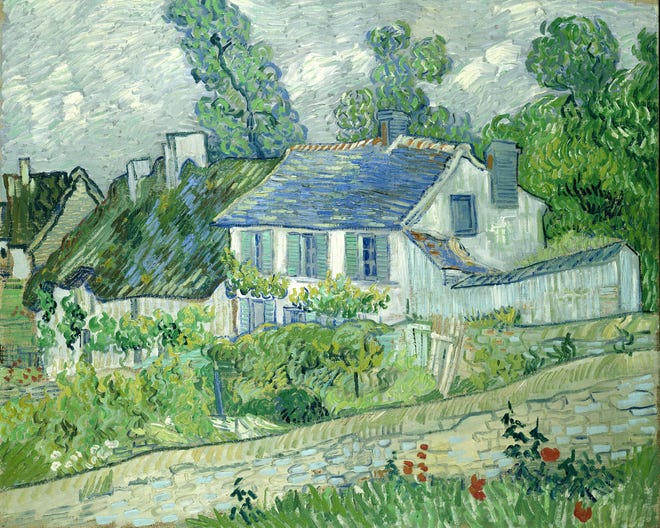
Of course, there are standout Van Gogh works — not the iconic “Sunflowers” or “Starry Night;” these are not part of this exhibition — but wonderful still lifes, landscapes and portraits, including “Houses at Auvers” and “Les Vessenots in Auvers” (both 1890), “Tarascon Stagecoach” (1888), “Undergrowth with Two Figures” (1890), lithograph “Potato Eaters” (1885) and “Portrait of Dr. Gachet” (1890), van Gogh’s only etching that captures the doctor who attended to him in the final years of his life.
Van Gogh’s love and appreciation for Japanese art — he collected woodblock prints — is reflected with the inclusion of lovely works by Ando Hiroshige (“Sudden
Evening Shower at Ohashi Bridge” from 1857) and Katsushika Hokusai (“Great Wave off Kanagwa” from between 1823-31).
The exhibit is organized in categories such as the “Life in Paris,” “Portraits,”
“Impressionism and After,” “Rustic Life and the Working Class,” “Landscapes” and “Religion.”
Occupying the first floor of the museum’s Walter Wing, the exhibit can be traversed however one likes, but exhibit co-curator David Stark suggests veering off to your left as you enter and first discovering some of van Gogh’s earliest works.
In the more southern portion of the wing, the museum has placed early editions of books van Gogh read (in their original languages because he was multilingual), including Harriet Beecher Stowe’s “Uncle Tom’s Cabin,” Edgar Allan Poe’s “The Raven and Other Poems” and a variety of Charles Dickens’ novels including “Oliver Twist” and “A Tale of Two Cities.” A great admirer of Dickens, van Gogh wrote: “I want to paint what Dickens has done with words.”
That the exhibit has obtained loans from prominent museums throughout the United States and the world is reflected in the van Gogh works and the numerous gems by his contemporaries. Not to be missed are Jean-Francois Millet’s “The Sower” (after 1852), Gauguin’s “Christmas Night” (1902-03) and Jean-Francois Raffaelli’s “The Absinthe Drinkers” (1881).
Along with Stark, co-curator for the exhibit was Columbus native Steven Naifeh, author of the new “Van Gogh and the Artists he Loved” and co-author with his late husband Greg White Smith of the biography “Van Gogh: The Life.” The exhibit was organized by the museum along with the Santa Barbara Museum of Art, where it will travel after closing in Columbus.
“Through Vincent’s Eyes” captures the remarkable output of van Gogh during his very short 10 years producing art, and has placed his work in context with that of his peers and the times. Viewers are the beneficiaries of this abundant, intelligently presented collection of art.
negilson@gmail.com
At a glance
“Through Vincent’s Eyes: Van Gogh and His Sources” continues through Feb. 6, at the Columbus Museum of Art, 480 E. Broad St. Hours: 10 a.m. to 5 p.m. Tuesdays through Sundays, until 9 p.m. Thursdays. Timed tickets cost $10 plus the regular admission of $18, or $9 for senior citizens, students and ages 4 to 17; free for members and children age 3 and younger. Masks required. Discounted admissions are available Thursday evenings and Sundays. Parking costs $5. Go to www.columbusmuseum.org.