Crews removed the statue of Confederate General Robert E. Lee from its perch in Charlottesville, Virginia, in July 2021. Controversy over the statue’s fate sparked the violent “Unite the Right” rally in 2017. Photo by John McDonnell / The Washington Post / Getty Images
Last summer, Black Lives Matter protests sparked by the murder of George Floyd spurred communities across the globe to remove or dismantle the racist public art decorating their government halls, museums, parks and city squares. Many of these monuments were tucked away in storage facilities. Others, such as the American Museum of Natural History’s Theodore Roosevelt statue and the toppled bronze likeness of an enslaver in Bristol, England, found new homes in museums.
In Charlottesville, Virginia, lawmakers decided to transform one torn-down monument entirely, reports Teo Armus for the Washington Post. Instead of storing a statue of Confederate General Robert E. Lee, officials will melt down the 1,100-pound bronze monument into metal ingots—raw material that can then be used to create new art.
City council members approved the proposal unanimously on Tuesday morning, reports Ginny Bixby for the Charlottesville Daily Progress. Put forth by the local Jefferson School African American Heritage Center (JSAAHC), the plan was one of six considered by lawmakers during months of deliberation.
According to JSAAHC’s proposal, organizers plan to hold community listening sessions in barbershops, places of worship, schools and other businesses throughout Charlottesville. With community input, the “Swords Into Plowshares” team hopes to select an artist or artists to design a new public artwork by 2024.
The museum has already raised more than half of the $1.1 million required to bring its project to fruition and is continuing to fundraise online. Proceeds will be used to donate the transformed statue back to the city, where it will go on display by 2026.
JSAAHC executive director Andrea Douglas tells the Post that the project “will allow Charlottesville to contend with its racist past.”
She adds, “It really is about taking something that had been harmful and transforming it into something that is representative of the city’s values today.”
In a JSAAHC video describing the proposal, the director says, “I think this project offers a road map for communities who are also grappling with what to do with their statues.”
The statue of Lee on horseback has sat in storage since July, when it was removed from Market Street Park by city officials. The work was installed in 1924 as one of hundreds of similar statues commissioned by white authorities across the United States in the 19th and 20th centuries.
Particularly in the Jim Crow South, these Confederate monuments paid “homage to a slave-owning society and [served] as blunt assertions of dominance over” Black Americans, wrote Brian Palmer and Seth Freed Wessler for Smithsonian magazine in 2018.
Controversy over the Charlottesville statue reignited in 2017, when it was became a “focal point” of the infamous “Unite the Right” rally, as Armus reported for the Washington Post in July.
Responding to calls for the statue’s removal, white supremacist groups organized a protest that quickly turned violent. A man drove his car through a crowd of counter-protesters during the two-day-long demonstrations, injuring dozens of people and killing 32-year-old Heather Heyer.
Council members will likely reconvene on December 20 to decide the fates of two additional statues removed in July. One depicts Confederate general Thomas “Stonewall” Jackson, while the other portrays explorers Meriwether Lewis and William Clark and Lemhi Shoshone interpreter Sacajawea, per the Daily Progress.
According to Monument Lab’s National Monuments Audit, a recent survey of more than 48,000 statues, plaques, parks and obelisks across the country, Lee is the sixth-most represented historical figure in the American commemorative landscape. As a general for the Confederacy, Lee led thousands to their deaths in a war waged in the name of preserving slavery. He personally enslaved multiple people and, as executor of his father-in-law’s estate, oversaw almost 200 enslaved people on three Virginia plantations.
Elsewhere in Virginia, authorities in the state capital of Richmond recently dismantled a separate equestrian statue of Lee. Standing 21 feet tall and weighing nearly 12 tons, the monument was the largest Confederate sculpture in the United States prior to its removal in September.
Historian Jalane Schmidt, director of the University of Virginia’s Memory Project, worked with JSAAHC to develop the proposal. Her organization develops public engagement around issues of public memory as they relate to the Charlottesville rally.
In the JSAAHC video, Schmidt notes that “Swords Into Plowshares” will offer locals the opportunity to heal from or reckon with the events of 2017 and beyond.
“Our community will confront white supremacy with creativity,” the scholar adds. “Beauty will heal the ugliness of the past.”
In a lockdown year, with travel reduced, there was no movable feast quite like an art book. Art is made by all sorts of people, everywhere, all the time, along many different paths, some of which are illuminated by these intriguing publications chosen by our critics, Pay Per Touch.
Holland Cotter’s Favorites
‘Ray Johnson c/o’
The maverick American artist Ray Johnson (1927-1995), who managed to be nowhere and everywhere in the art world through his invention of Mail Art, was lucky in his longtime friend William S. Wilson, to whom, over 60 years, he gave thousands of letters, collages, drawings and clippings. Wilson saved every last scrap, and a jampacked sampling of them makes up this gold mine of a book, edited and curated by Caitlin Haskell with Jordan Carter. Funny, biting, morbid, it’s a page-turner for sure, and accompanies a show at the Art Institute of Chicago through March 22). (Art Institute of Chicago, distributed by Yale University Press)
‘The Dirty South: Contemporary Art, Material Culture, and the Sonic Impulse’
Edited by the curator Valerie Cassel Oliver, this catalog for one of the outstanding exhibitions of the season — originating at the Virginia Museum of Fine Arts, it’s now in Houston — proposes that the culture of the African American South, as defined by music and vernacular art, is the bedrock of American culture itself, with a strong influence on new art today. The book vividly illustrates and deepens the show’s powerful argument. (Virginia Museum of Fine Arts, distributed by Duke University Press)
‘Yannis Tsarouchis: Dancing in Real Life’
This book lovingly excavates the career of a Greek modernist painter who designed sets for Maria Callas and kept a Greek Classical figurative tradition alive in paintings of homoerotic nudes. Tsarouchis (1910-1989) was both too radical and too conservative for the art world of his time and fell into oblivion outside of Greece. Edited by Niki Gripari and Adam Szymczyk (and including a selection of the artist’s writings, this tender tribute brings him back. (Sternberg Press)
‘Titian: Love, Desire, Death’
The London exhibition by this name reunited six major mythological paintings that Titian produced for the Spanish court. One of them, “The Rape of Europa,” belongs to the Isabella Stewart Gardner Museum in Boston, where the show, now called“Titian: Women, Myth & Power” is making its final stop (through Jan. 2.) A slender Gardner-issued publication devoted to that picture is an indispensable companion volume to the handsome London catalog. (National Gallery, London; published by Yale University Press)
‘Women in Abstraction’
Edited by Christine Macel and Karolina Ziebinska-Lewandowska and produced for a major show at the Centre Pompidou, Paris, this book documents the contributions of more than 100 female painters, sculptors, photographers and performers to the history of modernist abstraction and, by including artists from Asia and South America, demonstrates that abstraction itself has always been a global phenomenon. That many worthy figures aren’t included only makes the case for a continuing corrective art history stronger. (Thames and Hudson)
‘Godzilla: Asian American Arts Network 1990–2001’
Edited by Howie Chen, this compendium brings together archival documents related to the formation, in New York City in 1990, of Godzilla, a collective of artists and curators intent on pointing out the exclusion of Asian American artists from the contemporary art world and pushing for their presence in that world. The book includes protest letters, news releases, and the minutes of group meetings. The result is a how-to in advocacy politics, a study in the complexities of identity politics, and a chorale of treasurable voices. (Primary Information)
Roberta Smith’s Favorites
‘Sophie Taeuber-Arp: Living Abstraction’
Following the Guggenheim’s 2018 reveal of the mystical abstractions of Hilma af Klint, the Museum of Modern Art, Kunstmuseum Basel and Tate Modern further expand the mostly male ranks of European modernism to include Sophie Taeuber-Arp, one of its greatest polymaths (and colorists), whose egalitarian view of art and craft proved that abstractions in woven wool can trounce the oil on canvas kind. Edited by Anne Umland and Walburga Krupp. (Museum of Modern Art/Kunstmuseum Basel)
‘Frida Kahlo: The Complete Paintings’
The painting on the cover of this exceedingly large volume recently set an auction record for the artist, but don’t let that spoil it for you. This lavish book, edited by Luis-Martín Lozano, contains many rarely seen paintings bolstered by numerous drawings, extensive photographs from her life and reproductions of related works by other artists. (Taschen)
‘Really Free: The Radical Art of Nellie Mae Rowe’
This catalog, with a leading essay by the curator Katherine Jentleson, accompanies the largest show of the great visionary Nellie Mae Rowe (1900-1982), painter, sculptor, doll-maker, environment-builder and Christian, at the High Museum of Art in Atlanta (through Jan. 9). Some of her drawings announce “God is Not Dead,” in bold colorful cursive writing. Rowe is the fourth great American outsider artist to receive a major catalog since 2007, after Martin Ramírez, Bill Traylor and Joseph Yoakum. May the trend continue. (DelMonico Books — D.A.P., New York)
‘Erna Rosenstein: Once Upon a Time’
This small cornucopia of a book, edited by Alison M. Gingeras, accompanies the first American exhibition of the formidable Polish artist and activist Erna Rosenstein (1913-2004) at Hauser & Wirth (through Dec. 23). It shows the stunning variety of her work, not just its many shades of Surrealism and biomorphic abstraction, but also its affinities with Fluxus, Nouveau Realism and Art Povera. Her life and work are detailed against the vivid tapestry of postwar Eastern European history — itself an education. (Hauser & Wirth Publications)
‘Simple Pleasures: The Art of Doris Lee’
Doris Lee (1905-1983) worked simultaneously as a fine and a commercial artist, illustrating “The Rodgers and Hart Songbook,” while exhibiting paintings with the still-extant AAA Galleries in Manhattan. The paintings, which combined Grandma Moses with the textured color fields of Milton Avery cheerfully reflect this duality. This catalog, by Melissa Wolfe, and a traveling show at the Westmoreland Museum of American Art in Greensburg, Pa., (through Jan. 9) should begin to end her obscurity. (Westmoreland Museum of Art and Giles Ltd., London)
Jason Farago’s Favorites
‘Kuma. Complete Works 1988 — Today’
This year’s unhappy Tokyo Olympics at least leave an architectural legacy: the lean, low-impact New National Stadium, made of the unfinished cedar that Kengo Kuma has made his authorial and ecological signature. This immense architectural tome — spanning three decades, weighing in at 11 pounds — establishes once and for all that sustainability and style need not be set at odds. New photography highlights his serene Nezu Museum and brawny V & A Dundee; temporary experiments in New York and Milan; and a Fukuoka storefront whose 2,000 intersecting cedar struts frame the world’s most elegant Starbucks. (Taschen)
‘Marcel Duchamp’
He first declared a bicycle wheel to be a work of art in 1913, but it took nearly half a century — with the 1959 publication of Robert Lebel’s catalogue raisonné of his early painting, his ready-mades and his cryptic notes — for the New York art world to crown the discreet and debonair Duchamp as King Marcel. Long out of print, it’s now been re-editioned and bundled with a supplement that maps the influence of Lebel’s book over the decades, all housed in a handsome slipcase. (Hauser & Wirth Publishers)
‘Chizu (Maquette Edition)’
Few photobooks have the mythic status of “Chizu” (“The Map”), first published in Tokyo in 1965, for which the Japanese photographer Kikuji Kawada shot worn flags, dented Lucky Strike boxes and the walls of the Atomic Bomb Dome in Hiroshima as haunted abstractions in blown-out, high-contrast black-and-white. The 1965 edition is a single volume with gatefolds — but a maquette in the New York Public Library shows that Kawada initially conceived “Chizu” as a two-volume project. The N.Y.P.L. curator Joshua Chuang and the historian Miyuki Hinton have overseen this painstaking reproduction, while a new bilingual supplement offers further perspectives on this rarest and most mysterious artistic response to the nightmare of World War II. (Mack)
‘The Torlonia Marbles: Collecting Masterpieces’
‘Villa Albani Torlonia: The Cradle of Neoclassicism’
Statues also die; some get a second life. The year’s most beautiful exhibition, at the Capitoline Museums in Rome, brought to public view the world’s finest privately owned Greek and Roman sculptures — and its catalog, edited by the archaeologists Salvatore Settis and Carlo Gasparri, is as handsome as it is learned. But if it’s Roman grandeur you’re after, get the lush coffee table book “Villa Albani Torlonia,” for which Massimo Listri photographed the aristocratic family’s Neoclassical mansion, its chipped goddesses and rusting heroes standing against acres of trompe l’oeil marble and gold leaf. (Both, Rizzoli)
‘Private Lives: Home and Family in the Art of the Nabis, Paris, 1889-1900,’
The Impressionists were gripped by social life at the opera, the cafe, the seaside; the Nabis, two decades later, saw just as much modernity at home. This catalog of an exhibition at the Cleveland Museum of Art and Portland Art Museum (through Jan. 23) presents the sometimes tender, sometimes stifling domestic imagery of Maurice Denis, Félix Vallotton, Pierre Bonnard and — above all — Édouard Vuillard, whose dense, crosshatched scenes in the boudoir or at the kitchen table captured what one critic called “the daily tragedy and mystery of ordinary existence, and the latent poetry of things.” The curators Mary Weaver Chapin, Heather Lemonedes Brown and other contributors offer insight into domestic music performances, home garden design, and even pet ownership in fin-de-siècle Paris. (Yale University Press)
‘Antarctic Resolution’
The seventh continent is not frozen but in constant flux — and changing faster than ever thanks to us. Probe the 1,000 engrossing pages of this landmark publication, edited by Giulia Foscari and UNLESS and inaugurated at this year’s Venice Architecture Biennale, and you will learn everything you never knew you needed to know about human society on an uninhabited landmass: Antarctic law enforcement, Antarctic communication technology, Antarctic water management. Terra Australis stands here as a nearly utopian built environment, and the book concludes with an indispensable “Archive of Antarctic Architecture,” with site plans and photography of more than a century’s efforts to inhabit the most extreme of environments. (Lars Müller Publishers)
Siddhartha Mitter’s Favorites
‘A Black Hole Is Everything a Star Longs To Be’
Kara Walker offers an extraordinary tome: some 650 drawings, sketches and texts from her archive since the 1990s. It’s all here — Trump, Obama, the plantation, sexual demand and degradation, all the American phantasmagoria of her famous silhouette works and monumental installations; but also clippings, notecards, dream diaries, the artist wrangling with the fetters of prominence and racial expectations. In an essay, Walker wonders why she kept all this stuff; there must have been “some urge to talk about it later, an urge toward radical openness that any proper and studied artist would prefer to keep in check.” It’s a treasure. (JRP Editions)
‘The Journey: New Positions in African Photography’
This volume showcases 17 photographers from nine countries, graduates of a 2008-18 mentorship program founded by Simon Njami, a respected curator (and co-editor of this book, with Sean O’Toole). A few have become recognized — Sammy Baloji, Lebohang Kganye — while others, like Gosette Lubondo, are emerging just now into the continent’s photo vanguard, with a full spectrum of documentary and conceptual approaches. Here, 13 essays by critics approach the subject by theme — “Knowledge,” “Fiction,” “Desire”— and broaden their discussion to other emerging photographers as well as the archive. It’s a generous approach that proposes African photography as a fertile and expansive field of collective inquiry. (Kerber)
‘Reconstructions: Architecture and Blackness in America’
In an exhibition this year at MoMA, Black architects and designers imagined interventions in 10 American cities that would not only make visible but repair the effects of anti-Black planning, policy and spatial violence. It was an important show, if dense and all-too-brief. Fortunately, the catalog (edited by Sean Anderson and Mabel O. Wilson) supplements these propositions with texts by prominent scholars and critics that give the project an open feel and cross-disciplinary weave. In preparing for the exhibition, the architects and designers formed the Black Reconstruction Collective, modeling the self-determination and liberation values they insist are necessary. (MoMA)
‘Shahzia Sikander: Extraordinary Realities’
Shahzia Sikander is known for disruptions of the Indo-Persian miniature painting tradition, which she expanded compositionally and infused with feminist and political themes. Rich with essays and conversations (edited by Sadia Abbas and Jan Howard), this catalog accompanies an exquisite exhibition on her early career (1987-2003). It follows her training in Pakistan, move to the United States in 1993, and navigation of U.S. social and racial realities; it leaves off in the frenzy of the War on Terror. It proves instructive to re-examine those years through Sikander’s keen grasp and artistic choices. (Distributed for Hirmer Publishers by University of Chicago Press)
Landscape improvements can create functional living spaces. With the Covid-19 pandemic, homeowners are researching landscaping design ideas to improve their yards and create liveable spaces.
EDMONTON, Canada – December 5, 2021 /MarketersMEDIA/ —
“Professional landscaping has tremendous value. It gets people outdoors and improves their lifestyle while spending time at home. It also boosts curb appeal and can increase property value,” said Keith Riley, Founder and CEO of RenovationFind.com and Design Landscaping by RenovationFind.
Design Landscaping provides a valuable resource for homeowners looking for landscaping ideas and trends for their properties. Once they have a picture of the landscaping features and living spaces they want for their yard, they can contact a reputable landscaping contractor in their city.
Popular landscaping trends in Canada: Multiple spaces for outdoor living: Incorporating more than one living area is a popular landscaping trend. An example of multiple living spaces would be a deck for dining and a patio in another area for relaxing or sitting by the fire.
Deck additions: Decks are a valuable addition to the home. According to this report, decks have a good return on investment and can recover about 72{6d6906d986cb38e604952ede6d65f3d49470e23f1a526661621333fa74363c48} of their cost at resale. Homeowners can use a deck as an outdoor living space.
Pergolas and arbors: Other wood-built hardscape features that are great landscaping ideas are pergolas and arbors. A pergola can provide shade over a deck or patio. An arbor signifies a pathway or entrance to an area of the yard. Both of these structures can support climbing vines and plants.
Outdoor kitchen: Outdoor kitchens is one of many landscaping trends that has risen in popularity thanks to home improvement reality shows. A backyard chef can have multiple grills, a wood-fired oven, countertops and storage, and even a bar to entertain guests while cooking.
Backyard campfire: Landscapers can create a firepit area using a concrete or stone patio. Define the space with retaining walls or plant beds, and get out the marshmallows. You can have a traditional fire pit, unique fireplace, or even a gas fire table for the space.
Landscape lighting: Illuminate these landscaping ideas with a well-designed outdoor lighting plan. Motion sensor lights can help illuminate pathways and deter intruders. Use soft accent lighting around landscape features and living spaces to create a warm ambiance. Ask your landscaper about solar-powered outdoor lighting options.
Water features: A pond, creek, small waterfall, or fountain are all options for backyard water features. Design Landscaping can help determine what would be best for you based on space and how much you want to commit to maintenance. Always have a water feature installed by a professional.
Artificial grass: Artificial turf has come a long way over the years. Varying blade lengths, thickness, colour, and texture make this fake lawn look like the real things. If you never want to mow or water again, it’s a good option.
Xeriscaping: Another low-maintenance landscaping idea is xeriscaping. Use drought-resistant plants and surround them with mulch or gravel. The mulch keeps in moisture, so they require less water. A xeriscape reduces water use by up to 60{6d6906d986cb38e604952ede6d65f3d49470e23f1a526661621333fa74363c48} compared to conventional landscaping.
Edible landscape: If you’re looking for landscaping ideas that put food on the table, foodscaping can be the answer. In an edible landscape, Fruit and vegetable-bearing plants, herbs, and edible flowers are planted among the other plants creating a visually attractive and edible garden.
“Investing in landscaping is an investment for your lifestyle and home. It gives us more reasons to get outdoors and enjoy time with our family,” said Riley.
Design Landscaping by RenovationFind can assist with any commercial or residential landscaping project. Services include grading, sod, planting trees and shrubs, retaining walls, patios, walkways, plant beds, decks, fences, and more. Find a reputable and experienced landscape design and installer in your city with Design Landscaping. Because they have been certified and are continually monitored by RenovationFind, homeowners can feel confident they’ve found a trustworthy landscaper.
Contact Info: Name: Keith Riley Email: Send Email Organization: RenovationFind INC. Address: 11808 11 a ave NW Phone: 7802184541 Website: https://designlandscaping.ca/
Thompson Savannah is featuring a new art installation with hopes of connecting both locals and tourists to art and culture in the Hostess City.
The new installation is a part of the Thompson brand’s “Culture Lives Here” campaign.
The hotel has partnered with local gallerist Susan Laney, owner of Laney Contemporary, to bring 40-50 pieces of work by Atlanta-based Benjamin Jones to its lobby.
Jones’ featured works include sculptures of rabbits made from multicolor pins and pom poms, a display of hundreds of toy animals from Jones’ childhood, drawings and more. Laney Contemporary says Jones has been creating art for over 25 years that shows his “innermost feelings and insecurities, while touching a familiar place in all of us.”
Matt Graham, General Manager of the Thompson Savannah, says the point of the “Culture Lives Here” campaign is not to feature Savannah-themed art in the hotel’s lobby, but to celebrate work found in local galleries or by local artists that will be attractive to Savannahians. He says when locals enjoy a hotel in town, it creates a better experience for tourists and ultimately benefits the entire community.
“The best way to make a hotel great for visitors to Savannah is to make it relevant to locals in Savannah,” Graham said. “If we can position this hotel as having some relevance to what we find interesting, whether it’s established or up-and-coming, here, it lends a value to the community that guests feel when they visit.”
“If you come to the bar in the evening as a visitor, and the person to your left or to your right is someone from Savannah, it opens up the experience of visiting Savannah in a different way and connects you a little more to what’s happening in our town than a hotel may normally be able to do,” Graham added.
Graham says finding art, both established and up-and-coming, to feature in the hotel was a fun task.
“Savannah punches over its weight culturally,” he said. “I think there’s our history, the influence of SCAD, the people who choose to make this place their home. It’s not difficult to find things to celebrate. There’s a lot of things going on when you just go for a walk around town.”
Ultimately, Thompson Savannah landed on Laney Contemporary to put together the first “Culture Lives Here” installation.
“Susan graduated from SCAD and has been in town most of the time since then,” Graham said. “I think she has a good eye and she’s a really fantastic person.”
Laney has also put together a list of local “hot spots” for visitors of the hotel to check out. Graham says he’s excited about the idea of visitors looking at art curated by Laney, then being able to go visit her favorite spots around town, feeling even more connected to the community.
“I hope they feel that they chose a hotel for their visit to town that allowed them to connect to Savannah in a more meaningful way,” he said. “I hope that they feel the same love and connection to the arts that we all feel here and that they come away with the idea that culture matters in this town. If our hotel can be a small part of that just by celebrating others, then I feel like we’re on the right track.”
Jones’ work will be on display at Thompson Savannah, located at 201 Port St., through January, and then a new installation will go in.
You can follow Thompson Savannah on Instagram at @thompsonsavannahga and learn more about Laney Contempory at laneycontemporary.com
Scandinavian and Japanese aesthetics meet in this minimalistic, yet elegant, style.
authors
Lis King | November 29, 2021
Sometimes two great styles are better than one. That’s what happens when the raw functionality of Scandinavian design fuses with Japanese nature-suffused simplicity, and it’s a look that fits American kitchens like a glove. Designers say it creates wonderful zen, with some famous Scandi and Japanese variants adding warmth and interest to sleek minimalism.
At first glance it may seem an unlikely design union, since Japan and Scandinavia are on opposite sides of the globe. But, in actuality, their design sensibilities are remarkably similar, and Denmark, especially, has had a close trade relationship with Japan for hundreds of years. The Danish design museum in Copenhagen even devotes exhibit space to Japanese design.
Thomas Lykke of OEO Studio in Copenhagen, Tokyo and Kyoto applauds the design fusion of the two countries, but dislikes that it’s dubbed a trend.
“Trends tend to pass by,” he says. “The Japanese-Danish connection goes far beyond that. I call it shared DNA. Meticulous craftsmanship and attention to details, simplicity and timelessness are deep-rooted in both countries’ culture. We want design that will be relevant 50 years from now. And we are, in our hectic lives, looking for meaningful ways to live, through craftsmanship and rituals, whether that’s a tea ceremony in Kyoto or a coffee break in Copenhagen. Also, neither country has vast natural resources, so we respect what we have and work with it.”
Although Japandi at its roots is the epitome of minimalism, two special concepts set it apart. One is “hygge,” a Danish word now known by designers everywhere, meaning cozy comfort. In Scandinavia this is achieved with lots of textures and touches of color. The other is wabi sabi, the Japanese concept of finding beauty in something imperfect. This could be a well-loved heirloom, perhaps a piece of furniture or a well-used utensil. Although Scandinavians don’t talk about wabi sabi, they, too, love to let the patina of something old and well-loved add charm to a space.
Cabinetry in a Lykke kitchen is always the main event. In one kitchen, for example, cabinets aspire to be more a piece of furniture that fits naturally into living environments rather than a stand-alone kitchen. It combines simplicity and refined, contrasting materials. Lykke calls it “a quality culinary space rather than merely a show kitchen.” Another kitchen features modular cabinets, a popular concept in European homes. The modules are sectioned using slender metal dividers and sit on metal plinths creating a light, floating look.
A tiny concrete cave of a New York City apartment is turned into a work of art by architect Andrew Mikhael, who used walnut not just for cabinetry but also for structural elements. The concrete ceiling couldn’t accommodate recessed lighting, so he installed LED tape lights in channels and then surrounded them with walnut slats. The angled walnut wall was designed to reference a drawn-back curtain revealing the sculptural space.
Modern Nostalgia
When a 30-something guy bought a tiny, concrete cell of an apartment on New York City’s Upper East Side, he turned to architect Andrew Mikhael for help. The client showed Mikhael photos from his grandmother’s home, a place that inspired wonderful memories. When Mikhael saw the grandmother’s Danish serve ware and the simple, elegant mid-century furnishings, he knew exactly what to do.
“Since he loves to have people over and cook and bake for them, I knew the kitchen should be an unexpected centerpiece,” reports Mikhael, “a functional work of art. We removed the wall between the galley kitchen and the living room to combine the spaces. We also extended the kitchen into the entryway space, thus expanding the kitchen from 56 square feet to 87 square feet. Next, we installed an angled walnut wall that recalls a partially pulled-back curtain, dramatically revealing the sculptural kitchen.”
Mikhael used walnut throughout the kitchen as an homage to the client’s grandmother. He even wrapped a structural column that couldn’t be moved in walnut. The remarkable workmanship morphs and blends, wraps and anchors, and ultimately hammers out a rhythm.
Lighting was a problem in the apartment. “Because the ceilings were concrete, lighting couldn’t be recessed into them,” explains Mikhael. “As a result, LED tape lights were mounted in long channels one inch below the ceiling, and we then used wood slats to give them a home. The slats don’t just shield the lighting channels, they also hide the unsightly concrete.”
Cabinetry is frameless with simple finger pulls to keep the look minimalist, countertops are matte black Corian, the range and hood are wrapped in stainless steel, and backsplashes are backlit glass.
Mikhael warns that a meticulous carpenter is needed for this kind of work. “I asked my contractor if he minded if I worked with the carpenters at Conex Interiors directly,” he relays, “and he gave me his blessing. They did an incredible job.”
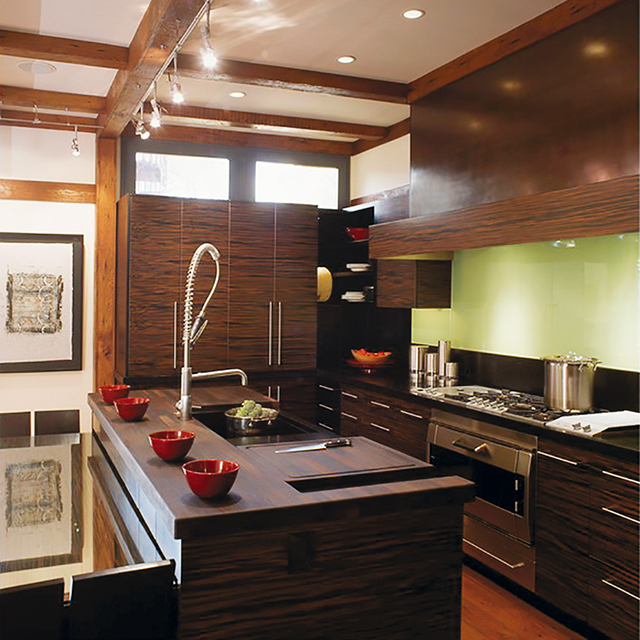
Designer Jennifer Gilmer proves that Japandi minimalism can be elegant and timeless, designing this kitchen with cabinetry crafted from Macassar Ebony, an engineered veneer. Photos: OEO Studio
Japandi Meets Bungalow
Jennifer Gilmer, an award-winning kitchen and bath designer and principal of Jennifer Gilmer Kitchen & Bath with showrooms in Maryland and Virginia, says that she tells clients, jokingly, that she designs “Western Feng Shui” kitchens. “But I am really quite serious,” she remarks. “The more I learned about Feng Shui, the more I realized that I was unwittingly doing just that. It has become my signature style. So no matter what the design is, and they are all very different, the one thing they have in common is that they make you feel good. That’s Feng Shui.”
Japandi fans will testify to its built-in Feng Shui, so it’s no surprise that Gilmer chose modern Japanese design as the look she wanted for her own home. “This was a Sears bungalow,” she tells. “It was a far cry from the elegant minimalism of Japanese design, but my architect magically made my aspirations possible with a modern addition at the back of the house. There, I got the beautiful and functional space I had visualized for cooking, family life and entertaining.”
Knowing that the cabinetry would be the main focus of the kitchen, Gilmer sought out Premier Custom-Built Cabinetry, which has developed its Mizuki style inspired by Japanese folk houses and traditional Tansu cabinetry.
“We chose an engineered veneer crafted to look like Macassar Ebony,” relays Gilmer. “The wood grain is horizontal, and the ‘striped’ look is so striking that everything else in the kitchen was chosen to complement the cabinetry. No other element was allowed to distract from its beauty. For example, honed black granite was used for the countertops and wenge for the island wood detail. Wenge is similar to cherry, but turns dark over time. The backsplash behind the cooktop is backpainted glass, the farmhouse sink sits on black granite to protect the cabinets from water damage, and dishes are kept on floating shelves.”
She’s especially fond of the pantry, with its retractable bi-fold doors. They open to reveal a countertop, and it houses a steam oven as well as a plethora of cooking accessories. When not in use, the doors are shut so the pantry looks beautiful when entering the kitchen.
The gnarly irregularity of the unclaimed wood floors and beams contrasts with the clean, sleek cabinets, creating precisely the kind of juxtaposition that’s quintessentially Japanese. “So, yes, modern Japanese design and American Bungalow can mix well,” concludes Gilmer. “This space will never go out of style because it honored and melded two very tasteful styles that have proven the test of time.”
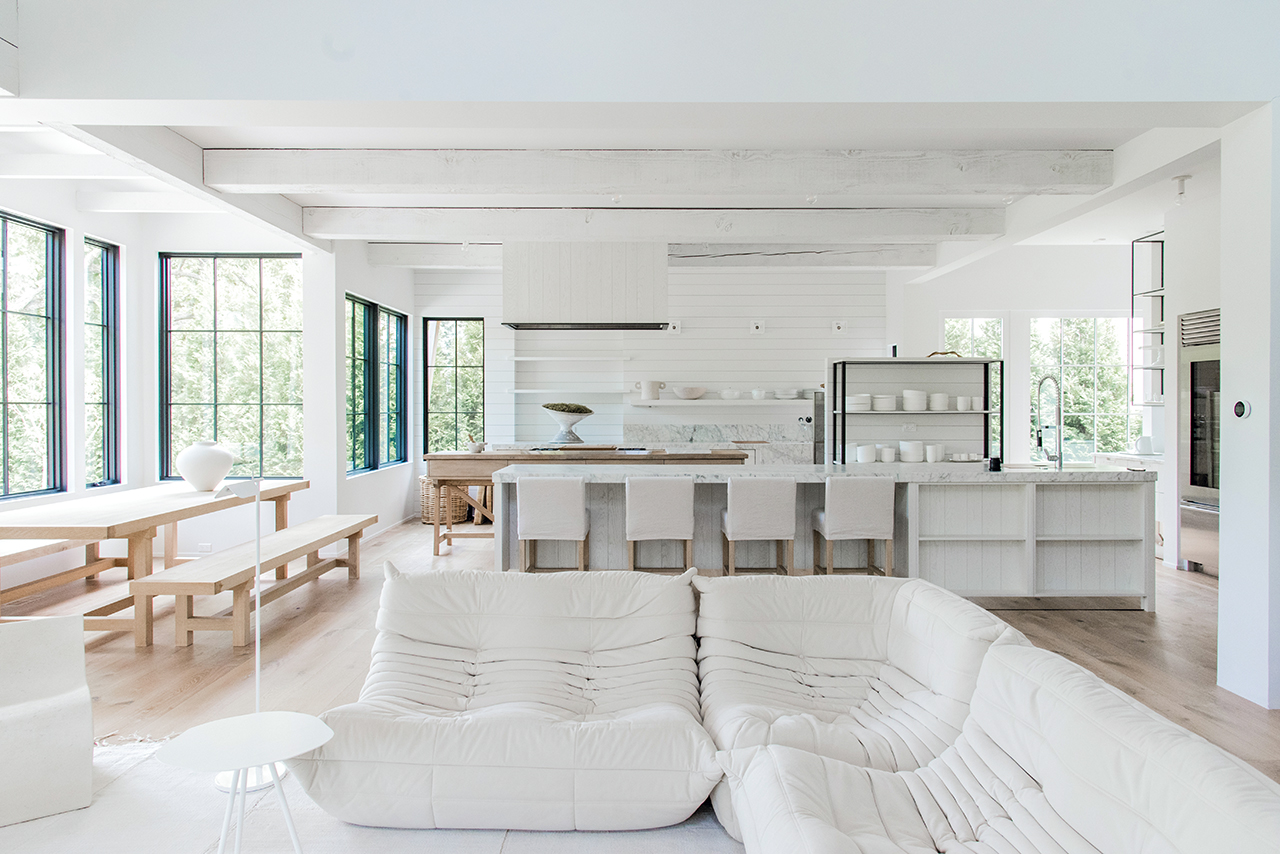
Neutral colors but strong texture contrasts of this Winnetka, IL open kitchen/family room/ dining area by Mick De Giulio reflect the design aesthetics of both Scandinavia and Japan. Photo: Belen Aquino
Detailed Minimalism
Mick De Giulio, principal of de Giulio Kitchen Design in Chicago, IL, pays visits to near and far locales, and those influences have a way of creeping into his kitchen designs. Japanese and Scandi aesthetics may appear in a design here and there, but in typical De Giulio fashion, inspirations remain just that. From there they are carefully curated and translated into one-of-a-kind designs.
Such is the case of a kitchen he designed in Boston – a classic 19th-century Victorian with a modern addition in the back. “It was just right for a family friendly kitchen,” notes De Giulio. “It’s a contemporary, clean-lined space, but it blends seamlessly with the old part of the house, he remarks. “The design emphasizes asymmetry and horizontals, and the layout is straightforward. Materials play an important role in keeping the space serene. We used light walnut in an organic, almost natural color that we nicknamed ‘Norwegian’ for its sun-bleached, Scandinavian look.”
Of course, everything that De Giulio designs is actually not that simple. A kitchen may look minimalistic, but it’s sure to include exquisite details that don’t shout. The Boston kitchen’s cabinetry, for example, is framed in bronze and contrasts subtly with brushed Iceberg quartzite. The edges of the quartzite counter were mitered to make the slab look extra thick, and a stair-step design at one end provides room for extra seating. The quartzite is repeated on the backsplashes and wrapped the range area.
In another kitchen in Winnetka, IL, De Giulio, worked the wood, creating cabinets with seemingly unfinished, textured surfaces. The space was a riff on a style that the client called Belgian farmhouse, but it is also a look that’s beloved in Scandinavian and Japanese farmhouses. De Giulio achieved it using white oak, cross-cut against the grain. To emphasize the casual, freewheeling look of the light-filled space, he installed legs on the island and placed the cooktop on a table made of reclaimed wood. Finally, he introduced some freestanding stainless steel cabinets for a bit of an industrial vibe.
“There’s nothing sleek about this space,” comments De Giulio. “It is full of textures and juxtapositions. Nobody ever heard of Japandi when this kitchen was designed, but I think it plays into the style. It’s a strong style, especially because it is so adaptable.”
Marcus Otten calls the Royal Ebony veneer used for the cabinets in this kitchen the most beautiful he has ever seen, with unique colors and patterns that dictate that the cabinetry should be the key element. Photos: Kimberly Gavin
Globetrotting Style
How do a couple of world travelers get a kitchen that reflects their global style, works as a canvas for treasures from many countries and yet functions for everyday life? They get together with award-winning designer Marcus Otten of Exquisite Kitchen Design in Denver, CO. Otten is known for a singular motto: “There are 10,000 different ways to do things, but only one way to do it right.”
For the world travelers, he designed a space where everything tells a story and brings up memories. The couple’s objets d’art are displayed throughout the space, including on floating shelves. The most stunning element, however, is the cabinetry featuring Royal Ebony veneer.
“It’s the most beautiful material I have ever seen,” remarks Otten. “It features unique color patterns and is very rare. There simply are no more logs. This African tree grows slowly and can only be turned into lumber when it’s 100 or so years old.”
Rift-cut oak for other cabinets and the island plus steel accents provide the layers and textures that Otten favors. Altogether, the space contains a lot of the Japandi influence: meticulous craftsmanship, beautiful wood, thoughtful contrasts and artistic accents.
Japandi’s elements are expected to continue to resonate with designers, who find its sophisticated minimalism warmed by craftsmanship and artistry endlessly adaptable. Many homeowners also understand and embrace the concepts of hygge and wabi-sabi, which Japandi fans call “yin and yang” at its best. Gilmer’s reference to it as “great Feng Shui” reflects its staying power in design. ▪
The City Council recently voted to sign off on awarding a trio of three-year public grounds maintenance contracts totaling $731,226 to a local landscaping and lawn care business.
Precision Cut is now authorized to maintain the grounds of 11 facilities or locations for $496,785, the Battleboro and Northeastern cemeteries for $131,589 and four low-lying areas or areas with boat ramps or water for $102,852.
The vote occurred during the Oct. 25 City Council regular meeting.
The action also came in the context of extensive discussion having occurred during the Oct. 11 council work session about wanting the Parks and Recreation Department to be able to do more in terms of maintaining the public grounds in the future.
City Manager Small-Toney during the Oct. 11 council work session made clear that, as far as increasing the skillset of Parks and Recreation employees, she believed the first step would be to come back to the council in January with what a higher level of service, managed internally, is going to cost.
Still, Small-Toney made clear her plan in the meantime was going to be to ask the council to approve the three-year contracts with Precision Cut to continue to help with maintaining the public grounds.
And Small-Toney made clear the contracts would include wording giving the ability to the municipal government to make changes, including to reduce Precision Cut’s service level.
Precision Cut had been continuing to work amid a month-to-month contract extension based on a previous contract.
During the Oct. 25 City Council regular meeting, Councilman Andre Knight was quick to note the discussion of Oct. 11 having been intense and there being a lot of concerns about the contracts and the Parks and Recreation employees and to note the municipal management saying they are going to bring back a plan in January.
Knight wanted to know whether, as the council waits for what is going to come from the municipal management, it would be wise to instead set the lengths of the contracts at one or two years.
Mayor Sandy Roberson, who chairs council regular meetings, said he would let Small-Toney answer that question, but Roberson said his recollection was that, regardless of the terms, the contracts could be broken within a 30-day notice.
Small-Toney said that would be correct because the requests for bids were issued with specific requirements and expectations.
“And so as I said, we could amend the contract once it’s awarded,” Small-Toney said. “But I think to go back now and change the requirements for the contract would negate it, in essence.”
“That answered my question, thank you,” Knight said, adding he has no problem.
Councilman Lige Daughtridge made the motion, seconded by Councilman Richard Joyner, for awarding the contracts to Precision Cut.
In a roll call vote, Knight and Councilmen Reuben Blackwell, W.B. Bullock and T.J. Walker voted yes.
Councilwoman Chris Miller was participating in the Oct. 25 council regular meeting via teleconferencing.
City Clerk Pamela Casey twice called Miller’s name, but an immediate response from Miller could not be heard.
After Roberson said the motion carried, Miller said, “I abstain.”
“Well, that’s a yes vote,” Roberson said.
“I made the point I think,” Miller said.
“Yes, you did,” Roberson said.
City Attorney Jep Rose said abstaining is an affirmative vote unless Miller had a recognized reason for declining to vote yes or no.
“Philosophical differences,” Miller said in response.
“OK, very well,” Roberson said. “The vote is in the affirmative. The motion carries.”
Precision Cut is a woman-owned business and the City of Rocky Mount strives to involve minority- and women-owned businesses in seeking contracts.
The contract with Precision Cut calls for maintaining the grounds at the following facilities or locations:
The Douglas Block.
City Hall.
The Rocky Mount Senior Center.
The Imperial Centre for the Arts & Sciences.
The Rocky Mount Business Services Center.
The Rocky Mount Event Center.
The two Main Streets alongside the rail line.
The Rocky Mount Judicial Center.
The Helen P. Gay Rocky Mount Historic Train Station.
The bus station.
Station Square.
The contract with Precision Cut for maintaining low-lying areas or areas with boat ramps or water specifically lists the following locations:
Holly Street Park.
City Lake Park.
The Tar River Reservoir boat ramp.
The Sapony Creek boat ramp.
During the Oct. 11 council work session, Parks and Recreation Director Joel Dunn said his department did not have the people power to tend all of the municipal grounds in a timely manner and started looking at contracting out some of the work.
During the Oct. 11 council work session, Blackwell said he was not questioning either the intention or the work being done by Precision Cut.
Blackwell said, however, he was concerned the skill level of the contractor seemed to exceed, at least in Dunn’s confidence, the Parks and Recreation staff concerning key properties being contracted out.
During the Oct. 11 council work session, Knight said he believed it to be really sad when the municipality has to hire somebody from the outside to come in and beautify Rocky Mount.


:focal(2188x1542:2189x1543)/https://tf-cmsv2-smithsonianmag-media.s3.amazonaws.com/filer_public/0a/c9/0ac912c2-3c8a-451e-adcb-8ec542fd2c2a/gettyimages-1233952196.jpg)