I’ve discussed the importance of native plants for the survival of our pollinators and birds, but I haven’t really explained why invasives are so damaging to our environment.
For over a century, we’ve imported plants to South Florida from all over the world. Some were thought to be beneficial while others were just ornamental. Many couldn’t adapt and disappeared, while many more grew nicely here and caused no problems. But some found the environment perfect: they went to seed and spread to new territory, choking out the existing native plants that couldn’t compete with their vigorous growth and, in so doing, displaced the associated pollinators, birds and wildlife.
Once established, invasive species adversely affect native-plant communities, outcompeting and killing the existing native species and damaging natural ecosystems. We need to be proactive in addressing this issue to maintain the health, function and long-term productivity of our landscapes.
Because Florida’s climate is so accommodating, invasive species cause more crises here than anywhere else in the United States. All of Florida’s native habitats — marine, freshwater, and terrestrial — are threatened by invasives.
The omnivorous Argentine black-and-white tegu lizards can grow to 5 feet in length and feast on the eggs of ground nesting birds.
Burmese pythons have been spotted swimming from the Everglades to the Florida Keys. These invasive constrictors feed on native species and can grow upwards of 20 feet.
Beautiful and exotic lionfish devour smaller species of native fish and have no known predators.
Studies have shown that non-native wood boring insects promote disease and reduce a forest’s ability to capture and store carbon.
The cost of managing Florida’s invasive plants is upwards of $100 million every year. The cost of animal management could easily exceed this.
Proper IDs
The first step in controlling invasives is identification: you can’t remove them if you don’t know what they are and you need to identify them so you don’t buy them accidentally. A few to be particularly aware of are: Japanese climbing ferns, melaleuca trees, Brazilian pepper, Australian pine, common lantana (Lantana camara), heavenly bamboo (Nandina domestica), Chinese privet (Ligustrum sinense), coral ardisia, and tropical or scarlet milkweed (Asclepias curassavica).
Milkweed, you say? Isn’t that the essential host plant for the monarch butterfly? Yes, but it is important that you buy the native species, as the non-native can transmit the deadly OE bacterium to the monarch caterpillars, causing wing deformity, an inability to fly and ultimate death. Plant butterfly milkweed (Asclepias tuberosa) or rose milkweed (Asclepias incarnata): If you have the scarlet milkweed in your garden, as many of us do, make sure you cut it back to the ground after the caterpillars have defoliated it. This will decrease the risk of the OE bacterium.
Unfortunately, many of these invasives are still being sold at nurseries under incorrect names.
One of the worst offenders is the invasive Lantana camara, often sold as the native Lantana depressa. The best way to avoid the invasive species is to understand the differences between the two.
Lantana camara, native to the West Indies and called shrub verbena, was loved by gardeners for its bright multicolored flowers, but it will dominate understory vegetation and is listed as a category I invasive. It has outcompeted our native Lantana depressa to the point that this is now listed as endangered.
Lantana camara decreases the productivity of citrus groves and pastures, where it’s toxic to cattle and sometimes to people. A member of the Verbenaceae family, it produces pentacyclic toxins that attack the liver; its berries are poisonous and can be very dangerous to small children and pets. Our native Lantana depressa is low and sprawling with bright yellow flowers; native Lantana involucrata is a woody shrub with clusters of white flowers that often appear at the same time as the ornamental purple fruits. Both native species are drought-tolerant and excellent garden plants, especially in coastal areas.
The beautiful silk tree or mimosa (Albizia julibrissin) has naturalized across a wide variety of habitats in Florida and has invaded riparian areas in southern forests, forcing out native understory and hardwood. Its ability to thrive in almost any soil, produce numerous seeds, and to resprout when cut back or damaged makes it a dominant competitor in open areas or along forest edges. A native of China, this deciduous tree with feathery leaflets and fragrant pink powder puff-like flowers has been an ornamental staple in many Florida gardens, but is now listed as a category I invasive, so please think twice before planting it.
If you already have one in your landscape and don’t want to move it, try to remove the seed pods before they can spread. If you want a beautiful native tree with the same light, airy appearance, try the native wild tamarind (Lysiloma latisiliquum). The flowers look like white powder puffs and this is a host plant for mimosa yellow, orange sulphur, cassius blue and amethyst hairstreak butterflies. It also attracts migrating warblers, gnatcatchers, flycatchers and vireos.
Tuberous sword fern (Nephrolepis cordifolia), is another aggressive spreader that will quickly displace any other ground cover. I can personally attest to this as I purchased several thinking it was our native Nephrolepis exaltata (it was erroneously labeled as such) and it quickly wiped out a whole section of lovely native fog fruit (Phyla nodiflora). It spreads by spores and by sending out linear scales with hairlike tips that immediately take root; the dense crowns of foliage will shade out anything beneath them. Once established, it’s difficult to remove as it seems to pop up everywhere. You can identify the invasive species by the distinctive white nodules on the rhizomes.
The ‘useless swamp’
And then there’s the melaleuca tree (Melaleuca quinquenervia), also known as the tea tree, punk tree or paperbark. This Australian native takes up great quantities of water, so it was originally brought to South Florida in 1909 by citrus and sugar growers to drain marshes and wetlands in order to produce more farmland. Planes dropped vast quantities of melaleuca seeds into the Everglades to help dry out the “useless swamp.”
Melaleucas were also planted as ornamentals and grown commercially for their wood, which is resistant to rot, termites and fungus. This entire event was a disaster. Growing up to 6 feet a year, and with no natural predators, melaleucas quickly took over huge areas of land, forming vast stands of monocultures and reducing critically endangered wetland habitat. Today, melaleucas cover an estimated half million acres of our endangered Everglades. Native birds and mammals cannot eat the seeds and fruit they produce, and the oils in the leaves and bark make them highly flammable.
The South Florida Water Management District (SFWMD) has spent 30 years and millions of dollars systematically clearing these invasives from Lake Okeechobee and the Everglades, but there is still much work to be done. This is just one example of how damaging invasive species can be.
Planting native species whenever possible is just smart landscaping. These plants provide the sustenance and habitat for our native pollinators that are essential to keeping our ecosystems intact and thriving, and they never need chemicals of any kind. Then there’s the added joy of seeing butterflies, songbirds, hummingbirds and wildlife return to your gardens.
For an introduction to a tremendous variety of native plants to add to your own landscapes, visit Pan’s Garden at the Preservation Foundation of Palm beach. With distinct areas of sun, shade and wetlands, something is always in bloom and butterflies abound.
Procedures on the selection and species of indigenous vegetation that can be utilized in Palm Seaside landscapes gained a compromise revision past week from the City Council.
In a 4-1 vote, with Councilman Ted Cooney dissenting, the council voted to make a number of variations to the town’s indigenous vegetation ordinance.
Amongst the changes accepted at the Jan. 11 Advancement Critique conference:
In any new landscape structure, 30{6d6906d986cb38e604952ede6d65f3d49470e23f1a526661621333fa74363c48} of the plant count need to be native. This most lately experienced been 35{6d6906d986cb38e604952ede6d65f3d49470e23f1a526661621333fa74363c48} below the procedures accredited by the council in November 2021. Prior to that, the percentage stood at 25{6d6906d986cb38e604952ede6d65f3d49470e23f1a526661621333fa74363c48} under rules passed in 2019.
The checklist of native crops now includes these that expand anywhere in the state, expanded from the 33480 ZIP code. This presents landscape designers and architects much more than 800 vegetation to do the job with, as opposed to between 200 and 300.
The time period “redevelopment” is now outlined in the ordinance as getting 50{6d6906d986cb38e604952ede6d65f3d49470e23f1a526661621333fa74363c48} or extra of a house, so the ordinance applies only to new landscapes and homes going through substantial improvement.
The approval of the improvements arrived just after months of discussion and attempts to search for compromise, as officials sought to address worries from residents and landscape designers who mentioned the ordinance was much too restrictive.
Amanda Skier, president and CEO of the Preservation Basis of Palm Seaside, said her business was delighted with the council’s vote. The foundation acted as an intermediary in proposing the changes to the native vegetation guidelines, assembly with all of the major landscape architects on the island to get responses.
“We have been extremely gratified simply because I believe it displays just how effective a collaborative method can be when it comes to working with troubles like this, like new ordinances,” Skier stated subsequent the council’s vote.
George Gann, president and board chair for the Institute for Regional Conservation, informed the council that native plant policies such as the 1 adopted by Palm Beach assistance to avoid species extinction and struggle the ongoing biodiversity crisis.
“This is not something that’s distant or tutorial, it is one thing that the town can have a purpose in dealing with,” he claimed.
He supported growing the list to include all Florida indigenous crops, not just those in the town’s ZIP code.
“There’s no reason why we cannot style amazing gardens using this checklist,” Gann claimed.
Jorge Sanchez, a landscape gardener and head of SMI Landscape Architecture, informed the council before the revise was approved that he opposed the rule due to the fact it would restrict creative imagination and stifle non-public property rights.
Speaking immediately after the meeting, he mentioned he felt “well” about the benefits of the dialogue and the vote.
“I wasn’t expecting that we might get 100{6d6906d986cb38e604952ede6d65f3d49470e23f1a526661621333fa74363c48} of what we had been inquiring, but I consider we obtained about 90{6d6906d986cb38e604952ede6d65f3d49470e23f1a526661621333fa74363c48},” he claimed of community landscape architects and designers who sought changes to the rules.
Most crucial, he explained, was changing the list to involve all Florida natives. However, he reported Palm Seaside must not consider to emulate landscaping policies from other cities or counties.
“We are the example, not just to Florida but to the nation,” Sanchez claimed. “We have the very best gardens in the country. They must be emulating us, not us them.”
All through the Jan. 11 conference, Susan Lerner, director of horticulture for the Preservation Basis, corrected a comment manufactured by Sanchez to the Everyday Information about Pan’s Back garden, which was established and is managed by the Preservation Foundation. Sanchez and his previous partner Phil Maddux made the yard, which was the very first all-native botanical backyard in the state, in 1994.
Speaking with the Day by day Information in advance of Jan. 11, Sanchez reported the backyard would not fulfill the needs of the November 2021 ordinance due to the fact 35{6d6906d986cb38e604952ede6d65f3d49470e23f1a526661621333fa74363c48} of the species were being not native to the 33480 ZIP code. He referenced a checklist from the Preservation Foundation.
“Pan’s is well more than the 35{6d6906d986cb38e604952ede6d65f3d49470e23f1a526661621333fa74363c48} that is directed by the ordinance, by species count, not only by plant rely,” Lerner mentioned.
She delivered up-to-date quantities of species inside of the garden, stating at its founding and now, the yard would slide within the ordinance.
“Pan’s Backyard was a daring and really productive endeavor, and I applaud it,” Lerner explained. “It is nonetheless currently being tweaked to greater reply to the shifting surroundings, including far more regionally indigenous vegetation as openings take place.”
When it was time for the council to vote, the issue of which proportion of indigenous crops to need for new landscape types hung in excess of the council. The vote initially was split, with council member Lew Crampton and Cooney dissenting and Council President Professional-Tem Bobbie Lindsay and Councilwoman Julie Araskog voting to approve.
Right before casting her vote, Council President Maggie Zeidman reported she felt the situation of a 10{6d6906d986cb38e604952ede6d65f3d49470e23f1a526661621333fa74363c48} variance between 25{6d6906d986cb38e604952ede6d65f3d49470e23f1a526661621333fa74363c48} and 35{6d6906d986cb38e604952ede6d65f3d49470e23f1a526661621333fa74363c48} “doesn’t quantity to a lot.” She instructed bridging the hole with a 30{6d6906d986cb38e604952ede6d65f3d49470e23f1a526661621333fa74363c48} need, which swayed Crampton to vote to approve.
“It’s not a enormous action, but it’s an acknowledgement to all those of you who genuinely come to feel strongly about this,” Zeidman reported.
Skier of the Preservation Basis stated her staff will get the job done with city personnel to established up a workshop to go more than the ultimate version of the ordinance with landscaping specialists.
“On prime of that, we also are very substantially seeking to aim our energy on education and learning for property house owners, simply because I believe it normally takes both of those sides to entirely have an understanding of the ordinance and the advantages and how to perform in just it and still achieve a wonderfully intended yard,” she said.
Just after months of dialogue amongst inhabitants, landscaping corporations and town officials, the Town Council has agreed to spot supplemental constraints on development and landscaping do the job on the island but with some exceptions.
At their meeting Tuesday at Town Corridor, council customers voted unanimously on 1st studying to approve an amended ordinance that sets restrictions on dates and hrs for design and landscaping work during the peak period, which the town defines as the Monday preceding Thanksgiving by means of April 30.
As section of the evaluate, which is expected to arrive again to the council up coming thirty day period for last acceptance, construction work cannot start out until finally 8 a.m. and will have to be full by 5 p.m. for the duration of peak period, other than for Saturdays, Sundays, observed town holidays, and the times in advance of and after Thanksgiving, when it is prohibited.
The ordinance also prohibits lawn routine maintenance activity on Saturdays, Sundays and observed town holidays through the peak period. But it allows it on the Wednesday prior to Thanksgiving and the Friday adhering to Thanksgiving between 9 a.m. and 5 p.m.
Perform performed among 1 p.m. and 5 p.m. on the Friday right after Thanksgiving ought to be quiet in nature, meaning no gasoline or electric powered-powered garden maintenance equipment or leaf blowers can be utilised.
The garden servicing exceptions were being designed after the landscaping industry expressed fears about the minimal quantity of time accessible for garden exercise all through the week of Thanksgiving.
In March, the council passed an ordinance on 1st reading through that banned landscaping on the working day immediately after Thanksgiving. It also prohibited construction and landscaping on weekday observation dates for holidays that drop on a weekend, and limited construction and landscaping function on the day in advance of Thanksgiving.
Council customers stated the more restrictions have been needed because of the substantial volume of vehicular site visitors within the town in the course of the holiday seasons previous yr. On the other hand, the ordinance in no way arrived just before the council for a final vote because of intense backlash from landscaping companies.
“The landscape industry objected to the limitations, stating that this would limit their capability to provide landscaping for their customers in advance of and just after the holiday getaway,” City Manager Kirk Blouin explained.
Building has been the focus of quite a few council conversations all through the past year.
New limitations include: the elimination of construction hours on Saturdays throughout the peak season a necessity that workers no longer be permitted to get there to construction web-sites prior to 7:30 a.m. on weekdays and 8:30 a.m. on Saturdays and boundaries quiet indoor building, which will be permitted only throughout the summer months, together with quiet garden upkeep and tree trimming.
A significant portion of orangutan habitat in Indonesia lies within corporate concessions, but industrial tree companies, like pulp and paper, don’t have strong enough safeguards and commitment to protect the critically endangered apes, a new report says.
According to the report by Aidenvironment, there are 6.22 million hectares (15.37 million acres) of orangutan habitat within corporate oil palm, logging, and industrial tree concessions.
Of the three types of concessions, industrial tree companies are the “key stakeholder” as they operate with much less transparency and scrutiny than the palm oil sector, Aidenvironment says.
JAKARTA — The vast majority of orangutan habitat in Indonesia is located outside of protected areas. That can be bad news for orangutans living in corporate concessions, where a new report finds many companies lack safeguards and commitments to protect these critically endangered apes.
The report, by Amsterdam-based sustainability consultancy Aidenvironment, found that Indonesia has 14.1 million hectares (34.8 million acres) of forested habitat suitable for orangutans. Only a quarter of that, or 3.46 million hectares (8.55 million acres), falls within the boundaries of protected areas such as national parks, nature reserves, game reserves and protected forests.
Meanwhile, almost double this amount, 6.22 million hectares (15.37 million acres), lies within corporate oil palm, logging, and industrial tree concessions, according to the analysis. This finding comes from overlaying Aidenvironment’s concession data with data on orangutan habitats derived from the orangutan population and habitat viability assessment (PHVA) carried out by the Indonesian government.
Aidenvironment pointed out that just because there’s orangutan habitat in a corporate concession, it doesn’t necessarily mean there are orangutans still living in the concession.
However, based on observations, orangutans are often found within areas with human activities, instead of in primary natural forests with no disturbance, according to Belinda Arunarwati Margono, the Indonesian environment ministry’s director of forest resource monitoring.
“What’s interesting is that they don’t only live in [undisturbed forests]. They live everywhere,” she said at an online press conference. “So orangutans like to be close to us, their distant relatives. They like to be in disturbed areas.”
Aidenvironment noted that if there are orangutans in a concession, it doesn’t necessarily mean they’re at risk of being captured and killed.
“However, in general, the ever-decreasing forest patches they are being confined to as a result of corporate concessions means it is harder for orangutans to survive in these landscapes,” Aidenvironment said.
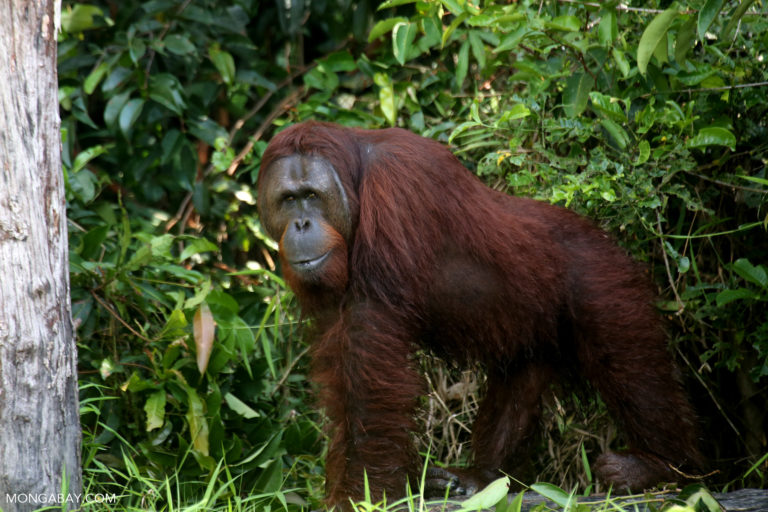
A male orangutan in Indonesian Borneo. Image by Rhett A. Butler/Mongabay.
Industrial tree plantations the ‘key stakeholder’
The study’s findings are in line with a 2021 analysis by the U.S.-based Environmental Investigation Agency (EIA), which also showed that orangutan habitat in Sumatra and Kalimantan (the Indonesian portion of the island of Borneo) covers millions of hectares of oil palm, pulpwood and logging plots.
Orangutan habitat occurs in 898,652 hectares (2.22 million acres) of industrial tree plantations, according to Aidenvironment, while 4.76 million hectares (11.76 million acres) overlap with selective logging concessions. Oil palm concessions host 563,282 hectares (1.39 million acres).
Industrial tree companies operate with much less transparency and scrutiny than the palm oil sector. And while they cover a smaller area of habitat than selective logging concessions, industrial tree plantations — by the very nature of their operations, which involve clearing vast swaths of forest — are what Aidenviroment calls “the key stakeholder.” It says this means more focus needs to be put into conserving orangutan habitat in industrial tree concessions, where trees are grown and cut to produce paper and textile fibers, as well as for timber and wood chips.
Of the 21 largest oil palm growers in Indonesia, 16 have adopted the so-called NDPE policy, which commits them to zero deforestation, no peatland development, and no exploitation of communities and workers. At the same time, the study found that only three of Indonesia’s 21 largest industrial tree growers have sustainability commitments that are close to palm oil NDPE policies: Sinar Mas, Royal Golden Eagle (RGE) and Marubeni.
Even then, the sustainability commitments of companies like Sinar Mas and RGE still allow the planting of industrial trees, like acacia, on peatlands, albeit non-forested ones, Aidenvironment said.
By contrast, palm oil NDPE policies forbid any development of peat areas, whether still forested or not.
Aidenvironment also pointed out that industrial tree concessions can also be cleared of native vegetation, unlike logging concessions.
Nevertheless, the adoption of sustainability policies among pulpwood producers has contributed to a decline in deforestation within industrial tree concessions.
Deforestation fell by 85{6d6906d986cb38e604952ede6d65f3d49470e23f1a526661621333fa74363c48} in the 2015-2019 period compared to 2010-2012 inside the 91 concessions supplying wood fiber to Indonesian pulp mills belonging to Sinar Mas, RGE, and Marubeni — all which have made public commitments to end deforestation in their supply chains. That’s according to a 2021 study by Trase, a transparency initiative that maps deforestation in commodities supply chains.
While there’s been some progress on curbing deforestation, clearing still continues in the industrial tree sector. Aidenvironment identified five industrial tree companies that were responsible for 13,000 hectares (32,100 acres) of deforestation in Indonesia in 2020, and four in 2021 that cleared 11,000 hectares (27,181 acres) of forest, peat forest and peat.
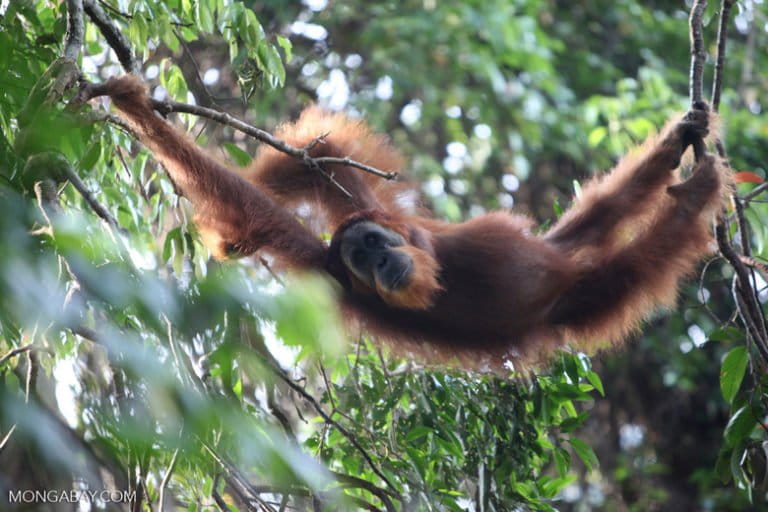
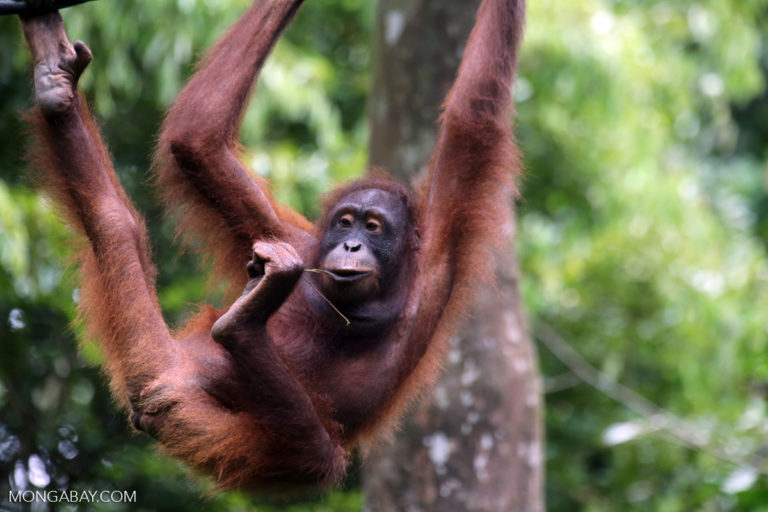
An orangutan hanging in a tree in Sumatra, Indonesia. Image by Rhett A. Butler/ Mongabay.
Top three concession holders — and deforesters
Aidenvironment highlighted three industrial key concessions with the largest areas of orangutan habitat. They are PT Mayawana Persada in the Mendawak habitat unit of the Kubu Raya landscape in West Kalimantan province; PT Industrial Forest Plantation in the Sungai Murui Hulu habitat unit of the Kahayan-Kapuas landscape in Central Kalimantan; and PT Taiyoung Engreen in the Rungan Timur habitat unit of the Rungan River landscape in Central Kalimantan.
All three concession holders are also among the largest deforesters in the industrial tree sector.
Of the three landscapes, the Rungan River has the best additional data and evidence of a viable orangutan population, with between 2,220 and 3,275 orangutans identified in the area.
The large number of individuals in the landscape means the Rungan River is home to one of the biggest unprotected populations of orangutans in the world.
Of the 147,357 hectares (364,127 acres) of forested orangutan habitat in the Rungan River, 41,609 hectares (102,818 acres), or 28{6d6906d986cb38e604952ede6d65f3d49470e23f1a526661621333fa74363c48}, are in the industrial tree concession of PT Taiyoung Engreen. The company is a joint venture between South Korea’s Taiyoung Global Co. Ltd. (which holds a 40{6d6906d986cb38e604952ede6d65f3d49470e23f1a526661621333fa74363c48} stake) and the Indonesian company Jhonlin (30{6d6906d986cb38e604952ede6d65f3d49470e23f1a526661621333fa74363c48}).
According to Aidenvironment’s analysis, deforestation has been ongoing in Taiyoung’s concession for years, with 3,510 hectares (8,673 acres) of deforestation detected since 2018, a quarter of it in 2021 alone.
Aidenvironment said the deforestation is almost entirely inside orangutan habitat.
More areas of orangutan habitat are likely to be cleared in the same concession, Aidenvironment said.
This is because neither Jhonlin nor Taiyoung have strong sustainability policies. Jhonlin recently moved into Indonesia’s domestic biofuel sector, which has weaker sustainability standards than the NDPE market.
Aidenvironment also noted that Jhonlin has a track record of clearing rainforests and peatlands as well as being embroiled in numerous disputes with local communities over land, labor, and human rights violations.
A Bornean Orangutan in Central Kalimantan province, Indonesia. Image by Rhett A. Butler/Mongabay.
Kahayan
The Kahayan-Kapuas landscape, also in Central Kalimantan, has a larger orangutan habitat than the Rungan River, spanning almost 400,000 hectares (988,400 acres), but likely has fewer orangutans, with a population estimated at between 1,065 and 2,300 individuals. Most of the forests in the landscape are peat swamp.
PT Industrial Forest Plantation is the key concession holder in the landscape.
Some 52,125 hectares (128,803 acres), or more than half of its concession, is forested orangutan habitat. The concession is also the scene of ongoing deforestation, with 9,673 hectares (23,902 acres) of forests having been cleared since 2018, largely in a strip running through the center of the concession.
It’s not known how many orangutans live in IFP’s concession, but a 2014 assessment identified the existence of orangutans and other protected flora and fauna inside the concession boundaries.
The Aidenvironment report also identified other industrial tree concessions operating inside the orangutan habitat in the Kahayan-Kapuas landscape, including PT Nusantara Fiber, PT Kalteng Green Resources, PT Bumi Hijau Prima, PT Bumi Agro Prima, PT Ramang Agro Lestari, and PT Hutan Produksi Lestari.
Despite the landscape having a significant orangutan habitat with many industrial tree concessions operating within it, there are no known conservation organizations working in the landscape. Surveys are badly needed in the landscape to develop relevant conservation interventions, according to Aidenvironment, which identified two areas in the landscape suitable for conservation.
The first one is a tract of forest that overlaps with the concessions held by Kalteng Green Resources and Industrial Forest Plantation, both of which contain most of the remaining forest within the landscape. Aidenvironment said the 23,000 hectares (56,800 acres) in these concessions, adjacent to each other, could be used to create a central undisturbed block for orangutan conservation.
“The central block of forest is still in good condition and is not intersected by roads or rivers, allowing unfettered movement for orangutans,” Aidenvironment said in the report.
The second proposed area is around 7,500 hectares (18,500 acres) of forested orangutan habitat that’s surrounded by two roads, a river to the north, and large amounts of cleared land within Industrial Forest Plantation’s concession to the southeast.
Large male orangutan in Sumatra, by Rhett A. Butler for Mongabay
Kubu Raya
The third landscape highlighted in the report is the Kubu Raya landscape in West Kalimantan province, which covers an area of 284,481 hectares (702,968 acres), where at least 1,348 orangutans live.
Most of the landscape here is forested orangutan habitat, estimated by Aidenvironment to be at 223,014 hectares (551,080 acres). This is more than double the amount of forested habitat in Gunung Palung National Park, located just south of the Kubu Raya landscape.
While civil society organizations have made high-profile efforts to conserve orangutan habitat within the park itself, the Kubu Raya landscape has received little attention, with just one conservation area, the 20,000-hectare (49,400-acre) Mendawak Protected Forest, lying within it.
But Mendawak has been heavily impacted by illegal logging, and there’s also conflicting information about whether the area is home to any orangutans.
According to Aidenvironment, field surveys conducted by WWF Indonesia in 2020 found indications that orangutans live in the area. “[However] from Aidenvironment’s own engagement in the area, we believe that there are no orangutans within the Mendawak Protected Forest,” Aidenvironment said.
The rest of the landscape is covered almost entirely by eight corporate concessions.
The one with the most remaining forested orangutan habitat is the 137,000-hectare (338,500-acre) concession held by PT Mayawana Persada, which contains 68,776 hectares (169,949 acres) of forested orangutan habitat.
According to Aidenvironment’s analysis, the orangutan habitat inside Mayawana Persada’s concession is under threat as there’s little to no information regarding conservation activity by the company.
“Specifically, it is unclear how many orangutans are present within PT Mayawana Persada, how much forest is designated for clearing and for protection, or whether the company has policies in place to protect orangutans,” Aidenvironment said.
The latest Indonesian government-instigated audit of the company in 2021, for instance, makes no mention of orangutans or company policies pertaining to orangutans.
Mayawana Persada is actively clearing forests to make way for industrial plantations, with 8,852 hectares (21,873 acres) of forest cleared between 2018 and 2021, Aidenvironment said. A small part of this was caused by third-party bauxite mining.
Most of the deforestation occurred last year, with 5,250 hectares (13,000 acres) of forest loss, indicating an increase in activity, Aidenvironment said.
“This demonstrates how under threat orangutans are in this area, and why PT Mayawana Persada should stop clearing immediately and conduct orangutan surveys of their concession,” Aidenvironment said. “Based on current available evidence the orangutan habitat, and orangutans it may contain, within this concession appear to be under significant threat.”
Mayawana Persada has previously denied the allegation that it has been clearing orangutan habitat within its concession.
“There’s no deforestation activity in orangutan’s habitat by PT Mayawana Persada,” the company told Mongabay in an email dated May 2021. “This can be seen from the company’s working map and the company’s activities on the ground, which have taken into account the results of studies on orangutan and high conservation values areas.”
“The studies were to minimize the impact of the industrial forest plantation on the orangutan population in PT Mayawana Persada’s concession,” the company said.
However, satellite and drone analysis by Aidenvironment shows high conservation value (HCV) areas have been cleared.
To preserve the remaining orangutan habitat within the Mendawak Protected Forest, Aidenvironment said there are two areas where conservation should be prioritized. The first one is a continuous stretch of forest between the concession of PT Daya Tani Kalbar and the protected forest that passes through three other concessions, held by Sumitomo Forestry. This area covers approximately 36,000 hectares (89,000 acres).
The second one is a 38,000-hectare (93,900-acre) forest that stretches from the coastal areas on the outskirts of Mayawana Persada until the thin strip of forest that lies between Mayawana Persada’s and Daya Tani Kalbar’s concessions.
Borneo orangutan at Sepilok Rehabilitation Center in Sabah, Borneo. Image by Rhett A. Butler.
Connecting fragmented habitats
When asked whether the government’s forest protection policies, particularly a permanent moratorium on the clearance of primary forests and peatlands, could protect orangutan habitat as well, the environment ministry’s Belinda said the moratorium wasn’t specifically designed to conserve orangutan habitat.
However, if a forest area has protected status or is zoned for conservation, it is automatically protected under the moratorium policy, even though the area might no longer be forested, she added.
“So we design so that at least primary forests and peatlands are protected, while the function of conservation and protection is maintained [through the moratorium policy],” Belinda said.
There are other policies that could protect forests and subsequently orangutan habitat as well, such as the social forestry program, she added. This program aims to reallocate state forest to local communities and give them the legal standing to manage the forests.
Some of the community titles under the social forestry programs are designed with forest conservation in mind, based on the idea that forests that are managed by communities will be better protected and more sustainably managed.
“So what’s important is to connect the network [of orangutan habitat] and to minimize fragmented forest, but not directly through the forest moratorium policy itself,” Belinda said.
The EIA said it’s not enough for the moratorium policy to only protect primary forests and peatlands as orangutans also live in secondary forests and forest fragments. A 2021 study, drawing on several decades of ground and aerial surveys in Borneo, found that some orangutans are adapting to the presence of oil palm plantations.
But this doesn’t mean that orangutans can cope well with massive alterations to their habitat and don’t need forest to survive, the researchers of the study said. They found that orangutans are able to survive in and among plantations only when they have access to small fragments of standing forest nearby.
Conservation groups like the EIA have called on the Indonesian government to place orangutan habitat, no matter where they are, under formal protection by including them within the permanent forest moratorium area.
The need for a more robust strategy in protecting orangutan habitat has grown even more urgent now as recent developments in Indonesian policies — such as the recent expiration of a moratorium on new oil palm concessions and the deregulation of environmental protections ushered in by controversial legislation passed in 2020 — put orangutan habitat at greater risks, according to the EIA.
“The confluence of threats facing orangutans is nothing short of a crisis,” Taylor Tench, EIA policy analyst, said in a press release.
Ancrenaz, M., Oram, F., Nardiyono, N., Silmi, M., Jopony, M., Voigt, M., … Meijaard, E. (2021). Importance of small forest fragments in agricultural landscapes for maintaining orangutan metapopulations. Frontiers in Forests and Global Change. doi:10.3389/ffgc.2021.560944
FEEDBACK: Use this form to send a message to the author of this post. If you want to post a public comment, you can do that at the bottom of the page.
Banner image: A young orangutan in Indonesian Borneo’s Tanjung Puting National Park. Image by Rhett A. Butler/Mongabay.
The the vast majority of international forest decline is prompted by land clearance for six commodities: cattle, timber, palm oil, soy, cocoa and coffee.
In reaction, the European Union revealed a draft regulation in November 2021 created to minimise Europe’s consumption of “deforestation-risk” goods.
While lawful NGO ClientEarth named the proposal a “leap ahead in world-wide environmental governance”, the governments of producer countries say it shifts the burden of making sure that commodities are deforestation-absolutely free from wealthy customers to poorer farmers.
Indonesia and Malaysia have named it aspect of a smear campaign versus palm oil. Involving them they generate 85{6d6906d986cb38e604952ede6d65f3d49470e23f1a526661621333fa74363c48} of the worldwide total of the commodity. In a joint statement launched a several months ahead of the proposal, the nations’ leaders said their intention to “continue to combat in opposition to palm oil discrimination”.
Each nations have lodged trade disputes with the Planet Trade Organisation (WTO), proclaiming the EU is seeking to secure its have vegetable oil producers from worldwide opposition. They also cited the EU’s conclusion in 2018 to stage out, by 2030, the use of palm oil in transport gasoline in Europe.
“Cleaning up the source chain to the EU won’t automatically support cut down international deforestation,” said Mardi Minangsari, the president of Kaoem Telapak, an Indonesian NGO that investigates deforestation. Modern investigation has advised that banning imports of deforestation-hazard commodities might have a much scaled-down impact on stemming forest decline than predicted.
Nevertheless, addressing need is essential, stated Minangsari, and must be carried out in a way that increases procedures in making international locations. She holds that the EU’s proposal fails to recognise the variance in between producer nations and sectors with weaker legislation and those people with extra sturdy regulations, these kinds of as Indonesian timber and its EU FLEGT (Forest Regulation Enforcement, Governance and Trade) licence. Recognising these dissimilarities would incentivise nations to comply with the regulation, Minangsari said. Usually, exports will change to much less-regulated countries, she additional.
Different marketplaces
“Indonesia will not run out of need for palm oil and has been on the lookout to extend the sector for its crude palm oil, like in China,” stated Montty Girianna, the country’s deputy coordinating minister for power and mineral resources. Girianna’s optimism is based mostly on an announcement designed back again in 2019 by China’s Ministry of Commerce that it will take away tariffs on palm oil imports.
In simple fact, on 22 April, Indonesia stunned the international market by saying it would ban all palm oil exports until finally additional detect. The go is an endeavor by the federal government to deal with ongoing domestic shortages of cooking oil and climbing charges.
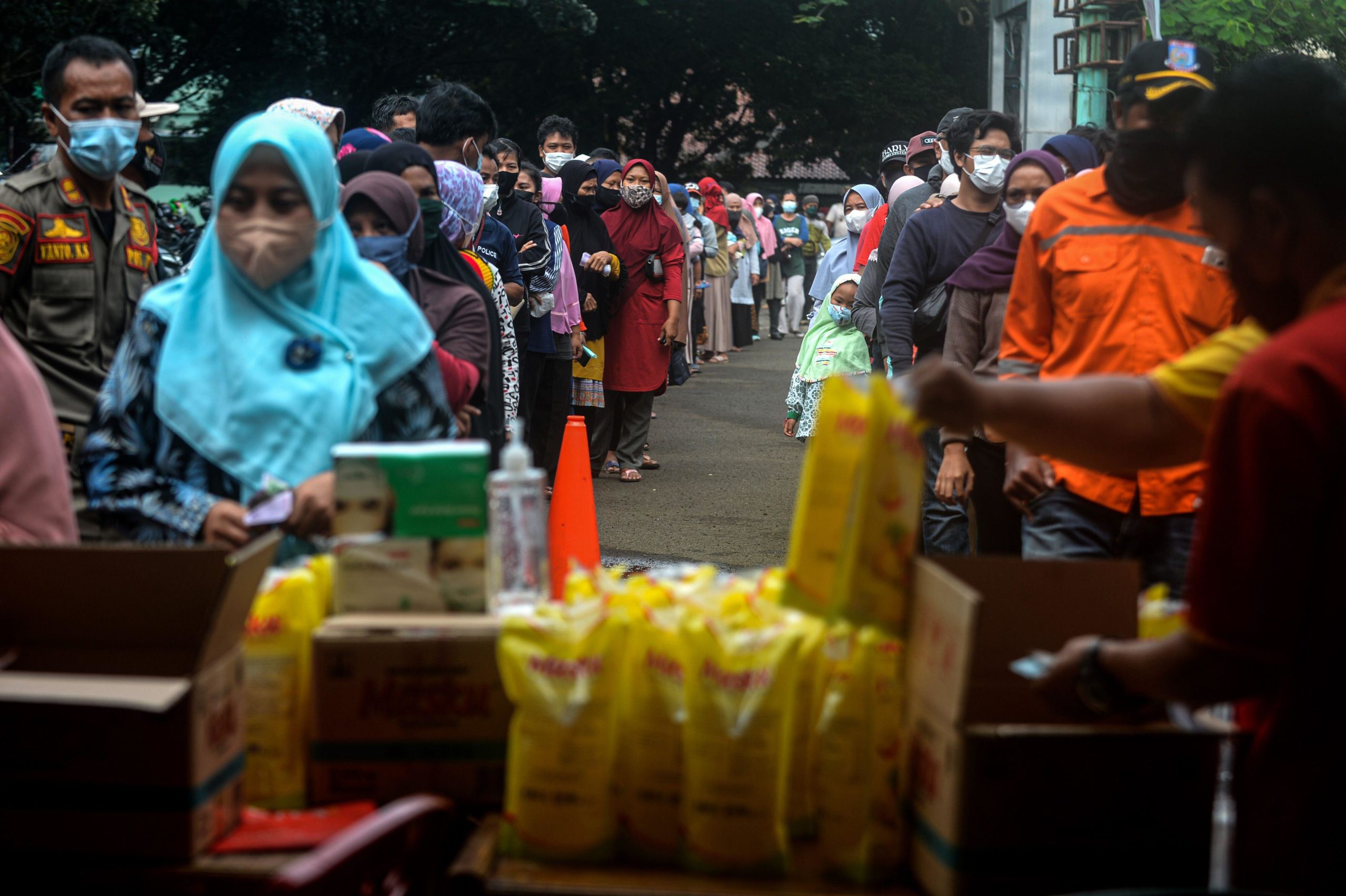
Indonesians in a suburb of Jakarta queue to buy subsidised cooking oil. To aid deal with shortages in the nation, the authorities last month banned exports of palm oil until eventually even more discover, a shift anticipated to worsen foods price inflation throughout the environment. (Graphic: Agung Kuncahya B. / Alamy)
“Indonesia’s response in the direction of the EU proposal is stressing. We have viewed that palm oil firms without NDPE commitments can market their merchandise to China,” Minangsari mentioned.
NDPE stands for No Deforestation, No Peat, No Exploitation and signifies a collection of commitments produced by palm oil producers to thoroughly clean up generation.
Only seven of the prime 10 suppliers of Indonesian palm oil to China have NDPE guidelines, as of January 2021, in accordance to a report by sustainability analysts Chain Response Research. The report uncovered refiners with out an NDPE policy, or those lagging in their implementation of this kind of guidelines, accounted for at the very least 12{6d6906d986cb38e604952ede6d65f3d49470e23f1a526661621333fa74363c48} of Indonesian palm oil materials to China.
China-dependent importers are beneath increasing pressure from customers, brand names and traders to source this risky commodity additional sustainably, and are producing endeavours to do so.
In 2018, the China Sustainable Palm Oil Alliance (CSPOA) was released, featuring huge companies this kind of as Mars Wrigley, L’Oréal, China Nationwide Cereals, Oils and Foodstuffs Company, Yihai Kerry, and SGS China. The businesses made a joint commitment on promoting the adoption of sustainable palm oil in the Chinese market place. The initial objective was to make sure that 10{6d6906d986cb38e604952ede6d65f3d49470e23f1a526661621333fa74363c48} of palm oil imports have been qualified as sustainably sourced by 2020, even though this was not achieved.
Encouraged
“The current world craze is leaning a lot more into sustainable palm oil,” Minangsari said. “Indonesia should really use it as the leverage to fortify its ISPO to stop unsustainable palm oil harms.”
ISPO and indigenous men and women
The ISPO (Indonesian Sustainable Palm Oil) standard is Indonesia’s have certification plan, began in 2009 to motivate oil palm plantations to make their operations more sustainable.
ISPO certification is necessary for palm oil companies operating in Indonesia, not like the voluntary certifications obtainable from the industry’s pioneering regulator, the Roundtable on Sustainable Palm Oil (RSPO).
However, the ISPO looks to have fallen even further small than the RSPO on shielding human legal rights and the natural environment. It has confronted specific criticism for disregarding enter from indigenous peoples and nearby communities influenced by palm plantations.
In accordance to an investigation by Uk-based mostly the Environmental Investigation Company (EIA) and Indonesia-primarily based Kaoem Telapak, the ISPO standard contains the suitable to consent for the indigenous peoples in a tokenistic manner, with palm oil companies expected to tick a box declaring they have consulted, without having any subsequent verification. In addition, secondary forest (which has regrown immediately after being cut down) carries on to be disregarded in the region as a organic landscape that warrants safety.
Minangsari states it is necessary to contain in the ISPO typical the consent system and ILO Convention 169 “if Indonesia wants to direct the industry by example”.
Indonesia is nonetheless to ratify ILO Conference 169, which recognises indigenous peoples’ proper to self-determination inside a country-condition, although placing benchmarks for nationwide governments pertaining to their broader legal rights, which includes the appropriate to a land base.
Muhammad Arman shares a similar look at. He is coverage, law and human legal rights director of the Indigenous Peoples Alliance of the Archipelago (AMAN), which advocates for indigenous peoples in Indonesia.
“Without addressing the indigenous peoples’ rights above their ancestral domains, we will look at more palm oil estates’ enlargement on unconsented indigenous territories, which is not in line with the spirit of the proposal to supply accountable palm oil,” Arman reported.
AMAN has been campaigning for an indigenous rights monthly bill considering the fact that 2013, which would present recognition of the customary rules and land rights of indigenous communities across Indonesia. But the Indonesian parliament has been gradual to act.
“Various legislation and restrictions have been issued that touch on the problem of indigenous legal rights to some degree,” Arman explained. “The indigenous legal rights monthly bill would tie them all alongside one another.”
Passing the bill is urgent specified the enhanced threats of violence and land grabbing against indigenous peoples since the Job Generation Monthly bill was passed in 2020. That legislation was passed even with staunch criticism from Indonesian and global civil culture.
The Indonesian governing administration wants to action up its match and be daring
Timer Manurung, government director of Auriga Basis
The lack of provision for indigenous peoples undermines the reliability of ISPO certification. A 2017 report by Forest Peoples Programme rating certification schemes for biofuels and edible oils place the ISPO at the very bottom.
The new ISPO common, updated by a presidential regulation in 2020, may perhaps possibly instil larger self-assurance. In specific, monitoring of plantations by an independent 3rd party is now required. However, watchdog Kaoem Telapak thinks the monitors could be tokenistic, as there is a deficiency of facts on how problems will be processed.
The rollout of ISPO certification itself has been sluggish according to Minangsari: “Only about 38{6d6906d986cb38e604952ede6d65f3d49470e23f1a526661621333fa74363c48} [of Indonesia’s oil palm acreage] is now accredited,” that means the ISPO is still failing to meet up with the target it set to certify all palm oil providers by 2014.
The ISPO’s battle to impose its authority is joined to the reality that, according to Greenpeace, a fifth of the oil palm plantation place in Indonesia lies in secured forests. In addition, it is hard to trace the provide chain from upstream to downstream industries and backlink the plantations with providers that possess processing amenities or refineries. Joint research by Trase, the Auriga Foundation and Santa Barbara College observed the possession of far more than 50 percent of Indonesia’s palm oil plantations to be unclear.
“The Indonesian government wants to step up its game and be bold,” claimed Timer Manurung, the government director of Auriga Foundation. “Brave initiatives to revoke the licences of illegal palm oil estates are still unusual and however threatened by strike back from these firms.”
He thinks that exercising and imposing administrative sanctions on palm oil companies, such as by revoking licences for mistakes or violations, will strengthen Indonesian initiatives to fight deforestation and combat the climate disaster, as well as gain the country’s palm oil in the worldwide market.
A Chinese translation of this posting will abide by before long.
In an hard work to relieve traffic congestion all-around the holidays, the Town Council authorized supplemental restrictions on development and landscaping activity on the island.
For the duration of their frequent meeting March 8, council users unanimously approved an ordinance that adds days through the peak period when design and landscaping do the job is prohibited.
The evaluate, which is expected to appear back to the council following month for remaining approval, bans landscaping on the day immediately after Thanksgiving prohibits construction and landscaping on weekday observation dates for holidays that drop on a weekend and limits construction and landscaping do the job on the working day prior to Thanksgiving.
Now, design and landscaping action are prohibited on Sundays and lawful holiday seasons, though building also is banned the working day immediately after Thanksgiving.
More restrictions were necessary for the reason that of the substantial volume of vehicular visitors within the town all through the vacations final year, council member Bobbie Lindsay reported.
Lindsay introduced the difficulty to her colleagues’ attention during the council’s January conference, noting that significantly of the ”nightmarish” holiday getaway site visitors was tied to hefty development activity.
Considering that the conclude of September, she reported then, the city had issued 734 design permits well worth $111 million — practically double the amount from the past calendar year.
“You couldn’t get into any of the parking a lot,” she explained to council associates. “It was whole everywhere you go I went, and a great deal of the slowdowns ended up construction associated.”
Lindsay reiterated those concerns during the council’s conference this month before voting to approve the ordinance, which in the beginning banned all development and landscaping exercise on the working day in advance of Thanksgiving, but was amended to allow it amongst 9 a.m. and noon.
Council members agreed to the adjust right after expressing considerations about situations this kind of as last-moment temperature occasions that would have to have instant attention from construction or landscaping crews.
“A good deal of time, we are going to get substantial winds,” council member Julie Araskog stated. “The pool gets terrible. The owner phone calls and claims he is getting every person over for Thanksgiving. He asks crews if they can appear. I you should not like (banning construction) the working day right before the holiday getaway. People kinds of items fret me a bit. I certainly you should not want to get a bunch of operator complaints that they are unable to have their house look great for Christmas Day or for Thanksgiving.”
Deputy Town Manager Jay Boodheshwar extra that the most important pushback the town has received about the ordinance has appear from the development sector, which opposes the measure, especially the ban on construction activity the working day prior to Thanksgiving.
“I’ve gotten some mobile phone phone calls declaring that this was terrible,” he advised council members. ”All of the feed-back is what you would anticipate from the business. But these had been your wishes.”
Building has been the emphasis of a lot of discussions at the latest council meetings.
The evaluate, which includes exemptions for some properties on the island, took effect Jan. 31.
New constraints contain: the elimination of construction hours on Saturdays throughout the peak year, which begins on the Monday previous Thanksgiving by the close of April a requirement that workers no longer be authorized to arrive to building web sites prior to 7:30 a.m. on weekdays and 8:30 a.m. on Saturdays and boundaries silent indoor development, which will be permitted only for the duration of the summer season months, along with quiet lawn servicing and tree trimming.
Jodie Wagner is a United states of america Currently Network of Florida journalist. You can get to her at jwagner@pbdailynews.com. Assist help our journalism. Subscribe today.