
University of New South Wales presents ten design projects

Dezeen School Shows: a helmet that forewarns bike riders of dangers on the road and a device that allows bee keepers to remotely observe their hives feature in Dezeen’s latest school show by students from the University of New South Wales.

Also included is an investigation into 3D printed clay for building structures and a scheme that overhauls an inaccessible creek into a community zone.


Institution: University of New South Wales
School: School of Built Environment
Courses: Landscape Architecture, Industrial Design and Computational Design

School statement:

“At UNSW Built Environment, we shape future cities – cities that are resilient, sustainable, connected, healthy, smart, liveable and inclusive.

“We focus on the challenges of cities at every scale, from industrial designed products to the architectural design of buildings and landscapes, as well as urban and regional policy and planning.

“We create sustainable built environments that contribute to tackling the climate crisis, while our human-centred design ethos responds to the needs of the individual as well as society and our cultural landscape.

“We develop skilled and enquiring graduates, with a conscience, who can positively engage, adapt and shape our future cities for the benefit of all people, with the planet firmly in mind.”
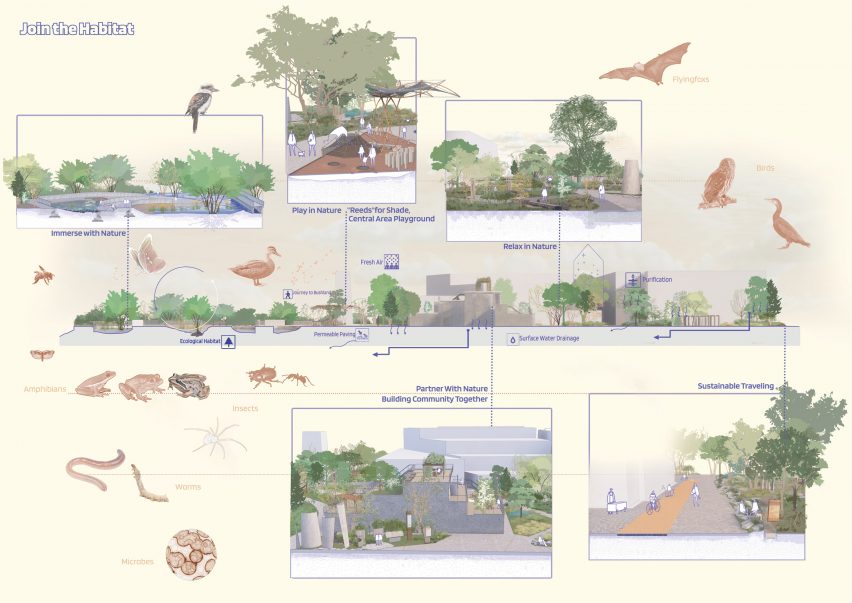

Board with visualisations and diagrams showing wildlife environment

Turrella North, Bardwell Valley Parklands, Sydney by Xinyi (Joy) Wang

“This project aims to modify the industrial landscape and offset carbon emissions over time for human and non-human inhabitants.”

“Turrella is an Aboriginal place term for ‘reeds growing in water’. The design is derived from a series of key morphological and functional moves.

“Reeds are adopted as the primary organiser of the spatial character, circulation and design elements. Growing is a generative idea that emerges within temporal scales of the project site.

“Ultimately, all the plants, including reeds, will be grown on the site. This is a place for people to immerse themselves in the rehabilitated ecologies of the Bardwell Valley.”

Student: Xinyi (Joy) Wang
Course: Master of Landscape Architecture
Tutors: Dr. Sara Padgett Kjaersgaard and Marc Deuschle
Email: xinyiwang98525[at]outlook.com
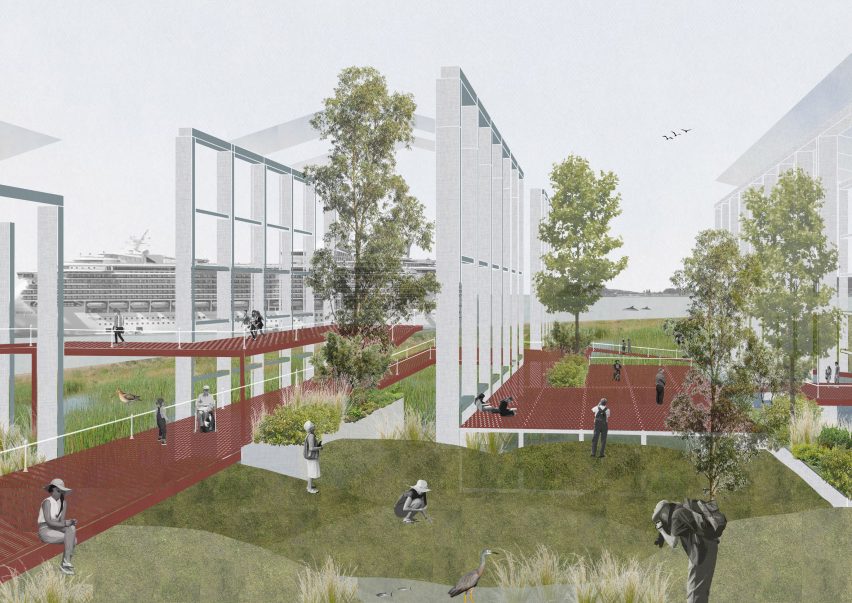

Visualisation showing structure on lawn

To Think Like a River, Onebygamba/Carrington Newcastle Australia by Jennifer Wu

“Through an entanglement of scales, To Think Like a River explores the interplay between the working port, local communities and the Aboriginal Australian approach to country.

“What if the working port can co-exist and evolve with social-ecological programs, enhancing the wellbeing of local communities and country?

“Across three phases – source, confluence and meander – the design approach adopts principles of adaptive reuse to underscore the country as a living being.

“These approaches reflect the philosophy of to think like a river – where water can take any route, adapting to the changing environment with what we encounter.”

Student: Jennifer Wu
Course: Bachelor of Landscape Architecture
Tutors: Patrick Franklyn, Ben Allen and Dr Mike Harris
Email: jenniferwu0414[at]gmail.com

Visualisations and diagrams of

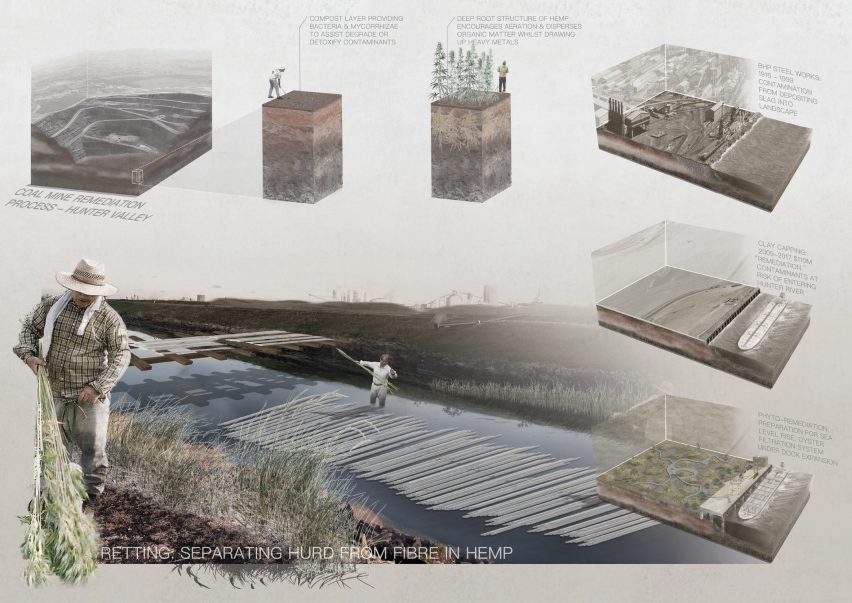
Routes of Regeneration, Onebygamba/Carrington Newcastle Australia by Latham Brook

“Can the remediation of coal mines with hemp provide a new economic model and identity for Newcastle? The answer may lie in compost, hemp and oysters.

“Compost and hemp can phyto-remediate mining sites, whilst oysters provide a filtration system for toxins entering the harbour from the former steelworks.

“Lime derived from oysters and hemp can be converted into hempcrete, a carbon negative product. What if areas at risk of rising sea levels could relocate with this regenerative building material?

“Routes of Regeneration offers a phasing strategy to integrate regenerative industries for the remedial transition away from coal extraction in the Hunter Valley.”

Student: Latham Brook
Course: Bachelor of Landscape Architecture
Tutors: Patrick Franklyn, Ben Allen and Dr Mike Harris
Email: latham.m.brook[at]gmail.com


Collage of visualisations showing medical device

HeartHub fully implantable ventricular assist device by Dorcas Chu

“Designed to improve clinical outcomes and user experiences of patients with end-stage heart failure, HeartHub is a fully implantable LVAD (left-ventricular-assist-device) that features a long-distance wireless charging system.

“Its high-capacity rechargeable graphene batteries enable a compact and lightweight design without compromising battery life.

“HeartHub pairs with a cloud-based app via Bluetooth, facilitating access to crucial information such as pump statistics and emergency signals.

“In the event of pump failure, the controller will vibrate, sound an alarm, display flashing LED lights, and call emergency services. The patient’s pump information is then transmitted to specialists for immediate analysis.”

Student: Dorcas Chu
Course: Bachelor of Industrial Design (Honours)
Tutors: Mariano Ramirez, Gonzalo Portas and Oya Demirbilek
Email: dorcaschukw[at]gmail.com

Visualisations of helmet with red accents

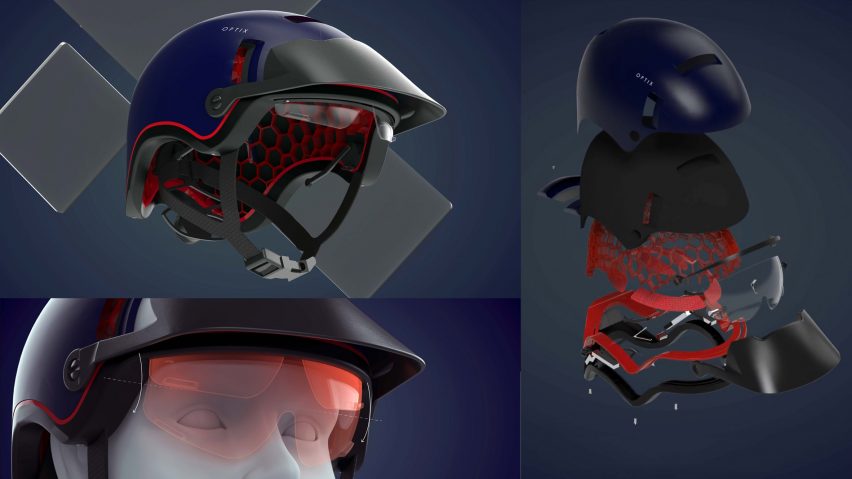
Optix smart cycling helmet by Keith Perry

“Designed for cyclists who constantly battle dangerous riding conditions, the Optix smart helmet forewarns of dangers around bike riders while simultaneously alerting other road users to their presence.

“Connected to the C-V2X (cellular vehicle-to-everything) platform, Optix notifies its wearer of vehicles pulling out of driveways, parked cars about to open doors, and cars approaching from behind.

“An augmented reality (AR) lens displays maps, weather reports, and imminent hazards. Optix intends to be an aid to the cyclist’s journey, not replace traditional ‘road sense’.

“Its compression zone mesh decelerates the skull slower than conventional helmets, potentially saving riders from serious head trauma.”

Student: Keith Perry
Course: Bachelor of Industrial Design (Honours)
Tutors: Gonzalo Portas and Oya Demirbilek
Email: keith42perry[at]gmail.com

Close-up texture

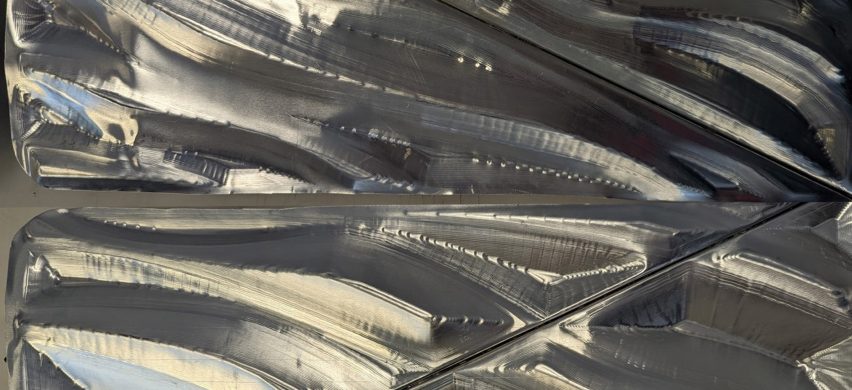
Prototypes of robotic incremental sheet forming by Millicent Marks, Jordan Hong, Ethan Nash, Luke Fadel and Paul Fynes-Clinton

“As part of the BENV2001 Emerging Digital Technologies class, students were exposed to robotics fundamentals as an introductory course for future architectural manufacturing investigations.

“In the course, students investigated robotic toolpaths using Grasshopper and Universal Robots UR5 in three stages.

“First generating 2D toolpaths to draw example patterns with the robot, secondly generating 2.5D toolpaths for incremental sheet forming and finally 3D toolpaths for foam cutting.

“While the aim of this course was not to produce a design outcome but to gain confidence in the use of robots, students gained knowledge in designing for and with robots as a learning outcome and can apply these skills in future robotic design and fabrication courses.”

Students: Millicent Marks, Jordan Hong, Ethan Nash, Luke Fadel and Paul Fynes-Clinton
Course: Bachelor of Computational Design
Tutors: Charlotte Firth and Kate Dunn

Board with visualisations of a circular textural object

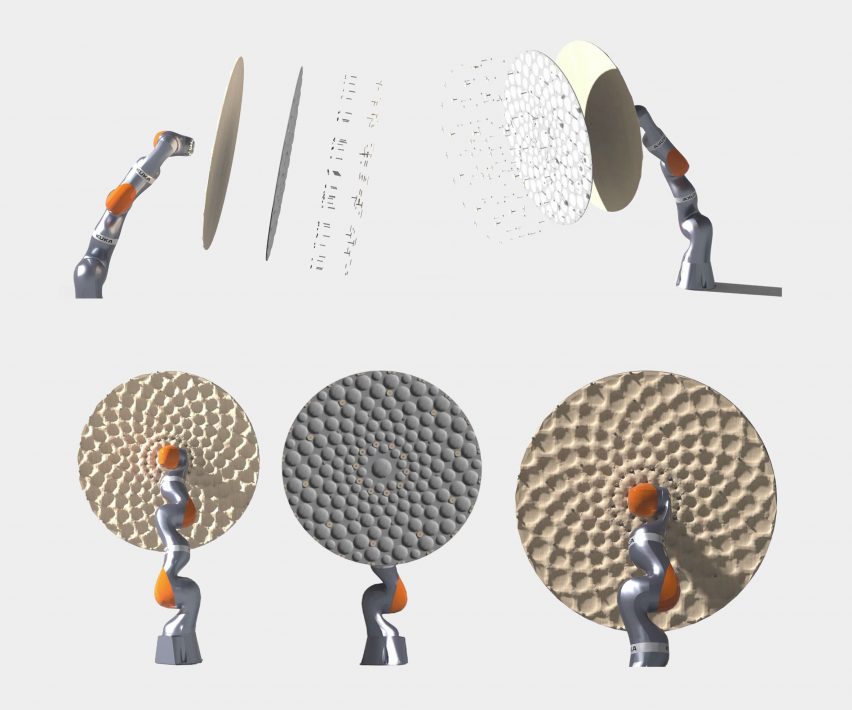
Soft robotics acoustic panel by Anthony Franco

“Open floor plans and activity-based work in offices generate different acoustic profiles due to various activities such as in office conversations, online meetings, kitchen use, etc.

“Yet most acoustic panels used in offices cater only for one fixed acoustic profile. The designs were fabricated from silicon and allowed control of each of the acoustic patterns pneumatically.

“The resulting design can be seen as a single element in a group of soft robotics acoustic panels that can direct themselves towards the sound source via the robotic arm and alter its acoustic pattern depending on the activity.”

Student: Anthony Franco
Course: Bachelor of Computational Design
Tutor: Daniel Yu
Email: a.franco[at]student.unsw.edu.au
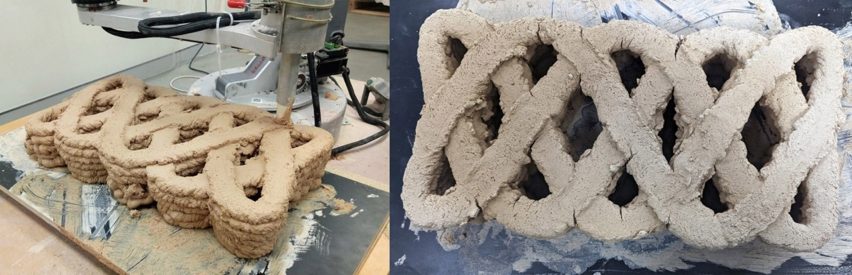

Lattice of 3D printed clay

Terracrete – Clay 3D printing via computationally generated architectural details by UNSW Computational Design Cohort

“3D printing has offered new manufacturing opportunities for architecture and design.

“Yet if one wants to incorporate other building elements such as windows or doors into a 3D printed wall these details need to be designed as a g-code (machine code) to communicate design intent to the 3D printer.

“In addition, when using clay as 3D print material one needs to also consider the shrinking of the material into the design process.

“These were the challenges given to the students to examine when designing and developing Grasshopper scripts for a 3D printed wall to window connection.

“Students explored the shrinkage of different materials to adjust the tool path accordingly.”

Group project: UNSW Computational Design Cohort
Course: Bachelor of Computational Design
Tutors: Kate Dunn and Charlotte Firth

Visualisation showing forest environment with river running through

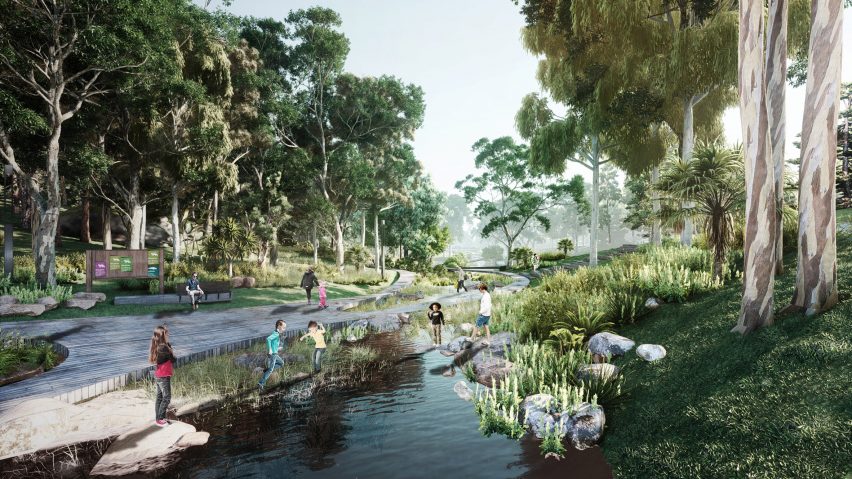
Bardwell Creek, Bardwell Valley Parklands, Sydney by Iris Wang

“Bardwell Creek is located 14km from the Sydney CBD adjacent to Sydney’s Kingsford Smith Airport terminal.

“The site is the largest public green space in the Bexley region, complete with undulating topography, difficult wayfinding routes and high levels of weed invasion within the creek system.

“The research foundation of the project is based on Fitzsimons (2013) theme of correlated elements of walkability within the built environment.

“Through the redesign of the ecological, hydrological, circulation and recreation systems of the Bardwell Creek this project seeks to make the site highly walkable and environmentally sustainable, as well as provide the opportunity for the local community to gather and express their culture and identity.”

Student: Iris Wang
Course: Master of Landscape Architecture
Tutors: Dr. Sara Padgett Kjaersgaard and Marc Deuschle
Email: irisxyw0910[at]gmail.com

Collage of three images showing construction

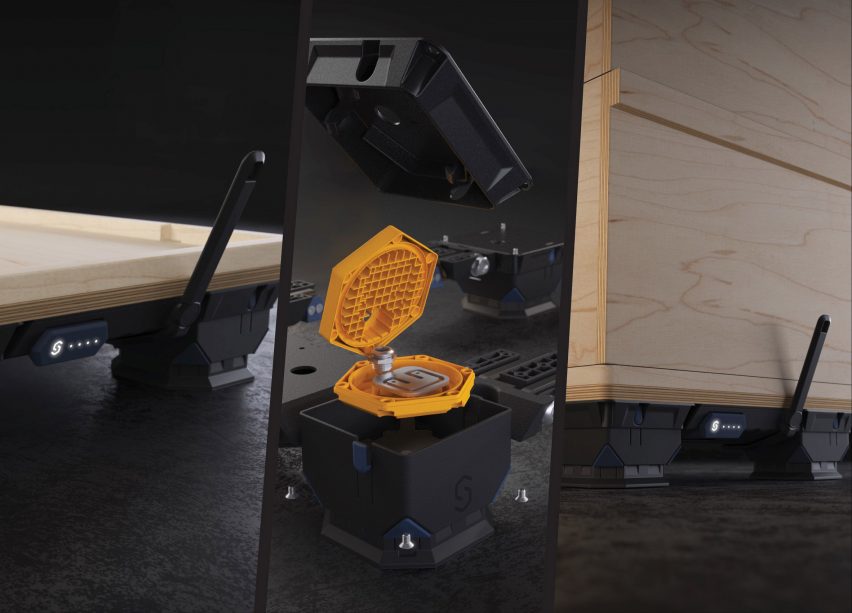
Supersend beehive weight monitor by Aidan Whitby

“Supersend enhances the efficiency of commercial apiaries by allowing beekeepers to remotely observe the condition of their hives without having to be on-site.

“Consisting of a landing plate that fits standard beehives and four legs housing weight-measuring cells, Supersend regularly transmits information to an app via the 4G internet-of-things network.

“The product is designed specifically for Australian beekeeping practices, factoring in the unique native flora species, the harsh environmental conditions, and the vast distances between apiculture sites.

“This innovation facilitates the replacement of parts, reduces initial and ongoing costs, and improves data security, reliability, and ergonomics.”

Student: Aidan Whitby
Course: Bachelor of Industrial Design (Honours)
Tutors: Gonzalo Portas and Oya Demirbilek
Email: aidan.whitby[at]outlook.com

Partnership content

This school show is a partnership between Dezeen and University of New South Wales. Find out more about Dezeen partnership content here.
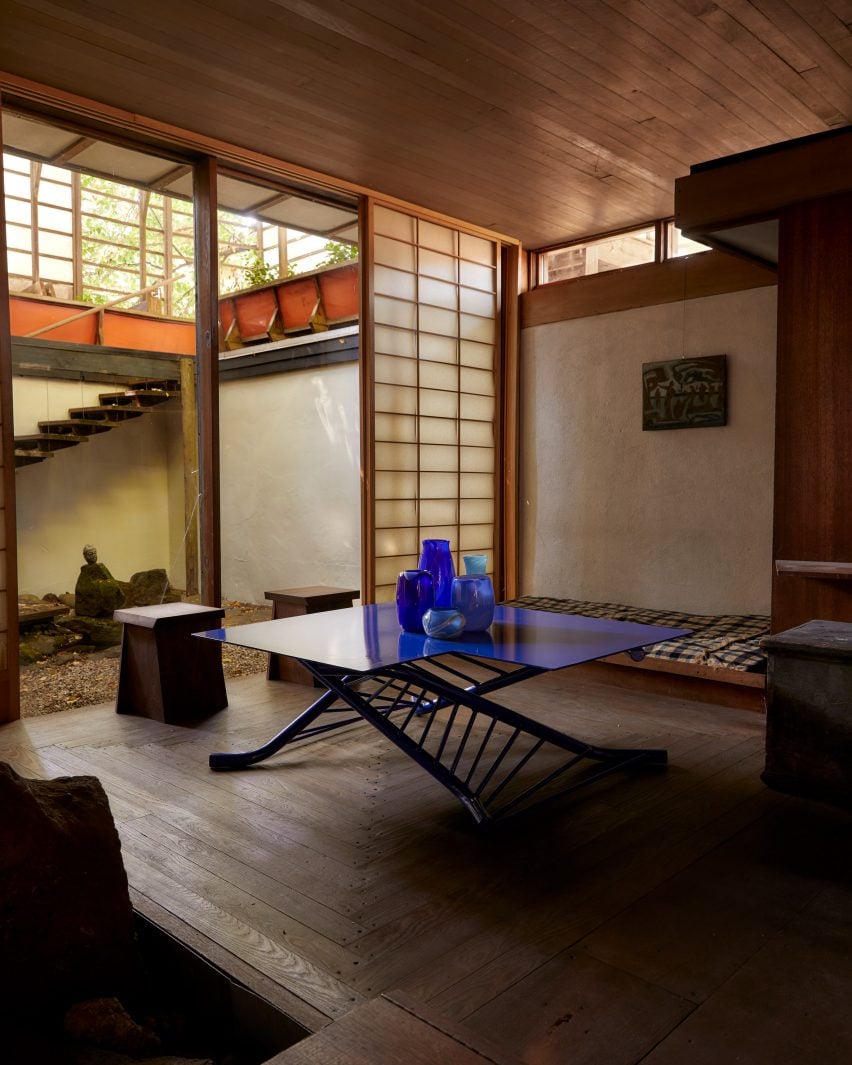
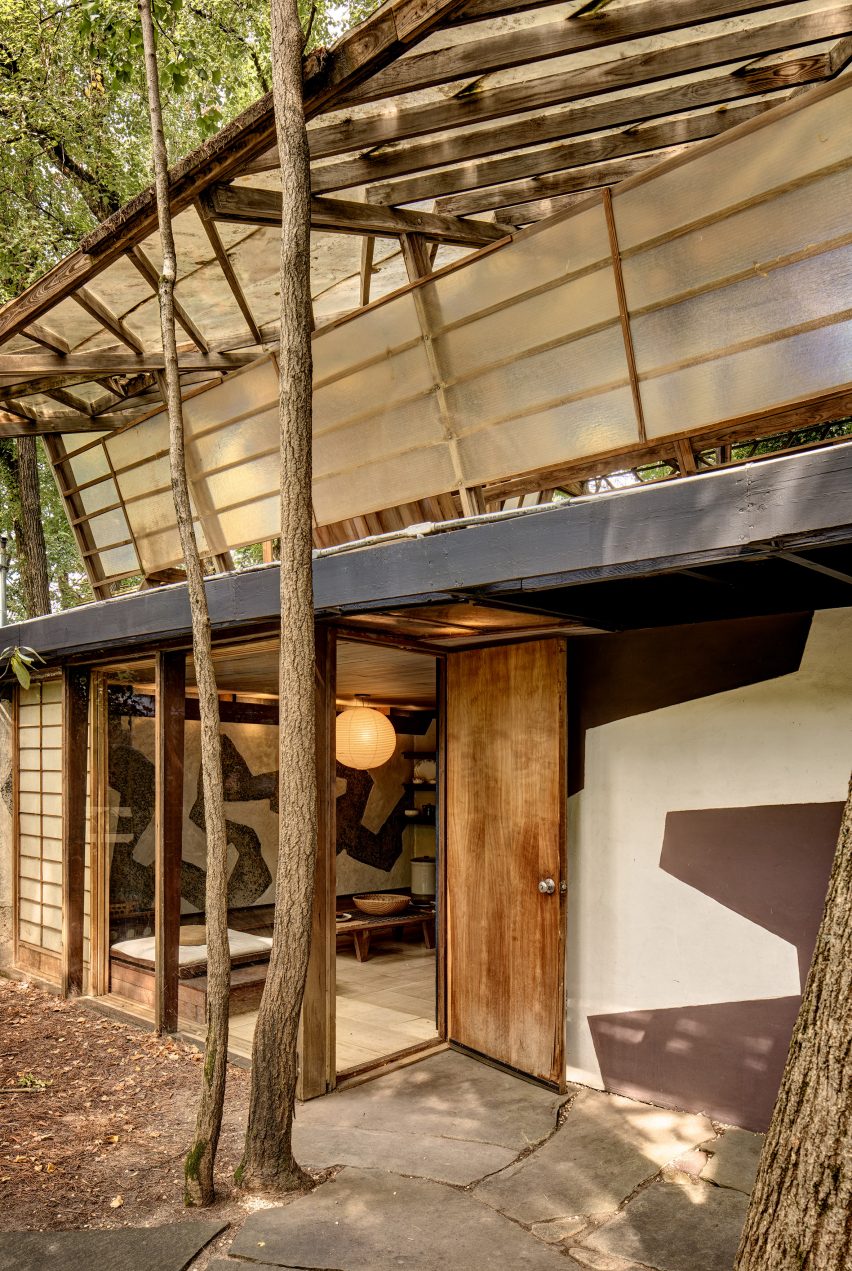
At The Rose House presents design at home of famed landscape architect

An exhibition of hand-crafted art and design and style parts, which include a seminal sculpture by Charles and Ray Eames, is on show at the former New Jersey residence of 20th-century landscape architect James Rose.

At the Rose Property is on exhibit at the Ridgewood dwelling that the late American modernist landscape architect made and hand-crafted for himself and his family in 1953 and lived in for pretty much 40 many years.

At The Rose House exhibition
Items in the exhibition are shown in the course of the residence as if they belong there

Organised by curatorial platform Item & Detail and household furniture and inside design and style studio Inexperienced River Task LLC, the exhibition stemmed from Rose’s appreciation for craft and resources.

The clearly show “emphasises the hand-designed, beauty in character and a sense of timelessness” according to the curators.

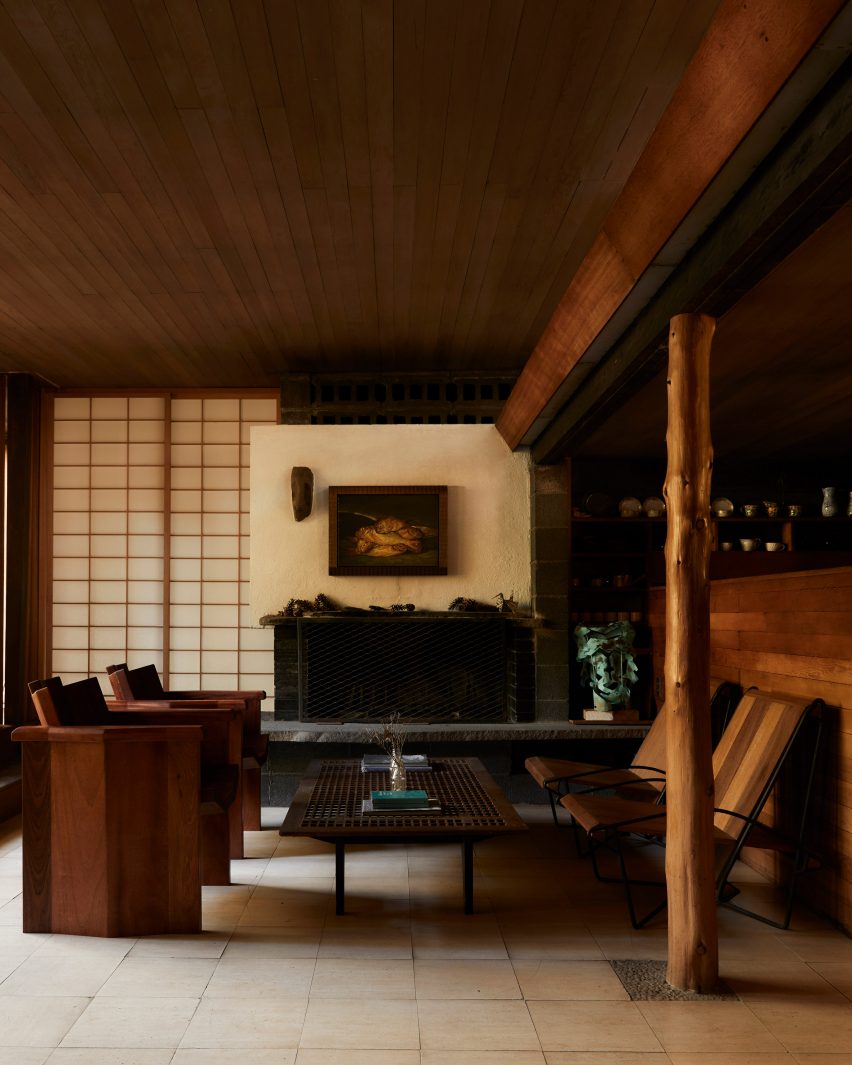
Living room of James Rose's Ridgewood home
Rose self-designed and hand-designed the dwelling, which functions a number of Japanese design aspects

Environmentally friendly River Project LLC founders Aaron Aujla and Benjamin Bloomstein, who have admired the landscape architect for some time, have manufactured a sequence of new patterns based on his do the job.

Designed in collaboration with a group of designers, these parts include things like a side chair by each Bloomstein Industrial and Luck Carpentry, rice paper lamps from Preziosi Lighting and carved grooming items on cabinets in the bathroom by Teague’s Path.

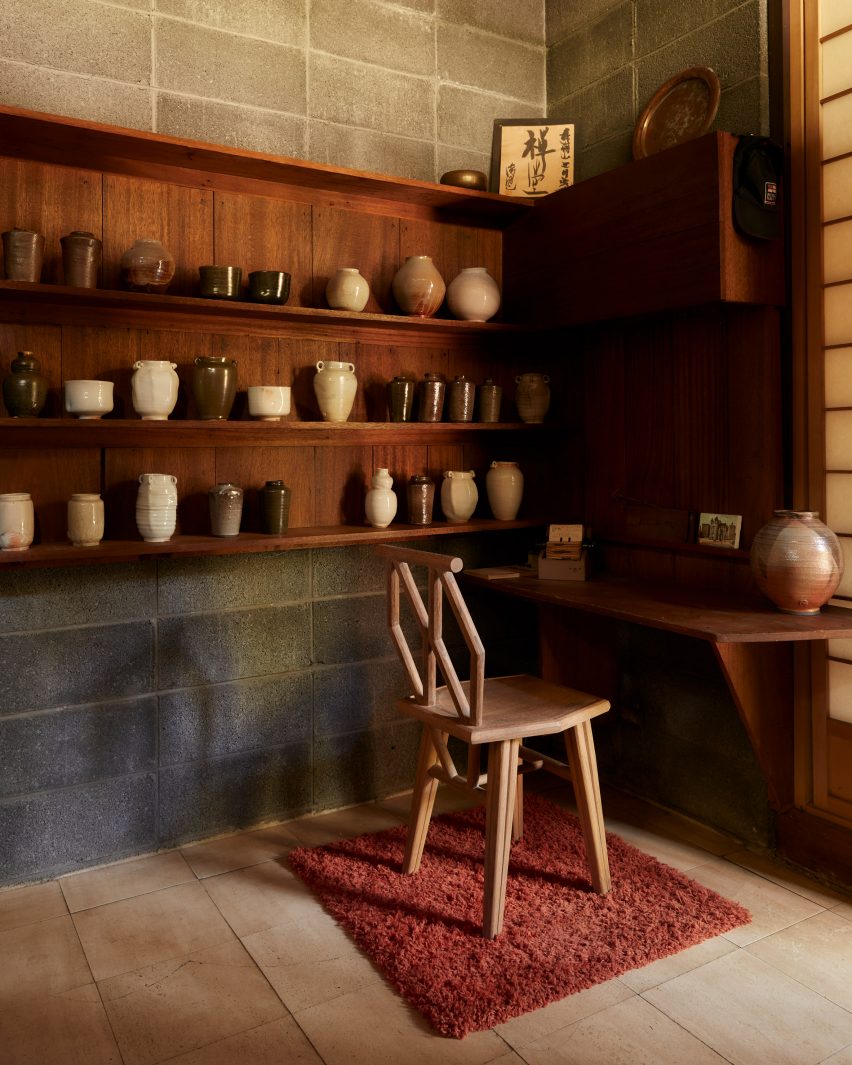
Ceramic pots displayed on wooden shelves
Artworks and patterns were selected to mirror Rose’s appreciation for craft and products

“The simplicity in which Rose expanded the house employing completely ready-built supplies was an early level of reference for our apply,” said Aujla.

“In distinct, there is a kitchen area with mahogany cabinets and pegboard that we need to have spent about 100 hrs dissecting and referring back to about the past 5 many years.”

Environmentally friendly River Project’s products and solutions are introduced along with the operate of mid-century and contemporary designers, such as Alvaro Barrington, Bode, Charles and Ray Eames, Louis Eisner, Hugh Hayden, Nancy Holt, Kiva Motnyk, Michele Oka Doner, Johnny Ortiz-Concha and Anne Truitt among many others.

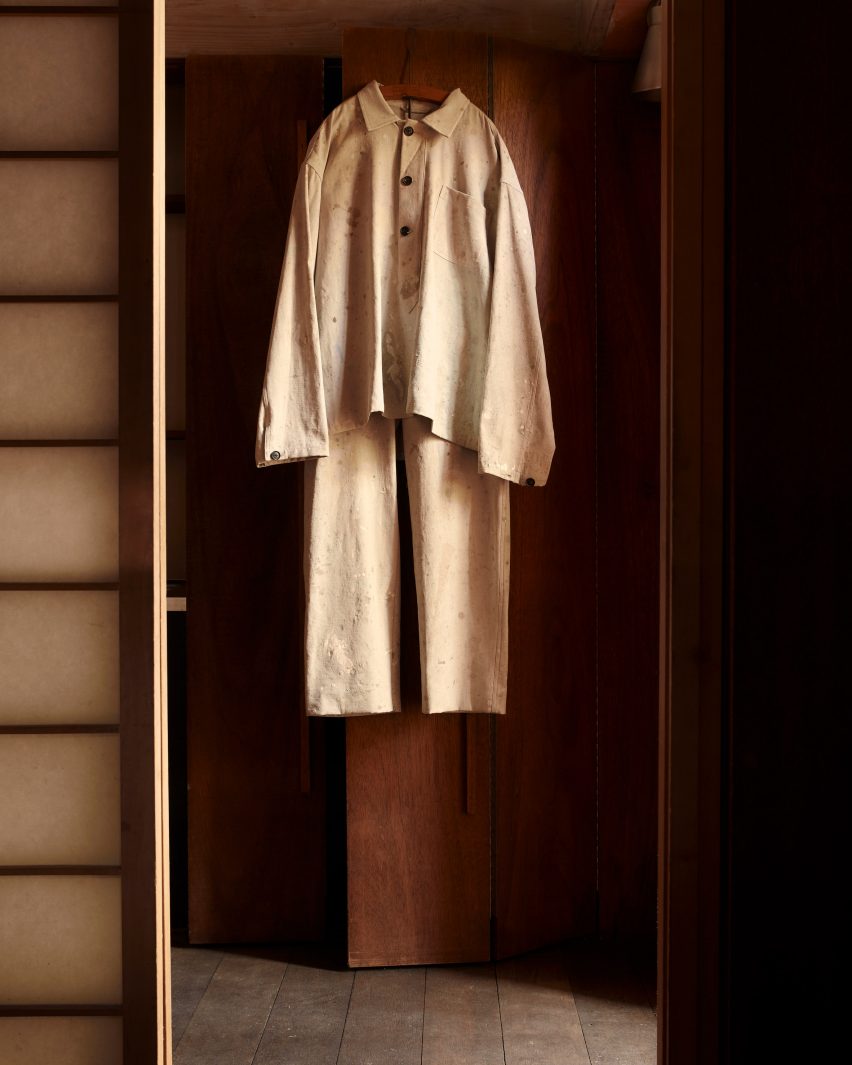
Clothing by Bose hung around the house
Garments primarily based on Rose’s personal type is hung in closets

The functions are set up as if they belong in the rooms and backyard, which – like numerous of Rose’s afterwards assignments – element factors of Japanese design and style, such as the exposed timber composition and shoji screens.

“[Rose] invested considerable amounts of time in Japan and became a Zen Buddhist,” said the curators. “This affect is evident in the Ridgewood household, primarily on the higher ground, which incorporates a area for his every day mediation practice that The James Rose Heart is now restoring.”

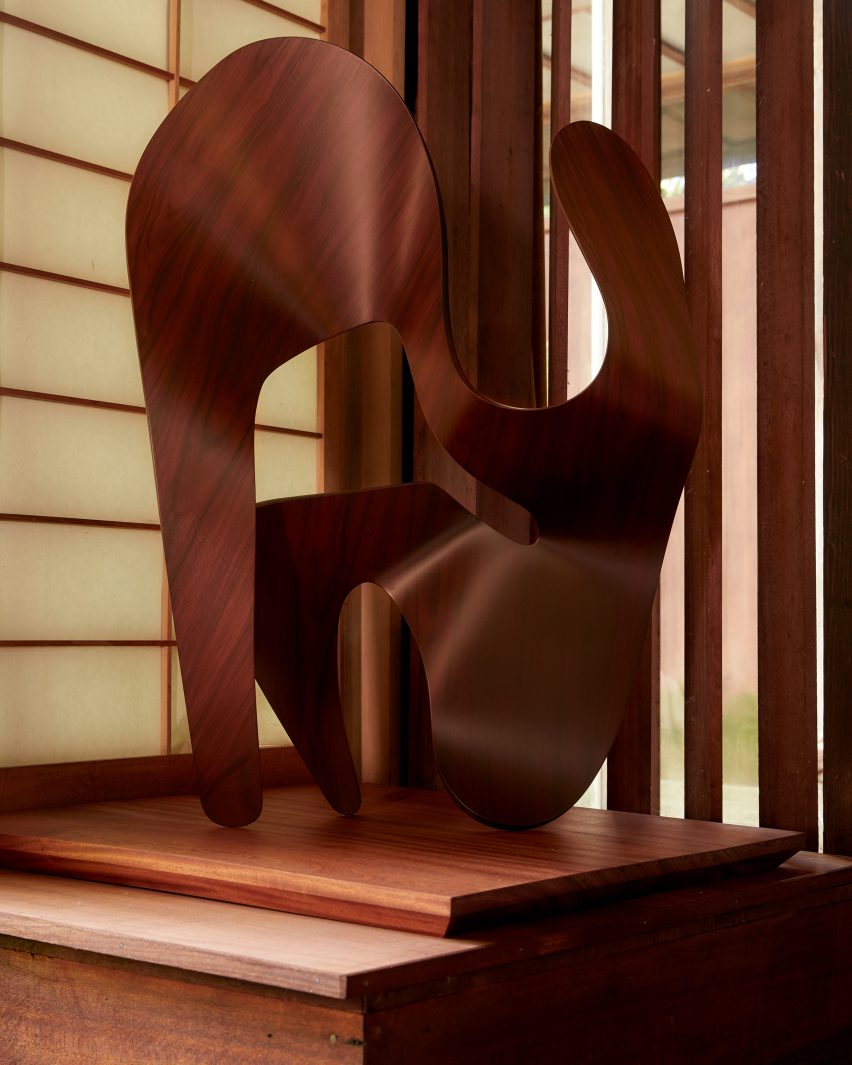
Eames Plywood Sculpture
An version of the 1943 Plywood Sculpture by Charles and Ray Eames is being introduced in the US for the very first time. Picture by Michael Biondo

Parts on exhibit include things like the Eames’ seminal 1943 Plywood Sculpture – the initially time that this edition, which was created and introduced by Eames Office environment, is getting offered in the US.

Amid the types designed for the showcase are leather-based Adirondack chairs by Hugh Hayden, wood-fired micaceous pots by Johnny Ortiz-Concha and in a natural way-dyed framed textile is effective by Kiva Motnyk.

A variety of apparel by New York model Bode, based mostly on Rose’s “eccentric” private model, is hung in the closets throughout the house.

Landscape paintings, rice paper drawings, flower vases, terracotta sculptures, and a screening of Nancy Holt’s 1975 movie Pine Barrens that “portrays the New Jersey wilderness” also feature.

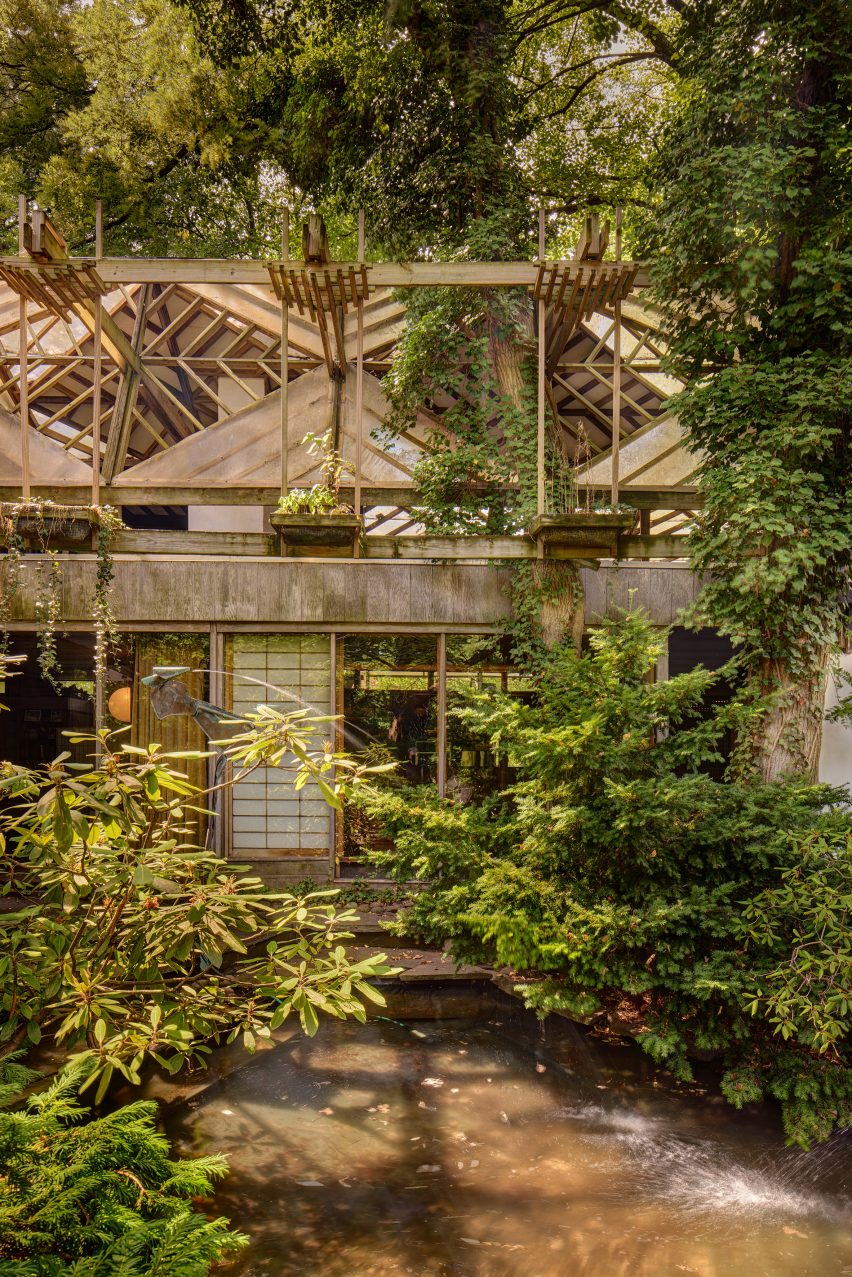
Exterior of James Rose house
The house in Ridgewood, New Jersey, is preserved by The James Rose Center. Photograph by Michael Biondo

Green River Venture LLC is also producing new editions of a person of Rose’s lanterns to coincide with this exhibition.

These will be bought to reward The James Rose Middle – a non-income landscape exploration and study foundation, which is based mostly at the dwelling and has preserved Rose’s legacy considering that his dying in 1991.

Exterior of James Rose house
The exhibition, curated by Item & Matter and Environmentally friendly River Undertaking LLC, operates till 2 Oct 2022. Photo by Michael Biondo

“Rose was an not possible maverick, known as by 1 creator, ‘The James Dean of Landscape Architecture,’ but I believe he would be extremely content with the vision Green River Project LLC and Object & Point have introduced to his residence,” mentioned foundation director Dean Cardasis.

At the Rose Home runs right until 2 October 2022. This is the most up-to-date in a series of exhibitions organised by Object & Factor inside of the properties of noteworthy 20th-century artists and architects, following presentations at the houses of Gerald Luss, Robert Dash and Eliot Noyes.

Other exhibitions that showcase the work of modernist designers consist of an exhibition of Le Corbusier’s tapestries in Manhattan.

 See our Dezeen Activities Guide for data about other exhibitions, installations and talks.

NewGal Presents Immersive Tour of New Art and Music

NewGal Presents Immersive Tour of New Art and Music

In its initial are living and in-man or woman effectiveness given that prior to the pandemic, the New Gallery Concert Collection (NewGal) offers an immersive tour of art and new music, checking out themes of adoption and adaptation. On Saturday, April 30 at 8 pm, Undertake and Adapt will welcome audiences to consider an active journey roaming visible and musical installations at the Longy School of Audio. Performances and artwork installations uncovered in the course of the rooms of the historic Zabriskie Home are intended to mirror the encounter of currently being adopted-into a household, into a region, into a person’s accurate self-and to evoke resilience, belonging, and empathy.

The program facilities on the operate of 3 neighborhood creators-visible artist Sharon Berke and composers Maria Finkelmeier and Jonathan Bailey Holland-who are developing by way of the lens of their own adoption experiences. A numerous group of artists-which include composers Fred Onovwerosuoke and Sarah Hennies, pianist Sarah Bob, cuatro player Fabiola Méndez and her trio, The Fisher/Lau Job, and percussionists Steph Davis and Aaron Trant-will broaden the concert’s topic by checking out the complexities of finding and adapting to one’s accurate id.

“NewGal exists to elevate new will work of audio art along with the living composers and artists who produce them,” states the organization’s president Sarah Bob. “No matter if another person has joined a new family members, moved nations around the world, or uncovered a new section of themselves, Undertake and Adapt invites curious listeners and adventurous art lovers to traverse the complexities of id as if it were a home of unlimited rooms.”

Through the night, concertgoers will regularly come upon will work from artist Sharon Berke’s Rearrangement sequence. These paintings and collages are research of duality, household, relatives, separation, connection, and belonging-all deeply personalized concepts to Berke, who was adopted at start. Her operates are abstractions of domestic scenes and serve as individual narratives for the artist, who states that each piece reflects her possess continuously evolving self-recognition.

Adapt and Adopt commences in Pickman Hall with the planet premiere of Jonathan Bailey Holland’s String Quartet No. 4, for string quartet and recording, which explores the distortion of time and narrative that accompany assimilation. The composer worries the audience to talk to thoughts: What does the approach of adoption and adaptation do to the idea of memory or history? How is a narrative designed when the connection to the previous is no lengthier recognised? The quartet will attribute Gabriela Diaz and Lilit Hartunian on violin, Ashleigh Gordon on viola and David Russell on cello. As the string quartet fades, the audience’s self-guided journey as a result of the tunes and artwork installations in the Zabriskie House starts.

In just one home, audiences will uncover Sarah Bob undertaking options from composer Fred Onovwerosuoke‘s The Twenty-Four Scientific tests in African Rhythms. Born in Ghana to Nigerian dad and mom, the award-profitable composer grew up in both nations around the world and traveled by about 30 African countries in advance of settling down in Saint Louis, MO, and founding the Intercultural Music Initiative. Onovwerosuoke’s songs is informed by a life span of adoption and adapting to new environment, even though remaining accurate to his roots. The 20-4 Reports in African Rhythms attract inspiration from unique dances and musical patterns discovered throughout the continent.

In a different room, concertgoers will uncover Fabiola Méndez and her trio accomplishing parts from her album “Afrorriqueña” (Afro-Rican). The album is motivated by her expertise as a Black Puerto Rican lady and celebrates the satisfaction, joy, difficulties, and self-acceptance that will come with adopting and adapting one’s genuine identity. Fabiola Méndez Trio will also accomplish selections from Mendez’s album “Al Otro Lado del Charco” (On the other aspect of the pond), which characteristics audio motivated by the thought of leaving one’s homeland in search of new chances and advancement.

Audiences will also discover percussionists Steph Davis and Aaron Trant doing composer Sarah Hennies‘ do the job Settle. Hennies’ minimalist piece enables two vibraphone gamers to adopt and adapt their artistic interpretations of the operate primarily based on their modifying bodily or psychological house. Their compositions typically discover musical, sociopolitical, and psychological concerns which includes queer & trans id, psychoacoustics, and the social and neurological circumstances fundamental creative thought.

Undertake and Adapt culminates with the globe premiere of percussionist, composer, educator, and general public artist Maria Finkelmeier‘s hottest installation, the Me you See. Built for a significant, versatile ensemble, the Me you See encompasses all the performers on the application. The get the job done starts with an on-stage efficiency by present-day percussion songs duo, the Fisher/Lau venture, who are step by step joined on phase by extra performers all over the new function. In the course of the functionality of the Me you See, a stunning movie projection will showcase a model new collage developed stay in the course of the functionality by visual artist Sharon Berke.

Tickets for Adopt and Adapt are out there online for amongst $10-$20. All attendees will be essential to present their ticket and proof of vaccination (such as booster shot) upon arrival. Masking is optional and supplemental COVID data related to the Longy University of Audio is out there listed here. Adopt and Adapt is made probable by funding from Are living Arts Boston by The Boston Foundation.

Marshall presents two new art exhibits | News

Ananda Village presents new art exhibit

A very first-at any time artwork exhibit discovering the meaning of the Divine Mom will open up on Feb. 14 at the Lotus Building in downtown Ananda Village outside the house of Nevada City. Hours on Valentine’s Working day are 1 to 4 p.m., and 7 to 9 p.m. The present is sponsored by the Ananda Higher education of Dwelling Knowledge.

The show’s title “The A lot of Factors of Divine Mother” enables artists to explore what the notion of Divine Mother usually means, expressed from their hearts and their faith.

For some artists, Divine Mom is all of development, manifested through nature. Other artists have expressed the Divine Mom in holy type, as a saint or a heavenly figure.


How do the artists participating in this distinctive exhibit watch “The Divine Mother?”

Jyotish Novak, religious director of Ananda, is also a painter. He has two paintings in the exhibit, just one entitled “Dark Eyes” and another of a tiger entitled “Rani of Ranikhet.” Of his portray of the tiger, Novak remembers, “We had been blessed with a marvelous sighting of Divine Mom in the form of a tiger although in India in 2014. Listed here I have put the tigress in a location of the higher Himalayas as noticed from Ranikhet, India. It is, or employed to be, the territory of wild tigers.”


Paula Madariaga Decebal-Cuza titled her painting “Divine Mother Eye.” The portray demonstrates symbolically the Divine Mother represented with certain colors of the Christic eye, inviting us to reflect on it’s uniqueness.

Rama Cryer, who grew up at Ananda Village and is a builder, selected the “Eternal Mom Earth” as his concept, expressed as a result of woodburning, acrylics and ink. Of his installation he writes, “Our Divine Mother manifests in my coronary heart as this the Everlasting Mother Earth. Her arms outstretched providing Her energetic force of Creation. Over, the Cycle of the Moon guides her way. In her still left hand, the Druid Sigil, releasing its magic to produce the Sacred Flower of Daily life and Wisdom. In Her reduced right, Her Coronary heart Chakra spreads the Appreciate. The center appropriate, the Spiral of the Wicca Mom, and the Ankh ablaze with Her electricity of Destruction and Independence. Her entire body is of the Earth, Roots expanding deep and farther than the eye can see.”

Mira Clark, a area Nevada Town artist who has organized quite a few art displays on behalf of CHIRP (California Heritage: Indigenous Investigation Challenge), selected to represent her really like of nature in the form of the Divine Mom with a painting titled “Water Prayer.” Of her set up Mira writes, “There is a correspondence concerning how our bodies join us to the Earth, our organic and natural types passing by means of the exact same cycles that all character goes as a result of. My get the job done considers women’s relationship to Mother nature as effectively as to the element of h2o. In several traditions and cultures of the globe, women of all ages are regarded as the keepers and tenders of the sacred aspect of water. I see my artwork as a representation of how deeply connected all of human lifetime is to the pure world and the unique landscapes we inhabit, and how sacred our bond is to the organic natural environment.”

The show operates through the summer season and will be open Saturdays, 10 a.m. to 2 p.m. The show will be open much more several hours through the Tulip Competition “Springtime at Ananda” in the course of the thirty day period of April. For special groups and much more facts, call admissions@anandacollege.org The show is sponsored by Ananda School of Dwelling Wisdom http://www.anandacollege.org and Ananda Village.

”Divine Mom Eye” by Paula Madariaga Decebal-Cuza.
Delivered

“The Everlasting Mom Earth” by Rama Cryer.
Presented

Feathered beauties are Christmas presents for all seasons

BRAINERD, MINN. – For more than two decades I’ve worked to attract wildlife to 70 acres of land I own not far from town. Each project I’ve implemented has been successful. It’s very gratifying work.

Equally rewarding has been landscaping my yard with fruit-bearing trees and shrubs meant to attract and hold birds year-round. Now, during winter, many species of birds rely on fruit as fuel for their internal furnaces because insect and other foods are nonexistent in winter. I’ve also planted a variety of evergreen trees. Birds seek shelter from the wind and cold among their thick branches. The trees also provide nesting sites in spring and provide protection from birds of prey and other predators.

We can and do, of course, attract birds to our yards by placing a variety of well-stocked feeders. Techniques outlined below are perhaps somewhat less traditional and can be more labor intensive at the outset. But they are also longer-lasting and ultimately, I believe, more satisfying — to people as well as birds.

You don’t have to live in the country to successfully lure birds with your plantings. Nor do you need to own a lot of land. Our feathered friends will respond to your habitat improvements even if you reside in the heart of a metropolitan area. And there’s no better time than now to start planning your bird-friendly backyard improvement project. All the better to be ready when nurseries open in spring.

Of course, for plants to grow here in Minnesota they need to be cold hardy. Fruit-bearing tree species to consider are crab apple (red-splendor is my favorite), mountain ash and highbush cranberry.

In more confined areas of your yard where trees might be too large, fruit-bearing shrubs will not only attract birds, but will add beauty to any landscape project. Shrubs can be placed singularly next to homes or garages, or can be planted close together and trimmed to form hedges and boundaries.

It’s a good idea to plant a variety of trees and shrub species that will provide food for wildlife throughout the year. For example, scarlet elder produces fruit in early summer, red-osier dogwood and serviceberry in mid-summer, grey dogwood, American elderberry, arrowwood and chokecherry in late summer. Most fruit from summer bearing species will be gone by now, but why limit your landscaping efforts to just winter varieties. Highbush cranberry, mountain ash and crabapple ripen in fall and hold their colorful bird-attracting fruit through winter, or until hungry birds devour the delicacies.

When choosing plant varieties, native species always grow best and with the least amount of effort. By talking with nursery staff, and by reading books and doing internet research, you will be able to find an assortment of trees and shrubs that grow well in your location and still provide birds and other wildlife the benefits of food and cover.

If you are looking for instant gratification, the addition of a heated bird bath is a great idea. Wildlife, even during the cold season, prefer to drink water rather than eat snow for their daily fluid intake because they don’t need to burn up extra energy melting the snow. And yes, some birds bathe during winter, especially when temperatures are above freezing.

An unforeseen problem I didn’t count on is that white-tailed deer also prefer drinking liquid to eating snow. So, some mornings I must fill the bird bath because deer — under the cover of darkness — drink it dry overnight.

Gray, fox and red squirrels also find the open water to their liking, and drink every day from my bird bath. I don’t mind sharing my projects with various species of wildlife.

Your entire landscape plan need not be accomplished in one season. However, the sooner you get started, the quicker you’ll realize the rewards. When you gaze in awe at a flock of pine grosbeaks as they descend upon your crabapple tree on a cold winter day, or when cedar waxwings gather to feed on mountain ash or highbush cranberries, you’ll know your labors were well worth it.

Keep this in mind, too: A bird friendly backyard not only provides treasured food and habitat for our feathered friends, it also increases the aesthetics and value of your property.

A win-win.