Your Concise New York Art Guide for February 2022

Installation view of Sadie Barnette: The New Eagle Creek Saloon, The Kitchen, New York, January 18, 2022–March 5, 2022 (courtesy of The Kitchen; photo by Adam Reich)

Contrary to the art world’s discursive habits, art isn’t a code you crack; it’s more like a place you go, ideally in good company. This February, go there. Lend an ear to a sonic fusion of orchestral music and noise from a concrete plant, watch furniture spring to life in protest or pleasure, and dance in a glittery reimagining of San Francisco’s first Black-owned gay bar.

Installation view, Cosmic Geometries, EFA Project Space, 2022. From left to right: Marilyn Lerner, Queen Bee, Oil on panel, 36×48 inches, 2020. Rico Gatson, Untitled (Double Sun/Sonhouse), Acrylic on panel, 36×48 inches. 2021, Courtesy of Miles McEnery Gallery, NYC. Natessa Amin, variable small works, materials and dimensions variable, 2018-2021. Stephen Mueller, Passeggiata, acrylic on canvas, 72×66 inches, 2005, Courtesy of DC Moore Gallery, NYC. Anoka Faruqee and David Driscoll, 2017P-07, Acrylic and linen on panel, 33.75x 33.75 inches,  2017. Dorothea Rockburne, Lamenting Angels #2, Aquacryl and gouache on paper, framed, 22.5×30 inches, 2021, Courtesy of David Nolan Gallery. 

When: through February 26
Where: EFA Project Space (323 West 39th Street, Midtown West, Manhattan)

Hilma’s Ghost, a feminist artist collective cofounded by Brooklyn-based artists Sharmistha Ray and Dannielle Tegeder in 2020, used ritual divination — and an invocation of the spirit of the organization’s departed namesake, the Swedish Theosophist artist Hilma af Klint — to curate Cosmic Geometries. Work by a diverse group of 25 creators, including Carrie Moyer, Yevgeniya Baras, and Laleh Khorramian, unites around a shared affinity for the spiritual, the mystical, and the occult in abstraction.

Still from Theo Triantafyllidis, Ork Haus, 2022, video (courtesy of the artist and Meredith Rosen Gallery, New York)

When: through February 26
Where: Meredith Rosen Gallery (11 East 80th Street, Upper East Side, Manhattan)

“The feeling of presence: this is the defining quality of the metaverse,” a voice flatly tells us, borrowing some of Mark Zuckerberg’s vacant techno-utopic utterances. Among the highlights of Athens-born, Los Angeles-based artist Theo Triantafyllidis’s solo show are two video installations that connect contemporary feelings of alienation with the radicalization pipeline: one simulation depicts bored Orks on their electronic devices amid storms and kitchen fires, while the other features a violent clash of figures, some of whom carry white nationalist flags.

La Monte Young, Trio for Strings, 2021. © La Monte Young. Cover design by Jung Hee Choi with calligraphy by Marian Zazeela (courtesy of Dia Art Foundation)

When: through February 26
Where: Dia Chelsea (537 West 22nd Street, Chelsea, Manhattan)

Dia Art Foundation, which counts Max Neuhaus’s sound installation in Times Square as one of the eleven sites it manages, has been a staunch supporter of sound art for some time — and now has three releases to celebrate. In Listening Space, gallery-goers can enjoy a jukebox preloaded with the nonprofit’s sound publications, from On Kawara’s “One Million Years (Future)” (1993), in which a man and a woman methodically count, to new records by La Monte Young, Deantoni Parks and Lucy Raven, and Carl Craig.

Installation view, Looking Back / The 12th White Columns Annual – Selected by Mary Manning, White Columns, 2022 (photograph: Marc Tatti; courtesy of White Columns)

When: through March 5
Where: White Columns (91 Horatio Street, Meatpacking, Manhattan)

After a pandemic pause on the tradition, New York’s oldest alternative art space has opened the 12th iteration of its Annual, thoughtfully guest-curated by New York City-based photographer Mary Manning as a reflection on and response to their past year of art experiences. The exhibition features work by 25 intergenerational artists, including Patrick Angus, Aria Dean, Stewart Uoo, and Gordon Parks, and will be accompanied by a screening of Barbara Hammer’s films at the Lesbian, Gay, Bisexual & Transgender Community Center.

Kate Millett, Dinner for One, 1967. Mixed media, 48 x 24 x 24 in. (courtesy of the artist and Salon 94 Design, New York. © Kate Millett)

When: through March 5
Where: Salon 94 (3 East 89th Street, Upper East Side, Manhattan)

In 1967, The Judson Gallery debuted a suite of fantasy furniture by downtown New York artist and radical feminist writer Kate Millett, who is best known today for her 1970 text Sexual Politics. The furnishings, currently on view at Salon 94, are whimsical, anthropomorphic, and wonderfully weird fusions of found objects and hand-carved wood that form a cabinet that opens its chest cavity, a bed with protruding feet, a stool that feeds itself, and even a table on roller skates (whose depiction on New York City’s streets in a 1967 edition of Life was weaponized as “proof” that Millett, a doctoral candidate at Columbia, was not a serious scholar).

Installation view of Sadie Barnette: The New Eagle Creek Saloon, The Kitchen, New York, January 18, 2022–March 5, 2022 (courtesy of The Kitchen; photo by Adam Reich)

When: through March 6
Where: The Kitchen (512 West 19th St, Chelsea, Manhattan)

Organized in conjunction with The Studio Museum in Harlem, The New Eagle Creek Saloon presents Oakland-based artist Sadie Barnette’s fluorescent recreation of the San Francisco gay bar that her father, founder of the Compton chapter of the Black Panther Party, operated in the early 1990s. On select Saturdays, the architectural installation is activated by DJs invited by queer scholar and artist madison moore as part of The Kitchen’s new nightlife and club culture residency; visitors are invited to dance, an homage to queer Black spaces past and present.

Liz Larner, vi (calefaction), 2015. Ceramic, glaze, stones, and minerals, 36.6 x 21 x 7.5 inches (courtesy of the artist and Regen Projects, Los Angeles)

When: through March 28
Where: SculptureCenter (44-19 Purves St, Long Island City, Queens)

Don’t put it back how it was, co-organized with the Walker Art Center in Minneapolis, surveys the work of Liz Larner, an astonishingly versatile sculptor and installation artist who came out of CalArts in the 1980s. The works on view run the gamut from Larner’s early experiments with bacterial cultures, to a kinetic wall-bashing machine, to the ceramic slabs that have occupied the artist for the past two decades. Though materially and aesthetically diverse, these sculptures are rooted in a common interest in the ways that bodies move and exist in social and architectural space.

Hugh Hayden’s Brier Patch at Madison Square Park, 2022 (courtesy of the artist and Madison Square Park Conservancy; photo by Yasunori Matsui)

When: through April 24
Where: Madison Square Park (11 Madison Avenue, Nomad, Manhattan)

Overtaking four lawns of Madison Square Park, Hugh Hayden’s ambitious sculptural installation features 100 wooden elementary school task chairs rendered unusable by the bare tree branches that aggressively sprout from them. Contemplating inequity in the American education system, Hayden’s Surrealist twist on vernacular classroom furniture depicts institutionalized learning as a thicket that is structurally uninviting, exclusionary, and absurd.

Beverly Semmes, Eye Tooth, 2021. Ink, acrylic over photograph printed on canvas. 54 7/8 x 40 in. (courtesy of Susan Inglett Gallery, NYC; photo by Chris Kendall)

When: February 3–March 12
Where: Susan Inglett Gallery (522 West 24th Street, Chelsea, Manhattan)

Initiated in the early 2000s, Beverly Semmes’ ongoing “Feminist Responsibility Project” intervenes with vintage porn magazines; using paint or ink to obliterate the bulk of women’s bodies in graphic images, Semmes transforms the subjects into awkward abstractions. Continuing this complex gesture, recent works on view in POT PEEK explore the resemblances between the effaced women and vessels, literally and conceptually.

Faith Ringgold, The Wake and Resurrection of the Bicentennial Negro, 1975-89. Mixed media, dimensions variable. (courtesy of the artist and ACA Galleries, New York, 2021 © Faith Ringgold / ARS, NY and DACS, London; photo by Ron Amstutz, courtesy Glenstone Museum, Potomac, Maryland)

When: February 17–June 5
Where: New Museum (235 Bowery, Lower East Side, Manhattan)

Celebrating six decades of art by Harlem-born nonagenarian Faith Ringgold, this long overdue retrospective features a collection of figurative paintings, narrative textiles, and soft sculptures shaped by a belief in the power of women’s labor and Black visual traditions. A highlight is the entirety of the “The French Collection” (1991–1994), Ringgold’s 12-part series of experimental story quilts exploring the life of a Black American artist and model working in the modernist circles of 1920s Paris.

The Punk Marie Antoinette of the 1970s New York Art Scene

Though she symbolically died from a staple cut at the Whitney Museum in 1978, Colette is alive and well. Resurrected a few days later as Justine, lead singer of a newly formed band, Justine and the Victorian Punks (a collaboration with Peter Gordon’s Love of Life Orchestra), Colette recalls in a 2013 BOMB magazine interview with Katie Peyton that her performative death was a critique of artists often having to wait until their passing to be recognized (which is particularly the case for women). And indeed, it is an indisputable fact that the French-Tunisian Colette Lumière is a severely under-recognized artist, whose lasting importance on visual culture and performance practice has yet to be fully grasped by the art world. Before moving to Berlin in 1984, Colette was a prolific artistic persona immersed in the 1970s New York art scene, a punky Marie Antoinette with a childlike voice and fashion confections. Working across a variety of media, yet always emphasizing the performance of identity, her creations ranged from frilly dresses and punk T-shirts to sculptural installations, light boxes and short films. 

Colette Lumière, “Untitled” (n.d.), archival material

Before Tilda Swinton ever slept in the glass box constructed by Cornelia Parker at MoMA, Colette incorporated sleep as an endurance practice in several of her performances. Between 1972 and 1983, the artist created a gesamtkunstwerk by turning her downtown loft into what she has termed “a living environment,” an immersive installation in which she herself is activated as a living sculpture. The current exhibition at Company gallery, Notes on Baroque Living: Colette and Her Living Environment, 1972-1983, curated by Kenta Murakami, takes the latter as its foundation. Entering Colette’s reconstructed living environment feels like stepping into a dreamlike universe saturated in a palette of crème and light pinks. Spread throughout the gallery are mixed-media wall fragments, light boxes, sculptures, garments and objects, as well as film footage and framed postcards. In Colette’s world, the theatricality of Versailles meets the punk ethos of the Sex Pistols, and ruched silky fabric is a signature material that you can’t possibly have too much of. The artist’s own likeness is omnipresent; photographs are embedded in the majority of the pieces, and her image is featured in the performance announcements and documentation. A large sculptural installation titled Notes of Baroque Living (1978-1983/2021), reconstructed from original elements of her living environment, centers a life-sized doll sculpture of Colette, made in collaboration with Company artist Cajsa von Zeipel. 

During a decade that witnessed a preponderance of conceptual art, as well as an emerging Pictures Generation that denounced the notion of authenticity even as artists returned to representation, Colette’s practice is nothing short of radical. Her performance of identity, embodying a number of personas in addition to Justine throughout the years, is combined with a deep dedication to materiality that is rare in performance art, by its nature an ephemeral form. The “baroque” element referenced in the title does not simply point to extravagance and taste for dramatic lighting. What Colette shares with the Baroque movement is a brilliant ability to eliminate the boundary between art and life, between the space of the viewer and that of the artwork, creating a truly immersive environment.

Colette Lumière, “The Messenger” (1978-2021), fabric, photograph, lights, plexiglass, and mixed media
Colette Lumière, “Beautiful Dreamer Uniform Series II” (1980-84), mixed media on linen
Colette Lumière, Notes of Baroque Living (1978-1983/2021), original Living environment panels and ceiling, original Colette-sized lamp, Colette-sized CRT monitor, selections from Records from the Story of My Life, carpet, mirrors, shelves, perfume bottle, Living Doll sculpture in collaboration with Casja von Zeipel
Colette Lumière, “Off the Wall (Homage a Paul Delvaux)” (1974), fabric, photograph, light, and mixed media on wood

Notes on Baroque Living: Colette and Her Living Environment, 1972-1983 continues at Company (145 Elizabeth Street, Manhattan) through January 22. The exhibition was curated by Kenta Murakami.

Students can enroll in a Full Residency in Portland, ME or a Low Residency from anywhere in the world. Apply by January 21 to be considered for a full-tuition scholarship.


If passed, clothing or footwear companies that rake in more than $100 million annually would need to report their energy usage, emissions, and supply information.


The long-term loan could “open the way for a similar agreement with an act of approval by the British Parliament,” said the Acropolis Museum’s director.


“Staff have already treated the most recent vandalism at Indian Head, but much of the damage is, unfortunately, permanent,” park officials at Big Bend National Park in Texas said.


Using magical realism and never taking the expected approach, Georgian director Alexandre Koberidze asks viewers to take more notice of the world around them.


Beauty is artist’s North Star: Denver’s Daniel Sprick to exhibit in New York | Arts & Entertainment

Daniel Sprick, a person of Colorado’s most achieved artists, a short while ago returned from New York Town, in which he was making ready for a new exhibition — his initially because 2016. Opening at the Gerald Peters Gallery on February 11, Sprick’s demonstrate “Interiors” will exhibit his ethereal, realist paintings of his 16th-ground apartment in close proximity to City Park, most made throughout Covid-19 lockdown, Travel & Tips.

Sprick is arguably the greatest representational painter in Colorado, or probably the Rocky Mountain location. In Sprick’s hands, interiors are concurrently just about every-day and otherworldly. The diploma of verisimilitude in his paintings techniques fine-art photography of areas saturated in luscious natural mild. Sprick’s paintings are, in a word, stunning.

“Great splendor can be identified, can be expressed,” Sprick stated. “I imagine there is a good deal far more consensus about natural beauty than a ton of people want to feel. Which is opposed to declaring that natural beauty is in the eye of the beholder.”

Beauty is Sprick’s North Star. And he finds magnificence in realism.

“Beauty is a little something that is under no circumstances mentioned in present-day artwork, not that I know of. If it is lovely, it’s for the reason that it boosts the prosperity and status of the owner, but not on the merits of the art,” he stated.

“In our time, in architecture of the early 20th century top up to now, magnificence was thought of a weakness. Magnificence was disdained in architecture, and I consider that the other arts adopted,” Sprick mentioned. “But absolutely nothing could be far more critical and very good than attractiveness. Mother nature, yet another human: At times it stops your heart to see amazing elegance. Extremely seldom, artwork does that.”

The natural beauty and verisimilitude of a Sprick portrait can choose absent one’s breath. Same with a Sprick however-lifetime or landscape.

“A portray is light-weight and darkish patches on canvas, but these combos of light-weight and dark can unlock the enjoyment facilities of the human mind, which is what we call natural beauty and can turn into transcendent,” reported Sprick.

John Madden — a person of metro Denver’s enhancement titans, a long-standing patron of the arts and co-founder of Museum of Out of doors Artwork (MOA) — commenced amassing fine artwork in the 1960s. Madden, now 92, reduce his aesthetic tooth at the Joslyn Museum in Omaha, Neb.

“I worked there 20 many years, every little thing from carpenter to tour manual,” Madden mentioned. “That’s in which I bought to know Rembrandt and Titian.”

The Madden Assortment — of which somewhere around 100 pieces have been donated to the College of Denver — consists of works by Robert Rauschenberg, Grandma Moses, Thomas Moran, Thomas Hart Benton, Wilson Hurly, Chen Chi and many other noteworthy artists. Madden also collected 8 Daniel Sprick paintings. MOA owns a different 3 Spricks, together with a person of the painter’s enormous nevertheless-everyday living is effective. MOA also made a documentary film, “Daniel Sprick: Pursuit of Fact and Magnificence,” which can be viewed at moaonline.org.

Madden explained a person of his Sprick paintings: “It’s a river at evening. Phenomenal! It is a intimate photo, really, pretty practical with an unbelievable handling of gentle,” Madden stated. “I believe Daniel Sprick is a keeper and is going to be any person who will be remembered. His artwork reflects that.”

Timothy Standring, Denver Artwork Museum curator emeritus, mirrored on Sprick’s paintings as poetic functionality art, of types.

“Because Sprick functions in the vernacular of realism, viewers search for verisimilitude, as if his paintings had been a mirror of reality — a actuality you and I may possibly come upon,” mentioned Standring. “And but, the additional we dwell on his paintings, the additional we turn into informed that they are everything but a part of our earth, and as an alternative, are poetic renditions of his very own producing. As this sort of, we come upon Sprick’s paintings as encounters whereby we have interaction deeply with the creation of his functions. By responding to his amazing performances, we practical experience the poetry of his performs.”

Sprick normally takes his perform seriously. He is nothing at all if not earnest, and portray is his vocation, his religious quest, his raison d’être.

Requested no matter whether he ever considers portray in a model a lot less demanding than his intensely representational realism, Sprick mentioned, basically, “No.”

But then, soon after a prolonged silence, he added, “Abstract portray has no skill included. When folks say, ‘My kid could do that,’ they could. It is correct. It’s no obstacle to manufacture a merchandise or splatter paint. Never think it when connoisseurs throw a cloak of obscurity and place to criteria the place none exist. It is a activity with no policies. No material. Very little there. The emperor’s dresses,” he explained.

“I have no capability for self-delusion. I’ve in no way had the slightest layout to fake, no make any difference what accolades or good results it could be rewarded with. I feel I’d fairly drink poison,” Sprick mentioned. “That’s why I have no artist statement, no concept. Here’s my artist assertion: What you see is what you get.”

Authenticity by way of verisimilitude in Sprick’s realist paintings impresses every person in his orbit. Longmont-primarily based Scott Fraser, an additional renowned painter functioning in realism and surrealism, is Sprick’s peer.

“I’ve known Dan for 40 yrs. We have each and every other’s paintings. He’s on my record of preferred artists. We’re close mates,” Fraser claimed. “It’s remarkable what he’s accomplished technically. There is a consistent top quality to his do the job that he has taken care of. He has experimented with subject issue, and I value that. He’s quite broad. I’m just a nevertheless-everyday living painter, but Dan paints continue to-lifes and landscapes, seascapes, cityscapes. He paints the figure,” Fraser claimed. “He has a specific talent established that will get greater, and he applies it to all points.”

Sprick, now working on an almost-daily life-sized nude, credits not only his expertise, but also his devotion.

“I’m continue to making an attempt to grasp it, because it can’t be mastered. My complex skill will get superior and much better, partly for the reason that I really do not do just about anything else. I try to eat, rest and ride bicycles — I trip a bicycle to get the job done most days — but I do practically very little else but artwork. Which is fully my choice to are living and breathe and development into bigger attractiveness,” reported Sprick.

His life-style evidently works for him. At 68, Sprick appears virtually boyish: slight, an unwrinkled facial area, a complete head of brown hair. Still he appreciates he’s no Peter Pan of portray.

“I’ll preserve likely as extensive as I’m equipped. I’m having more mature, and I will run out of time. The clock is ticking for me like for everybody else, so I’m working complete tilt when I however can due to the fact I know the capability will go absent.”

Meanwhile, he’s fulfilled and pursuing his inner compass: “There is even now undiscovered territory,” Sprick explained. “I’m sailing for a continent I’m not even positive exists.”

Colleen Smith is a longtime arts writer primarily based in Denver.


Online Education
Business Law
Women Fashion

When New York floods, this “living street” stays dry

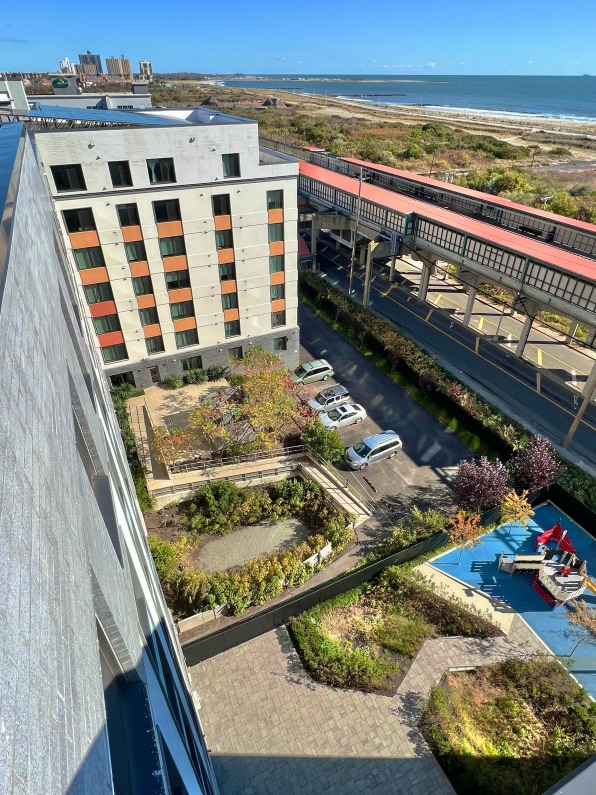
When Hurricane Ida dumped record amounts of rain on New York Town in late August, shutting down the subway and drowning some residents trapped in basement flats, streets flooded in the Queens neighborhood of Rockaway Seaside. Two weeks previously, the same streets flooded in Tropical Storm Henri. But in entrance of one making, the pavement stayed dry.

“The complete neighborhood flooded,” says Walter Rodríguez Meyer, cofounder and principal city designer at Nearby Office Landscape & Urban Style and design, which worked on the landscape style and design for the building—a combined-use, 100{6d6906d986cb38e604952ede6d65f3d49470e23f1a526661621333fa74363c48} affordable complicated referred to as Beach Inexperienced Dunes. “Our web site stayed bone dry.”

[Photo: Local Office Landscape & Urban Design]

All around the building, permeable pavement—asphalt built with rocks that are all a very similar size, which produces substantial pores—is designed to suck up water rapidly in large rains. Under the pavement, “structural” soil, a blend of soil and a stone construction, is sturdy more than enough to be load-bearing but can also make it possible for tree roots to develop freely and enable take up much more h2o in storms. On roadways, the solution is referred to as a residing road.

“Instead of a standard street tree, wherever a tree is by itself in the city, this means you community it to the future tree, and the up coming tree is in a position to reconnect like a forest,” Meyer claims, noting that simply because of the way the technique is engineered, it should really really be ready to soak up extra rainwater than a natural forest. Rain gardens and bioswales (plant-crammed channels that can gather a lot more water) substitute additional regular landscaping on the web-site. An additional garden utilizes plants to support suck up groundwater on sunny days, so when a downpour comes about, there’s a lot more potential underground.

This conceptual rendering displays how a dwelling road style could renovate portion of Northern Boulevard in Queens, New York. [Image: Local Office Landscape and Urban Design]

1 part of the complicated, an condominium developing concluded in 2020, has a flood-evidence foyer, and all of the apartments are on the 2nd floor or higher, keeping people earlier mentioned any likely floodwater. (The structures also have solar panels on the roof, and could later on be related to batteries to assistance continue to keep ability on immediately after significant storms.) But the landscaping, created for 1,000-12 months storms, ought to aid avert floodwater accumulation in the to start with location. Meyer says that in the course of the latest heavy storms, a developing manager documented watching the drinking water rise on the nearby avenue, whilst concurrently sinking underground on the residence. The same issue has transpired in other storms and during king tides.

The landscaping strategy is something that can make sense across the town and any other people vulnerable to flooding, Meyer says. Recent codes have not caught up with the actuality of heavier rainfall and more substantial storm surges mainly because of weather improve. “As the city is currently created, stormwater is only managed in the 5-to-10-year capacity by code,” he states. “But we’re getting rain situations that are 500-year functions again to again.”

In a the latest report from the nonprofit Regional Prepare Affiliation that thought of how New York City’s streets could be reimagined—including generating a lot more room for people walking and on bikes, and more parks, green place, and other uses—the designers shared an case in point of how a further closely paved intersection could be transformed. A rendering displays a parking whole lot getting to be inexperienced place, bike lanes divided by plantings, and additional trees almost everywhere. “The avenue by itself is absolutely porous, allowing for water to infiltrate through the structural soil, the bike lanes, the sidewalk—everything you see on the proper absent is in essence porous,” states Tricia Martin, associate principal at Area Business Landscape & City Design and style.

Although that style, at the intersection of Northern Boulevard and Broadway in Queens, is just a principle, it’s the type of transform that could realistically take place to aid the city adapt to climate improve, and a thing that the new metropolis administration could most likely champion. “I think that the appetite for this is shifting,” Martin suggests. “It doesn’t essentially have to be additional pricey. Due to the fact if you really do this at a systemic amount, and community these trees and truly start off to reconstruct streets this way, you conclusion up not needing pipes, and you do not want to retain pipes. And so you can start out to see exactly where there’s price tag cost savings there.”

Dwelling devices of “regenerative infrastructure” final lengthier, Meyer claims. “There’s additional money costs—they cost amongst 30{6d6906d986cb38e604952ede6d65f3d49470e23f1a526661621333fa74363c48} and 50{6d6906d986cb38e604952ede6d65f3d49470e23f1a526661621333fa74363c48} more to create on the cash aspect, but the life costs are exponentially reduced,” he suggests. “And when you calculate in how significantly a lot more stormwater this procedures, as well as the reduction in hazard to insurance policies premiums for properties close to it and for neighborhoods, then it’s an exponential payback.”

This Sultry New York Apartment Puts the ‘Art’ in Art Deco

There are certain buildings in New York with these kinds of incredible provenance that they evoke sighs of envy in any dialogue about the city’s household real estate. In the scenario of 1 these types of making in Manhattan’s Midtown East, the sighs are incredibly loud without a doubt: The spectacular limestone edifice was designed by architect Harry M. Clawson in 1929 as a resort and afterwards transformed into a co-op. Recent citizens of this prestigious address involve boldface names in the architecture and style community.

“You understood that beneath were being the bones of a thing quite majestic and humble at the very same time.”

There is a specific responsibility that goes with getting the custodian of 1 of these architectural gems, and this has been the endeavor of Dorothy Berwin, a Londoner who moved to New York some two many years in the past. Berwin, a passionate filmmaker, artwork collector, mother, and philanthropist, claims that when she observed a 3,500-square-foot duplex in the building for the initial time, it was “literally love at first sight!”

She was not the initial one to fall in like with the condominium: A late U.S. senator lived listed here because the 1970s, and the interiors—first adorned in the Artwork Deco style by Austrian architect Joseph City in its 1930s heyday—hadn’t been touched in effectively above 40 yrs. The condominium was in a a lot less-than-pristine condition, but, remarks Berwin, “you realized that beneath ended up the bones of a little something quite majestic and humble at the very same time.”

dorothy berwin house tour
The daring black-and-white kitchen attributes a bubble-gum-pink table built by Sabine Marcelis, and a photograph by Gregory Crewdson.

Douglas Friedman

Protecting the integrity of the unique structure was a priority for equally Berwin and her architectural designer Sandra Arndt of Studio AKTE. The initial ’30s details included spectacular casement windows, tongue-and-groove wooden floors secured by timber dowels, an tremendous marble hearth, and two monumental spherical mirrors facing a single a different in the living room. “One of my complete favored factors,” notes Berwin, was an original Bakelite-and-brass bannister that qualified prospects upstairs.

In addition to respecting what was there, Berwin wanted to produce a comfortable, informal, and inviting household for herself, her family, and good friends (a fantastic cook who loves to entertain, Berwin has a consistent stream of global attendees and family users). She also sought to emphasize her pretty particular modern art and style assortment as nicely as incorporate quieter, extra private areas. This transient necessitated a number of substantial tweaks to the floor prepare, which includes the addition of a foyer, yet another bedroom and tub, as effectively as an consume-in kitchen and a marginally greater eating space.

Installing the art was a separate challenge solely. To get the lights just right, the entire living area ceiling necessary to be opened for rewiring to put in the proper luminaires. A function by Roni Horn proved so significant that hoisting it within the condominium required two road closures and the removal of one of the double-top home windows. Other products in Berwin’s assortment did not need pretty as hefty a raise: A huge Gregory Crewdson photograph discovered a sensational house in the kitchen area, and a Florian Maier-Alchen landscape was excellent for the dining space.

dorothy berwin house tour
The media home attributes two Sarah Lucas photographs, both birthday gifts for Berwin.

Douglas Friedman

Equal care went into the furnishings, several of which Berwin has owned for yrs and brought to the U.S. from her native England, like a pink resin dining table made by Sabine Marcelis. “I’ve hardly ever experienced a property without the need of a sofa from Francis Sultana,” she notes, and in the case of her new abode, it “had” to be orange. She leaned on her friend designer Sybille Schneider to help her uncover the ideal crimson-orange for the sofa, the excellent whites for the walls, and just the correct window therapies. “Everything I live with I definitely like, and I pick out cautiously,” Berwin adds.

A wonderful case in point is in the media area, affectionately referred to as “the Sarah Lucas room.” It incorporates two images from the YBA photographer, presents from Berwin’s brother to celebrate two milestone birthdays. The latter celebration, a merged Oscar social gathering and 60th birthday bash, was an incredible fete with family members and close friends, 1 designed all the additional remarkable by her breathtaking new residence.

This written content is developed and managed by a 3rd party, and imported on to this webpage to support users supply their e mail addresses. You may possibly be ready to come across a lot more information about this and related content material at piano.io

‘Greater New York,’ a Show of the Moment, Dwells in the Radical Past

Three things stand out about the current edition of “Greater New York,” a survey at MoMA PS1 of artists living and working in New York, which happens every five years: pitch-perfect politics, intense nostalgia and an underwhelming display of new art.

Organized by a curatorial team led by Ruba Katrib, “Greater New York” — which opened Thursday — is both a show of our moment and one that attempts to escape it through the trap door of history. In the art world at the moment, it’s safer to celebrate the underknown, underrecognized and under-acknowledged artist who was radical half a century ago than to dive into the actual messy politics of the present.

The best work here, overwhelmingly, is the art made decades ago, not within the last few years. That is unfortunate, because it gives the impression that great art isn’t being made right now. Meanwhile, art in New York is vibrant, which you can see on any given day, particularly in galleries on the Lower East Side, Chinatown and TriBeCa, and in pockets of Queens.

However, this is still a deeply political show. Every large exhibition trains you how to observe it, and here you quickly learn to look at the wall labels, which focus in many cases on the ethnicity of artists. This is interesting information but the hazard is that art is turned into a rhetorical instrument rather than a bearer of illuminating or speculative ideas.

The show features the work of 47 artists and collectives and bridges documentary photography, surrealism, painting and video. Here are dominant threads and standout contributors.

The excavation of history weighs so heavily in “Greater New York,” it calls to mind classic narratives of our metropolis: Edwin G. Burrows and Mike Wallace’s masterpiece, “Gotham: A History of New York City to 1898” (1999); Luc Sante’s “Low Life: Lures and Snares of Old New York” (2003); the film “Downtown 81” (2000), which starred a young Jean-Michel Basquiat and a pre-gentrified Lower East Side.

Some of the work here is directly linked to these histories. Alan Michelson (a Mohawk artist) has created an installation, “Midden” (2021), in which a video created along the Gowanus Canal in Brooklyn and Newtown Creek on the border of Queens glides over a pile of oyster shells, a food mainstay in New York for millenniums, until the oyster beds were stripped away during colonization and industrialization.

Two installations by the collective Shanzhai Lyric draw from the history of Canal Street, which started off as a swamp and a waterway and later became an artery for commerce, including bootleg luxury goods and T-shirts. A dedicated room at MoMA PS1 displays the contents of the collective’s “Canal Street Research Association” storage unit: foam Statue of Liberty crowns, miniature Empire State Buildings and other tourist curios. Near the museum’s entrance, their installation of T-shirts manufactured in China and printed with odd phrases in English creates a disjointed “poem.”

Hands down the best paintings in the show are the bright, colorful abstractions by Paulina Peavy (1901-1999), an artist who said she had an encounter with a U.F.O. while attending a séance in California in 1932 and later moved to New York, where she lived and worked until age 97. Peavy’s paintings here, made between the 1930s and ’60s, are part of a wave of resurrections of lesser-known women artists in the 20th century, including Agnes Pelton, Hilma af Klint and Emma Kunz, whose abstract paintings were based in spiritual or healing practices rather than the formal arguments and battles of mainstream art movements.

The best photographs in “Greater New York” are also historical ones. Hiram Maristany served as the official documentary photographer for the Puerto Rican Young Lords, a group that arose from the Black Power movement in the 1960s. His black and white images from that period are a powerful representation of an artist “preserving his own community,” as he says in the wall text. After a year of the most documented protests in history (Black Lives Matter), it would be nice to see more recent documentation of the current social justice movement.

Marilyn Nance traveled to Lagos, Nigeria, in 1977 to document FESTAC ’77, the Second World Black and African Festival of Arts and Culture that drew thousands of artists, writers and activists. A range of her New York street photographs from the ’70s and ’90s are on display, capturing people jumping subway turnstiles, musicians and circus elephants sauntering down a nocturnal city street.

A 1989 video of the poet Diane Burns (identified as Chemehuevi and Anishanabe) reciting a punk poem on the Lower East Side crackles with humor around Indigenous politics, gentrification and displacement. Regina Vater’s two “Saudades do Brasil” videos, from the mid-70s and mid-80s, compare New York with gritty Brazilian cities. There are also drawings, photographs and paintings from the ’80s by artists like E’wao Kagoshima, Julio Galán, Peter Hujar, Andreas Sterzing and Luis Frangella that offer a window into an edgier, largely pre-AIDS New York — as well as the rise of various aesthetics around graffiti and L.G.B.T.Q.I.A. art.

While many of these artists have been overlooked, a fraction of the historical displays would suffice. They allude, however, to art being produced right now. Swing by the gallery Higher Pictures Generation in Dumbo for a tutorial on contemporary photography. For queer art and work that explores and celebrates intersectional identities check out Queer Thoughts, Company, Fierman, PPOW or the Leslie-Lohman Museum of Art. For overlooked artists of all stripes, go to Ortuzar Projects in TriBeCa. And for painting by emerging artists, check out small galleries like 56 Henry, Jack Barrett, Charles Moffett or Housing, at 191 Henry, which aims to support Black artists in particular.

A wave of anti-Asian hate crimes, Donald Trump’s presidency and the reinvigorated #MeToo and Black Lives Matter movements have challenged curators and institutions to highlight diversity and right historical wrongs. Here are some notable presentations that intelligently address these issues.

The Seneca author and artist G. Peter Jemison’s excellent works on paper reference the Canandaigua Treaty of 1794, its impact on the Haudenosaunee — the Six Nations of the Iroquois Confederacy — and campaigns by churches and schools to eradicate the culture and language in northeast North America. His use of humble paper bags is what is most exciting about his work.

Similarly, Curtis Cuffie’s sculptures from the ’90s address where art flourishes and is displayed. He saw the sidewalk as his primary venue and used scavenged materials — clothing, objects and trash items. They were originally installed around Astor Place and the East Village, which was undergoing intense gentrification. (If Cuffie, who died in 2002, were a young artist today, his witty assemblages and costumes would likely appear on Instagram or TikTok.)

Yuji Agematsu’s impactful wall of detritus collected on daily walks during the pandemic and stuffed into cellophane cigarette-box wrappers is a scruffy update of On Kawara’s conceptual “Date Paintings,” which marked the days, starting during the Vietnam War.

Steffani Jemison’s “Similitude” (2019) is a wry commentary on cultural appropriation filmed in anonymous sites across New York. The video, starring a Black actor trained in mime, recreates gestures and actions of people carrying out daily activities. Politics here are drawn from everyday life and question the idea of language and mimicry.

Some of the most powerful aesthetic statements last year appeared in the form of monuments covered with graffiti, torn down, or removed. Images of activists in Bristol, England, removing the statue of the slave trader Edward Colston last year suggested a wave of empowered community action, joy and possibility.

I thought of this when viewing Doreen Garner’s sculpture “Lucy’s Agony” (2021), which references gynecological experiments carried out on African American women by doctors like J. Marion Sims. A statue honoring Sims was removed from its prominent site on Fifth Avenue in 2018, but it was not destroyed.

Garner’s sculpture borrows the ’90s installation shock tactics of artists like Mona Hatoum, Robert Gober and Pepon Osorio, but it also conjures battles over the Covid-19 vaccine, and modern-day inequities in medicine.

A typical phenomenon in large surveys is to include merely acceptable art by extraordinary artists. Too often, it gives a lukewarm introduction to people who have made exceptional contributions but whose best works may not be available. This challenge was met here by curators presenting paintings and works on paper by Milford Graves, who started off as a percussionist and became a visionary healer, teacher, visual artist and martial arts master. Graves, who died in February, has an exhibition opening in a few days at Artists Space, where I expect he will be better represented.

Look, too, for works on paper by Rosemary Mayer (1943-2014), though her recent show at Gordon Robichaux gallery featured examples of her best work: billowing fabric suggestive of women’s anatomy.

The bulk of the art here by younger contemporary artists unfortunately replicates, without much vision, the dreamy, quirky, surrealism of artists like Marc Chagall, Leonor Fini or Remedios Varo; early Modernist abstract painting and sculpture; experimental photography from the 1920s and ’30s; and the bodily sculpture of Kiki Smith.

One of the most enduring and important factors in the art world — class — remains largely invisible in this show. Rents are still high in New York, and artists are expected to have costly graduate degrees. The wealth of museum patrons and trustees, has become a sticking point among protesters and groups like Decolonize This Place. While wall labels describing the ethnicity of artists feels quaint at this point, what would be truly radical would be to include the artist’s debt load, which literally determines many contemporary artists’ ability to participate in the studio-based art world. (Moreover, the faulty assumption that artists from so-called developing nations are not among the wealthy classes in their countries of origin is a huge oversight.)

One of the don’t-miss works addressing class is Marie Karlberg’s satirical video “The Good Terrorist” (2021), which updates Doris Lessing’s 1985 novel of the same name. It features several well-known artists (Nicole Eisenberg, Jacolby Satterwhite) playing entitled revolutionaries occupying a luxury apartment on the Upper East Side.

Here, identity politics — actors include people of color and some who are gay — are seamlessly woven into a work in which radical leftists attempt to coexist and effect change in the world. Perhaps the most telling feature is that their privilege — as famous artists cozy in the museum world — goes unmentioned in the wall text.

Greater New York 2021

Through April 18, 2022, MoMA PS1, 22-25 Jackson Ave., Queens; (718) 784-2084; moma.org. Entry to MoMA PS1 is by advance timed ticket.