Photographer and Northbrook resident Michael Greenberg returns to the North Suburban YMCA’s Community Gallery in December with a new exhibit of photos entitled “Nature Gone Wild.” The exhibit captures the power of Mother Nature, unleashing scenes of motion, intense colors, textures, and astronomical/weather wonders. The high-resolution framed photographs are for sale and could make a great holiday gift. A portion of the proceeds benefits the Y’s Visual Arts Program.
When he travelled to Argentina in 2020, Greenberg captured images of Iguazu National Park Waterfalls that dwarfed Niagara Falls. Cruising off the coasts of Argentina and Chile offered unique “nature gone wild” images of a breaching whale, flying fish, squawking and cuddly magellanic penguins, melting glaciers wildlife, and glacier photos.
In the past, extended stays in Europe, Asia, and Israel allowed Greenberg to capture distinctive images from unusual angles, during both day and nighttime. He received a PhD in Chemistry and worked as a scientist and Research Director for over 36 years in the food industry. Thirty years were spent working for the Wm. Wrigley Jr. Company. As a high-level scientist/manager, he travelled internationally to meet other scientists and sponsor research in their laboratories. His photo gear went on all the business trips.
“I have a lifelong passion for capturing landscape and travel images that provide sensory cues triggering memories of past experiences,” commented Greenberg. “This is known as “Imagetripping.” These images bring back the aroma, tastes and visual stimulus of the moment the image was captured. I weave distinctive lighting and composition with vibrant colors through the intersection of subject, weather, and astronomical conditions. My mission is to share my work so others can enjoy these experiences.”
The North Suburban YMCA’s Community Galleries support the local arts community by giving it a place to show and sell their works. For more information about the gallery contact Cathie Winnie at cwinnie@nsymca.org.
About the North Suburban YMCA
The North Suburban YMCA services Northbrook and 14 surrounding communities with programs and tools that help its residents become healthier, more connected, and confident, ensuring that everyone, regardless of age, income, or background, has the opportunity to learn, grow, and thrive. The NSYMCA focuses on Youth Development, Healthy Living, and Social Responsibility and is a charitable organization, inclusive and welcoming to all in our community. Learn more at NSYMCA.org.
SULPHUR, Okla. – Lake of the Arbuckles in southeastern Oklahoma is well known as a great local fishing spot and for its ability to provide ample supplies of life-sustaining water to cities of Ardmore, Davis and Wynnewood.
In recent years, however, several groups have grown concerned about the lake’s water quality. They have started work to ensure the lake remains ecologically sound for this and future generations.
“Arbuckle Lake is a fantastic trophy, largemouth bass lake, but during the summer we see areas now within the lake that have impaired levels of dissolved oxygen in them, Chickasaw Nation Natural Resources director Kris Patton said.
“If water quality parameters within Arbuckle Lake continue to decline, we are going to see more algal blooms (rapid growth of microscopic, unicellular algae) which will certainly impact water quality.”
Research has demonstrated the culprit to be excess nitrogen and phosphorous from fertilizers and possible runoff from septic tanks. Mr. Patton said if algal blooms were allowed to grow unfettered, more than just fish will be in jeopardy. So, too, may be the sustainability of the water supply for more 60,000 residents in the region.
Working with local landowners, the Chickasaw Nation is taking action to protect the resource. Using a grant from the U.S. Bureau of Reclamation, the Chickasaw Nation’s Natural Resource Office brought together an independent board – the Lake of the Arbuckles Watershed Association (LAWA). The board is made up of local landowners with a direct stake in lake.
“The Natural Resource Office was developed to assist the Chickasaw Nation with implementation of its historic water settlement with the state of Oklahoma,” Mr. Patton said. “The Chickasaw Nation formed that settlement with the Choctaw Nation, the State of Oklahoma, and Oklahoma City in 2016, and work continues to finalize the settlement so that it may be fully enforced. The settlement and the planning processes our office manage allows us to take a seat at the table and impact how our region’s water resources are managed.”
A Chickasaw-Choctaw water planning team operates jointly to evaluate area water resources throughout both tribal territories, which encompasses 22 counties within the State of Oklahoma. The team identifies strategies for the best protection and sustainable use.
The Lake of the Arbuckles is not the only area of concern and the Natural Resource Office’s work. The Oklahoma Department of Environmental Quality compiles water samples data, which are then evaluated to determine which lakes or streams should be considered “impaired waters.” Impaired waters are color-coded red on a composite map, with red markings indicating areas of heightened concern.
“As you look at the streams and surface water bodies across the state, you see a brightly colored red map,” Mr. Patton said. “When you narrow that down, the Chickasaw Nation and the Choctaw Nation have a lot of red streams, which includes Arbuckle Lake within the color-coded red impacts.”
Previous water quality sampling efforts are evaluated. The team has deduced that water bodies and streams within the Chickasaw Nation are becoming more and more impaired.
“We wondered what we could do to assist with turning the situation around,” Mr. Patton said. “So, we hit on the idea of the watershed organization process. The first step was the Lake of the Arbuckles Watershed Association, which is based out of Sulphur and is a landowner driven organization. Members must own land within the watershed to serve on that board. They are directing what best management practices should occur within the Arbuckle Lake watershed.”
Another emphasis in the LAWA effort is using prescribed fire to reduce wildfire potential. If a wildfire does break out, areas managed with recurring prescribed fires ensure it doesn’t have as much highly volatile fuel to keep it going.
From a landowner’s perspective, prescribed fires help promote a healthier ecosystem and better grazing for cattle and horses. Prescribed fire also allows better forage for deer, turkey and other game.
Promoting stands of native grass and vegetation, especially along riparian waterways, reduces the potential for erosion resulting in significant loss of top soil within creeks, lakes and streams.
Wes Harden is a Chickasaw citizen who owns 1,000 acres five miles west of Mill Creek, Okla. The property has been in his family the better part of a century. The U.S. Bureau of Indian Affairs (BIA), in conjunction with the Chickasaw Nation, helped burn 300 of his acres.
Mr. Harden said it was much easier than doing it himself and reduced his stress level over concern a fire he set might get out of hand.
“It’s a lot more than just lighting a match,” he said. “As a landowner, you are responsible when you light that match. You’re responsible for if it gets out of hand. The BIA and the Chickasaws made it tremendously easier because they have the equipment that we don’t have.
“This was the first time we’ve had the BIA and Chickasaws come in and it sure took a lot of stress off knowing it was under control. They’re pros. Plus, they came in with their crew of about 15 whereas in the past we’ve tried to do it with three or four. What usually takes us two or three days, they had done in about six hours.”
Mr. Harden said the reason for wanting to burn the land was to reduce the number of red cedar trees from ruining the property’s land use.
“If you don’t control the red cedar, before long they just take over a place,” he said. “We run 180 to 200 head of cattle on our land. We also use it for recreation, hunting deer and turkeys on it. The little sprouts that come back after the burn benefit the deer and the turkeys.”
He said a controlled burn also reduced the amount of chemicals he used.
“It cuts down on using chemicals,” he said. “You have to use some chemicals, but it helps not having to use spray that ends up washing into the lake.”
LAWA president Larry Kennan owns acreage through which Sandy Creek flows one-and-a-half miles north of where it pours into Lake of the Arbuckles. He says removing eastern red cedar trees is critical to maintaining the ecological integrity of the lake.
“If you look underneath an eastern red cedar tree, there is no vegetation. It’s bare ground,” Mr. Keenan said. “And if you see one, you see a hundred. It’s a very invasive species. Not only do they consume huge amounts of water, they eliminate that natural filtration system of native prairie grass that acts to filter impurities before they get to the creek and it flows into the lake.”
He said prescribed fires hearkened back to the original inhabitants of the land and by nature itself.
“Back before statehood, prescribed fires were common, conducted by Native Americans as well as lightning that would run across the rangeland and take out a lot of trees, in particular, eastern red cedar,” he said.
The result was excellent forage for cattle, buffalo and other native wildlife. Mr. Keenan said as the state grew in population, fire had been largely removed from the landscape due to urbanization and residents not understanding and appreciating its value.
“There are some challenges out there,” Mr. Keenan says, referring to opposition LAWA members have run into as fires start burning.
“Prescribed fires are absolutely natural,” he said. “It’s been going on for years and we’re just trying to reincorporate them back into management and back into the environment. Our strategy is to use prescribed fire and some mechanical removal to control, remove, reduce the presence of eastern red cedar in the watershed and that will eventually have a positive impact on the water quality in the watershed.”
NEW YORK, Dec. 1, 2021 /PRNewswire/ — The popularity of chat platforms has transformed the customer relationship management landscape. Chat platforms are now ubiquitous and have made their way into the fabric of everyday life. The demand for chat-based communications tools to support customers has grown, and that trend skyrocketed exponentially during the pandemic – a time when travel companies struggled to address the sharp rise in customer support requests.
In response, Fareportal, the travel tech company powering online travel agencies CheapOair and One Travel, went to work to enhance its existing chatbot service. The chatbot uses natural language understanding to mimic human conversation and is available 24/7. Customers can engage with the chatbot to search for flights, request help with their existing booking, and make changes to – or even cancel – their existing bookings quickly and easily. The chatbot can resolve most inquiries and when needed, complex cases that require human intervention are routed to the company’s live agents.
Werner Kunz-Cho, CEO of Fareportal, comments, “The number of travelers needing our assistance keeps growing, so we’ve fast tracked many innovations for CheapOair and OneTravel. Our commitment to customer service is unwavering, and we are very pleased to offer our customers an easy to use and efficient chatbot solution.”
Due to the success of the chatbot’s end-to-end solution that helps customers through the lifespan of their travel plans, the tool handles 7,000 chats daily, a 12-fold increase from January 2021, with a 55{6d6906d986cb38e604952ede6d65f3d49470e23f1a526661621333fa74363c48} containment rate for chats resolved by the bot and a 95{6d6906d986cb38e604952ede6d65f3d49470e23f1a526661621333fa74363c48} success rate in customers’ intent identification. Further enhancements will be rolled out in the future as the demand for chatbot-based service grows and customer needs evolve.
About CheapOair CheapOair is an online travel agency that specializes in providing cheap flights and great last-minute flight deals for travelers worldwide. Consumers can book online, on mobile apps for iOS and Android, by phone or live chat. Part of Fareportal’s family of travel brands, CheapOair bridges the gap between an online travel agency and a traditional agency with travel agents available worldwide to help find great deals on flights to global destinations on over 600 airlines, a million hotels, and 100s of car rental companies. Follow CheapOair on Facebook, Twitter, and Instagram for travel inspiration and helpful travel tips.
About Fareportal Fareportal is a travel technology company powering a next-generation travel concierge service. Utilizing its innovative technology and company owned and operated global contact centers, Fareportal has built strong industry partnerships providing customers access to over 600 airlines, a million hotels, and hundreds of car rental companies around the globe. With a portfolio of consumer travel brands including CheapOair and One Travel, Fareportal enables consumers to book online, on mobile apps for iOS and Android, by phone, or live chat. Fareportal provides its airline partners with access to a broad customer base that books high-yielding international and domestic flight, hotel and other travel and add-on ancillaries.
—Opening the Way to Financial Evaluation of Biodiversity with Publication of Nature-Positive Methodology—
OSAKA, Japan, November 30, 2021–(BUSINESS WIRE)–Sekisui House, Ltd. (TOKYO:1928) has been pursuing the conservation of biodiversity since 2001 by creating green networks in urban residential districts under its Gohon no ki (“five trees”) indigenous landscaping concept. Together with the University of the Ryukyus1, the company has analyzed the outcome of the Gohon no ki Project that it has implemented with 1 million customer households2 over the space of 20 years, and has designed the world’s first mechanism for quantitatively evaluating urban biodiversity. It has published this qualitative evaluation mechanism today as a nature-positive methodology for promoting the conservation of biodiversity.
Results of quantitative evaluation analysis (1) – The number of native tree species in each region—the foundation of regional biodiversity—has increased tenfold. (Graphic: Business Wire)
The Gohon no ki Project
Since the 1970s, incessant urban development has dramatically reduced the amount of habitat available for flora and fauna in our cities. Sekisui House launched its Gohon no ki Project in 2001 as an initiative to conserve biodiversity through the eco-friendly landscaping and greening of the gardens of its customers. Based on the concept of planting five locally native trees, three for birds and two for butterflies, the Gohon no ki Project proposes greening gardens and local communities with native tree species suited to the local climate and benevolent to birds, butterflies, and other local fauna. The project takes its lead from garden landscaping modeled on traditional Japanese satoyama (which translates roughly as “village woodland”).
In the 20 years from 2001 up to 2020, more than 17 million trees have been planted under the project. The company has also promoted urban greening throughout Japan by incorporating the Gohon no ki concept into its planning of green spaces in its condominium and community development initiatives.
Quantitative evaluation of biodiversity
Sekisui House has since 2019 been working with the Kubota Laboratory, Faculty of Science, University of the Ryukyus, and Think Nature Inc. to quantitatively evaluate the contribution of this network-type greening to urban biodiversity. Based on the Japan Biodiversity Mapping Project (J-BMP)3 managed and operated by Think Nature Inc., a company established by Professor Yasuhiro Kubota, the partners have analyzed the data on tree number, species, and location accumulated over the 20 years of the Sekisui House Gohon no ki Project to quantitatively evaluate the effectiveness of the project in conserving and restoring biodiversity.
This quantitative evaluation revealed the following benefits for biodiversity from planting native tree species in line with the Gohon no ki Project as opposed to planting conventional horticultural and exotic species in gardens in urban areas where biodiversity has declined significantly (Japan’s three major metropolitan areas).4
The number of native tree species in each region—the foundation of regional biodiversity—has increased tenfold.
The number of bird species that residential districts can attract has doubled.
The number of butterfly species that residential districts can attract has increased fivefold.
Biodiversity in the three metropolitan areas has recovered to 30{6d6906d986cb38e604952ede6d65f3d49470e23f1a526661621333fa74363c48} of the level of 1977 for which the first trustworthy biodiversity related data exists.
This is the world’s first mechanism for quantitatively evaluating urban biodiversity and its application to an actual case. The disclosure of numerical data enables biodiversity to be expressed in terms of financial value, thereby providing a means for visualizing private sector contribution to biodiversity.
Nature-positive methodology
In recent years, increasing efforts are being made to conserve biodiversity. In June of this year, the Taskforce on Nature-related Financial Disclosures (TNFD) was launched, and in October, the 15th Conference of the Parties to the Convention on Biological Diversity (COP15) was held. In Japan too, discussion has begun in earnest on other effective area-based conservation measures (OECMs) for enlisting the support of the private sector to drive urban greening.
In this societal context, Sekisui House is making its 20-year biodiversity conservation initiative available to the public as a nature-positive methodology. The Gohon no ki Project’s nature-positive methodology represents a means for expressing urban biodiversity. Sekisui House is making this methodology available to the general public with the aim of raising awareness and enabling its store of knowledge and expertise to be utilized by others to promote greening and contribute to the conservation of biodiversity.
Based on joint review of available data, Sekisui House and its partners set the number of tree, bird, and butterfly species, diversity index, and number of individual trees, birds, and butterflies in 1977 as 100{6d6906d986cb38e604952ede6d65f3d49470e23f1a526661621333fa74363c48}, and using 2000, the year before the Gohon no ki Project was launched, as the base year, simulated change up to 2070 in Japan’s three largest metropolitan areas (Kanto, Kinki and Chukyo) that have suffered the greatest decline in biodiversity. This simulation indicated that planting native tree species that are likely to benefit local fauna (the Gohon no ki concept) compared to 2000, the year before the launch of the Gohon no ki Project, would enable biodiversity to recover to 37.4{6d6906d986cb38e604952ede6d65f3d49470e23f1a526661621333fa74363c48} of 1977 levels by 2030 (target year for conservation of biodiversity internationally), 40.9{6d6906d986cb38e604952ede6d65f3d49470e23f1a526661621333fa74363c48} by 2050, and 41.9{6d6906d986cb38e604952ede6d65f3d49470e23f1a526661621333fa74363c48} by 2070.
If the Gohon no ki concept of planting native trees were applied to 30{6d6906d986cb38e604952ede6d65f3d49470e23f1a526661621333fa74363c48} of all newly constructed properties in Japan moving forward, urban biodiversity is predicted to rise to 84.6{6d6906d986cb38e604952ede6d65f3d49470e23f1a526661621333fa74363c48} of 1977 levels. Sekisui House believes that this indicates that if the private sector works with the general public, the decline in biodiversity can be reversed to achieve the goal of post-2020 biodiversity recovery that is the theme of COP15, and that its Gohon no ki concept can contribute to this goal.
Mr. Makoto Haraguchi, Fellow, MS & AD InterRisk Research Institute and Sustainability Section SVP for TNFD, MS & AD Insurance Group Holdings
Mr. Teppei Dohke, Executive Secretary General of the Japan Committee for the International Union for Conservation of Nature
Ms. Mariko Kawaguchi, Specially Appointed Professor, Rikkyo University / Executive Advisor to CEO, Fuji Oil Holdings Inc.
Mr. Yasuhiro Kubota, Professor, Faculty of Science, University of the Ryukyus / Representative Director, Think Nature Inc.
1. This is joint research with the Kubota Laboratory, Faculty of Science, University of the Ryukyus. 2. Cumulative number of households built from February 2001 to January 2021 is 1,001,977. 3. Japan Biodiversity Mapping Project (J-BMP) website: https://biodiversity-map.thinknature-japan.com 4. Comparison of continuing to plant conventional garden tree species with planting tree species in line with the Gohon no ki concept over the 20 years from 2001 to 2020
Funds are secured, materials are being ordered and construction is scheduled to begin on the Children’s Nature Playscape on Bronson Park, a new playground that eventually will be one of the largest natural playscapes in an urban core.
The 130-foot square greenspace at 302 Academy Street, slated to open next summer, is a nature-inspired space that will give kids rocks and trees to climb, water to splash in, and logs to traverse — right in downtown Kalamazoo.
“We are planning for a soft opening June 1,” says Jody Brylinsky, Children’s Nature Playscape on Bronson Park Steering Committee chair. Children and families will be welcomed to the site with some areas yet to be developed.
Construction will continue throughout 2022 as features and plants continue to be added. As is the case in the natural world, trees will get bigger, flowers will grow, and new opportunities for exploration will continue.
Outdoor play is especially important now during the COVID-19 pandemic, and the new play area is a welcome opportunity, community leaders say.
Rachel M. Roberts, director of preschool programs for Kalamazoo Regional Educational Service Agency, says the new playscape will provide children the opportunity to express themselves through nature and increase gross motor skills as well as social skills.
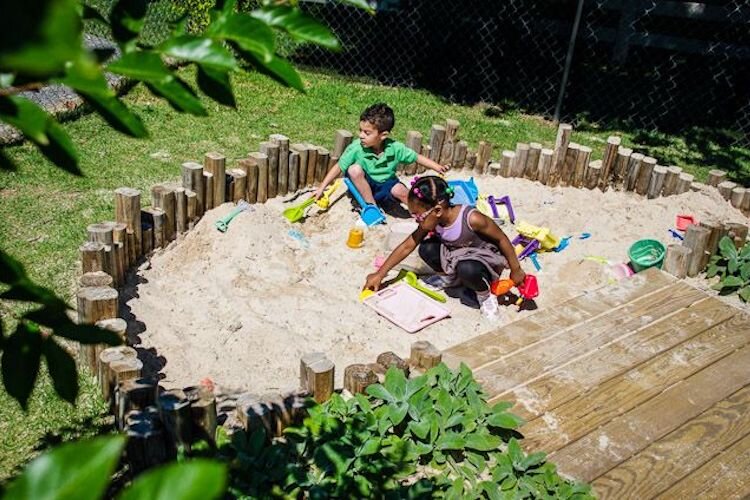
Children will be able to dig in sand.“In the midst of the COVID and racial pandemics that are plaguing our country,” Roberts says, “play is a healthy way to address mental health as it lends itself as an outlet to reduce stress and anxiety.”
Ming Li, Dean of Western Michigan University’s College of Education and Human Development, says the new nature playscape serves as a place to “encourage children and their parents to connect with nature, exercise their right to play, and practice discovery-based learning in the heart of the city.”
The project began in 2019 when the First Congregational Church funded the purchase of the property and necessary site preparation. The planning committee had hoped to do some of the site preparation this fall, but delays in scheduling contractors make that unlikely.
“At this point moving soil and concrete paving for features, putting up fencing, and other required improvements will occur when the weather breaks early next spring,” Brylinsky says. Still, behind the scenes materials are now being ordered and contractors scheduled for 2022.
“We hope to avoid any supply chain delays with this proactive action,” she says.
Construction will kick off with a formal groundbreaking, date and time to be announced.
Meanwhile, the area, near downtown Bronson Park, remains an open green space.
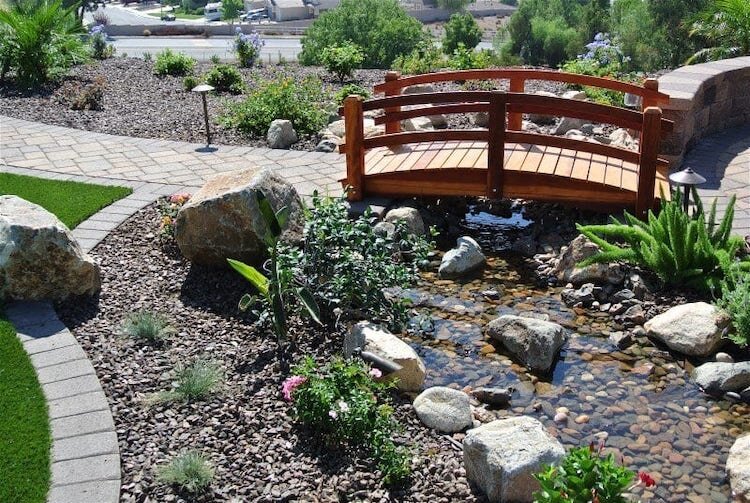
A footbridge is planned as part of the Children’s Nature Playscape.“The turf is still pretty immature and has not been cleared for small children play,” Brylinsky says.
But by next summer that space will be transformed into a safe and accessible space for young children of all backgrounds “to interact freely and creatively with the natural world,” Brylinsky says.
Nature’s playground won’t include the usual array of swings, slides, and jungle gyms. Instead, children will find shallow creeks, boulders, trees, and other nature-inspired features.
The playscape design is barrier free and compliant with the Americans with Disabilities Act. It will include a paved walkway, low-level log benches for children, and artistic benches for adults throughout.
Signs will be designed to meet the needs of families with visual or physical challenges, and as funds become available a small toilet facility will be erected in the northeast corner of the playscape.
The playscape will be bordered by native tall grass, shrubs, and plants to create a sense of neighborhood and home. Much of the transformation will occur next spring with landscape improvements and the installation of age-appropriate play structures, including a pondless water stream and grass turf. Mature trees, shrubs, grasses, perennial plants will take time to develop into the full scope of natural features.
There is a general play space and two play areas geared to children’s ages that contain features such as a preschool log obstacle course, a log climbing structure, a sand play area, and a hollow log tunnel. A sensory garden will be installed as funds become available.
In addition to providing city kids a spot to romp in near Bronson Park, the new playscape can help promote environmental education, from spontaneous play to formal teaching.
The design includes a performance platform to allow for community groups to hold educational programs. With guidance from the Match-E-Be-Nash-She-Wish Band of Potawatomi, the Kalamazoo Nature Center, and other educational, spiritual, and youth-focused community partners, nature-inspired public programming will be provided at no cost.
There is a space for some small, raised garden beds to encourage understanding of food sources.
The playscape will be surrounded by a 6-foot fence approved by the Downtown Design Review Committee of Kalamazoo. Bicycle racks, wheelchair parking areas, and sufficient trash containers will make it easy for patrons to help maintain a clean and healthy environment. There will be a grand entrance on the southeast corner of the property welcoming everyone into the Playscape.
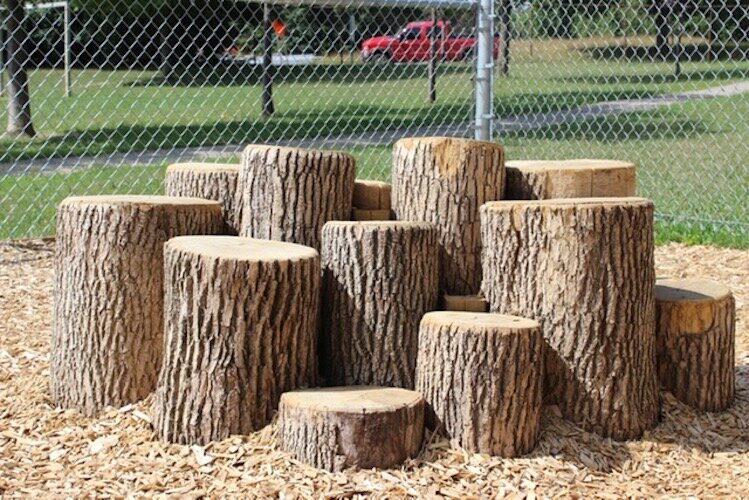
Instead of swings and slides children will be able to climg on stumps at the Children’s Nature Playscape.Ideas for the space were developed with community input by a team led by Sandy Bliesener, Rachel Hughes-Nilsson, and Deborah Dawe. Tricia Keala from Safer Outdoors, part of the OCBA Design Team, has helped create a park with as inherently natural a setting as possible.
Fundraising continues to secure support from local foundations, philanthropic organizations, and community members.
To find out how to volunteer, make an in-kind donation of materials, or provide a financial donation visit Kalamazooplayscape.org.
“Our landscape architect is stockpiling material,” Brylinsky says, “and we hope to launch an in-kind donation campaign where local nurseries and green industries can contribute to the ‘greening’ of the playscape.”
What’s next?
The Children’s Nature Playscape will be participating in the nationwide philanthropy campaign called #GivingTuesday, Nov. 30, with a goal of raising $10,000 is to provide specific funding for the All-Ages Sensory Garden in the new Children’s Nature Playscape.
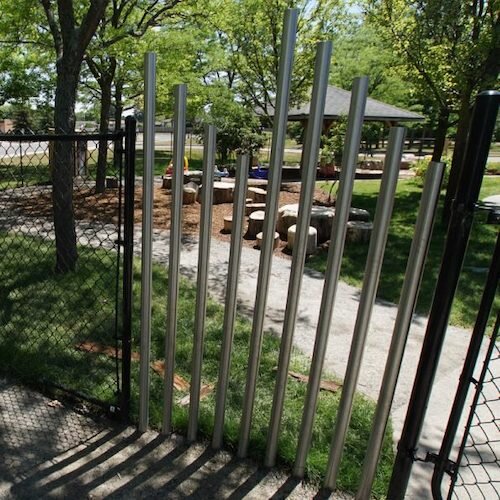
The All-Ages Sensory Garden will feature special fencing that children enter through a secret gate. The garden’s surfaces, objects, and plants will stimulate the senses through touch, sight, scent, and hearing. Visually challenged children will get a feel of trees and shrubs identified by markers written in Braille and English. Priority will be given to plants, shrubs, and grasses that are native to West Michigan, especially those with cultural significance to the Match-E-Be-Nash-She-Wish Band of Pottawatomi Indians.
Go to KalamazooPlayscape.org to participate in Giving Tuesday or to support the playscape.
About Children’s Nature Playscape
The Children’s Nature Playscape is a project of the First Congregational Church of Kalamazoo, Michigan, which is a 501(c)(3) nonprofit organization. All gifts and contributions are tax-deductible to the extent allowed by law. The Children’s Nature Playscape does not sell or rent its donor list to any organizations or mailing houses. The Children’s Nature Playscape Steering Committee oversees the development and operations of the Children’s Nature Playscape. Steering Committee members represent leading community partners, including the First Baptist Church, Kalamazoo Nature Center, Western Michigan University, Kalamazoo Valley Community College, and numerous community youth/service organizations
Text description provided by the architects. Located in the centuries-old whaling village of Sag Harbor, NY, Harbor Hideaway is a single-family two-story residence. The property is situated in the center of a small peninsula and is one of the only lots in the neighborhood without direct water views. Although the instinct would be to design a new house to face the street, The Up Studio flipped the traditional orientation of the home to face the rear corner of the yard. This design decision created privacy from the street corner, immersed the family in greenery, and reclaimed previously obstructed water views, Heal Me Healthy.
The home was nearing completion in 2020 as New York experienced a major shift towards remote work, which made many seasonal neighborhoods like these more desirable for full-time residents seeking relief from congested city life. Although the homeowners initially hired The Up Studio to design a custom home specifically for their family, the increase in demand from homebuyers in the area led them to list the house prior to moving in.
Plan – Ground floor
Plan – First floor
Section
The home was quickly sold just after completion and both the new owners and the original family have continued to work with The Up Studio. The entire home utilizes a simple material palette of blackened steel, light hardwood, and neutral colors. These material and fixture selections provide a subtle sophistication and allow the property’s surrounding natural elements to organically provide a pop of color. At entry, the custom wood stair design connects the three interior levels of the home with a single gesture and provides a sense of openness that makes the home’s modest footprint feel much larger.
The home’s rhythmic, black cedar facade wraps the entire home to naturally shade the south-facing bedrooms from the high summer sun and becomes a visual connection between the home and the carport, creating a covered entry in its path. The first-floor facade was designed to act as a subtle privacy screen from the street, while the rear of the home is fully glazed on both levels with custom Marvin Modern windows to create a strong connection between the home’s interiors, the property’s natural landscape, and the spectacular views of the nearby harbors.