YNACIO Releases Two New Art Pieces

HARDIN, Mont., Dec. 9, 2021 /PRNewswire/ — Ynacio, an artist from eastern Montana, gives us a rare glimpse into his soul as he explains the journey that led him here and the inspiration for his unique artwork. He says, “As I begin to paint I’m looking at the kitchen counter of my double-wide trailer asking God, what are you sending me tonight? As I paint, I’m pursuing what God put into me. I put Him first in my life and everything I do, my gift comes from Him and Him alone. I’m self-taught, I’ve never taken an art lesson in my life.”
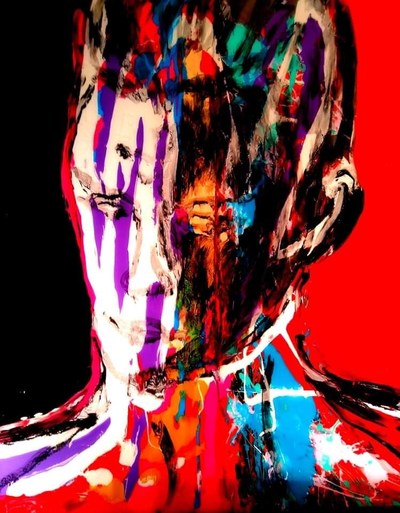
“I was homeless for years,” he goes on, “eating free bread or nothing, living with no heat or water, in an abandoned building at -40 degrees, and today I’m a homeowner. I was an alcoholic, drinking until I blacked out, but I’m clean and sober today. Now I help other recovering alcoholics to fight their demons. I was sexually abused for years as a child by evil men who were supposed “men of faith”. All of this about destroyed me, but the human will to live and God kept me alive.

Today I talk with people about what I went through and I believe it helps them. Why? Because I truly understand their situations. I hope others can find the same healing and peace I have through God and my artwork.

When you look at these two pieces or my other work online, remember what you see is being finger painted in the dark, by a 50-year-old guy who’s gone through hell and back, praising almighty God because He’s in control.”

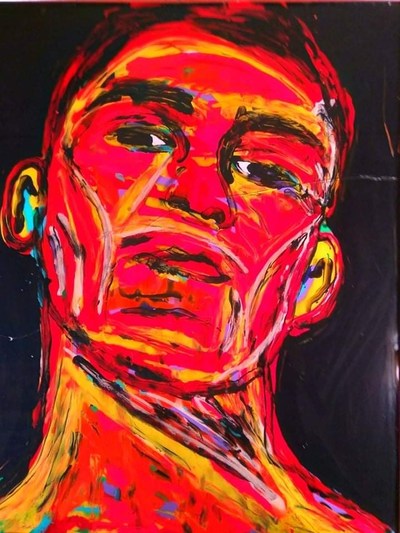
Displayed here are two of his pieces with descriptions given in his own words:

“His whole life, Broken has been told he would never be anything and he’s accepted it. Although he was created by a God who gave him so much potential he listens to the voices in his head and that’s what broke him. Broken is like many of us; he believes it’s easier to fade away than to fight. He is absolutely worth fighting for but he doesn’t see it in himself. Look into his eyes. Feel his pain. Let him speak to you. But don’t become him. I love Broken and I know the world will love him, he just doesn’t love himself.”

“When this piece came to life he didn’t say anything. He just walked out of the darkness as you see him. I poured my soul into this piece and felt nothing in return. Some pieces speak and some pieces just remain still and I feel nothing. “Man” was that piece. Look at Man and take what you want, or give to him what you choose. But honestly, he doesn’t care either way, he’s just Man.”

To learn more about the artist, view a wider variety of his work, or speak with a sales representative please join us on social media pages or visit our website.

Instagram: ynacioart

Facebook: ynacio

Website: Ynacio.com

Media Contact:
Devin Foy
801-404-4721
[email protected]

SOURCE YNACIO

Newton artists sell their wares at New Art Shop

The New Art Shop launched a three-weekend pop-up shop at the end of November selling the various wares of 45 local artists, with more than half of the artists from Newton and the rest from the Boston area. Emily O’Neil, executive director of the New Art Center, said her goal is to turn the space into a cooperative-style shop for local artists to sell their pieces while simultaneously running the shop themselves.

Currently, the artists earn a minimum of 65 percent of the profit from the sales of their work, O’Neil said, and if the shop fully becomes a co-op, the artists running the shop will also earn an hourly wage. The works sold in the shop vary from homemade candles and soaps to ceramics and wall art to books written by local authors.

“Our hope is at the culmination of our nine shopping days, we will have enough evidence to prove that there’s enough community interest to support a retail endeavor,” O’Neil said.

The New Art Center, a Newton-based nonprofit art education space, currently supports the volunteer-run shop. If the shop were to become a more permanent co-op endeavor, it would be run entirely by the artists, more independently from the Center, according to O’Neil and Kim Spencer, who founded the initiative together.

“Sales have been brisk,” Weinberg said, as 27 of her 39 pieces in the shop had already sold, and she was asked to bring in more.

Over the six days the shop has been open, sales have been “robust” and “above initial projection,” Spencer said. There have been an average of 30 transactions per day, she said, and the New Art Shop anticipates the overall gross sales for the nine sale days will be close to $20,000.

Sayaka Rawizza, a ceramic artist and instructor at the New Art Center, said the shop was “important to support the community.”

She said the shop was “an ideal style” for her this year during the pandemic, as it was less crowded and better ventilated in comparison to more traditional art fairs.

Sarah Kahn, a mixed media collage artist and New Art Center instructor, said within the first night, she received a call from the shop that she had already sold four of her pieces and they wanted her to bring in two more.

“I was so excited to think about selling myself to the community,” Kahn said.

Weinberg said it’s more important to her for people to “have my pieces in their home” than the money made from the sales.

“Having a venue for local artists to sell their work is really important to the community,” Weinberg said.

O’Neil said the New Art Shop is the only store in Newton selling work exclusively made by local artists.

“We’re hoping that people will shop locally, support local artists, support the community, and allow us to move this forward as a permanent retail venture,” O’Neil said.

The shop will be open for its last weekend of the season Friday, Dec. 10, through Sunday, Dec. 12. Hours can be found on the website.

Katherine Hapgood can be reached at newtonreport@globe.com.

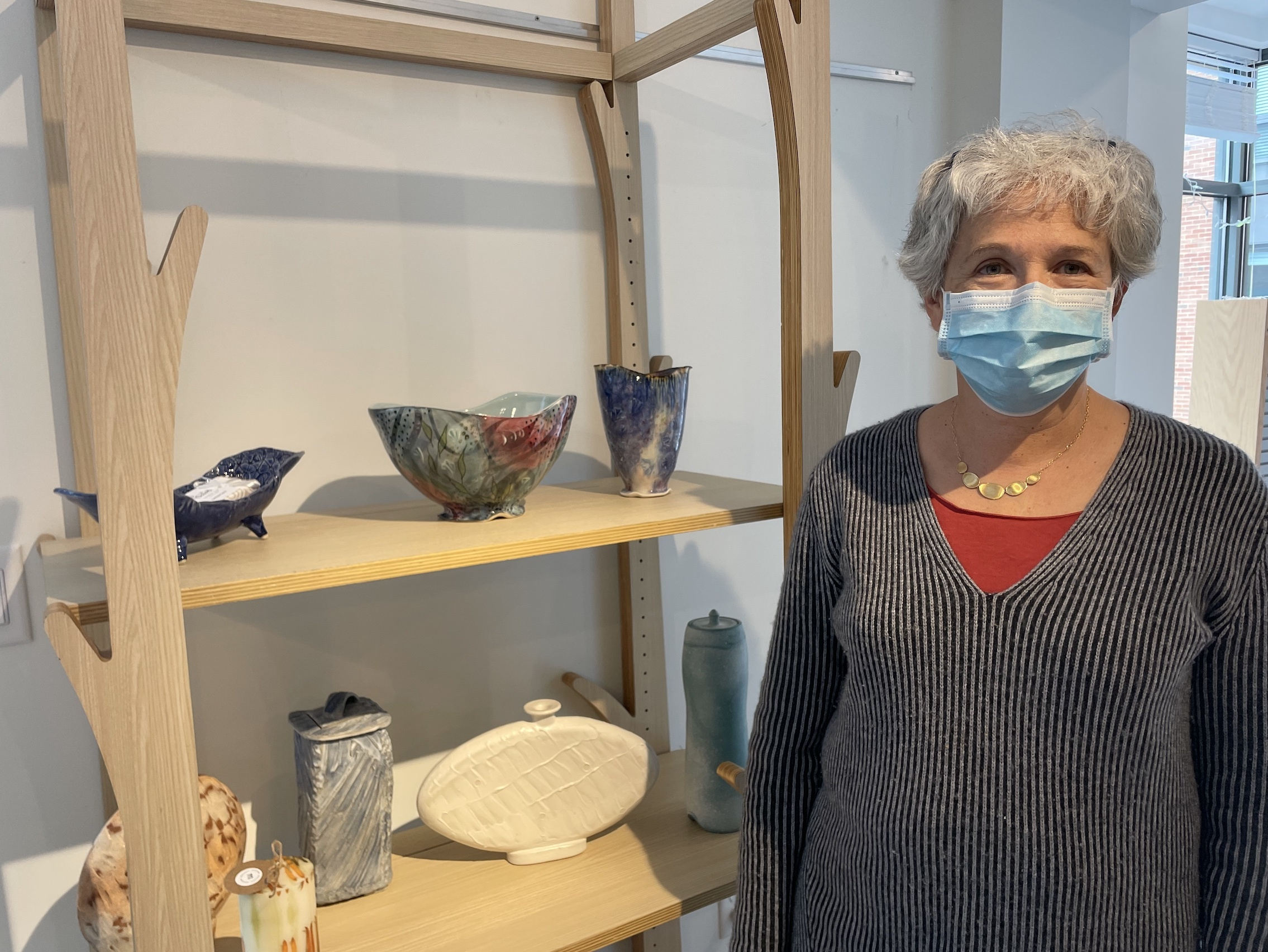
Ellen Weinberg shows her ceramics for sale on the second shelf of a display in the New Art Shop.
Ellen Weinberg shows her ceramics for sale on the second shelf of a display in the New Art Shop.Katherine Hapgood
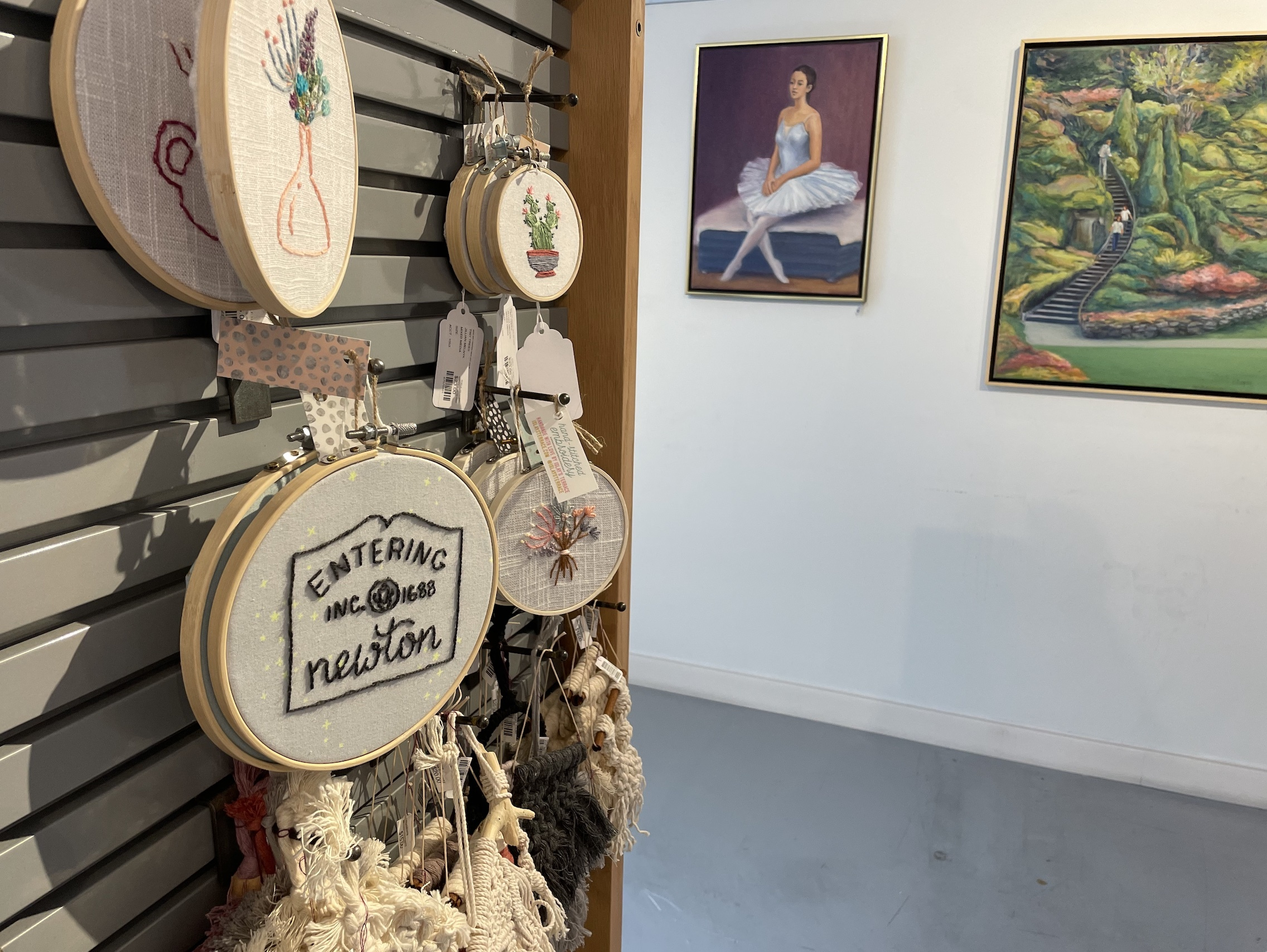
Various wares are available for sale at the New Art Shop.
Various wares are available for sale at the New Art Shop. Katherine Hapgood

A Major New Art Center Has Opened in a Former Moscow Power Plant, But Rising Political Unrest in the Region Is Cooling Excitement

Russian President Vladimir Putin took a tour this week of a century-old power plant, which has just reopened as a contemporary art center after a major, years-long renovation.

The GES-2 House of Culture, the newest home of the V-A-C Foundation, is an ambitious new cultural center set in the heart of Moscow, just opposite Russia’s formidable seat of power. It hopes to become a world-ranking cultural attraction and bring new creative energy to the Russian capital, though it has had to face down a pandemic as well as growing tensions between Russia and the West over Ukraine.

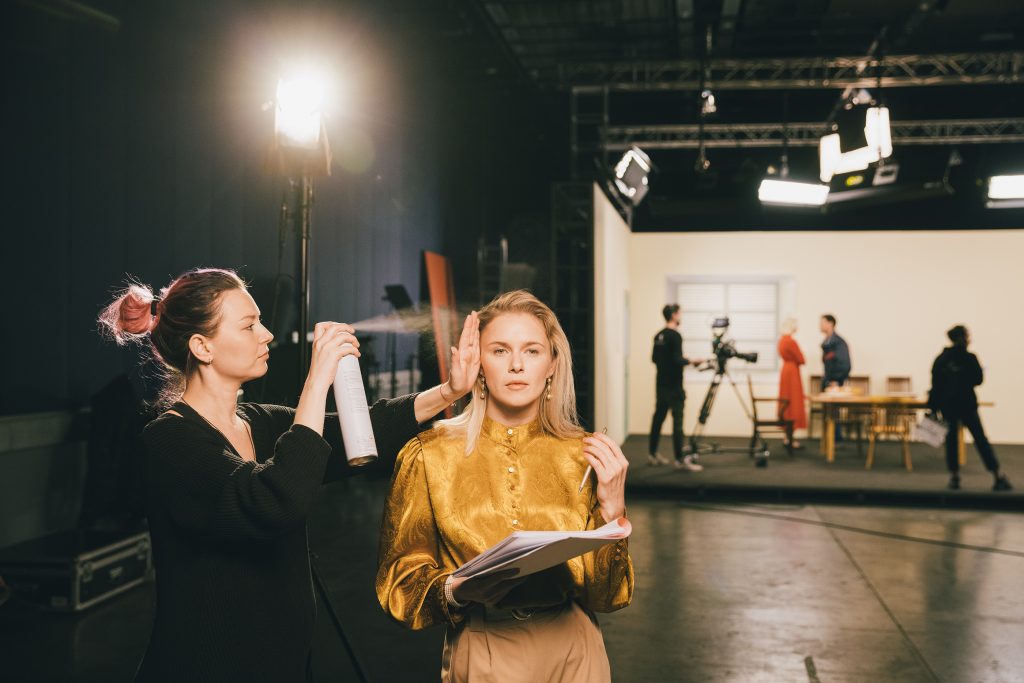
Nevertheless, GES-2 is well on its way to becoming a world-class institution. The museum welcomed international press last weekend to its first exhibition and its ultra-modern new home designed by Renzo Piano, who maintained as much of the early 20th-century structure as possible. Sprawling over a 328-foot-long stretch of the main gallery are its inaugural exhibitions and a new “living sculpture” by Icelandic artist Ragnar Kjartansson, comprised of a live film set with actors and a crew who are working over the next months to reshoot 98 episodes of a popular post-Soviet-era soap opera, Santa Barbara.

Ragnar Kjartansson, Santa Barbara, 2021–22 Durational performance, Directed by Ása Helga Hjörleifsdóttir. Staging and production: Lorem Ipsum Commissioned by V-A-C Foundation, Moscow; Courtesy of the artist, Luhring Augustine, New York and i8 Gallery, Reykjavik/ Based on the series originally created by Bridget and Jerome Dobson ‘SANTA BARBARA’ ©1984 TwentiethCenturyFox Television, all rights reserved.

Ragnar Kjartansson, Santa Barbara (2021–22), durational performance, directed by Ása Helga Hjörleifsdóttir. Staging and production: Lorem Ipsum Commissioned by V-A-C Foundation, Moscow; Courtesy of the artist, Luhring Augustine, New York and i8 Gallery, Reykjavik/ Based on the series originally created by Bridget and Jerome Dobson ‘SANTA BARBARA’ ©1984 TwentiethCenturyFox Television, all rights reserved.

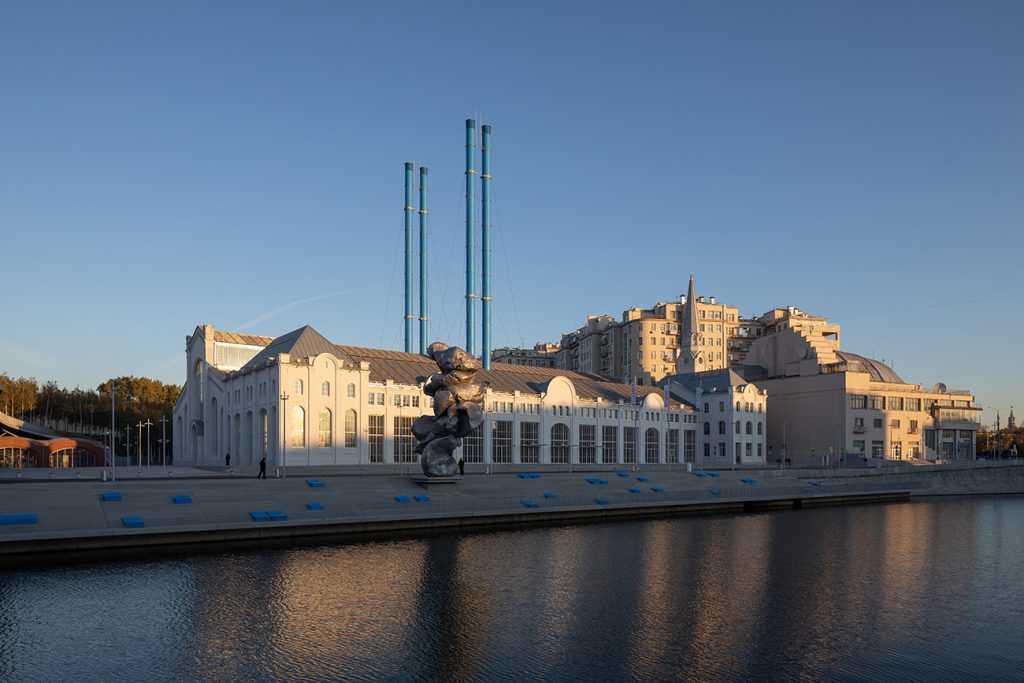
The 440,000-square-foot disused electrical facility has been under renovation for several years to transform it into an airy and futuristic meeting place for art, performance, and culture. The restoration included redoing its roof with large glass panels and windows on all sides, in order to flood the galleries with light, but also to give a sense of openness and accessibility. On the banks beside the river just outside stands Urs Fischers Big Clay No. 4. Inside, there’s an indoor cinema, areas for artist workshops, and a library, as well as large exhibition spaces.

The institution’s new location has been paid for by Leonid Mikhelson, the billionaire behind Russia’s largest private gas group and cofounded V-A-C foundation alongside its director, curator Teresa Iarocci Mavica. The privately-financed project has not disclosed its costs, though it was last stated in 2018 that the GES-2 may cost at least $300 million. No updated figure has been given, though V-A-C Foundation director Mavica told Moscow Times that it was “incredibly expensive.” Entry will be free of charge.

GES-2 House of Culture. Photo: Ivan Erofeev, 2021

GES-2 House of Culture. Photo: Ivan Erofeev, 2021

“Culture is the process of learning about the world around us, the world of other people, the world within oneself. In other words, culture is a means of direct communication between everyone and everyone, in the most diverse forms,” said Mikhelson, the financial backer and founder of the V-A-C, in a statement, calling the GES-2 “a space of cultural communication open to all.”

Kjartansson’s inaugural exhibition, which is called “Santa Barbara – A Living Sculpture” is a performance piece that takes over the main hall of the museum. Each day of the exhibition, the crew will shoot another episode, to be started and completed that day and shot in one take.

In another part of the museum, his artistic partner Ingibjörg Sigurjònsdottír curated a group show called “To Moscow! To Moscow! To Moscow!” which includes artists Roni Horn, Theaster Gates, and Carolee Schneemann. The projects are both part of the first “season” of the museum’s program, which explores a larger story that the GES-2 has set out to explore, called “Holy Barbarians, or Both Are Worse.” This topic hopes to address the complexities of post-Soviet Russia and its relationship to the West.

Ragnar Kjartansson, Santa Barbara, 2021–22 Durational performance, Directed by Ása Helga Hjörleifsdóttir. Staging and production: Lorem Ipsum Commissioned by V-A-C Foundation, Moscow; Courtesy of the artist, Luhring Augustine, New York and i8 Gallery, Reykjavik/ Based on the series originally created by Bridget and Jerome Dobson ‘SANTA BARBARA’ ©1984 TwentiethCenturyFox Television, all rights reserved.

Ragnar Kjartansson, Santa Barbara, 2021–22 Durational performance, Directed by Ása Helga Hjörleifsdóttir. Staging and production: Lorem Ipsum Commissioned by V-A-C Foundation, Moscow; Courtesy of the artist, Luhring Augustine, New York and i8 Gallery, Reykjavik/ Based on the series originally created by Bridget and Jerome Dobson ‘SANTA BARBARA’ ©1984 TwentiethCenturyFox Television, all rights reserved.

And though it sets a jovial tone in some the darkest months of the year, the launch comes as the region is living through its second pandemic winter, but also amid escalating political tensions between Russia and the West. (Nearly 100,000 Russian troops were sent to the Ukrainian border this week, and NATO allies, including the U.S. and the U.K., have threatened Putin that they would retaliate should an invasion take place.)

Some also wonder how much freedom of expression there really will be at GES-2. One gallerist told the Moscow Times that the venue could run into problems given that the Russian government has reportedly said it would like to follow a “Chinese model where they completely freeze any political developments.”

Follow Artnet News on Facebook:


Want to stay ahead of the art world? Subscribe to our newsletter to get the breaking news, eye-opening interviews, and incisive critical takes that drive the conversation forward.

What Is ‘Art Jewelry’? Look at the Term Again.

Emily Waterfall, the head of Bonhams’s jewelry department in Los Angeles, knew she was dealing with something special in November 2020, when she found herself inside a private storage facility surrounded by thousands of pieces of jewelry owned by Byron and Jill Crawford, a local couple who had devoted 40 years to collecting.

“The first piece I opened was the Picasso Grand Faune,” Ms. Waterfall said.

Like his fellow artists Alexander Calder, Salvador Dalí and Man Ray, Pablo Picasso dabbled in jewelry. To make the Grand Faune pendant, Picasso worked with the goldsmith François Hugo, who immortalized the impish-looking face of the half human, half goat creature in 23-karat gold. The men made 20 pieces, one of which (No. 7) belonged to the Crawfords.

In mid-October, that pendant sold for $62,813 in “Wearable Art: Jewels From the Crawford Collection,” a noteworthy Bonhams sale that featured 314 lots of jewelry by some of the 20th century’s most important makers — including the modernists Art Smith and Margaret De Patta, the Hopi jeweler Charles Loloma and the American-born, Mexico-based silver jeweler William Spratling. Totaling $1.7 million, the sale was the first single-owner collection of artist jewelry ever presented at auction. Bonhams already is planning a second art jewelry sale for next fall.

“I was beyond flabbergasted by the response,” Ms. Waterfall said. “But we’re just at the beginning.”

Ms. Waterfall was referring to a growing segment of the jewelry market — sometimes called “art jewelry” — focused on one-of-a-kind pieces that often, but not always, employ non-precious materials to convey meaning.

The category dates from at least the turn of the 20th century, when the Art Nouveau master René Lalique challenged traditional notions of preciousness by incorporating glass and horn into his creations. In recent years, a wave of interest among museum curators, collectors and gallerists, not to mention a growing secondary market, has cast a spotlight on this esoteric niche.

Sienna Patti, the founder of a namesake contemporary jewelry gallery in Lenox, Mass., explained the momentum behind art jewelry partly as a collective search for authenticity. “Younger generations want something that feels real,” she said. “Buying something mass produced feels less appealing.”

Lately, that interest has been stoked by arbiters of culture, such as the producers of “Craft in America,” a PBS series whose new episode on jewelry began streaming on Nov. 4, and institutions such as the Cincinnati Art Museum, where an exhibition titled “Simply Brilliant: Artist-Jewelers of the 1960s and 1970s” is on view through Feb. 6.

The easiest way for art lovers to understand the category may be through pieces like the Grand Faune, a classic example of how fine artists “use different media to express themselves,” said Louisa Guinness, whose gallery in London represents, as she described it, “painters and sculptors who made forays into jewelry,” including 20th-century artists such as Picasso, Calder and Max Ernst and contemporary makers such as Anish Kapoor, Antony Gormley and Ed Ruscha.

“Calder is the ‘get’ in this world,” Ms. Guinness said. She singled out the American sculptor as the rare artist who made his own jewels, rather than outsourcing the manufacturing to a workshop.

“He constantly had a pair of pliers in his pocket,” she said. “You’d go to stay in his house and he’d attack the silverware drawer and would have a beautiful brooch waiting for you with his initials. He made 1,800 pieces out of mostly silver or brass, all very well archived by his foundation.”

Ms. Guinness said when she opened her gallery in 2003, she made a conscious decision to focus on fine artists who had crossed over, however briefly, into jewelry. “I wanted to be known for one thing,” she said.

“Having said that, I am now, nearly 20 years on, moving over a little bit,” she added. “I do a show at Christmas every year where I do select jewelers who are artists, not artists who are jewelers. But I will only buy or represent people who make one-off or limited editions.”

Ms. Guinness is not the only one with a newfound openness to the notion of jewelers as artists.

“Museums are just waking up to the artistry involved in jewelry making,” said Cynthia Amnéus, chief curator and the curator of fashion, arts and textiles at the Cincinnati Art Museum.

Take the 120 or so pieces on display in the museum’s “Simply Brilliant” exhibition, which is based on a collection of 1960s and 1970s jewelry owned by Kimberly Klosterman, a Cincinnati native who said she discovered her love for the era’s independent jewelers — including Andrew Grima, Gilbert Albert, Arthur King, Jean Vendome and Barbara Anton — when she took a Sotheby’s jewelry course in London in the mid-1990s.

“Looking for jewelry by artist-jewelers, at that time, was not so easy,” Ms. Klosterman recalled. “Art fairs were not showing it at all. I would find the odd pieces and buy them out of what some dealers called their ‘big and ugly boxes.’ I tried to rescue pieces before they were scrapped.”

Even though the jewelers Ms. Klosterman gravitated toward did enjoy commercial and critical success in their day (Grima, for one, was a favorite of Princess Margaret’s), their use of traditional materials such as gold was secondary to their artistic visions. They often sought to evoke nature by texturing their metal and eschewing diamonds in favor of unusual, occasionally raw gem materials.

“When you read interviews with these artists, they talk about themselves first as artists, second as jewelers,” Ms. Amnéus said.

To hear Melanie C. Grant, the London-based editor, stylist and author of Coveted: Art and Innovation in High Jewelry,” tell it, the gulf that has historically separated the two worlds is narrowing.

“In the 2020s, you have a combination of exceptional jewelry artists working in interesting materials,” Ms. Grant said. “That has culminated in a moment where galleries and collectors, the life force of fine art, are actually entertaining this as fine art.”

She referred to some of the market’s most desired and collectible jewelers, including Joel Arthur Rosenthal, a.k.a. JAR, an American based in Paris who initially “did stuff with color and scale and texture that changed what was possible for many designers,” she said.

The New York jeweler James Taffin de Givenchy; the Hong Kong-based lapidary and jeweler Wallace Chan; the family-owned brand Hemmerle in Munich; and Jacqueline Rabun, “a modern minimalist based in L.A.,” also topped Ms. Grant’s list.

At the opposite end of the spectrum are contemporary studio jewelers who, unlike the high jewelers cited above, use found objects and banal materials to tell stories about themselves and the world around them.

“They’ll use wood or shells or lots of things that have no intrinsic value,” said Susan Cummins, founder and board chair of the nonprofit Art Jewelry Forum and co-author of the 2020 book “In Flux: American Jewelry and the Counterculture.” “The value of the piece comes from their ideas or their skills in making it.”

She named a handful of critically acclaimed artists whose work she admires, including Gijs Bakker from the Netherlands; Joyce Scott, a 2016 MacArthur Fellow based in Baltimore; and Dorothea Prühl, a talented wood carver from Germany, known for her dramatic, nature-inspired necklaces.

Many experts in the category also cited Lola Brooks of Atlanta, whose work occupies both the precious and conceptual worlds. “She’s playing on the saccharine quality of jewelry, nostalgia and sentimentality,” Ms. Patti said. “Her work can be very oversized or really small, and often has humor in it, but she’s using traditional skills.”

The unifying thread among all of these disparate studio jewelers is their desire to imbue their work with meaning, often resulting in bold statement jewels that disregard traditional aesthetic ideals and, sometimes, even the basics of wearability.

Their jewels have “political and sociological content — they deal with issues of gender, race and sex,” said Toni Greenbaum, a New York-based art historian and author of “Messengers of Modernism: American Studio Jewelry 1940-1960.” “Their jewelry has meaning beyond its use as an accessory.”

It should come as no surprise that the customers for such pieces are not typical jewelry buyers.

“My clients are not interested in fashion or trends,” said Lisa M. Berman, a contemporary art jewelry advocate and gallerist based in Laguna Beach, Calif., whose Sculpture to Wear by-appointment showroom stages pop-ups and events around Southern California. “They are well heeled, well traveled, and they are interested in conveying a nonverbal message with a piece of jewelry.”

Compared with traditional fine jewelry, art jewels are considerably less expensive. “You could buy a really good piece of art jewelry for under $5,000,” Ms. Cummins said. “And you can buy a lot of the greatest jewelers in this field for $20,000 to $25,000.”

To gain familiarity with the category, experts advise newcomers to read books, visit the Art Jewelry Forum website and follow artists on Instagram. They also advise attending art and design fairs such as Salon Art + Design in New York; the European Fine Art Fair, better known as TEFAF, in Maastricht, the Netherlands, and New York; and Design Miami.

For a hands-on education, however, nothing rivals seeing the work in person. In the United States, Ornamentum in Hudson, N.Y., and Ms. Patti’s Massachusetts gallery are highly regarded. So are Atta Gallery in Bangkok and, in New Zealand, Fingers and The National.

In Europe, Galerie Marzee in the Dutch city of Nijmegen, about a 90-minute drive southeast of Amsterdam, is widely considered to be the finest showcase of contemporary art jewelry in the world. Founded in 1979 by Marie-José van den Hout, the gallery is spread across four floors, including one dedicated to Ms. van den Hout’s personal collection of about 2,000 pieces.

“It’s not commercial and you can hardly make a living with this sort of jewelry,” Ms. van den Hout said. “Sometimes people say, ‘Why don’t you sell easier jewelry?’ But for me, this is not so interesting.”

Sylvester Stallone Gets New Art Exhibit in Germany

Sylvester Stallone is a man of many talents. Writer, actor, producer, and even … artist? That’s right, the KO king himself turns out to be a talented painter and, according to The Hollywood Reporter, will be showing several of his paintings in the German city of Hagen at the Osthaus Museum Hagen.

The Rambo and Rocky star’s exhibition, titled Sylvester Stallone: The Magic of Being, will debut this Saturday, December 4, 2021 through February 20, 2022. The multitalented star said, “You know, maybe I should have been a painter. It sure would have meant a lot less stress” after arriving at the museum to unveil the exhibition’s first look.

“It’s an amazing honor to have my work hanging here, next to some of the greatest artists in the world. This gallery world is still a very new world for me,” Stallone added. And while this exhibit will mark the iconic actor’s largest showing of paintings from the late 1960s until present, his spot at the Osthaus Museum Hagen isn’t his first. In 2013, Stallone had an exhibition at St. Petersburg’s State Russian Museum and then again in 2015 at Musée d’Art Moderne et d’Art Contemporain located in Nice, France.


stallone-painting-Hercules-o-clock-publicity-H-2021
Image via Osthaus Museum Hagen

RELATED: Sylvester Stallone Shows Off ‘Guardians of the Galaxy Vol. 3’ Costume in Set Image

For those that wonder what would move a museum to give an actor their own exhibition, Mathias Rastorfer, an art dealer who calls the Gmurzynska Gallery in St. Moritz home and who was one of the people to organize the Hagen exhibit said, “Is [celebrity art] about the art or about the celebrity? I remember people asking the same question when we first showed Karl Lagerfeld’s art. Now every art museum in the world wants to show Largerfeld’s work,” Rastorfer explains before adding, “It will be the same with Stallone.”

Drawn to the work of artists, such as Jackson Pollack and Willem de Kooning, Stallone picked up a paintbrush at a young age. The master painters can be seen in much of Stallone’s work which he mentions selling “for $5 to get bus fare” after finishing each one with a signature of “Mike Stallone”. Upset by his initial attempt to become a famed artist and join his heroes, Pollack and de Kooning, Stallone went full steam ahead into his passion for writing and acting. His past characters and roles make appearances in some of his artwork as well. Many have nods to Rambo and Rocky as Stallone uses his paint brush to reflect on what the characters mean to him and his giant fan following.

COLLIDER VIDEO OF THE DAY

For those panicking that their favorite actor will ditch the screen for the canvas, they have no need to worry. Stallone recently wrapped filming for the newest installment of The Expendables franchise and, a few weeks ago, shared an Instagram post confirming that he would be reprising his role as Stakar Ogord in the upcoming, Guardians of the Galaxy Vol. 3.


syllvester-stallone-rocky 4 interview social
Sylvester Stallone on His New Cut of ‘Rocky IV’ and the Other Films He’d Love to Re-Edit

He also reveals who wins in a fight between Rocky in his prime and King Shark.

Read Next


About The Author

Ansel Elgort and Offset Party During Art Basel

A hazy concert by Offset. A Gen Z model blew out birthday candles. A book signing at Gucci. The tropical bacchanal of art fairs, private dinners and A-list parties known as Art Basel Miami Beach has returned with a vengeance. Here are some highlights from Wednesday night.

There was a long line at the Gucci store in Miami’s Design District, but this time it was for a book. Mickalene Thomas and her partner Racquel Chevremont were signing copies of their new art book, “Monograph.” Less bookish fans posed in front of neon lights and disco balls for the perfect selfie.

Occasion: A book signing and cocktail party for Ms. Thomas.

The Room: Upstairs from Gucci’s shiny store, with images of Ms. Thomas’s work displayed on giant screens.

In Attendance: Ms. Thomas; Ms. Chevremont; Michael Chow, the restaurateur, and his wife, Vanessa Rano; Tourmaline, an activist; and models including Selah Marley.

The Food: Nina Compton, a chef from New Orleans, served hot fried chicken, tuna tartare and jerked tofu.

The Mood: “I’m really excited to see the work at the Untitled Art Fair tomorrow,” Ms. Thomas said. “They do a beautiful job of displaying the work, and it doesn’t look like you’re going through a mall.”

Jordan Barrett, a model once labeled, by Vogue, an “It Boy,” said he has never had a proper birthday party before. So he invited 40 of his closest friends at Art Basel to help him celebrate.

Occasion: Mr. Barrett turned 25. He was also promoting his sparkling sake brand, Hape.

The Room: Gitano Miami, the South Beach outpost of the clubby Mexican restaurant in Tulum.

The Food: Small shared plates like queso with chorizo, guacamole and branzino with kiwi.

In Attendance: Mr. Barrett; his partner Fernando Augusto Casablancas; Ricky Thompson, an actor; Chloe Wise, an artist; Candice Swanepoel, a model; and the musician Duckwrth.

Moment of the Night: Around 11 p.m., Mr. Barrett blew out the candles on two large cakes, one that resembled his sparkling sake can.

The Mood: “The moment I leave here I really want to get away from as many people as I can and be alone for a moment,” Mr. Barrett said of his holiday plans. “I want to be in the jungle and in nature, so hopefully I can go to the waterfall in Las Palmas.”

The mezcal was flowing, and the dance floor was wet with spilled drinks. After midnight, partygoers squeezed themselves into a basement lounge for a late-night performance by Offset.

Occasion: Flaunt, a fashion magazine from Los Angeles, celebrated its latest issue.

The Room: The downstairs lounge at Gale, a South Beach hotel, decorated with tropical wallpaper.

In Attendance: The hip-hop musicians Offset and Quavo; Michele Lamy, the fashion designer; the actor Ansel Elgort; Shaun Ross, a model and musician; and Cuba Gooding Jr., the actor.

Moment of the Night: After some technical glitches, during which Offset requested a few shots of tequila to fill the awkward silence, he performed two songs including “Bad and Boujee,” around 1:30 a.m.

The Mood: “I was signing books that featured me. I’m also doing a few things with Offset, but mainly I am here in Miami for Virgil,” Ms. Lamy said, referring to Virgil Abloh, who died last week. A Louis Vuitton show on Monday became an impromptu tribute. “The show was absolutely great, it was the best thing we ever saw of him. It’s difficult, but it brought people together. On Monday I’m going to Chicago for the funeral.”