
New interactive art installations light up South Lake Union
The light art will be here until Dec. 31. Sponsored by South Lake Union Chamber of Commerce.
SEATTLE — Holiday lights are common this time of year — but a new art installation in Seattle’s South Lake Union neighborhood is taking lights to the next level.
“One of the goals was to bring to Seattle installations that would occupy and activate the public spaces,” said Alexandre Lemieux, co-founder of Creos who brought the art installations to Seattle. “So, it was to find something very unique, interactive that would generate very unique interest,”
One of those displays generating interest is called Passage.
“The installations itself, you have sensors on the side of you, and when you’re walking you trigger the installation itself. So, it’s a very beautiful, luminous installation where interactively every user has a part in it, and you can see different patterns whenever you go.”
A few blocks away you’ll find two more displays to interact with.
“Prismatica, I would say that it’s one of the pieces that we traveled the most,” said Lemieux. “You have those 25 units at Prismatica. So just in terms of quantity, you have all of them that you can go and have them for a spin. It kind of invites you to whenever you’re on your working hours or go during the day, but at night, you want to come back with your friends and family. It kind of gives you this ability to kind of see something different whenever you go by.”
At the display Oscillation, you can see as well as hear the art.
“You can trigger sensors with your hands. Each of the units becomes a musical instrument that whenever you activate them, and it’s free, you can have your very own experience with them and the unit themselves.”
The light piece Impulse can be found by the Amazon Spheres.
“This installation, it’s really about bringing the nostalgia in, thinking about when you’re a little younger, you’re going to the park. But then with this unique vision of the artist, you have something that is really beautiful. That’s where you can play, you can go on to seesaw. For a moment of time, you want to go for a laugh, you just forget all problems and anything that you had during your day and you’re just you become a child for a few minutes.”
So while holiday lights are nice, in South Lake Union, they’re even better after dark.
“You want to come in and enjoy your neighborhood in a way that you’ve never experienced it before.”
SLU After Dark will be in place till December 31.
Thompson Savannah features new art installation, curated by local gallerist Susan Laney | Visual Arts | Savannah News, Events, Restaurants, Music
Thompson Savannah is featuring a new art installation with hopes of connecting both locals and tourists to art and culture in the Hostess City.
The new installation is a part of the Thompson brand’s “Culture Lives Here” campaign.
The hotel has partnered with local gallerist Susan Laney, owner of Laney Contemporary, to bring 40-50 pieces of work by Atlanta-based Benjamin Jones to its lobby.
Jones’ featured works include sculptures of rabbits made from multicolor pins and pom poms, a display of hundreds of toy animals from Jones’ childhood, drawings and more. Laney Contemporary says Jones has been creating art for over 25 years that shows his “innermost feelings and insecurities, while touching a familiar place in all of us.”
Matt Graham, General Manager of the Thompson Savannah, says the point of the “Culture Lives Here” campaign is not to feature Savannah-themed art in the hotel’s lobby, but to celebrate work found in local galleries or by local artists that will be attractive to Savannahians. He says when locals enjoy a hotel in town, it creates a better experience for tourists and ultimately benefits the entire community.
“The best way to make a hotel great for visitors to Savannah is to make it relevant to locals in Savannah,” Graham said. “If we can position this hotel as having some relevance to what we find interesting, whether it’s established or up-and-coming, here, it lends a value to the community that guests feel when they visit.”
“If you come to the bar in the evening as a visitor, and the person to your left or to your right is someone from Savannah, it opens up the experience of visiting Savannah in a different way and connects you a little more to what’s happening in our town than a hotel may normally be able to do,” Graham added.
Graham says finding art, both established and up-and-coming, to feature in the hotel was a fun task.
“Savannah punches over its weight culturally,” he said. “I think there’s our history, the influence of SCAD, the people who choose to make this place their home. It’s not difficult to find things to celebrate. There’s a lot of things going on when you just go for a walk around town.”
Ultimately, Thompson Savannah landed on Laney Contemporary to put together the first “Culture Lives Here” installation.
“Susan graduated from SCAD and has been in town most of the time since then,” Graham said. “I think she has a good eye and she’s a really fantastic person.”
Laney has also put together a list of local “hot spots” for visitors of the hotel to check out. Graham says he’s excited about the idea of visitors looking at art curated by Laney, then being able to go visit her favorite spots around town, feeling even more connected to the community.
“I hope they feel that they chose a hotel for their visit to town that allowed them to connect to Savannah in a more meaningful way,” he said. “I hope that they feel the same love and connection to the arts that we all feel here and that they come away with the idea that culture matters in this town. If our hotel can be a small part of that just by celebrating others, then I feel like we’re on the right track.”
Jones’ work will be on display at Thompson Savannah, located at 201 Port St., through January, and then a new installation will go in.
You can follow Thompson Savannah on Instagram at @thompsonsavannahga and learn more about Laney Contempory at laneycontemporary.com
New art exhibit installed in First United Methodist Church gallery | News
How Can Arts Organizations Reduce Their Carbon Footprint? Here Are 6 Takeaways From a New Art-World Climate Conference
Is the art world going to save the warming planet? Yes, according to novelist and poet Ben Okri, for art deals with vision, which is needed to paint the picture of a sustainable future amid the urgent calls for change. “Don’t talk yourselves down,” he told the art-world audience members at the Gallery Climate Coalition (GCC) conference “Decarbonising the Art World” at London’s Barbican Centre on November 24.
Okri’s words were not empty. The GCC, a confederation of some 600 dealers, has set the ambitious goals of reducing the art world’s carbon emissions by 50 percent (from 2018 and 2019 levels) and achieving zero-waste operations by 2030. The conference marked the official launch of the detailed, 43-page Decarbonisation Action Plan, which offers concrete tips and a step-by-step guide to help its members (consisting primarily of art galleries and artists in Europe and the Americas) to transform pledges into action.
The goal is aligned with those set out by the Paris Agreement, and the conference at the Barbican Centre was intended as a follow-up to the recently concluded United Nations Climate Change Conference (COP26) in Glasgow, which lacked discussion of culture on the agenda, said Lucia Pietroiusti, a curator and strategic consultant for ecology at the Serpentine Galleries.
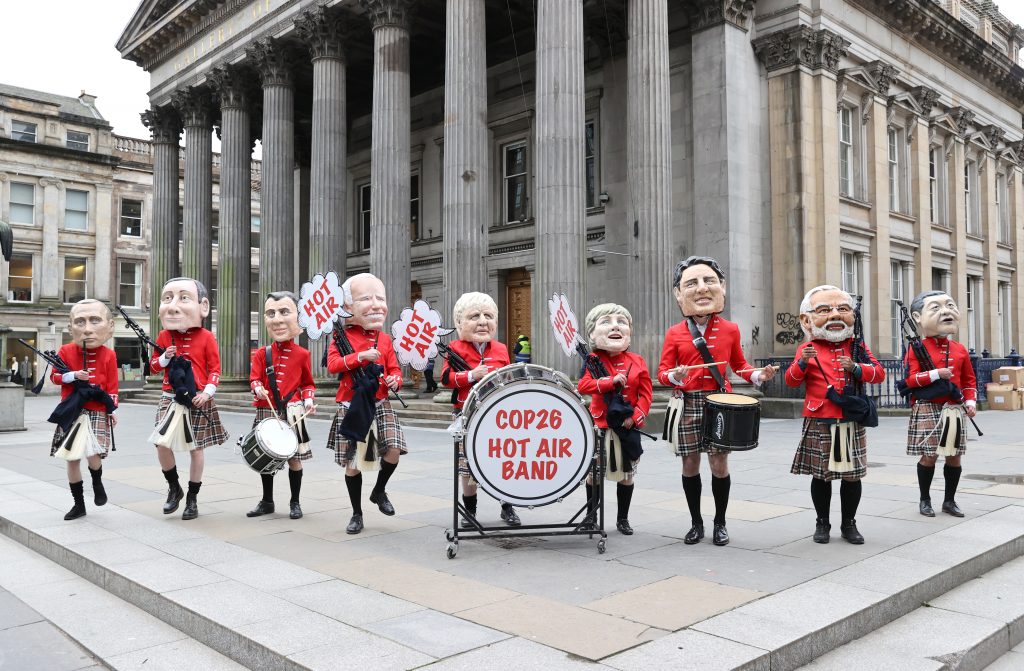
An Oxfam demonstration outside Glasgow’s Gallery of Modern Art on November 1, 2021. Photo: Chris Jackson/Getty Images.
“Compared to five years ago, there’s so much more activism and people are more outspoken,” Danny Chivers, an environmental researcher and advisor who played a key role in drafting the GCC’s Decarbonisation Action Plan, said at the conference. “If you talked about 50 percent [reduction in carbon emissions], people would be like, ‘Oh God!’ but now, people would say, ‘Let’s have that conversation.’ We are in a different space.”
Experts and some art-world leaders believe the goal is achievable—particularly those who have already taken action, following the coalition’s guidelines and plan.
Here are six simple steps proposed by GCC’s Decarbonisation Action Plan for the art world to kickstart reducing carbon emissions:
1. Appoint a ‘Green Team’
The GCC encourages art organizations are encouraged to form an internal group dedicated to making changes to reduce environmental impact. The team should be in charge of setting and reviewing targets, organizing meetings, and drafting a timeline for the organization to implement the action plan.
2. Do a Carbon Audit
“It’s like a tax return,” the London-based dealer Kate MacGarry said at the conference. Reduction goals cannot be set without calculating the baseline emissions in the first place, according to experts. The GCC has developed an online carbon calculator for its members, who are encouraged to do the carbon audit annually.
3. Analyze Data and Make Changes
In MacGarry’s case, emissions from business travels and art transport accounted for nearly 45 percent of the gallery’s total carbon emissions between 2018 and 2019. This year, the dealer decided to go to Art Basel by train. She has also given up bubble wrap and plastic for art packaging.
4. Set Targets for 2025 and 2030
The GCC action plan suggests art organizations divide their reduction goal into several stages. Those aiming to reduce carbon emissions by 50 percent in 2030 can start with a 25-to-30 percent reduction from the baseline by 2025. Those who are aiming for a 70 percent reduction by 2030 can set themselves a higher bar, at a 30-to-40 percent reduction by 2025.
5. Setting a Year-on-Year Milestone
As a follow-up to step four, art organizations can look at their year-on-year annual carbon dioxide allocation, which should show a gradual reduction in carbon emissions every year. It’s almost like setting a financial goal and creating an annual financial budgeting that allows one to achieve this goal within a period of time, says the action plan.
For instance, a 30 percent reduction of carbon emissions by 2025 will require an average of five percent cut per year from 2019 to 2025. Then an art organization can look into the various areas of its operation, from travels to energy consumption and shipping, and decide what actions to take in order to achieve the reduction goal.
6. Action Time
Once you have done your carbon audit and set your goals, now it’s time to take action. The GCC has come up with a list of 50 effective actions to give art organizations ideas for changes to make, from smaller, manageable tasks to ambitious jobs that may require a little more research and planning. These actions are divided into six categories: shipping, travel, energy, packaging and materials, waste and recycling, as well as exhibitions and gallery spaces.
Regarding shipping, for example, the GCC asks its members to prioritize land and sea freight over air. (“Collectors need to be understanding as well, and not hurry the works,” said MacGarry.) The coalition also asks members to reconsider non-essential travel and avoid flying—whenever possible, taking a train rather than a plane. It also recommends hiring local teams to install international exhibitions remotely and avoiding single-use plastics in packaging.
This article was updated on November 26.
Follow Artnet News on Facebook:
Want to stay ahead of the art world? Subscribe to our newsletter to get the breaking news, eye-opening interviews, and incisive critical takes that drive the conversation forward.
After 200 years CT’s Way sisters get their first exhibition
Back in the 1890s when professional women artists were few and far between, the Lyman Allyn Art Museum’s new show highlights how the Way sisters of New London were creating art that was quite unique for its time.
Mary Way (1769–1833) and Elizabeth “Betsy” (Way) Champlain (1771–1825) were among the earliest professional women artists in the United States. Living far from art centers or schools, the two were entirely self-taught. According to “The Magazine Antiques” Elizabeth never signed her works and only one signed piece by Mary is known so while their art was known regionally, it was attributed to unknown artists. Their story and legacy in the art world was largely forgotten until 1992. A scholar researching their work published an article in the magazine that fall and it was the first time the Way name was associated with their artwork in over a century.
The sisters are at last getting their due in the first exhibition about their artwork, “The Way Sisters: Miniaturists of the Early Republic,” on view through Jan. 23 at the Lyman Allyn Art Museum in New London. About 85 artworks from the sisters are on view: a mixture of works from the museum’s own collection and loans from regional museums and private collections, several never publicly displayed.
“I think what makes their work pretty remarkable is that they produced this unique kind of hybrid new form of collaged miniature portraits that were dressed with fabric clothing, which was different from anything that anybody else was doing in that era,” said Dr. Tanya Pohrt, the exhibition’s curator. “They took their schoolgirl training in textile embroidery and sewing and used those skills to create portrait miniatures.”
From the late 1780s until 1811 when Betsy moved to New York City to expand her artistic horizons (Mary stayed in New London painting portraits for another 15 years), the sisters created portraits of friends, relatives and acquaintances, as well as a large sampling of successful business people across southeastern Connecticut. She said many of their sitters were among the “blueblood” elite of Connecticut.
The sisters not only made significant contributions to the art and history of Connecticut at a key time in the nation’s history, but their body of artwork helps shape modern knowledge of early American art, Pohrt explained.
The struggles they faced as artists and their triumphs will come to life through their own words. A collection of letters between the two sisters from the American Antiquarian Society in Worcester, Mass., has been reproduced in a series of audio recordings.
“One thing we have done to make these stories in the letters come alive is that we have a panel where we have voice recordings of actors reading the letters aloud,” Pohrt said.
Pushing the boundaries of miniatures as an art form, the Way sisters merged painting and fabric work to create a new style of art.
“Their really creative use of materials is really striking and being able to see these objects in person, they have a lot of three dimensionality, particularly the dressed miniature portraits,” she said. “There are layers and sometimes the sisters painted little details onto the fabric: buttonholes, little seams and decorative details that are really difficult to see unless you are kind of right up there looking at these pieces with a magnifying glass.”
Audiences at the exhibition will find magnifying glasses available for use in order to inspect the artworks up close to see these details.
The Lyman Allyn Museum is located at 625 Williams Street. For more information, visit www.lymanallyn.org.