Working With Customers for 20 Years to Conserve Urban Biodiversity With the Gohon no ki Indigenous Landscaping Concept

—Opening the Way to Financial Evaluation of Biodiversity with Publication of Nature-Positive Methodology—

OSAKA, Japan, November 30, 2021–(BUSINESS WIRE)–Sekisui House, Ltd. (TOKYO:1928) has been pursuing the conservation of biodiversity since 2001 by creating green networks in urban residential districts under its Gohon no ki (“five trees”) indigenous landscaping concept. Together with the University of the Ryukyus1, the company has analyzed the outcome of the Gohon no ki Project that it has implemented with 1 million customer households2 over the space of 20 years, and has designed the world’s first mechanism for quantitatively evaluating urban biodiversity. It has published this qualitative evaluation mechanism today as a nature-positive methodology for promoting the conservation of biodiversity.

This press release features multimedia. View the full release here: https://www.businesswire.com/news/home/20211130005350/en/

Results of quantitative evaluation analysis (1) – The number of native tree species in each region—the foundation of regional biodiversity—has increased tenfold. (Graphic: Business Wire)

The Gohon no ki Project

Since the 1970s, incessant urban development has dramatically reduced the amount of habitat available for flora and fauna in our cities. Sekisui House launched its Gohon no ki Project in 2001 as an initiative to conserve biodiversity through the eco-friendly landscaping and greening of the gardens of its customers. Based on the concept of planting five locally native trees, three for birds and two for butterflies, the Gohon no ki Project proposes greening gardens and local communities with native tree species suited to the local climate and benevolent to birds, butterflies, and other local fauna. The project takes its lead from garden landscaping modeled on traditional Japanese satoyama (which translates roughly as “village woodland”).

In the 20 years from 2001 up to 2020, more than 17 million trees have been planted under the project. The company has also promoted urban greening throughout Japan by incorporating the Gohon no ki concept into its planning of green spaces in its condominium and community development initiatives.

Quantitative evaluation of biodiversity

Sekisui House has since 2019 been working with the Kubota Laboratory, Faculty of Science, University of the Ryukyus, and Think Nature Inc. to quantitatively evaluate the contribution of this network-type greening to urban biodiversity. Based on the Japan Biodiversity Mapping Project (J-BMP)3 managed and operated by Think Nature Inc., a company established by Professor Yasuhiro Kubota, the partners have analyzed the data on tree number, species, and location accumulated over the 20 years of the Sekisui House Gohon no ki Project to quantitatively evaluate the effectiveness of the project in conserving and restoring biodiversity.

This quantitative evaluation revealed the following benefits for biodiversity from planting native tree species in line with the Gohon no ki Project as opposed to planting conventional horticultural and exotic species in gardens in urban areas where biodiversity has declined significantly (Japan’s three major metropolitan areas).4

  • The number of native tree species in each region—the foundation of regional biodiversity—has increased tenfold.

  • The number of bird species that residential districts can attract has doubled.

  • The number of butterfly species that residential districts can attract has increased fivefold.

  • Biodiversity in the three metropolitan areas has recovered to 30{6d6906d986cb38e604952ede6d65f3d49470e23f1a526661621333fa74363c48} of the level of 1977 for which the first trustworthy biodiversity related data exists.

This is the world’s first mechanism for quantitatively evaluating urban biodiversity and its application to an actual case. The disclosure of numerical data enables biodiversity to be expressed in terms of financial value, thereby providing a means for visualizing private sector contribution to biodiversity.

Nature-positive methodology

In recent years, increasing efforts are being made to conserve biodiversity. In June of this year, the Taskforce on Nature-related Financial Disclosures (TNFD) was launched, and in October, the 15th Conference of the Parties to the Convention on Biological Diversity (COP15) was held. In Japan too, discussion has begun in earnest on other effective area-based conservation measures (OECMs) for enlisting the support of the private sector to drive urban greening.

In this societal context, Sekisui House is making its 20-year biodiversity conservation initiative available to the public as a nature-positive methodology. The Gohon no ki Project’s nature-positive methodology represents a means for expressing urban biodiversity. Sekisui House is making this methodology available to the general public with the aim of raising awareness and enabling its store of knowledge and expertise to be utilized by others to promote greening and contribute to the conservation of biodiversity.

Nature-positive methodology website
https://www.sekisuihouse.co.jp/gohon_sp/method/

Predicted benefits

Based on joint review of available data, Sekisui House and its partners set the number of tree, bird, and butterfly species, diversity index, and number of individual trees, birds, and butterflies in 1977 as 100{6d6906d986cb38e604952ede6d65f3d49470e23f1a526661621333fa74363c48}, and using 2000, the year before the Gohon no ki Project was launched, as the base year, simulated change up to 2070 in Japan’s three largest metropolitan areas (Kanto, Kinki and Chukyo) that have suffered the greatest decline in biodiversity. This simulation indicated that planting native tree species that are likely to benefit local fauna (the Gohon no ki concept) compared to 2000, the year before the launch of the Gohon no ki Project, would enable biodiversity to recover to 37.4{6d6906d986cb38e604952ede6d65f3d49470e23f1a526661621333fa74363c48} of 1977 levels by 2030 (target year for conservation of biodiversity internationally), 40.9{6d6906d986cb38e604952ede6d65f3d49470e23f1a526661621333fa74363c48} by 2050, and 41.9{6d6906d986cb38e604952ede6d65f3d49470e23f1a526661621333fa74363c48} by 2070.

If the Gohon no ki concept of planting native trees were applied to 30{6d6906d986cb38e604952ede6d65f3d49470e23f1a526661621333fa74363c48} of all newly constructed properties in Japan moving forward, urban biodiversity is predicted to rise to 84.6{6d6906d986cb38e604952ede6d65f3d49470e23f1a526661621333fa74363c48} of 1977 levels. Sekisui House believes that this indicates that if the private sector works with the general public, the decline in biodiversity can be reversed to achieve the goal of post-2020 biodiversity recovery that is the theme of COP15, and that its Gohon no ki concept can contribute to this goal.

We’ve received comments of endorsement from the following people. For more details, please refer to the attached document or the original news release via your browser.
https://www.sekisuihouse.co.jp/english/company/release/topics_2021/20211126_en/

  • Mr. Makoto Haraguchi, Fellow, MS & AD InterRisk Research Institute and Sustainability Section SVP for TNFD, MS & AD Insurance Group Holdings

  • Mr. Teppei Dohke, Executive Secretary General of the Japan Committee for the International Union for Conservation of Nature

  • Ms. Mariko Kawaguchi, Specially Appointed Professor, Rikkyo University / Executive Advisor to CEO, Fuji Oil Holdings Inc.

  • Mr. Yasuhiro Kubota, Professor, Faculty of Science, University of the Ryukyus / Representative Director, Think Nature Inc.

1. This is joint research with the Kubota Laboratory, Faculty of Science, University of the Ryukyus.
2. Cumulative number of households built from February 2001 to January 2021 is 1,001,977.
3. Japan Biodiversity Mapping Project (J-BMP) website: https://biodiversity-map.thinknature-japan.com
4. Comparison of continuing to plant conventional garden tree species with planting tree species in line with the Gohon no ki concept over the 20 years from 2001 to 2020

View source version on businesswire.com: https://www.businesswire.com/news/home/20211130005350/en/

Contacts

Media Contact:
Sekisui House, Ltd. Public Relations Office (in actio inc.)
Chie Tagami
sekisuihouse-pr@actioinc.jp
+81-80-7096-5040


Discovering a Secret Wonderland of Architecture in Dallas

Many of the city’s skyscrapers, I learned, were seen as contributions to the postmodern architecture movement. “PoMo,” in the shorthand favored in the architecture world, began to emerge in the 1960s as a reaction to the white-walled minimalism of modernist architecture, epitomized by Mies van der Rohe’s oft-quoted dictum “Less is more.” Early PoMo architects like Charles Moore and Robert Venturi rejected this formula — “Less is a bore,” Venturi famously quipped — and sought to inject color, iconography and kitschy nods to historical ornamentation into their designs. In the Southwest, this tendency bloomed in the 1980s during the savings-and-loan boom.

Unlike modernists, PoMo architects conceived their buildings as dynamic components of urban life, not as exalted geometric abstractions. They wanted to create theatrical set pieces that visitors could navigate experientially, almost like at an amusement park. Moore argued cheekily that the most authentic urban experience available in the American West, where so many cities emerged after the invention of the automobile, was Disneyland, whose eclectic historical references and architectural playfulness encouraged a participatory experience of public space. Were some of the resulting buildings provocative? Certainly. Gaudy? No doubt. When the real estate bubble burst at the end of the 1980s, PoMo buildings were roundly dismissed as tacky and targeted for demolition. Now a new generation of architects is arguing that PoMo spaces are architectural landmarks that deserve re-evaluation.

On my first trip home after joining the magazine, I decided to explore some PoMo sites for myself. I discovered a trove of delightfully eccentric urban environments I had never encountered growing up, a secret map of magnificent lobbies and semipublic piazzas hidden behind the city’s corporate facades. I was thrilled by the battlement-shaped Cityplace Tower that looms beside Central Expressway like a colossal sentinel, its grounds containing a Grecian amphitheater and the city’s only underground subway station. My favorite find was the Plaza of the Americas, a complex known for its 13-story indoor atrium, which was immortalized in the 1987 film “RoboCop.” With capsule elevators zooming up and down, inward-facing concrete balconies from the adjoining hotel, gargantuan glass skylights and access to the “Dallas Pedestrian Network” — a warren of tunnels and sky bridges connecting many of downtown Dallas’s buildings — it makes for a grandiose and strange urban experience, part Galleria Vittorio Emanuele II in Milan, part abandoned shopping mall.

It was during a recent canal-side stroll in Las Colinas, an extravagant experiment to create an “alternative downtown” on Dallas’s outskirts, that I realized I had come to see my hometown in a new light. Walking beside a defunct monorail from the 1980s, while a collection of skyscrapers towered overhead and a stripes-clad gondolier punted by, I found a spatial identity as evocative of its era as anything from the Art Deco or neoclassical days. I’d developed a rueful affection for PoMo’s theatrical vision of urban life, scattered in far-flung semipublic environments or among glass corporate facades — a vision I hadn’t experienced as a child. Dallas’s postmodern cityscapes offer a conception — though largely unrealized — of how car-centric cities can carve out communal urban spaces tailored to their logic.

When I moved to Berlin, I fell for the drama of its rich architectural past, the feeling that the closer you inspected, the more there was to discover. I had thought this was an experience unavailable to a city like Dallas, but it turned out I just hadn’t known where to look.

Meet artist Kristi Lin: bringing a natural balance

Kristi Lin grew up in La Jolla. So, on the surface, one might assume that living among all the natural elements that make the neighborhood so idyllic — the cliffs, pines, beaches, etc. — would have been the catalyst for Lin’s love of landscape architecture. But when asked about it, she pauses, as if reaching desperately for an answer. It doesn’t come.

“Actually, to really answer that question, I know exactly the space that got me into landscape architecture,” Lin says.

She goes on to say that, yes, growing up in San Diego and La Jolla was instrumental in exposing her to an unparalleled natural beauty. For Lin, however, it was a trip to the Manzanar National Historic Site that awed her to a point to where she said to herself “this is real.”

“I went there on a civil rights pilgrimage in college,” says Lin, who at that time was an undeclared student at the University of California Davis. “It really was a life-changing experience.”

Lin goes on to say that while she was heavily involved in the Japanese-American community in San Diego, it wasn’t until she visited Manzanar, a former concentration camp for Japanese-Americans during World War II, that she felt a connection to what landscape design could bring to an outdoor space. In the case of Manzanar, a site nestled in between the bleak environs of Death Valley and the lushness of Sequoia National Park, Lin says the experience “made it real” for her.

“Walking on the same paths that they walked on and feeling the wind and the sun,” Lin says. “It felt like getting a sandblast to the face. And seeing the barbed wire around you. It was so moving just to be really moving through that space. I really felt a sense of what it might have been like if it had been me there.”

Lin researched further and found that many of the designs at the Manzanar site, from restoring old buildings to creating pathways featuring natural vegetation, were facilitated by landscape architects working for the National Park service. She went back to UC Davis and declared Landscape Architecture as her major.

“After that, I was like, ‘I want to go into that field,’ because it just changed the whole way I related to my cultural heritage,” Lin recalls.

Landscape compositions

Like many local artists, Lin grew up knowing she had artistic inclinations, but was worried about the financial impracticalities that come with being a working artist. In the field of landscape architecture, she says she found that balance; a profession that allows her to be creative and inspired while also paying the bills. Since graduating from UC Davis in 2017, she’s become a licensed landscape architect, but has also made time to work on more personal projects.

“I really like historic sites, but I wanted to interpret the past in a new, artistic way,” Lin says.

Such is the case with “Borrowed Scenery,” an exhibition she opened at the Japanese Friendship Garden in Balboa Park earlier this year. Using the concepts behind ancient landscaping techniques of shakkei (Japanese) and jièjǐng (Chinese), Lin created an immersive, walkthrough experience that used up-cycled materials like old clothes and food waste (to make dyes) to fashion hanging, see-through trellises. The pieces gave the garden an almost maze-like feel, while the viewer could still see the natural elements of the garden through the screens.

“What I really wanted to explore was that these old traditions aren’t dying, they’re just changing,” says Lin, herself a fourth generation Japanese American and third generation Chinese American. “So the materials would be changing over time. The whole idea of ‘borrowed scenery’ is that it’s this technique in garden design where the designer takes a distant view. For example, they’ll take a faraway mountain and incorporate it into their landscape composition. So they might frame a mountain and have rocks and trees around that view.”

In the case of the Japanese Friendship Garden, the screens are the composition framing the decades-old plants and trees of the garden. For Lin, the metaphor here is that future generations aren’t losing touch of the culture from which they originally came from, they’re just building a new design around ancestral elements.

“It’s like a lot of the culture of older Japanese Americans and who immigrated here in the early 1900s, that’s like borrowed scenery to me,” Lin says. “I live now in the 21st century and their culture is still important and part of my life, but it’s a scenery that I’m framing with what’s around me.”

Lin has found other ways to put her own spin on traditional practices. Her most recent art shows, “Blend,” which will be up through the end of the year, are at the two locations of Paru Tea in La Jolla and Point Loma. For the two spaces, Lin created what appear to be vivid watercolors, but are actually Japanese-inspired landscapes made from blended tea leaves (the clouds are made from cherry blossom petals and the sun is a dried orange, for example).

“When I was doing research on Japanese landscape painters, I found they weren’t even trying to be accurate with what they were painting,” Lin continues. “It was all about how they felt about the place. So for a while, I was really focused on trying to convey a specific place, but then I was all about leaving it up to chance and seeing what happens.”

Looking ahead

Next up, she’s teaming up with the Parkeology public arts project for two park design and sculpture pieces, one at the Mira Mesa Community Park and the other in Seattle.

The Seattle project will emphasize accessibility via a gateway sculpture that will include small cavities inspired by the holes woodpeckers create.

The Mira Mesa project, a collaborative effort with local arts organization the AjA Project, will feature a steel sculpture and mural that will serve as something of an amphitheater-like structure for gatherings and picnics. The overhanging structure will include varying shapes, inspired by the stories of the community, cutout of the top and resulting in what Lin calls a “collage of silhouettes” from the sun being cast to the ground.

Both projects are expected to begin and be completed in 2022.

“I’ve really enjoyed the Mira Mesa project, because we really did get a lot of the community to contribute stories. It will be a nice collage, much like the community itself,” says Lin, referring to the diversity of the community.

And while Lin continues to work at her day job as a landscape designer and project manager at a local firm, she says she’s found a “nice balance” between the professional and personal. That is, a place where she has a job that allows her to harness her creative skills in order to create something for someone else, but also a place where she has time to work on her own practice of honoring traditional methods through a present-day outlook.

“This year was really cool. It really went from nothing to ‘oh, I really can do art. “I love all the projects at my job, but I do want to make stuff that isn’t for someone in particular; to explore ideas that aren’t for a particular project,” Lin says. “The middle ground is the place I like.”

Meet Kristi Lin

Age: 27

Born: San Diego

Fun fact: Early in her career, Lin says she found a hero in landscape architect/artist Maya Lin (no relation), who is most famous for designing the Vietnam Veterans Memorial in Washington, D.C. when she was a 21-year-old student at Yale.

Combs is a freelance writer.

The Art of Japandi – Kitchen & Bath Design News

Kitchens

Scandinavian and Japanese aesthetics meet in this minimalistic, yet elegant, style.

authors
Lis King | November 29, 2021

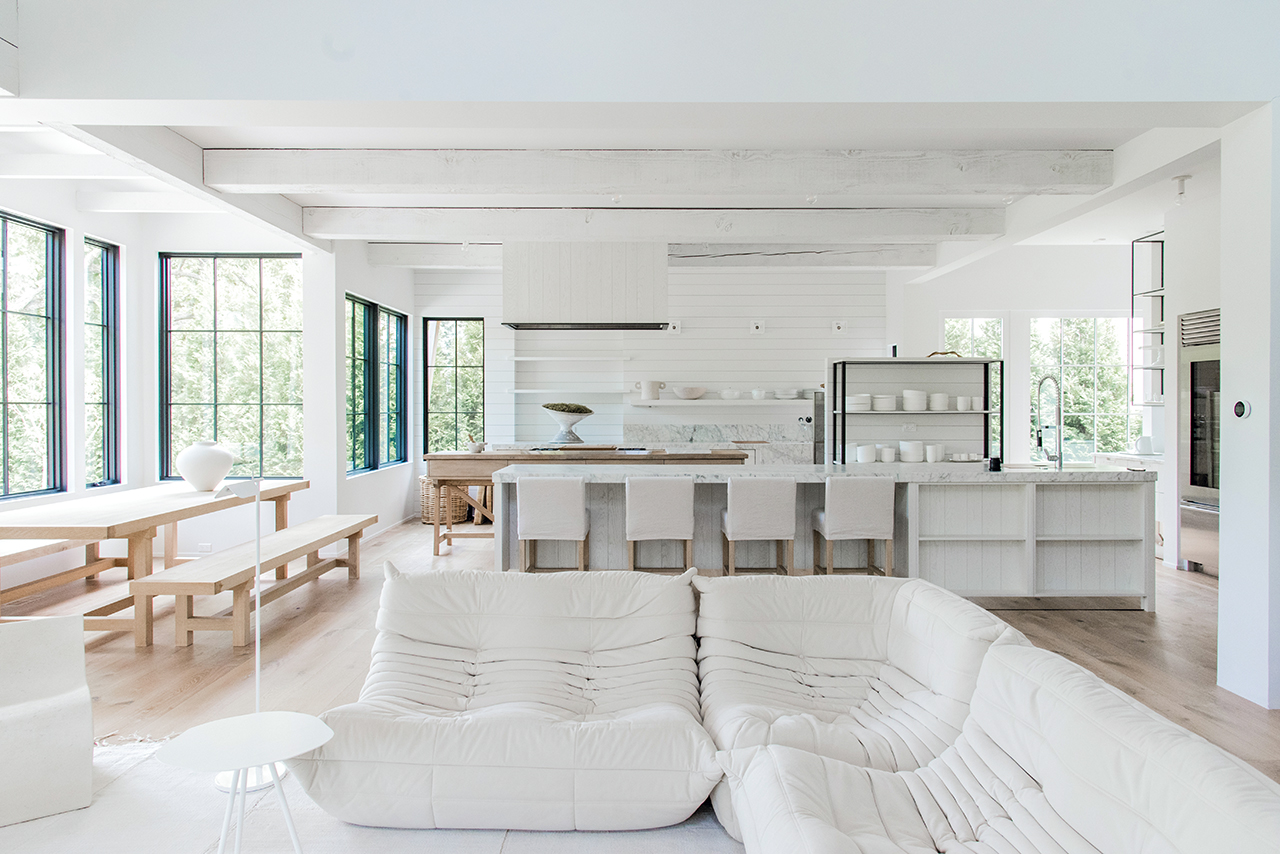
Sometimes two great styles are better than one. That’s what happens when the raw functionality of Scandinavian design fuses with Japanese nature-suffused simplicity, and it’s a look that fits American kitchens like a glove. Designers say it creates wonderful zen, with some famous Scandi and Japanese variants adding warmth and interest to sleek minimalism.

At first glance it may seem an unlikely design union, since Japan and Scandinavia are on opposite sides of the globe. But, in actuality, their design sensibilities are remarkably similar, and Denmark, especially, has had a close trade relationship with Japan for hundreds of years. The Danish design museum in Copenhagen even devotes exhibit space to Japanese design.

Thomas Lykke of OEO Studio in Copenhagen, Tokyo and Kyoto applauds the design fusion of the two countries, but dislikes that it’s dubbed a trend.

“Trends tend to pass by,” he says. “The Japanese-Danish connection goes far beyond that. I call it shared DNA. Meticulous craftsmanship and attention to details, simplicity and timelessness are deep-rooted in both countries’ culture. We want design that will be relevant 50 years from now. And we are, in our hectic lives, looking for meaningful ways to live, through craftsmanship and rituals, whether that’s a tea ceremony in Kyoto or a coffee break in Copenhagen. Also, neither country has vast natural resources, so we respect what we have and work with it.”

Although Japandi at its roots is the epitome of minimalism, two special concepts set it apart. One is “hygge,” a Danish word now known by designers everywhere, meaning cozy comfort. In Scandinavia this is achieved with lots of textures and touches of color. The other is wabi sabi, the Japanese concept of finding beauty in something imperfect. This could be a well-loved heirloom, perhaps a piece of furniture or a well-used utensil. Although Scandinavians don’t talk about wabi sabi, they, too, love to let the patina of something old and well-loved add charm to a space.

Cabinetry in a Lykke kitchen is always the main event. In one kitchen, for example, cabinets aspire to be more a piece of furniture that fits naturally into living environments rather than a stand-alone kitchen. It combines simplicity and refined, contrasting materials. Lykke calls it “a quality culinary space rather than merely a show kitchen.” Another kitchen features modular cabinets, a popular concept in European homes. The modules are sectioned using slender metal dividers and sit on metal plinths creating a light, floating look.

A tiny concrete cave of a New York City apartment is turned into a work of art by architect Andrew Mikhael, who used walnut not just for cabinetry but also for structural elements. The concrete ceiling couldn’t accommodate recessed lighting, so he installed LED tape lights in channels and then surrounded them with walnut slats. The angled walnut wall was designed to reference a drawn-back curtain revealing the sculptural space.

Modern Nostalgia

When a 30-something guy bought a tiny, concrete cell of an apartment on New York City’s Upper East Side, he turned to architect Andrew Mikhael for help. The client showed Mikhael photos from his grandmother’s home, a place that inspired wonderful memories. When Mikhael saw the grandmother’s Danish serve ware and the simple, elegant mid-century furnishings, he knew exactly what to do.

“Since he loves to have people over and cook and bake for them, I knew the kitchen should be an unexpected centerpiece,” reports Mikhael, “a functional work of art. We removed the wall between the galley kitchen and the living room to combine the spaces. We also extended the kitchen into the entryway space, thus expanding the kitchen from 56 square feet to 87 square feet. Next, we installed an angled walnut wall that recalls a partially pulled-back curtain, dramatically revealing the sculptural kitchen.”

Mikhael used walnut throughout the kitchen as an homage to the client’s grandmother. He even wrapped a structural column that couldn’t be moved in walnut. The remarkable workmanship morphs and blends, wraps and anchors, and ultimately hammers out a rhythm.

Lighting was a problem in the apartment. “Because the ceilings were concrete, lighting couldn’t be recessed into them,” explains Mikhael. “As a result, LED tape lights were mounted in long channels one inch below the ceiling, and we then used wood slats to give them a home. The slats don’t just shield the lighting channels, they also hide the unsightly concrete.”

Cabinetry is frameless with simple finger pulls to keep the look minimalist, countertops are matte black Corian, the range and hood are wrapped in stainless steel, and backsplashes are backlit glass.

Mikhael warns that a meticulous carpenter is needed for this kind of work. “I asked my contractor if he minded if I worked with the carpenters at Conex Interiors directly,” he relays, “and he gave me his blessing. They did an incredible job.”

Designer Jennifer Gilmer proves that Japandi minimalism can be elegant and timeless, designing this kitchen with cabinetry crafted from Macassar Ebony, an engineered veneer.
Photos: OEO Studio

Japandi Meets Bungalow

Jennifer Gilmer, an award-winning kitchen and bath designer and principal of Jennifer Gilmer Kitchen & Bath with showrooms in Maryland and Virginia, says that she tells clients, jokingly, that she designs “Western Feng Shui” kitchens. “But I am really quite serious,” she remarks. “The more I learned about Feng Shui, the more I realized that I was unwittingly doing just that. It has become my signature style. So no matter what the design is, and they are all very different, the one thing they have in common is that they make you feel good. That’s Feng Shui.”

Japandi fans will testify to its built-in Feng Shui, so it’s no surprise that Gilmer chose modern Japanese design as the look she wanted for her own home. “This was a Sears bungalow,” she tells. “It was a far cry from the elegant minimalism of Japanese design, but my architect magically made my aspirations possible with a modern addition at the back of the house. There, I got the beautiful and functional space I had visualized for cooking, family life and entertaining.”

Knowing that the cabinetry would be the main focus of the kitchen, Gilmer sought out Premier Custom-Built Cabinetry, which has developed its Mizuki style inspired by Japanese folk houses and traditional Tansu cabinetry.

“We chose an engineered veneer crafted to look like Macassar Ebony,” relays Gilmer. “The wood grain is horizontal, and the ‘striped’ look is so striking that everything else in the kitchen was chosen to complement the cabinetry. No other element was allowed to distract from its beauty. For example, honed black granite was used for the countertops and wenge for the island wood detail. Wenge is similar to cherry, but turns dark over time. The backsplash behind the cooktop is backpainted glass, the farmhouse sink sits on black granite to protect the cabinets from water damage, and dishes are kept on floating shelves.”

She’s especially fond of the pantry, with its retractable bi-fold doors. They open to reveal a countertop, and it houses a steam oven as well as a plethora of cooking accessories. When not in use, the doors are shut so the pantry looks beautiful when entering the kitchen.

The gnarly irregularity of the unclaimed wood floors and beams contrasts with the clean, sleek cabinets, creating precisely the kind of juxtaposition that’s quintessentially Japanese. “So, yes, modern Japanese design and American Bungalow can mix well,” concludes Gilmer. “This space will never go out of style because it honored and melded two very tasteful styles that have proven the test of time.”

Neutral colors but strong texture contrasts of this Winnetka, IL open kitchen/family room/ dining area by Mick De Giulio reflect the design aesthetics of both Scandinavia and Japan.
Photo: Belen Aquino

Detailed Minimalism

Mick De Giulio, principal of de Giulio Kitchen Design in Chicago, IL, pays visits to near and far locales, and those influences have a way of creeping into his kitchen designs. Japanese and Scandi aesthetics may appear in a design here and there, but in typical De Giulio fashion, inspirations remain just that. From there they are carefully curated and translated into one-of-a-kind designs.

Such is the case of a kitchen he designed in Boston – a classic 19th-century Victorian with a modern addition in the back. “It was just right for a family friendly kitchen,” notes De Giulio. “It’s a contemporary, clean-lined space, but it blends seamlessly with the old part of the house, he remarks. “The design emphasizes asymmetry and horizontals, and the layout is straightforward. Materials play an important role in keeping the space serene. We used light walnut in an organic, almost natural color that we nicknamed ‘Norwegian’ for its sun-bleached, Scandinavian look.”

Of course, everything that De Giulio designs is actually not that simple. A kitchen may look minimalistic, but it’s sure to include exquisite details that don’t shout. The Boston kitchen’s cabinetry, for example, is framed in bronze and contrasts subtly with brushed Iceberg quartzite. The edges of the quartzite counter were mitered to make the slab look extra thick, and a stair-step design at one end provides room for extra seating. The quartzite is repeated on the backsplashes and wrapped the range area.

In another kitchen in Winnetka, IL, De Giulio, worked the wood, creating cabinets with seemingly unfinished, textured surfaces. The space was a riff on a style that the client called Belgian farmhouse, but it is also a look that’s beloved in Scandinavian and Japanese farmhouses. De Giulio achieved it using white oak, cross-cut against the grain. To emphasize the casual, freewheeling look of the light-filled space, he installed legs on the island and placed the cooktop on a table made of reclaimed wood. Finally, he introduced some freestanding stainless steel cabinets for a bit of an industrial vibe.

“There’s nothing sleek about this space,” comments De Giulio. “It is full of textures and juxtapositions. Nobody ever heard of Japandi when this kitchen was designed, but I think it plays into the style. It’s a strong style, especially because it is so adaptable.”

Marcus Otten calls the Royal Ebony veneer used for the cabinets in this kitchen the most beautiful he has ever seen, with unique colors and patterns that dictate that the cabinetry should be the key element.
Photos: Kimberly Gavin

Globetrotting Style

How do a couple of world travelers get a kitchen that reflects their global style, works as a canvas for treasures from many countries and yet functions for everyday life? They get together with award-winning designer Marcus Otten of Exquisite Kitchen Design in Denver, CO. Otten is known for a singular motto: “There are 10,000 different ways to do things, but only one way to do it right.”

For the world travelers, he designed a space where everything tells a story and brings up memories. The couple’s objets d’art are displayed throughout the space, including on floating shelves. The most stunning element, however, is the cabinetry featuring Royal Ebony veneer.

“It’s the most beautiful material I have ever seen,” remarks Otten. “It features unique color patterns and is very rare. There simply are no more logs. This African tree grows slowly and can only be turned into lumber when it’s 100 or so years old.”

Rift-cut oak for other cabinets and the island plus steel accents provide the layers and textures that Otten favors. Altogether, the space contains a lot of the Japandi influence: meticulous craftsmanship, beautiful wood, thoughtful contrasts and artistic accents.

Japandi’s elements are expected to continue to resonate with designers, who find its sophisticated minimalism warmed by craftsmanship and artistry endlessly adaptable. Many homeowners also understand and embrace the concepts of hygge and wabi-sabi, which Japandi fans call “yin and yang” at its best. Gilmer’s reference to it as “great Feng Shui” reflects its staying power in design. ▪

Gardeners say California’s subsidy to phase out gas-powered tools won’t cut it

Though Gov. Gavin Newsom has signed a bill banning the sale of most new gas powered tools by 2024, gardeners and landscapers say a $30 million state subsidy isn’t nearly enough to help small operators make the switch to electric.

The state agency responsible for administering the subsidy estimates it has only enough to give each self-employed gardener a 50{6d6906d986cb38e604952ede6d65f3d49470e23f1a526661621333fa74363c48} coupon for one tool, far from the truckload of leaf blowers, lawn mowers, small chainsaws, brushcutters and trimmers most haul around.

In fact, local governments have learned they need to offer more. In Southern California, a regional air quality district that has been running a similar incentive program since 2017 saw few takers until it increased rebates to 75{6d6906d986cb38e604952ede6d65f3d49470e23f1a526661621333fa74363c48} per tool. The district paired that with an outreach program and encouraged landscapers to test electric equipment.

The California Air Resources Board is still figuring out who will qualify for the rebate but Assemblymember Marc Berman, one of the authors of the bill, said he’s open to adding more funding if needed.

“Let’s not make the perfect be the enemy of the good,” said the Menlo Park Democrat.

111621-Gas-Lawn-Ban-CAD-CM-03.jpg

Aric Crabb

A chainsaw and gas on the ground during fire mitigation work at a property along Via Floreado road in Orinda on Nov. 16, 2021. Ken’s Rototilling and Landscaping company owns around 50 gas powered tools that could be impacted by a state ban on new small gas motors.

Environmentalists hailed the first-in-the-nation law for advancing California’s clean energy goals, noting the state estimates that smog-forming pollution from small gas-powered engines will surpass emissions from passenger cars this year. But electrifying the landscaping industry creates financial and physical burdens for the estimated 60,000 one-person and often unlicensed landscaping operations, an industry with an average income under $40,000 a year, according to the Bureau of Labor Statistics.

There’s an argument for subsidizing the transition. An electric leaf blower and batteries cost nearly twice as much as a comparable gas version. California estimates that a full transition of nearly 3 million tools used by landscaping professionals will cost $1.29 billion.

Bryan, a landscaper who asked to be identified by his first name only because he fears losing business, uses a mix of electric and gas equipment. The electric ones fall short.

“I have 10 to 15 houses a day, right now, but with electric (tools), I may do seven or five houses a day,” he said. That’s a loss of $1,000 a week.

Already, Bryan has told his kid he can’t afford books or a new laptop. The cost of a full conversion by purchasing all electric tools, he said, would require him to raise prices 30{6d6906d986cb38e604952ede6d65f3d49470e23f1a526661621333fa74363c48}. He fears his residential clients will purchase their own tools and do it themselves, pushing him out of a job.

When the bill was signed, Berman and Assemblymember Lorena Gonzalez of San Diego called it a win for both the environment and human health. Electric tools have already been widely adopted by California homeowners, but only a fraction of commercial landscaping companies have made the switch, according to a 2018 survey by the air resources board.

111621-Gas-Lawn-Ban-CAD-CM-02.jpg

Aric Crabb

Jorge Mijango of Ken’s Rototilling and Landscaping uses a chainsaw to cut trees for fire mitigation at a property along Via Floreado road in Orinda on Nov. 16, 2021. The landscaping company owns around 50 gas powered tools that could be impacted by a state ban on new small gas motors.

At that time, 8 in 10 landscapers said they planned on buying gas-powered equipment with many prioritizing performance, run-time and cost. But operating a gas-powered leaf blower for one hour, for example, emits the same amount of pollution as driving a Toyota Camry from Los Angeles to Denver, according to the air board.

The lawn equipment conversion will bring the rest of the state in line with cities such as Palo Alto, Los Altos and Menlo Park, which have already banned noisy leaf blowers. The law also directs the air resources board to come up with statewide regulations for other small motor equipment, such as golf carts, small generators and power washers.

But the landscaping industry, the main target of the ban, says the transition has already been costly.

Steven Wood purchased four batteries for his electric leaf blower after a number of communities in the Bay Area banned gas-powered leaf blowers. Woods, who owns a small landscaping business, immediately noticed the batteries don’t go far enough.

“I never spent $200 on something that lasted 45 minutes,” Wood said, “and it doesn’t last for six to eight houses a day.”

Once the batteries drain, Wood’s two employees resort to raking, which takes three times as long to complete a job.

Tests back him up.

Consumer Reports rated gas and electric tools, such as lawn mowers, leaf blowers and string trimmers, side by side. The nonprofit consumer organization found that battery-powered tools, with low maintenance and ease of use, were strong candidates for homeowners with less than an acre of land who could wait to recharge their batteries. But when it came to larger plots, more robust weeds to whack, or long hours of use, gas tools excelled.

“As an industry, we want this (battery-powered) equipment to be able to handle what we throw at it,” said Sandra Giarde, executive director of the California Landscape Contractors Association. “But it’s not there yet.”

111621-Gas-Lawn-Ban-CAD-CM-04.jpg

Aric Crabb

Ken Tamplen, owner of Ken’s Rototilling and Landscaping holds a chainsaw at a property along Via Floreado road in Orinda on Nov. 16, 2021, in Orinda.

The air resources board said the technology is close enough. While electric tools may not have the same power, they offer other benefits, such as longer lifespan, better torque for some tools and savings on gas and maintenance, said air pollution specialist Christopher Dilbeck.

“We recognize that, yes, there will be substantial costs associated with what we are proposing,” said Dilbeck. “That is part of why this funding is available.”

The board, which will allocate the state’s $30 million subsidy, has yet to release how it will hand out incentives other than saying it will target small operators, including those without a business license. In one scenario, California could offer 12,000 small landscapers a 50{6d6906d986cb38e604952ede6d65f3d49470e23f1a526661621333fa74363c48} discount on all their new tools, or every sole-proprietor could receive a 50{6d6906d986cb38e604952ede6d65f3d49470e23f1a526661621333fa74363c48} discount on one tool.

“You are not going to be able to get the jobs done as fast,” said Ken Tamplen, owner of Ken’s Rototilling, a landscaping company in Contra Costa County. “You’re not going to be able to make as much money.”

This article is part of the California Divide, a collaboration among newsrooms examining income inequality and economic survival in California.

CalMatters is a nonprofit, nonpartisan media venture explaining California policies and politics. 

Delhi-Based Artist Creates Beautiful Art Work On Olive Ridley Turtles With Message To Curb Plastic Menace In Oceans

Bhubaneswar: On the closing ceremony of the METIS Initiative on Plastics and Indo-Pacific Ocean 2021 at Utsha Foundation here this evening, the grant-winning artist Manveer Singh shared his experience at the month-long residency and also displayed a short film on his journey in Odisha in transforming his ideas to create beautiful art from plastics and also generating awareness among people and especially among the youth and students.

Today’s installation by Manveer at Utsha created a wall of Olive Ridley turtles hanged from net and the artist has the concept to tell to the visitors, how human activities like fishing are killing the turtles. The tiny ones consuming plastics are also facing life threat near the coastline and especially adjacent locations near the mass nesting grounds. The work today at Utsha, thus explained all the challenges behind the lifecycle of the Olive Ridley turtles, which are in love with the Odishan coast.

The wonderful event on art and sustainability was attended by Consulate General of France Kolkata Mr. Talpain, Regional Director South Asia AgenceFrançaise de Développement (AFD) or French Development Agency Mr. Jacky Amprou, Director AFD India Mr. Bruno Bosle and Sector Portfolio Manager AFD Mrs. Fanny Ragot and Founder of Utsha Foundation and eminent artistJagannath Panda, among others.

Congratulating Manveer, the Consulate General of France Mr. Talpain said ‘’this artistic food for thought is the reminder that art and artists have the power to influence the way we think about the environment. I strongly believe that artists have the power not just to raise awareness about critical issues, but their work is also the key to creating real world impact.’’

Delhi-based artist Manveer Singh’s concept “From Plastic to Art” was selected from 26 applicants. During his stay for the Utsha Residency in association with AFD, Manveer visited various institutions and offices and distributed 40 habit changer boxes to collect the layered plastics to make the tiny turtles for his art work. He also organized a workshop with 28 Peer Leaders (PragatiSathis) of the Bhubaneswar Smart City so that the concept of “From Plastic to Art” is translated to action by others in the society. Peer Leaders are youth and student leaders of Bhubaneswar Smart City to create public awareness among the 100 slums across the Temple City. The workshop was organized at BDA City Centre (NICCO Park) where the Quick Win project under City Investments to Innovate, Integrate and Sustain (CITIIS) is under implementation in Bhubaneswar.

Manveer also conducted a workshop for students at Unit VI Girls High School in which 50 students participated. He also interacted with more than 15 families residing in Government quarters near Utsha Foundation. His installation on Puri sea beach also attracted more than 5,000 visitors on November 24.

The artist, popularly known as “Plastic Wallah’’ in Delhi, has dedicated his works in creating awareness on the menace of plastics in and around the human habitations. However, as the marine ecology is going to be severely affected by plastics by 2050, the artist feels, the awareness level should also get more attention so that the oceans and their ecosystems would be less affected by the plastics and their derivatives.

The METIS initiative is part ofAFD celebrating its 80th Anniversary on December 2, this year and for this the agency has planned events across the Indo-Pacific Region including India, Mauritius and Indonesia. AFD has decided to launch a global initiative METIS, to create a global public opinion on marine debris and pollution.

While this has encouraged participation of artists in India to express their ideas relating to plastic waste production, management and its ill effects on the fragile coastal ecosystem, in Mauritius and Indonesia music and comics respectively were used to create the public awareness.

Currently, AFD is also funding the CITIIS Programme in Bhubaneswar and 11 other cities of India through the Smart City Mission. AFD is funding CITIIS Programme here, supported by Ministry of Housing and Urban Affairs, European Union and National Institute of Urban Affairs, New Delhi and the Government of Odisha.