Japanese Barberry, an invasive shrub that has become widely-used in landscaping due to its color and ability to keep deer away, will soon be prohibited in Pennsylvania.
Known as Berberis thunbergii, the plant originated in Japan and Eastern Asia and was brought to the United States in the 19th century as a decorative shrub.
Japanese Barberry quickly overgrows and forms dense, prickly thickets that can crowd out other plants and be disruptive to various ecosystems. The plant can spread easily across wooded areas, fields and other green spaces. It is also a popular spot for black-legged ticks to spread lyme disease.
Pennsylvania added Japanese Barberry to its list of noxious weeds, which are plants that have an adverse impact on public health, crops, livestock and land. Plants that are identified as noxious weeds cannot be sold or grown across the state.
“Many seemingly attractive plants can actually harm our environment, our food supply and our health,” Agriculture Secretary Russell Redding said. “Pennsylvania does not take banning the sale of a plant lightly. Prevention is the best alternative — choosing native plants that harbor pollinators and allow a healthy, natural ecosystem. Carefully considering the potential impact of what we plant can prevent lasting damage that is difficult, expensive or impossible to reverse.”
Enforcement of the statewide ban will take place over the next two years to provide landscaping companies, garden centers and nurseries with time to dispose of Japanese Barberry and seek out alternative plants that are not as harmful to agriculture.
Businesses received notices of the prohibition this month and were told to decrease inventory of the plant. Companies that are still selling and producing Japanese Barberry by next fall will receive a warning from state officials. All remaining Japanese Barberry in Pennsylvania will be destroyed by Fall 2023.
Sterile, seedless versions of the plant that are less threatening to the environment are eligible for an exemption through an application process.
Property owners are also encouraged to get rid of any Japanese Barberry they may have. Experts at Penn State Extension recommend pulling the entire plant out of the ground either by hand or by using a machine, depending upon the shrub’s size. Removing the entire root system is paramount to prevent re-sprouting to occur among leftover seeds and branches.
Pennsylvania had previously considered banning Japanese Barberry in 2018, according to TribLive.com. Massachusetts, New York, Maine, Minnesota, Wisconsin and West Virginia have also banned the sale and cultivation of the plant, according to NorthCentralPA.com.
Johanna Weiss spent the summertime creating desire in her two university student bands, but devoid of enough funding, putting collectively reside performances appeared out of attain.
Just after getting a $1,000 artwork grant, however, the band director of Gainesville’s Expressions Studying Arts Academy said her associates are established for good results.
“This grant has been certainly a godsend,” Weiss said.
The Alachua County Arts Council not long ago declared four recipients for the $1,000 mini arts grants: Weiss, Corey Cheval, MusicGNV and Y-Not Theatre. Newberry and Superior Springs each gained a $1,500 matching grant, which means they need to fundraise a part of the dollars.
The grants had been funded with dollars from “I Guidance the Arts” license plate product sales. The county received $23,000 in unspent specialty plate proceeds from Gainesville in 2017 and awarded $7,000 of it this calendar year.
Gina Peebles, assistant county manager and chief of team, said the 18 candidates for the mini grants ended up ranked dependent on a rubric focused on neighborhood impression. Peebles claimed the grants will set seed money into the hands of neighborhood artists.
Weiss claimed she will use the funds to nutritional supplement her two student bands, splitting $500 apiece. 1 group is a mariachi band referred to as Conquistadores de la Música and comprised of 12- to 14-yr-olds the other is In Total Swing, a jazz band made up of significant schoolers from Gainesville.
She stated she will buy a piano amp, folding chairs and rights to copyrighted songs, which can price $50 per piece.
In accordance to Weiss, 15-yr-outdated Isaac Savin was an integral component of In Full Swing’s founding and remains a main member. Isaac, who plays trombone for the group, explained he was grateful for the grant.
“To me, it validated the whole band,” stated Savin, a 10th grader at Eastside High Faculty.
MusicGNV, a nonprofit business focused to strengthening alternatives for local music artists, will use the dollars to develop a new tunes label termed MusicGNV Data.
“This grant was a fantastic chance to get the funding to get it off the ground,” mentioned Jacob Adams, a founding member of the team.
MusicGNV also intends to split its funding in 50 percent, utilizing each individual $500 to endorse report releases of two artists by way of image and online video written content alongside with news interviews.
After it recoups its expenditures through vinyl and merch sales, MusicGNV will let artists personal their music with out it taking a lower. Then, the rest of the $500 will be employed to advertise a new release.
“That $1,000 could perhaps be funding artists many years from now,” Adams said.
Corey Cheval will use the money to boost manufacturing of her are living show, Dusty’s Ragtime Circus. She reported the grant will support to enhance her set models and output high-quality, which will help the circus attain consideration.
“If you really don’t have a good quality sound system, and you really do not have that wonderful framing and established style, it is tricky to get recognized,” Cheval mentioned. “It’s just heading to more the top quality of this production and make it much more finish.”
Her brother, Dustin Cottrell, is the circus’ new music director. He stated the grant will go toward a new wood frame for his piano.
“It’s obtained probable for all sorts of prop use,” Cottrell stated. “It’s absolutely heading to be a massive aspect of the clearly show.”
Paul Gabbard is the founding creative director for Y-Not Theatre. He mentioned the organization is devoted to producing new American plays, compensating artists and strengthening variety.
The mini grant will guidance all these elements by funding Gabbard’s touring functionality application. His group will perform a are living, bilingual adaptation of “Tomás and the Library Woman,” a children’s story about a younger immigrant boy befriending a librarian. The team will stop by county schools, parks and libraries to conduct.
The two $1,500 matching grants awarded to Newberry and Significant Springs have been at first just one $3,000 grant. The two towns tied in their rating, and the council determined to split the dollars.
Peebles stated Newberry will use its grant to fund artwork on its electrical panel containers to beautify the town, even though High Springs intends to build a sculpture walkway.
“It was a earn-win problem for the two Significant Springs and Newberry,” stated David Sutton, the coordinator for Significant Springs’ Neighborhood Redevelopment Agency and a voting member of the arts council.
Sutton stated the sculptures will possible replicate his city’s link with ecotourism, with representations of aquatic wildlife like manatees and alligators as sturdy candidates. He also reported the walkway would allow persons to get away from the frantic distractions of day-to-working day daily life.
“Art is just one particular of those matters that make you sluggish down and enjoy lifetime,” he mentioned.
Anyone who knows Kerri Rosenthal’s art—or her cheerful shop in Westport, Connecticut—might expect her home to be busting with color. But, despite the bold hues favored in her creative work, Rosenthal’s family home goes neutral, relying on texture and light to bring coziness and warmth. “For me, my business world is all about color—our business model is a happy chaos, but it feels chaotic—so when I go home I need to chill out,” Rosenthal says. “I need my home to be as neutral as possible.”
The other benefit of a neutral backdrop? “It allows me to paint whatever paintings I want and hang them up,” says the artist. “I’m not a believer in matching your art to your interior—but when your home is neutral, the sky is the limit. So that allows me to change things out whenever the mood strikes me.”
And that strike happens often—the Rosenthal home is somewhat of a revolving gallery space, with artwork (as well as remnants of whatever project Rosenthal may be working on) rotating constantly. “Either I’m in the mood to change it or something sells,” Rosenthal explains.
Rosenthal’s store.
Kyle P Norton
She and her husband and kids moved into the home a little over 5 years ago…and faced some much-needed renovation. “It had been built in 1995 and had never been updated,” Rosenthal says. When she first saw the home, “my first reply to my husband was ‘no way,’” laughs the designer. She had just opened her first retail store and didn’t think she could take on a Reno at the same time. But the home’s layout was promising, so, “we made it happen,” says Rosenthal.
That meant not tackling everything at once: “We made a very achievable priority list and did things that were more of a surface renovation than a gut,” she reveals. “The floors were stripped—we triple-bleached the red oak and got them down to the purest of pure oak we could possibly and did a natural matte coat. That was a game changer. Then we put white paint everywhere so we had a clean canvas.”
But finding the right white was a project in itself. “I don’t like too much yellow and I don’t like stark, cold white either,” Rosenthal says. “When the sun hits it, you want it to warm up. I find that with Farrow & Ball paints especially, so I tend to use those.” She opted for All White throughout most of the home (“It has a real warmth to it,” she explains), then switched to Wimborne in the dining room. “When the sun hits it, it glows,” she says of the color. “It feels like a New York apartment white, but it worked with the oak table.”
For her bedroom, she selected a mix of Pointing and All White, and for her daughter’s room went with Cornforth White, which was also used for the trim throughout.
With the base set, Rosenthal filled the home with textural elements that invite coziness. Take the full tour below.
Entry
WINNIE AU
Though the home’s double-height entryway has a minimal palette, there’s always a slew of artwork propped against the walls. “That’s my hub, my Grand Central,” Rosenthal says of the space. “I have art going out to customers that ends up there for my messenger to pick up—I have new art that’s going to be scanned and added to my print collection, art that’s going to my shop. So a lot just ends up leaning there.”
Kitchen
WINNIE AU
Though the kitchen “needed more of a gut” when the family first moved into the house, Rosenthal found a way to (partially) hack it: “We worked with the cabinetry and just turned doors around, so the shaker was inside” for a more minimalist look. Then, they added a few new drawer fronts, new appliances, quartzite countertops, and changed the shape of the island. “We gave it a fresh look that maybe took three weeks,” Rosenthal says.
WINNIE AU
Meanwhile, a table and banquette serve as a work and homework station, dining table, or crafts center, depending on the day. “I loved bringing in richer colors with the walnut table and the mix of pillows on my Frederico bench,” says Rosenthal.
Living Room
WINNIE AU
In this all-white room, it’s all about texture. “You have to know when to have the right balance with what I call the earth wind and fire,” Rosenthal says of balancing different neutral hues and textures. “When it’s out of whack you feel off.” But here, she finds a mix that adds depth: “The sectional is a crushed velvet that’s very white, mixed with a Belgian linen couch from a previous house that works together, with an oyster-colored wool rug, and then lots of wood, and even the little vintage Lucite coffee table,” she says. “With the stone around the fireplace and some trees for greenery—there’s your balance.”
Family Room
WINNIE AU
WINNIE AU
“It can’t always be white, and even darker colors are neutrals,” points out Rosenthal. In the family room, that comes in the form of dark cabinetry. “I still have my grays and my woods and my taupes, but the house came with these amazing built-ins with this slate backdrop and I really liked it—so as soon as I whited out the rest, I felt like this was the inspiration for the rest of the room,” she explains. “I did add curtain panels in one of my fabrics, but they’re indigo and oyster linen, so still neutral.” The family’s books and collectibles add character to the shelves. The room’s smartest feature, though, may be Rosenthal’s use of a large-scale painting to conceal the TV.
Primary Bedroom
WINNIE AU
“I wanted the walls to be warmer, so I mixed two Farrow & Ball colors to create a very warm feel,” Rosenthal reveals. She opted for plenty of gray furniture and warmed things up with a rug. “I love a wall-to-wall rug in my bedroom—all the bedrooms have it,” she says. “Ours is kind of tweedy, which makes you feel cozy.”
Daughter’s Bedroom
WINNIE AU
For her daughter’s bedroom, Rosenthal went bolder with a pink bedspread, which pops against a wallpaper from Rosenthal’s own line. But the loudest elements are removable, so her daughter can redesign as she gets older.
Studio
WINNIE AU
Rosenthal creates her colorful work in the home’s sunny upstairs studio. “The selling point of this house was that it had a space I could use as a studio,” she says. Like the rest of the house, she painted the space white when she moved in—but five years of work has resulted in a rainbow of splatter on the floor, a motif that Rosenthal actually turned into a fabric pattern. “The life in the room are the paintings and my table filled with all my materials,” she says. “It’s my favorite place.”
Patio
WINNIE AU
When they moved in, the patio was angled—”and I don’t like anything angled,” Rosenthal reveals. “We squared it off, painted it black, and then stripped the wood decking and let it do its natural thing, so it’s graying beautifully.” She outfitted it (along with the veranda that runs around the house) with comfortable outdoor furniture. “We had so much fun designing a space that felt like it was an extension of what was happening inside—just as cozy,” she says. “We use that space so much. We sit there at the end of the day during the summer and see the sunset. It’s just a great perch.”
Hadley Keller Digital Director Hadley Keller is a writer and editor based in New York, covering design, interiors, and culture.
This content is created and maintained by a third party, and imported onto this page to help users provide their email addresses. You may be able to find more information about this and similar content at piano.io
Horticulturists, like theater directors, work behind the scenes. They don’t sign up to get booed. But during the summer of 2019 at Brooklyn’s Green-Wood Cemetery, its director of horticulture, Joe Charap, was chewed out by lot owners time and again. His offense? He had decided to stop mowing half of the site’s 400 acres of turf to reduce carbon emissions and check the spread of invasive plants.
“The headstone was shrouded in weeds and covered in tall grass,” one person said of their father’s plot. “It’s disrespecting our family.” Another wrote: “The area looks terrible. It is not mowed and looks disheveled.” And another: “I couldn’t help but feel I was looking onto the Serengeti plains with grassland growing out of control in a manner that I feel desecrates the final resting place of all lying in eternal [sic] slumber. What’s next, controlling the growth with grazing sheep and cattle?”
A life-long New Yorker, Charap expected some shock. For a cemetery, not mowing was a radical step, but the complaints still stung. After all, his job was to care for Green-Wood’s most valuable feature: its landscape. The glacier-carved hills, valleys, and ponds were the reason a group of wealthy Brooklynites chose it for one of America’s earliest rural cemeteries in 1838. Since then, New Yorkers of all stripes have visited the roughly 500-acre grounds to mourn, or get their fill of fresh air and nature.
But those grounds, as Charap learned over the first few years in his role, were changing for the worse. The main culprit was Bermudagrass, a fast-growing, warm-season invasive which had been introduced to the southern US, likely from Africa, more than two centuries ago. At Green-Wood, Bermudagrass was growing unabated due to some of the energy-intensive practices used to tend cemeteries and yards across the US.
It was a model that Charap walked into when Green-Wood hired him out of horticulture school in 2015. Rejecting it wasn’t going to be easy. There are upwards of 144,000 cemeteries and graveyards in the US, according to one NASA cartographer; they cover 4,300-plus acres of New York City alone. With all that ground, there’s plenty of room to test out lawncare techniques that break with the century-and-a-half tradition of over-pruning, overwatering, and over-fertilizing open spaces. A strategic, yet laissez-faire approach, as more research is finding, can save resources and help mitigate human impacts on local wildlife and climate change.
To put it more bluntly, by scaling back mowing, Charap wanted to change Americans’ perceptions of landscaping, one cemetery—or tiny burial plot—at a time.
However Bermudagrass ended up at Green-Wood in the 20th century (perhaps from ship ballasts or Southerners who buried it at the gravesite of a loved one), by 2019 it had taken over 10 percent of its grounds, thanks in large part to Brooklyn’s warming seasons.
Aesthetically, the plant was a disaster. Straw-like and brown when dormant, it only turned green after Mother’s Day, an important holiday at any cemetery. The more frequently it was cut, the faster it grew: By mid-summer, it was creeping up over the gravestones by about two inches per week. What’s more, the growing season was reaching into November due to climate change. The result was an intractable monoculture.
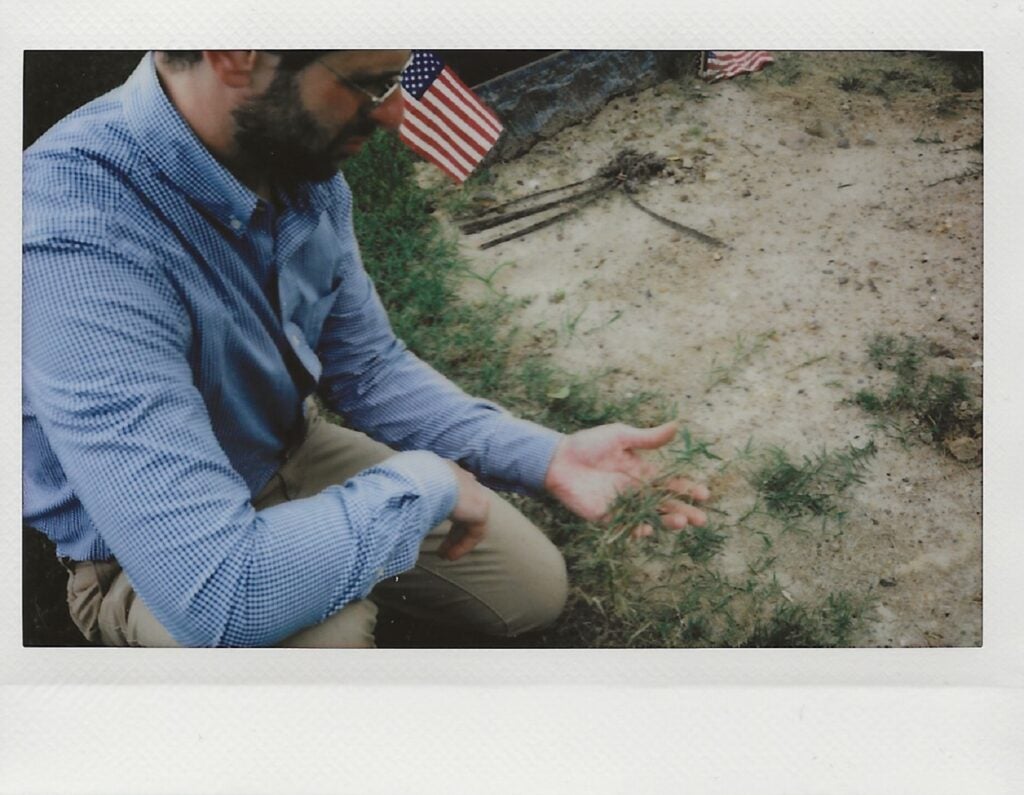
Joseph Charap, the director of horticulture at Green-Wood, digs up a long piece of Bermudagrass. The weedy plant thrives in disturbed soils. Photo: Purbita Saha
As landscaping crews battled the Bermudagrass, Green-Wood’s annual mowing bill ballooned to $1.2 million. The use of herbicides was also proving costly and ineffective.
Charap had once looked at these expenses as one would their utility bill—annoying but unchangeable—until he began assessing the true cost of conventional lawn care. The weedwackers and ride-on mowers burned 12,000 gallons of gasoline a year, equivalent to 235,000 pounds of carbon dioxide emissions. As an accredited arboretum, Green-Wood boasts more than 7,000 trees, but the canopy is well short of the forest it would take to offset such pollution. Decades of weekly mechanical mowing had also left visible scars, like pockmarked monuments and eroded slopes, as well as invisible ones, like the native flora unable to survive the blades.
Charap knew that most lot owners expected cemeteries to be neatly manicured, but he wanted to do better. So he turned to Cornell University’s Frank Rossi, a straight-talking, Bronx-born turfgrass scientist who advises major golf courses and sports teams like the Packers and Yankees. They convinced Green-Wood’s trustees to invest in a three-year partnership with Cornell to tackle the effects of Bermudagrass and climate change on the cemetery’s landscape. If it all went according to plan, Green-Wood would become the leader in this fight among all urban grasslands.
Nobody at the cemetery had studied these effects before. In 2018, Charap and Rossi flew a dozen drone missions over its core to uncover the biggest problem areas. They buried three microclimate sensors in different areas to learn where Bermudagrass was growing fastest, and outfitted 20 mowers with trackers to record their activity and fuel use. The two experts also brought in new seed mixtures and topsoil for landscaping, and laid out more careful burial procedures to keep invasives away from fresh gravesites. But their main hurdle was that Bermudagrass thrives in disturbed soil—an existential crisis for an active cemetery with more than a thousand burials each year.
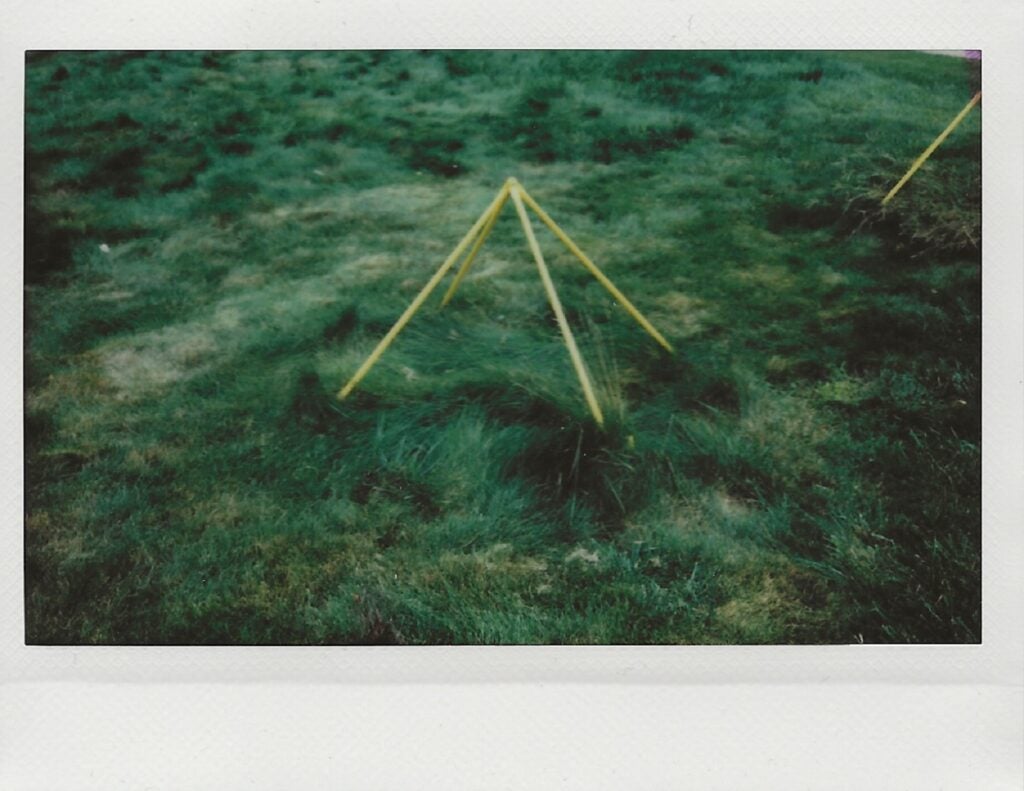
Stakes mark off different experimental plots for native grasses at the cemetery’s main entrance. Photo: Purbita Saha
In June 2019, a fluke in the landscape showed them a way forward. Rossi and two colleagues were walking through a quiet corner called the Hill of Graves when they stumbled on a patch of little bluestem, a well-known native prairie grass, rising out of a spot the mowers had missed. So there was a chance that underdogs could grow here, and maybe even beat out the Bermudagrass. Why not let certain areas go a little wild and see what happened, Rossi asked?
He and Charap decided to try. They removed a hundred acres of Green-Wood from the mowing rotation entirely, and set aside another hundred to be mowed monthly. With that, they charged into a cultural firestorm—and very quickly those comparisons to the Serengeti plains. “We started having this institutional conversation about reimagining the American lawn,” Rossi says. But that conversation became painfully one-sided. Charap, who discoursed with lot owners in person and over email, faced the brunt of it. “We underestimated the emotional connection that many people have with turf,” he says. While some told him they agreed with his mission, they also demanded, “but don’t do it on my lot, do it on that other lot.”
Within two months, a disappointed Charap had all the grass mowed, and he and Rossi returned to the drawing board.
Almost two years later, on an unnervingly warm late-spring morning, Rossi bounds up the gently sloping Hill of Graves with grass lapping at the top of his black leather boots. “Where’s that little bluestem, Joe?” he shouts behind him to Charap, who is not about to give chase in 90-degree heat.
There’s nobody else around. And it’s otherwise quiet save for a mockingbird imitating a car alarm from a dogwood on the hillside. The sweet fragrance of a flowering linden fills the air. The grass hasn’t been cut in three weeks, and what looks like a meadow has grown in. The Hill of Graves, like most of Green-Wood, used to be cropped within two inches of the soil almost every week outside of winter. Now it’s mowed to five inches only six times a year.
“It’s never looked this good, Joe,” Rossi says. “If this is what six mows looks like, we could do this for the whole cemetery.”
That’s Charap’s goal, and after the initial setback of 2019, this is a more carefully plotted step in that direction. Last year, he and Rossi set aside 43 acres of what they’re calling perpetual meadows, and the roughly 12-acre Hill of Graves is the largest one. Still, Charap carries the scars—and lessons—of that earlier summer. “We thought that no one was going to notice when we stopped mowing 100 acres, which in hindsight is just ridiculous,” he says. “You can slowly adapt people to a change in the landscape, but you have to prepare them for it.”
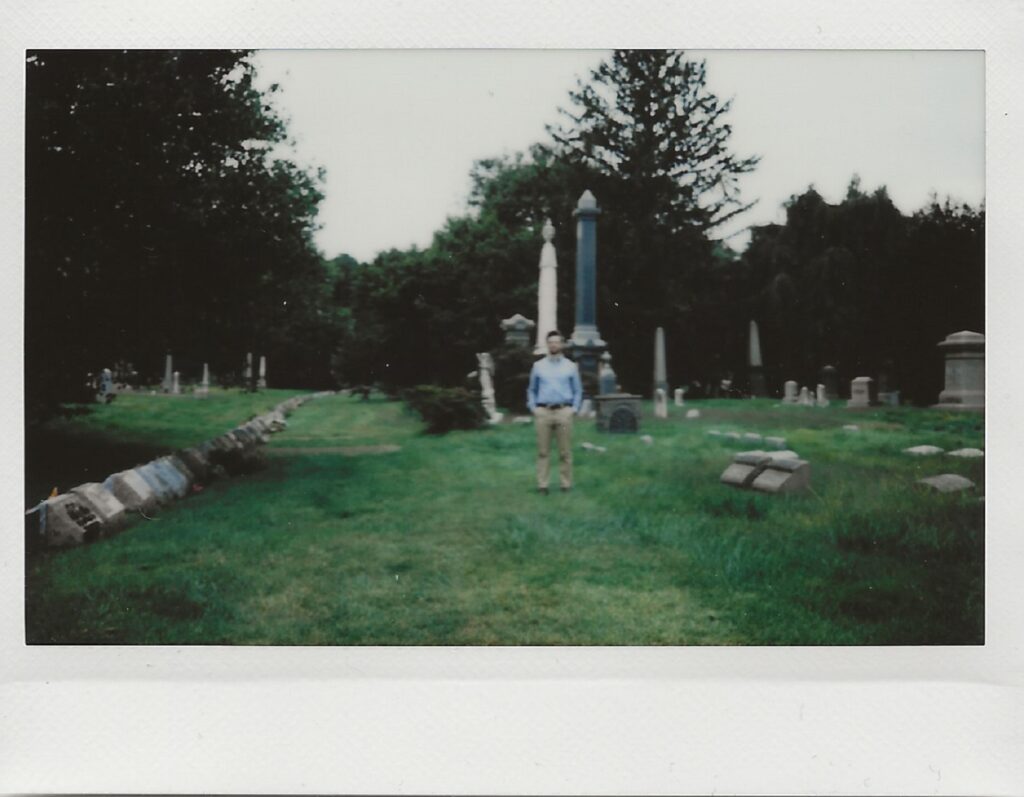
Charap stands in a freshly mowed vs. unmowed plot in October. Photo: Purbita Saha
But a countermovement is emerging. From suburban yards to historic cemeteries like Green-Wood, there’s a growing push to reckon with the unsustainable consequences of this obsession. “The impact that cemeteries can have by changing the way they’re managing their lawns is significant,” says Sara Evans, Green-Wood’s manager of horticulture operations. Reducing soil disturbances like mowing and digging helps cut down the amount of greenhouse gases released; so does strategic rewilding with meadows and other ground cover.
Other historic cemeteries are seeing how they can reduce their carbon emissions, too. Cincinnati’s Spring Grove opened seven years after Green-Wood and became the home of the first “lawn plan,” a design that emphasized open spaces and clean lines and was adopted throughout the country. But now, according to Dave Gressley, its director of horticulture, they plant sedge, which requires little mowing, wherever possible, one plug at a time. They’re also working to rebuild their canopy after the loss of hundreds of mature trees to disease and storms. As for meadows, though, Gressley says, “Cincinnati is on the conservative side, so that wouldn’t fly here.”
At Green-Wood, the free-growing patches were chosen in large part by visitation and the contours of the ground. Areas with newer graves were avoided. The Hill of Graves, for instance, is mostly made up of 19th-century public lots. Grass there now reaches halfway up simple flagstones. Fields of clover rise after spring rains, and Green-Wood puts on small classical-music concerts under a sprawling European beech tree at the slope’s crest.
The Hill of Graves, a popular attraction at the cemetery, was the first test site. Photo: Purbita Saha
This and the other meadows look unplanned—a little wooly in parts, tidier in others—but Charap and Rossi say they require more attention and foresight than simply mowing. Weed control is still employed twice a year to keep invasives at bay. Instead of a monoculture, Bermudagrass now blends in with native grasses like fescue, bluestem and Kentucky bluegrass. Once on the Hill of Graves, they used a tractor-trailer outfitted with blowtorches to try to regenerate those grasses through fire, as a way to recreate the natural fire cycle that once existed in tallgrass prairies of the Great Plains and upper Midwest. Heating up the soil releases nutrients from decaying plant material that feed the growth of new grasses and flowers. “We’re working with the landscape as opposed to trying to bend it to our will,” Rossi says.
Working with Rossi, who began mowing lawns in New York’s suburbs as a kid and briefly studied to become a Catholic priest, has converted Charap into a turfgrass obsessive. When he began working at Green-Wood, he says, the only thing on his mind was its “charismatic megaflora.” The grass was a place to rest his eyes between trees.
“But now when I look at the landscape,” he says, “all I see is grass.”
Rossi laughs, as Charap continues. “We can plant trees here till the cows come home, but in terms of climate change, that would be a drop in the bucket compared to what we can accomplish with managing the turf better.”
Indeed, Green-Wood has reduced its greenhouse gas emissions by nearly a quarter since 2018. They’ve continued to track environmental data throughout the cemetery—on microclimates, burials, mowing, soil movement—and used that to keep the grass at a taller height, but one that is largely uniform. Rossi and Charap believe that consistency (and the presence of fewer weeds) has led to fewer complaints.
[Related: It’s time to rip up your lawn and replace it with something you won’t need to mow]
Less mowing has created a healthier, often surprising ecosystem. For the first time in memory, Charap and his team found a patch of the delicate pink wildflower springbeauty. A two-year wildlife survey turned up 62 native bee species, most of them in the new meadows. And a male bobolink, a small grassland specialist in decline that migrates between South and North America, recently turned up on the Hill of Graves. During that extraordinary journey, bobolinks seek out weedy fields or tall grass, of which Green-Wood once had very little. In spring, the males look like they’re wearing a backward tuxedo, but their song is their calling card, a robotic, R2D2-like mashup which this one sang from atop wind-blown cedars.
“We call that proof of concept,” Charap says of the discovery.
Thethird and final year of the Green-Wood and Cornell partnership was a busy one in unexpected and tragic ways. The early months of the COVID-19 pandemic halted all non-burial work. Charap’s eight-person crew of gardeners and arborists assisted with burials, and the restoration staff helped run the crematorium, where workers alternated 16-hour, seven-day shifts. In the pandemic’s first year, almost 5,600 people were cremated, buried, or entombed at Green-Wood—up 38 percent from the previous 12 months.
At the same time, the cemetery offered relief during crisis. As the city went into lockdown, access to greenspace felt like a boon. It was as if Green-Wood, which had been the model for New York’s first parks and was said to rival Niagara Falls as America’s most popular destination, was reborn—a refuge for the living as much as the dead. Roughly 110,000 people came through its four gates in May 2020, almost triple the same month in 2019. The cemetery extended its hours and has continued to keep all those gates open daily. Around 600,000 individuals visited Green-Wood in 2020, up 82 percent from 2019.
For many of these visitors, the meadows became Instagram-worthy favorites. Buoyed by this reception, Green-Wood leaned into them. They turned the lawn in front of its famous Gothic arches into a two-acre meadow. Charap had never seen so many kids playing in it. “This is right in front of the cemetery and we’re saying, ‘This is who we are now.’”
It seems more like a clean break with the past, in which the landscape possesses a voice on par with its many private owners.
Education has become central to their work. Rossi, though technically off the hook at the end of last year, is beginning a new chapter at Green-Wood. He and Charap are planning an Urban Grasslands Institute that will occupy space in a restored, landmarked greenhouse, where they’ll share land-management techniques with climate-change researchers, city parks managers, homeowners—a place to continue rethinking the American lawn.
I met Charap again on a cloudy spring morning in front of his residence at Green-Wood—a brownstone-clad, slate-roofed Gothic Revival gatehouse where he lives with his wife and their two young children—and we walked a short distance to the ridge that marks the southernmost reach of the last glacier in these parts. From there, we looked out upon the flatlands of Brooklyn and the rides of Coney Island along the Atlantic Ocean.
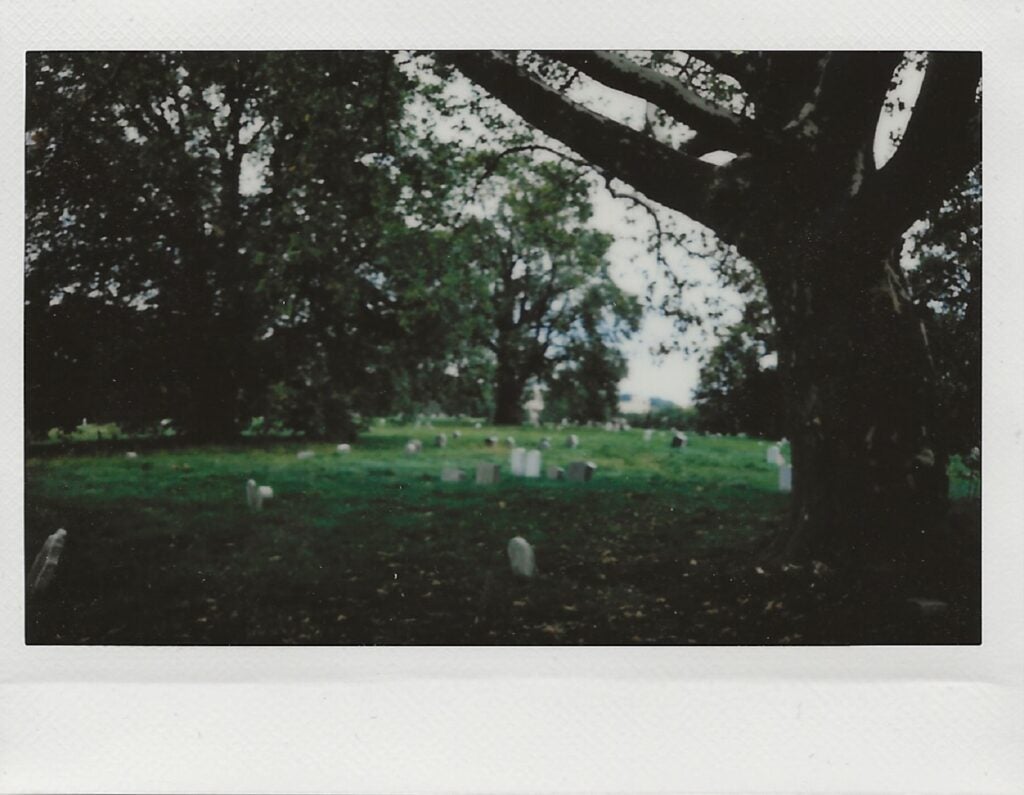
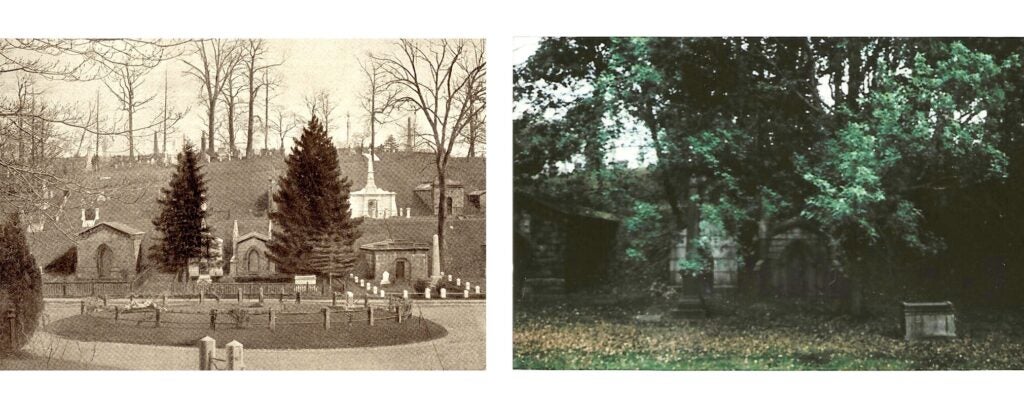
This choice vista had been claimed long ago by Stephen Whitney, the second richest man in New York, when he was laid to rest here in 1860. Whitney wouldn’t recognize the spot now, though; thickset oaks and poplars surround his gabled mausoleum, and seedlings of sweetgum and black cherry sprout from a leaf-strewn understory. In his day, Green-Wood’s official view of nature was benign, then later to be controlled. But never quite as hands off as this. “I have to resist the temptation to make Green-Wood a forest,” Charap said.
Green-Wood’s canopy has changed in the past century, both due to its human stewards and natural events like hurricanes. Photos: Green-Wood Cemetery; Purbita Saha
As Green-Wood runs out of burial space, Charap’s work is part of its evolution into a cultural institution overflowing with history, art, music, and social events. His goal, he told me, is to help Green-Wood reclaim its origins “as a public garden for the people.” But it seems more like a clean break from the past, in which the landscape now possesses a voice on par with its many private owners.
Below Whitney’s gravesite, Charap brought me to a colony of sassafras trees that had taken over the hillside. He snapped off a branch to expose its aromatic bark, which historically has been used for soaps, teas, root beer, and medicines. Sassafras, with its mitten-shaped leaves, typically moves into forest clearings and old fields—or an unmowed slope in a cemetery reimagining itself as it reaches its 200th birthday. Charap decided to run with this happenstance, so his crew trimmed openings through the flora to allow access to the headstones and tombs. These hardy trees would now attract dozens of butterfly and moth species, and the likes of robins and catbirds would feed on their deep blue berries. Left alone, they will sequester carbon for decades.
“Once you stop mowing, you don’t have to do much land management except for figuring out what’s native and what’s not native and deciding what to keep,” Charap said. “We didn’t choose this. But the landscape can occasionally speak for itself.”
Daniel Hymanson’s debut feature is a delicately noticed portrait of extensive-married Chicago artists as they confront their twilight years.
The couple at the middle of Daniel Hymanson’s documentary “So Late So Soon” normally look at by themselves to a mouse and an alligator. The characterization feels apt for Jackie and Don Seiden, two ageing artists who’ve occupied a multicolored Victorian residence in Chicago for many years. Jackie scurries all over, dancing, dusting, and decorating their dwelling with identified objects from Furbies to classic suitcases — all in pastel hues of pink, purple, blue, or yellow. Don, in the meantime, sits in his chair as he reads and sketches, like an alligator, he suggests, waiting “for points to pass me by.” He couldn’t be more out of area in Jackie’s candy-colored wonderland, and it’s this opposition that would seem to gas their fascination with a single a further, as very well as their fairly frequent feuds, as they navigate the ups and downs of getting older, artistic generation, and long-phrase cohabitation.
Hymanson grew up with Jackie and Don, becoming buddies with them right after getting Jackie’s youth art courses at the Artwork Institute of Chicago. Debut aspect “So Late So Soon” is an extension of a number of of his quick movie jobs centering on Jackie, the very first of which he built when he was 15. He cites “Charleen” — Ross McElwee’s extremely subjective, observational portrait of his pal and poetry instructor — as an affect on his do the job, and like that film, “So Late” is impressed by the impactful connections we make with folks outside our family members or age team. It’s clear he’s designed a stage of rely on and convenience with Jackie and Don that allows him fade into the background as he shoots with his handheld digicam. Every single so generally, even so, Jackie will handle Hymanson directly, or he’ll pop into the reflection of a toilet mirror, echoing the directorial interjections McElwee was acknowledged for, and reminding us that a person else is in there.
Linked
Associated
Though we fulfill the Seidens later on in lifetime, Hymanson and editor Isidore Bethel little by little introduce bits of Don and Jackie’s earlier into the photo, portray a fuller portrait of their life and highlighting their sluggish decay by way of comparison. Jackie is shown coming to terms with the constraints of her 78-yr-old overall body, crying out in soreness as she bemoans her condition. “I’m just broken-hearted,” she states. “Me of all men and women: the whirling dervish.” Hymanson then cuts to Tremendous 8 footage of Jackie dancing on roller skates in underwear and a bandeau bra leading in advance of transitioning to faucet shoes. She’s hardly touching the floor as she moves like no 1 is watching, entire of daily life and a seemingly inexhaustible strength. This footage, in particular in comparison with the subsequent shot of Jackie in fetal placement on her sofa, will make you want to get up and shift your physique even though you nevertheless can.
Jackie’s honesty about the ageing system is refreshing. Even as an artist who’s usually been interested in disintegration, she states, it is really hard for her to find the beauty in seeing her personal human body drop aside. Nonetheless, she doesn’t submit simply to old age, which she describes as a “really soiled trick.” Her persona would seem to be completely intact as she “power-dances” to Sade in her dwelling place, skips dessert at lunch (due to the fact she ate ice cream and fudge for breakfast), and carries on her eccentric art tasks around the house with products ranging from rocks to dental floss.
Even though Don is certainly a quieter existence in the house (his laconic mother nature can get on Jackie’s nerves), his inside world is highlighted by means of Hymanson’s watchful camerawork, which observes him speaking to the quirky portraits he sketches in his notebook, animating every 1 with its own identity. Via archival information footage, we’re released to Don’s far more significant artistic pursuits in sculpture, which are influenced by regular visits to the zoo and a adore of the rhinoceros. “I wished I experienced a rhino of my very own to stare at,” he tells the nearby Chicago news station. He sees his everyday living-measurement sculpture of the animal that emerged from this drive as a self-portrait: “The rhinoceros is endangered, but a survivor.”
Jackie and Don conduct a dance that’s in all probability familiar to most couples — how to strike the equilibrium between individuality and separatism? Placid photographs of Jackie participating in jazz piano while Don reads in the dwelling area counsel domestic bliss, but neither of them shy absent from expressing their displeasure when they sense as well individual from just one one more. Don feels “left out” when Jackie semi-lucidly cries for “Mama, daddy, Mark, somebody” to assist her when she’s in pain. Jackie feels slighted when Don wishes to purchase his individual toothpaste. At a dinner get together she spiritedly tells the story of how Don “choked” at the altar, acquiring to action exterior to imagine it in excess of ahead of in the end declaring “I do.” While she laughs about it now, it is distinct that the incident continue to bothers her, as does the reality that he did not want to have children with her. “You ended up exhausted of women, so you would have me. The basic insult,” she sighs all through a combat toward the close of the movie.
Eventually, Don, who’s about 10 a long time Jackie’s senior, has a serious tumble, forcing him to shell out time at a rehabilitation center. The film’s most poignant second comes when Hymenson performs a voice information from Don in excess of footage of their vacant, scarcely lit home, emphasizing just how desolate it feels without the need of him. “I don’t miss out on the television and I really do not miss the computer system, and I never overlook my chair even. But I pass up you.” It is the type of sentiment, clichéd as it may be, that is sometimes needed following a fight (or 50 a long time of them).
Capturing for the movie wrapped in 2017, and Don passed absent in 2019. Jackie has moved to a senior residing elaborate and is promoting the household. Even with out realizing this, the movie feels like a tribute, and an eventual goodbye — to two terribly unique folks, their unconventional house, and their actually outstanding way of everyday living.
Quality: A-
“So Late So Soon” is now playing theatrically in Chicago from Oscilloscope Laboratories. It will open up in New York on December 9 with a countrywide rollout to follow.
FOR Immediate Launch: MEDIA CONTACTS: Clark Back garden Wins Honorable Point out in All-The usa Selections Landscape Design and style Challenge North Hempstead, NY – North Hempstead Town Supervisor Judi Bosworth and the City Board are happy to announce that Clark Botanic Garden was an honorable point out in the All-The us Selections (AAS) 2021 Landscape Design Obstacle in the 10,000 to 100,000 guests for each calendar year classification. All-America Selections is an impartial non-earnings corporation that tests new, by no means-ahead of-offered types. After a entire season of nameless trialing by volunteer horticulture experts, only the major backyard performers are given the AAS Winner award designation for their superior efficiency.
“I was so delighted to find out that All-The united states Choices has as soon as once again identified the natural elegance that is on total display screen at Clark Botanic Back garden in their Landscape Layout Problem,” mentioned Supervisor Bosworth. “This is a testomony to our remarkable Parks Section staff and the superb workers working at Clark Botanic Garden. Their enthusiasm for and determination to Clark Botanic Backyard is what helps make this specific park a accurate hidden gem worth browsing here in the City of North Hempstead.”
This year’s topic of the AAS Landscape Structure Problem was “Range in the Backyard.” AAS supplied the gardens with successful seeds from the last 5 a long time. Gardens not only experienced to create and execute a style and design centered on this year’s concept, but were being also inspired to produce publicity by using social media and “true existence” social gatherings. Gardens had been divided into 3 categories dependent on the variety of visitors per calendar year:
Class I: less than 10,000 people for each yr Classification II: 10,000 – 100,000 website visitors for every calendar year Class III: About 100,000 guests for every year
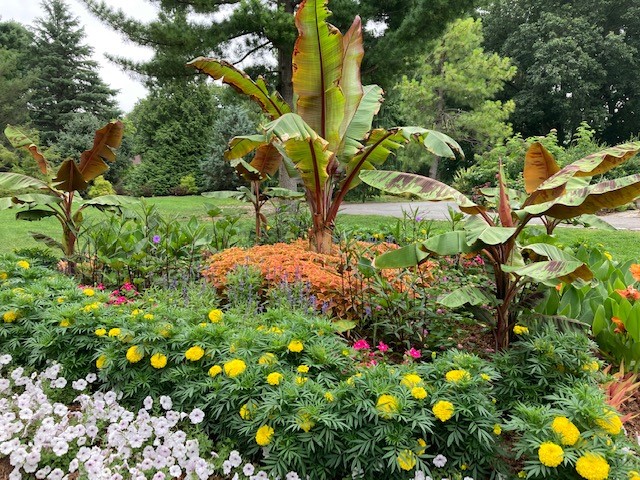
City Horticulturist Bonnie Klein directed Clark Botanic Garden’s participation in the All-The us Alternatives (AAS) 2021 Landscape Style and design Problem. This 12 months a formal Victorian oval such as All-The united states Picks Winners ended up grown and created by Clark team. The planting location holds a numerous array of plant substance, traditional in a botanic backyard garden.
“The AAS application at Clark Botanic Backyard aids to educate our local community about the amazing wide range of plants you can use in your household landscape. These grand displays are a fantastic sort of leisure where people can come across an remarkable however tranquil house at Clark Botanic Garden for all to explore and love,” stated Bonnie Klein, City Horticulturist.
Clark Botanic Yard is an AAS Screen Backyard, providing the public with an possibility to check out the newest AAS Winners (annuals) in an desirable nicely-preserved setting. The network of almost 200 devoted AAS gardens consists of 55 places that have served for 25 several years or lengthier.
Established in 1969, Clark Botanic Garden is a 12-acre dwelling museum and education and learning facility for all ages. Collections at the yard include native spring wildflowers, conifers, roses, perennials, daylilies, wetland vegetation, rock back garden crops, herbs and around a dozen collections of distinct plant families.
Clark Botanic Yard is situated at 193 I.U. Willets Road in Albertson.
This press launch was created by the Town of North Hempstead. The sights expressed below are the author’s individual.