Delhi-Based Artist Creates Beautiful Art Work On Olive Ridley Turtles With Message To Curb Plastic Menace In Oceans

Bhubaneswar: On the closing ceremony of the METIS Initiative on Plastics and Indo-Pacific Ocean 2021 at Utsha Foundation here this evening, the grant-winning artist Manveer Singh shared his experience at the month-long residency and also displayed a short film on his journey in Odisha in transforming his ideas to create beautiful art from plastics and also generating awareness among people and especially among the youth and students.

Today’s installation by Manveer at Utsha created a wall of Olive Ridley turtles hanged from net and the artist has the concept to tell to the visitors, how human activities like fishing are killing the turtles. The tiny ones consuming plastics are also facing life threat near the coastline and especially adjacent locations near the mass nesting grounds. The work today at Utsha, thus explained all the challenges behind the lifecycle of the Olive Ridley turtles, which are in love with the Odishan coast.

The wonderful event on art and sustainability was attended by Consulate General of France Kolkata Mr. Talpain, Regional Director South Asia AgenceFrançaise de Développement (AFD) or French Development Agency Mr. Jacky Amprou, Director AFD India Mr. Bruno Bosle and Sector Portfolio Manager AFD Mrs. Fanny Ragot and Founder of Utsha Foundation and eminent artistJagannath Panda, among others.

Congratulating Manveer, the Consulate General of France Mr. Talpain said ‘’this artistic food for thought is the reminder that art and artists have the power to influence the way we think about the environment. I strongly believe that artists have the power not just to raise awareness about critical issues, but their work is also the key to creating real world impact.’’

Delhi-based artist Manveer Singh’s concept “From Plastic to Art” was selected from 26 applicants. During his stay for the Utsha Residency in association with AFD, Manveer visited various institutions and offices and distributed 40 habit changer boxes to collect the layered plastics to make the tiny turtles for his art work. He also organized a workshop with 28 Peer Leaders (PragatiSathis) of the Bhubaneswar Smart City so that the concept of “From Plastic to Art” is translated to action by others in the society. Peer Leaders are youth and student leaders of Bhubaneswar Smart City to create public awareness among the 100 slums across the Temple City. The workshop was organized at BDA City Centre (NICCO Park) where the Quick Win project under City Investments to Innovate, Integrate and Sustain (CITIIS) is under implementation in Bhubaneswar.

Manveer also conducted a workshop for students at Unit VI Girls High School in which 50 students participated. He also interacted with more than 15 families residing in Government quarters near Utsha Foundation. His installation on Puri sea beach also attracted more than 5,000 visitors on November 24.

The artist, popularly known as “Plastic Wallah’’ in Delhi, has dedicated his works in creating awareness on the menace of plastics in and around the human habitations. However, as the marine ecology is going to be severely affected by plastics by 2050, the artist feels, the awareness level should also get more attention so that the oceans and their ecosystems would be less affected by the plastics and their derivatives.

The METIS initiative is part ofAFD celebrating its 80th Anniversary on December 2, this year and for this the agency has planned events across the Indo-Pacific Region including India, Mauritius and Indonesia. AFD has decided to launch a global initiative METIS, to create a global public opinion on marine debris and pollution.

While this has encouraged participation of artists in India to express their ideas relating to plastic waste production, management and its ill effects on the fragile coastal ecosystem, in Mauritius and Indonesia music and comics respectively were used to create the public awareness.

Currently, AFD is also funding the CITIIS Programme in Bhubaneswar and 11 other cities of India through the Smart City Mission. AFD is funding CITIIS Programme here, supported by Ministry of Housing and Urban Affairs, European Union and National Institute of Urban Affairs, New Delhi and the Government of Odisha.

New art exhibit installed in First United Methodist Church gallery | News

Art critic Dave Hickey, known for book ‘Air Guitar’, dies

Dave Hickey, a prominent American art critic whose essays covered topics ranging from Siegfried & Roy to Norman Rockwell, has died.

His books, including “The Invisible Dragon: Essays on Beauty” (1993) and “Air Guitar: Essays on Art & Democracy” (1997), won him legions of fans beyond the art world experts.

His stylish prose, brash criticism of taste-making institutions like museums and universities and equal embrace of works considered both high- and low-brow left a lasting influence on a generation of artists and critics.

“There is no one like him. He belongs in the canon of American nonfiction prose,” his biographer Daniel Oppenheimer wrote in “Far From Respectable: Dave Hickey and His Art,” published last June.

He died Nov. 12 at home in Santa Fe, New Mexico, after years of heart disease, said Libby Lumpkin, an art historian who was married to him. He was 82.

David Hickey was born in 1938 in Fort Worth, Texas, and grew up moving around Texas, Oklahoma, Louisiana and California. After hopscotching through graduate school programs, he dropped out and opened a contemporary art gallery in Austin, Texas. He moved to New York in 1971, where he ran more galleries, edited the publication Art in America and wrote for the Village Voice and Rolling Stone magazine. His work and interests immersed him in an artistic community that included Andy Warhol, Dennis Hopper and David Bowie.

Dave Hickey speaks at Art Los Angeles Contemporary: Vanity Projects and A Talk with Dave Hickey on February 1, 2014 in Santa Monica, California.
Art critic Dave Hickey often defended the gambling culture and lifestyle of Las Vegas.
John Sciulli/Getty Images for Art Los Angeles Contemporary

Hickey later moved to Las Vegas to teach at the University of Las Vegas, Nevada. In the essays published in “Air Guitar” about how art should fit into broader culture, he championed Las Vegas as the most American of American cities for its detachment from traditional social hierarchies.

America “is a very poor lens through which to view Las Vegas, while Las Vegas is a wonderful lens through which to view America. What is hidden elsewhere exists here in quotidian visibility,” he wrote.

Hickey challenged the idea that the Strip’s neon lights were somehow inauthentic, pushed back against notions that Las Vegas entertainment was culturally irrelevant and “especially enjoyed a good smoke and gambling spree at Eureka Casino on East Sahara Avenue, where he was often spotted with a cigarette while jabbing at slot machine buttons,” according to a Las Vegas Review-Journal obituary.

This May 2008 photo provided by Libby Lumpkin shows Dave Hickey, left with Peter Schjeldahl.
Dave Hickey (left) with fellow art critic Peter Schjeldahl in May 2008.
Libby Lumpkin via AP

In “The Invisible Dragon” and later works, Hickey’s endorsement of “beauty” as the ultimate arbiter of artistic value ignited a clash with his contemporaries focused on 20th century conceptual art’s theory and meaning, who preferred to deconstruct the reasons why people find things to be beautiful.

“He chooses to overlook the view that beauty may be merely what the ruling economic and social elites say it is. In the process, his adversaries argue, he substitutes his own bad-boy outsider judgments for those of narrow-minded art professionals,” The New York Times wrote in a 1999 profile of Hickey.

Lumpkin said her husband never intended to champion traditionalism as his critics claimed.

“A lot of Dave’s work was misinterpreted. The assumption was made that the beauty he was talking about was something very old fashioned, but he was a supporter of very conceptual artists from the beginning,” she said.

Grace Slick and Dave Hickey (with her portrait of Hunter S. Thompson)
Dave Hickey (right) spent his remaining years being a professor at the University of New Mexico in Albuquerque.
Denise Truscello/WireImage

His tastes were indeed eclectic. He sang the praises of artists and figures in popular culture ranging from Norman Rockwell to Robert Mapplethorpe to Ellsworth Kelly. His essays covered basketball player Julius Erving, reruns of the television series “Perry Mason,” and outlaw country music.

In 2001, the MacArthur Foundation awarded him a “genius” grant for his body of work. He was inducted into the Nevada Writers Hall of Fame in 2003 and won a Peabody Award for a 2006 documentary about Andy Warhol.

Hickey and Lumpkin decamped to Santa Fe in 2010 and accepted positions at the University of New Mexico in Albuquerque. Lumpkin said Hickey considered teaching among his most important work and legacy.

“He was a real intellectual without being a snob and he trusted his students to be able to think theoretically. When you put your trust in students like that, they get it and they make good art,” Lumpkin said.

She Fell for the Art, Then for the Artist

Rebekah Headen fell in love with Tony Hernandez years before she actually met him. Not only that, it was love at first sight.

“Where did you get that beautiful painting?” Ms. Headen, 57, who is known as Becky, recalled asking a neighbor who had moved from Atlanta to Charlotte, N.C., where she lives, in 2001.

“It’s a Tony Hernandez,” the neighbor said of the painting of a WWI airplane with a fish hook hanging out of one of the wings. “He’s an extremely talented artist who lives in Atlanta.”

Ms. Headen’s interest in Mr. Hernandez, 56, as an artist increased significantly when he enjoyed a brush with fame following the release of “Drops of Jupiter,” the second album produced by the rock band Train, which featured his artwork.

“That was huge for him,” said Ms. Headen, who received a bachelor’s degree in studio art from the University of North Carolina, Chapel Hill, and works as a talent strategy manager for the Hendrick Automotive Group in Charlotte.

“I fell in love with his style,” added Ms. Headen, who at the time was married and raising two young boys. “I was like OK, I’m going to get one of those paintings one day.”

In 2002, she did just that, commissioning a painting by Mr. Hernandez through Hidell Brooks, an art gallery in Charlotte, as a Father’s Day gift for her then husband. (Titled “Inhook,” it was completed in 2003.)

Ms. Headen followed her order with her very first call to Mr. Hernandez, with whom she confirmed shipping details before learning that he is a history buff who has drawn inspiration from the lives of children who grew up during the Holocaust, as well as those who struggled through the Great Depression, especially in the ghettos of the Bronx where his grandparents lived.

An Atlanta native, Mr. Hernandez attended Georgia Tech before leaving college to pursue a career in painting. His works, mostly of children during the Holocaust and Great Depression, are currently on display at numerous art galleries, including the Fine Arts Museums of San Francisco and the Bronx Museum of the Arts.

The two connected again in 2004, this time in person, at a gallery opening in Charlotte.

“He was such a nice guy,” Ms. Headen said, “though he did seem to mumble a lot.”

After that, they would not see each other until 2013.

Early that year, Ms. Headen, who by then was divorced, went to Chicago with several friends, one of whom mentioned that she had a friend who was single and talented and that his name was Tony Hernandez.

“I thought to myself, ‘This could be very interesting,’” Ms. Headen said.

Mr. Hernandez, also divorced, reached out to Ms. Headen at the suggestion of their mutual friend in June 2013. They eventually began a conversation that led to a first date to watch the Sept. 1 episode of Breaking Bad, their favorite television show.

Mr. Hernandez rode his Harley motorcycle in the rain from Atlanta to Charlotte to meet Ms. Headen for the date.

“I had no negative thoughts as to why I shouldn’t go, which is rare for me,” Mr. Hernandez said. “So I thought maybe it was meant to be.”

In February 2018, after years of dating long-distance, Mr. Hernandez moved to Charlotte to live with Ms. Headen. (Her two sons were living on their own by then.) The pair became engaged roughly three years later, on Feb. 14, 2021.

“I found Becky to be the sum of so many beautiful things,” Mr. Hernandez said. “She was beautiful, smart and understanding, especially about the fact that I spend more time with my painting than I do with her.”

The couple was married Oct. 29 at the home of their friends Kim and Ed Seeger on Little Stono Island, in Charleston, S.C. Lauren Stines, a Unitarian Universalist minister, officiated before 10 fully vaccinated guests, who included Ms. Headen’s sons Franklin, 27, and James, 24.

“We connect on so many different levels,” the groom said of the bride a week after their wedding. “She fell in love with my art long before she fell in love with me, and I don’t think we could have happened any other way.”

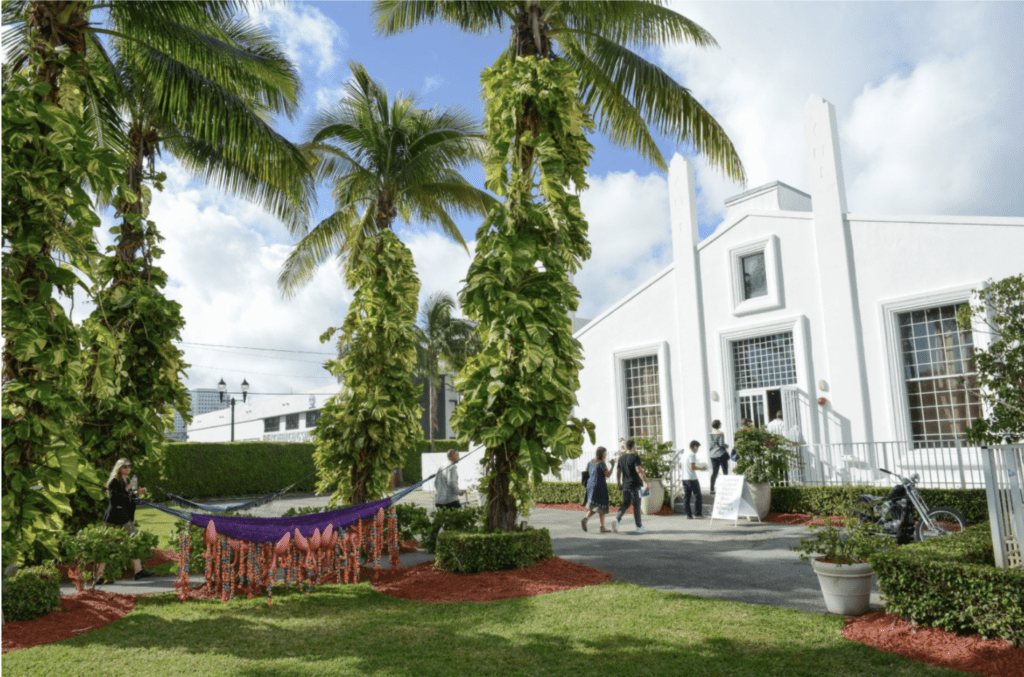
Art Basel Miami Beach Returns, Smaller but Ready to Party

MIAMI BEACH — It’s back. Canceled last year because of Covid-19, the annual Art Basel Miami Beach fair returns next week, unfolding throughout the area. Beginning on Tuesday with invitation-only hours, and open to the public Thursday through Saturday, it will feature 253 galleries exhibiting work inside the city’s Convention Center, as well as a dizzying number of accompanying satellite art fairs, pop-up shows, and celebrity-studded private dinners.

It’s a sprawling cultural circus that has come to be called “Miami Art Week,” complete with corporate branding exercises, from a sculptural forest by the stage designer Es Devlin (commissioned by a Chanel fragrance) to a “Yacht the Basel” fete hosted by the snack food Cheetos, with “dynamic original art pieces created from Cheetos’ iconic orange dust.”

The return of Basel’s Miami fair couldn’t have come soon enough for the gallerists about to converge on Florida from around the globe. While contemporary art auctions are once again smashing records, overall gallery sales remain sluggish. A midyear Art Basel and UBS report by the economist Dr. Clare McAndrew found that nearly half of the 700 surveyed dealers saw a continued decline in sales during the first six months of 2021. Mega-dealers like Larry Gagosian and David Zwirner, with blue-chip rosters and multiple outposts, were rebounding quickly, the report said. But many smaller dealers, who had relied on Art Basel to develop new clients and introduce emerging talents, had been struggling.

Marc Spiegler, Art Basel’s global director, can pinpoint the moment when Miami’s revived art frenzy took off: Sept. 20, when the U.S. government said it would lift the Covid travel ban on most visitors from Europe and Asia in November, thus making the Miami fair the first truly international one in the U.S. since the pandemic’s start.

Spiegler’s phone immediately began burning up with messages from dealers who had previously passed on participating: “By the end of that week more than 30 galleries ‘uncancelled,’” he said, noting that despite all the grousing over “fair fatigue,” there was still no digital substitute for buying and selling art in the flesh. Nearly half the fair’s exhibitors will now be arriving from overseas and Latin America. “I’ve read all the predictions that art fairs were finished, that nobody was going to travel anymore,” Spiegler continued. “We have a show only marginally smaller than the one in 2019.”

This is no doubt a relief for Art Basel’s owners, the Swiss MCH Group, whose stockholder reports show they have lost more than $109 million since the pandemic’s start. Yet if the Miami fair’s return is reason for MCH to cheer, the future of its other two art fairs — Art Basel Hong Kong, scheduled for March 2022, and the flagship Art Basel in Switzerland, scheduled for June 2022 — remains uncertain. Even setting aside the growing wave of government repression and censorship in Hong Kong, there is a mandatory quarantine of up to three weeks for visitors entering the city. Come March, if that quarantine remains, Spiegler said it’s hard to imagine a full-fledged Basel fair happening. And with Covid infections surging again across Europe, sparking new lockdowns, it’s anyone’s guess what June will bring.

These potential losses in revenue for Art Basel make the smooth execution of the Miami fair all the more crucial. To avoid crowding, entry tickets are now timed and proof of a Covid vaccination or a recent negative test is required, as is the wearing of masks. These protocols may seem familiar — and reassuring — to visitors from New York or Los Angeles, but they’re almost nonexistent throughout Miami. Local officials have found themselves overruled on mask mandates by the Florida governor, Ron DeSantis, who has tried to make himself the face of Republican opposition to Biden administration virus policies. For Spiegler, however, the subject isn’t open to debate.

“When you bring together thousands of people from all over the world, wearing masks is the only thing that makes sense,” he said. And if a fair attendee, say, a billionaire art collector, refused to comply with the mask mandate? Would Basel’s security physically eject them from the Convention Center? “That’s what it means to have a mask mandate,” Spiegler answered firmly.

Beyond Art Basel, the mood within Miami’s year-round art scene is anything but tentative. Superblue, a joint venture of the heavyweight Pace gallery and Laurene Powell Jobs’s Emerson Collective, opened this past spring inside a 50,000-square-foot renovated warehouse in the Allapattah neighborhood. Meanwhile, Fotografiska, the privately owned global string of photography museums, has announced that it is moving into the 42,000-square-foot warehouse right across the street, next door to the Rubell Museum, with its David Rockwell-designed building set to open in 2023.

And in the city’s pre-eminent galleries, business is strong. At the Fredric Snitzer Gallery, the director, Joshua Veasey, said things are as busy now as at any point during his six-year tenure there. He credits the established collectors who fled cities up north or out west, riding out the coronavirus in their new Miami residences, who began visiting the gallery for the first time.

“After being stuck inside for so long, there was a lot of redecorating,” Veasey quipped. “These are the problems of the wealthy.” Yet the fresh faces at the gallery didn’t emerge out of Miami’s newly arrived “tech bros,” from the aspiring new media mogul Bryan Goldberg to the PayPal co-founder Peter Thiel, who have relocated here amid a wave of Silicon Valley cheerleading from the city’s mayor. New lower-key clients come with the more typical collector backgrounds of finance and real estate development.

What has trickled down from the tech industry is the love of all things NFT. Art Week hosts a bewildering array of NFT-themed gatherings, including the daylong NFT.BZL conference, featuring a bulging roster of NFT artists, tech figures, and both the city and county mayors. One of the many new NFT marketplaces, SuperRare, has even enlisted the engineers at SuperWorld to install 20 3-D sculptures throughout Art Basel’s Convention Center, viewable there only on their app — a novel way to get in front of influential eyeballs while sidestepping the fair’s curatorial committees and the roughly $60,000 (and up) booth fee.

“I was skeptical at first, I wanted to see if NFTs would have more than five minutes of life,” conceded the Miami multimedia artist Carlos Betancourt, one of the few established local talents to have embraced the new blockchain-based medium. He said the key to his comfort was finding a platform, Aorist, with a curator, Ximena Caminos, who was already a longtime supporter of his work. That, and Aorist’s willingness to produce a real-life version of his seen-only-on-a-screen NFT piece “What Lies Beneath,” which spotlights global warming’s rapid melting of the polar ice caps. The result, whose sale will benefit a local underwater sculpture park, is a pair of faux icebergs — one of which is 20 feet high and 30 feet wide, wrapped in collages of Sven-Olof Lindblad’s photos of actual icebergs, and set afloat in the oceanfront pool of Miami Beach’s Faena Hotel.

While room rates at the Faena — starting at $3,300 a night, $5,500 for an ocean view — may limit the audience for “What Lies Beneath,” it’ll still be hard to avoid seeing Betancourt’s artwork and its varied styles around Miami next week. “Into The Everglades,” his animated silhouettes of Florida wildlife, will lope nightly across the side of downtown’s 35-story-high InterContinental Miami hotel; “Milagro!,” a 38-foot-long string of 245 handcrafted charms, commissioned by the city of Miami Beach, will hang across a busy city boulevard; and two of his photos — homoerotic portraits of both himself and his longtime partner and collaborator, the architect Alberto Latorre — will be featured in a group show, “Skin in the Game,” inside a Beach storefront.

His ubiquity, Betancourt said, is proof that Miami’s museums and collectors alike have finally embraced the city’s own artists, prodded by Art Basel’s attention to made-in-Miami work. “People had an inferiority complex here for many years,” he continued, recalling his arrival from Puerto Rico as a teenager in 1980, discovering an art scene that too often looked elsewhere for direction. The shift is evident next week as local institutions proudly exhibit work steeped in Miami’s social fabric.

For starters, Anastasia Samoylova’s “FloodZone” photos at the HistoryMiami museum capture an often surreal visual interplay of flora, fauna, and crumbling concrete; Gary Monroe’s “Refuseniks” photographs at Florida International University’s Miami Beach Urban Studios offer a poignant study of early ’80s Jewish immigrants from the Soviet Union rebuilding new lives in a then-unraveling South Beach; and Jared McGriff’s otherworldly paintings at the NSU Museum of Art Fort Lauderdale depict visions of Black life that are simultaneously troubled and stirringly gorgeous.

This seriously minded artwork is being presented within the context of a tropical weeklong party. If that seems contradictory, Betancourt believes that embracing that contradiction is precisely what has made Miami finally come into its own as an art city: “We enjoy the party and that manifests itself in our work,” he said. “That’s what Miami brings to the equation — we do it all unapologetically.”

New Art Dealers Alliance Announces MobileCoin Art Prize, To Be Awarded at NADA Miami 2021

NADA miami 2021

The New Art Dealers Alliance (NADA), the definitive non-profit arts organization dedicated to the cultivation, support, and advancement of new voices in contemporary art, is partnering with MobileCoin for the inaugural MobileCoin Art Prize, an award that highlights, celebrates, and supports artwork addressing the critical topic of privacy at NADA Miami 2021. Juried by writer and curator Andrew Beradini and contemporary artist and MobileCoin Art Director Inga Bard, the prize is the first of its kind within the cryptocurrency sector, establishing MobileCoin as an industry pioneer thoughtfully navigating the intersection between art and cryptocurrency. It will be awarded to one of the 170 plus exhibitors at NADA Miami 2021 in the form of $7,500 equivalent to MOB.

“We’re thrilled to partner with MobileCoin to introduce a new initiative that shines a light on privacy issues in the digital art space. As we see the art world expand into the digital sphere, we share in MobileCoin’s commitment to give artists at all stages of their careers the space, time, and platform that remains essential to artistic freedom.”

said NADA Executive Director Heather Hubbs.

MobileCoin is a cryptocurrency designed to be used as digital cash on your phone. With nearly instantaneous transactions and a strong commitment to supporting the arts, MobileCoin is the first carbon-negative cryptocurrency. 

“We believe that privacy is fundamental to art. The right to privacy is the right to solace, to reflection, to expression; it is the right to association and movement without intrusion or intimidation. Privacy is essential to the autonomy and dignity required to make art and participate in the cultural life of a free society,”

said Joshua Goldbard, Founder of MobileCoin.

NADA Miami will feature over 170 exhibitors across three sections: Galleries; NADA Projects, an open, exhibition-like presentation of new art from emerging voices; and the latest addition, Artists’ Book Publishers, a co-presentation of artist book publishers with Printed Matter and EXILE Books. This year also introduces Curated Spotlight, an inaugural special section at NADA Miami 2021 curated by Ebony L. Haynes. The section will feature eight solo presentations by exhibiting galleries.  

NADA MIAMI 2021 VIP Opening Previews (by Invitation): Wednesday, December 1, 10am–2pm
Open to the Public: Wednesday, December 1, 2–8pm, Thursday, December 2, 11am–7pm Friday, December 3, 11am–7pm Saturday, December 4, 11am–7pm newartdealers.org/nada-miami-2021

About MobileCoin
MobileCoin is a cryptocurrency designed to be used as digital cash on your phone. MobileCoin’s payment system is easy to use with near-instantaneous transactions. With a strong commitment to supporting the arts, MobileCoin is the first carbon-negative cryptocurrency. @mobilecoin.art

Categories

Tags

Author

Mark Westall

Mark Westall is the Founder and Editor of FAD magazine Founder and co-publisher of Art of Conversation and founder of the platform @worldoffad

The Ingram Collection today announced the finalists for Ingram Prize 2021, the leading annual prize for contemporary artists in the UK. The […]

lido-swimming-pool-at-the-curtain-hotel-shoreditch-london-conde-nast-traveller-7june17-Adrian-Houston

The covid-19 pandemic revealed to many people just how important travelling is. The lockdown has been eased in many countries; […]

Jacob Love wins the Concord Art Prize with his three-channel audio-visual installation, created in response to Rodgers & Hammerstein’s My […]

CasinoUSA.com has recently announced a plan to acquire a total of 50 BTC. The popular online gambling platform has been […]