
Green-Wood Cemetery leads sustainable landscaping

Horticulturists, like theater directors, work behind the scenes. They don’t sign up to get booed. But during the summer of 2019 at Brooklyn’s Green-Wood Cemetery, its director of horticulture, Joe Charap, was chewed out by lot owners time and again. His offense? He had decided to stop mowing half of the site’s 400 acres of turf to reduce carbon emissions and check the spread of invasive plants.

“The headstone was shrouded in weeds and covered in tall grass,” one person said of their father’s plot. “It’s disrespecting our family.” Another wrote: “The area looks terrible. It is not mowed and looks disheveled.” And another: “I couldn’t help but feel I was looking onto the Serengeti plains with grassland growing out of control in a manner that I feel desecrates the final resting place of all lying in eternal [sic] slumber. What’s next, controlling the growth with grazing sheep and cattle?”

A life-long New Yorker, Charap expected some shock. For a cemetery, not mowing was a radical step, but the complaints still stung. After all, his job was to care for Green-Wood’s most valuable feature: its landscape. The glacier-carved hills, valleys, and ponds were the reason a group of wealthy Brooklynites chose it for one of America’s earliest rural cemeteries in 1838. Since then, New Yorkers of all stripes have visited the roughly 500-acre grounds to mourn, or get their fill of fresh air and nature.

But those grounds, as Charap learned over the first few years in his role, were changing for the worse. The main culprit was Bermudagrass, a fast-growing, warm-season invasive which had been introduced to the southern US, likely from Africa, more than two centuries ago. At Green-Wood, Bermudagrass was growing unabated due to some of the energy-intensive practices used to tend cemeteries and yards across the US.

It was a model that Charap walked into when Green-Wood hired him out of horticulture school in 2015. Rejecting it wasn’t going to be easy. There are upwards of 144,000 cemeteries and graveyards in the US, according to one NASA cartographer; they cover 4,300-plus acres of New York City alone. With all that ground, there’s plenty of room to test out lawncare techniques that break with the century-and-a-half tradition of over-pruning, overwatering, and over-fertilizing open spaces. A strategic, yet laissez-faire approach, as more research is finding, can save resources and help mitigate human impacts on local wildlife and climate change.

To put it more bluntly, by scaling back mowing, Charap wanted to change Americans’ perceptions of landscaping, one cemetery—or tiny burial plot—at a time.


However Bermudagrass ended up at Green-Wood in the 20th century (perhaps from ship ballasts or Southerners who buried it at the gravesite of a loved one), by 2019 it had taken over 10 percent of its grounds, thanks in large part to Brooklyn’s warming seasons.

Aesthetically, the plant was a disaster. Straw-like and brown when dormant, it only turned green after Mother’s Day, an important holiday at any cemetery. The more frequently it was cut, the faster it grew: By mid-summer, it was creeping up over the gravestones by about two inches per week. What’s more, the growing season was reaching into November due to climate change. The result was an intractable monoculture.
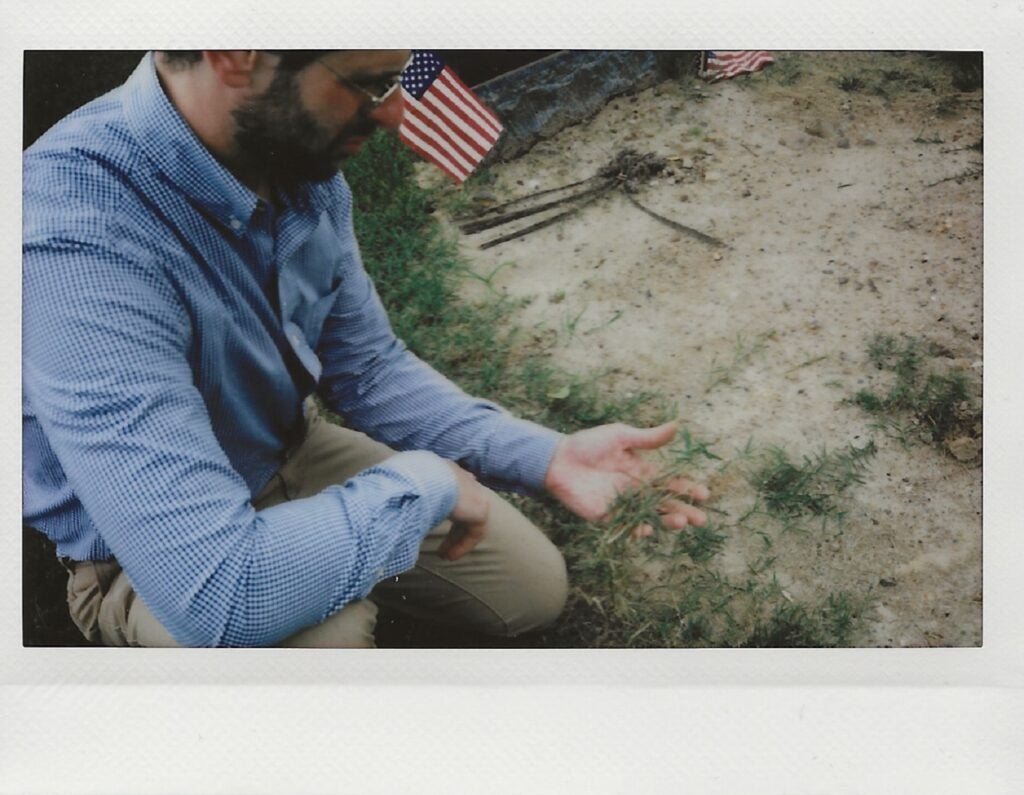
A horticulturist in glasses, a blue shirt, and khakis holding a long piece of Bermudagrass with its root on a sandy grave plot decorated with American flags
Joseph Charap, the director of horticulture at Green-Wood, digs up a long piece of Bermudagrass. The weedy plant thrives in disturbed soils. Photo: Purbita Saha

As landscaping crews battled the Bermudagrass, Green-Wood’s annual mowing bill ballooned to $1.2 million. The use of herbicides was also proving costly and ineffective.

Charap had once looked at these expenses as one would their utility bill—annoying but unchangeable—until he began assessing the true cost of conventional lawn care. The weedwackers and ride-on mowers burned 12,000 gallons of gasoline a year, equivalent to 235,000 pounds of carbon dioxide emissions. As an accredited arboretum, Green-Wood boasts more than 7,000 trees, but the canopy is well short of the forest it would take to offset such pollution. Decades of weekly mechanical mowing had also left visible scars, like pockmarked monuments and eroded slopes, as well as invisible ones, like the native flora unable to survive the blades.

Charap knew that most lot owners expected cemeteries to be neatly manicured, but he wanted to do better. So he turned to Cornell University’s Frank Rossi, a straight-talking, Bronx-born turfgrass scientist who advises major golf courses and sports teams like the Packers and Yankees. They convinced Green-Wood’s trustees to invest in a three-year partnership with Cornell to tackle the effects of Bermudagrass and climate change on the cemetery’s landscape. If it all went according to plan, Green-Wood would become the leader in this fight among all urban grasslands.

Nobody at the cemetery had studied these effects before. In 2018, Charap and Rossi flew a dozen drone missions over its core to uncover the biggest problem areas. They buried three microclimate sensors in different areas to learn where Bermudagrass was growing fastest, and outfitted 20 mowers with trackers to record their activity and fuel use. The two experts also brought in new seed mixtures and topsoil for landscaping, and laid out more careful burial procedures to keep invasives away from fresh gravesites. But their main hurdle was that Bermudagrass thrives in disturbed soil—an existential crisis for an active cemetery with more than a thousand burials each year.
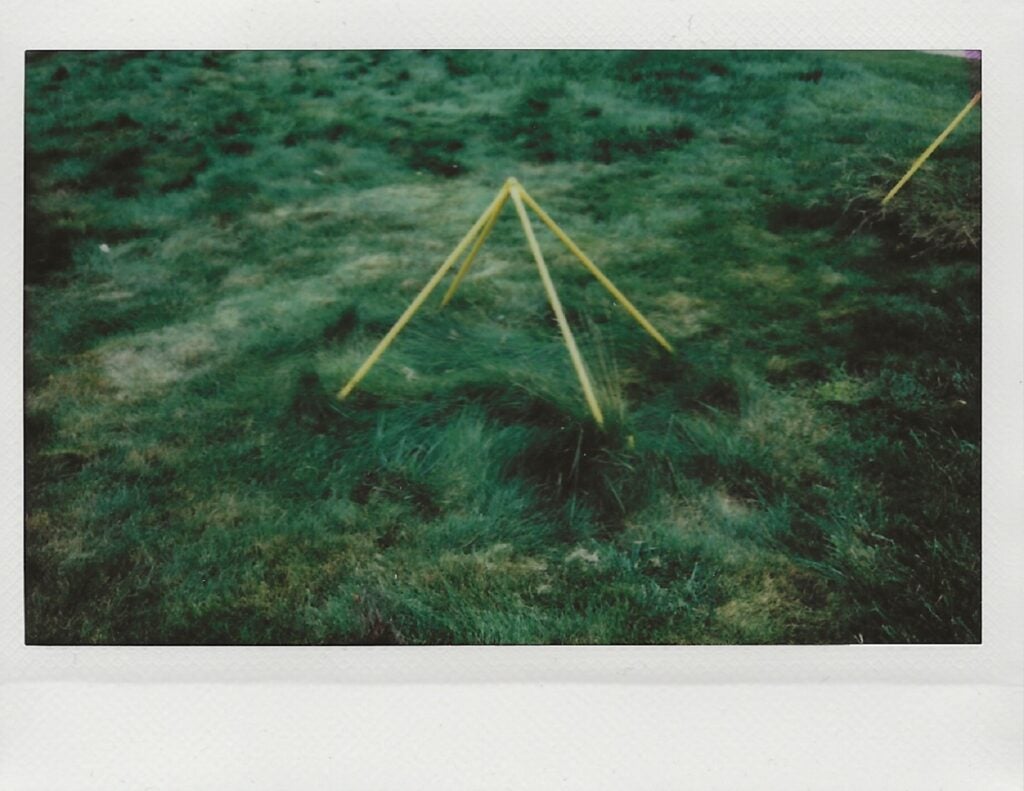
Yellow stakes in a teepee formation over an experimental grass plot outside the main entrance of Green-Wood Cemetery
Stakes mark off different experimental plots for native grasses at the cemetery’s main entrance. Photo: Purbita Saha

In June 2019, a fluke in the landscape showed them a way forward. Rossi and two colleagues were walking through a quiet corner called the Hill of Graves when they stumbled on a patch of little bluestem, a well-known native prairie grass, rising out of a spot the mowers had missed. So there was a chance that underdogs could grow here, and maybe even beat out the Bermudagrass. Why not let certain areas go a little wild and see what happened, Rossi asked?

He and Charap decided to try. They removed a hundred acres of Green-Wood from the mowing rotation entirely, and set aside another hundred to be mowed monthly. With that, they charged into a cultural firestorm—and very quickly those comparisons to the Serengeti plains. “We started having this institutional conversation about reimagining the American lawn,” Rossi says. But that conversation became painfully one-sided. Charap, who discoursed with lot owners in person and over email, faced the brunt of it. “We underestimated the emotional connection that many people have with turf,” he says. While some told him they agreed with his mission, they also demanded, “but don’t do it on my lot, do it on that other lot.”

Within two months, a disappointed Charap had all the grass mowed, and he and Rossi returned to the drawing board.


Almost two years later, on an unnervingly warm late-spring morning, Rossi bounds up the gently sloping Hill of Graves with grass lapping at the top of his black leather boots. “Where’s that little bluestem, Joe?” he shouts behind him to Charap, who is not about to give chase in 90-degree heat.

There’s nobody else around. And it’s otherwise quiet save for a mockingbird imitating a car alarm from a dogwood on the hillside. The sweet fragrance of a flowering linden fills the air. The grass hasn’t been cut in three weeks, and what looks like a meadow has grown in. The Hill of Graves, like most of Green-Wood, used to be cropped within two inches of the soil almost every week outside of winter. Now it’s mowed to five inches only six times a year.

“It’s never looked this good, Joe,” Rossi says. “If this is what six mows looks like, we could do this for the whole cemetery.”

That’s Charap’s goal, and after the initial setback of 2019, this is a more carefully plotted step in that direction. Last year, he and Rossi set aside 43 acres of what they’re calling perpetual meadows, and the roughly 12-acre Hill of Graves is the largest one. Still, Charap carries the scars—and lessons—of that earlier summer. “We thought that no one was going to notice when we stopped mowing 100 acres, which in hindsight is just ridiculous,” he says. “You can slowly adapt people to a change in the landscape, but you have to prepare them for it.”
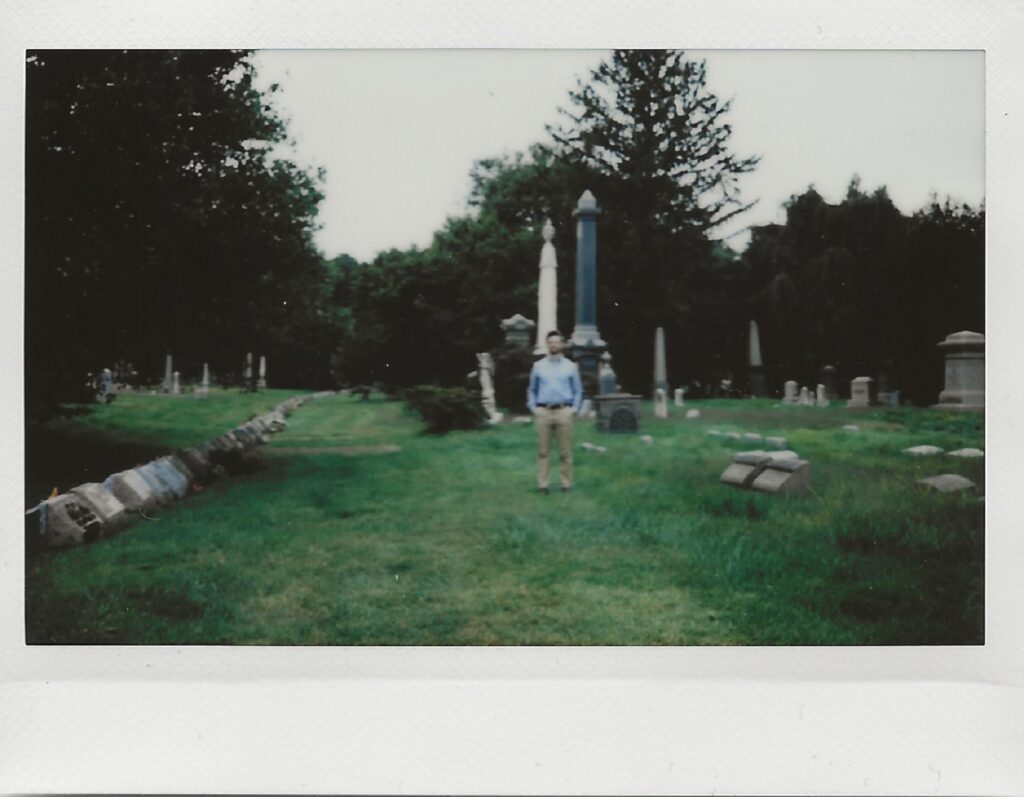
A horticulturist in a blue shirt and khakis staying on the mow line among tall headstones
Charap stands in a freshly mowed vs. unmowed plot in October. Photo: Purbita Saha

Turf grass is a deeply rooted social construct, Rossi says, pointing to the fact that US households spend around $30 billion annually on landscaping. Most of it is devoted to lawncare, which itself adds to ecological problems. Lawns are considered the most widely irrigated landscape in the country, and the Environmental Protection Agency reports that 5 percent of the country’s air pollution comes from two-stroke mowers. The explosion in lawns has also been connected to a decline in native insects and other wildlife.

But a countermovement is emerging. From suburban yards to historic cemeteries like Green-Wood, there’s a growing push to reckon with the unsustainable consequences of this obsession. “The impact that cemeteries can have by changing the way they’re managing their lawns is significant,” says Sara Evans, Green-Wood’s manager of horticulture operations. Reducing soil disturbances like mowing and digging helps cut down the amount of greenhouse gases released; so does strategic rewilding with meadows and other ground cover.  

Indeed, natural grasslands act as major carbon sinks—even more so than trees in places where wildfires are common, given that most of the carbon is stored underground. What’s more, 90 percent of the world’s grasslands have been grazed, cleared, or otherwise corroded, making them one of the most endangered habitats. 

Other historic cemeteries are seeing how they can reduce their carbon emissions, too. Cincinnati’s Spring Grove opened seven years after Green-Wood and became the home of the first “lawn plan,” a design that emphasized open spaces and clean lines and was adopted throughout the country. But now, according to Dave Gressley, its director of horticulture, they plant sedge, which requires little mowing, wherever possible, one plug at a time. They’re also working to rebuild their canopy after the loss of hundreds of mature trees to disease and storms. As for meadows, though, Gressley says, “Cincinnati is on the conservative side, so that wouldn’t fly here.”

At Green-Wood, the free-growing patches were chosen in large part by visitation and the contours of the ground. Areas with newer graves were avoided. The Hill of Graves, for instance, is mostly made up of 19th-century public lots. Grass there now reaches halfway up simple flagstones. Fields of clover rise after spring rains, and Green-Wood puts on small classical-music concerts under a sprawling European beech tree at the slope’s crest.
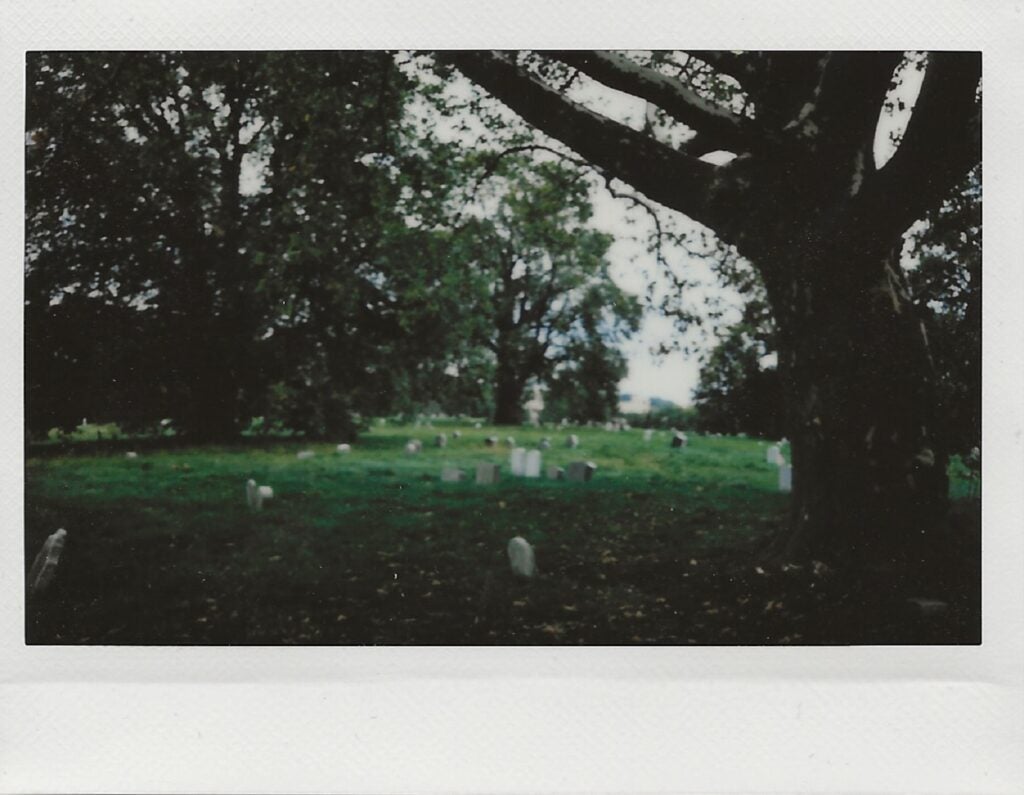
A tree-lined hill covered with headstones
The Hill of Graves, a popular attraction at the cemetery, was the first test site. Photo: Purbita Saha

This and the other meadows look unplanned—a little wooly in parts, tidier in others—but Charap and Rossi say they require more attention and foresight than simply mowing. Weed control is still employed twice a year to keep invasives at bay. Instead of a monoculture, Bermudagrass now blends in with native grasses like fescue, bluestem and Kentucky bluegrass. Once on the Hill of Graves, they used a tractor-trailer outfitted with blowtorches to try to regenerate those grasses through fire, as a way to recreate the natural fire cycle that once existed in tallgrass prairies of the Great Plains and upper Midwest. Heating up the soil releases nutrients from decaying plant material that feed the growth of new grasses and flowers. “We’re working with the landscape as opposed to trying to bend it to our will,” Rossi says.

Working with Rossi, who began mowing lawns in New York’s suburbs as a kid and briefly studied to become a Catholic priest, has converted Charap into a turfgrass obsessive. When he began working at Green-Wood, he says, the only thing on his mind was its “charismatic megaflora.” The grass was a place to rest his eyes between trees.

“But now when I look at the landscape,” he says, “all I see is grass.”

Rossi laughs, as Charap continues. “We can plant trees here till the cows come home, but in terms of climate change, that would be a drop in the bucket compared to what we can accomplish with managing the turf better.”

Indeed, Green-Wood has reduced its greenhouse gas emissions by nearly a quarter since 2018. They’ve continued to track environmental data throughout the cemetery—on microclimates, burials, mowing, soil movement—and used that to keep the grass at a taller height, but one that is largely uniform. Rossi and Charap believe that consistency (and the presence of fewer weeds) has led to fewer complaints.

[Related: It’s time to rip up your lawn and replace it with something you won’t need to mow]

Less mowing has created a healthier, often surprising ecosystem. For the first time in memory, Charap and his team found a patch of the delicate pink wildflower springbeauty. A two-year wildlife survey turned up 62 native bee species, most of them in the new meadows. And a male bobolink, a small grassland specialist in decline that migrates between South and North America, recently turned up on the Hill of Graves. During that extraordinary journey, bobolinks seek out weedy fields or tall grass, of which Green-Wood once had very little. In spring, the males look like they’re wearing a backward tuxedo, but their song is their calling card, a robotic, R2D2-like mashup which this one sang from atop wind-blown cedars.

“We call that proof of concept,” Charap says of the discovery.


The third and final year of the Green-Wood and Cornell partnership was a busy one in unexpected and tragic ways. The early months of the COVID-19 pandemic halted all non-burial work. Charap’s eight-person crew of gardeners and arborists assisted with burials, and the restoration staff helped run the crematorium, where workers alternated 16-hour, seven-day shifts. In the pandemic’s first year, almost 5,600 people were cremated, buried, or entombed at Green-Wood—up 38 percent from the previous 12 months.

At the same time, the cemetery offered relief during crisis. As the city went into lockdown, access to greenspace felt like a boon. It was as if Green-Wood, which had been the model for New York’s first parks and was said to rival Niagara Falls as America’s most popular destination, was reborn—a refuge for the living as much as the dead. Roughly 110,000 people came through its four gates in May 2020, almost triple the same month in 2019. The cemetery extended its hours and has continued to keep all those gates open daily. Around 600,000 individuals visited Green-Wood in 2020, up 82 percent from 2019.

For many of these visitors, the meadows became Instagram-worthy favorites. Buoyed by this reception, Green-Wood leaned into them. They turned the lawn in front of its famous Gothic arches into a two-acre meadow. Charap had never seen so many kids playing in it. “This is right in front of the cemetery and we’re saying, ‘This is who we are now.’”

It seems more like a clean break with the past, in which the landscape possesses a voice on par with its many private owners.

Education has become central to their work. Rossi, though technically off the hook at the end of last year, is beginning a new chapter at Green-Wood. He and Charap are planning an Urban Grasslands Institute that will occupy space in a restored, landmarked greenhouse, where they’ll share land-management techniques with climate-change researchers, city parks managers, homeowners—a place to continue rethinking the American lawn.

I met Charap again on a cloudy spring morning in front of his residence at Green-Wood—a brownstone-clad, slate-roofed Gothic Revival gatehouse where he lives with his wife and their two young children—and we walked a short distance to the ridge that marks the southernmost reach of the last glacier in these parts. From there, we looked out upon the flatlands of Brooklyn and the rides of Coney Island along the Atlantic Ocean.

This choice vista had been claimed long ago by Stephen Whitney, the second richest man in New York, when he was laid to rest here in 1860. Whitney wouldn’t recognize the spot now, though; thickset oaks and poplars surround his gabled mausoleum, and seedlings of sweetgum and black cherry sprout from a leaf-strewn understory. In his day, Green-Wood’s official view of nature was benign, then later to be controlled. But never quite as hands off as this. “I have to resist the temptation to make Green-Wood a forest,” Charap said.
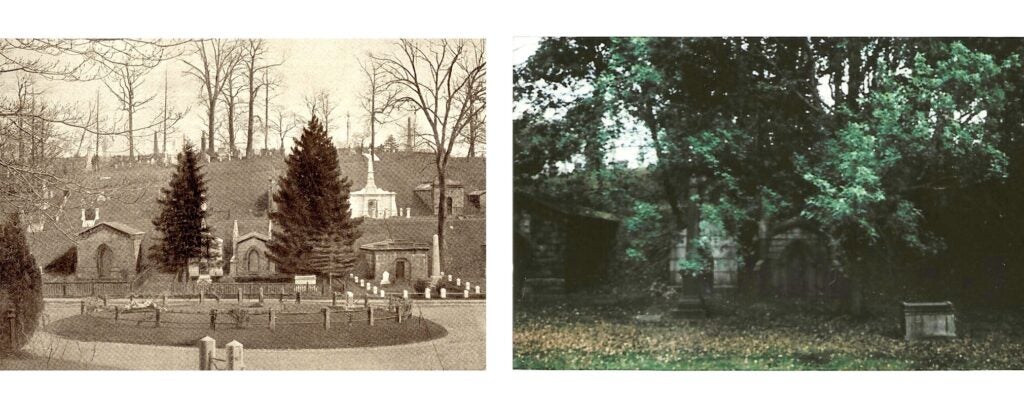
Green-Wood Cemetery Cooper tomb in the early 1900s next to the tree-covered modern landscape
Green-Wood’s canopy has changed in the past century, both due to its human stewards and natural events like hurricanes. Photos: Green-Wood Cemetery; Purbita Saha

As Green-Wood runs out of burial space, Charap’s work is part of its evolution into a cultural institution overflowing with history, art, music, and social events. His goal, he told me, is to help Green-Wood reclaim its origins “as a public garden for the people.” But it seems more like a clean break from the past, in which the landscape now possesses a voice on par with its many private owners.

Below Whitney’s gravesite, Charap brought me to a colony of sassafras trees that had taken over the hillside. He snapped off a branch to expose its aromatic bark, which historically has been used for soaps, teas, root beer, and medicines. Sassafras, with its mitten-shaped leaves, typically moves into forest clearings and old fields—or an unmowed slope in a cemetery reimagining itself as it reaches its 200th birthday. Charap decided to run with this happenstance, so his crew trimmed openings through the flora to allow access to the headstones and tombs. These hardy trees would now attract dozens of butterfly and moth species, and the likes of robins and catbirds would feed on their deep blue berries. Left alone, they will sequester carbon for decades.

“Once you stop mowing, you don’t have to do much land management except for figuring out what’s native and what’s not native and deciding what to keep,” Charap said. “We didn’t choose this. But the landscape can occasionally speak for itself.”
Landscaping ideas dominate design input meeting for North Augusta public safety headquarters

Nov. 18—Boards and boards of thought styles for the new North Augusta General public Basic safety headquarters lined the Palmetto Terrace in the North Augusta Municipal Setting up for a community structure input meeting.

The informal, collaborative assembly allowed citizens and council members to give their impressions and remark on the exterior of the new headquarters, which will sit at Georgia Avenue involving Butler and Observatory avenues.

Reps from Johnson, Laschober & Associates, the prime consulting architecture and engineering business on the venture, had been in attendance to solution queries for the public. JLA labored together with an architect from North Carolina that specializes in public safety buildings on the job.

“These are the people that will be dwelling with this facility for a variety of a long time. They’ve ridden by it. They have lived about it and they have a vested desire in what it is heading to glimpse like, if it really is heading to mix with the architecture,” Darren Prickett, a senior landscape architect with JLA claimed. “So, this is crucial for us as architects to get the architecture suitable.”

“We want it to glance like it belongs in North Augusta and I assume that we are going to get there. I consider the Georgian design and style, the additional standard type of architecture, is what we need to do,” Prickett mentioned.

While some inhabitants were upset with the design and sourcing talent from outside the house the CSRA, most attendees ended up content they were being able to deliver enter on the challenge.

Various citizens proposed a memorial for the 7 Gables and Flythe attributes, in addition to adding greenspaces, a pollinator backyard garden and preserving historic trees.

“I imagine that it is wonderful that the city is obtaining us occur in to give our opinions. I am encouraged by what I am listening to,” North Augusta resident Lenny Birt reported. “I am right here to consider to sustain as significantly of the experienced trees on the house as attainable and it appears like the city’s accomplishing that. I feel it’s a very good very first step for the task.”

North Augusta Mayor Briton Williams was happy to see public engagement on the venture.

“Is it real looking that we are going to consider anything they say? Completely not,” Williams said “But, we are offering them a voice. We wager that there will be tips that we can use.”

Throughout the Nov. 15 town council conference, North Augusta Metropolis Administrator Jim Clifford gave council an update on the home, indicating that metropolis crews have been clearing the site, poles have been de-energized by Dominion and that asbestos has been observed in the old motel tiles. According to Clifford, the asbestos removing will have to have to be bid on just before total demolition of the property.

Clifford explained finalized layout designs must be done and shown to council in early 2022.

“It’s a terrific asset for us to have this in our potential. We have been waiting around on it for a long long time. It truly is one thing that we have been talking about at the very least for the 12 many years I’ve been below. It’s a terrific option for community protection to take a move ahead into the long term,” North Augusta General public Security Section Director John Thomas mentioned. “We are pretty grateful that the council and the mayor have supported this effort and hard work and we are fired up about what we are going to get in the upcoming.”

Samantha Winn addresses the metropolis of North Augusta, with a concentrate on government and local community oriented organization. Observe her on Twitter: @samanthamwinn and on Facebook and Instagram: @swinnnews.

Landscaping suggestions dominate design input meeting for pubic safety headquarters

Nov. 18—Boards and boards of concept models for the new North Augusta Public Protection headquarters lined the Palmetto Terrace in the North Augusta Municipal Making for a public style and design input assembly.

The casual, collaborative meeting allowed residents and council customers to give their impressions and reviews on the exterior of the new headquarters, which will sit at Ga Avenue in involving Butler and Observatory Avenues.

Johnson, Laschober & Associates, the key consulting architecture and engineering organization on the job, was in attendance to reply questions for the public. JLA worked along with an architect out of North Carolina who specializes in public safety structures on the venture.

“These are the people today that will be residing with this facility for a number of many years. They have ridden by it. They’ve lived all-around it and they have vested interest in what it is going to search like, if it’s likely to mix with the architecture,” Darren Prickett, a senior landscape architect with JLA claimed. “So, this is vital for us as architects to get the architecture correct.”

“We want it to appear like it belongs in North Augusta and I feel that we are heading to get there. I imagine the Georgian type, the more traditional fashion of architecture, is what we require to do,” Prickett reported.

When some residents have been upset with the style and the outsourcing of expertise outside the CSRA, most attendees had been delighted that the citizens experienced an enter in the project.

A number of inhabitants proposed a memorial for the 7 Gables and Flythe attributes, in addition to introducing greenspaces, a pollinator yard and preserving historic trees.

“I think that it is good that the city is getting us arrive in to give our responses. I am inspired by what I am listening to,” North Augusta resident Lenny Birt stated. “I am below to attempt to keep as considerably of the experienced trees on the property as achievable and it appears like the city’s performing that. I think it’s a very good to start with move for the challenge.”

Mayor Briton Williams was glad to see general public engagement on the challenge.

“Is it reasonable that we are likely to consider all the things they say, certainly not. But, we are providing them a voice,” Williams mentioned. “We guess that there will be concepts that we can use.”

In the course of the Nov. 15 city council meeting, metropolis administrator Jim Clifford gave council an update on the home, expressing that metropolis crews have been clearing the internet site, poles have been de-energized by Dominion and that asbestos has been located in the previous motel tiles. In accordance to Clifford, the asbestos removal will require to be bid on prior to comprehensive demolition of the home.

Clifford claimed that finalized style ideas should really be completed and shown to council in early 2022.

“It really is a great asset for us to have this in our future. We’ve been ready on it for a long extended time. It is really something that we’ve been talking about at minimum for the 12 years I’ve been in this article. It can be a good option for community basic safety to choose a action ahead into the long term,” North Augusta General public Protection Department Director John Thomas claimed. “We are really grateful that the council and the mayor have supported this exertion and we are energized about what we are going to get in the upcoming.”

Samantha Winn covers the town of North Augusta, with a concentrate on government and group oriented organization. Observe her on Twitter: @samanthamwinn and on Fb and Instagram: @swinnnews.

R&R Landscaping Receives National Award of Excellence

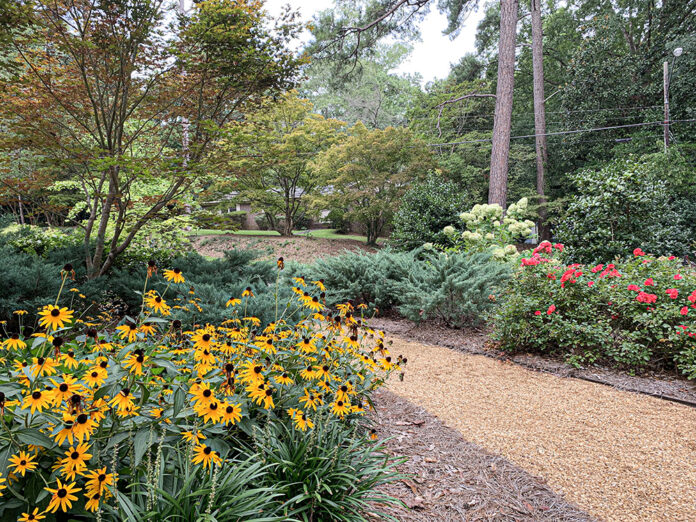
R&R Landscaping’s clients requested plant substance that introduced coloration and texture without high routine maintenance. The large variety of plant content fits with each other like a puzzle to offer visual interest all calendar year prolonged.


Contributed
to the Observer

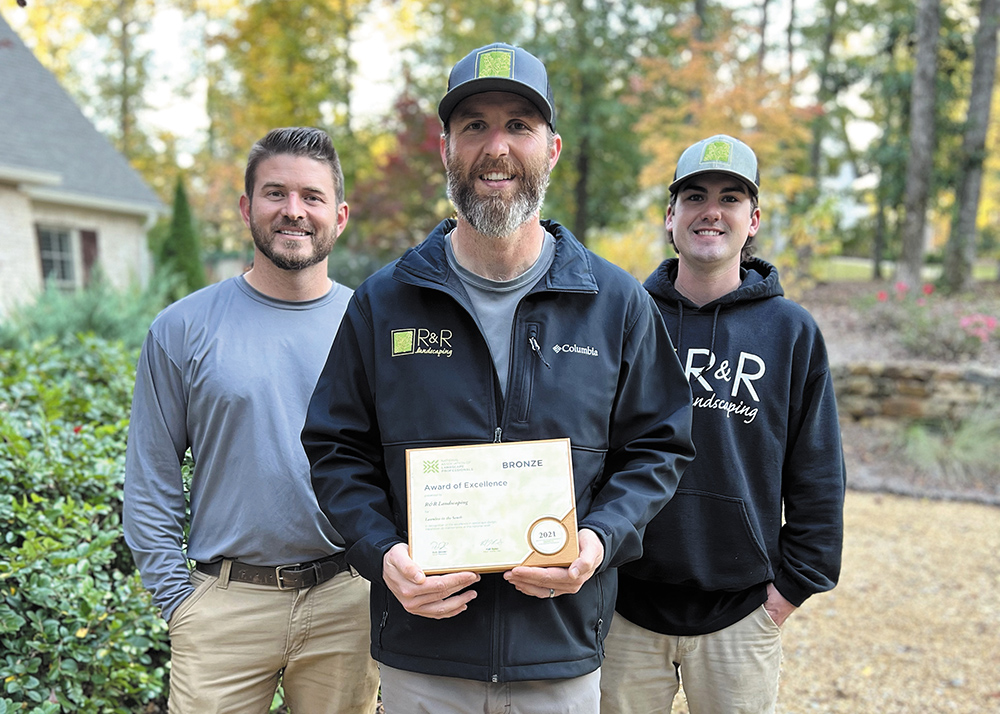
R&R Landscaping is proud to have attained an Award of Excellence by The National Association of Landscape Gurus (NALP) for its perform in residential style/build assignments in the Auburn local community. 

Its successful challenge, Lawnless in the South, showcased an out of doors house for a shopper with “a enthusiasm for plants and zero time to treatment for them.” The owners built this house to simplify and deliberately restrict the require for maintenance crews coming in and out all the time. With these objectives in brain, they asked for impactful plant selection, no lawn and as a great deal privateness as attainable.

Every 12 months, the Nationwide Association Landscape Experts Awards of Excellence recognizes excellent professional and residential garden care and landscape installation, maintenance and style and design initiatives from close to the country. This yr 140 awards had been bestowed to businesses for their outstanding do the job. 

“We are honored to acquire this award, specifically for just carrying out what we like to do,” stated Claire Goldman, R&R principal and head of Design/Business enterprise Development. “Each working day, our workforce goes earlier mentioned and past to provide the finest landscape layout and installation companies to our customers, and we’re thrilled to be recognized for our get the job done.

Pictured left to right: Lane Mobley, director of operations Charlie Goldman, principal and Bo Arnold, production manager.
Pics CONTRIBUTED TO THE OBSERVER

“This challenge in certain was distinctive, as the installation was happening in the course of our nearby 200-year flood. It was a trying install, but our crew persevered and we were being able to supply the householders with a attractive out of doors area that provides them pleasure.”

For much more facts about the Awards of Excellence, go to: www.landscapeprofessionals.org/LP/Membership/LP/Awards/Awards_of_Excellence.aspx

ABOUT R&R LANDSCAPING

R&R Landscaping is a style/construct landscape organization serving residential and industrial clients through the Auburn, Opelika and Lake Martin locations. They request to improve the attractiveness, perform and value of outdoor spaces through outstanding structure and services. To learn much more, visit rrlandscapes.com.

ABOUT NALP

The National Affiliation of Landscape Pros signifies an marketplace that employs almost 1 million landscape, garden care, irrigation and tree care industry experts who generate and maintain nutritious eco-friendly spaces for the gain of modern society and the atmosphere. For far more information and facts, visit LoveYourLandscape.org.

Landscape marked by giant designs

You may well have witnessed aerial pics of geoglyphs in Peru and Chili or even people situated in Fantastic Britain and Australia, but here in the United States we also have equal cultural treasures.

A geoglyph is outlined as “a huge structure or motif created on the floor by strong aspects of the landscape, these types of as stones, stone fragments, gravel or earth.” Additional than 600 geoglyphs of the precise style known as “intaglios” have been found in the Southwest, Get Auto Tips.

Amid the ideal-identified and most interesting are the Blythe Intaglios, considerably less than 4 hrs driving from Las Vegas, in the vicinity of the lower Colorado River in jap California. These gigantic artworks are greatest considered from helicopter or airplane but without a flying equipment at your disposal, a stop by by way of car and shoe leather can be satisfying, too.

Intaglios had been presumably guy-created extensive ago, by engraving, tamping and scraping away the all-natural desert pavement, which uncovered the lighter soils and gravel beneath. These intaglios are so substantial that they have been not obvious to non-Indians until finally 1932. That yr a pilot, George Palmer, discovered them though traveling from Las Vegas to Blythe, California. His discovery led to a study of the region by the All-natural History Museum of Los Angeles County.

There are 6 intaglios at this web site, lying in 3 spots, atop two mesas. Intaglios are categorized by their designs, these as anthropomorphs (humanlike), zoomorphs (animallike) and different geometric shapes. The greatest anthropomorph at this site is 171 ft from head to toe. One particular, named the Human Determine, has arms stretched out and the feet turned outward and measures 105.6 toes from suggestion to toe with the arm span measuring 91.8 ft large. There are apparent knees and elbows. For some reason, anthropomorphs so significantly found out lie in close proximity to the Colorado River.

At this web page there are also zoomorphs that look to be a rattlesnake and an animal assumed to stand for a cougar or probably a horse. There are interpretive signs with aerial photographs, possibly the viewpoint from which the artists envisioned their performs to be considered.

Many presume they are religious figures as they are organized to be visible to supernatural beings in the sky. Scientists really do not all concur on the precise age of these geoglyphs, but most imagine they ended up manufactured by the Mohave and Quechan Indians about 450 to 2,000 many years ago. However, neither of these peoples, who reside close by on the Colorado, claims to have designed them.

Even so, these will work are thought of sacred by Native Americans. They are mentioned on the Countrywide Register of Historic Areas, and now lie in the Significant Marias Location of Critical Environmental Worry, selected in 1987 to secure the cultural and normal sources in the location these as these intaglios, location rock art, Alversons’ foxtail cactus, barrel cactus and wildlife such as desert bighorn sheep.

Regretably, the Blythe Intaglios weren’t fenced in until finally 1974 and hence expert destruction prompted by 20th century humans and their wheeled automobiles. This instance really should provide as a warning to those people of us who enjoy the back state.

When other intaglio web-sites have been recognized in our area, there are considered to be a lot more even now unidentified and therefore unprotected. If you are out poking all-around in the desert and you do stumble upon what may possibly be a internet site, respect it. Be certain not to disturb in any way and just take a extensive detour about it. It can be ruined for good by driving on it, or disturbing it in any way, possibly even walking on it. Higher than all, hardly ever increase your own design and style as this compromises the website and modifications the meaning of long-in the past men and women who developed it.

For far more facts make contact with the Bureau of Land Management’s Yuma discipline workplace in Arizona at 928-317-3200 or go to www.blm.gov.

Lots of of Deborah Wall’s columns have been compiled into books about climbing in the Southwest. She is also the creator of “Great Hikes, a Cerca State Guide” and a co-creator of the book “Access For All, Viewing the Southwest With Constrained Mobility.” Wall can be achieved at Deborabus@aol.com.

Visit : https://ahjedlvjmxsd.com/

Philadelphia star Four Seasons Total Landscaping: The documentary on a small business success

💌 Really like Philly? Indication up for the totally free Billy Penn publication to get almost everything you want to know about Philadelphia, each day.


Pay attention to the radio variation of this tale right here.

Update: The documentary will be rebroadcast at 10 p.m. on Friday, Nov. 12. Streaming info is not still accessible.

If Marie Siravo experienced named her lawn treatment enterprise anything diverse, the Trump marketing campaign would have most likely however held its infamous push conference there.

Which is one of the takeaways from “Four Seasons Overall Documentary,” which gives the inside monitor on 1 the most weird political gatherings in U.S. historical past — and the American dream achievement tale for the lady-owned business enterprise in the city the place the nation was established.

“What if it was termed Marie’s Whole Landscaping?” somebody asks in the 30-minute movie, which debuted Sunday night time on MSNBC, accurately just one 12 months following the unique function.

Had it not shared a name with the swanky Four Seasons Lodge in Heart Town, however, the 12 months that followed would have been pretty distinctive for the family members-run enterprise, which transformed from struggling operation to internationally renowned brand name that’s witnessed far more than $1.5 million in t-shirt revenue and has a rapt social media following.

Which is what attracted director Chris Stoudt, a Los Angeles-centered filmmaker who started function on the job in just a thirty day period of the global hoopla.

“I desired to give Four Seasons an opportunity to inform their own tale from their viewpoint, and to shine a light on the simple fact that these have been great men and women,” Stoudt stated in an interview. “These ended up sincere folks who were being just trying to do their civic duty.”

Campaign operatives chose the Northeast Philly company upcoming to an adult bookstore and throughout the avenue from a crematorium since of its physical place, the documentary can make apparent.

Sean Middleton, revenue director at Total Landscaping, was in a Bible review course on that fateful Saturday, in accordance to the film. Around 8:45 a.m., his cell phone would not quit ringing, so he took the phone. It was marketing campaign employees for Donald Trump.

“Why not?” Middleton states he remembers imagining, and by 9:45 a.m., the offer was completed. “We would have completed it for possibly bash,” he later on adds. “We have been just trying to aid.”

The parking ton of 4 Seasons Overall Landscaping was considered a person of the only spaces with very good access to I-95 that could be rapidly secured, safe sufficient for Rudy Giuliani to give a speech to the throngs of global media that had descended on Philadelphia as ballots ongoing to be counted in the 2020 presidential contest.

It was also cost-free, a position created by Olivia Nuzzi, a political reporter who serves as the Washington correspondent for New York Journal. “The Trump marketing campaign had blown via $1.5 billion … they had been out of funds,” Nuzzi claims in the movie.

Revenue was also a be concerned for the individuals at Total Landscaping.

“We were battling [before this],” claims Mike Siravo, son of founder Marie Siravo and general manager of the organization, in the film. “Almost residing paycheck to paycheck.”

Now, items are fairly unique, Middleton explained to Billy Penn. In addition to the side hustle of merch — a joint enterprise with Philly Drinkers, yet another neighborhood small small business, that has authorized the crew to donate about $50,000 to charity — Full Landscaping has obtained 3 actual new landscaping consumers due to the fame.

And it’s looking up. “Everyone is optimistic as the identify 4 Seasons Overall Landscaping and the folklore involved with it carries on to develop,” Middleton mentioned.

It practically did not change out that way. At initial, the vitriol that characterized the 2020 election threatened to swallow up 28 a long time of tough do the job the Siravo workforce experienced put into constructing the organization.

They been given literally 1000’s of hateful voicemail messages. Yelp opinions went nuts. “I place my residence up for the house loan on this position,” Marie suggests in the doc. “We had been in hazard of shedding the two.”

Then Middleton and the youthful Siravo turned items about. Longtime friends who’d developed up jointly, they made the decision to embrace the craziness, and “let people today know we were being in on the joke.” Within just a day, Sean jumped on Twitter and Mike took about Instagram. The memes started off flying and the merch began selling.

From there, it was off to the races. An artist in Berlin sculpted a 4 Seasons Complete Landscaping diorama. A punk rock concert held there bought out in seconds. Marie and the business starred in a Tremendous Bowl industrial.

As director Stoudt said on Sunday, in advance of the film’s debut: “Everybody wanted to make this documentary.”

How’d he get the gig? A person, he experienced an inside of relationship: he was buddies with Kevin Middleton, more youthful brother to Sean Middleton, the Full Landscaping revenue director. (“He and Chris are fantastic close friends and both of those enjoy guitar in the band La Lenguas,” Sean stated.)

Two, Stoudt required to aim on the people. “It did truly feel a tiny classist,” the filmmaker claimed. “All these stores conversing about this doing the job-course, salt of the earth landscaping business. I wanted to press again on that.”

That was the providing place. “We experienced so several shops achieving out to us … it felt exploitative,” Middleton explained. “I knew promptly we could function with Christopher and his heart was in a good position. When Glen Zipper and Sean Stuart agreed to deliver, we all understood it was a good conclusion.”

Stoudt, who worked his way up to director from beginnings as a manufacturing assistant on “The Apprentice” — he in no way fulfilled Trump, but located the places of work they labored out of at Trump Tower surprisingly “dingy” — reported he understood Zipper simply because the Los Angeles documentary scene is reasonably modest, and imagined he’d be a excellent suit.

Zipper, whose preceding do the job involves acclaimed substantial college football doc “Undefeated” and the Emmy-profitable “What’s My Title: Muhammad Ali,” was straight away on board, Stoudt claimed. He despatched an e-mail with the subject matter “Four Seasons Total Documentaries,” and the challenge was born.

When Stoudt spent eight days in Philadelphia to shoot scenes, he was dealt with to the full loved ones embrace.

Cheesesteaks from Steve’s Prince of Steaks were being unforgettable, but not as significantly as the homemade dishes from Marie, who as for each her typical habits, held absolutely everyone fed with meatball hoagies and roast pork sandwiches with provolone and broccoli rabe.

“Literally just about every day was a distinct Italian feast for lunch,” Stoudt reported. “I ate definitely nicely.”

All through their time with each other, the filmmaker labored to persuade his subjects that their tale would resonate. “Is this what folks wanna listen to about?” Marie asks incredulously at one particular issue, right after recounting how difficult it was to get begun in landscaping when prospective clients didn’t choose her significantly due to the fact she was a lady.

Indeed, Stoudt affirms with his movie, which is just the tale he required to notify.

“My occupation purpose is to notify great tales that challenge people’s standpoint and provide people today closer with each other,” he said. “I like acquiring men and women choose a reserve by its deal with and forcing them to confront the commonality they could have with the subject they judged.”

A indigenous of New Orleans who arrived as a result of Philadelphia frequently to pay a visit to kin in Examining, Pa., Stoudt explained the city as “honest and forthright,” with a populace that “does not hold again.”

“I just witnessed so lots of people who were being combating for democracy,” Stoudt mentioned. “I gained a newfound sense of regard for Philadelphia.”